Best ATS software (2026): top 10 applicant tracking systems
Ask "which ATS should we buy" in any recruiter forum and the first reply is a question back: how many people work at your company?
That instinct is correct. We compared the 10 best ATS software platforms through one specific lens: an in-house hiring team at a company between 5 and 500 employees, buying for the whole company rather than a staffing agency.
In recruiting software terms: dedicated applicant tracking systems, not the HRIS suites or sourcing add-ons around them (we map those categories further down). The table below gives you the short answer.
The rest of the article shows the work.
Full disclosure before anything else: 100Hires is our product. We rank it first, we explain exactly how we ranked everything in the methodology, and we tell you where our own evidence is thin. You get the receipts and make the call.
Best ATS software at a glance
The hiring playbook, in your inbox
One email a week - benchmarks, AI screening tactics, and short interview templates from the 100Hires team. No product pitches.
Prices were checked on each vendor's own pricing page in October 2026, on annual billing unless noted; where a vendor prices by company size, we show its smallest band.
"Custom quote" means the vendor publishes no numbers at all, which tells you something about the sales process you are signing up for.
"Avoid if" is our honest disqualifier per tool. Review scores and counts live in the tool cards below, where we can give them context: a 4.7 from about 200 reviews and a 4.8 from nearly 13,900 reviews are different animals.
Notice that four of the ten publish no pricing at all. The vendors won't say that out loud, so we will: for Teamtailor, Pinpoint, Lever, and Greenhouse, budget for a sales cycle before you see a number.
| Tool | Best for | Starting price | AI capability reality | Setup time (vendor's own figure) | Avoid if |
|---|---|---|---|---|---|
| 100Hires | SMB and mid-market in-house teams | public, USD $49/mo billed annually ($99/mo month-to-month), up to 20 employees | AI Score + AI Copilot on every plan, usage-capped by tier | Typically within minutes, per the 100Hires pricing FAQ | You need deep native HRIS integration |
| Workable | Growing SMBs wanting a proven all-rounder | public $299/mo billed annually ($360 monthly), up to 20 employees | AI Agent is a credit-metered add-on on any plan | Within days, per Workable | Add-on costs bother you |
| JazzHR | Small teams on a tight budget | public $1,000/yr billed annually (about $83/mo) | AI candidate matching from the Plus plan | A few days, per JazzHR | You expect modern AI screening |
| Breezy HR | First-time ATS buyers | free plan for 1 position; paid from $157/mo billed annually | Breezy Intelligence sold as a credit add-on | Self-serve trial; no published setup time | You need API access on entry tiers |
| Zoho Recruit | Tiny teams and Zoho-ecosystem shops | free plan for 1 job; paid from $25/recruiter/mo | AI matching and analytics gated to the Enterprise tier | No published setup time; paid Jumpstart service takes 20 to 40 days | You plan to scale past ~50 employees soon |
| Teamtailor | Employer-brand-first teams | custom quote | Co-pilot features published; tier gating not public | About 2 to 3 weeks on average, per Teamtailor | You want pricing before a sales call |
| Pinpoint | Candidate-experience-focused mid-size teams | custom quote | AI copilot and match scores marketed; tier gating not public | 4 to 6 weeks for small and mid-size teams, per Pinpoint | You want a published price or trial |
| Ashby | Data-driven scale-ups | public $300-900/mo month-to-month by company size (about 10% less billed annually), up to 100 employees | Strong analytics core; AI Notetaker is a paid add-on | 6 to 8 weeks for growth customers, per Ashby | Your team wants simple |
| Lever | Mid-market teams wanting ATS + CRM | custom quote | AI screening marketed on all plans; add-ons unpriced | Weeks rather than months, per Lever | Fast, fresh reporting is a daily need |
| Greenhouse | Structured hiring at 200+ employees | custom quote | Core has AI Notetaker and talent matching; AI filters and fraud detection start at Plus | No current published timeline | You are under ~100 employees |
How we ranked the top applicant tracking systems
Most "best ATS" lists hide who wrote them and why. Here is our bias, stated plainly, and the method we used to keep it honest.
100Hires is our product.
For the July 2026 edition we read 494 comments across 14 recruiter threads, watched 15 reviewer, demo, and comparison videos, and went through 220 LinkedIn posts plus roughly 2,000 tweets about ATS switching.
We prioritized independent walkthroughs and discounted vendor-led content.
For this October 2026 update we added 35 newer recruiter threads (about 600 comments) and 23 new videos, and rechecked every price and plan on the vendors' own pages and every rating on G2 and Capterra.
100Hires appeared in none of that organic chatter, in July or in October. We are a newer entrant, and we would rather tell you that than fake it.
So the #1 ranking leans on third-party evidence instead: Forbes Advisor lists 100Hires first in its 10 Best Applicant Tracking Systems, as best for startups and small businesses.
As of October 2026, G2 shows a 4.8 rating across 1,391 reviews and Capterra shows 4.9 across 1,215.
Weigh that against our bias however you see fit.
Every tool got scored on six criteria:
- Core ATS depth: pipelines, collaboration, job distribution, career site. The unglamorous daily work.
- AI capability reality: what is actually included on each tier. Marketing badges don't count; gated features get named.
- Pricing transparency: published numbers beat "book a demo to find out." Four of our ten finalists publish nothing.
- Implementation speed: time from signup until the first candidate moves through a pipeline.
- Hiring-manager usability: if managers hate the tool, adoption dies and your data goes with it.
- Review signal: rating and volume together, per G2's ATS category. Across all the tools we reviewed, review counts varied by more than 60x: a maturity story, not a tie.
One more filter shaped the AI scoring.
Torin Ellis, founder of the accessibility firm Ngoma, which stress-tests AI hiring systems, frames vendor diligence as four questions: what human decisions does this AI replace, how often is it audited, what disciplines built it, and who answers when it causes harm.
Tools whose AI can't survive those questions scored lower on our AI-reality column no matter how loud the marketing.
We left agency and staffing tools out of the main ranking on purpose, where most recruiting software comparisons mix them in. Bullhorn, Recruiterflow, and similar platforms solve a different job: client submittals, placements, commissions.
If that's you, our best ATS for recruiters guide covers that world properly.
Which ATS fits your company stage
Company size is the pre-filter practitioners apply before naming any tool. Without it, every recommendation is a coin flip.
Headcount is only half of it.
In the recruiter threads we read for this update, buyers sized the tool by hires per year and by how many people touch each hire: a 120-person company making 35 to 40 hires a year with three recruiters needs a different ATS than one making five hires a year.
At a handful of hires a year, the applicant tracking built into a job board like Indeed can be enough. As volume and the number of interviewers grow, the ATS choice starts to matter.
1-50 employees. Budget, simplicity, and setup speed dominate. 100Hires, JazzHR, Breezy HR, and Zoho Recruit all live here comfortably.
Ashby technically works at this size, but its own reviewers keep describing it as overwhelming for small teams, and G2's reviewer demographics back that up: the tools with the highest small-company concentration are the simpler ones.
A common trap at this stage is buying analytics nobody will staff. Reporting that goes unread is a line item, not a capability.
50-500 employees. This is where seat-based pricing starts to bite.
In one widely discussed r/recruiting thread from September 2025, a company that grew from 10 to 150 employees watched its Ashby renewal land in the $24,000-28,000 range once hiring managers counted as billable seats.
Reporting depth and hiring-manager adoption start to matter as much as price: 100Hires on Advanced or Pro, Workable, Teamtailor, Pinpoint, Ashby, and Lever all compete for this bracket.
500+ employees. Greenhouse and Lever serve this tier well. Workday deserves a special mention: across the 14 recruiter threads we read for the July edition, not one practitioner defended it as an ATS.
The kindest framing we found was "tempting, since it comes free with the HRIS." iCIMS and SmartRecruiters play in this tier too; both sit in our specialized section below. One market shift to watch: payroll and EOR incumbents are entering the ATS category.
Deel, for instance, launched a native ATS in 2026, and several of its own employees have publicly framed the move as a step away from Ashby - worth watching as a competitive signal, though Deel's own careers page was still running on Ashby's infrastructure as of this writing.
New to the category and need the fundamentals first? Start with our guide to what an applicant tracking system is and how to choose one, then come back to compare.
Shopping for something broader than tracking? Our recruitment management software guide covers the full ATS plus CRM category.
For the startup-stage view specifically, see our breakdown of ATS options for startups.
Free ATS software: free plans vs free trials
Search for the best ATS software and half the results are free-ATS lists. The honest version: free plans exist, but they are usually one job deep or time-limited, and most serious tools offer a trial instead. Terms below were checked on each vendor's own page in October 2026.
| Tool | Free plan | Free trial |
|---|---|---|
| Zoho Recruit | Free plan for 1 active job | 15 days, then the account moves to the free plan |
| Breezy HR | Bootstrap plan, free for 1 active position | 14 days, no credit card |
| Dover | Free plan with unlimited users, jobs and candidates; Premium is $199/mo | Not needed for the free plan |
| Gem | All-in-One free for 6 months for companies under 30 employees, then 50% off | None published |
| 100Hires | No free plan | 14 days, no credit card; posts to job boards after company verification, capped at 10 candidates from external boards across the account |
| JazzHR | No free plan | 14 days, no credit card |
| Workable | No free plan | 15 days with Standard features, no credit card; the AI Agent is not included |
| GoHire | No free plan | 14 days, then from $99/mo month-to-month (USD) |
| Teamtailor, Pinpoint, Lever, Greenhouse | None published | None published |
Free plans work for a single opening, or for a founding team that hires a handful of people a year. Once several roles run in parallel with hiring managers involved, the limits bite, which is why most teams use a trial to test a paid plan instead.
How ATS software is priced, and what really sets your bill
Sticker prices compare badly because vendors charge for different things. Before you compare numbers, find out which unit each vendor bills on.
- Per recruiter or per seat: Zoho Recruit charges per recruiter, and Ashby meters AI credits per seat on its higher tiers. Buyers in recent recruiter threads report seat counts that include hiring managers, which is where renewals jump.
- By company size: Ashby, Workable and 100Hires price by employee band, so the same plan costs more as you grow. 100Hires Advanced is $199/mo billed annually (USD) at 1 to 20 employees and $999/mo billed annually at 251 to 500.
- By active job: GoHire prices by the number of active jobs (3, 10 or unlimited) with unlimited users, and BambooHR's ATS includes 5, 25 or 50 job openings depending on the tier.
- AI credits on top: Workable's AI Agent and Breezy Intelligence are credit-metered, while 100Hires includes a monthly AI allowance per plan (100 credits on Start, 1,000 on Advanced and 5,000 on Pro, billed annually).
For transparency on our own model: 100Hires prices by company size, with unlimited users on Advanced and Pro, so adding hiring managers does not raise the bill; Start is limited to 1 user and 3 jobs. Our ATS pricing guide walks through the models in more detail.
The 10 best ATS software platforms in 2026
Each card follows the same skeleton: what the tool is, who it fits, what stands out, where it disappoints, what it costs, and a one-line verdict. Limitations included for everyone. Us too.
1. 100Hires - best ATS overall for SMB and mid-market in-house teams
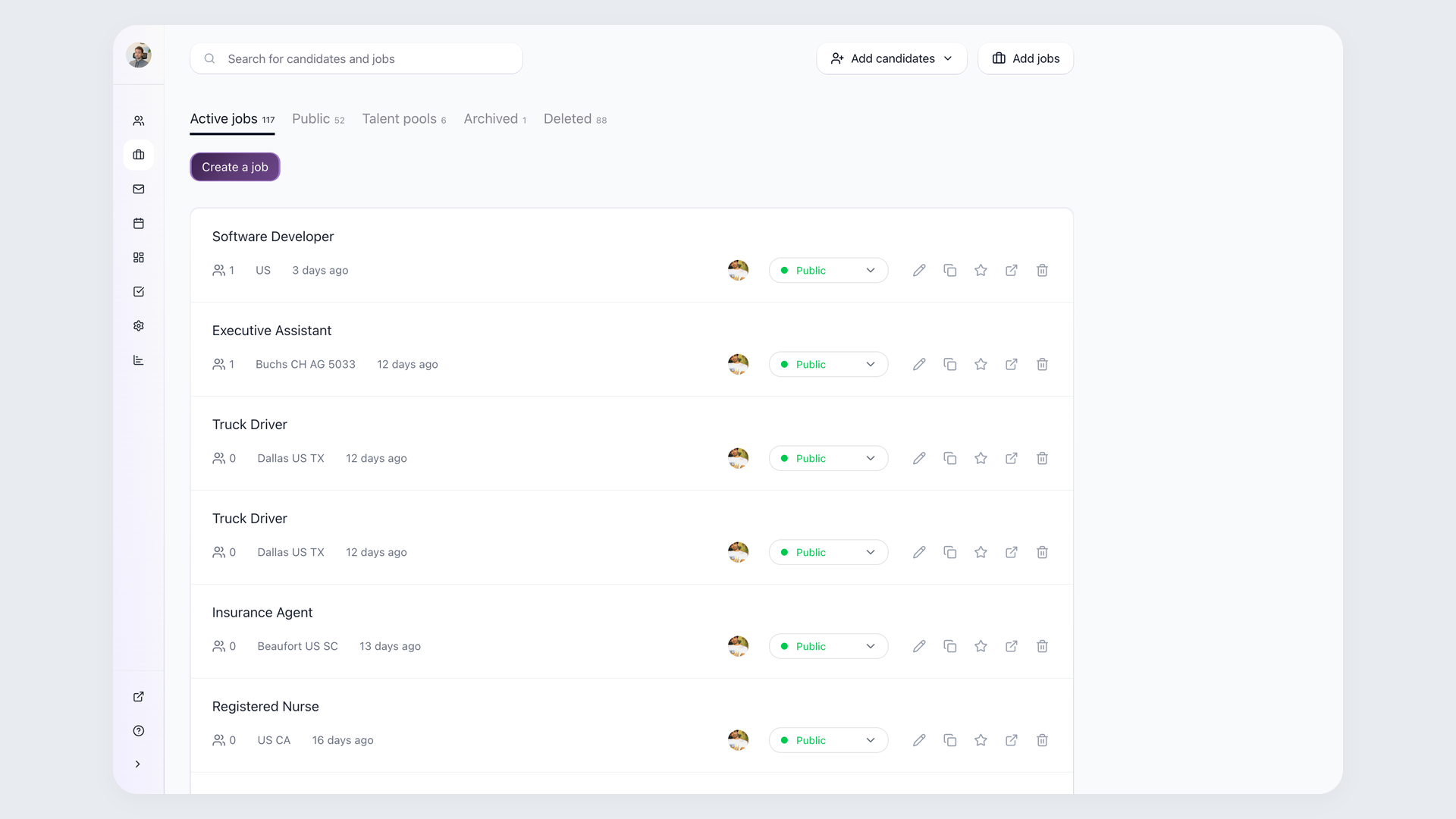
100Hires is an AI-first applicant tracking system built for in-house teams that want enterprise-grade screening without enterprise procurement.
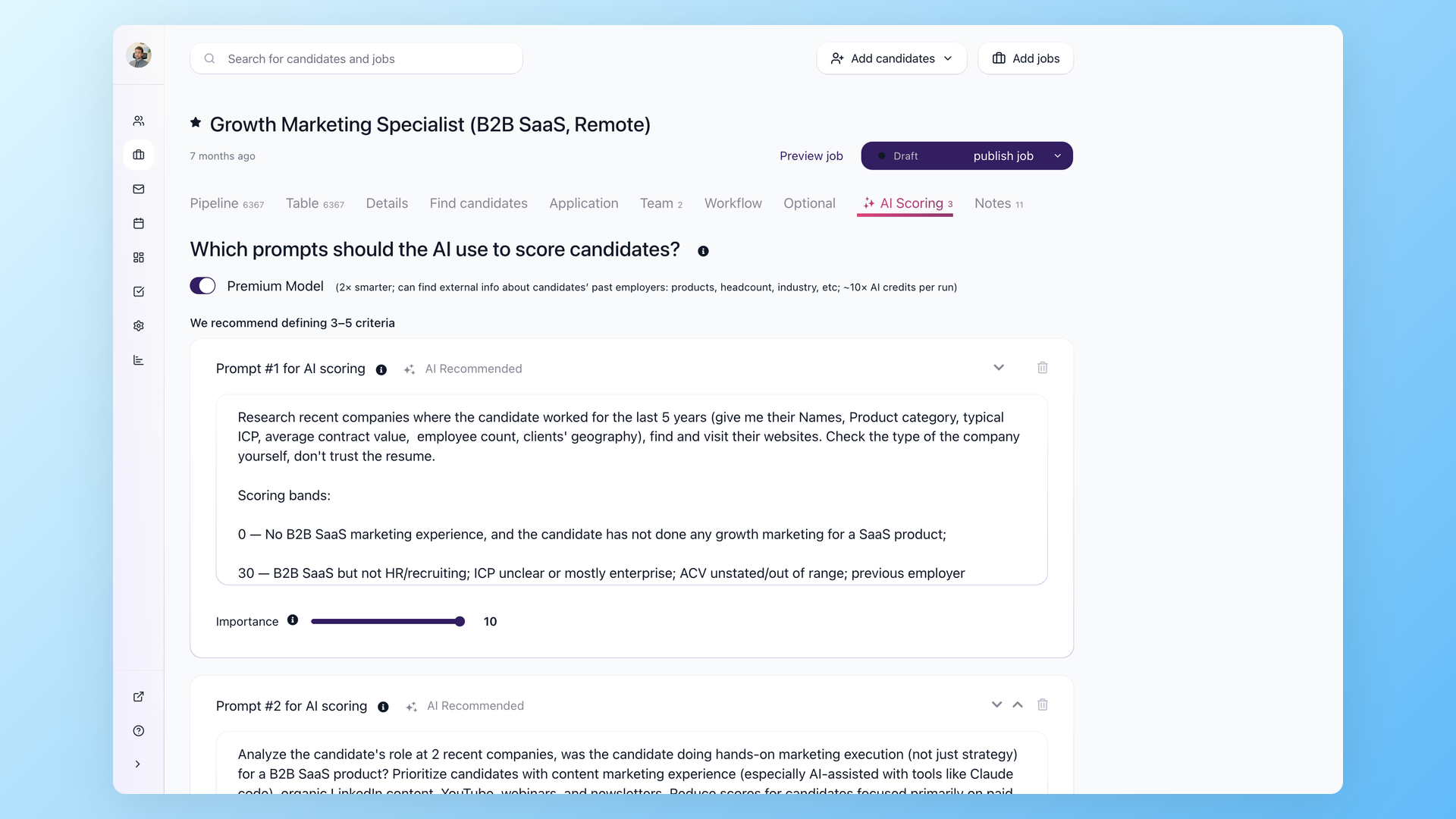
Best for: companies from 1 to 500 employees that want published pricing, self-serve setup, and AI screening included from the first tier.
The buyer question we hear on every demo call is some version of "why you over Ashby, Lever, or Greenhouse?"
The honest answer: Lever and Greenhouse won't show a price without a sales call. Ashby's Foundations plan runs $300 to $900 a month by company size (1 to 100 employees), with its AI Notetaker sold separately. Our Advanced plan, with unlimited users and jobs, starts at $199 a month billed annually (USD, up to 20 employees) and costs less than Foundations at every size up to 100 employees, though Ashby bundles sourcing sequences that we keep in Pro.
We publish the price, cap the AI by usage instead of locking it to an enterprise tier, and let the 14-day trial make the case.
Why it stands out: AI Score reads every application against your job requirements and scores each of your criteria from 0 to 100, plus a total, so you can see why a candidate ranks where they do.
AI Copilot answers questions about any candidate from their resume and interview history. AI Email Composer drafts and transforms outreach in your voice.
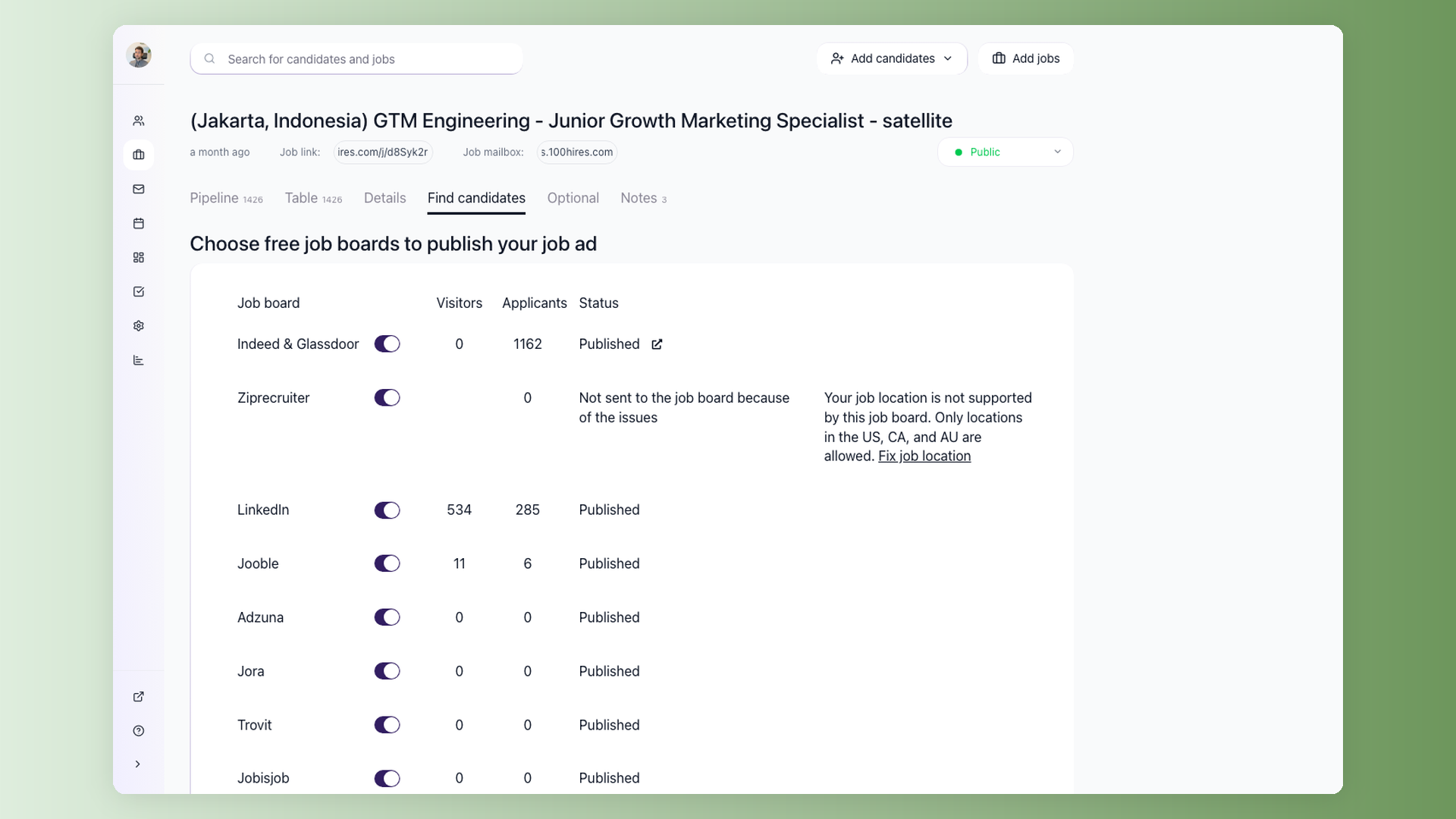
One publish action distributes a job to 13 job boards (Indeed and Glassdoor share one toggle), a hosted career site comes standard, and workflow automations move candidates, send emails, and trigger scoring without manual clicks.
Knockout questions, included on every plan and the trial, screen out hard mismatches such as missing work authorization automatically, before anyone on your team reads the application.
As of October 2026, G2 shows 4.8 from 1,391 reviews; Capterra shows 4.9 from 1,215. Setup is self-serve: you can sign up and start the trial without a sales call, and the AI features are included on every plan rather than hidden behind an enterprise tier.
Limitations: the integration catalog is smaller than what Greenhouse-class suites offer, and there is no native HRIS module; Gusto syncs natively on the Pro plan, and other payroll tools connect through Zapier or the API.
Monthly AI usage is capped by tier (100 on Start, up to 3,000-5,000 on Pro), so high-volume teams should choose the tier that matches their hiring volume before committing. And as disclosed above: you won't find organic 100Hires chatter in recruiter forums yet.
Pricing and trial: Start at $49/mo billed annually, or $99/mo month-to-month; Advanced at $199/mo billed annually ($249 month-to-month), all in USD.
Those are the prices for companies with up to 20 employees; larger companies pay more per tier, for example $449/mo billed annually ($559 month-to-month) for Advanced at 51 to 100 employees.
The 14-day free trial needs no credit card and posts to job boards after company verification, capped at 10 candidates from external boards across the account.
Verdict: pick it if you want transparent pricing and AI screening that works out of the box. Avoid it if your stack demands deep native HRIS integration. Book a demo to pressure-test it against your pipeline.
2. Workable - best all-rounder for growing SMBs
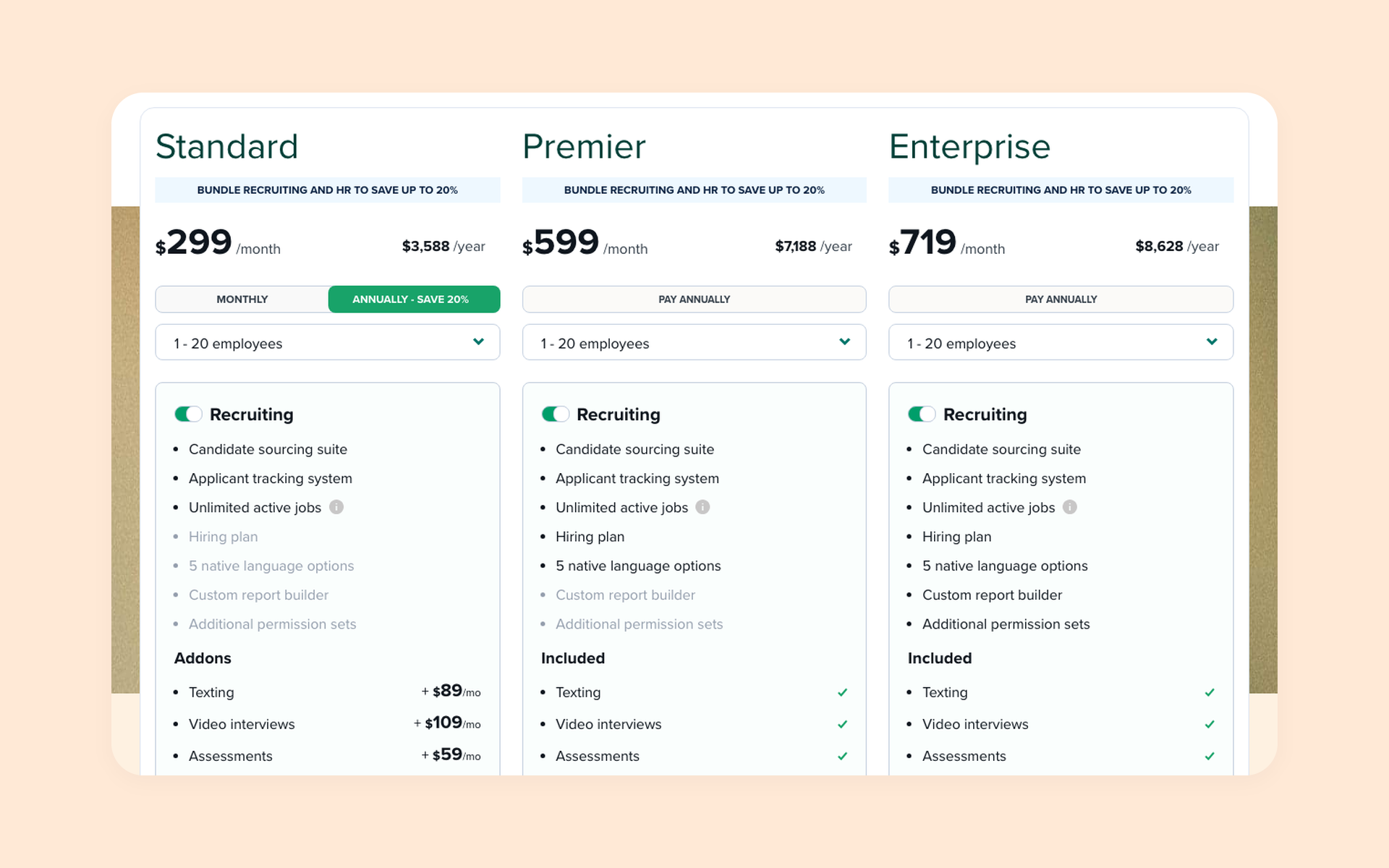
Workable is the safe, proven middle of the SMB market: broad features, huge job-board reach, and pricing you can read without a sales call.
Best for: 20-200 employee teams that want one tool covering sourcing through offer.
Why it stands out: distribution to 200+ job boards and a genuinely good mobile app that reviewers call an underrated differentiator.
The 15-day trial runs on full Standard features, so you evaluate the real product rather than a crippled demo.
Workable markets a candidate database in the hundreds of millions, with a caveat: one public bake-off found its profiles thin on basics like candidate location, so test the database against a real role before counting it as sourcing.
Strengths: low learning curve ("you don't need to be a tech genius" is the recurring reviewer sentiment), guided setup, G2 4.4 from 706 reviews.
It shows up in our own sales calls constantly as the tool buyers demo in parallel, which says something about its default-choice status.
Limitations: moving candidates through the pipeline takes more clicks than drag-and-drop rivals. Reporting customization thins out on lower tiers.
The Workable AI Agent is a separate credit-metered add-on (every paid account starts with 3,000 free AI credits, and packs then run $0.095 to $0.12 per credit), and those add-ons stack up fast on the bill, a pattern reviewers flag on camera.
One head of people who ran a public five-way ATS bake-off in 2025 passed on it over lackluster sourcing data and scheduling friction with Google and Microsoft calendars.
And a prospect on one of our demo calls described a prior Workable setup where a paid LinkedIn ad sync quietly stopped posting, which pushed them to Indeed instead: internal anecdote, single case, but integration reliability is worth probing in your trial.
Pricing and trial: public $299/mo Standard billed annually ($360 month-to-month) for up to 20 employees, 15-day trial with full Standard features.
Verdict: pick it if you want the proven all-rounder and can budget for add-ons. Avoid it if metered AI credits on top of a subscription bother you.
3. JazzHR - best budget ATS for small teams
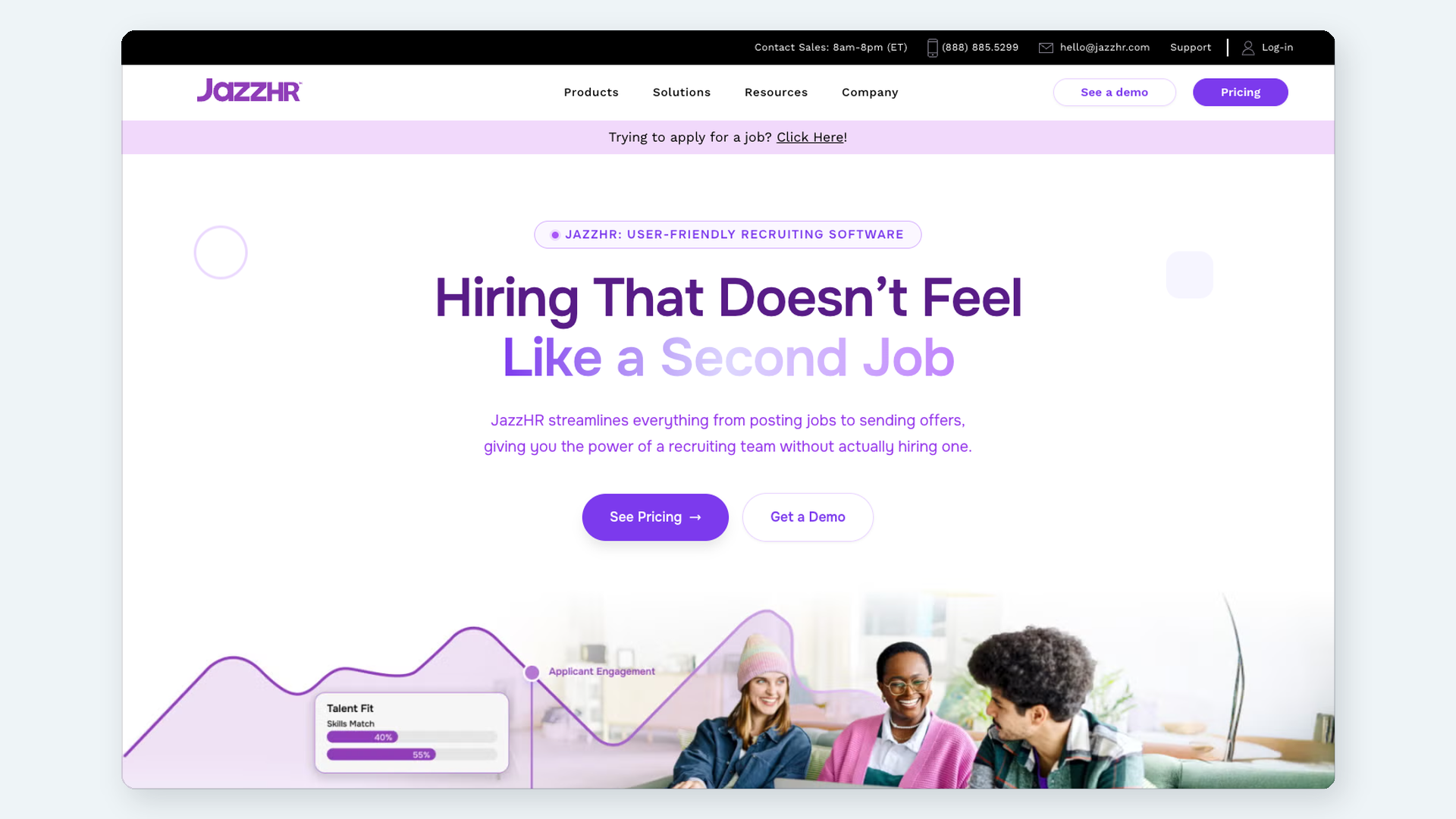
JazzHR is the budget workhorse of SMB hiring.
Best for: teams under 50 employees where price is the first filter.
Why it stands out: straightforward pipelines, easy interview scheduling with calendar tools, and a long track record in the small-business segment.
For an office manager wearing the recruiter hat two days a week, that simplicity is the feature.
Strengths: G2 4.4 from 872 reviews. Simple enough that a non-recruiter office manager can run it. The annual plan brings the effective price near $83/mo, one of the lowest credible entries in the category.
Limitations: AI candidate matching starts on the Plus plan ($350/mo month-to-month), and the entry Hero plan lists no AI features.
Employ's own chief people officer describes the company's AI philosophy as "a tool, not a replacement," which reads as honest and as a preview of the roadmap's pace.
Job syndication eligibility sits at JazzHR's discretion per its own terms. TechnologyAdvice dropped it from their top five in a 2024 rescoring, then kept it as an honorable mention, which matches our read: fine budget pick, no longer a frontrunner.
It is part of the Employ family alongside Lever and Jobvite. Note the fine print: JazzHR's standard pricing excludes staffing agencies, franchises, multi-location businesses and organizations with more than 250 employees.
Pricing and trial: public $1,000/yr for Hero (about $83/mo effective); the monthly view of the pricing page lists Plus at $350/mo and Pro at $549/mo. 14-day free trial, no credit card.
Verdict: pick it if the budget caps everything else. Avoid it if AI-driven screening is why you are switching.
4. Breezy HR - easiest first ATS
Breezy HR made its name on one thing: the drag-and-drop pipeline other tools get compared against.
Best for: first-time ATS buyers who think in Kanban boards.
Why it stands out: the most intuitive pipeline UI in the segment, built-in candidate messaging, video screening questions, and a credit-based Breezy Intelligence layer for resume enrichment.
When reviewers criticize other tools' pipelines, Breezy's drag-and-drop is the yardstick they reach for.
Strengths: the same Forbes Advisor list that puts 100Hires first places Breezy third, and TechnologyAdvice made it their #1 overall.
G2 4.4 from 695 reviews. Our own sales calls regularly feature teams that have run Breezy happily for five years.
Limitations: API access is gated to the Pro tier and above. One r/Recruitment user reported an SSO request quoted at a year of delivery time plus extra cost; single report, so weigh it lightly, but it fits the pattern of advanced features arriving slowly.
Long-tenured customers on grandfathered pricing face a real jump when upgrading to current plans, something we hear directly in demo calls.
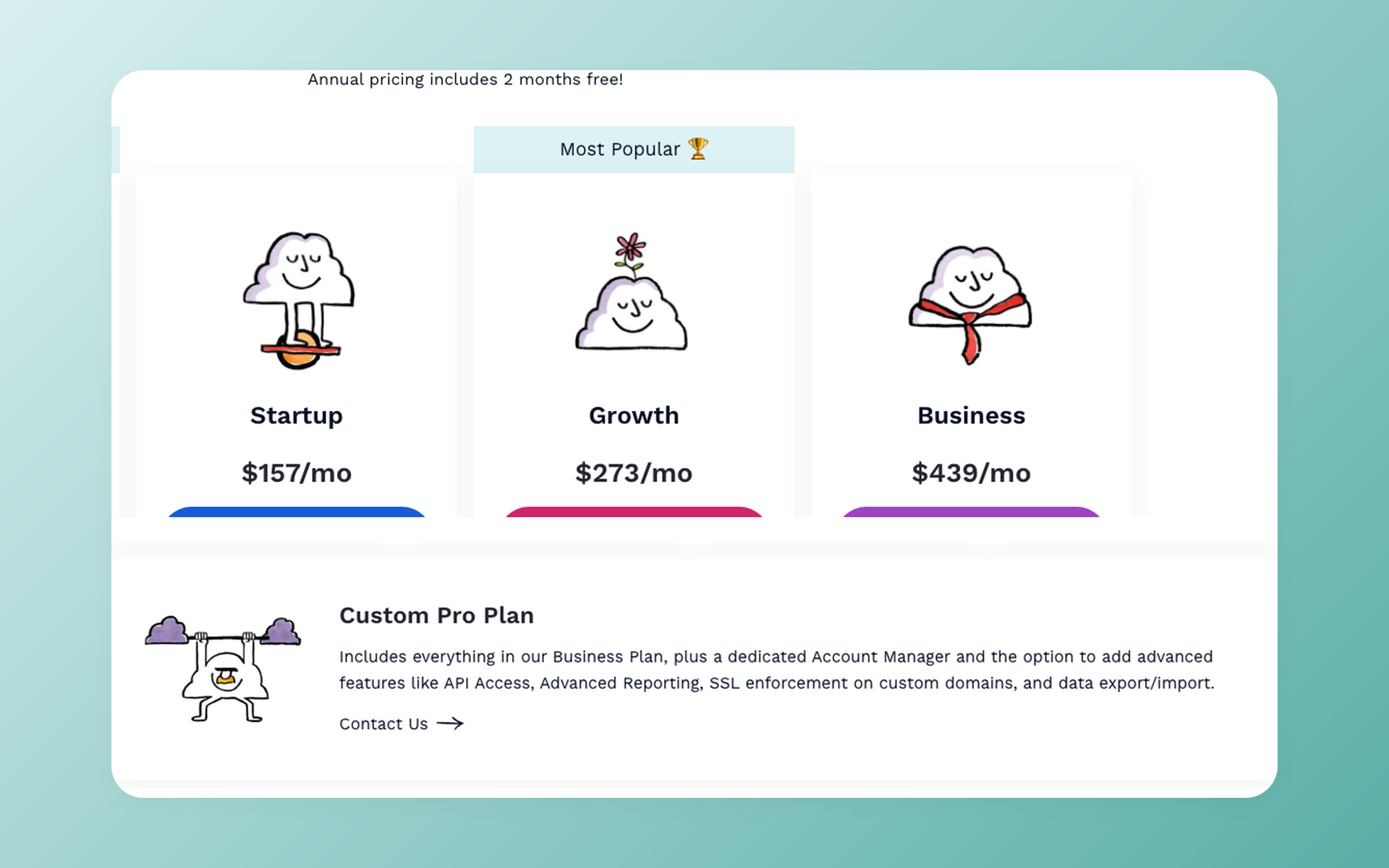
Pricing and trial: free Bootstrap plan for 1 active position; paid plans from $157/mo billed annually ($189 monthly), 14-day trial.
Verdict: pick it if visual simplicity gets your hiring managers to actually participate. Avoid it if you need API access or fast-moving AI features.
5. Zoho Recruit - cheapest credible entry point
Zoho Recruit is the price floor of serious ATS software, and it comes with a ceiling you should know about before signing.
Best for: tiny teams, and companies already living in the Zoho ecosystem.
Why it stands out: $25 per recruiter per month is the lowest paid entry among our finalists. Blueprint automation can enforce required workflow steps, keeping a junior recruiter's process on rails.
The Zoho suite integration means CRM, mail, and docs snap together without connector fees.
Strengths: G2 4.4 from 1,865 reviews, a serious volume for this price band. It appears on 9 of the 14 competing ATS lists we reviewed in October 2026, even where they stop short of ranking it.
Limitations: the AI features that make the marketing page, candidate matching and advanced analytics, sit on the Enterprise tier at double the entry price. Reviewers describe onboarding as complex for new recruiters.
And the recurring story in our own demo calls: teams run Zoho for three or four years, outgrow it, and go shopping for something that scales without the price jumping on them.
Pricing and trial: public $25/recruiter/mo Standard billed annually, free single-job tier exists; paid editions advertise a 15-day trial.
Do the per-seat math before comparing: at 10 recruiters this costs more than several flat-rate rivals, so the bargain holds for small teams and inverts as you grow.
Verdict: pick it if you need a real ATS at the absolute minimum spend. Avoid it if you expect to pass 50 employees within two years.
6. Teamtailor - best for employer branding
Teamtailor treats your careers page as the product, and for brand-led companies that is exactly right.
Best for: SMB and mid-market teams where employer brand drives applications.
Why it stands out: the strongest career-site builder in our research set, content-driven candidate nurturing, and workflow automation that earned it the #2 spot in TechnologyAdvice's ranking with top marks for automated workflows.
Strengths: G2 4.6 from 581 reviews.
Practitioners weighing it against incumbents advise checking any quote-only European vendor's funding stability and GDPR posture as standard diligence, and that advice applies here.
Limitations: there is no public pricing anywhere, just "let us give you a quote." For a tool courting SMBs, that adds procurement friction the segment hates.
Ironically, its concentrated customization complaints in review mining center on the career pages themselves.
Its Co-pilot features are now published (evaluating candidates against your criteria, suggestions, meeting summaries, interview-kit questions), but which tier includes what is still not public.
Pricing and trial: custom quote only.
Verdict: pick it if your careers page is your main source of applications. Avoid it if you want numbers before a sales conversation.
7. Pinpoint - best for candidate experience
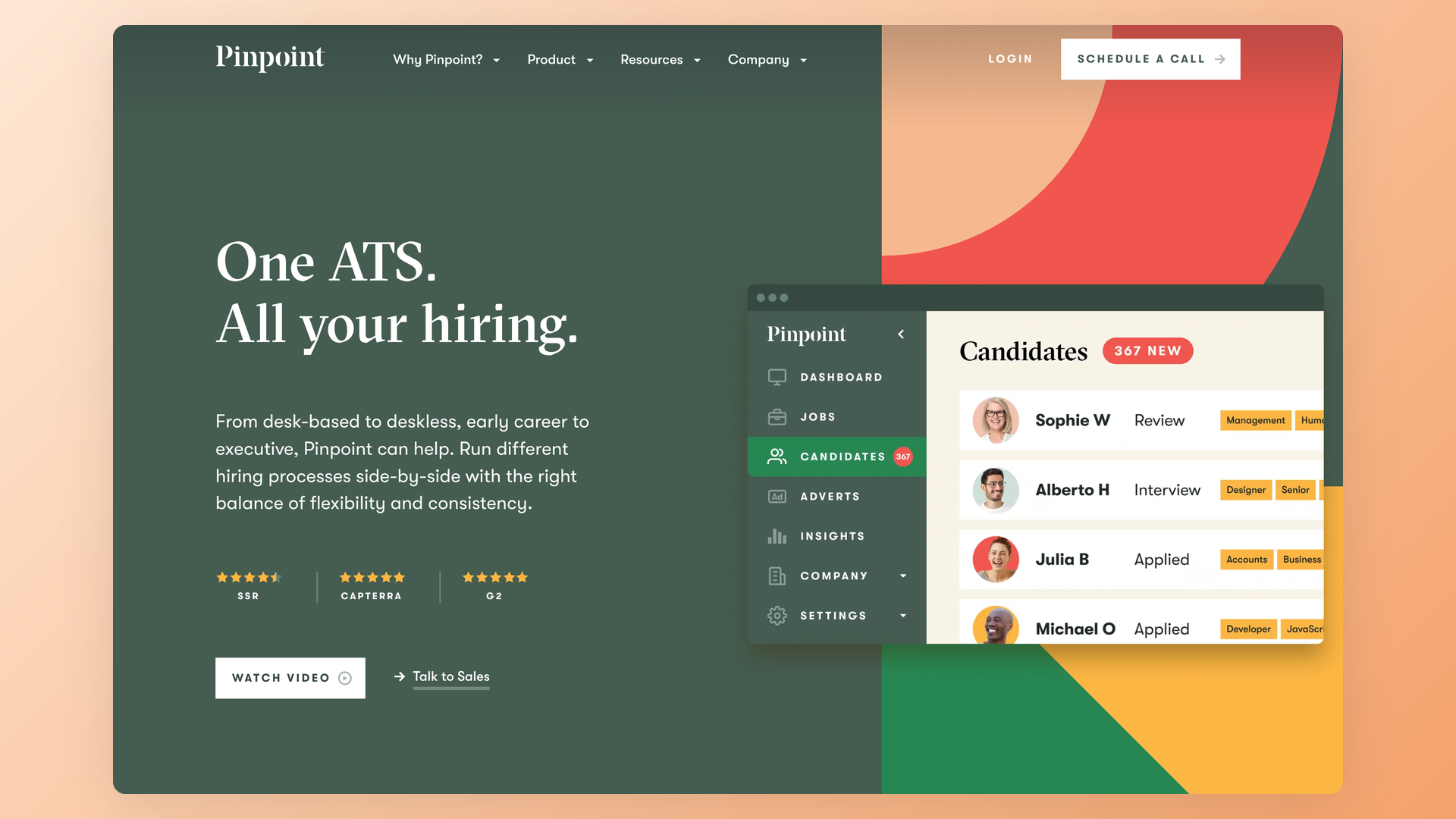
Pinpoint is the quiet achiever of this list, with a very visible public endorsement behind it.
Best for: mid-size in-house TA teams, UK and EU friendly, that grade themselves on candidate experience and hiring-manager adoption.
Why it stands out: polished candidate-facing flows, strong employer-brand tooling, and reporting built for people who are not recruiters.
The VP of Global Talent at SKIMS publicly documented months of demos that ended in choosing Pinpoint.
That post was the highest-engagement ATS switching story in our LinkedIn research corpus.
Her team had tracked candidates in spreadsheets for three years before the first ATS, then outgrew that system at global scale: the exact trajectory this tier of tool exists for.
Strengths: G2 4.6 from 167 reviews, an AI suite now in the pitch (a hiring copilot, match scores and an AI notetaker), and it has started appearing in the buyer shortlists we hear on our own demo calls, including one three-way comparison against Workable and TeamDash.
Limitations: 167 G2 reviews is still the smallest evidence base in our main list, so treat the rating with proportionate confidence. Pricing is by request only, no trial is published, and Pinpoint says most small and mid-market customers are live in 4 to 6 weeks.
Pricing and trial: custom quote; no published trial.
Verdict: pick it if candidate experience is a board-level metric for you. Avoid it if you want a published price or trial before talking to sales.
8. Ashby - best for data-driven scale-ups
Ashby is the migration destination of the moment: nearly every 2024-2026 "we switched" post we found names it as where teams landed. The honeymoon has fine print.
Best for: 50-500 employee tech teams that will genuinely use analytics every week.
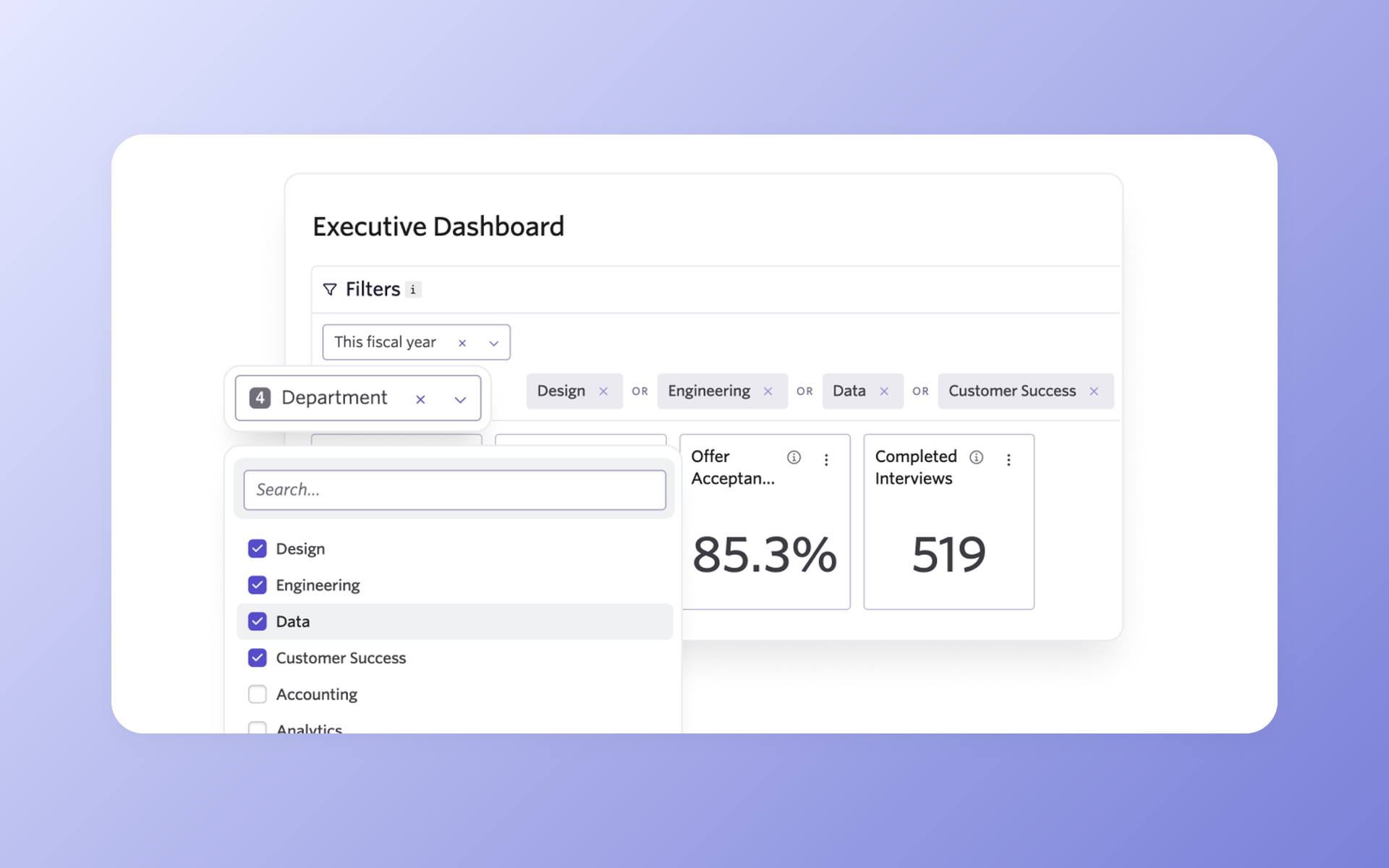
Why it stands out: native BI-grade reporting without an external tool, a sourcing Chrome extension the Stackfix reviewer called the best ATS extension tested, and scheduling automation with panel-availability links.
Sourcing, ATS, and analytics live in one platform.
Strengths: G2 4.7 from more than 200 reviews, fast product development, and responsive support that delivers requested features. Practitioners consistently credit its data model as a generation ahead of older suites.
One People-ops leader publicly credited Ashby's fraud signals with flagging the same candidates who later ghosted interviews, a quietly valuable feature as AI-generated fake applicants become a real screening problem.
Limitations: the learning curve is real; the same reviewers who recommend it describe settings inside settings and a 14-tab scheduling screen. Analytics beyond basics and the AI Notetaker are paid add-ons.
Then there's pricing at renewal: the September 2025 r/recruiting thread linked above describes seat-based renewal pricing that counted hiring managers and turned into a $24,000+ line item, and 2026 threads report similar seat math.
By mid-2026, cost grumbling started appearing even among fans on X.
Pricing and trial: Foundations is priced by company size, from $300/mo for 1 to 10 employees to $900/mo for 76 to 100, with 10% off for annual commitments; Plus and Enterprise are quote-only. Ashby says most growth customers go live in 6 to 8 weeks.
Verdict: pick it if reporting depth will change your decisions and someone owns admin. Avoid it if your team wants simple, or your headcount is about to triple.
9. Lever - best ATS and CRM combo for mid-market
Lever answered a real question early: why buy a separate CRM to nurture candidates you already met? LeverTRM still owns that answer.
Best for: 100-1,000 employee teams that rely on nurture campaigns and silver-medalist pipelines.
Why it stands out: ATS and CRM in one data model, a visual color-coded pipeline, deep Slack collaboration, and a public integration marketplace you can browse without talking to sales, a rare transparency point in this tier.
LinkedIn Recruiter System Connect and timezone-aware self-scheduling add candidate-experience features that mid-market teams care about.
Strengths: G2 4.3 from 2,125 reviews. Candidate-experience features like timezone-aware scheduling. StackAdapt's TA lead publicly credited Lever's ROI dashboard for a standout year even as the team outgrew it, the most honest kind of endorsement a tool can get.
Limitations: People Managing People's reviewer walkthrough clocked Visual Insights dashboards refreshing on a 4-6 hour lag, and rescheduling an interview means deleting and rebooking it.
About two thirds of Lever's G2 reviewers come from mid-market companies; small teams are the exception. Pricing is quote-only; a prospect on one of our demo calls put their Lever estimate near $10,000 a year, which we pass along as an estimate, not gospel.
Pricing and trial: custom quote.
Verdict: pick it if candidate nurture is central to your team's recruiting work. Avoid it if same-day reporting freshness matters.
10. Greenhouse - best for structured hiring at scale
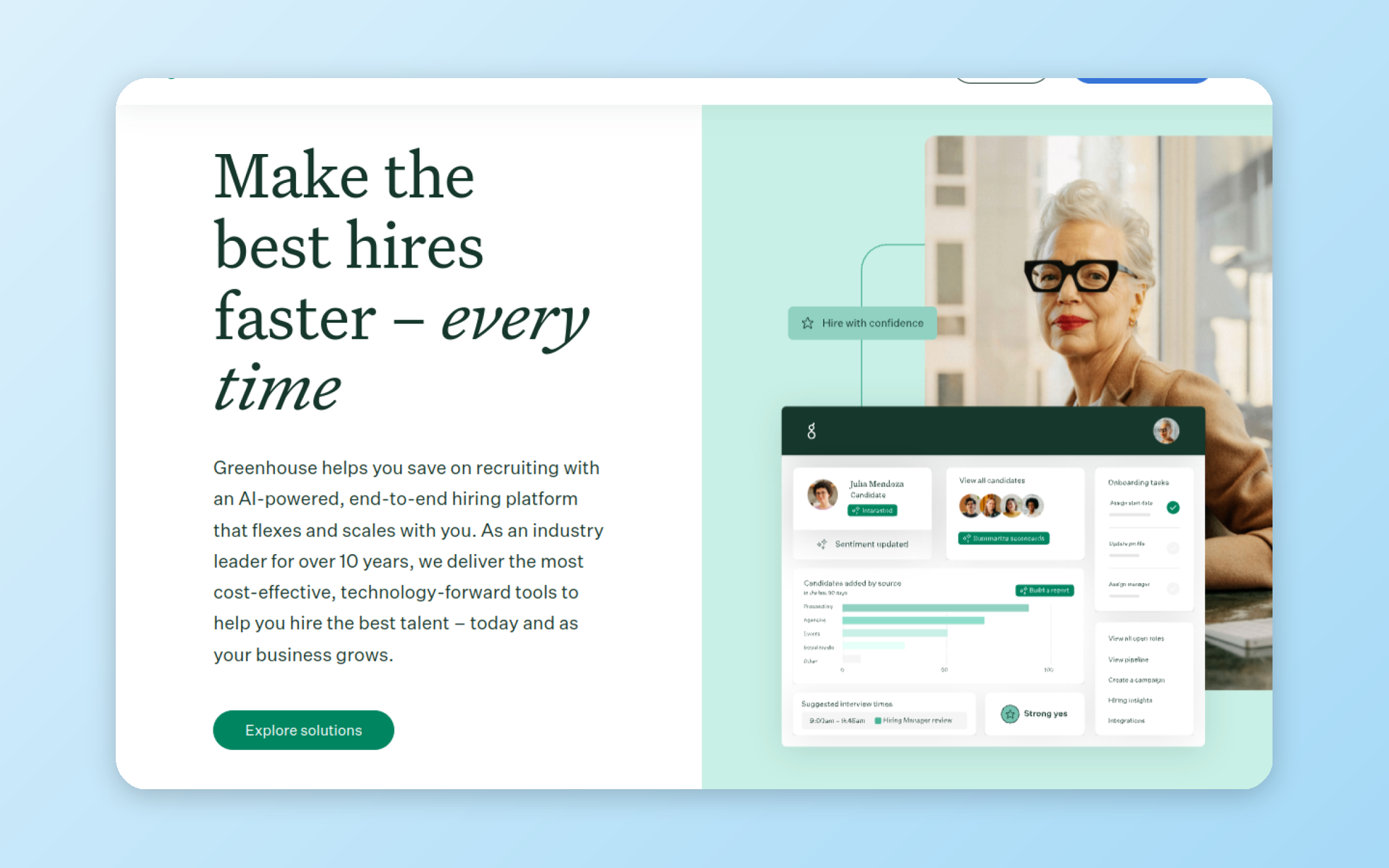
Greenhouse is the most respected name in structured hiring, and the most argued-about tool in our entire research corpus.
Best for: 200+ employee companies standardizing interviews across many teams.
Why it stands out: scorecard-driven structured hiring nobody matches, audit-ready compliance, fraud detection through Real Talent, and the ecosystem gravity of a category leader. Undercover Recruiter made it their 2026 #1 for exactly these reasons.
Strengths: G2 4.4 from 4,035 reviews. Practitioners on the pro side call it stable, built for scale, and the safest choice for global compliance.
Greenhouse's own CEO framed the philosophy on the Rec Tech podcast in early 2026: employers won't read a thousand resumes, they'll read enough to trust the pipeline they built.
Scorecards are how Greenhouse sells that trust, and teams switching to it still post about the move with genuine excitement.
Limitations: the practitioner split is real and close to 50/50 in the threads we read: the other half describes a product that has barely moved since the mid-2010s, with reporting that feels dated under private-equity ownership.
AI is tier-gated: Core now lists an AI Notetaker and talent matching, while AI-powered report filters and fraud and spam detection start at Plus. A head of people who ran a five-way bake-off on LinkedIn in 2025 rejected it over enterprise pricing and thin AI.
Startup buyers on our own demo calls call it a non-starter on price.
Pricing and trial: custom quote across all tiers.
Verdict: pick it if structured, defensible hiring at scale is the mandate and the budget exists. Avoid it if you are under 100 employees or want AI filtering and fraud detection on the entry tier.
Strong ATS options that did not make the main list
Seven tools came up constantly in our research and deserve a straight answer on why they sit here instead.
BambooHR. An HRIS company first; the ATS is a bundled module, and a comparatively weak one.
Reviewers on camera describe candidate evaluation as old school, with manual entry where rivals parse resumes automatically. Our ATS-specific evidence on it is thinner than for main-list tools, so we say that plainly.
Pick it when the HR suite is the purchase and the ATS is incidental. Pricing is now public: $250/mo for Core at 25 employees or fewer, and the ATS includes 5 job openings on Core, 25 on Pro and 50 on Elite.
Manatal. Popular with staffing agencies, most visibly agencies placing candidates into European client markets, with about three quarters of its G2 reviewers at small companies.
At $15/user/mo billed annually ($19 monthly) it is tempting, but the Professional plan caps you at 15 jobs, automations plus API access sit on Enterprise tiers, and product depth trails the mature suites: it drew the highest customization-complaint volume in our review mining.
Rippling. The ATS exists only as a module of the Rippling HRIS platform; you cannot buy it standalone. Its eye-catching 4.8 on G2 from nearly 13,900 reviews rates the whole platform, payroll included, not the ATS.
Recruitee (now Tellent). Collaborative hiring for EU-leaning teams, with a catch worth knowing: the Start tier includes no AI screening or matching; those arrive on the Advance tier, while Start has AI writing for emails and feedback.
Pricing is quote-driven.
iCIMS. High-volume enterprise recruiting. Over half of its G2 reviewers work at enterprise-size companies.
Practitioner sentiment in our threads included blunt frustration over repeated price increases.
SmartRecruiters. A capable enterprise global-hiring suite in the middle of a transition: SAP completed its acquisition in September 2025, and its G2 listing was restructured during our verification window,
so current review data is genuinely hard to pin down.
We would wait for the dust to settle before signing.
Gem. It started as sourcing and CRM and now markets an AI-native ATS, free for six months for companies under 30 employees. The sourcing side is mature; the ATS side is newer than the suites above.
If sourcing is your actual bottleneck, that is a different shopping list, and Gem belongs on it.
Recruiting software comparison: where an ATS fits in the wider stack
Run a recruiting software comparison on any review site and the lists mix tools that solve different jobs: applicant tracking systems, HRIS suites with a hiring module, agency platforms, sourcing add-ons. "Recruiting software" is the umbrella term for all of it.
An ATS is one subtype: the system of record where applications land, pipelines live, and hiring decisions get made. Most other recruiting software either feeds it or bolts onto it.
Here is the map we wish every comparison started with.
| Category | What it does | When it is the right buy | Examples from this article |
|---|---|---|---|
| Dedicated ATS | System of record for applications, pipelines, screening, and hiring decisions | Hiring is the problem you are solving and you want depth in the daily work | Most of the top 10 above |
| ATS plus CRM, or talent acquisition suite | Adds candidate nurture, sourcing, and deeper analytics on top of tracking | You rehire from a talent pool and run outreach, not just fill posted roles | Lever and Ashby from the main list |
| HRIS with a hiring module | Recruiting as one module inside a payroll and HR platform | The HR suite is the purchase and hiring is incidental to it | BambooHR, Rippling, Workday |
| Agency and staffing platforms | Client submittals, placements, commissions | You place candidates into other companies | Bullhorn, Recruiterflow, Manatal |
| Point tools | One slice done deep: sourcing, assessments, scheduling, video screening | Your ATS is fine and a single stage is the bottleneck | Gem's sourcing side; assessment and scheduling add-ons |
One pattern to watch in any recruiting software comparison: vendor-written lists tend to rank the publisher first and skip the publisher's own limitations. We wrote this one with the opposite rule, a deliberate scope and an honest avoid-if on every tool, ours included.
If what you actually need is the stack around the ATS, our recruiting tools guide covers what a small hiring team actually needs, and the talent acquisition software comparison maps tools by hiring stage.
Which ATS should you shortlist
Four guardrails from the switching horror stories in our research. They will save you more money than any discount.
Price the exit before the entrance. Lock-in is the universal complaint.
One founder documented his old vendor quoting $1,000 for a CSV export of his own candidate data during a migration.
Ask every vendor, in writing: how do we export everything, in what format, with attachments and notes included, and what does it cost? A vendor that hesitates on that answer is telling you how the relationship ends.
Better still, request a sample export during the trial and open it.
Model the renewal, not the sticker. Seat definitions decide your real bill. When seat definitions start counting hiring managers, a tool that looked like a few hundred dollars a month can become a $24,000/yr line item at renewal, as the Ashby thread above shows.
Ask which roles count as billable and what happens at 3x headcount.
Demo with your hiring managers, not just recruiters. Managers who hate the tool stop using it, your data quality collapses, and the platform gets blamed. Adoption is the hidden line item on every ATS contract.
A practical test: have your least technical hiring manager complete a scorecard in the demo without help. If they can't, keep shopping.
Fix the process before switching platforms. One TA consultancy makes the contrarian case that serial ATS switchers carry the same broken process into every new tool.
If the last two migrations didn't fix the pain, the process deserves a look before the platform does. Our step-by-step guide to choosing an ATS covers the process side properly.
Ready to run the checklist against a live system? Book a 30-minute 100Hires demo and run this checklist against us first.
Frequently asked questions
What are the top 5 applicant tracking systems?
For in-house teams up to 500 employees: 100Hires (best overall, with AI Score screening on every plan), Workable (all-rounder), JazzHR (budget), Breezy HR (easiest first ATS), and Ashby (analytics-heavy scale-ups). The right top 5 shifts with your headcount, so start from the company-stage section above.
What is the best ATS system?
There is no single best ATS, only a best fit per company stage. For SMB and mid-market in-house teams, our pick is 100Hires: published pricing, AI Score and AI Copilot on every tier, and a 14-day trial to check the fit. Enterprise structured hiring points to Greenhouse; candidate nurture points to Lever's ATS-CRM combo. Sitting specifically at 100-1,000 employees? See our dedicated best ATS for mid-market companies comparison.
Which ATS is best for small businesses?
100Hires, JazzHR, and Breezy HR fit small teams best: published pricing, self-serve setup, and entry plans under $200/mo on annual billing. 100Hires adds AI screening small teams rarely get at this price. Our guide to the best applicant tracking system for small business goes deeper.
Do recruiters actually use ATS software?
Yes. Once hiring passes a handful of roles per year, an ATS is the norm, and the real debate in recruiter forums is which one, not whether. The screening layer is where modern systems earn their keep. In 100Hires, for example, AI Score reads every application so recruiters interview the strongest candidates first instead of working through the whole pile.
How much does ATS software cost?
Published entry points run from $25/recruiter/mo (Zoho Recruit) to plans priced by company size: 100Hires from $49/mo billed annually ($99 month-to-month) in USD for up to 20 employees, Workable $299/mo billed annually for up to 20 employees, and Ashby $300 to $900/mo month-to-month depending on headcount. Zoho Recruit and Breezy HR also have free plans for one open job. Four of our ten finalists publish no pricing, and SmartRecruiters starts at $14,995. 100Hires keeps its full tier table public, including the AI usage caps per plan.
How does ATS software compare to other recruiting software?
Recruiting software is the umbrella category: applicant tracking systems, recruiting CRMs, sourcing tools, assessment platforms, interview schedulers, and the hiring modules inside HRIS suites. An ATS is the system of record the rest plugs into. In the recruiter threads and reviews behind this comparison, Workday and BambooHR drew weak ATS-specific feedback, while Rippling's headline rating covers its whole platform rather than the ATS. That is why this list sticks to dedicated systems; a suite's bundled module makes sense mainly when the HR platform itself is the purchase. 100Hires is one of those dedicated systems, with job board posting, a career site and AI screening in one product. Our recruiting tools guide breaks down the rest of the stack.
Is ATS software free?
Some is. Zoho Recruit and Breezy HR have free plans for one open job, Dover offers a free plan with unlimited users and jobs, and Gem is free for six months for companies under 30 employees. Most other tools offer a free trial instead: 100Hires and JazzHR give 14 days with no credit card, and Workable gives 15.
Do applicant tracking systems automatically reject candidates?
Mostly through rules you set, not AI judgment. In recruiter discussions, automatic rejections usually trace back to knockout questions, such as a required license or work authorization, that disqualify an applicant who answers no. In 100Hires, knockout questions are available on every plan, including the trial, and AI Score can move or disqualify candidates by a score threshold only if you switch that automation on.
Final verdict
Small team, first ATS: 100Hires, JazzHR, or Breezy HR - all three publish prices and offer a free trial without a sales call.
Scale-up that runs on dashboards: Ashby, with your eyes open on seat definitions at renewal. Structured hiring across hundreds of employees: Greenhouse or Lever, budget permitting.
If you want the shortest path to a working, AI-assisted pipeline at a price you can read without a sales call, start the 100Hires 14-day free trial.
No credit card, and your candidate data leaves with you as a CSV export if we are not the right fit.
Try 100Hires for free
No credit card. 14-day trial. Forbes Advisor #1 ATS for SMBs.