iCIMS Competitors & Alternatives in 2026: What Buyers Actually Pay
iCIMS is enterprise talent acquisition software, and the complaints about it are enterprise complaints: price, interface, and support that customers say declined as the company grew. Almost nobody says it cannot do the job.
Before comparing anything, be clear which direction you are moving. Most people searching for iCIMS alternatives are trying to go down in complexity and cost, not sideways to another enterprise suite.
Those are two different shortlists, and mixing them is why these evaluations drag on for months.
What iCIMS costs
The hiring playbook, in your inbox
One email a week - benchmarks, AI screening tactics, and short interview templates from the 100Hires team. No product pitches.
iCIMS does not publish pricing. Its website routes every enquiry to sales, so the most reliable figures come from verified buyer data rather than vendor pages.
| Source | Figure | Note |
|---|---|---|
| Vendr verified buyer data (2025) | Average $20,781 per year | Contracts range $14,500 to $635,000 |
| Third-party 2026 guides | From about $9,000 a year at the low end | Compared with Greenhouse near $6,000 |
| Capterra listing | Starting price $10 per user per month | Treat with caution, it does not match observed contracts |
The spread from $14,500 to $635,000 tells you what kind of purchase this is: negotiated, module-based, and sized to your organisation. Your renewal is a negotiation whether or not you treat it as one.
Reviews sit at 4.3 on Capterra across roughly 824 reviews, with close to 1,000 on G2. This is a mature, widely deployed product with a large satisfied base.
What customers actually say
Recruiter forums are consistent enough to be useful. From an r/recruiting thread asking directly about iCIMS:
Their summary is blunt on all three counts: overpriced, an interface they dislike, and customer service they rate as poor, which they attribute to the company being understaffed.
A second, more measured account from someone actively leaving:
Their account is more measured. They are leaving within about six months, they do not find the additions of recent years valuable, and they rate support as materially worse than it used to be.
Their overall verdict is that the product is fine and does the job, but that better options exist.
Note the phrasing: it works adequately. That is the honest centre of gravity for iCIMS.
A third comment separates the two audiences inside every enterprise ATS decision:
Their split is the useful part. From an individual contributor's seat the interface is clunky and error-prone, and support responses unhelpful. From their manager's seat the reporting is strong, which is why the two roles reach opposite conclusions about the same system.
That split matters. Recruiters live in the interface daily; leadership lives in the reports. A system can be genuinely good for one and painful for the other, and whoever runs the evaluation tends to weight their own experience.
Two harder numbers from internal research
Two findings from our own competitor tracking sharpen the picture beyond forum sentiment.
Price increases function as a standalone switching trigger. Reports include a 2,000-employee government contractor leaving over repeated increases, a texting add-on quoted around $50,000 a year, and one account describing a 40 percent renewal rise.
Implementation is typically another $15,000 to $25,000 in the first year for a 100 to 500-employee deployment, and three-year mid-market total cost commonly lands between $60,000 and $100,000.
There is one measured productivity claim. A technology company running around 100 open requisitions reported per-recruiter throughput falling from roughly ten requisitions per quarter to about six, and attributed the drop to the system itself.
Treat a single report cautiously, but it is the only quantified version of the interface complaint we have seen, and it is the kind of number worth testing against your own before renewing.
One more framing point: iCIMS's G2 reviewer base skews heavily to organisations above 1,000 employees. If you are materially smaller than that, the reviews you are reading describe a different deployment from the one you would run.
Two counterweights worth taking seriously
This page would be dishonest without them.
First, iCIMS has real advocates. One TA manager in the same thread described switching to it two years earlier and being very happy, while noting that living in the ATS full-time is their job. Depth of configuration rewards people who invest in it.
Second, and more useful, is what happened to one team that left:
Their experience of moving into the Oracle and UKG ecosystem was that they strongly preferred iCIMS, citing system limitations in what they moved to.
Leaving an enterprise ATS for another enterprise suite is the move most likely to end in regret. If you are going to migrate off iCIMS, be sure you are moving to something structurally different rather than to a different vendor with the same shape of problem.
Which direction are you going?
| Your situation | Shortlist | Realistic cost |
|---|---|---|
| Enterprise scale, genuine complexity, want better UX | Greenhouse, Ashby, SmartRecruiters | Similar or slightly less |
| Mid-market, bought enterprise and never grew into it | Workable, Pinpoint, Teamtailor | Meaningfully less |
| Hiring volume dropped and the contract did not | 100Hires, JazzHR, Breezy HR | A fraction of the current spend |
| High-volume hourly hiring is the real workload | Fountain, Paradox, Harver | Depends on volume |
The third row is the most common and the least discussed. Companies sign enterprise contracts during growth and keep paying them through a hiring freeze.
Alternatives worth shortlisting
Greenhouse
The usual destination for teams leaving iCIMS who still need structure. Quote-only, with buyers reporting roughly $6,000 to $12,000 a year under 100 employees and one 80-person company citing about $12,000 for the top tier.
Better structured interviewing, and its own criticisms around support responsiveness and permission granularity.
Ashby
Analytics-led, published entry at $400 per month with a 10 percent annual discount. Read the seat definition carefully: hiring managers count as billable seats by default, which has produced renewal surprises for fast-growing teams.
SmartRecruiters
The closest like-for-like at enterprise scale, quote-only. Consider it if you genuinely need enterprise breadth and are unhappy specifically with iCIMS rather than with enterprise software as a category.
Workable
Published pricing, which is a relief after a quote-only vendor: $299 per month for Standard, $599 Premier, $719 Enterprise in the 1 to 20 employee band, plus add-ons for texting, video, assessments and performance. Widest job-board reach in this group.
Pinpoint
Mid-market usability, quote-based, with one buyer reporting about $10,000 for up to 250 employees. The strongest option if hiring-manager adoption is your real complaint.
Fountain or Paradox
If most of your requisitions are hourly and high-volume, the honest answer may be that you never needed a corporate ATS. Both are built around that workload rather than around structured white-collar hiring.
100Hires, JazzHR, Breezy HR
The downgrade tier, and for a company hiring twenty people a year it is often the right answer. 100Hires publishes from $49 per month, JazzHR from $1,000 a year, Breezy has a free tier and paid plans from $157 per month.
What an enterprise ATS migration really costs
The reason so many teams stay on a system they complain about is that the switching cost is genuinely large, and it is usually underestimated by a factor of two. Budget for six things.
- Data migration and cleaning. Years of candidate records, attachments, notes and stage history. The cleaning is the expensive half, and it cannot be skipped without carrying the mess into the new system.
- Integration rebuild. HRIS, payroll, background screening, assessments, calendar and SSO. Ask your background-screening provider which systems they integrate with before you shortlist, because it removes options faster than any feature comparison.
- Process rebuild. Requisition and offer approval chains encode how your company actually makes decisions. Rebuilding them surfaces disagreements that were settled years ago.
- Compliance continuity. Retention schedules, audit trails and regulated reporting such as EEO and OFCCP have to work from day one, not eventually.
- Retraining at scale. Not the recruiters, who will adapt. The hundreds of hiring managers and interviewers who use the system occasionally and will simply stop if it changes.
- Parallel running. Most enterprise migrations run both systems for a period, which means paying twice for a quarter or more.
A realistic total for a mid-sized enterprise is one to two quarters of a project owner's time plus implementation fees. Against a renewal increase of a few thousand dollars, staying and negotiating usually wins.
Against a five-figure annual overspend on capability you no longer use, moving wins clearly.
Our verdict
If iCIMS does the job and reporting matters to leadership, negotiate rather than migrate. An enterprise ATS migration is a two-quarter project with integration, data and retraining costs that dwarf a renewal increase.
Take a competing quote to the conversation and ask for a multi-year term.
If your recruiters hate the interface and your leadership loves the reports, fix the interface problem specifically. That is a training, configuration and permissions question before it is a vendor question, and it is much cheaper to answer.
If you are moving to another enterprise suite, pause. The one first-hand migration account we found ended in regret, with the team preferring iCIMS to what they moved to. Enterprise-to-enterprise moves swap one set of limitations for another.
If your hiring volume no longer justifies enterprise software, move down decisively. This is the case where switching genuinely saves five figures a year, and where the migration pays for itself in one renewal cycle.
Where 100Hires fits, and where it does not
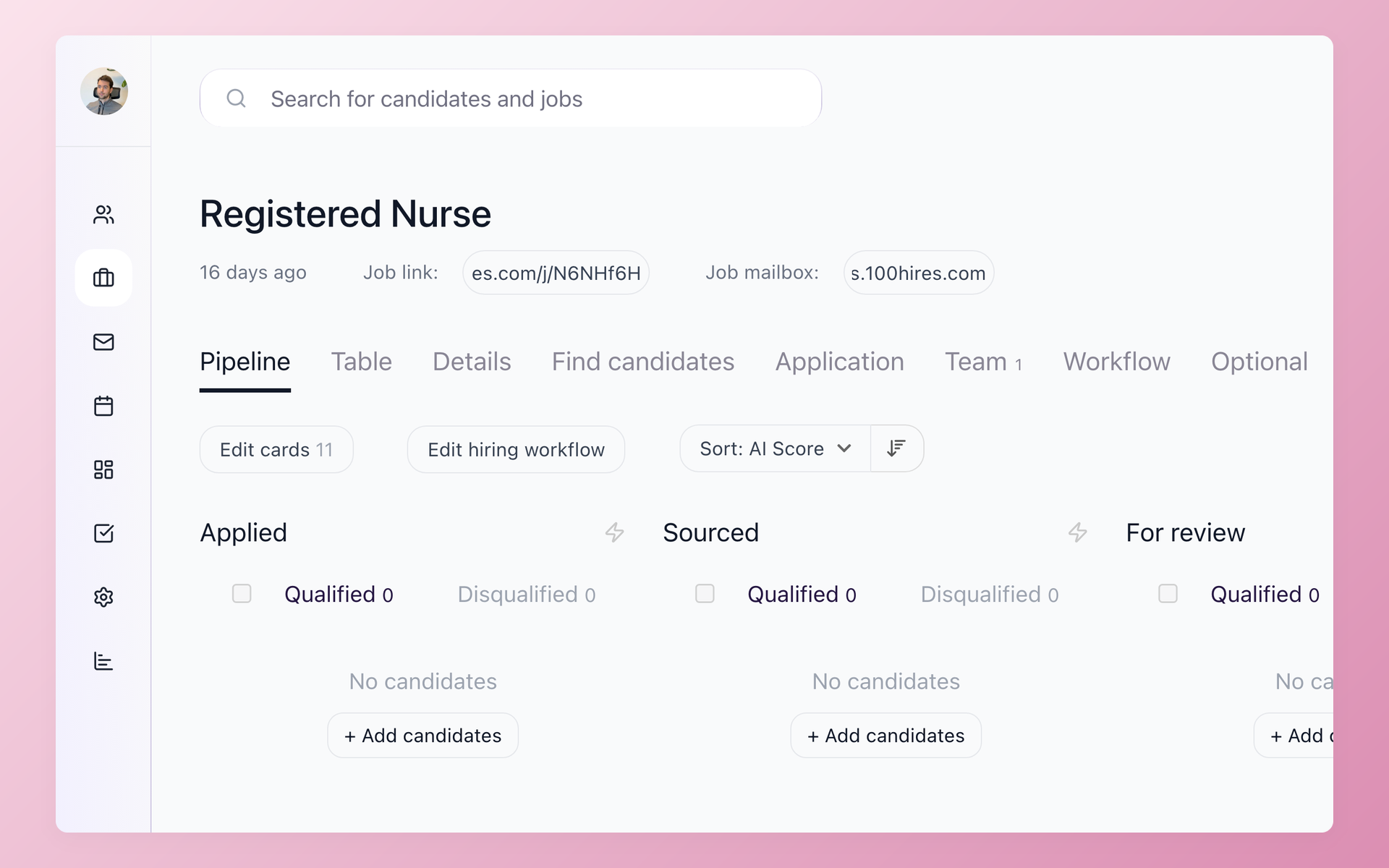
100Hires is an applicant tracking system for small and mid-sized in-house teams. Start is $49 per month billed annually ($99 monthly) for up to 100 candidates a month.
Advanced at $199 annually ($249 monthly) covers unlimited jobs, candidates and users, plus automated emails, a custom domain and knockout questions. Pro at $399 annually ($499 monthly) adds sourcing and contact enrichment.
Capterra rating is 4.9 from more than 1,100 reviews as of July 2026.
100Hires is the wrong choice if:
- You need enterprise governance. Granular permissions across legal entities, complex approval chains, SOC-level audit trails and SSO provisioning at scale are exactly what iCIMS is for. We are not that product.
- Your reporting is a board-level dependency. The recurring praise for iCIMS is reporting depth. If leadership relies on it, moving down will be felt.
- You run a large integration estate. Enterprise ATSs earn their price partly through breadth of integrations with HRIS, background screening and payroll.
- You hire thousands of hourly workers a year. Fountain or Paradox are purpose-built for that and will outperform both iCIMS and us.
- You have a recruiting-operations team whose job is configuration. They will find us simple to the point of limiting.
Where we fit is the company that signed an enterprise contract during a growth phase that has since ended. See 100Hires pricing or start a free trial.
If you are moving sideways rather than down, our Greenhouse alternatives and Ashby alternatives guides carry the same pricing detail.
One question to settle before any demo
Ask your own recruiters and your own leadership to each write down, separately, the three things the current system prevents them from doing. Then compare the lists.
In most iCIMS evaluations those two lists barely overlap. Recruiters name interface friction, click depth and support response times. Leadership names reporting, compliance and integration coverage, and often names nothing at all, because the reports arrive and the audits pass.
If the lists do not overlap, you do not have a vendor problem, you have two different problems, and only one of them is solved by buying something else. That exercise takes an hour and regularly ends an evaluation before it consumes a quarter.
Frequently asked questions
How much does iCIMS cost per year?
iCIMS does not publish pricing. Vendr's verified buyer data puts the average at about $20,781 a year, with observed contracts ranging from $14,500 to $635,000 depending on organisation size and modules. Third-party 2026 guides place the low end near $9,000 a year. Because pricing is negotiated per account, a competing quote is the most effective tool you have at renewal.
What are the main complaints about iCIMS?
Three recur: price, interface, and support quality that long-standing customers say has declined. One recruiter described it as overpriced with a poor interface and weak support, while another leaving within six months concluded that it does the job adequately but that better options exist. Reporting depth is the most consistent praise, which is why recruiters and leadership often disagree about the product.
Is Greenhouse cheaper than iCIMS?
Usually, for companies under a few hundred employees. Buyers report Greenhouse at roughly $6,000 to $12,000 a year at that size, against an iCIMS average near $20,781 across all sizes. Both are quote-only and both price on employee count and modules, so the gap narrows at enterprise scale. Get both quotes rather than relying on published ranges.
Should we move from iCIMS to Oracle or UKG?
Be careful. The one first-hand account we found of that exact move was negative: the team strongly preferred iCIMS to what they moved to, citing system limitations in the Oracle and UKG environment. Moving between enterprise suites tends to swap one set of constraints for another while incurring a full migration cost. If your reason for leaving is usability or price, a structurally different product is the safer target.
When does it make sense to downgrade from an enterprise ATS?
When your hiring volume has fallen but the contract has not, when nobody uses the enterprise-only capabilities you are paying for, and when your recruiting team is small enough that configuration depth is a burden rather than an asset. A company hiring twenty people a year on a $20,000 contract is spending $1,000 per hire on software alone, and that is the case where moving to a published-price product pays back within one renewal.
Try 100Hires for free
No credit card. 14-day trial. Forbes Advisor #1 ATS for SMBs.