
Structured interview scorecards that predict performance
Eighty-five years of selection research put the structured interview at the top of the validity rankings - the single best predictor of how a candidate will actually perform on the job, ahead of experience and far ahead of free-form conversation. 100Hires Evaluation Forms build that structure into every interview: the same criteria, the same rating scale, and written evidence on every candidate record. No more debriefs where the loudest voice wins.






Why structured interviews predict job performance
An interview scorecard is what turns a regular interview into a structured interview, and structured interviews are the most accurate predictor of on-the-job performance that hiring science has found. Decades of meta-analytic research in industrial-organizational psychology rank them among the strongest signals a hiring team can act on - well ahead of years of experience, education, or an unstructured chat.
The foundational paper is Schmidt and Hunter (1998), "The Validity and Utility of Selection Methods in Personnel Psychology" in Psychological Bulletin, summarizing 85 years of validation studies. They reported a corrected validity coefficient of r = 0.51 for structured interviews against on-the-job performance, versus r = 0.38 for unstructured interviews. A panel using a structured scorecard is roughly twice as predictive as the same panel chatting freely.
The Schmidt and Hunter estimates were re-examined in 2022 by Sackett, Zhang, Berry, and Lievens in the Journal of Applied Psychology (107(11), 2040-2068). They corrected a long-standing overcorrection for range restriction in prior meta-analyses and produced updated operational validity estimates. In the revised table, structured interviews come out on top at r = 0.42 corrected, ahead of work sample tests, ahead of cognitive ability tests, and far ahead of unstructured interviews (which sit closer to r = 0.20, barely better than chance). The takeaway: a structured scorecard is the single highest-validity predictor a hiring team can deploy at scale.
The mechanism is the boring part of the story. Forcing every interviewer to rate the same dimensions on the same scale removes the variance that makes free-form interviewing nearly useless. The scorecard is the tool that turns the research finding into a practice. 100Hires builds the structure into the workflow so the validity gain shows up in your hires, not in a binder no one opens.
What is an interview scorecard
An interview scorecard is a structured rating form that every interviewer on a hiring panel fills out for the same candidate against the same criteria. It captures a rating per competency, the evidence behind each rating, and an overall hire-or-no-hire recommendation.
The scorecard turns subjective impressions into a comparable record so the debrief argues about evidence, not feelings.
Teams call it an interview scoring sheet, an interview score card, or an interview evaluation form. The terms overlap. The principle is the same: shared criteria, anchored scale, written evidence, one place to compare candidates side by side.
100Hires calls this feature Evaluation Forms. The scorecard lives directly on the candidate record alongside the resume, the emails, and the AI score - not in a separate spreadsheet that no one opens after the interview.
How 100Hires Evaluation Forms make every interview structured
A 100Hires evaluation form is a list of questions you build once in Settings and reuse across candidates. The form opens on the candidate page when an interviewer is ready to evaluate. Candidate name, role, interview stage, and interviewer identity are already on the candidate record - the form does not ask the interviewer to retype any of that.
Because every panel member on a stage sees the same form, the debrief compares like with like. That is the whole point of a structured interview: same dimensions, same scale, evidence per rating, no two interviewers grading on a different bar.
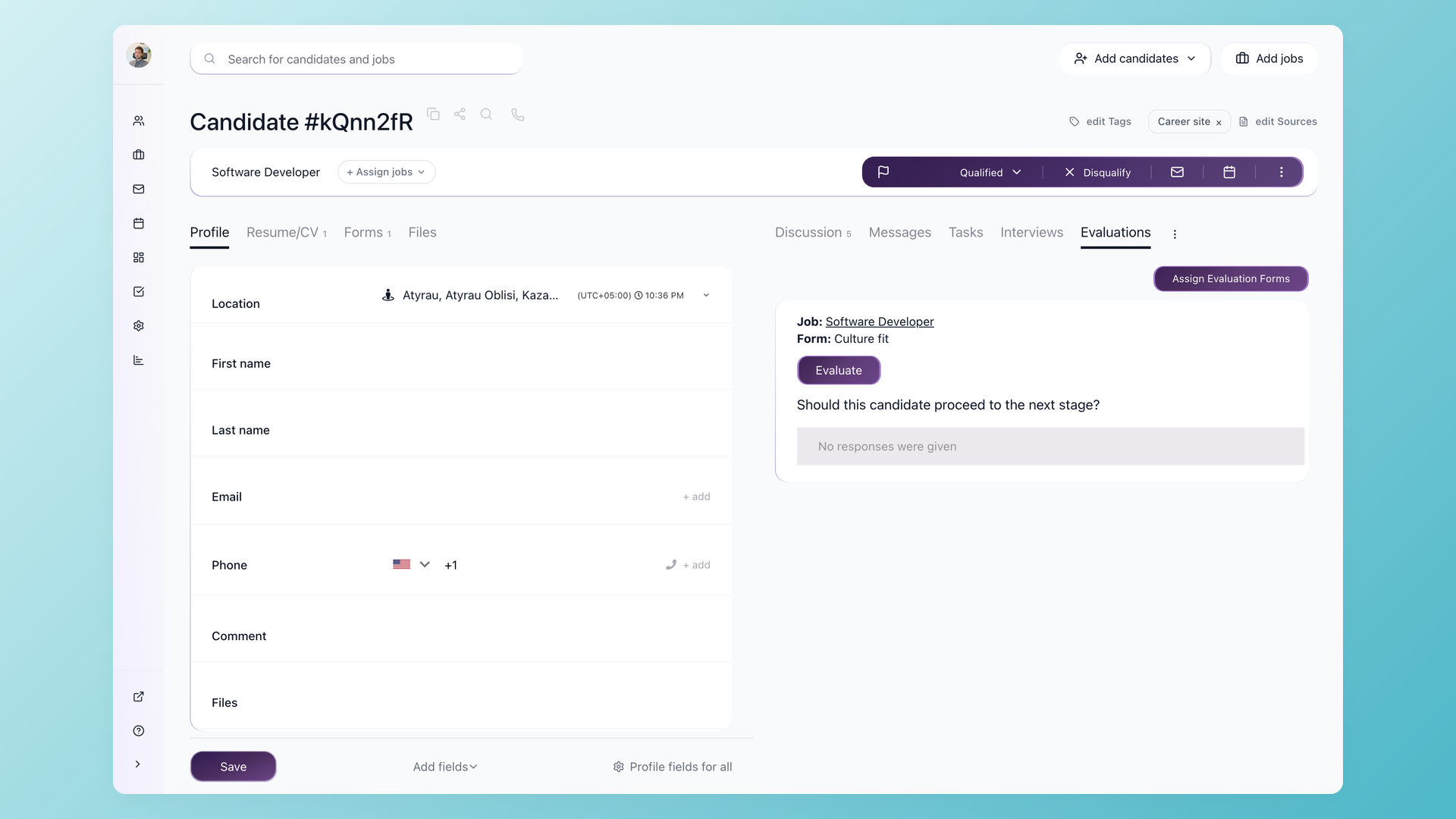
Capture evidence per rating, not just the number
100Hires shows the candidate's resume, AI score, and prior-stage evaluations next to the scorecard form so the interviewer is rating against context, not from memory. The form is the same for every panel member on this stage so the debrief compares like with like.
- Multi-criteria Scorecard questions, five-point thumbs scale with neutral
- Short-answer and Paragraph fields for written evidence
- Yes/No field for the hire-or-no recommendation
- Required-or-optional flag per question
The candidate's AI score sits next to the human scorecards as a complementary signal, not a replacement. Where the panel and the AI agree, you have a strong yes or a clean no. Where they disagree, the recruiter knows exactly which dimension to probe in the next round.
100Hires does not auto-fill the scorecard from an interview recording. The interviewer still fills it in. The AI score is a second opinion on the resume and the structured answers, not a transcript summary pretending to be human judgment.
What goes on the evaluation form in 100Hires
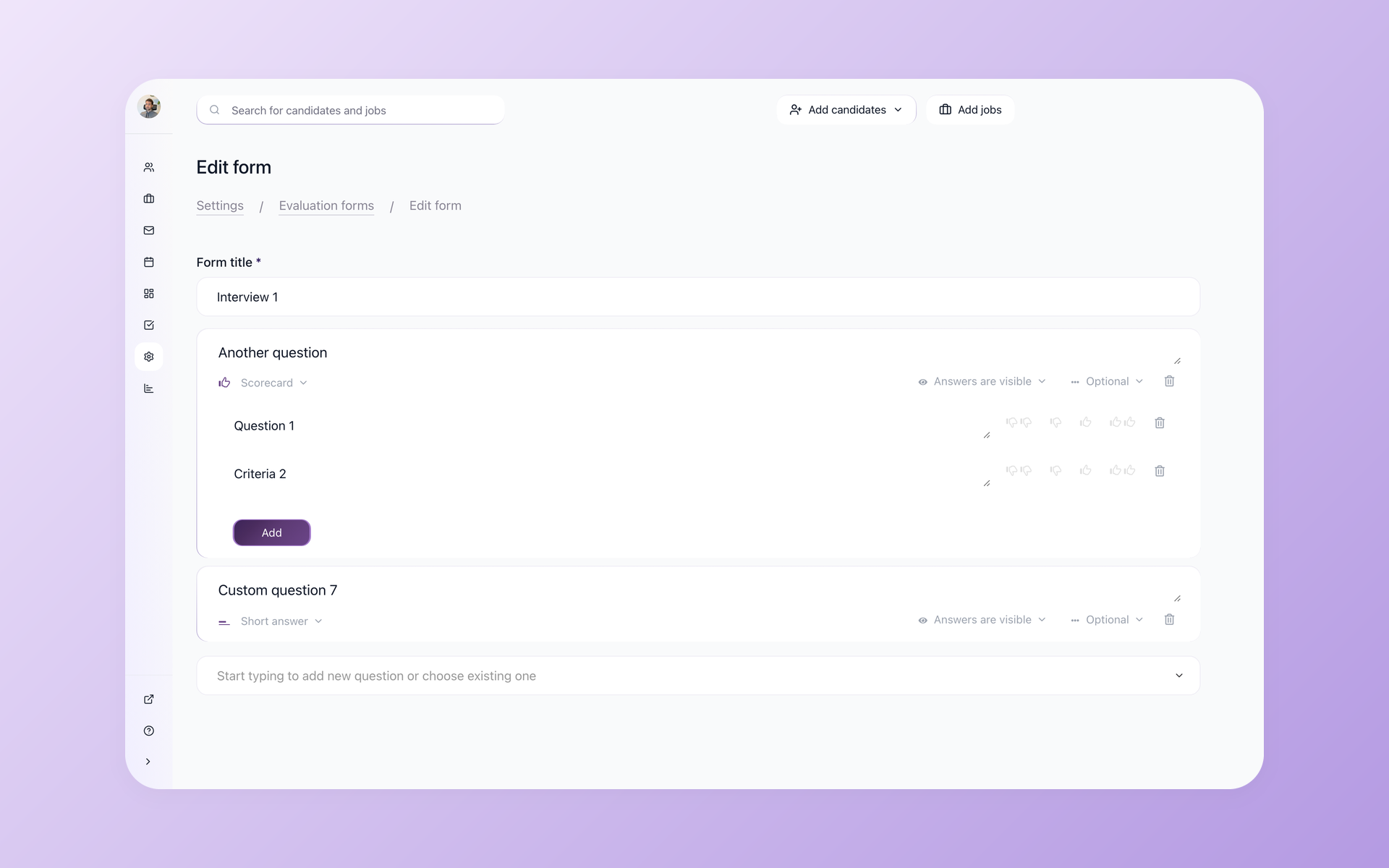
You build the form from eight question types and set each question to required or optional. Mix them based on what the interview round is actually testing.
- Scorecard questions (the workhorse) - one heading like "Technical depth" or "Communication" with multiple criteria listed underneath. Each criterion is rated on a five-point thumbs scale with a neutral middle: double thumbs-down, single thumbs-down, neutral, single thumbs-up, double thumbs-up. Stack several criteria under one Scorecard question and the interviewer rates each one independently.
- Short answer and Paragraph questions - for the written evidence behind a rating. The interviewer types what the candidate actually said or did that justifies the score. Without this field, ratings are unfalsifiable at debrief.
- Yes/No questions - quick screening calls. Would you work with this person? Did they clear the bar for this round? Useful for a closing hire / no-hire field.
- Number, Date, Time, Email - structured supporting fields for roles where they matter. Years of relevant experience, expected start date, current salary, secondary contact email.
- Required or Optional, per question - a required question blocks form submission until the field is filled, so the evidence box is never left empty on the ratings that matter.
Build once, attach a different form to every interview stage
Phone screen, technical panel, and exec round each evaluate different dimensions, so each needs a different scorecard. 100Hires Evaluation Forms lets you save a library of forms and assign each one to a specific pipeline stage on a specific job. Tie it to interview scheduling and the right form is already attached when the round is booked, so the interviewer sees the form for their stage, not a one-size-fits-all template.
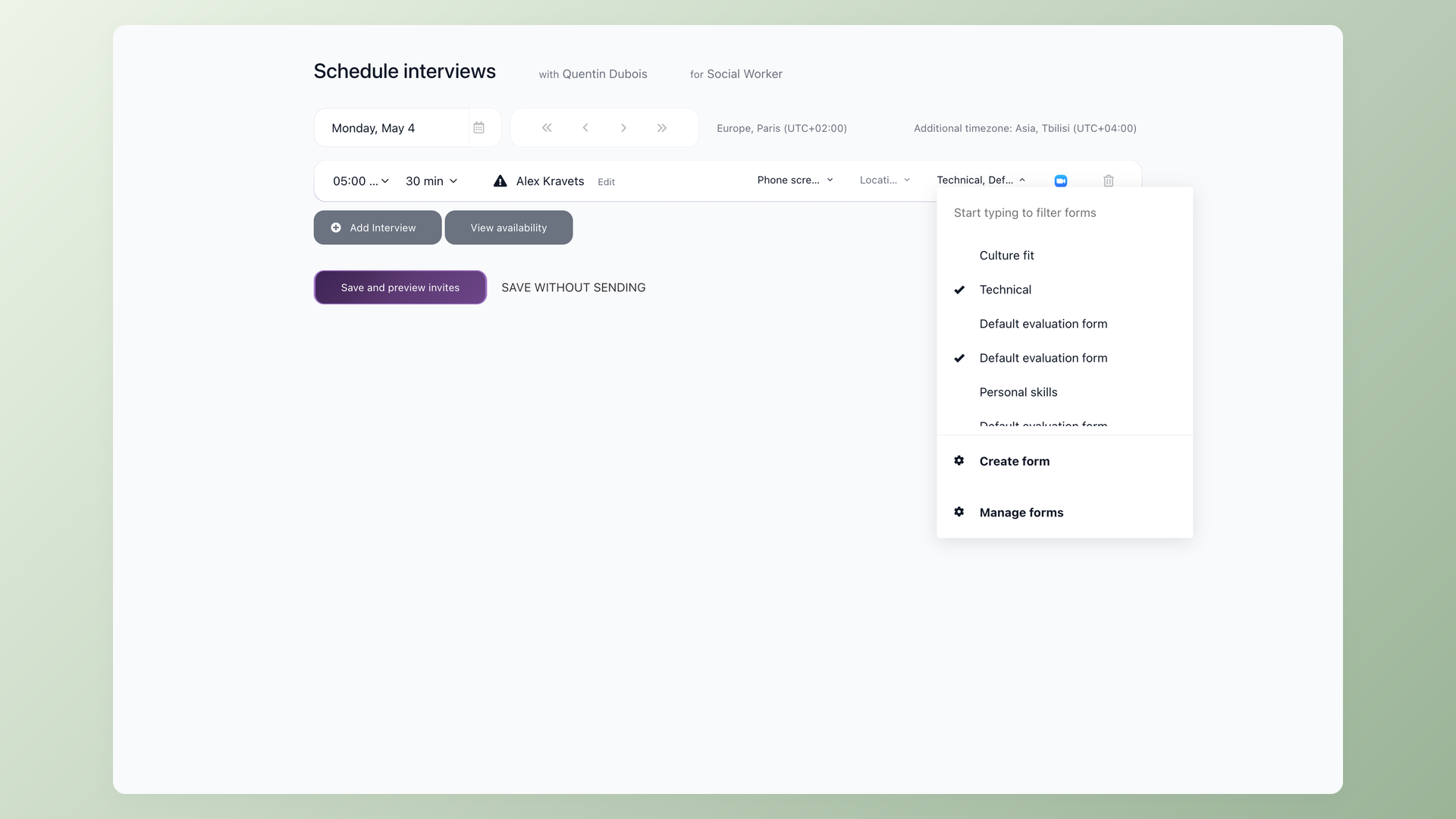
A different Evaluation Form for every stage of the pipeline
Build a library of evaluation forms per role family and assign each one to a pipeline stage on the job. When the interview is scheduled, the matching form is already attached, so the interviewer opens the candidate page and sees the scorecard built for that exact round.
- Library of evaluation forms per role family
- Per-stage assignment on each job
- Eight question types: Scorecard, Short answer, Paragraph, Yes/No, Number, Date, Time, Email
- Email reminders until the form is submitted
Keep the panel honest with blind evaluations
Once one interviewer files a strong yes, the rest of the panel anchors on it. The first confident opinion quietly becomes everyone's opinion, and the structure you built into the scorecard leaks right back out at debrief.
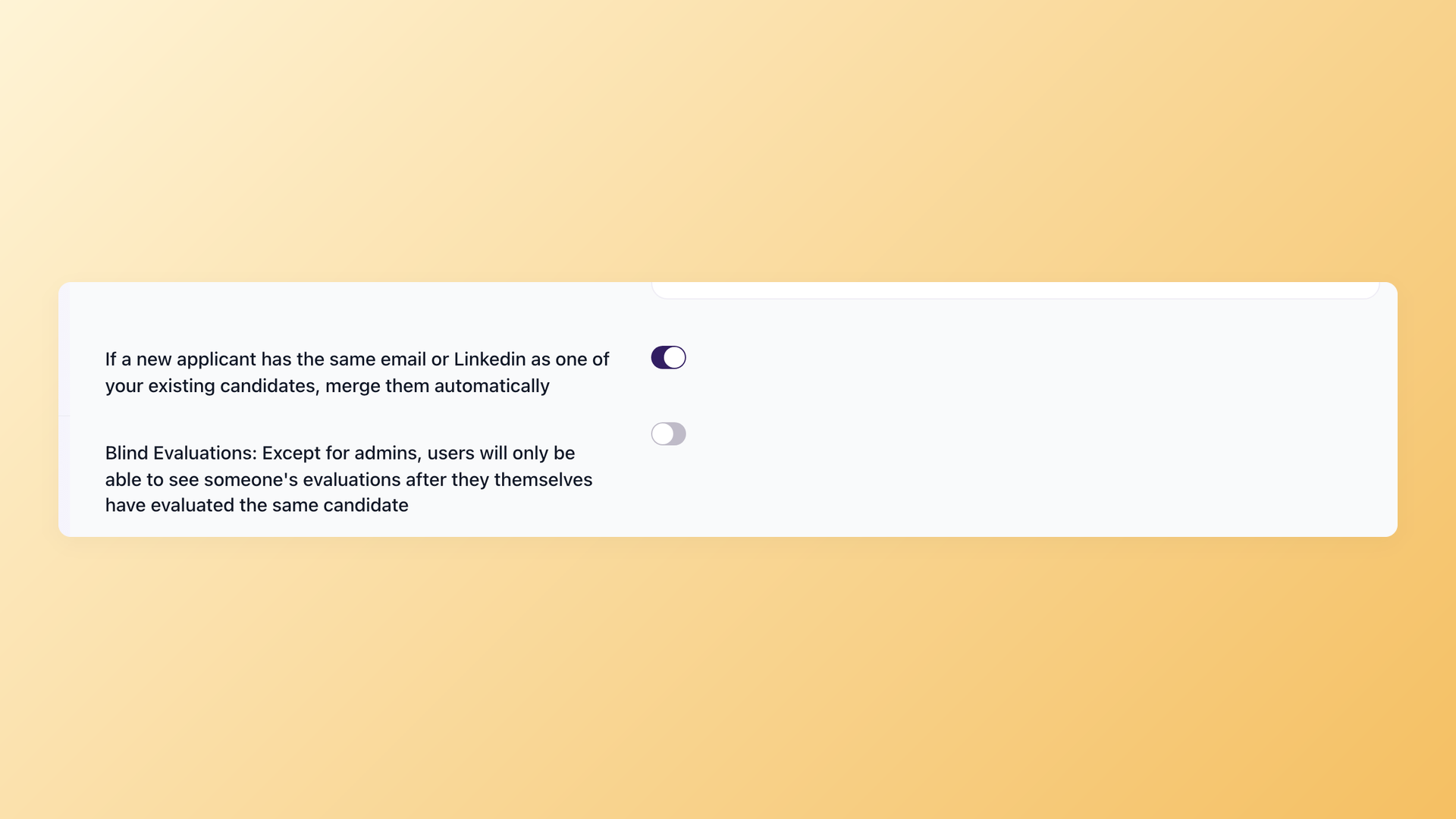
Turn on blind evaluations so the panel rates independently
100Hires has a Blind Evaluations setting: turn it on and each interviewer can only see the others' scores after submitting their own. The first strong opinion never anchors the panel. Admins are exempt, so the recruiter or hiring lead keeps full visibility and pulls every evaluation together at debrief.
- Blind Evaluations toggle in company settings
- Interviewers see peers' scores only after submitting their own
- Admins keep full visibility for the debrief
- One setting, applies across every evaluation form
Why teams skip the scorecard and what breaks without one
The pattern is consistent across recruiting forums. A recruiter spends fifteen minutes writing a scorecard. The hiring manager skims it, replies with a one-line approval, and the file goes back in the drawer. The information never makes it into the next conversation.
Recruiters running eight to twelve open roles in parallel consistently flag scorecard prep as one of the biggest time drains in the cycle. Most of the work is reformatting the same competency rubric for the next role, not designing new questions.
At the scale of a few hundred interviews a month across a multi-recruiter team, notes drift into a different format from every interviewer. By the time the debrief starts, no one can compare candidates apples-to-apples and the loudest voice in the room wins.
Interviews drift off-script for the same reason. Half the panel skips the prepared questions, convinced they already picked up the answer organically. Some interviewers fill the time talking instead of listening.
Without a scorecard pulling everyone back to the same dimensions, each interview becomes a different kind of interview, scored against a different bar.
The cost shows up downstream. Hire-decision turnarounds stretch from same-day to three days. Candidates accept other offers as your team is still debating which interviewer was right.
Rejected candidates ask for feedback and there is none to give. When a gut-feel rejection lands on a candidate from a protected class, you have no documented rubric to point to. Defensibility is not the reason to use scorecards, but it is the reason you cannot afford not to.
Build your first structured interview scorecard in five steps
A scorecard takes about thirty minutes to design and two minutes to fill in once it is set up. The thirty minutes is competency selection, not form-building. 100Hires handles the form mechanics so you can focus on what to rate.
- Pick four to six competencies from the job description. Read the JD, list the qualifications, and group them into three buckets: must-have technical skills, must-have behavioral or values dimensions, and one or two role-specific outcomes. Cap the total at six. A scorecard with twelve competencies takes too long to fill out and no one will use it past the first week.
- Write a two-sentence definition for each competency. Spell out what great looks like at this seniority. Concrete examples beat abstract labels - a vague label like cross-team collaboration becomes specific when you write it as: drives a weekly sync with product and design without being asked, surfaces blockers before they hit the team.
- Pick a short bounded rating scale. A 1-to-10 scale invites everyone to default to 7. A short scale with directional anchors forces a real choice. The 100Hires Scorecard question type uses a five-point thumbs scale - double thumbs-down, single thumbs-down, neutral, single thumbs-up, double thumbs-up - so the interviewer commits to a directional rating with a defined neutral, not a middle number that means nothing.
- Map questions to competencies. Each competency needs one or two questions that probe it. The same question can probe two competencies. The point is to make sure the panel collectively covers every dimension on the scorecard, not that every interviewer asks every question.
- Distribute by stage. Phone-screen scorecard is shorter than panel scorecard. Exec interview has different dimensions than the team interview. In 100Hires you build a scorecard once, attach it to a job, and assign different versions to different pipeline stages so the interviewer always sees the right form for their interview stage.
Interview scorecard vs evaluation form vs interview rubric
The three terms are used interchangeably, and labels like "interview scorecard", "interview evaluation form", "candidate evaluation form", and "interview rubric" show up in the same recruiter conversations. The distinction matters when you are building the form.
An interview scorecard is the document an interviewer fills out for a specific candidate at a specific stage. One scorecard per interviewer per interview. It contains the ratings and the evidence.
An interview evaluation form is usually the same thing under a slightly different name. Some teams reserve "evaluation form" for the post-hire performance review (a different concept entirely - rate of growth over six months, not fit at the offer stage).
An interview rubric is the rating criteria and anchored scale that sits behind the scorecard. The rubric is what tells an interviewer what a 3 means for "Technical depth" on a senior engineer scorecard.
You write the rubric once for a role family and reuse it across every scorecard for every interviewer in that family. 100Hires stores the rubric inside the evaluation form definition, so building a scorecard creates the rubric as a byproduct.
100Hires Evaluation Forms vs a typical ATS scorecard
Most ATS platforms support scorecards in some form. The differences show up in how easy it is to build one, whether the form stays attached to the candidate after hire, and whether peer scores are blocked from view until each interviewer submits.
 100Hires
Free interview scorecard template
If you want a starting point before you build the form in 100Hires, use the template below. Replace the example competencies with the four to six dimensions that matter for the role you are hiring for, then load it into Evaluation Forms in a couple of minutes.
Inside 100Hires Evaluation Forms the rating is a five-point thumbs scale with a neutral middle: double thumbs-down, single thumbs-down, neutral, single thumbs-up, double thumbs-up. The paper template below uses the same anchored five-point scale in text form so you can fill it out on paper and load it into Evaluation Forms one-to-one.
| Competency | Rating (five-point thumbs scale - pick one) | Evidence (what the candidate said or did) |
|---|---|---|
| Role-specific technical skill | Strong no / No / Neutral / Yes / Strong yes | Quote, scenario, or observed behaviour |
| Problem solving and judgment | Strong no / No / Neutral / Yes / Strong yes | Quote, scenario, or observed behaviour |
| Communication and collaboration | Strong no / No / Neutral / Yes / Strong yes | Quote, scenario, or observed behaviour |
| Values fit or motivation for the role | Strong no / No / Neutral / Yes / Strong yes | Quote, scenario, or observed behaviour |
| Overall recommendation | Hire / No hire / Strong yes / Strong no - one sentence why | |
To load this into 100Hires Evaluation Forms, sign up for a free trial and open Settings - Evaluation forms - Add form. Add a Scorecard question for each competency above with criteria listed underneath, plus a Paragraph question for the evidence. Turn on Blind Evaluations in company settings so peers do not anchor on each other, and attach the form to a pipeline stage on the job.
Common interview scorecard mistakes
Scorecard rollouts fail in the same way most of the time. Here are the patterns worth flagging during your first month, plus what to do instead.
- Optional templates. If filling the scorecard is not required to move the candidate forward, the people already inclined toward structure use it and everyone else does not. Require it before the candidate can move to the next stage. 100Hires sends automatic email reminders to interviewers until each scorecard is submitted.
- Twelve competencies on a phone screen. Long forms get half-filled or skipped. Drop to four to six competencies per scorecard and accept that a phone screen scorecard rates fewer dimensions than a panel scorecard.
- Vague competency labels. "Good communicator" means different things to two interviewers. Write a two-sentence anchored definition for every dimension and store it inside the form so the interviewer reads it before rating.
- 1 to 10 rating scales. Scores cluster at 7. Use a short bounded scale with directional anchors and a defined neutral - 100Hires Scorecard questions use a five-point thumbs scale (double down, single down, neutral, single up, double up) for this reason.
- Score-only feedback. A 3 with no evidence is unfalsifiable. Make the evidence box mandatory and treat any submission without evidence as incomplete.
- Letting the first strong opinion anchor the panel. A confident yes filed early pulls everyone else toward it. Turn on Blind Evaluations in 100Hires so each interviewer sees the others' scores only after submitting their own - the recruiter pulls them together at debrief.
- Throwing scorecards away after hire. The evaluation history is what tells you, six months later, whether the panel was actually right. Keep the scorecards attached to the candidate record long-term.
Most of these are not scorecard problems. They are scorecard-adoption problems. The fix is usually not a better form - it is reducing the friction that lets interviewers skip the form in the first place.
The hiring playbook, in your inbox
One email a week - benchmarks, AI screening tactics, and short interview templates from the 100Hires team. No product pitches.