
Lever Competitors & Alternatives in 2026: Renewal Costs and the Employ Question

There is one fact about Lever that belongs at the top of any comparison, and it is almost never mentioned: Lever is not an independent company. It has been part of Employ Inc. since August 2022, alongside JazzHR, Jobvite and NXTThing RPO.
Employ segments its own brands explicitly: JazzHR for foundational hiring, Lever for scalable hiring, Jobvite for the enterprise. Three applicant tracking systems, one owner, one engineering budget to divide between them.
That does not make Lever a bad product. Capterra reviewers give it 4.6 across 654 reviews and 90 percent say they would recommend it.
But it does explain the two complaints that come up most at renewal, reporting depth and product momentum, and it means two of the alternatives you might shortlist are owned by the same company you are trying to leave.
What Lever costs
The hiring playbook, in your inbox
One email a week - benchmarks, AI screening tactics, and short interview templates from the 100Hires team. No product pitches.
Lever's pricing page is a quote request, checked on 25 July 2026. The numbers below come from marketplace data and buyers.
| Source | Figure | Context |
|---|---|---|
| Vendr marketplace | Median $15,400 a year | Full observed range $6,714 to $51,864 |
| Third-party pricing guide | About $12,000 to $15,400 a year | 200-person company near $12,000, 500-person near $37,000 |
| Buyer reports on Reddit | $4,000 to $8,000 a year | Smaller teams, seat-dependent |
| Per-seat analysis | $2,400 to $3,600 per full seat | Mid-market; $1,800 to $2,800 at 50-plus seats |
The spread from $6,714 to $51,864 for the same product tells you what kind of purchase this is. There is no list price to compare against, so your leverage at renewal is the only thing setting your rate.
One recruiter's reaction to a quote, from an r/Recruitment renewal thread, is worth keeping in mind as a sanity check: calling $7,500 for a basic ATS absurd.
Why teams leave Lever
The clearest account came from a first-time Talent Director at a 100-person tech startup, posting in r/recruiting under the title about evaluating replacements for Lever:
Their account lists four pain points at once: reporting that does not go deep enough, hiring-manager collaboration that is not seamless, pricing that has started to feel rigid, and pressure from leadership to add AI across the stack.
A vendor-side participant in the same thread confirmed the pattern rather than disputing it, saying the collaboration complaints come up consistently from teams making the switch.
Capterra's own review text points at the same shape of problem from a friendlier angle: reviewers describe it as a strong first ATS for a smaller, growing company with a limited recruiting team.
Read those together and the honest summary is that Lever is strong for a team growing into structured hiring, and strains for a team that has arrived. Reporting and hiring-manager collaboration are the two walls people hit.
One cautionary data point on where switchers land: a 330-employee company that had just moved from Lever to Workable reported being unimpressed, while acknowledging they were still implementing. Migrating is not automatically an upgrade.
Two structural weak points worth verifying
Two Lever limitations show up in internal competitor research often enough to test directly rather than discover after signing.
Dashboard refresh latency. Visual Insights dashboards have been reported to take several hours to refresh, and building custom views through the Data Explorer is both a paid extra and a real learning curve.
If you expect same-day reporting, ask for a live demonstration on a populated account rather than a sample.
Scheduling. There is no native Calendly-style self-scheduling, so candidate self-booking depends on an integration. Worth confirming against your process before you assume it is included.
Neither is disqualifying. Both are the kind of thing that turns into a recurring annoyance if discovered in month two rather than during evaluation.
The renewal play that works
Because pricing is negotiated, the highest-return hour you can spend is not on comparison articles but on quotes. A peer in the r/Recruitment renewal thread laid out the exact play:
Their advice: get written quotes from Pinpoint and Greenhouse, tell each you intend to move by a stated date, then tell your Lever account manager that the team is pushing for a rival and the decision comes down to cost.
Their expectation was that Greenhouse would undercut Lever by at least a thousand dollars, and their closing point was that this is no longer the seller's market it was in 2021.
The unfinished thought at the end is the important part. The 2021 seller's market is over, and buyers have leverage they did not have three years ago.
The counter-argument in the same thread deserves equal weight: even a 20 percent saving is unlikely to persuade leadership to absorb an ATS migration over roughly $1,500. Usually the answer is no, which is precisely why the quote is worth more than the migration.
The AI mandate, and how to evaluate it honestly
Note the fourth item in that Talent Director's list: pressure from leadership to add AI across the whole tech stack. That pressure is now a common reason ATS evaluations start, and it is the easiest thing in this market to buy badly.
Every vendor demos AI well. The pilot above is the useful precedent: an existing customer gave the AI applicant review to their team, and nobody endorsed using it. A demo tells you what the feature does on the vendor's data. It tells you nothing about your data.
Three questions that separate real capability from a demo script:
- Score my last 200 applicants. Ask the vendor to run screening against a role you have already filled, then compare the ranking against who you actually interviewed and hired.
- Show me the reasoning, not the number. A score without an explanation cannot be audited, defended to a hiring manager, or corrected when it is wrong.
- What does it cost at volume? Several vendors meter AI separately from the seat. Workable sells AI credits from $0.095 to $0.12 each, and metered pricing surprises people who plan a high-volume campaign.
Alternatives, with the ownership map
Check who owns what before you shortlist. Two of the obvious names share Lever's parent company.
Greenhouse (independent of Employ)
Lever's oldest rival and the standard structured-hiring alternative. Quote-only, with buyers reporting roughly $6,000 to $12,000 a year under 100 employees. Stronger reporting than Lever, which addresses complaint number one.
Its own weak points are support responsiveness and permission granularity.
Ashby (independent)
The analytics answer, and the most common shortlist partner in 2026. Published entry price of $400 a month with a 10 percent annual discount.
Resolve the seat definition in writing: a customer in a widely read thread reported $800 per elevated seat annually, including hiring managers, reaching about $24,000 as they scaled.
Pinpoint (independent)
The name that comes up when hiring-manager collaboration is the complaint, which makes it directly relevant here. Quote-based; one buyer reported about $10,000 for up to 250 employees.
Teamtailor (independent)
Career-site and employer-brand strength, collaborative by design, widely used in Europe. Quote-only. Expect real setup time on templates.
Workable (independent)
Published pricing at $299, $599 and $719 a month in the 1 to 20 employee band, plus add-ons for texting, video, assessments and performance. Where one 330-person team went from Lever, with mixed early impressions.
JazzHR (same parent: Employ Inc.)
Published at $1,000 to $5,508 a year, and genuinely the right answer for a team that overbought. Just be clear that you are moving down a tier inside the same corporate group rather than changing vendor.
Jobvite (same parent: Employ Inc.)
The enterprise rung of the same ladder. Consider it only if you are moving up in scale and want to stay with the group.
Gem
Now sells an ATS alongside its sourcing CRM, and shows up in Lever comparisons. An existing Gem customer who demoed the AI features in 2025 was blunt about them:
Their experience: after piloting the AI on real applicant review and giving the team access, nobody endorsed using it. They also rated Gem below expectations on implementation and customer success.
100Hires (independent)
Published plans from $49 a month with AI screening included at the higher tiers. Detail and honest limits below.
Side by side
| Option | Owner | Pricing | Fixes which Lever complaint |
|---|---|---|---|
| Lever | Employ Inc. | Median $15.4k a year | - |
| Greenhouse | TPG-backed, independent | About $6k to $12k a year | Reporting |
| Ashby | Independent | From $400 per month | Reporting and analytics |
| Pinpoint | Independent | About $10k at 250 employees | Hiring-manager collaboration |
| Teamtailor | Independent | Quote | Collaboration and employer brand |
| Workable | Independent | From $299 per month | Pricing transparency |
| JazzHR | Employ Inc. | $1,000 to $5,508 a year | Cost, if you overbought |
| 100Hires | Independent | From $49 per month | Cost and AI screening |
Our verdict
If your only complaint is price, do not migrate. Get two quotes and negotiate. The evidence in recruiter forums is consistent: rivals will undercut, and a 20 percent saving rarely justifies an ATS migration. Spend the afternoon, not the quarter.
If reporting is the wall you hit, Ashby is the most direct fix, Greenhouse the safest. Ashby was built analytics-first; Greenhouse has visibly improved reporting since 2021 and carries less seat-definition risk.
If hiring-manager collaboration is the wall, look at Pinpoint and Teamtailor. This is a workflow and interface problem, not a data problem, and the two products with the best hiring-manager reputations are the rational shortlist.
If you are moving to cut cost, check the ownership map first. Moving from Lever to JazzHR can be a sensible downgrade, but understand you are renegotiating inside Employ Inc. rather than leaving it.
Where 100Hires fits, and where it does not
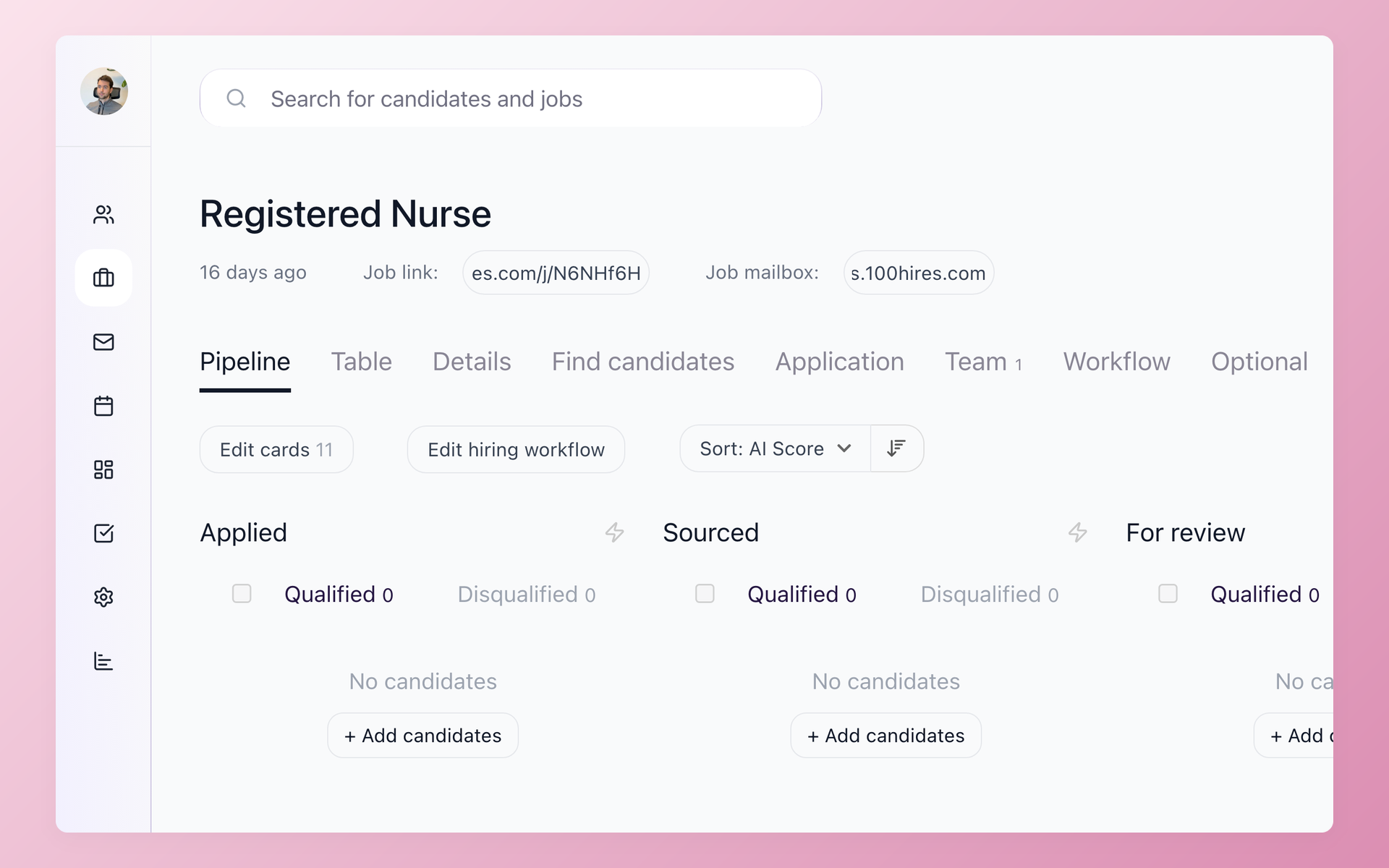
100Hires is an applicant tracking system for small and mid-sized in-house teams with published pricing. Start is $49 per month billed annually ($99 monthly) for up to 100 candidates a month.
Advanced at $199 annually ($249 monthly) covers unlimited jobs, candidates and users, plus automated emails, a custom domain and knockout questions. Pro at $399 annually ($499 monthly) adds sourcing and contact enrichment.
Capterra rating is 4.9 from more than 1,100 reviews as of July 2026.
100Hires is the wrong choice if:
- Advanced reporting is the reason you are leaving. If you need cohort funnel analytics, pass-through rates by interviewer and forecasting, Ashby is a better answer than we are. That is their whole thesis.
- You have a recruiting-operations function. Teams with dedicated TA ops usually want the configurability of Greenhouse or Ashby, and they have the capacity to run it.
- You are scaling past roughly 500 employees with approval chains. Requisition and offer approvals at that scale are enterprise territory.
- You need a large integration marketplace. Lever and Greenhouse both have deeper ecosystems than we do. If your stack depends on twelve integrations, verify each one before considering us.
- Nurture campaigns and a candidate CRM are central. Lever's CRM side is a real strength and one of the more common reasons teams stay.
If the honest situation is that you bought for a scale you have not reached, that is where a published price from $49 a month beats a negotiated one.
See 100Hires pricing or start a free trial.
The two most common shortlist partners are covered in our Greenhouse alternatives and Ashby alternatives guides.
Frequently asked questions
How much does Lever cost?
Lever quotes rather than publishes. Vendr marketplace data shows a median buyer paying $15,400 a year, with an observed range from $6,714 to $51,864. Third-party guides put a 200-person company near $12,000 a year and a 500-person company near $37,000, while smaller teams on Reddit report $4,000 to $8,000. Per-seat analysis suggests $2,400 to $3,600 per full seat at mid-market scale.
Who owns Lever?
Employ Inc, which acquired Lever in August 2022. Employ also owns JazzHR, Jobvite and NXTThing RPO, and positions the three applicant tracking systems at different segments: JazzHR for foundational hiring, Lever for scalable hiring, Jobvite for enterprise. Each continues to operate under its own brand.
Is Lever or Greenhouse better?
They are close, and the choice usually turns on price and reporting. Greenhouse is stronger on structured interviewing and reporting depth; Lever is often cheaper for smaller teams and stronger on candidate CRM and nurture. One recruiter's summary was that Lever covers almost the same ground for roughly half the price. Another countered that Greenhouse sits clearly above the rest of the field. Get both quotes and test reporting against your actual questions.
What are the main complaints about Lever?
Three, consistently: limited reporting, hiring-manager collaboration that is not seamless, and pricing that feels rigid at renewal. A Talent Director at a 100-person startup listed all three in a single post, and a vendor-side commenter confirmed the collaboration feedback is heard consistently from switching teams. None of them are dealbreakers for a team that is still growing into the product.
How do I negotiate a Lever renewal?
Get written quotes from Greenhouse and Pinpoint first, then tell your account manager that cost is the deciding factor and your team is pushing for a rival. Recruiters who have run this play report competitors undercutting by a meaningful margin. Keep the migration cost in view as well: a 20 percent saving on a mid-market contract is often less than the cost of the switching project itself.
Try 100Hires for free
No credit card. 14-day trial. Forbes Advisor #1 ATS for SMBs.