
Teamtailor Competitors & Alternatives in 2026: Slot Pricing Explained

Teamtailor sells something most applicant tracking systems treat as an afterthought: the career site. It is an employer-branding product with an ATS attached, rather than an ATS with a careers page bolted on, and that shapes both who loves it and who leaves.
It also prices differently from almost everything it competes with. Teamtailor charges by job slots, not by seats, employees or candidates.
Understanding that one mechanic explains most of the frustration in this category, because a slot-based meter punishes exactly the companies that run many concurrent adverts.
What Teamtailor costs
The hiring playbook, in your inbox
One email a week - benchmarks, AI screening tactics, and short interview templates from the 100Hires team. No product pitches.
Teamtailor does not publish prices. Its pricing page is a request form, checked on 25 July 2026, so every figure below comes from third-party research and buyer reports rather than the vendor.
One genuinely public data point exists. Teamtailor's UK G-Cloud public-sector listing, dated May 2024 and therefore now stale, published headcount-band pricing with unlimited users and postings inside each band.
It ran from roughly £1,250 a year for a 1 to 5 employee organisation up to about £28,000 a year at 1,000 to 2,000 employees. Treat it as a shape rather than a current quote, but it is the clearest published illustration of how the model scales.
| Source | Figure | Basis |
|---|---|---|
| Third-party pricing guide | $2,750 to $72,000+ per year | Scales by job slots |
| Third-party review | About $229 to $279 per month at entry | Small teams |
| Per-user estimate | $79 to $279 per user per month | Roughly $395 to $1,395 a month for five people |
The 26-fold spread between the low and high figures is not sloppy research. It reflects a product sold on company size and slot count, where two buyers of the same product can pay wildly different amounts.
The practical consequence: your renewal is a negotiation, and the only way to know your number is to get a written quote with the slot count stated explicitly.
What users actually say
Teamtailor's reviews are good, around 4.4 to 4.6 across roughly 529 G2 reviews, but recruiter forums are more specific than star ratings, and the picture splits sharply by who is using it.
From an in-house recruiter in r/recruiting who had been using Manatal and was considering the switch:
Their verdict: functional, mid-range on price, better than many alternatives, with good customer service and an attractive design. Their reservations were the scheduling feature, which they found confusing until it clicked, and one specific irritation covered below.
That second irritation is worth naming precisely, because it is small and consequential: acknowledgement and rejection emails go out attached to an individual recruiter's name.
A rejection signed personally generates replies, and at volume it generates a lot of them, all landing on one person.
The harshest verdict in the same thread came from an agency:
Their account: they asked for a refund after six months, citing missing CSV imports, slow server performance and a high bug count, and advised recruitment firms specifically against it.
Weigh that one carefully. It comes from an agency, and Teamtailor is not built for agencies: no client-side workflows, no submittals, no placement tracking. Judging an employer-branding ATS by agency criteria is judging it for a job it never applied for.
The CSV-import complaint, though, is worth verifying yourself in a trial regardless of what you do.
A separate buyer evaluating it against Pinpoint and Kula summarised the setup cost: capable, but visually busy, with meaningful time needed on templates and disposition reasons before it runs smoothly.
What the review base says, ranked
Aggregated review mining across both major review sites gives a steadier ranking than any single account, and it is worth reading alongside the split above.
On the positive side the order is consistent: ease of use and interface quality lead by a distance, then customer support, then automation and workflow, then candidate management, then the career-site builder.
That last one is the differentiator, but note that it is fifth rather than first even among people who like the product.
The complaints rank as follows:
- Limited customisation, the top complaint. Career pages, email templates, fonts and interface elements. Notable because customisation is exactly what an employer-branding product is bought for.
- Reporting depth. Attractive dashboards that reviewers find thin for real analysis or meaningful export.
- Bugs, freezes and unexpected logouts. Independent confirmation of the harsher account above.
- Integration gaps. LinkedIn, Google Meet, HR systems and calendar syncing specifically.
- Career-page editing constraints. Layout limits that sometimes require code.
The first and fifth points deserve weight in your decision. If you are buying Teamtailor for the career site, the most common complaint among existing customers is that the career site is harder to shape than expected.
One further commercial detail to confirm in writing: contracts are commonly annual with no monthly option, which is a meaningful constraint if your hiring is seasonal or uncertain.
Who Teamtailor is genuinely right for
Before listing alternatives, it is worth being clear about when you should not switch.
- Your career site is a hiring channel, not a formality. If you get meaningful direct applications and want to grow that, Teamtailor is among the best products for it.
- Employer brand is a company priority with budget behind it. Content, culture pages, employee stories: this is what the product is designed around.
- You are in Europe. Adoption, localisation and support coverage are strongest there.
- Your hiring is a steady handful of concurrent roles. Slot pricing rewards that shape and punishes the opposite.
If two or more of those describe you, the honest advice is to negotiate rather than migrate.
How to work out your real slot count before renewal
Slot pricing is negotiable in a way that seat pricing is not, because the number is entirely within your control. Most teams buy more slots than they need because nobody has measured.
- Export twelve months of job publish and close dates. Plot how many were live simultaneously each week. You are looking for the peak, not the average, but you also want to know how often that peak occurred. A single spike week is a scheduling problem, not a licensing problem.
- Find the roles that never close. Evergreen adverts for drivers, care workers or sales development consume a slot permanently while producing applications in bursts. Consider running them as a single pooled advert rather than one per location.
- Check whether unpublished, draft and archived roles count. Vendors differ, and teams routinely hold slots hostage with drafts nobody remembers creating.
- Ask what an extra slot costs mid-term. If overflow slots can be bought monthly, you can license for your normal state instead of your worst week, which is usually a large saving.
Teams that run this exercise commonly find they are licensed twenty to forty percent above their actual peak. That is a negotiation you can win without changing vendor.
The rejection-email detail worth testing in a trial
One complaint in the recruiter thread above deserves its own paragraph, because it is the kind of thing no feature comparison captures and every high-volume team eventually hits.
If automated rejection and acknowledgement emails go out signed with an individual recruiter's name, candidates reply to that person. At fifty applicants a role that is a nuisance.
At five hundred it is a part-time job, and it lands on whoever is named rather than on a shared inbox.
When you trial any ATS, send yourself the full candidate sequence and check three things: what name and address appear in the from field, where replies land, and whether you can change either without breaking the template.
It takes ten minutes and it prevents a recurring annoyance you cannot easily undo later.
Alternatives, by the reason you are leaving
If the slot pricing is the problem: 100Hires
Published plans from $49 per month billed annually, with unlimited jobs, candidates and users from the Advanced tier at $199. No slot meter to manage. Details and honest limits below.
If you want the career site without the price: Workable
Published at $299 per month for Standard, $599 Premier, $719 Enterprise in the 1 to 20 employee band, plus add-ons for texting, video, assessments and performance.
Its careers pages are competent rather than beautiful, and its job-board distribution is the widest in this group, which is a different route to the same goal of more applicants.
If hiring-manager adoption is the problem: Pinpoint
The strongest reputation in the mid-market for getting hiring managers to actually use the system. Quote-only; a buyer reported about $10,000 for up to 250 employees.
If you need structure and reporting: Greenhouse or Ashby
Greenhouse for structured interviewing, quote-only, roughly $6,000 to $12,000 a year under 100 employees.
Ashby for analytics, published from $400 per month with a 10 percent annual discount, though its seats include hiring managers by default, which has produced renewal surprises.
If you want the cheapest working option: JazzHR or Manatal
JazzHR publishes $1,000 to $5,508 a year, with a three-postings-a-month floor on the entry tier. Manatal starts at $15 per user per month billed annually for up to 15 jobs. Neither will match Teamtailor's career site.
If you are an agency: not Teamtailor, and not most of this list
Recruit CRM, Loxo or Crelate. Agency workflows are a different product category, and the review above is what happens when the categories get mixed up.
Side by side
| Option | Pricing meter | Entry cost | Career site strength |
|---|---|---|---|
| Teamtailor | Job slots | About $229 per month, quote-only | Best in class |
| 100Hires | Plan tier | $49 per month, published | Standard |
| Workable | Employee band | $299 per month, published | Competent, huge board reach |
| Pinpoint | Employee count | About $10k at 250 employees | Strong |
| Greenhouse | Employee count and tier | About $6k to $12k a year | Functional |
| Ashby | Elevated seats | $400 per month | Functional |
| JazzHR | Job postings | $1,000 a year | Basic |
Our verdict
If the career site is why you bought it, keep it and negotiate the slots. Nothing else on this list replaces that capability, and slot count is the most negotiable line in the contract. Go in with your true concurrent peak rather than your average.
If you are paying employer-brand prices for a plain pipeline, you are over-tooled. Teams that never publish content, never update the culture pages and get most applicants from job boards are funding a capability they do not use.
If your complaint is applicant volume rather than presentation, buy distribution instead. Workable's board network moves that number more reliably than a better-looking careers page.
If you are an agency, leave. This is not a criticism of the product. It was not built for client-side work and you will keep hitting the same walls.
Where 100Hires fits, and where it does not
100Hires is an applicant tracking system for small and mid-sized in-house teams, priced by plan rather than by job slots. Start is $49 per month billed annually ($99 monthly) for up to 100 candidates a month.
Advanced at $199 annually ($249 monthly) covers unlimited jobs, candidates and users, plus automated emails, a custom domain and knockout questions. Pro at $399 annually ($499 monthly) adds sourcing and contact enrichment.
Capterra rating is 4.9 from more than 1,100 reviews as of July 2026.
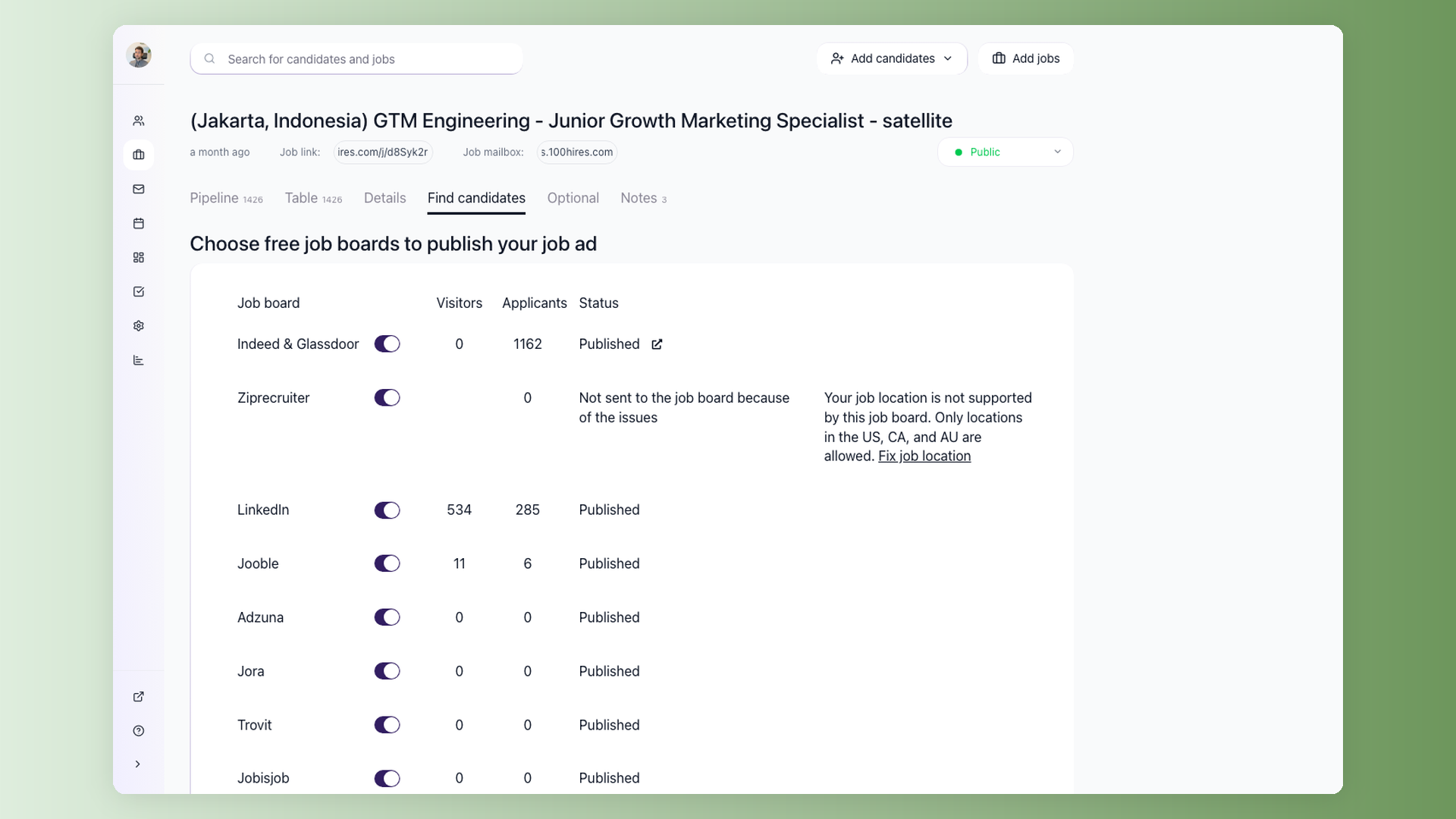
100Hires is the wrong choice if:
- Employer branding is your strategy. Teamtailor's career sites, content blocks and design control are genuinely better than ours. If that is the reason you are on this page, we are not the upgrade.
- You want a beautiful careers page with no work. Ours is clean and functional. It is not a website builder.
- You are hiring across many European markets with local-language career pages. Teamtailor's localisation is stronger.
- You are an agency. Recruit CRM, Loxo or Crelate handle client-side workflows that we deliberately do not.
- You need the widest job-board reach. Workable wins that comparison.
Where we fit is the team that liked Teamtailor's simplicity but not its slot maths. See 100Hires pricing or start a free trial. Our Workable alternatives and Ashby alternatives guides cover the usual shortlist partners.
Frequently asked questions
How much does Teamtailor cost?
Teamtailor does not publish pricing. Third-party research puts it between roughly $2,750 and $72,000 or more per year, scaling by job slots and company size, with entry plans reported around $229 to $279 per month. Because the range is so wide, the only reliable number is a written quote that states your slot count explicitly.
What is job slot pricing?
You buy a fixed number of concurrently published roles rather than paying per user, per employee or per candidate. It suits companies that run a steady handful of adverts and penalises multi-site or evergreen hiring, where the same roles stay live continuously. Before renewing, check your peak concurrent postings over the last twelve months rather than the average.
Is Teamtailor good for recruitment agencies?
No, and it does not claim to be. It has no client-side CRM, submittal workflow or placement tracking. One agency on Reddit described asking for a refund after six months and cited slow performance and missing CSV imports. Agencies should look at Recruit CRM, Loxo or Crelate instead, which are built for that model.
What is the best Teamtailor alternative for employer branding?
Honestly, there is no like-for-like replacement. Teamtailor leads this category. Pinpoint is the closest on candidate experience and hiring-manager usability, and Workable takes a different route to the same outcome by maximising job-board distribution rather than career-site quality. If employer brand is genuinely your strategy, negotiating with Teamtailor usually beats switching.
Can you export your data from Teamtailor?
Ask before you sign, and ask specifically. One agency reported that CSV imports were not supported, which is a different function but the same underlying concern about data portability. Request a documented export covering candidate records, attachments, stage history, notes and email threads, and confirm the format in writing rather than relying on a verbal answer during a demo.
Try 100Hires for free
No credit card. 14-day trial. Forbes Advisor #1 ATS for SMBs.