Recruitment Management Software & Systems Guide 2026
Recruitment management software puts job posting, pipelines, interviews, and hiring reports in one place. See how an RMS works, 2026 pricing, and how to choose.
This guide defines the category in plain terms, shows the seven jobs the software actually does, compares eight tools on verified pricing, and answers the questions buyers ask most.
We also cover how recruitment management systems differ from a plain ATS, and when a spreadsheet is still enough.
What is recruitment management software?
The hiring playbook, in your inbox
One email a week - benchmarks, AI screening tactics, and short interview templates from the 100Hires team. No product pitches.
Recruitment management software runs your entire hiring operation from one place: publishing jobs, collecting applicants, screening them, scheduling interviews, keeping the team aligned, and reporting on what worked.
The same product is often called a recruitment management system, or RMS.
Recruiters rarely use the term RMS when they shop, though. On Reddit, the same need shows up as a request for an ATS and CRM combo: one tool that tracks candidates and manages relationships instead of two subscriptions taped together.
A useful way to hold the distinction: an applicant tracking system is the scoreboard, a recruitment management system is the whole game plan. Tracking who applied is one function.
Sourcing, outreach, scheduling, scoring, and analytics around that pipeline are what turn tracking into management.
Recruitment management systems vs ATS vs recruiting software
The honest answer: the labels overlap far more than vendors admit. Companies name products an ATS because buyers know that term, even when the product covers the full recruiting lifecycle. Judge the feature list, not the label on the box.
The real differences hide in scope. A narrow applicant tracking system starts working after someone applies: it stores applications and moves them through stages.
A recruitment management system also covers what happens before and around the application: sourcing, multi-board posting, automated outreach, interview logistics, and reporting.
ATS vs CRM is the other question buyers ask. An ATS manages candidates against jobs. A recruiting CRM manages relationships: clients for agencies, or passive talent pools for in-house teams.
Agency platforms such as Recruit CRM and Bullhorn bundle both, which is why the ATS plus CRM combo phrasing stuck.
The RMS term is real enough that a vendor named TrackerRMS built its brand on it. The spelling drifts too: recruiting management system, recruiting management software, and recruitment management system all point at the same tool. What matters is whether it manages the whole process or just the paperwork after the apply click.
What a recruitment management system does
Seven jobs come up in almost every buying conversation. Here is each one, with how it looks in 100Hires as a concrete example.
Job posting and distribution
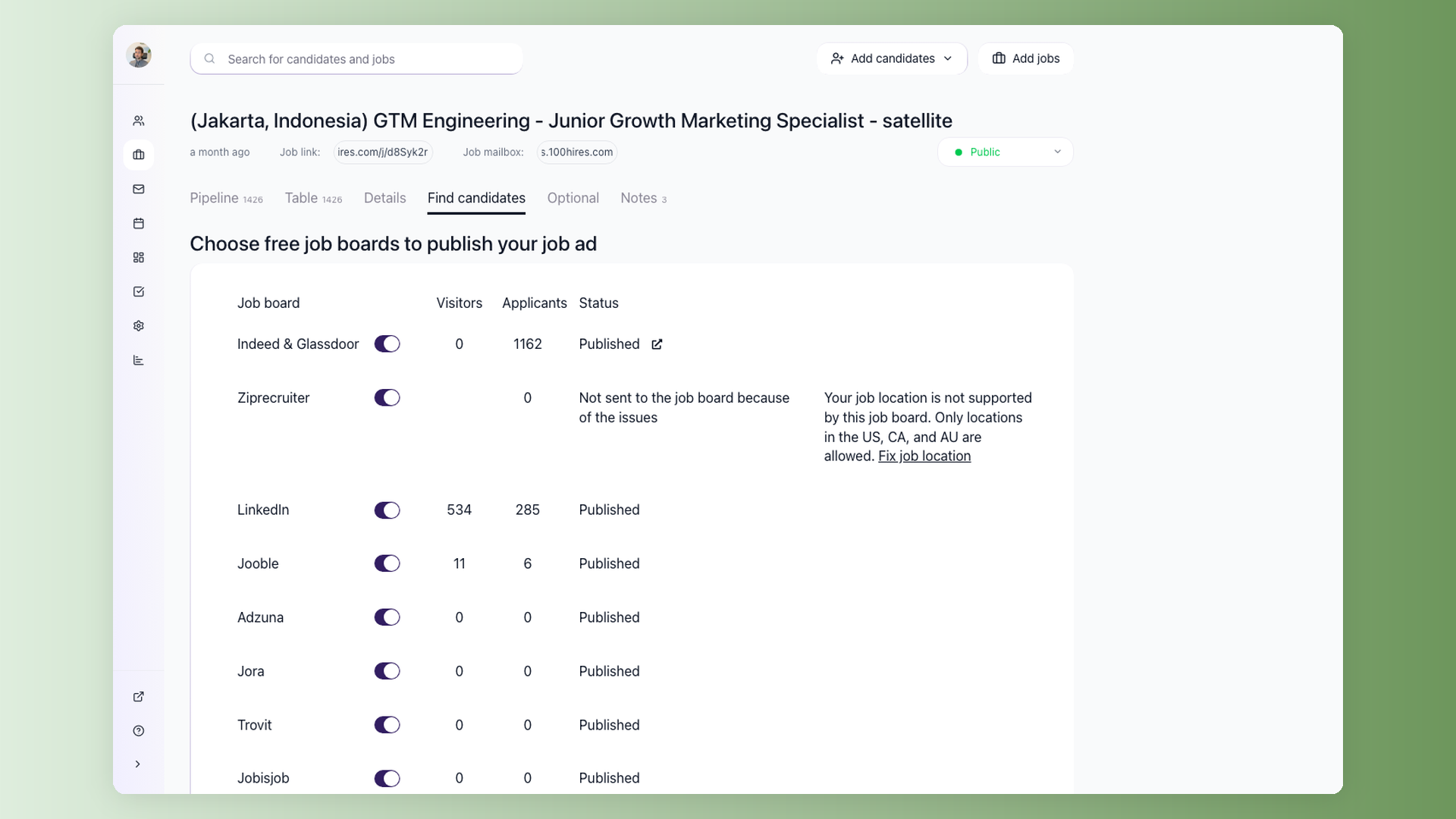
Writing a job once and publishing it everywhere is the first time-saver. In 100Hires, each job board is a toggle on the publish screen: flip Indeed, LinkedIn, ZipRecruiter, and the rest on, and the job syndicates without separate logins.
The platform connects 13 named job boards.
Candidate database and pipelines
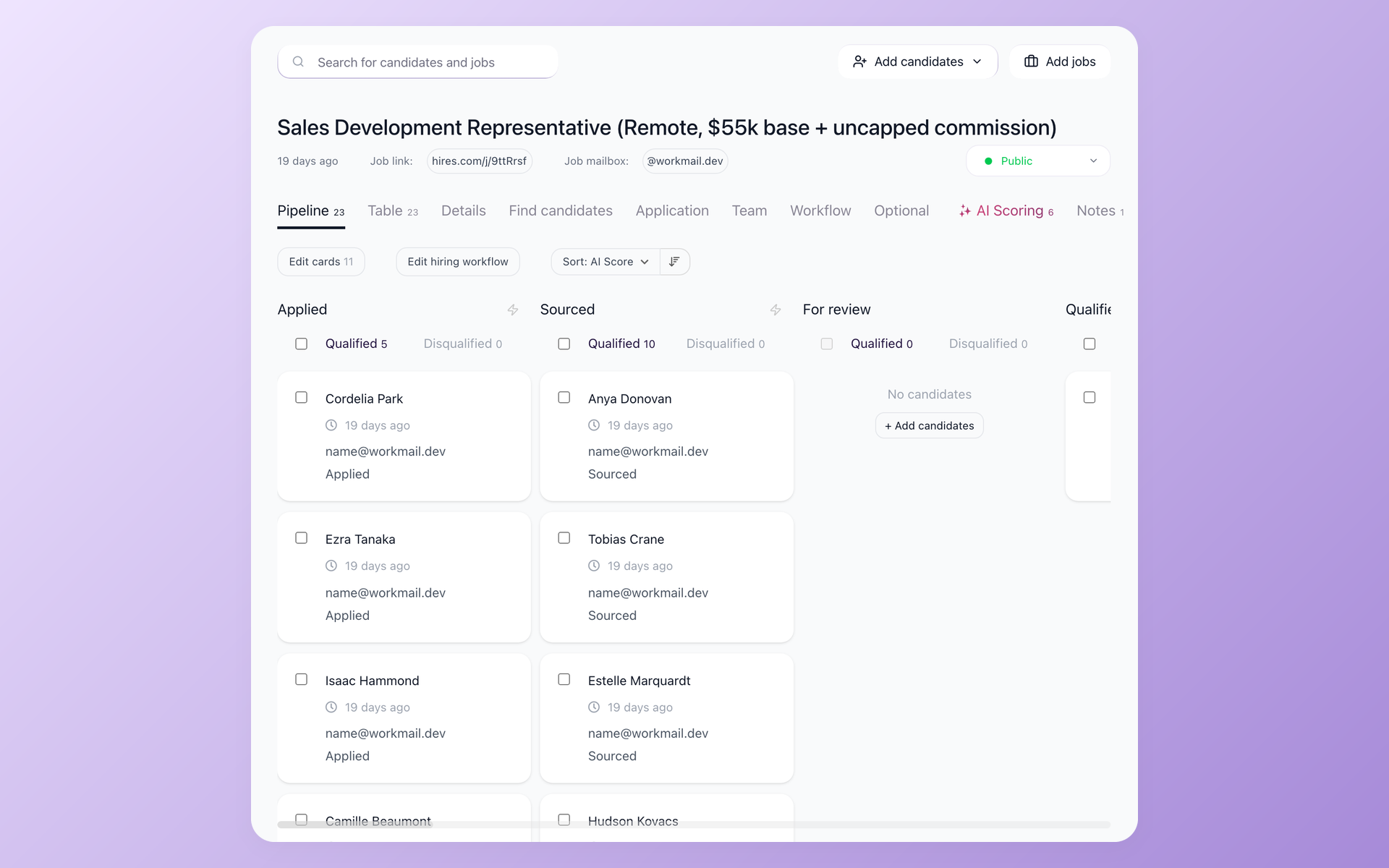
Every applicant, sourced candidate, and referral lands in one searchable database. Pipelines are kanban boards with stages you define per job. 100Hires also auto-merges duplicate profiles that arrive with the same email or LinkedIn URL, so the count you see is the truth.
Screening
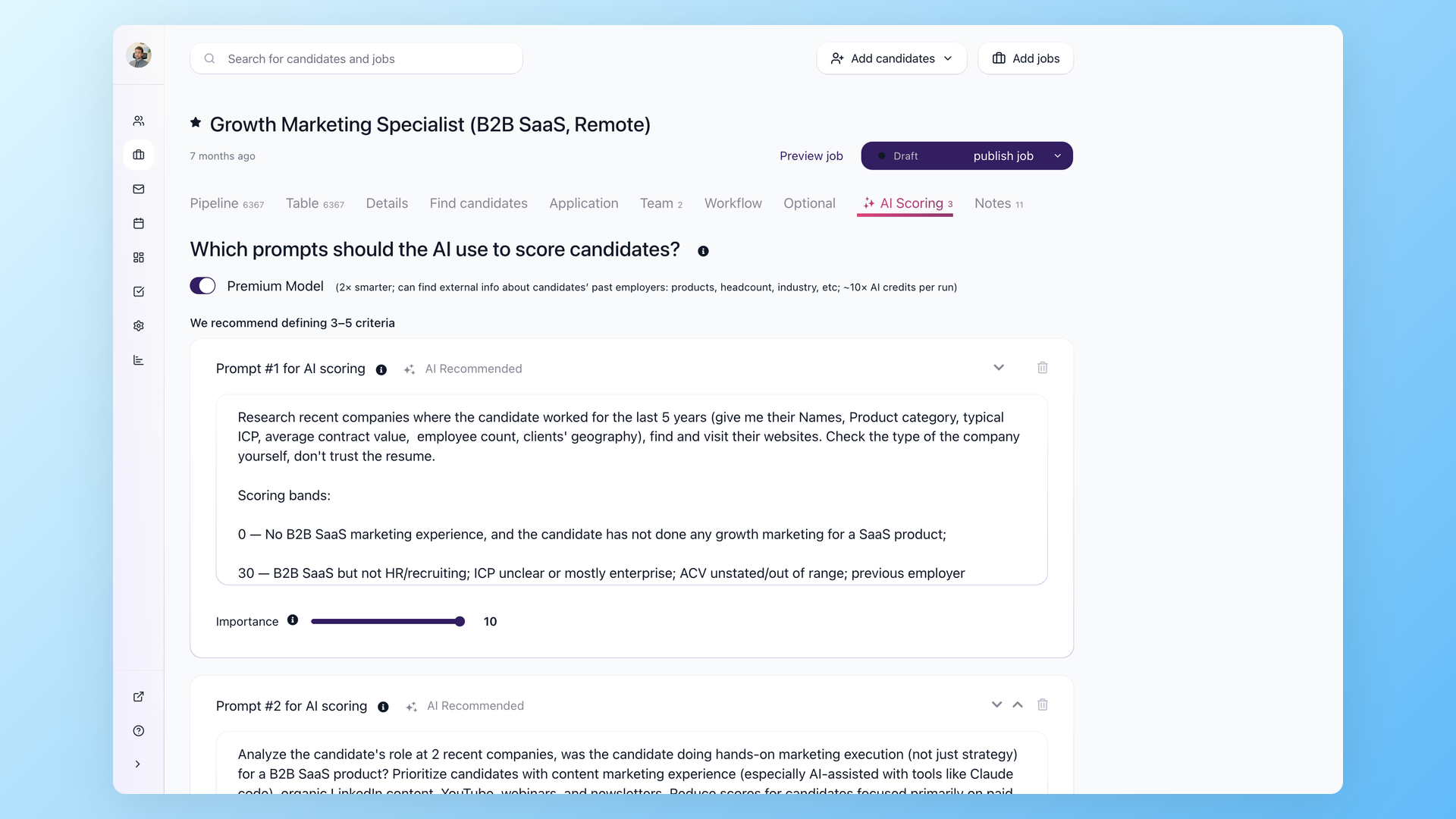
Screening automation earns its keep at volume, and it works in two layers. Knockout questions are the first: you write a dealbreaker question, and candidates who fail it are disqualified automatically with a polite email.
You authored the rule, so the rejection logic is yours, not an algorithm's guess.
The second layer is scoring. 100Hires AI Score reads each application against criteria you write and weight, then returns a 0 to 100 number you can sort by. You can add threshold rules, such as moving candidates above 80 forward.
US EEOC guidance on AI in hiring expects human oversight of hiring decisions, and recruiters on YouTube keep debunking the myth that some hidden ATS robot rejects resumes on its own. Configured rules plus human review is the defensible setup.
Interview scheduling
Back-and-forth scheduling emails are the classic pipeline killer. An RMS syncs recruiter calendars and lets candidates book themselves.
100Hires connects Google Calendar and Outlook Calendar, generates self-scheduling links per interviewer, supports panel interviews, and attaches Zoom links to video interviews automatically.
Candidate communication
Communication belongs inside the candidate record, not in a personal inbox. 100Hires syncs two-way with Gmail and Outlook, so messages send from your own domain and replies thread back to the profile.
Templates, multi-step nurture campaigns, and SMS through the Twilio integration cover the follow-ups nobody remembers to send manually.
Reporting
Management means knowing where hires come from and where they stall. 100Hires reports cover source breakdown, time to hire, time to disqualify, disqualification reasons, current pipeline breakdown, email stats, and nurture campaign stats.
That is the difference between renewing a job board contract on data versus on habit.
Career site and integrations
An RMS should also host a branded careers page and plug into your stack instead of replacing it.
100Hires ships a customizable career site, embeds job listings into any website via iframe, and integrates with Google Workspace, Outlook, Slack, Twilio, Zapier, Zoom, Typeform, Gusto, and WordPress.
For sourcing-heavy teams there are seven contact enrichment providers (Apollo, Signalhire, Swordfish, Peopledatalabs, Nymeria, Kendo, Dropcontact), ZeroBounce email validation, and a full REST API for custom workflows.
Who needs an RMS (and who does not)
Recruiters put the spreadsheet-to-software tipping point at around 15 to 20 active roles, or the moment you lose track of who is at what stage. Below that, a form and a spreadsheet genuinely work.
One story that comes up often: a team plans five hires, makes seventeen, and the spreadsheet stops working.
Small teams should weight ease of use over feature depth. The recurring advice from recruiters who review these tools: you may not need the luxury-trim feature set, and unused features are just line items you pay for.
Mid-market teams hit the opposite wall: volume. That is where automation depth, structured scorecards, and reporting maturity start paying for themselves, and where enterprise-grade platforms like Greenhouse earn their premium.
Agencies are a separate category. They need candidate tracking and client relationship management in one product, which is exactly the ATS plus CRM combo territory of Recruit CRM, Recruiterflow, and Bullhorn.
One more honest option: if you already pay for an HR suite like Paycom, Paylocity, or ADP, its bundled ATS module may be good enough. Users describe those modules as convenient for onboarding handoff but behind dedicated tools on recruiting features.
Try the module before buying anything.
Best recruitment management software compared (2026)
Full disclosure before the table: I run 100Hires, so treat its row as the maker's claim, backed by third-party proof.
Forbes Advisor named 100Hires the best applicant tracking pick for startups and small businesses, and it holds a 4.8 on G2 across 1,341 reviews and a 4.9 on Capterra across 1,157.
Prices below were pulled from each vendor's own pricing page or pricing API in July 2026, annual billing where both exist. Per-seat costs compound as your team grows; flat plans do not.
| Tool | Best for | Starting price (annual billing) | Pricing model | Free trial |
|---|---|---|---|---|
| 100Hires | SMB teams that want ATS + CRM in one | $49/mo | Flat, by company size | 14 days, no card |
| Zoho Recruit | Budget teams already on Zoho | $25/recruiter/mo | Per recruiter seat | 15 days |
| Workable | All-in-one HR for growing teams | $299/mo | Company plan + paid add-ons | 15 days |
| JazzHR | Entry-level applicant tracking | $1,000/yr | Job-slot tiers, annual only | Not listed |
| Manatal | Solo recruiters, small agencies | $15/user/mo | Per user + gated add-ons | 14 days |
| Recruit CRM | Agencies needing client CRM | $95/user/mo | Per user + add-on menu | Yes, length not listed |
| Bullhorn | Staffing firms with temp desks | $99/user/mo | Per user, quote to buy | None listed |
| Greenhouse | Structured enterprise hiring | Quote only (reported $9,500-12,000/yr) | Custom quote | None |
100Hires covers posting, pipelines, scoring, outreach, and scheduling natively. Unlike Zoho, Manatal, Recruit CRM, and Bullhorn, it does not charge per seat: the price is flat by company size. Workable also skips per-seat pricing but starts at $299/mo.
The honest caveat: the Start plan caps at 3 jobs, 100 candidates, and 1 user, so actively hiring teams need Advanced.
Zoho Recruit divides recruiters. Fans call it deeply customizable and unbeatable inside the Zoho ecosystem; critics describe a clunky setup, sync bugs, and a product that tries to do everything. AI matching and recruitment automation sit on the Enterprise tier, not the $25 one.
Workable is a polished all-rounder with strong job-board reach. Texting, video interviews, and assessments are paid add-ons on the standard plan, so the sticker price is rarely the real price.
JazzHR wins on entry cost, and recruiters describe it accordingly: it houses candidates and not much more. Public pricing is annual-only, and automation features live on the higher tiers.
Manatal is the default budget pick, and the base tier genuinely delivers. The pattern users report: cheap base, expensive add-ons, with workflow automation and API access gated to enterprise tiers. Its Gmail integration has also tested reviewers' patience.
Recruit CRM is a strong agency pick with real ATS plus CRM depth. Budget for the add-on menu: workflow automation, multiposting, enrichment, and analytics bill separately below the Enterprise plan.
Bullhorn remains the staffing-industry standard for temp desks and back office needs. Long-time users call it reliable but dated, and buying still means talking to sales even though starter prices are public.
Greenhouse earns its reputation for structured, consistent hiring at scale. Small teams routinely call it the tool they wanted and could not justify: pricing is quote-only, and reported contracts run well into five figures per year.
How much does recruitment management software cost in 2026?
Verified starting prices in this category run from $15 per user per month (Manatal) to $99 per user per month (Bullhorn), with flat company plans from $49 to $299 per month.
Enterprise platforms sell by custom quote, with Greenhouse contracts reported at $9,500 to $12,000 per year and Lever at $7,000 and up. Treat any lower figure you see quoted for those two as an outlier.
The pricing model matters more than the sticker. Per-seat pricing compounds: five users on a $95 seat cost more than most flat plans. 100Hires prices by company size instead, which keeps the cost flat as the hiring team grows.
Watch four hidden-cost patterns. Add-on gating: Manatal and Recruit CRM sell automation, enrichment, and analytics as separate line items. Tier gating: Zoho locks AI matching behind Enterprise; JazzHR locks task automation behind Plus.
Annual-only disclosure: JazzHR publishes no monthly digits. And billing-cycle effects: on 100Hires, annual billing halves the Start plan to $49/mo and also raises monthly AI credit allowances on higher tiers.
Full plan-by-plan details are on the 100Hires pricing page.
How to choose a recruitment management system
Start from your biggest hiring pain, not the longest feature list. Drowning in applicants points to screening automation. Losing candidates to slow scheduling points to self-booking. No idea which source works points to reporting.
Then shortlist by segment: flat-priced all-in-one tools for SMB in-house teams, per-seat agency suites for client work, quote-priced platforms for enterprise structure. The comparison table above maps to those three lanes.
Verify three integration dealbreakers on a trial, not a demo. Email and calendar: two-way Gmail or Outlook sync, sending from your own domain.
LinkedIn: most tools only import partial profile data through the official API, and deeper sync requires partner-tier access many vendors lack. Job boards: count the boards you actually use, not the marketing number.
Check implementation and support before you sign. Migration help is a plan differentiator, not a given: JazzHR includes it on select plans, Recruiterflow charges for white-glove migration, and 100Hires includes free data migration on the annual Pro plan.
Ask what onboarding costs and how support responds once you are a customer, not a prospect.
Finally, run one real requisition through the trial end to end: post it, screen real applicants, schedule one interview, send one rejection. Two hours of real use beats ten demos.
Frequently Asked Questions
What is a recruitment management system?
A recruitment management system (RMS, also spelled recruiting management system) is software that runs the full hiring process: posting jobs to multiple boards, collecting and screening applicants, scheduling interviews, managing candidate communication, and reporting on the pipeline.
Tools like 100Hires combine these functions so teams stop juggling spreadsheets, inboxes, and separate point tools.
Is a recruitment management system different from an ATS?
Mostly in scope, not in kind. An ATS tracks applicants after they apply; a recruitment management system also covers sourcing, job distribution, outreach, scheduling, and analytics around that pipeline. Vendors use the labels loosely, so compare feature lists.
Modern platforms like 100Hires are ATSes that grew into full recruitment management systems.
What is an ATS vs CRM?
An ATS manages candidates applying to your jobs. A recruiting CRM manages relationships: client companies for agencies, or passive talent pools you nurture before a role opens. Agencies usually need both, which is why combined platforms exist.
100Hires includes candidate nurture campaigns and talent pools alongside applicant tracking, covering both sides for SMB teams.
What are the top 5 recruitment management systems?
It depends on segment. For SMB in-house teams: 100Hires (disclosure: our product) and Workable. For budget-first buyers: Manatal and Zoho Recruit. For agencies: Recruit CRM or Bullhorn. For enterprise structure: Greenhouse.
The comparison table in this guide shows verified 2026 starting prices for all of them.
Is there free recruitment management software?
Free tiers exist but are capped hard: Zoho Recruit's free plan allows one active job, and Breezy HR's free plan one position. They work for a single occasional hire.
Teams hiring continuously outgrow them within months, which is why 14-day trials, like the one 100Hires offers without a credit card, are the more useful way to evaluate.
How much does recruitment management software cost?
Verified 2026 starting prices: $15 to $99 per user per month for per-seat tools, $49 to $299 per month for flat company plans, and custom quotes for enterprise platforms (Greenhouse reportedly $9,500 to $12,000 per year).
100Hires starts at $49/mo on annual billing, flat for the whole company.
Try 100Hires as your recruitment management system
The loudest complaint in recruiter communities is not about any single tool. It is tool fatigue: too many platforms to log into, each billing per seat. A recruitment management system exists to end that, and that is the job 100Hires was built for.
One flat price by company size, from $49/mo billed annually. One-toggle posting to 13 named job boards, recruiter-authored knockout screening with AI scoring, two-way email from your own domain, self-scheduling, and pipeline reporting, all on the same login.
Start your free 14-day 100Hires trial - no credit card required
Try 100Hires for free
No credit card. 14-day trial. Forbes Advisor #1 ATS for SMBs.