
JazzHR Competitors & Alternatives in 2026: Job Limits and Real Costs

JazzHR is one of the few applicant tracking systems that publishes a price, and that transparency is most of why people buy it.
It is also why the shortlist for alternatives is short: once you are used to seeing a number on a website, quote-only vendors feel like a step backwards.
Two things are worth knowing before you compare anything. JazzHR meters job postings, not candidates or users, so your ceiling is the number of roles you run at once.
And JazzHR is not an independent company: it sits inside Employ Inc. alongside Lever and Jobvite, which means two of the obvious alternatives share its owner.
What JazzHR costs
The hiring playbook, in your inbox
One email a week - benchmarks, AI screening tactics, and short interview templates from the 100Hires team. No product pitches.
Prices from JazzHR's own pricing page, checked on 25 July 2026. Annual billing saves up to 24 percent against monthly.
| Plan | Billed annually | The limit that matters |
|---|---|---|
| Hero | $1,000 per year | Starts at 3 job postings per month |
| Plus | $3,480 per year | Up to 200 active jobs |
| Pro | $5,508 per year | Adds offers and eSignatures |
Hero at roughly $83 a month is genuinely cheap for a real ATS. The jump to Plus is 3.5 times the price, and that jump is what sends people looking.
It is worth checking which limit you are actually hitting. If you need four concurrent roles rather than three, you are looking at a $2,480 annual increase to solve a one-job problem.
The job-limit arithmetic, worked
Most ATS pricing pages meter candidates, users or employees. JazzHR meters concurrent job postings, and that changes which company it suits.
Take three teams hiring the same twelve people a year.
- A software company filling roles sequentially. Two or three requisitions open at any moment, twelve hires over the year. Hero at $1,000 covers this comfortably. Cost per hire in software terms: about $83.
- A multi-site services business. Same twelve hires, but every location advertises its own role, so eight postings run at once. Hero cannot do it. Plus at $3,480 is the only route, and the price per hire triples to $290 for identical output.
- A company running evergreen requisitions. Drivers, care workers, sales development. The same four adverts stay live all year. Four concurrent postings again breaks Hero, for hiring volume that is otherwise modest.
Two of those three teams pay 3.5 times more than the first for no additional capability, purely because of how their hiring is shaped. That is the single most useful thing to understand before shopping.
Four checks before you upgrade or switch
- Count your true concurrent maximum, not your average. Pull the last twelve months and find the peak week. Plans are broken by peaks, not averages.
- Ask whether a closed job frees a slot immediately. Vendors differ on whether archived, paused and draft roles count against the limit. This detail decides whether you can manage within a lower tier.
- Separate the features you want from the limit you hit. If you are moving to Plus for offers and eSignatures, that is a feature purchase. If you are moving for slot count, it is a tax, and it is the case where shopping pays.
- Check who counts as a user. JazzHR does not meter users the way seat-priced vendors do, which is a genuine advantage over the products people usually compare it against. Do not give that up without noticing.
What the review base flags, beyond price
Three limitations come up consistently in recruiter research and matter more than the headline rating, because each one maps to a specific tier decision.
- No custom report builder on the lower plans. Reporting is the most common reason teams outgrow JazzHR, and it is a plan gate rather than a missing capability.
- Duplicate candidate detection misses variations. A candidate applying twice with slightly different details can create two records, which quietly corrupts pipeline reporting.
- A smaller integration ecosystem than the mid-market systems. Fine if you run a simple stack, limiting if your background checks, HRIS and assessments all need to connect.
There is one more gate worth checking against your plans: configurable task automation and AI matching sit on Plus and above. If automation is part of why you are shopping, Hero does not include it, which changes the arithmetic in the section below.
The blunt version of the trade-off, from recruiters who have run it: JazzHR wins clearly on sticker price, and you pay some of that back in recruiter hours spent on manual workarounds per role.
What users say
The consensus is unusually consistent: good value, some gaps, occasional reliability complaints.
From an HR director comparing JazzHR against Greenhouse in r/humanresources:
Their assessment: JazzHR delivers well for what it costs, lacks a handful of features that pricier systems have, and came in at roughly a quarter of the price of the next most expensive option they evaluated.
The most useful caveat came from an r/recruiting thread weighing ADP, JazzHR and Greenhouse:
Their framing of the trade-off: JazzHR is cheap and quick to start with, at the cost of time spent on workarounds, while Greenhouse offers stronger automation in exchange for real upfront investment.
Review aggregates line up: 4.4 on G2 across roughly 860 reviews and 4.3 on Capterra across about 490. The recurring negative in Capterra's own summary is downtime, phrased as frequent maintenance downtime.
The ownership question
JazzHR joined Employ Inc. alongside Lever, Jobvite and NXTThing RPO. Employ markets the three applicant tracking systems as a ladder: JazzHR for foundational hiring, Lever for scalable hiring, Jobvite for the enterprise.
For a buyer this cuts two ways. Upgrading within the family should be smoother than a true migration, and the vendor has an obvious commercial interest in moving you up that ladder.
It also means that if you are shopping JazzHR against Lever, you are comparing two products with one roadmap owner.
Alternatives, grouped by which limit you hit
If you hit the job limit: 100Hires
Unlimited jobs from the Advanced plan at $199 per month billed annually, with unlimited candidates and users too. Start is $49 per month for up to 100 candidates a month. Details and honest limits below.
If you want a free tier first: Breezy HR
The only credible free plan in this bracket. Paid tiers are $157 per month for Startup, $273 for Growth and $439 for Business billed annually, so it is more expensive than JazzHR Hero once you pay, but the free entry lets you validate before committing.
If you want the widest job-board reach: Workable
$299 per month for Standard, $599 for Premier and $719 for Enterprise in the 1 to 20 employee band. Add-ons stack: texting $89, video interviews $109, assessments $59, performance $39, plus metered AI credits. Substantially more than JazzHR, and you are buying distribution.
If you are moving up in structure: Greenhouse
Quote-only, roughly $6,000 to $12,000 a year for companies under 100 people according to buyer reports. This is the real upfront investment the commenter above referred to. Worth it only if structured interviewing is genuinely how you hire.
If reporting is the gap: Ashby
Published entry at $400 per month with a 10 percent annual discount, and the strongest analytics in this group. Read the seat definition first, because hiring managers can count as billable seats.
If you are cheaper than Hero: Manatal
Professional at $15 per user per month billed annually, covering up to 15 jobs, with Enterprise at $35 for unlimited jobs. For a one-recruiter team this genuinely undercuts JazzHR. The consistent caveat from recruiters is that it strains as you grow.
Same family, one rung up: Lever
Quote-only, Vendr median $15,400 a year. Only sensible if you have outgrown JazzHR substantially, and remember it is the same parent company.
Side by side
| Option | Entry price | Job limit | Published price? |
|---|---|---|---|
| JazzHR | $1,000 a year | 3 postings a month on Hero | Yes |
| Manatal | $15 per user per month | 15 jobs on Professional | Yes |
| 100Hires | $49 per month | Unlimited from Advanced | Yes |
| Breezy HR | Free, then $157 per month | By tier | Yes |
| Workable | $299 per month | Unlimited, fair use | Yes |
| Ashby | $400 per month | Seat-based | Entry only |
| Greenhouse | About $6k to $12k a year | Employee-count based | No |
| Lever | Median $15.4k a year | Seat and size based | No |
What migrating actually costs you
A cheaper sticker price is not a saving until the move is done. Budget for four things that rarely appear in the business case.
- Candidate data. Ask for a full export in a documented format before you commit, and confirm whether attachments, notes and email history come with it or only the candidate records.
- Job board reconnection. Every integration and sponsored posting has to be re-established, and indexed job URLs change, which briefly costs you organic applicant flow.
- Templates and workflows. Rejection emails, screening questions and stage definitions are usually rebuilt by hand. Half a day per job family is a realistic estimate.
- Hiring-manager retraining. The people least invested in your ATS are the ones whose habits break, and they are the reason migrations quietly fail.
For a small team the honest total is one to two weeks of someone's attention. Against a $2,480 annual difference that is often not worth it, and against a $5,000 difference it usually is.
Our verdict
If Hero covers your volume, stay on it. At $1,000 a year there is very little in this market that beats it, and the value verdict from actual users is consistent. Do not migrate to save money you are not spending.
If you are being pushed from Hero to Plus by the job limit alone, price unlimited-job alternatives first. A $2,480 increase to unlock more concurrent roles is the moment to compare, because several products remove the limit entirely for less.
If your complaint is the "workarounds", accept that fixing it costs more. Every product recruiters describe as more capable than JazzHR is more expensive than JazzHR. The question is whether the workaround time is worth the delta.
If you are considering Lever, know you are staying in the family. That is not automatically bad, but negotiate it as an upgrade conversation with one vendor rather than as a competitive bid.
Where 100Hires fits, and where it does not
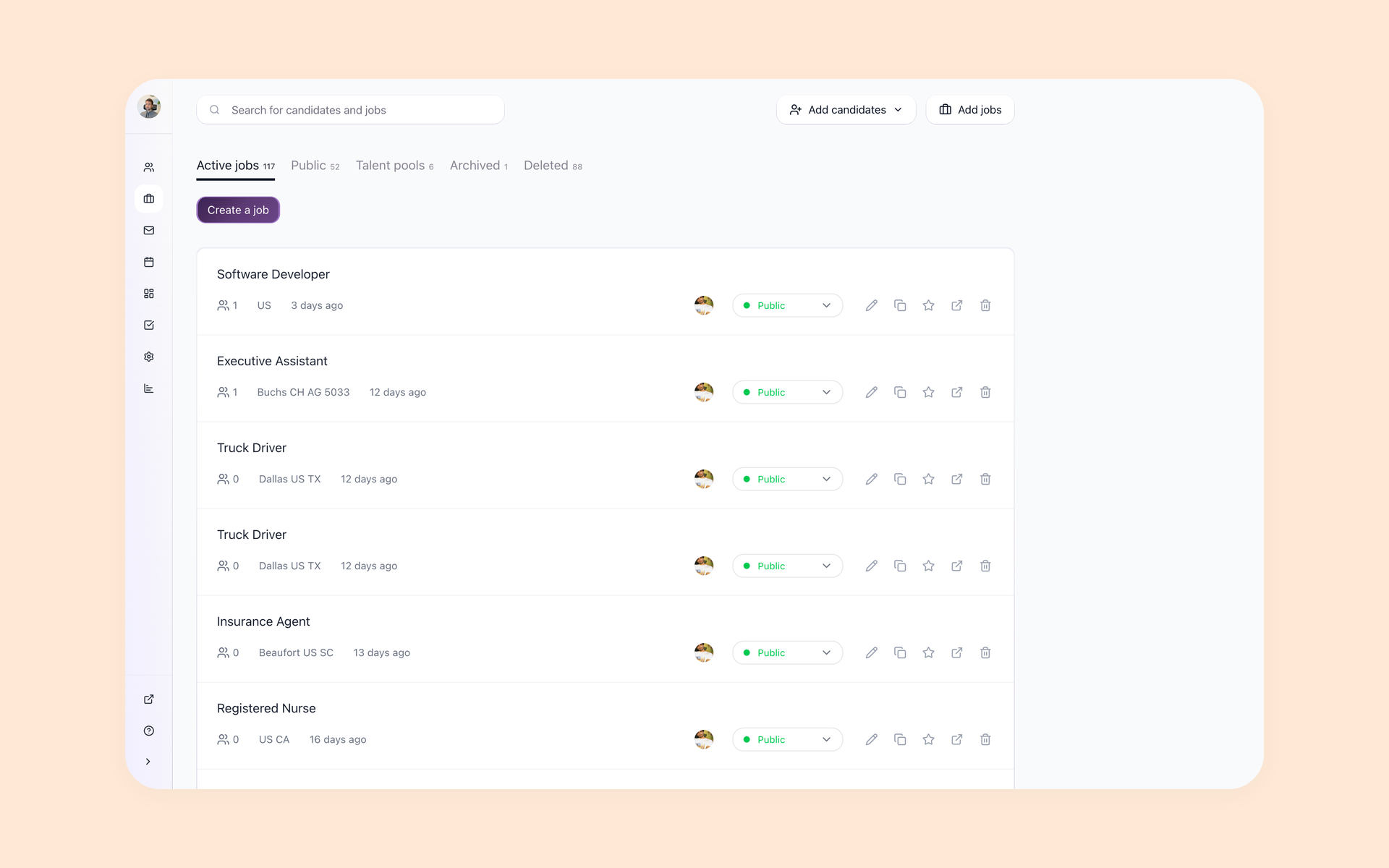
100Hires is an applicant tracking system for small and mid-sized in-house teams, with published pricing. Start is $49 per month billed annually ($99 monthly) for up to 100 candidates a month.
Advanced at $199 annually ($249 monthly) covers unlimited jobs, candidates and users, plus automated emails, a custom domain and knockout questions. Pro at $399 annually ($499 monthly) adds sourcing and contact enrichment.
Capterra rating is 4.9 from more than 1,100 reviews as of July 2026. The free trial can post to job boards.
100Hires is the wrong choice if:
- You hire three roles a year and JazzHR Hero already fits. $1,000 annually is less than our Advanced plan. We are not going to pretend otherwise.
- You want the absolute floor on price. Manatal at $15 per user per month and Breezy's free tier both undercut our $49 entry.
- You need offers and eSignatures natively. That is JazzHR's Pro tier feature. We integrate rather than provide document signing.
- You are an agency placing candidates with clients. You want an agency CRM: Loxo, Recruit CRM or Crelate.
- You need structured interview kits and scorecards. Greenhouse is built around that discipline and does it better.
Where we do fit is the specific squeeze this page is about: you have outgrown a job-posting limit but not the budget of a small company.
See 100Hires pricing or start a free trial.
If you are weighing the step up instead, our Greenhouse alternatives and Lever alternatives guides cover those with the same pricing detail.
Frequently asked questions
How much does JazzHR cost?
JazzHR publishes three annual plans: Hero at $1,000 a year, Plus at $3,480 and Pro at $5,508, all billed annually, with savings of up to 24 percent against monthly billing. Hero starts at three job postings a month and Plus allows up to 200 active jobs, so the practical limit is concurrent roles rather than candidates or users.
Who owns JazzHR?
Employ Inc, which also owns Lever, Jobvite and NXTThing RPO. Employ positions the three applicant tracking systems at different segments: JazzHR for foundational hiring, Lever for scalable hiring and Jobvite for enterprise. If you are comparing JazzHR against Lever, you are comparing two products under one owner.
Is JazzHR good value?
By the consistent account of its users, yes. One HR director summarised it as delivering well for the price, at roughly a quarter of the cost of the next most expensive option, while lacking a few features. Ratings are 4.4 on G2 across about 860 reviews and 4.3 on Capterra across about 490. The recurring complaint in review summaries is downtime during maintenance.
What is the cheapest alternative to JazzHR?
Breezy HR's free Bootstrap tier costs nothing for very low volume, and Manatal's Professional plan at $15 per user per month billed annually undercuts JazzHR Hero for a single recruiter. Note that Manatal's Professional tier caps at 15 jobs, so check the limit against your concurrent-role count before switching purely on price.
Should I upgrade to JazzHR Plus or switch?
Compare the reason for the upgrade. If you are moving from Hero to Plus purely to run more concurrent jobs, that is a $2,480 annual increase to lift a posting limit, and several alternatives remove the limit entirely for less. If you are upgrading for features such as offers and eSignatures, the comparison is a normal feature-for-price question and staying is often simpler.
Try 100Hires for free
No credit card. 14-day trial. Forbes Advisor #1 ATS for SMBs.