
Multiposting: post one job to 13 named boards and every city you hire from
Most ATS multiposting just blasts one job to a handful of boards. 100Hires clones your main job into every city you hire from. AI rewrites the title, description and salary for each market. Every applicant lands back in one pipeline, so you compare candidates across all cities in one place. Remote roles often see a multi-fold lift in qualified applicants, without you copy-pasting 50 versions of the same job.






screening candidates
response rates
time to fill
per hire
Multiposting is not just "post one job to many boards"
The simple definition of multiposting is publishing the same job ad to multiple job boards in one action - it is what most multiposting software is built to do, and that part is solved. If you only need to push a job to Indeed, LinkedIn, ZipRecruiter and Glassdoor at once, see our companion page on posting a job to multiple boards.
Multiposting is included on every paid 100Hires plan with no per-board fee. Sponsoring a job is paid to the board itself; see what that costs in our Indeed job posting cost guide.
The harder problem is multi-location multiposting: cloning one job into every city or country you are willing to hire from, and keeping every applicant in a single pipeline. That is what actually drives applicant volume on a remote role.
Posting a remote job once leaves most of your applicants on the table
If you list one remote role with a single location field, you only show up in that one city's search results. Indeed, LinkedIn and Google Jobs all rank by geographic relevance. A candidate in Lisbon searching "remote frontend engineer" sees Lisbon-tagged listings first, and your "Remote, San Francisco" post barely surfaces for them. Teams that start cloning their remote roles into multiple cities commonly see applicant counts grow several times over, because the same job suddenly appears in dozens of city-level searches instead of one.
The manual workaround is painful. A remote-first company hiring a senior engineer across 15 cities ends up with 15 near-identical job posts. Each one needs its own title adapted to the local market, salary converted to local currency, and the location field rewritten for that city. That is hours of copy-paste per role.
Standalone multiposting tools exist, but they live outside your ATS. You end up logging into yet another dashboard, and applicants from those boards do not flow back into the same pipeline where you screen and score everyone else.

Satellite Jobs: clone one main job into every city you hire from
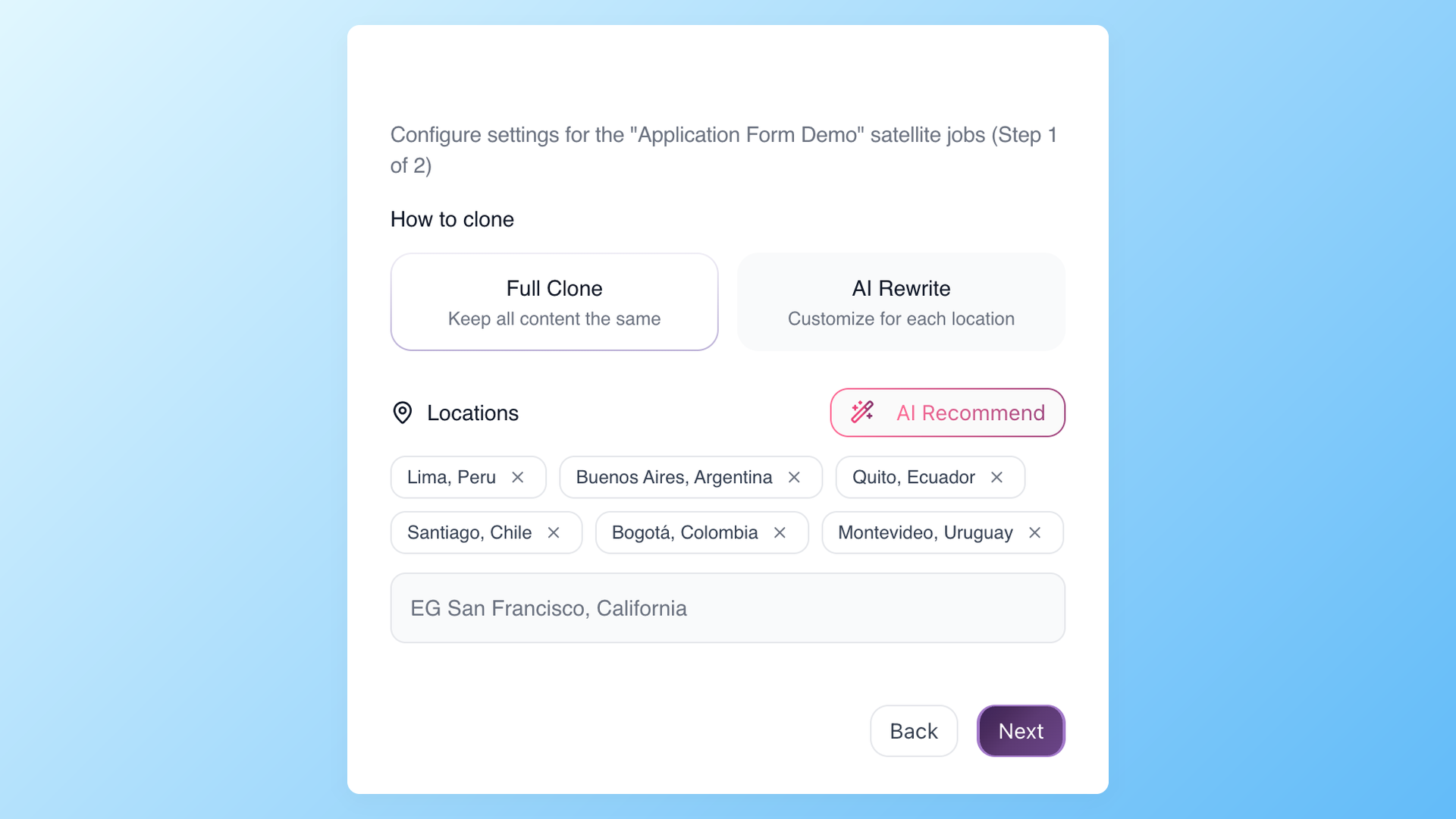
On the Jobs page, click Clone on any role and pick Create and Publish Satellite Jobs. Add cities manually, or hit AI Recommend to surface markets you had not considered. 100Hires creates one satellite job per location. Each satellite is a real listing on the integrated boards, but every applicant routes back to the main job. Your AI scoring criteria, automations, evaluation forms and pipeline stages live on the main job and apply to every candidate from every city.
- AI Recommend Locations surfaces cities you had not thought of
- AI rewrites title and description for each local market, not just a city name swap
- AI suggests a market-appropriate salary range with currency conversion per market
- All satellite applicants funnel back to one main job - one pipeline, one set of automations
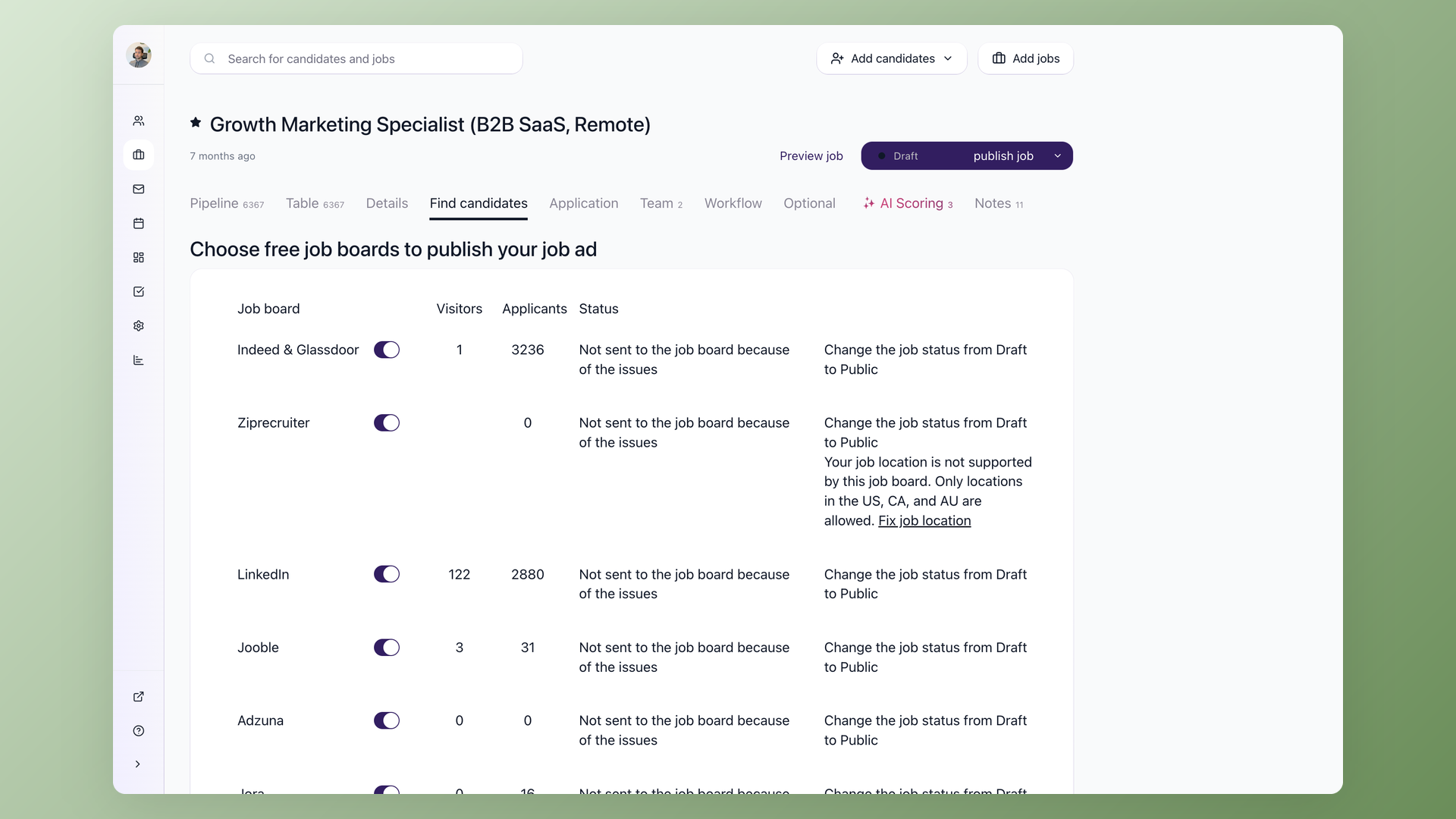
Every satellite job posts to 13 named boards under the hood
For every city you clone the role into, the job goes out to Indeed, LinkedIn, ZipRecruiter, Glassdoor and 9 more boards in that city's local results. No per-board surcharge, no separate multiposting subscription, no premium tier gating the integrations.
- Indeed, LinkedIn, ZipRecruiter, Glassdoor, Jooble, Adzuna, Jora, Trovit, Monster, CareerJet, Google Jobs, Talent.com, Jobisjob
- Bundled in every paid plan - no per-board fees
- Each satellite city gets its own board distribution in the local market, not only the headquarters city
Stagger publishing so 50 cities do not flood your inbox at 9am Monday
If you publish 15 satellite jobs at once, every integrated board pushes them simultaneously and you wake up to 800 applications in a single morning. Satellite Jobs let you set a gap between each city going live. The default is 12 hours, and you can configure it from instant to multi-day. Each satellite picks its own publish time in that city's local timezone, so candidates arrive spread across days and your team can actually screen them.
Refresh expiring posts without losing applicant history
Job boards de-prioritize listings older than 30 days. The standard fix is to close the old job and create a new one, but that splits your applicant history across two separate records. The Rotate Existing Satellite Jobs option closes satellites older than one month and creates fresh clones in the same cities. Every applicant from the old satellites already lives on the main job, so reporting, scoring and pipeline stay intact. You just get fresh listings on the boards.
How 100Hires Satellite Jobs compares to a typical ATS
Most ATS products ship some kind of multiposting. Few of them ship multi-location cloning, and almost none ship per-location AI rewrites. The comparison below is against a generic ATS baseline rather than any specific named product.
 100Hires
| Job board | Reach | Typical strength |
|---|---|---|
| Indeed | Global | Highest absolute volume for SMB roles; strong on operational, hospitality, healthcare |
| Global | Tech, sales, executive, knowledge-worker roles; passive-candidate sourcing | |
| ZipRecruiter | US, UK, CA | High-volume hourly + driver hiring; strong mobile applicant flow |
| Glassdoor | Global, US-heavy | Employer-brand-conscious candidates; reviews + jobs in one search |
| Monster | Global | Mid-career office and operations; sticky among 35+ candidates |
| Google for Jobs | Global | Generic job-search queries; aggregates from your career page automatically |
| Talent.com | Global | Aggregator with strong organic SEO presence in EU + LATAM |
| Jooble | 120+ countries | Strong in EE, CIS, EU; covers markets where Indeed is weaker |
| Adzuna | UK, AU, CA, US | Strong UK and Commonwealth coverage; ONS partner |
| Jora | AU, NZ, IN, UK | Apac and Commonwealth aggregator; high volume in AU/NZ |
| Trovit | EU, LATAM | Classified-style aggregator; strong in Spain, Italy, LATAM |
| CareerJet | 90+ countries | Long-tail global aggregator; useful for non-US hiring |
| Jobisjob | EU-wide | EU aggregator with deep regional taxonomy |
Where Satellite Jobs is not the right fit: if your role is genuinely city-bound (a single Chicago retail manager opening), you do not need to clone it into 20 cities. One listing on 13 named boards is enough. The AI per-location rewrite also needs a complete original job description to work from. It adapts existing copy for each market, it does not generate a job from a title alone. See pricing for plan details, or read the step-by-step Satellite Jobs setup guide in the help center.

It solved all of my recruitment problems and offered all of the features I was looking for. It can automate most of my recruitment processes.

I’d happily recommend it to my industry peers. I’m able to use the platform with ease and don’t have to think twice about which function to use.

The system is very user-friendly. Even people with no experience will find it easy to understand its functionality.
How Gainey Financial Group dropped job-post time from 2 hours to 2 minutes
Before 100Hires, Jerri Reiff at Gainey Financial Group was posting every role manually - up to 2 hours per job. Now one publish action distributes a single post across 13 named boards in 2 minutes, saving 10 hours every week.







The hiring playbook, in your inbox
One email a week - benchmarks, AI screening tactics, and short interview templates from the 100Hires team. No product pitches.