GDPR-Compliant Applicant Tracking System
Track candidate consent, set how long you keep data, remove candidate records, and export it in a few clicks, with EU customer data hosted in Germany.
What a GDPR-compliant applicant tracking system should let you control
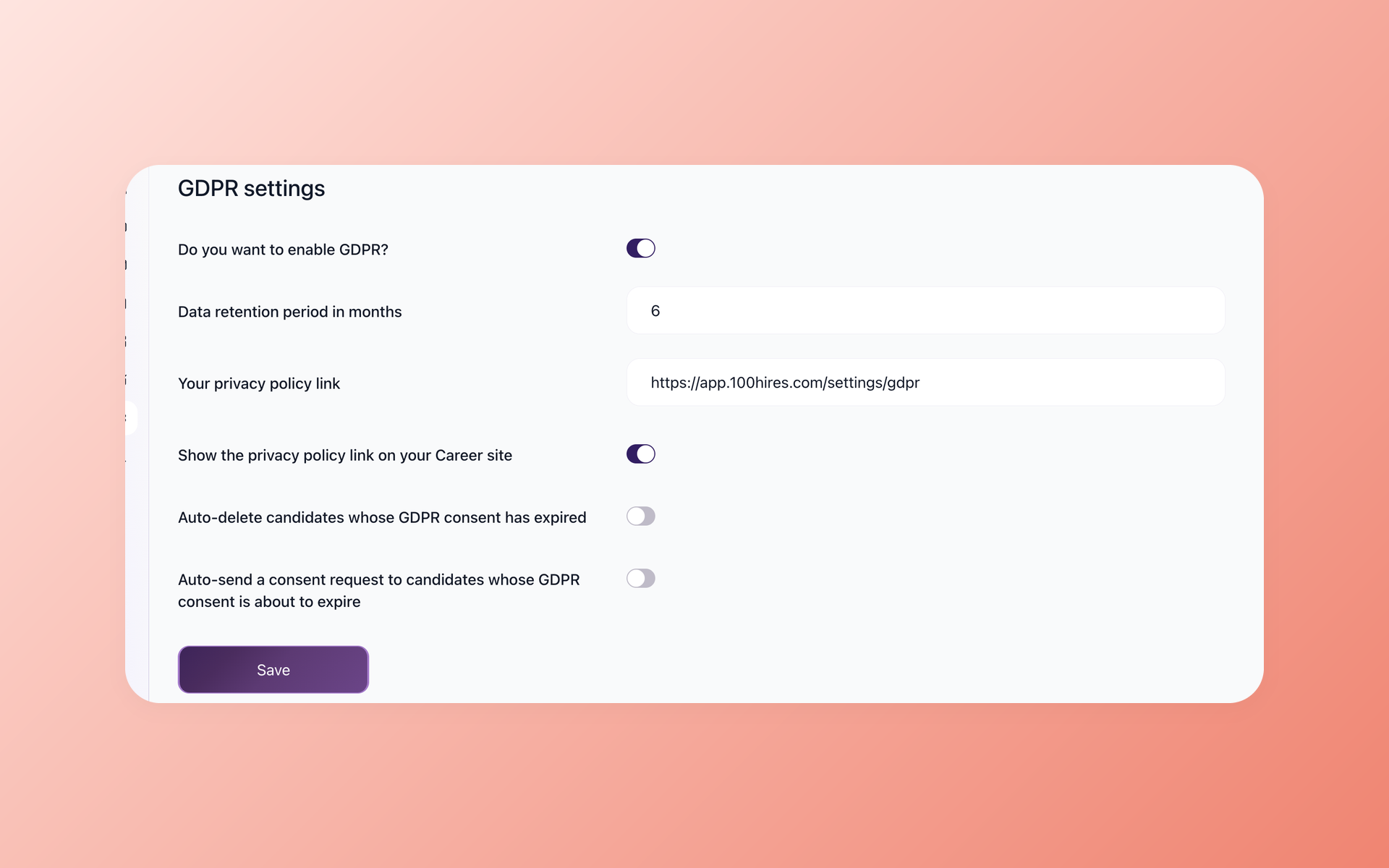
An applicant tracking system cannot make you GDPR compliant on its own. What GDPR-compliant recruitment software should do is give you the controls to track consent, set retention periods, run deletion workflows, show a privacy notice, and export candidate data.
100Hires is a GDPR-compliant data processor under Article 28, and you remain the data controller. That split matters: you decide the lawful basis, the privacy notice, and the outreach rules for candidates.
Consent is not always the right basis in recruitment, since applying for a job is not the same as consent. 100Hires records the consent you collect and applies the retention, deletion, and export workflows you configure, so the controls match the decisions you have already made.






Stop scrambling when a candidate asks you to delete their data
The most common source of GDPR exposure in recruiting is not a misconfigured system. It is the email inbox. A candidate sends their CV directly, and it sits in Outlook. Their details get forwarded to a hiring manager.
Notes from the call go into a spreadsheet. Months later they send a deletion request, and you do not know where everything is.
Right-to-be-forgotten and access requests are also arriving more deliberately. Candidates who feel ignored or treated unfairly now send data subject access requests as a form of accountability.
Erasure requests that used to be rare now arrive monthly for many EU and UK hiring teams.
Recruiters are unsure how long they can hold a CV, what a privacy notice has to say, and what to do when a candidate emails asking for everything on file.
Then procurement gets involved, asking where data is hosted, whether you sign a DPA, and what happens to the candidates you reject and the resume database you build over time.
When the answers live in scattered spreadsheets and inboxes, every one of those questions becomes a fire drill. GDPR-compliant recruitment software keeps the candidate-data controls and records in one hiring system.
Keep GDPR work inside the hiring workflow
Know who consented, and when
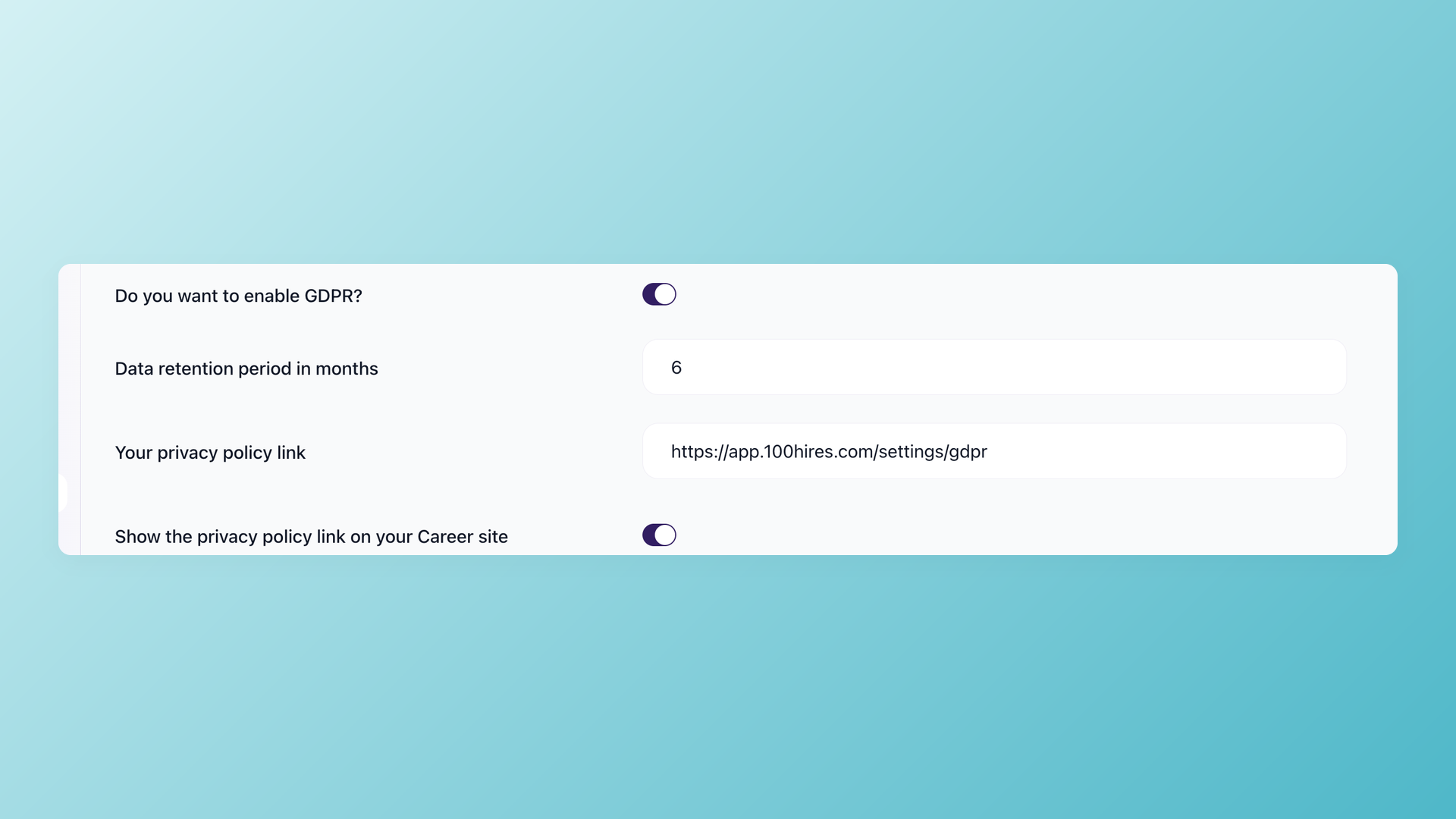
100Hires captures candidate consent and keeps the status on every profile, so the consent status is always clear. Send a consent request in one click, and the candidate gets a page that names your company, your retention period, and a link to your privacy policy. Every consent change is kept in the audit trail.
- Request consent in one click
- Send retroactive consent to email applicants
- Consent status on every candidate profile
- Audit trail of consent changes
Hold candidate data on a clock, then clear it on request
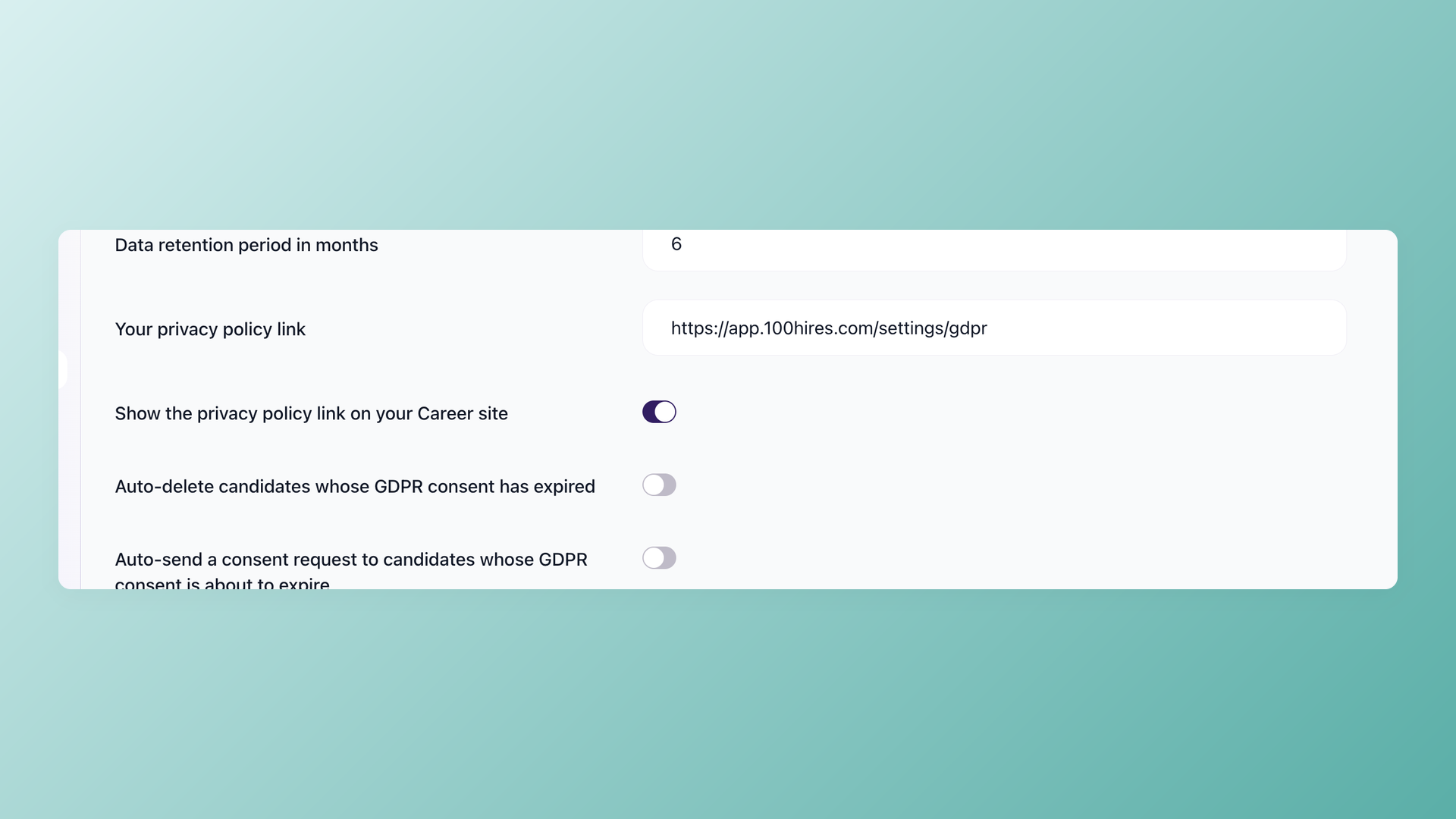
Set a data retention period from 1 to 60 months. When it runs out, 100Hires can auto-delete the candidate or auto-send a renewal request first. When a candidate asks to be removed, the Remove candidate profile action deletes all of their data from the record, and you can export candidate data to CSV for an access request.
- Data retention from 1 to 60 months
- Interview notes follow the same retention clock
- Auto-delete when consent expires
- Remove candidate profile for erasure
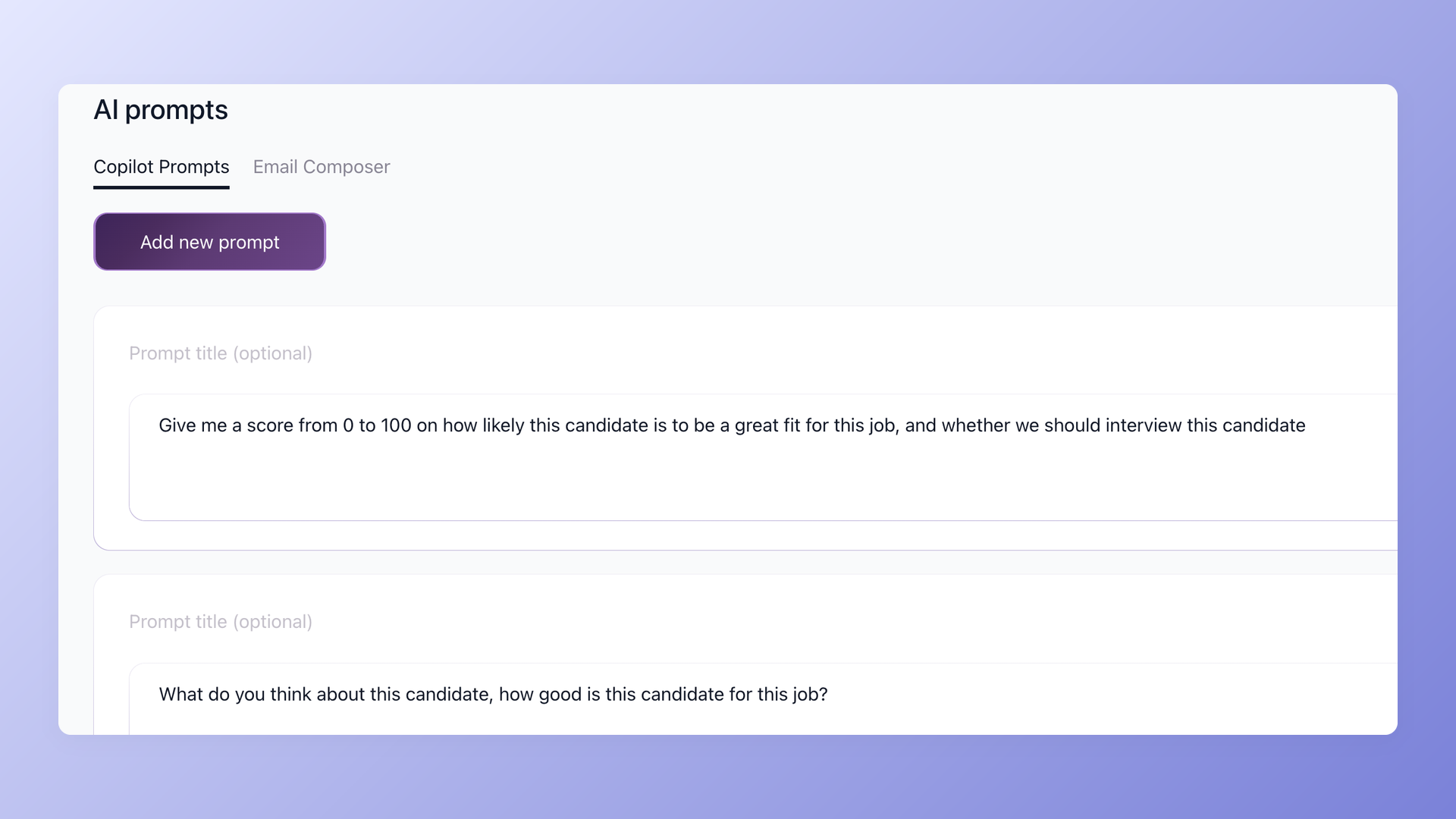
Use AI without training models on your candidate data
100Hires does not use your candidate data to train its AI, and its AI sub-processors run under paid terms that prohibit training on your data. AI Score, AI Copilot, and the AI Email Composer can be switched off at the account level. Review your own automated rules too, such as knockout questions that can auto-disqualify candidates, since a decision made with no human in the loop can carry extra obligations under GDPR.
- No training on your candidate data
- AI features can be disabled at the account level
- AI supports human decisions
- Review rules that auto-disqualify candidates
What your security and procurement team will ask for
Security reviews ask the same questions every time. Here is how 100Hires answers them in one place, with the hosting, encryption, and DPA details your procurement team will want on file. For the full program, see the 100Hires security overview.
| What they ask | How 100Hires answers |
|---|---|
| Data residency | EU customer data is hosted in Germany on Hetzner. Data for the US, Canada, and the rest of the world is hosted on AWS in the US. |
| Encryption | TLS 1.2 or higher in transit, and AES-256 at rest. |
| DPA and SCCs | A GDPR-compliant DPA including Standard Contractual Clauses is available on request at [email protected]. |
| Sub-processors | A published list of sub-processors. Each sub-processor has a DPA with 100Hires. |
| Breach notification | 100Hires notifies you without undue delay, within 72 hours of confirming a breach, to support your Article 33 response. |
| Data ownership and AI | You own your candidate data. 100Hires never sells it and does not use it to train its AI. |
| Hosting and audits | ISO 27001-certified data centers (AWS, Hetzner). SOC 2 Type II attestation is in progress, with controls already mapped to the SOC 2 criteria. |
How to choose the best ATS for GDPR compliance
Skip the vendor badges and look at the controls. The best ATS for GDPR compliance is the one that covers the specific obligations recruiting teams actually face, without an enterprise implementation project to switch them on.
- Consent tracking - request consent in one click, see the status on every candidate profile, and keep an audit trail of changes
- Retention with auto-delete - set how long you keep candidate data and let expired records clear themselves
- Erasure and export - handle right-to-be-forgotten and access requests in a few clicks, not a week of inbox archaeology
- Data residency and a DPA - know where candidate data lives (EU customer data in 100Hires is hosted in Germany) and get the DPA with SCCs procurement will ask for, available on request
- AI without training on your data - candidate data is not used to train AI, and AI features can be disabled at the account level, with AI built to support human decisions
Run any hiring system on your shortlist through this checklist, including 100Hires: the controls and procurement answers above are documented on this page.
If you also hire in US healthcare, the same evaluation logic applies to HIPAA, and the HIPAA-ready ATS page walks through it.
100Hires vs a typical ATS on GDPR
Here is how 100Hires lines up against a typical ATS on the GDPR features hiring teams actually use, with pricing you can check up front.
 100Hires

It solved all of my recruitment problems and offered all of the features I was looking for. It can automate most of my recruitment processes.

I’d happily recommend it to my industry peers. I’m able to use the platform with ease and don’t have to think twice about which function to use.

The system is very user-friendly. Even people with no experience will find it easy to understand its functionality.





 4.7
4.7
 4.8
4.8
screening candidates
response rates
time to fill
per hire
The hiring playbook, in your inbox
One email a week - benchmarks, AI screening tactics, and short interview templates from the 100Hires team. No product pitches.