
ATS for Startups
Track every applicant, post to job boards, and let AI rank the stack - all from one place your whole team can use from the first hire.
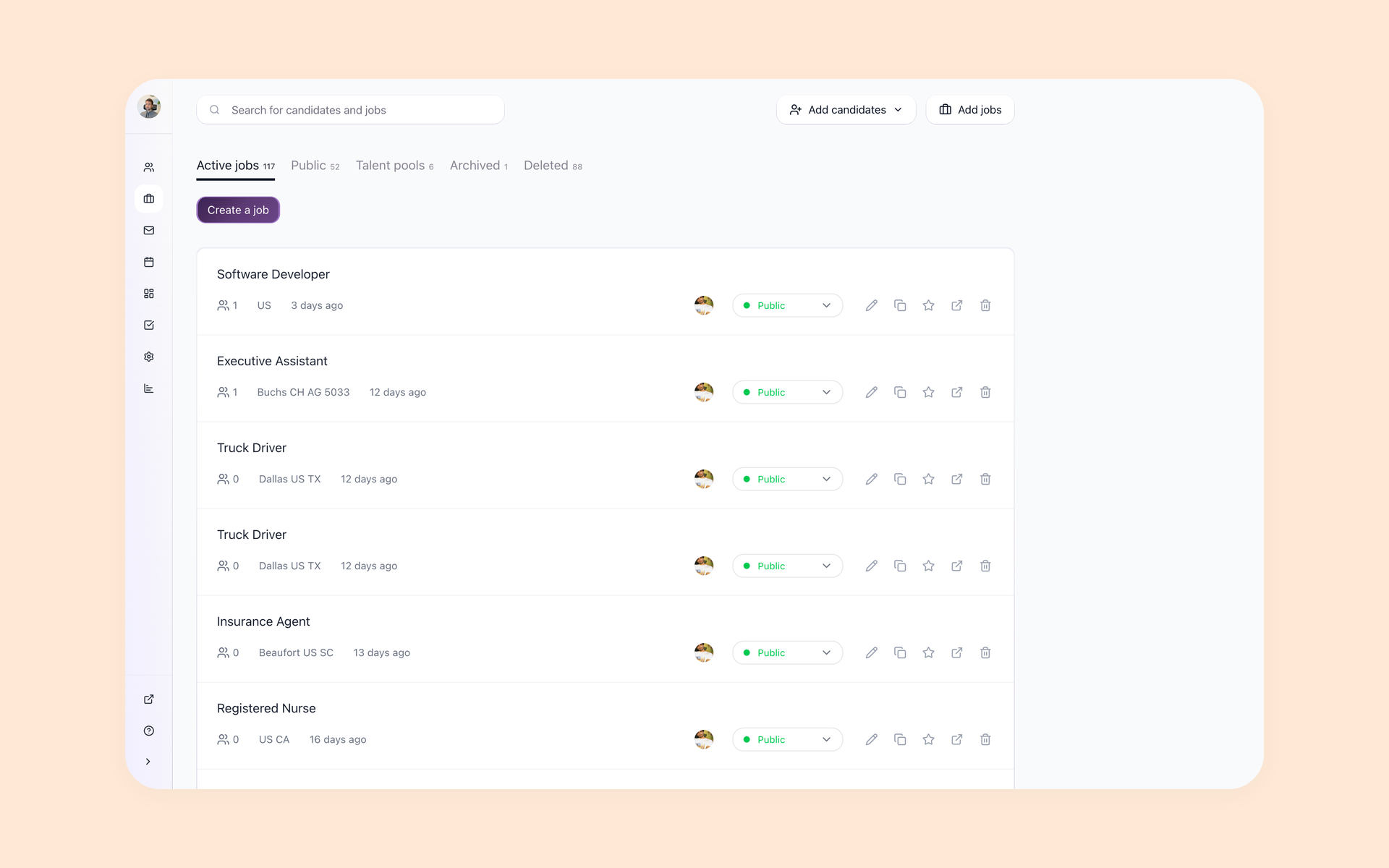






At 170 applications in a spreadsheet, you stop tracking who came from where. LinkedIn, email, referrals, and job boards all land in different tabs - some candidates wait too long for a reply while the spreadsheet keeps growing.
100Hires puts every applicant in one pipeline the moment they apply, with the source already tagged - so the whole team sees the same view, not six separate inboxes.
There is no implementation project to schedule - this is an ATS for startups, not an enterprise rollout. The trial is free for 14 days, no credit card. Teams that need onboarding support can move up to Pro, and enterprise SSO lives on the Enterprise plan.
Set up your first hiring pipeline without an implementation project
1. Post your job
Write the job description in 100Hires or draft it with AI Copilot. Activate the job boards you want with one toggle. Your branded career page goes live with your first job - no dev work needed.
2. Review and score applicants
Set scoring criteria once. 100Hires ranks every incoming applicant against your requirements before you open the first resume. Knockout questions filter out mismatches right at the application stage.
3. Interview and decide as a team
Send a self-scheduling link. Teammates add evaluation scores. Every note, email, and rating lives on one candidate page - so the debrief is a scroll through one page, not an afternoon of chasing feedback.
Stop losing candidates between tabs and inboxes
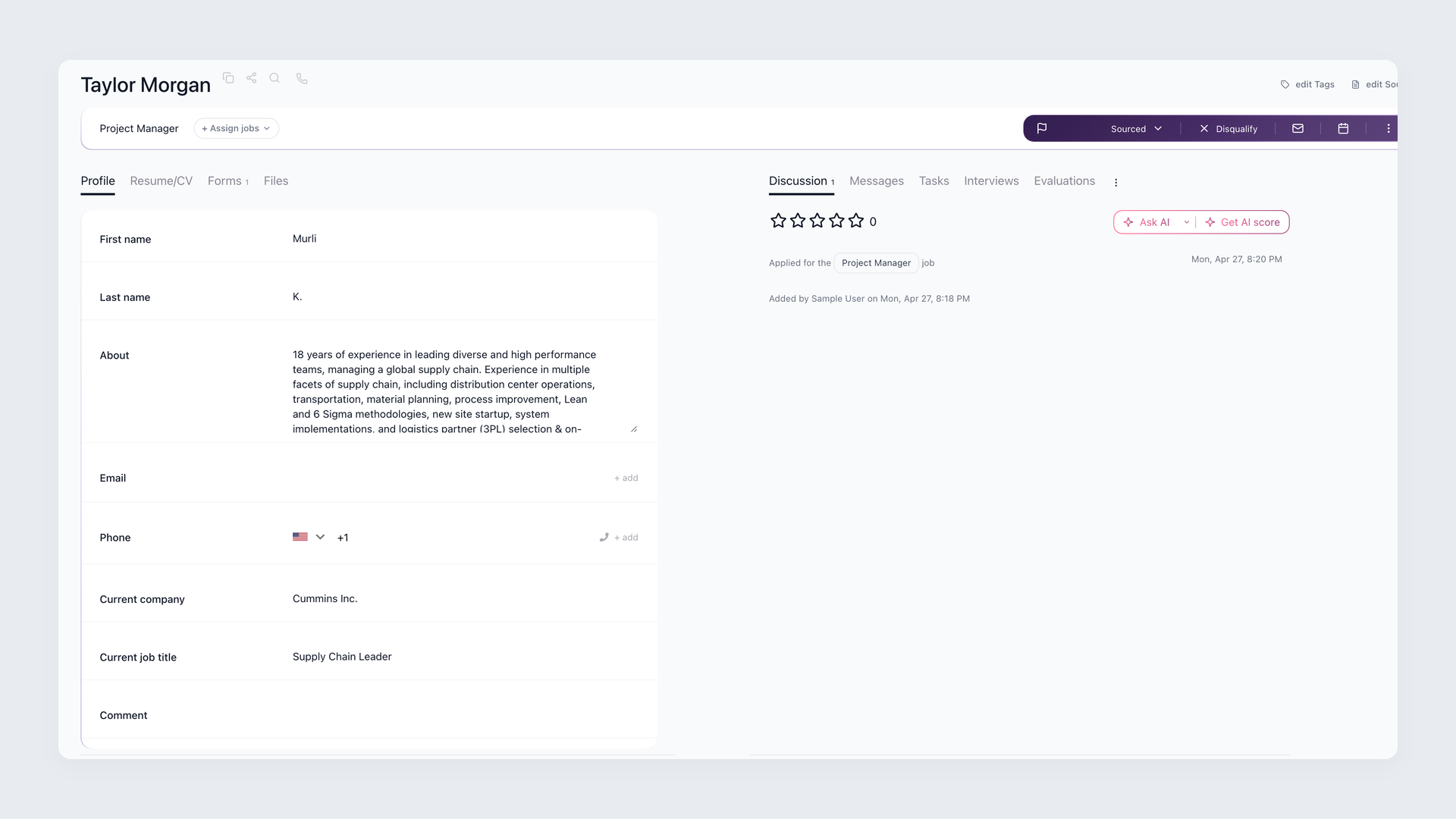
One candidate page, every conversation in it
When two people are hiring at once, spreadsheets break. Candidates go cold while feedback sits in someone's inbox. 100Hires keeps emails, notes, evaluations, and stage history on a single candidate record every teammate can open without asking for access.
- Pipeline view with drag-and-drop stages
- Bulk-move candidates between stages and email them in one action
- Stage-change timestamps and history
- @mention teammates directly in the discussion
Post one job description, reach 13 named job boards at once
Manually copying a job post to Indeed, LinkedIn, and three other boards eats recruiter hours on every role. 100Hires multiposting does it in one click - toggle which boards to activate and the job goes live across all of them from the same screen.
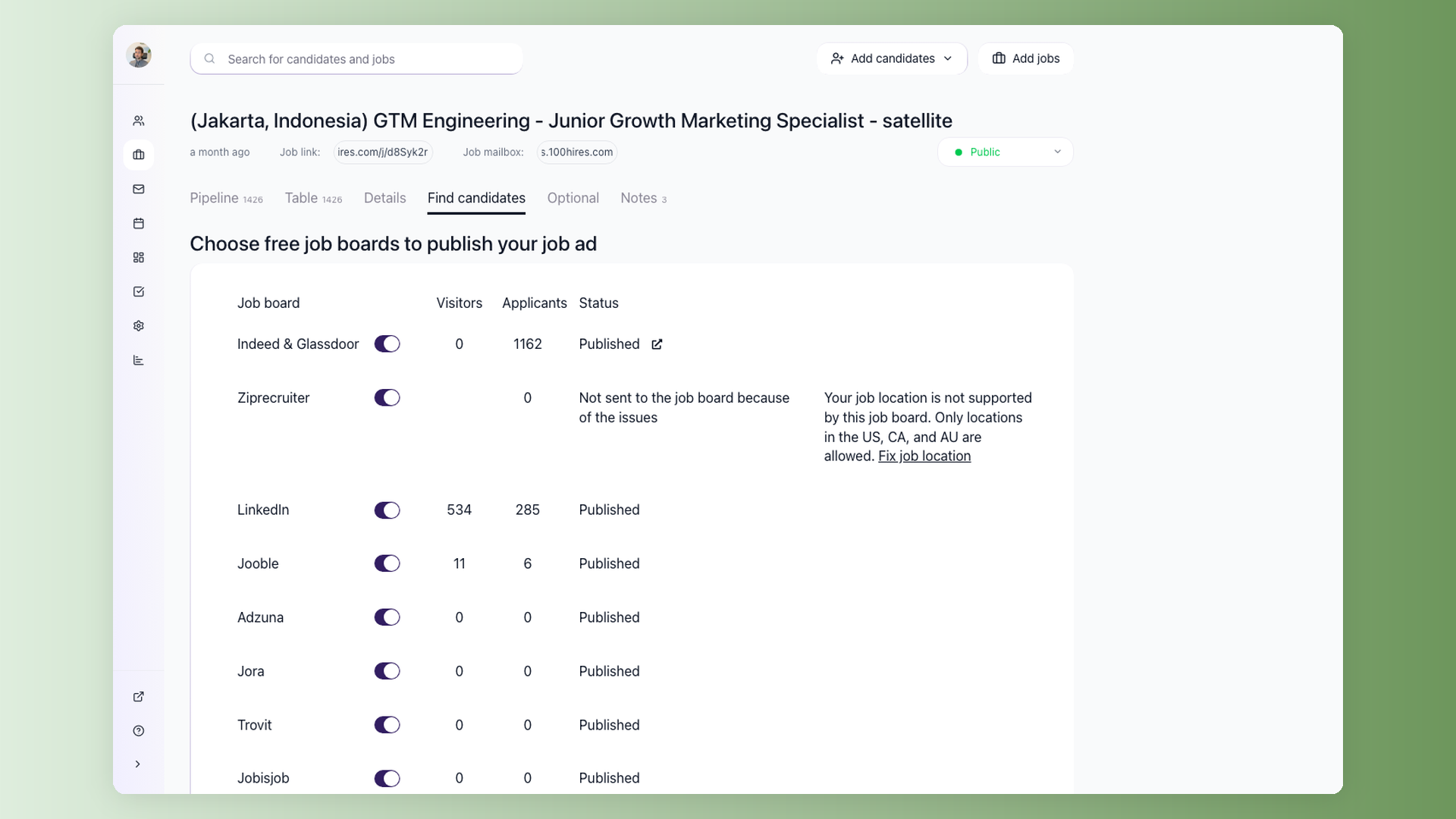
Toggle boards on. Applicants flow in.
Free and paid job boards, your branded career page, and trackable source links all live on the Find Candidates tab of every job. Flip the boards you want, publish, and watch applications arrive with their source already tagged. A referral from LinkedIn, a direct email application, and a job board applicant all land in the same pipeline - compare them side by side, not across three different tabs.
- Indeed, LinkedIn, Glassdoor, ZipRecruiter, and more
- Branded career page included
- Trackable links per sourcing channel
- Source report shows which boards send applicants
Read the strongest resumes instead of all of them
Screening 80 applications manually is the task that kills Friday afternoon when you're running the company and hiring at the same time. AI Score in 100Hires ranks every applicant 0-100 against your job's specific requirements before you open a single resume.
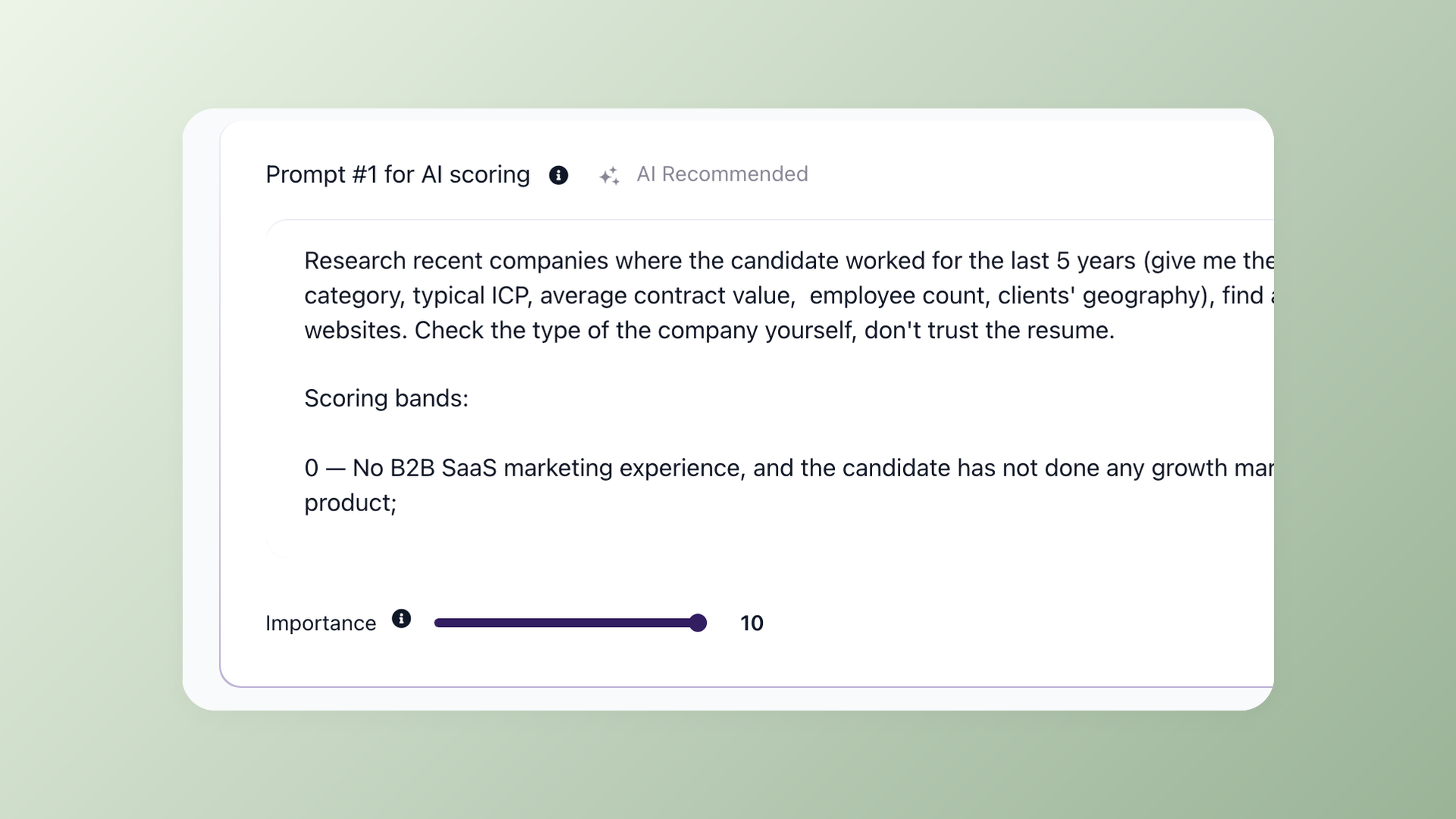
AI Score surfaces who clears the bar before you start reading
Set your scoring criteria once per job. 100Hires runs every incoming application through AI and returns a ranked list with a score from 0 to 100. You sort by score, call the top candidates, and skip the stack that clearly doesn't fit. Knockout questions pre-filter at the application stage so only eligible candidates reach the scored queue.
- Score 0-100 per criterion, summary on the candidate card
- Knockout questions built into the application form
- Sort any pipeline view by AI Score
- AI Copilot lets you ask follow-up questions about any candidate
Schedule interviews without the back-and-forth
A single interview slot across three calendars can take a day of emails to confirm. Self-scheduling links in 100Hires let candidates pick their own slot from your available windows - the meeting appears on both calendars without a thread.
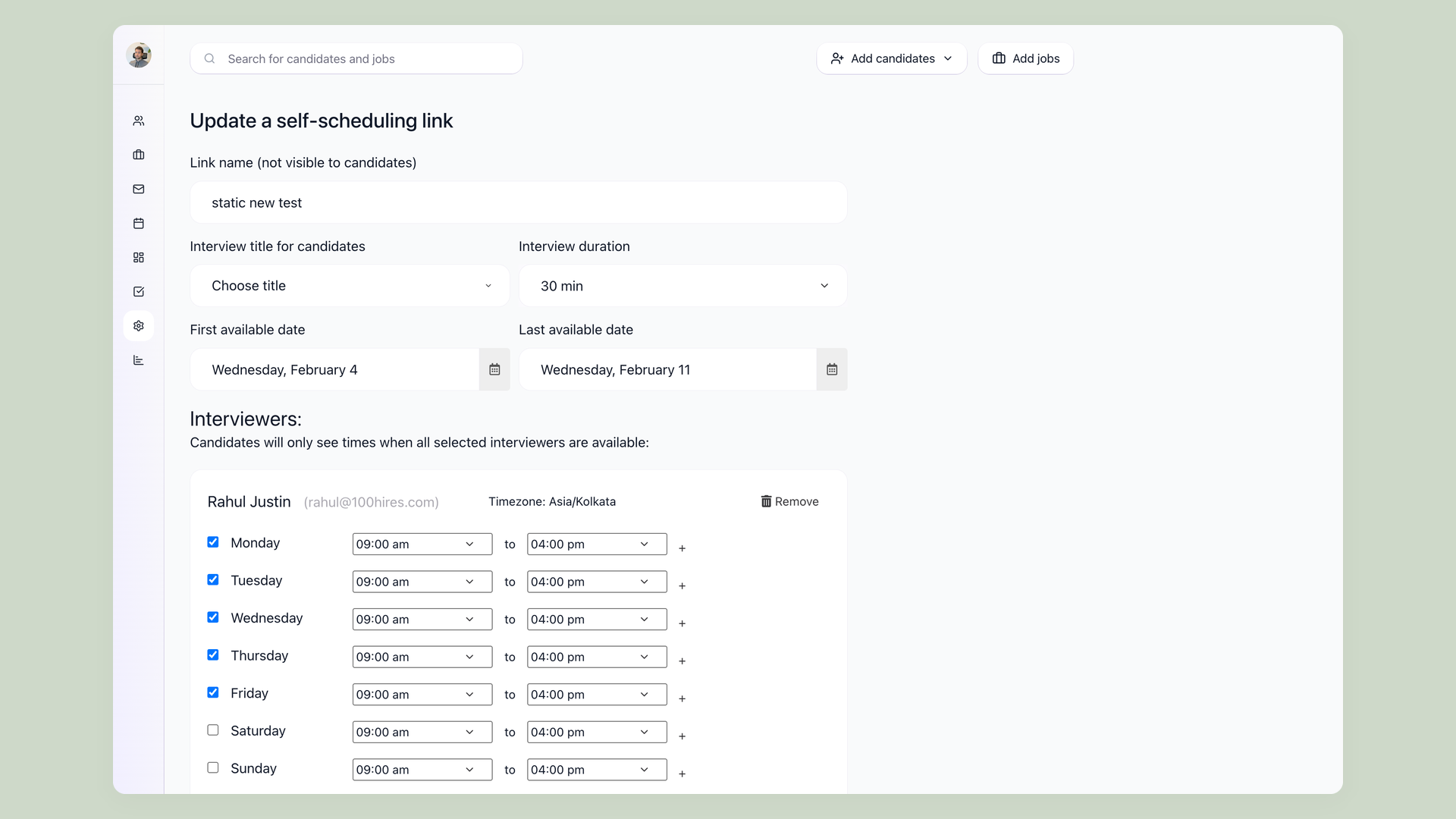
Candidates book their own slot - you get the meeting, not the coordination
Create a self-scheduling link for any interviewer or panel. Set your availability windows once. Share the link in your screening email. Candidates choose a time, the event is created automatically, and the Evaluation Form is already attached when the interview block lands on the calendar.
- Self-scheduling links per interviewer or panel
- Calendar sync with Google and Outlook
- Evaluation Forms attached at scheduling
- Panel interviews book only when all interviewers are free

It solved all of my recruitment problems and offered all of the features I was looking for. It can automate most of my recruitment processes.

I’d happily recommend it to my industry peers. I’m able to use the platform with ease and don’t have to think twice about which function to use.

The system is very user-friendly. Even people with no experience will find it easy to understand its functionality.
Best ATS for startups: what the market actually looks like
The startup ATS market splits into three tiers: free tools, SMB platforms priced by company size, and premium products built for dedicated recruiting teams. Picking an applicant tracking system for startups means knowing which tier you are actually shopping in.
Real free tiers exist. Dover offers a free ATS with unlimited users and jobs (its $199 per month tier gates the AI features), Zoho Recruit's Forever Free covers one active job, and Breezy's Bootstrap plan covers one position with a 30-day candidate window.
Free tiers are useful for a first hire or occasional hiring. Teams that adopt them describe the same arc, though: once hiring picks up, screening quality and volume handling become the walls, and a second tool gets bolted on.
At the premium end, Ashby publishes a startup plan from $300 per month for 1-10 employees, with pricing reassessed annually. Buyer reports describe renewals moving to per-seat models at scale. Our Ashby vs Greenhouse comparison covers both premium options.
Greenhouse and Lever publish no pricing at all these days, and Lever's own parent company now routes small businesses to JazzHR. Two of the four legacy startup ATS names no longer court the segment with a public number.
100Hires sits in the middle tier, priced by company size: Start is $49 per month billed annually ($99 month to month) for 1 user, 3 jobs, and 100 candidates per month. Advanced at $199 per month billed annually removes the caps: unlimited jobs, candidates, and users.
AI Score, AI Copilot, and knockout questions are the working screening stack, and custom candidate and job fields ship on every plan (Ashby gates custom fields to Plus and Enterprise). There is no free 100Hires plan; the free 14-day trial needs no credit card.
Third-party reviewers back the fit: Forbes Advisor rates 100Hires 4.8 and names it best for startups and small businesses (July 2026), and the US Chamber of Commerce's CO hub calls it the most customizable ATS for fast-growing startups.
New to the category? Start with our guide to what an applicant tracking system is, or see the 10 best ATS platforms we ranked for 5-500 employee companies.
How to choose an applicant tracking system for your startup
Buy when volume breaks the spreadsheet, not at a headcount. A form works until one posting draws hundreds of applications and sorting collapses - and application records generally must be kept anyway (US federal rules: one year for most employers; California: four).
Do the per-seat math at twice your team. Ask every vendor what the price becomes at your next headcount and what a renewal looks like - entry pricing and year-two pricing are different questions.
Check what is genuinely included. Automations, API access, and custom fields are the three features most often gated to top tiers; 100Hires includes custom fields and its full REST API on paid plans.
At startup size, setup should not be an implementation project measured in months - those belong to enterprise suites. A careers page you can publish to immediately is a good test.
Answer the honest question first: do you need one yet? A two-person team hiring once a quarter can wait. A team with real applicant flow cannot - that is the point where a Start-tier plan or one of the free tiers above beats the spreadsheet.
100Hires vs a Typical ATS
 100Hires
If you are scaling into a dedicated recruiting-ops function with a five-figure tooling budget, Ashby-class depth is real. If you barely hire yet, a spreadsheet is honestly fine. 100Hires is built for the stretch in between: real applicant volume without an enterprise contract.
The hiring playbook, in your inbox
One email a week - benchmarks, AI screening tactics, and short interview templates from the 100Hires team. No product pitches.