
AI Job Description Generator that turns role notes into a finished, hire-ready posting
Tell 100Hires a few details about your company and the open role. The AI pulls from hundreds of real, hired-against templates and writes a brand-aligned, bias-screened JD - inside the same ATS where you post the role, score applicants, and run interviews.
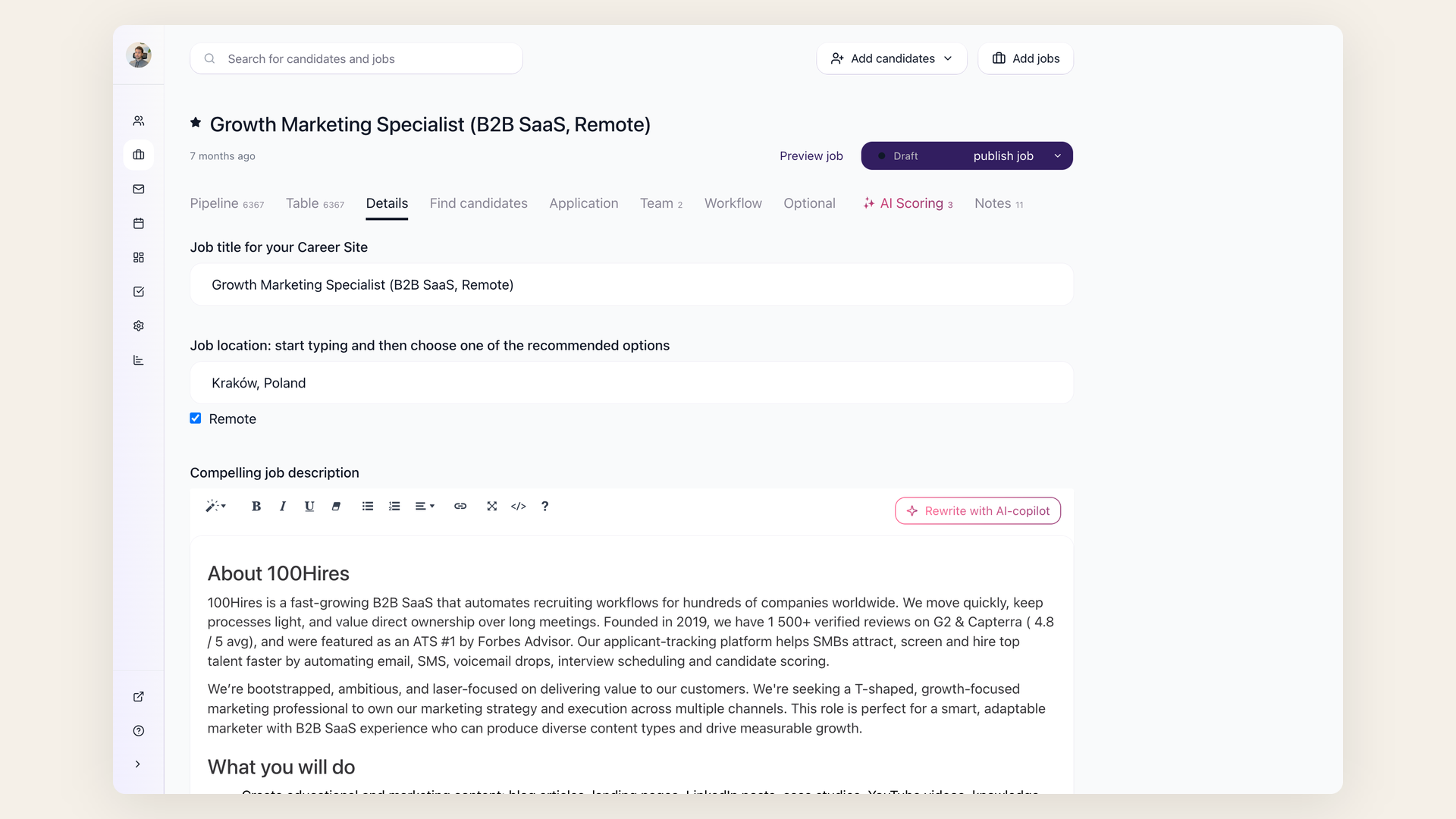






How the AI Job Description Generator works
If you have never used an AI JD generator before, the easiest way to think about it is this: it removes the blank-page problem. No staring at an empty doc, no opening five other postings to borrow phrasing from, no pasting a ChatGPT blob into your ATS and reformatting it for hours.
Here is what actually happens behind the scenes:
- You give it the basics. Job title, seniority, your industry, a few requirement bullets - or paste rough notes from a hiring-manager call. That is all the input the AI needs to get started.
- The AI pulls from hundreds of real templates. The 100Hires library is built from job descriptions that companies actually hired against - spanning engineering, sales, hospitality, transportation, healthcare, and operational roles. The generator starts from the closest match instead of a blank prompt.
- It writes the JD in your voice. Brand-tone matching reads your other 100Hires postings on the same account, so the third JD sounds like the first two. Inclusive-language screening flags biased phrasing before the role goes live.
- You edit, regenerate, or post. Tweak any section in place, regenerate a single paragraph, or paste an existing JD and have the AI rewrite it. When the draft is ready, 100Hires posts it to 13 named job boards.
For teams writing 5 to 20 JDs a month, that is the difference between a one-hour task and a sixty-second one.
Rewrite with AI Copilot, right on the job record
The Rewrite with AI Copilot button lives inside the job creation form itself, so the generated description lands on the same record you post from, score applicants against, and run interviews from. There is no copy-paste blob to keep in sync with the version on the boards, and no separate doc to re-attach when the team edits the requirements three weeks in.
- Role-specific templates, not a blank prompt
- Draft in seconds
- Edit or regenerate any paragraph
It blows my mind: how Truck Star Recruiting fills driver seats 3x faster
Truck Star Recruiting switched to 100Hires because the AI Job Description Generator removed an entire role from the workflow. Owner Nick Lalatovic on the result: "The best thing that I ever seen so far using an ATS platform is the AI job description generator. You can basically put in some plain data about your job and with a couple of entries it generates a perfect job description."
The JD is more than copy - it powers the rest of hiring
Because 100Hires writes the JD inside the ATS, the same description does more than attract candidates:
- It feeds AI candidate scoring. Skills, responsibilities, and requirements are pulled from the JD - so applicants are ranked against what you actually wrote, not a separate rubric you have to maintain.
- It powers hiring automations. Email outreach, status updates, interview scheduling - all run against one source of truth.
- Versions stay on the job record. When the team edits the description three weeks in, the change history is right there with the role.
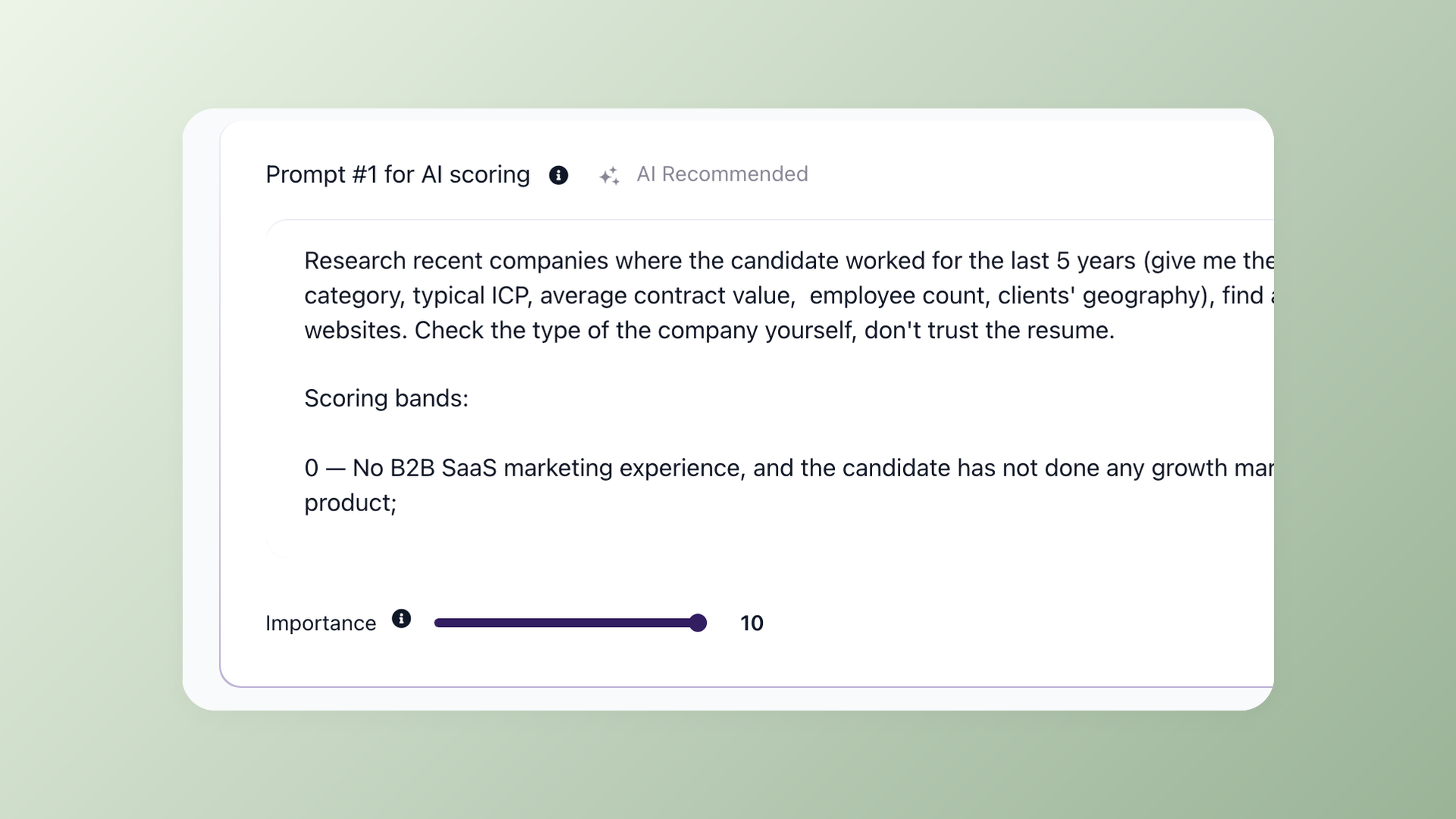
Your JD shapes how applicants are scored
The same JD the generator wrote is what the AI Copilot reads when applicants come in. Scoring criteria come directly from the description - the skills you required, the responsibilities you listed, the seniority you set.
- Scoring criteria generated from the job description
- Skills, responsibilities, and requirements pulled straight from the JD
- Tied directly to the AI Copilot used in candidate emails and interview prep
How 100Hires compares to free standalone JD widgets
 100Hires
| Input you provide | Section the AI writes | How that section gets reused |
|---|---|---|
| Job title | Title + summary opener | Sets the primary keyword for the AI Scoring prompts on this role |
| Seniority + years of experience | Responsibilities + leadership scope | AI Score reads the required experience years when grading applicants |
| Must-have skills | Required qualifications | AI Score weighs candidates strictly against these |
| Nice-to-have skills | Preferred qualifications | AI Score boosts soft matches without disqualifying them |
| Compensation + benefits | Compensation section | Pre-fills the 100Hires offer-letter template later in the pipeline |
| Company description | About + culture section | Stays in sync with the careers page hosted on 100Hires |
The 100Hires generator is built for teams who hire often enough that they want the JD, the applicants, the interview notes, and the offer to live in one place. The AI Job Description Generator is included on every plan - see the pricing page.
Job description management software, without the extra platform
Job description management software is its own category: platforms that store, version, and route JDs through formal approval chains across a large organization. If you maintain thousands of descriptions across departments with HR-led approval workflows, a dedicated platform is the right tool. For teams that manage job descriptions as part of hiring, 100Hires covers the day-to-day lifecycle inside the ATS: hundreds of templates to start from, AI rewrites, edit history on the job record, and reuse the next time the role reopens - no separate system to buy or keep in sync.
What teams say

It solved all of my recruitment problems and offered all of the features I was looking for. It can automate most of my recruitment processes.

I’d happily recommend it to my industry peers. I’m able to use the platform with ease and don’t have to think twice about which function to use.

The system is very user-friendly. Even people with no experience will find it easy to understand its functionality.







The hiring playbook, in your inbox
One email a week - benchmarks, AI screening tactics, and short interview templates from the 100Hires team. No product pitches.