
BambooHR Competitors & Alternatives in 2026: Price per Employee vs per Hire

BambooHR is an HR information system first and an applicant tracking system second. That single fact explains almost every search for an alternative. Teams rarely leave because the product is bad: it holds a 4.6 rating from more than 3,400 Capterra reviews.
They leave for one of two structural reasons.
Either the bill is calculated per employee, so it grows with the headcount you already have rather than with the hiring you are doing, or the hiring module turns out to be the thinnest part of a platform built around records, time off and payroll.
Those are two different problems with two different answers, and most comparison articles blur them.
This guide separates them: what BambooHR actually charges in 2026, what people say when they leave, which platforms replace it outright, and which tools fix only the hiring half so you can keep the HRIS you already paid for.
What BambooHR costs, and why the bill tracks headcount
The hiring playbook, in your inbox
One email a week - benchmarks, AI screening tactics, and short interview templates from the 100Hires team. No product pitches.
BambooHR is one of the few vendors in this category that publishes rates rather than routing everyone to a quote. Prices below are the list rates on BambooHR's own pricing page, checked on 25 July 2026.
| Plan | List price | What it is for |
|---|---|---|
| Core | $10 per employee per month | Foundational HR records, time off, reporting |
| Pro | $17 per employee per month | People-focused add-ons, deeper workflows |
| Elite | $25 per employee per month | The full platform with premium support |
| 25 employees or fewer | Flat rate from $250 per month | Small teams billed as a package instead of per head |
The important part is not the headline number, it is the multiplier. Run the Pro rate against three company sizes:
- 25 employees: the flat band, from $250 per month, roughly $3,000 a year.
- 60 employees: about $1,020 per month, roughly $12,240 a year.
- 150 employees: about $2,550 per month, roughly $30,600 a year.
None of those numbers change if you hire two people this year or twenty. That is the opposite of how applicant tracking systems are usually priced, where the meter runs on active jobs, recruiter seats or a flat monthly fee.
The mismatch runs in both directions. A 150-person company that hires eight people a year pays HR-platform rates for a hiring tool it barely opens. A 30-person company hiring aggressively pays almost nothing for the part of the system doing the most work.
Why teams leave BambooHR, in their own words
The clearest signal comes from a thread in r/humanresources titled asking for alternatives after a price-tier increase. The original poster runs HR at a fully remote fintech with 15 people:
They describe the platform itself as good and easy to use, and the new pricing structure as prohibitive for a team of that size. That combination, liking the product and being unable to justify the bill, runs through the whole thread.
The replies are more interesting than the question, and they cut both ways. One person who left came back:
One replier had already left in April when prices rose and existing customers were moved onto new plans, then returned, having found nothing comparable that saved enough to justify the disruption.
Another pushed back on the whole premise, which is a fair point worth repeating even though it argues against switching:
Another pushed back on the premise entirely, arguing that replacing an HR system over roughly $2,500 a year is disproportionate even at seed or Series A stage, and reporting having run BambooHR in global companies of up to 700 people with very few limitations.
A third confirmed the trap that catches most shoppers: the alternatives are not obviously cheaper. Their read was that almost every large player suggested in the thread cost the same as, or more than, BambooHR's new rate.
The hiring-specific complaint sits in a different thread, r/recruiting comparing Greenhouse and Bamboo, and it is blunt:
The argument there is structural rather than emotional: purpose-built hiring software will out-perform an accessory module, and an HR platform has little commercial reason to invest heavily in a hiring tool that is not where its revenue comes from.
Review data lines up with that. BambooHR scores 4.6 on Capterra across more than 3,400 reviews, with customer service at 4.7, so this is a well-liked product.
The recurring criticism is not quality but rigidity. The pattern in r/humanresources is that employees find it intuitive and easy to use, while HR teams hit walls on heavy customisation and edge cases.
It rewards companies willing to adopt its way of working rather than reshape it.
What the review base says, at scale
Individual forum posts are useful but easy to cherry-pick. Aggregated review mining across G2 and Capterra gives a steadier picture, and for BambooHR the pattern is a well-liked HR platform whose limits show up in customisation rather than in reliability.
That matches the pricing story. Companies do not leave because the software fails. They leave when the per-employee meter outgrows the value they get from the hiring half, or when they need the product to bend in a way it does not.
Why the hiring module feels like an afterthought
BambooHR was founded in 2008 by Ben Peterson and Ryan Sanders in Lindon, Utah, as HR software for small and mid-sized businesses. Its centre of gravity has always been the employee record: onboarding, time off, documents, reporting, and later payroll and performance.
Hiring arrived as one module inside that platform, and it was never the reason customers bought.
That history matters when you are shopping. A vendor invests where the revenue is, and for an HRIS the revenue is in headcount, payroll and benefits, not in candidate pipelines.
So if your problem is that job posting is clumsy, screening is manual, and hiring managers will not log in, you are asking an HR platform to lead on something it was never built to lead on. The fix is usually not a different HRIS.
Two different searches, two different shortlists
Before comparing anything, decide which of these you are:
| Your situation | What to shortlist | Realistic cost impact |
|---|---|---|
| The whole platform is the problem: pricing model, payroll, HR workflows | Full HR platforms (Group A below) | Usually the same or more than BambooHR, plus a migration project |
| HR admin is fine, hiring is the weak part | Keep BambooHR, add a dedicated ATS (Group B below) | Often $49 to $300 per month on top, no HR data migration |
| You are a staffing agency billing clients | An agency CRM, not an in-house ATS | Different category entirely: Bullhorn, Loxo, Recruit CRM |
Group B is the option most articles skip, and it is usually the cheaper one. Replacing an HRIS means migrating employee records, documents, time-off balances and payroll history. Adding an ATS means connecting a job board and importing candidates.
Group A: platforms that replace BambooHR outright
One thing to set expectations: BambooHR is unusually transparent for this group. The three most common replacements do not publish rates at all, so every comparison you read about them is either a quote someone leaked or a guess.
Rippling
An HR, IT and finance platform with a recruiting product included. Buyers pick it when they want one system for payroll, devices, apps and hiring rather than a best-of-breed stack.
Pricing is quote-only and assembled per module, so the number depends entirely on what you switch on.
In the r/recruiting thread about Ashby's renewal pricing, a Rippling Recruiting user recommended it specifically because bundling HR and recruiting can bring the overall cost down. The trade-off is that you are consolidating vendor risk into one platform.
HiBob
Popular with 100 to 1,000-person companies that care about engagement, culture and manager workflows as much as records. Quote-only. Strong on the people-experience side, lighter than a full enterprise HCM on complex payroll geographies.
Personio
The common answer in Europe, where local compliance, contracts and works-council requirements matter more than they do in the US. Quote-only.
Its ATS is more capable than BambooHR's but still a module inside an HR platform, so the "accessory tool" critique above applies to it too.
If payroll is the real driver rather than HR workflow, Gusto and Deel belong on the list as payroll-first options, with hiring features that are thinner again.
Group B: keep your HRIS, replace the hiring half
These are dedicated applicant tracking systems. Because they are priced on hiring activity rather than headcount, the arithmetic is different: your bill stops growing when you stop hiring.
Workable
The most feature-complete option here (we keep a fuller breakdown in our Workable alternatives comparison), with an enormous job-board network and a candidate database.
Published pricing in the 1 to 20 employee band is $299 per month for Standard, $599 for Premier and $719 for Enterprise.
Read the add-on list before you budget: texting adds $89 per month, video interviews $109, assessments $59, and performance and engagement $39, with AI credits metered separately from $0.095 to $0.12 each.
A team that wants texting, video and assessments is at roughly $556 per month before credits. The reaction from smaller teams in r/recruiting is consistent: capable, but several times the price of a basic small-business ATS once the add-ons are counted.
JazzHR
Transparent annual pricing (see also our JazzHR alternatives guide) and a genuine small-business fit: Hero at $1,000 a year, Plus at $3,480 and Pro at $5,508.
Note the job limits, since Hero starts at three job postings a month and Plus allows up to 200 active jobs. Worth knowing before you sign: JazzHR sits under Employ Inc. alongside Lever and Jobvite, so you are buying the entry rung of a three-ATS portfolio.
Breezy HR
The only option in this group with a genuinely usable free tier, which makes it the right answer for very low hiring volume. Paid plans run $157 per month for Startup, $273 for Growth and $439 for Business when billed annually, rising to $189, $329 and $529 on monthly billing.
Onboarding and performance modules cost extra, from $41 and $49 per month.
Pinpoint
Frequently shortlisted by 100 to 500-person companies for its interface.
Quote-only, though a buyer in the r/recruiting Ashby thread reported being quoted roughly $10,000 for up to 250 employees. Note that this is employee-count pricing again, the same model people leave BambooHR to escape.
Teamtailor
Strong on career sites and employer branding, popular in Europe. Quote-only. In a separate thread a buyer described it as good but visually busy with meaningful setup time for templates.
100Hires
Our own product, so treat this section as a disclosure rather than a neutral review. It is an ATS with AI screening, sourcing and outreach, priced on hiring rather than headcount, with plans published on the site. Details and the honest limits are below.
At a glance
| Option | Category | Pricing approach | Best for |
|---|---|---|---|
| Rippling | HR platform | Quote only, per module | One vendor for payroll, IT and hiring |
| HiBob | HR platform | Quote only | 100 to 1,000 people, culture-led HR |
| Personio | HR platform | Quote only | European compliance requirements |
| Workable | ATS | Public, from $299 per month plus add-ons | Broadest feature set and job-board reach |
| JazzHR | ATS | Public, $1,000 to $5,508 per year | Small teams that want fixed annual cost |
| Breezy HR | ATS | Free tier plus $157 per month and up | Very low hiring volume |
| Pinpoint | ATS | Quote only, employee-count based | Mid-market teams prioritising usability |
| Teamtailor | ATS | Quote only | Career sites and employer brand |
| 100Hires | ATS | Public, from $49 per month | SMB teams that want AI screening without a quote process |
Our verdict
Three recommendations, depending on which problem you actually have.
If your only complaint is the invoice and you like the product, do not migrate yet. The Reddit thread above contains someone who left over price and came back because nothing comparable was cheaper enough to justify the move.
Take a quote from Rippling or HiBob, put it in front of your BambooHR account manager at renewal, and see what happens. An HRIS migration is a quarter of someone's year.
If hiring is the thing that is broken, keep BambooHR and buy an ATS. This is the answer for most people reading this page. You are adding $49 to $300 a month rather than moving employee records, documents and payroll history.
Choose Breezy HR if you hire a handful of people a year, JazzHR if you want a fixed annual number, Workable if you need the widest job-board reach and can absorb the add-ons.
If you genuinely need a new platform, be honest about the driver. Rippling if consolidation is the goal, HiBob if the people experience is, Personio if you are in Europe. Expect to pay the same or more than BambooHR, and expect a real implementation project.
Nobody in the thread reported saving money by switching HRIS.
Where 100Hires fits, and where it does not
100Hires is an applicant tracking system for small and mid-sized teams. Published plans: Start at $49 per month billed annually, or $99 monthly, covering up to 100 candidates a month.
Advanced at $199 billed annually, or $249 monthly, with unlimited jobs, candidates and users, automated emails, a custom domain and knockout questions. Pro at $399 billed annually, or $499 monthly, adding sourcing tools, contact enrichment and onboarding support.
The free trial can post to job boards, so you can test the part that matters before paying. Capterra rating is 4.9 from more than 1,100 reviews as of July 2026. Done-for-you migration is included on the Pro annual plan; other plans get a custom quote.
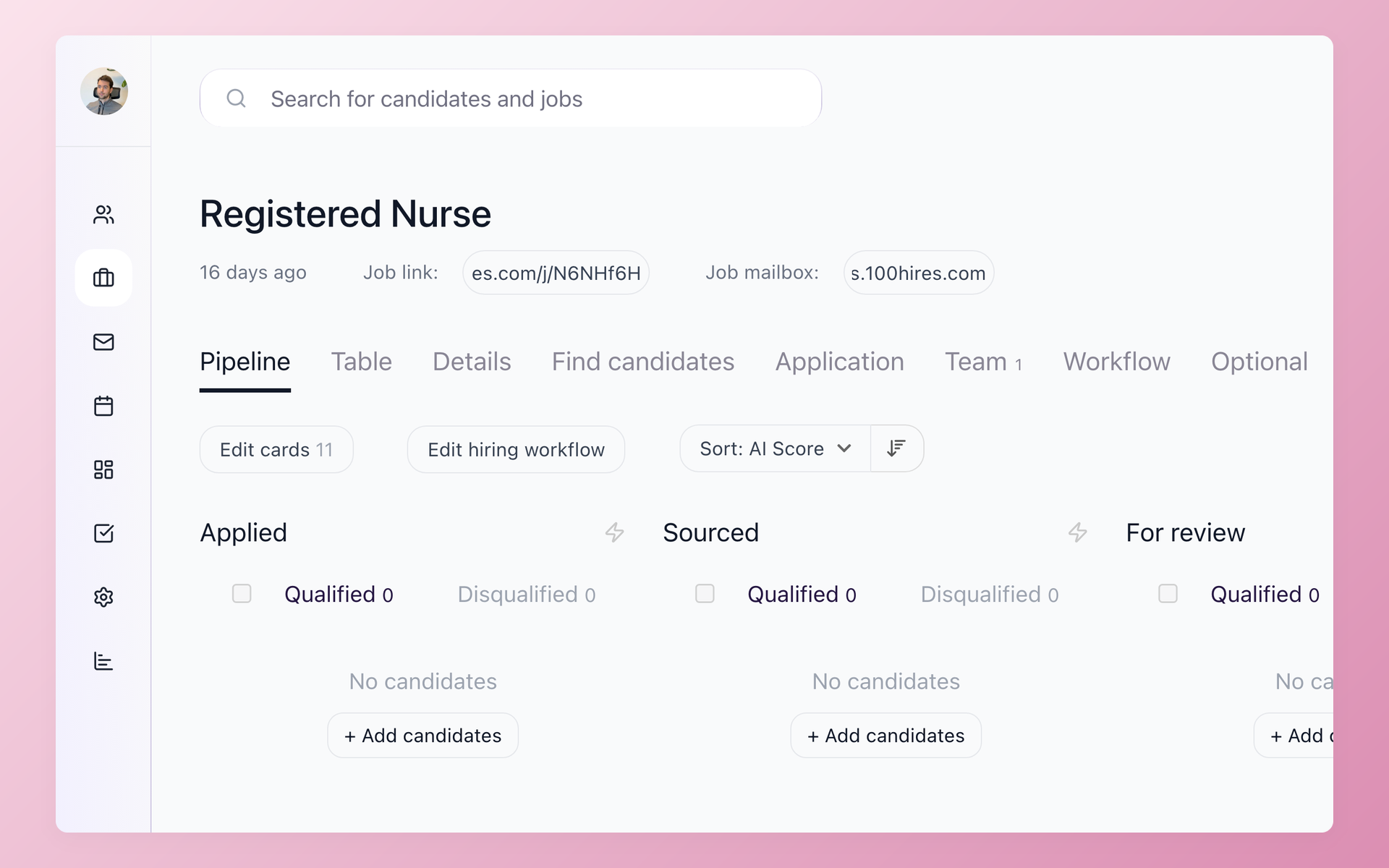
Now the part most vendor pages leave out. 100Hires is the wrong choice if:
- You need what BambooHR actually does well. We do not run payroll, benefits, time-off balances, org charts or performance reviews. If you are shopping for an HRIS, buy an HRIS. Several of our customers keep BambooHR and run us alongside it.
- You hire fewer than about five people a year. Breezy HR's free tier or a well-kept spreadsheet will do the job. Paying us $49 a month to manage four hires a year is not a good trade.
- You need enterprise permission governance. Granular role permissions across multiple legal entities, complex approval chains and SSO provisioning at scale are where Greenhouse, Ashby and Avature earn their price.
- You are a staffing or search agency billing clients. You want an agency CRM with client-side workflows and placement tracking: Bullhorn, Loxo or Recruit CRM. We are built for in-house hiring.
- You want one vendor for everything. If reducing vendor count is the actual objective, Rippling wins that argument and we are not going to pretend otherwise.
If you are in the middle case, the one where the HRIS is fine and hiring is the bottleneck, that is exactly what we built for. See 100Hires pricing or start a free trial.
Frequently asked questions
How much does BambooHR cost per employee?
BambooHR publishes three list rates: Core at $10 per employee per month, Pro at $17 and Elite at $25. Companies with 25 employees or fewer are billed as a flat package starting at $250 per month instead of per head. Because the meter is headcount, a 150-person company on Pro pays roughly $30,600 a year whether it hires two people or twenty, or none.
Is BambooHR's applicant tracking system good enough on its own?
It is adequate for low-volume hiring: post a job, collect applications, move candidates through stages. It is not a match for a dedicated ATS on sourcing, automated screening, multi-channel outreach or hiring-manager collaboration. Recruiters put it bluntly: an HR platform has little incentive to invest in a hiring module that is not a revenue driver for it.
What is the cheapest alternative to BambooHR for hiring?
Breezy HR's free Bootstrap tier is the cheapest real option if your volume is very low. Among paid plans, 100Hires starts at $49 per month billed annually and JazzHR at $1,000 a year. If you also need to replace BambooHR's HR functions, expect no savings: buyers in that r/humanresources thread reported most large alternatives cost the same or more.
Should I replace BambooHR or add an ATS to it?
Add an ATS if your HR admin works and hiring does not. You avoid migrating employee records, documents, time-off balances and payroll history, and the incremental cost is typically $49 to $300 per month. Replace the platform only if the pricing model itself, or a missing HR capability, is the real problem.
Which BambooHR alternatives publish their prices?
Among HR platforms, almost none: Rippling, HiBob and Personio all quote. Among applicant tracking systems, several do: Workable from $299 per month, JazzHR from $1,000 a year, Breezy HR from $157 per month with a free tier, and 100Hires from $49 per month.
Try 100Hires for free
No credit card. 14-day trial. Forbes Advisor #1 ATS for SMBs.