Best ATS for mid-market companies in 2026: 11 leading systems compared
Most ATS lists are written for two companies: the 10-person startup and the 10,000-person enterprise. You are neither.
If your company sits between roughly 100 and 1,000 employees, the real shortlist is short: Greenhouse, Ashby, Lever, Pinpoint, and a handful of others keep coming up in practitioner discussions. The full comparison, with verified pricing, is below.
Mid-market means you have outgrown spreadsheets and starter tools, but you do not have an enterprise procurement team or a dedicated HRIS integration crew.
This guide is for in-house talent teams at companies of that size. If you run a staffing or recruiting agency, your criteria differ enough that we keep a separate guide to staffing agency software.
Two things set this list apart from our ATS ranking for companies of all sizes. We tracked how each tool's pricing behaves as headcount grows, a renewal-risk pattern that keeps recurring in buyer stories. And we scored every tool against reviewer-size data, not marketing copy.
Quick disclosure up front: 100Hires is our product. It appears first on this list, limitations included, and we flag it every time.
Best ATS for mid-market companies at a glance
The hiring playbook, in your inbox
One email a week - benchmarks, AI screening tactics, and short interview templates from the 100Hires team. No product pitches.
Here is the whole comparison in one table. Pricing cells show public numbers where the vendor publishes them. The split is itself a finding: six of the 11 ranked tools publish no standard commercial price at all.
| Tool | Best for | Pricing | How pricing scales | G2 snapshot (Jul 2026) | Trial or demo |
|---|---|---|---|---|---|
| 100Hires | Lean TA teams, 100-250 employees | public $49-$499/mo | Flat tiers, banded by company size | 4.8 (1,353) | 14-day trial, no card |
| Workable | Fast setup, 100-300 employees | public $299-$719/mo | Employee-count brackets per tier | 4.4 (705) | 15-day trial |
| BambooHR | HR system first, ATS second | public $10-$25 per employee/mo | Per-employee, job caps by plan | 4.4 (~5,700, HRIS-wide) | Free trial |
| Teamtailor | Employer-brand-led hiring | custom quote | Flat annual fee, banded by headcount | 4.6 (514) | Demo only |
| Pinpoint | Candidate experience + approvals, 150-500 | custom quote | Quoted by headcount and complexity | 4.6 (~150) | Demo only |
| ClearCompany | Recruiting + onboarding + performance suite | custom quote | Modular, quoted per module | 4.6 (507) | Demo only |
| Ashby | Analytics-first scale-ups, 150-500 | public $400/mo to 100 employees | Per-seat above Foundations, hiring managers count | ~4.7 (approx) | Demo only |
| Lever | ATS + CRM nurture, 200-800 | custom quote | Quoted, renewals often reprice | 4.3 (2,117) | Demo only |
| Greenhouse | Structured hiring, 250-1,000 | custom quote | Quoted by tier + hiring volume | 4.4 (3,925) | Demo only |
| SmartRecruiters | Global hiring programs | from $14,995 (billing period unstated) | Outcome-based packages since 2025 | n/a (listing in flux post-SAP) | Demo only |
| iCIMS | Regulated, high-volume enterprise | custom quote | Module stacking, buyer-reported avg $20,781/yr | 4.2 (989) | Demo only |
| Workday Recruiting | Already on Workday HCM | custom quote (HCM bundle) | Sold inside the HCM suite, never standalone | 3.7 (101, module only) | Demo only |
Want to see what the lower half of this table feels like in practice? Start a free 14-day 100Hires trial, no credit card, and run your next opening through it this week.
The 11 best ATS for mid-market companies in 2026
The list runs by buying path, roughly small to large. That ordering matters more than any star rating: in the renewal threads we read, teams left Greenhouse for Ashby and Ashby for Greenhouse in the same size band, for opposite reasons.
Fit beats feature count. The six checks we scored against come right after the list.
1. 100Hires - best for lean TA teams in the lower mid-market
Full disclosure: 100Hires is our product, so judge this section accordingly. One outside reference point exists on this exact search, though: the Forbes Advisor ATS roundup ranking on page one places 100Hires first of its ten picks, with a 9.3/10 composite score.
Where the evidence is strongest: companies of roughly 100-250 employees with a lean recruiting team, up to about 15 recruiters.
AI Score ranks every applicant 0-100 against criteria you write in plain language, and the reasoning is readable, not a black box. 100Hires posts a job to 13 named boards in one click, including LinkedIn, Indeed, ZipRecruiter, and Glassdoor.
Sourcing, a built-in CRM, email automation, and a REST API with webhooks are included on every paid plan.
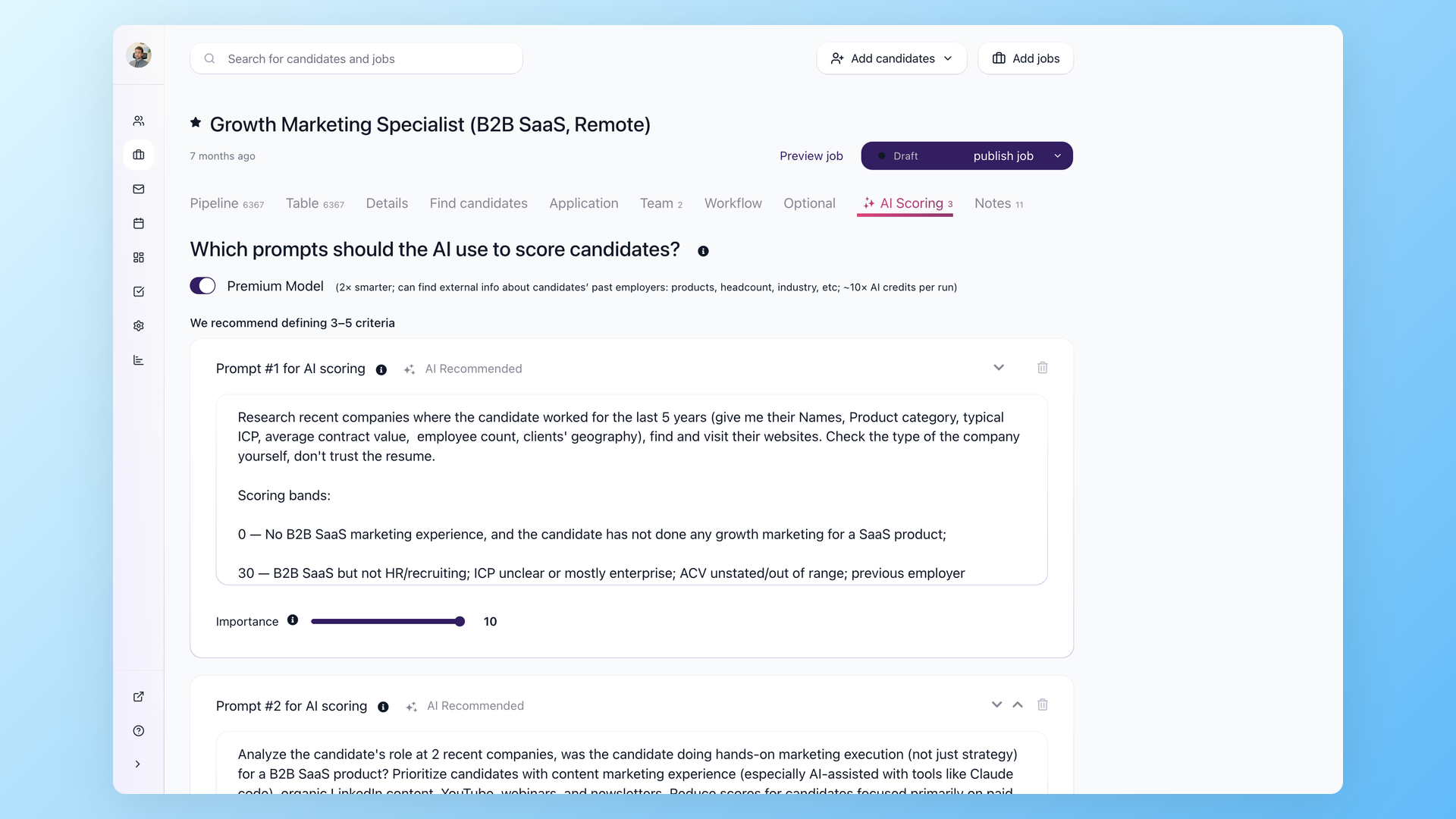
Pricing is public and set by company size: at 101-250 employees, Advanced (unlimited jobs, candidates, and users) is $699/mo billed annually and Pro is $1,149/mo billed annually.
One caveat: headline numbers are the smallest company-size band, and a 250-person company gets quoted a higher band in checkout or on a demo.
Reviewers rate it 4.8 on G2 (1,353 reviews) and 4.9 on Capterra (1,163), with Capterra's Best Value and Best Ease of Use badges for 2026.
Now the honest part. There is no SSO in the product today, no requisition-approval workflow, and only three fixed roles. HRIS sync means the API, webhooks, or Zapier, not a native connector. Reporting is seven canned reports plus API-to-BI.
There is no SOC 2 Type II or ISO 27001 certification.
Above roughly 500 employees, or when those items are hard gates, pick from the upper half of this list. Our enterprise recruiting software page draws the same line.
2. Workable - best for fast setup at the SMB-to-mid-market boundary
Workable is the fastest route from signup to posted job for a 100-300-person company that wants public pricing. Plans are $299, $599, and $719 per month, bracketed by employee count, with a 15-day trial. If it stops fitting, there is a whole ecosystem of Workable alternatives.
The March 2026 addition is Workable Agent, an autonomous sourcing add-on billed in AI credits. Every paid account gets 3,000 free credits. Workable says its job distribution reaches 200+ boards.
Reviewers rate it G2 4.4 (705 reviews) and Capterra 4.4 (661). Per Capterra's reviewer-size data, its base thins sharply above 500 employees, and Reddit's recurring framing puts the outgrow point at 50-300.
EU teams flag US data hosting, support speed draws complaints, and buyers on our demo calls called its AI promising but still maturing.
Size fit: 68% of its G2 reviewers are mid-market companies, and only 2% sit above 1,000 employees.
3. BambooHR - best when you are buying an HR system first
Nobody shortlists BambooHR as a standalone ATS, and that is the point. It enters when the real purchase is an HR platform: employee records, PTO, onboarding, and hiring in one system.
Teams weighing it against dedicated recruiting tools usually end up reading about BambooHR alternatives for the ATS half.
The ATS module is real, not a token: job distribution, self-scheduling, offers, e-signatures, and funnel reporting. Hired candidates hand off into the HRIS one way.
Pricing is public: Core, Pro, and Elite at $10, $17, and $25 per employee per month above 25 employees, with a $250/mo floor below that.
The mid-market catch is the open-job cap: 5, 25, or 50 simultaneous openings by plan. A 700-person company running 60 openings hits the ceiling of the top plan.
G2 shows 4.4 with about 5,700 reviews; read that as a rating of the whole HR platform, not the ATS. One system means a simpler life. Recruiting depth is where it stops.
4. Teamtailor - best for employer-brand-led hiring
Teamtailor is the pick when your bottleneck is attraction, not process. The career-site builder is the spine: branded, multi-language sites, a built-in CRM with nurture, and a Co-pilot AI layer. Unlimited users, 120 job boards, 500+ integrations per its own directory.
Comparison shoppers can start from our list of Teamtailor alternatives.
A fair note on evidence: its online buyer voice is thin, and we discounted some vendor-adjacent Reddit praise. Per 6sense, its largest customer band is 100-249 employees, and Teamtailor's own site files everything up to 1,000 employees under one segment.
Pricing is a custom quote, but a vendor-published rate card exists in UK government procurement: a flat annual fee banded by headcount, £13,000/yr for 150-500 employees and £19,000/yr for 500-1,000. Treat it as directional; it is public-sector, GBP, and dated 2024.
The catches matter at this size. Requisition approvals and offer approvals are paid add-ons, not core features, and there is no built-in e-signature. The BI connector is an add-on too.
One prospect on our sales calls put the value question bluntly: around EUR 8,000 a year felt steep for five or six open roles. Reviewers rate it G2 4.6 (514) and Capterra 4.6 (110). No trial, demo only, and candidate emails carry vendor branding unless you address it.
5. Pinpoint - the mid-market dark horse for approvals and candidate experience
Pinpoint splits practitioners like no other tool here. One recruiter who has run most of the majors calls it badly underrated; another warns it gets clunky under hyper-growth hiring. Both takes are real.
The data places it well: according to Apps Run the World's customer database, 43.4% of Pinpoint's measured customers sit at 101-1,000 employees, the plurality of its base.
Approval workflows are a full standalone feature: unlimited approval levels, parallel or sequential chains, and email-based approvals that need no login. That contrasts directly with Teamtailor, where approvals are paid add-ons.
It checks boxes the lower half of this list cannot: SSO and SCIM on the enterprise tier, plus SOC 2 Type II, ISO 27001, and ISO 42001.
Add a report builder with role-based data access, multi-brand career sites in one account, and named HRIS connectors for Workday, UKG, ADP, Paycom, and Paylocity.
Vendor-claimed implementation: 4-6 weeks for most mid-market customers.
Pricing is a custom quote, and the opacity is total: the public pricing page is gone entirely. One buyer reported a quote around $10k/yr for up to 250 employees.
Ratings: G2 4.6 (about 150 reviews) and Capterra 4.7 (89). No self-serve trial, and one G2 summary hints at gaps in basic ATS plumbing, though the underlying detail is thin.
6. ClearCompany - best mid-market talent suite
ClearCompany is the quiet one. You will rarely see it in Reddit shortlist threads, and we say that openly.
It is ranked anyway on the strength of its base: per Capterra's reviewer-size data, 66.4% of its reviewers work at companies of 51-1,000 employees, the most mid-market-concentrated suite we measured.
The pitch is one vendor for recruiting, onboarding, and performance management, without Workday-class procurement. Six modules cover the employee lifecycle, with a Talent AI layer across the platform. Competitive context lives on our ClearCompany alternatives page.
Pricing is a custom quote on every module, with no stated trial. G2 rates it 4.6 across 507 reviews.
Recurring complaints: add-on costs pile up (several reviewers describe feeling nickel-and-dimed), reporting takes work, and performance occasionally lags. Thin public discourse cuts both ways: fewer war stories to learn from.
7. Ashby - best for analytics-first scale-ups heading into mid-market
Ashby earned its momentum. In one Zapier growth lead's curated sample of AI-native startups, Ashby ran recruiting at roughly 30% of the companies, ahead of Greenhouse and far ahead of Lever. His sample, not market share.
The product is a true all-in-one: ATS, CRM, scheduling, and the best-regarded native analytics on this list.
Our house rule from the all-sizes ranking holds: pick Ashby if reporting depth will change your decisions and someone owns admin; avoid it if your team wants simple, or headcount is about to triple.
Pricing: Foundations is public at $400/mo flat up to 100 employees. Above that, Plus and Enterprise are custom quotes, and seats become the story.
One company that grew from 10 to 150 employees described a renewal in the $24,000-28,000 range once every hiring manager counted as a billable seat. That is one company's renewal, not a rate card. Another buyer's advice fits: pin the seat definition down before you sign.
Foundations gates real things: no custom fields, no custom dashboards, no self-serve bulk export. A TA lead who documented her migration noted that features teams assume are core, especially analytics, actually live in Plus.
Ratings: G2 around 4.7 (direct verification is bot-blocked, so treat as approximate) and Capterra 4.5 on a thin 13 reviews. About 30% of reviewers are under 50 employees. It is the bridge tool in this list.
8. Lever - best ATS and CRM combo for the middle of the band
Lever's case is the unified ATS plus CRM: one database where sourcing, nurture campaigns, and pipeline live together. If candidate re-engagement is central to how you recruit, this is the strongest native combo here.
Size fit is Lever's strongest card: 82% of its G2 reviewers work at companies of 51-1,000 employees, the most mid-market-concentrated base we measured. Our heuristic from prior coverage: best under roughly 150 hires a year.
Pricing is fully quote-gated. Buyer-reported numbers from our own pipeline: around $10k/yr to start, and one renewal that landed near $16k once a support add-on stacked on. Third-party estimates put mid-market contracts at $10-30k/yr; treat those as estimates.
Ratings: G2 4.3 (2,117 reviews), Capterra 4.6 (654). The cons cluster on reporting and reliability: Capterra's review analysis flags limited, confusing reporting and recurring glitches, there is no mobile app, and e-signature requires a paid DocuSign add-on.
In 2026 Lever moved support to a ticketing model with pre-designated contacts, which left at least one customer team on our calls unable to file tickets at all.
Ownership: Employ Inc. runs Lever, JazzHR, and Jobvite as siblings, with one shared AI layer under IBM watsonx governance. The live marketplace counts about 180 integration partners.
9. Greenhouse - best for structured hiring at 250-1,000 employees
Greenhouse is the most mid-market-native heavyweight by the numbers: per G2's segment data, 66% of its reviewers are mid-market companies, with only 26% above 1,000 employees.
Structured hiring is the signature: scorecards, interview kits, and interview discipline across many teams.
It is having a fast product year. The Ezra AI Labs acquisition closed May 27, 2026, bringing a voice AI interviewer plus Warden bias auditing. A Greenhouse MCP server went into open beta in June 2026, wiring the ATS into Claude, Gemini, and Copilot.
Greenhouse also announced a six-capability AI wave in June 2026: the first agents launched then, with the rest staged as beta or expected through Q3.
Baseline AI assists come standard on every tier, including Core. Talent Matching and natural-language report filters need Plus or Pro, resume anonymization is Pro, and Sourcing Automation is a paid add-on at any tier.
Pricing is a custom quote across Core, Plus, and Pro. According to PriceLevel's buyer-reported data (updated June 2026), the median annual contract is $12,250, in a $5,100 to $70,000+ range.
Reddit buyers reported $18-30k quotes at 200-400 employees and about $29k at 500 on a three-year term.
Two things deserve homework at this size. Budget the renewal, not the year-one quote; quote-only pricing means the second contract is where the real number shows up. And plan for a 1-3-month implementation with a named admin owner.
Ratings: G2 4.4 (3,925 reviews, July 2026 snapshot), Capterra 4.5 (763). It claims 7,500+ customers and, per its own count as of July 2026, 500+ integrations.
10. SmartRecruiters - best for global hiring programs heading upmarket
SmartRecruiters is now SAP's ATS. The acquisition closed September 11, 2025, and it will replace SAP SuccessFactors Recruiting over a 3-5-year transition, with migration tooling live since June 2026. That means more resources and a roadmap that now answers to SAP.
Alternatives-side context sits on our SmartRecruiters alternatives page.
The product case is global: multi-country hiring, governance, and the Winston AI suite with an EU AI Act control hub. The AI hiring agent needs the Professional tier or above, and conversational screening sits in the High Volume tier.
Pricing: the Essential package is listed at $14,995, and the vendor page states no billing period for it, which we would confirm in writing. Other tiers are custom quotes, priced since 2025 on headcount and planned hires. The corporate floor is around 50 employees.
One transparency gap we hit ourselves: its G2 listing was restructured after the SAP deal, so we could not verify a current G2 rating and will not quote one. Capterra shows 4.2 (150 reviews).
Practitioners praise the global support and knock the reporting beyond standard dashboards. With 32% of reviewers above 1,000 employees, this is the upper-mid pick: right when you are heading past 500 and hiring across borders, early if you are not.
11. iCIMS - the enterprise anchor where mid-market ends
iCIMS closes the list to mark the boundary. Per G2's reviewer demographics, 70% of its reviewers work at companies above 1,000 employees, the most enterprise-skewed base we measured. In our own sales conversations with mid-market buyers it essentially never comes up.
When it does, people are usually looking for iCIMS alternatives.
According to Apps Run the World, iCIMS holds the largest share of the global ATS market at 10.7%, with 750+ integration partners and a quarter of the Fortune 500 as customers.
Its defenders are specific: regulated, audit-heavy, high-volume employers who need compliance reporting more than a pretty interface. Its critics are recruiters who carry the dated UX without needing that audit depth.
There is no public pricing page. Vendr's buyer data puts the average contract at $20,781/yr in a $14,500 to $635,000 range, with $15-25k first-year implementation and a three-year mid-market total cost of $60-100k. One buyer reported a 40% renewal increase.
Another described a stack that reached $136,000 a year once texting licenses piled on top of the core ATS.
Ratings: G2 4.2 (989 reviews), Capterra 4.3 (824). Application flows average around 19 minutes, a recurring candidate-abandonment complaint. Deployments run 3-6 months.
If you are 800+ employees, regulated, and hiring at volume, shortlist it. Below that, the tools above will fit better.
What a 100-1,000-employee company actually needs from an ATS
Six checks kept separating winners from regrets across the buyer stories we read. Use them as your scorecard.
- Pricing that survives growth. The renewal-shock pattern keeps recurring: per-seat models recalculate hard once hiring managers count as seats. One company that grew from 10 to 150 employees watched its renewal land near $28k. Model every quote at double your headcount.
- Hiring-manager experience. HM access is where both adoption and per-seat pricing break. If managers hate the tool, they retreat to email and your pipeline data goes stale. Our hiring manager software page covers this lens in depth.
- Reporting that answers executives without CSV surgery. Reporting gaps, not missing features, were the most-cited trigger in the migration stories we read. See what good looks like in recruitment analytics software.
- Integrations that survive the demo. Three of the five TA podcasts we analyzed flagged the same pattern of demo-stage integration promises meeting post-signature reality. Make the vendor demo your actual HRIS sync live.
- Compliance gates. SOC 2 Type II, ISO 27001, and GDPR turn into RFP gates somewhere past 200 employees. We watched a deal die on exactly this in our own sales calls. Vendor security pages, including ours, deserve a read before the shortlist.
- Implementation time and admin load. The spread is wide: 2-4 weeks for Ashby, 4-6 for Pinpoint, 1-3 months for Greenhouse, 3-6 months for iCIMS. Someone on your team owns this project; size it honestly.
How we picked these tools
We mapped both mid-market search results pages, then deep-read or mined eight ranking pages plus the one Reddit thread that ranks for this query.
Beyond the SERP: 12 Reddit shortlist and renewal threads, 10 YouTube reviews, five TA podcasts, 317 LinkedIn posts, our own sales-call corpus, and 14 prior research packages.
Tools that showed up across five or more channels made the list or got a named reason not to.
The named exclusion is Jobvite. Every channel we read treats it as a migration origin rather than a destination, its reviewer base skews larger than Greenhouse's (half above 1,000 employees), and its AI stack is the same Employ portfolio layer we covered under Lever.
A signal-quality note: several "best ATS" Reddit threads carry vendor-seeded accounts pushing long-tail tools. We discounted recommendations from single-thread accounts with no history.
Roundups of the leading ATS for mid-market firms mostly recycle the same handful of names. Slots here were earned by recurrence across independent channels plus reviewer-size data; our own product's slot is disclosed, not claimed as consensus.
And the disclosure, again: 100Hires is ours. Across the external channels we mined it appeared once, in the Forbes Advisor roundup that ranks for this query and places it first. Judge our #1 slot with that in mind, and verify us independently on G2 or Capterra.
Public vendor prices and vendor-published procurement cards were re-checked in July 2026. Quote-only tools carry buyer-reported anchors, labeled as such.
The HRIS-bundled path: Workday, Paycom, UKG, Paylocity
If your company already runs an HRIS, someone in finance will ask the fair question: why not use its recruiting module? We did not evaluate Paycom, UKG, or Paylocity recruiting modules as ranked entries, since none publish rate cards. Here is the decision logic instead.
Bundled wins on plumbing: zero-integration data flow, one vendor, one login. It loses, repeatedly, on recruiter and hiring-manager experience.
A 300-person industrial company on our calls wanted to leave Paycom's ATS module but keep Paycom as the HRIS, since managers could not see candidate status cleanly. In the Reddit threads, field managers rebelling against Workday's recruiting UX drove moves to Ashby and Lever.
Workday Recruiting itself is never sold standalone, so no verified standalone price exists. Its module rates G2 3.7 (101 reviews) against 4.2 for the platform overall. A small group of suite-first buyers defends it on governance and position management.
There is an ongoing federal case about AI screening that names the vendor, worth tracking.
If you already run Workday HCM and hire mostly salaried roles through structured requisitions, the bundled path is defensible. The middle road is real too: keep the HRIS, replace the recruiting layer.
Pinpoint lists named connectors for Workday, UKG, ADP, Paycom, and Paylocity, and BambooHR at #3 is itself the HRIS-first answer. Whatever you pick, demo the actual sync, not the integrations slide.
Under 100 employees? Use the small-business list instead
Below roughly 100 employees the criteria invert: price sensitivity rises, governance needs drop, and a different set of tools wins.
JazzHR competes hard on budget annual plans, Breezy HR brings a free tier and visual pipelines, Manatal is the low-cost per-user option (92% of its G2 reviewers are under 50 employees), and Zoho Recruit fits teams already inside the Zoho stack.
We rank all of them properly in our guide to the best applicant tracking systems for small business.
A pattern from our demo calls: teams that start on a budget tool tend to outgrow it in 3-4 years, when scaling needs and reporting expectations arrive together. If you are at 80 employees and doubling, buy for where you will be.
How to run a mid-market ATS evaluation
A 20-year HR-tech sales veteran laid out a six-question vendor framework on a recent TA podcast.
Before any demo, write down: the problem and what it costs you; why the current setup fails; what this vendor would change; why you should believe them; the full costs, ROI, and rollout plan; and the risks, from data security to AI bias.
Three mid-market-specific moves from the buyer stories we studied:
- Get the renewal price modeled at twice your headcount, in writing. Year-one quotes are marketing; the renewal is the real price. One TA leader on LinkedIn warned against long lock-ins without price protection after living through one.
- Make the vendor demo your actual HRIS handoff live, not the integrations slide. The overselling pattern is independent and repeated.
- Reference-check inside your size band and industry, not against the vendor's logo wall. Forum consensus can be seeded; a 30-minute call with a peer company cannot.
Budget-wise, anchor on the three pricing families from the table above, and check our own pricing page for what the public flat-pricing end of the market looks like.
FAQ
What is the best ATS for midsize companies?
It depends on where in the 100-1,000-employee band you sit and which criteria bind. For lean teams around 100-250 employees, 100Hires delivers AI Score screening, one-click posting to 13 named boards, and public pricing by company size (Advanced is $699/mo billed annually at 101-250 employees). Above 250, evaluate carefully; when SSO, native HRIS sync, or SOC 2 are hard gates, or headcount passes 500, Greenhouse's structured hiring and SmartRecruiters' global governance earn their quotes.
What are the top 5 ATS systems for mid-market firms?
Across the shortlist and renewal discussions we analyzed, the five leading ATS for mid-market firms that keep recurring are Greenhouse, Ashby, Lever, Workable, and Pinpoint, with SmartRecruiters and iCIMS entering as headcount climbs. Separately and disclosed as our own product, 100Hires is our pick for the lower half of the band, with AI screening on every plan and published pricing.
What's the top recruiting software for medium businesses?
Treat it as a criteria question, not a brand question: pricing that survives growth, hiring-manager UX, reporting, HRIS integration, compliance, and implementation load. 100Hires wins the flat-pricing and speed criteria for medium businesses up to about 250 employees, with unlimited users on its Advanced plan and a 14-day trial. Above that, weigh Greenhouse, Ashby, and Lever against those six checks.
How much does an ATS cost for a mid-market company?
Three pricing families cover the market. Published tiers start at $49/mo for 100Hires (smallest company-size band, billed annually; larger headcounts are band-quoted) and $299-719/mo for Workable (employee-bracketed). Headcount-banded quotes land in the low-to-mid five figures annually; Teamtailor's published UK public-sector card shows £13,000-19,000/yr for 150-1,000 employees, and one Pinpoint buyer reported about $10k/yr. Enterprise quote-only tools run higher: buyer-reported Greenhouse median $12,250/yr and iCIMS average $20,781/yr. Whatever the family, model the renewal at double your headcount before signing.
Which ATS do most companies use?
By revenue share, iCIMS leads the global ATS market at 10.7% according to Apps Run the World, though that reflects enterprise spend. In one curated sample of AI-native startups, Ashby and Greenhouse dominated. Most-used is not best-fit: a 10,000-person platform and a 150-person company need different systems, which is where right-sized tools like 100Hires make their case.
If you are in the lower half of mid-market, 100-250 employees with a lean TA team, you can get structured hiring and AI screening live this week: start the free 14-day 100Hires trial (no card) or scan the pricing ladder first.
Past 500 employees, or facing hard compliance gates? Shortlist from the upper half of this list: Greenhouse, SmartRecruiters, iCIMS.
Try 100Hires for free
No credit card. 14-day trial. Forbes Advisor #1 ATS for SMBs.