
Greenhouse Competitors & Alternatives in 2026: What Buyers Actually Pay
Greenhouse does not publish prices, which is why most searches for alternatives start with a number nobody can verify. So start there: real figures from real buyers, then the alternatives worth your time.
Greenhouse is the reference implementation of structured hiring. Scorecards, interview kits, defined roles, and reporting built on the assumption that you run a repeatable process. It is genuinely good at that, and it is priced accordingly.
Teams leave for three reasons: cost at renewal, permission rigidity, and a sense that the product stopped moving.
What Greenhouse actually costs
The hiring playbook, in your inbox
One email a week - benchmarks, AI screening tactics, and short interview templates from the 100Hires team. No product pitches.
The Greenhouse pricing page is a quote form, checked on 25 July 2026. Every number below comes from buyers rather than the vendor, which is the best available evidence when a vendor gates pricing.
From an r/recruiting thread on ATS pricing, a Greenhouse customer describing their own renewal:
Their account is specific and useful. Pricing is set by employee count and tier, one and two-year terms are both offered, and the longer term carries a modest discount. At 80 employees, their renewal on the top tier with everything included came to about $12,000 a year.
Another buyer in the same thread gave market ranges:
Their market ranges: Greenhouse typically $6,000 to $10,000 a year, Lever $4,000 to $8,000 depending on seats, and ClearCompany somewhere between $5,000 and $12,000. All quoted rather than published, which is the underlying complaint.
So the working assumption for a company under about 100 people is $6,000 to $12,000 a year, with employee count and tier as the two levers, and a modest discount for a two-year commitment.
Two practical consequences. First, the meter is headcount, not hiring volume, so a 200-person company that hires ten people a year pays like a 200-person company. Second, because pricing is negotiated, your renewal is a negotiation whether you treat it as one or not.
Why teams leave
The most quotable comparison came from an r/recruiting thread titled asking whether anything beats Greenhouse:
Their assessment: Lever covers almost the same ground for roughly half the price, Teamtailor does more for about two thirds, and Greenhouse trails both on interface and on how it has integrated AI and automation.
Price is the most common trigger. Another commenter in the same thread had shortlisted Greenhouse, Ashby and Screenloop, then eliminated Greenhouse on price before comparing features.
Support comes second, and users describe it in strong terms. Capterra's aggregated complaint themes point elsewhere, at permissions that reviewers find confusing, inflexible, or insufficiently granular.
Third, and hardest to verify, is the pace of change. A buyer evaluating options in 2025 dismissed Greenhouse as having seen almost no product development.
That last claim deserves a counterweight, because the evidence is genuinely mixed. Another commenter pushed back in the same conversation:
Their counter-view is that Greenhouse has improved materially since 2020 and 2021, specifically on reporting depth and added automation.
And the aggregate numbers are strong: 4.5 on Capterra across 764 reviews, and Greenhouse announced a number-one rank in 57 G2 reports in the Spring 2026 grid, including mid-market, enterprise and EMEA.
Recruiters on Reddit still name it the best option available and single out how far it can be configured.
The honest summary: Greenhouse is a strong product with a high price, uneven support, rigid permissions and a divided reputation on innovation pace. None of that makes it the wrong choice. It makes it a choice you should test against cheaper options before renewing.
What a migration off Greenhouse actually costs
Price comparisons ignore the switching cost, and for Greenhouse specifically it is higher than average because teams build process into it. A recruiter who has run this project laid out the variables:
The variables they list: how clean your existing data is and how much of it genuinely needs to move, platform compatibility, whether you have a recruiting-operations function, what you are approved to spend on implementation support, how familiar the team already is
and how well documented your interview process is.
Budget for four things that rarely appear in a business case: cleaning candidate data before export, rebuilding scorecards and interview kits, reconnecting background-check and HRIS integrations, and retraining hiring managers who had finally learned the old system.
A useful sequencing tip from the same discussions: ask your background-screening provider which systems they integrate with before you shortlist. It removes options faster than any feature comparison.
The implementation cost people underestimate
One criticism appears in internal competitor research consistently enough to plan around: implementation is slow, commonly described as taking around three months, with a learning curve steep enough to need real training and some technical capability.
That is the hidden half of the price. A $10,000 contract with a three-month implementation and a recruiting-operations person part-assigned to it costs considerably more than $10,000 in the first year.
The related complaint is hiring-manager usability. Reports of managers spending long stretches simply working out how to leave interview feedback are common enough that it is worth testing in a trial, with an actual hiring manager rather than a recruiter, before committing.
Both points argue the same way: Greenhouse rewards companies that invest in adopting it properly, and punishes those that expect it to work out of the box for occasional users.
Who owns Greenhouse, and why it shows up in your quote
Greenhouse was founded in 2012. In January 2021, TPG Growth and The Rise Fund took a majority stake, valuing the company at roughly $820 million, with about $500 million invested of which approximately $450 million bought out existing shareholders.
That structure matters to a buyer for one reason: a private-equity majority holder expects revenue growth from an installed base.
It is the most plausible explanation for the pattern customers describe, which is firm pricing at renewal and steady packaging of capability into higher tiers.
It also means Greenhouse is not going anywhere, which is worth something. Vendor stability is a real feature when you are choosing a system of record.
Greenhouse alternatives worth shortlisting
Lever
The closest functional substitute, and the one buyers most often describe as similar for less. Quote-only. Vendr's marketplace data puts the median buyer at $15,400 a year across a wide range, while Reddit buyers cite $4,000 to $8,000 for smaller teams.
One caveat that belongs in any honest comparison: Lever has been part of Employ Inc. since August 2022, alongside JazzHR and Jobvite, so three of the group's brands are applicant tracking systems.
Ashby
The analytics-first challenger, and the most common shortlist partner for Greenhouse in 2026. Published entry pricing at $400 a month with a 10 percent annual discount.
Check the seat definition carefully. In a widely read r/recruiting thread, a customer described being charged $800 per "elevated seat" annually including hiring managers, which took them to roughly $24,000 as they grew.
Teamtailor
Named above as doing materially more for around two thirds of the price with the strongest career-site and employer-brand tooling in this group. Quote-only, popular in Europe.
Pinpoint
Mid-market usability, quote-based, with one concrete data point from a buyer: a basic plan quoted at around $10,000 for up to 250 employees.
Workable
The transparent option at this level: $299 per month for Standard, $599 for Premier, $719 for Enterprise in the 1 to 20 employee band, plus add-ons for texting, video, assessments and performance, and metered AI credits. Widest job-board network in the category.
iCIMS
The enterprise direction rather than the cheaper one. Consider it only if you need enterprise talent-acquisition breadth. One recruiter in a 2025 thread reported leaving iCIMS that October, citing the price as the deciding factor.
JazzHR
The downgrade that is sometimes the right answer: $1,000 to $5,508 a year, published. If you adopted Greenhouse for structure but only hire fifteen people a year, this is worth the conversation.
100Hires
Published plans from $49 a month, with AI screening and sourcing at higher tiers. Detail and honest limits below.
Side by side
| Option | Pricing | Published? | Strongest for |
|---|---|---|---|
| Greenhouse | About $6k to $12k a year under 100 employees | No | Structured interviewing, reporting, stability |
| Lever | $4k to $8k small, median $15.4k overall | No | Similar capability, lower price |
| Ashby | From $400 per month | Yes, entry only | Analytics depth |
| Teamtailor | Quote | No | Career site and employer brand |
| Pinpoint | About $10k at 250 employees | No | Mid-market usability |
| Workable | From $299 per month plus add-ons | Yes | Job-board reach |
| iCIMS | Quote, enterprise | No | Enterprise breadth |
| JazzHR | $1,000 to $5,508 a year | Yes | Low volume, fixed cost |
| 100Hires | From $49 per month | Yes | SMB teams wanting AI screening |
Our verdict
If structured hiring is genuinely how you operate, Greenhouse is worth its price and you should negotiate rather than migrate. Get a competing quote from Lever or Ashby, mention it, and ask about a two-year term. Buyers report discounts for exactly this.
If you bought Greenhouse for structure you never implemented, you are paying for scorecards nobody fills in. That is the most common quiet waste in this category. Look at JazzHR, Workable or 100Hires and spend the difference on something that moves hiring.
If reporting is the reason you are shopping, look at Ashby before Lever. Analytics is Ashby's actual differentiator. Just resolve the seat definition in writing first, because hiring managers counting as billable seats is what generates renewal surprises.
If permissions are your blocker, test them in a trial with real role assignments. This is the one complaint that no comparison table captures and that every enterprise buyer discovers three months in.
Where 100Hires fits, and where it does not
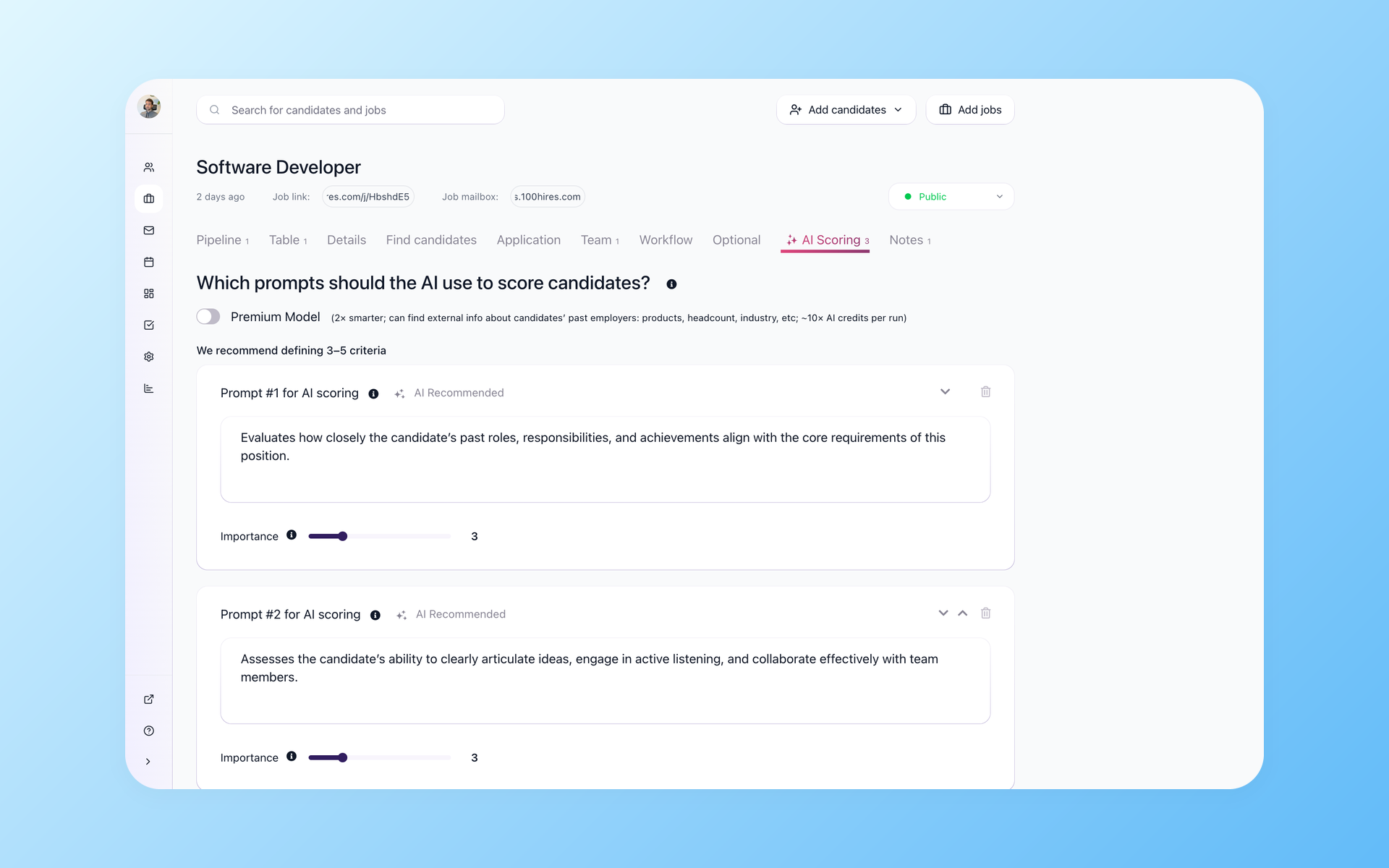
100Hires is an applicant tracking system for small and mid-sized in-house teams, with published pricing and no quote process. Start is $49 per month billed annually ($99 monthly) for up to 100 candidates a month.
Advanced at $199 annually ($249 monthly) covers unlimited jobs, candidates and users, with automated emails, a custom domain and knockout questions. Pro at $399 annually ($499 monthly) adds sourcing and contact enrichment.
Capterra rating is 4.9 from more than 1,100 reviews as of July 2026.
100Hires is the wrong choice if:
- Structured interviewing is your operating model. If interview kits, scorecards and calibrated hiring decisions are how your company hires, Greenhouse does that better than we do. That is what it is for.
- You need granular permissions across entities. Ironically this is Greenhouse's most-criticised area and still stronger than ours. Multi-entity governance is not our strength.
- You have a recruiting-operations team and an analytics roadmap. Ashby and Greenhouse are built for that reader. We are built for the team where the recruiter is also the coordinator.
- You are above roughly 500 employees with heavy approval chains. Requisition and offer approval workflows at that scale are enterprise territory.
- You need a deep integration marketplace. Greenhouse's integration ecosystem is one of its genuine moats.
If you are paying enterprise prices for a process you have not implemented, that is the case where switching down makes sense. See 100Hires pricing or start a free trial.
Comparing the two obvious rivals first is fair: our Lever alternatives and Ashby alternatives guides cover them with the same pricing detail.
Frequently asked questions
How much does Greenhouse cost per year?
Greenhouse does not publish pricing. Buyer reports put it at roughly $6,000 to $12,000 a year for companies under about 100 employees, with one 80-person company reporting about $12,000 for the top tier at renewal. Pricing is based on employee count and tier, and buyers report a slight discount for a two-year contract rather than one year.
Is Lever cheaper than Greenhouse?
Often, though not always. Buyers cite Lever at $4,000 to $8,000 a year for smaller teams against Greenhouse at $6,000 to $10,000, and one recruiter argued Lever covers almost the same ground for roughly half the price. Vendr marketplace data shows a median Lever buyer paying $15,400 a year across all sizes, so at larger scale the gap narrows or reverses. Get both quotes.
What is the best Greenhouse alternative for a mid-market company?
Ashby if analytics matter most, Lever if you want similar capability for less, Teamtailor if career site and employer brand are the priority, Pinpoint if hiring-manager usability is the deciding factor. All four are quote-based except Ashby's published $400 per month entry tier.
Why do people say Greenhouse has stopped innovating?
It is a contested claim. One buyer in 2025 dismissed it as having almost no product development, while another in the same discussion said reporting had improved markedly and praised the newer automation. Greenhouse also announced a number-one rank in 57 G2 reports in Spring 2026. Treat the criticism as a signal to check the current roadmap against your specific gaps rather than as settled fact.
Can I negotiate Greenhouse pricing?
Yes, and you should. Because pricing is quoted rather than published, your renewal is a negotiation by default. Buyers report discounts for two-year terms, and the standard tactic is to hold a competing quote from Lever, Ashby or Pinpoint. As one recruiter advised a peer facing a renewal: get the rival quote, tell your account manager cost is the deciding factor, and let them respond.
Try 100Hires for free
No credit card. 14-day trial. Forbes Advisor #1 ATS for SMBs.