
Where to find employees in 2026: 12 best places compared
The best places to find employees in 2026 don't live on a single website: employee referrals fill trust-critical roles, job boards deliver raw volume, and your own past applicants are the fastest free pool.
This guide compares 12 hiring channels on the same five fields: best-for roles, cost, speed, setup effort, and candidate quality. We pulled the numbers from primary and published sources so the channels compare like for like.
For scale: US employers had 7.1 million job openings in August 2026 and made 5.2 million hires, per the BLS JOLTS report.
Where you look decides who fills your gap. For the process side, from job description to offer, see our guide to hiring employees. This article is about where the people come from.
The 12 best places to find employees at a glance
The hiring playbook, in your inbox
One email a week - benchmarks, AI screening tactics, and short interview templates from the 100Hires team. No product pitches.
Here's the full comparison in one table. Costs were checked in July 2026; our ratings for speed, setup, and quality are based on the evidence linked in each section below.
| Channel | Best for | Typical cost | Speed | Setup effort | Candidate quality |
|---|---|---|---|---|---|
| 100Hires (the measurement layer) | Running and measuring every channel below | From $49/mo billed annually | One form, every board | Low | Shows you which channel delivers |
| Employee referrals | Trust-critical and hard-to-fill roles | Bonus paid only on success | Varies | Low | Highest screen passthrough on record |
| Your past applicants | Repeat and seasonal roles | $0 marginal | Days | Near-zero with an ATS | Pre-screened, decays over time |
| Major job boards | Hourly, admin, office volume | Free options plus paid ads | Hours for raw volume | Low | Mixed, needs screening |
| Social media | Local hourly, trades, service | Your time, plus optional ads | Hours to days | Low | Mixed, better via employee shares |
| Career site + Google for Jobs | Every employer, every role | $0 beyond your site | Always-on once indexed | Medium | High intent |
| Direct sourcing and poaching | Senior and skilled roles | Your time, or tools reported from $170/mo | Slow per hire | High | Highest ceiling, targeting-dependent |
| Niche and free boards | Local and specialized roles | Varies by board | Days | Low, manual per board | Hyperlocal, varies by metro |
| Staffing agencies | Same-week coverage, 1-2 key roles | 15-30% of salary (industry-consensus figures) | Fastest external option | None | Good short-term fit |
| Community and local | Hourly, trust-critical, local | Near $0 | Slow, ambient | Low | High trust, low volume |
| Campus + apprenticeships | Entry-level pipelines | Free tier, paid options reported | Slowest | Medium | High retention when structured |
| Veteran hiring programs | Reliability-heavy hourly and trades | $0 to post via DOL channels | Medium | Medium | Strong reputation, thin data |
Want to test several channels at once without juggling logins? Start a free 100Hires trial. It can post to job boards during the trial, capped at 10 candidates from external job boards across all jobs after account verification.
1. 100Hires: the measurement layer for every channel on this list
Full disclosure up front: 100Hires is our product, and it isn't a place where candidates hang out. It sits above the 11 candidate pools below and turns them into one pipeline you can measure.
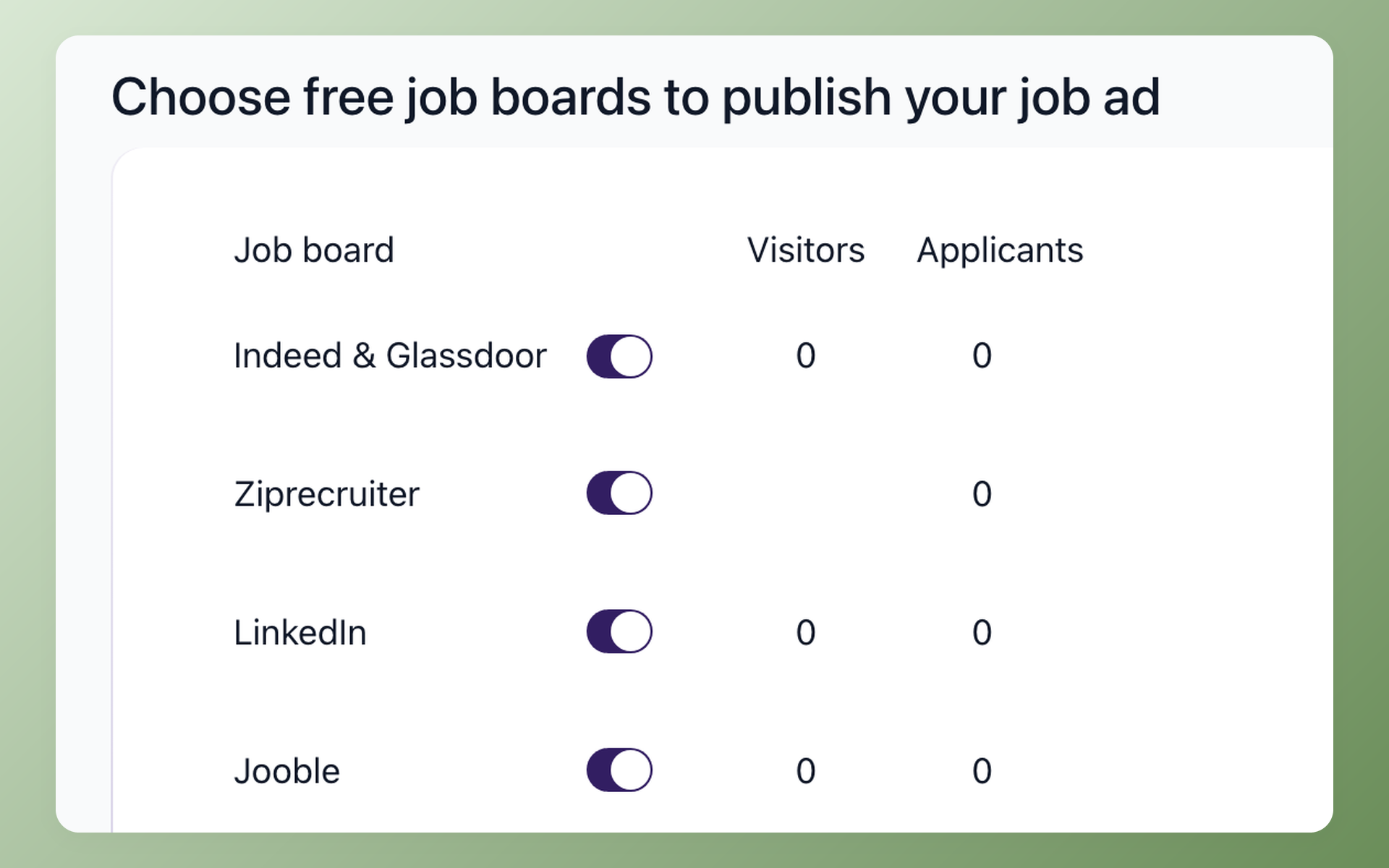
Post a job once and it goes out to major destinations including Indeed, LinkedIn, ZipRecruiter, Glassdoor, and Google Jobs.
For every channel it doesn't post to, you create a trackable link: one for the Facebook group, one for the referral program, one for the flyer at the trade school.

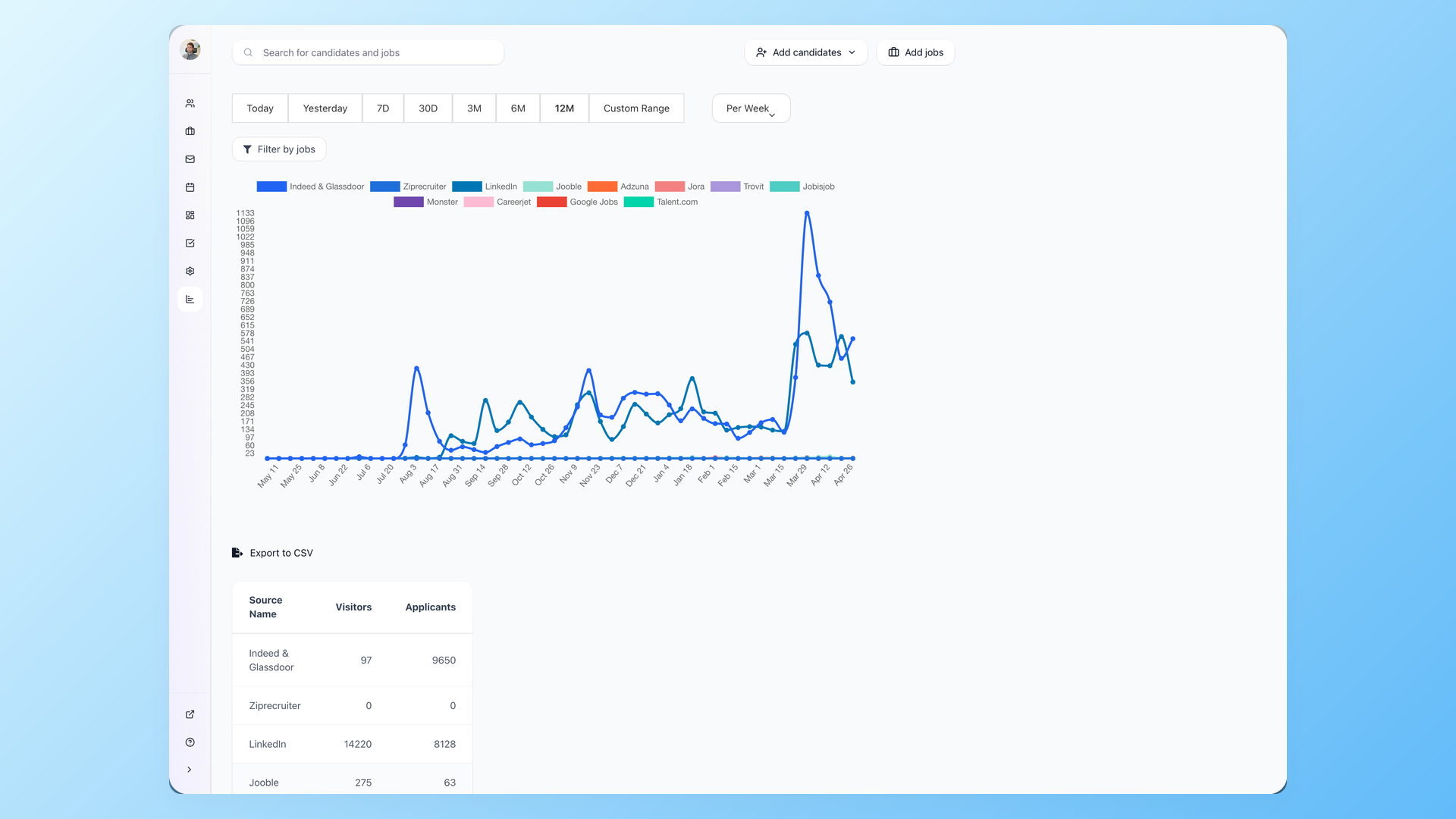
The source report then answers the question this whole article circles: which channel earned its money? You see visitors, applicants, and hires per source, side by side.
Volume channels get manageable too. AI Score ranks incoming applicants against your criteria, and knockout questions filter out the noise before you read a single resume.
One customer, Gainey Financial Group, reports saving around 10 hours a week on job posting alone. Another, StratifyIQ, screens 100 applicants in about two hours.
The honest limits: there's no free plan (you get a 14-day trial instead), the Start plan caps you at 3 jobs, 100 candidates a month, and 1 user. Plans run from $49/month billed annually.
2. Employee referrals: the quality channel hiding on your payroll
In Ashby's report on 54 million applications from 2021 to 2026, referrals carried the strongest screening signal in the dataset: 52% of referred candidates passed initial screening, against 35% for everyone else, and referred candidates accepted offers more often.
Real programs look like this. The recruiting lead at Kit shared her H1 2026 numbers: 11 hires against a goal of 4, six of them referrals, on a $1,000 flat bonus plus a $2,000 travel upgrade for the year's top referrer.
In one recruiting-forum thread, a law firm pays $2,000 split at the 3- and 6-month marks. A large employer in the same thread cut its payout from $5,000 to $2,500 and doubted the bonus size was what drove referrals in the first place.
The pattern across programs: mechanics beat money. A monthly email listing open roles, a direct ask to every new hire in week one (their networks are freshest), and a public shout-out when someone gets paid do more than raising the bonus.
One caution from program operators: referral-heavy pipelines can flood you with lookalike candidates and narrow your team over time. Keep a second channel running next to the program.
Attribution is the usual gap, and you don't need new software for it: a 100Hires trackable link per employee or per program shows exactly who sent the hire.
3. Your own past applicants: the talent pool you already paid for
Every applicant you've collected cost you money once. Most employers never look at them again.
An 80-employee landscaping company owner described his approach: keep a list of qualified past Indeed applicants, then text them a year later when a seat opens. He calls it the hiring lesson that took him eight years to learn.
SHRM makes the same case for silver medalists: the runners-up from your last search are the fastest warm pool you have. Availability decays, so timing and a light nurture cadence decide whether the pool stays alive.
The economics are hard to beat: zero marginal cost and days instead of weeks. The catch is tooling. From a spreadsheet this is painful; from an ATS it's a saved search.
In 100Hires, talent pools hold your silver medalists by role, nurture campaigns keep them warm on a schedule, and AI Score re-ranks an old pool against a new job in minutes.
4. The major job boards: Indeed, LinkedIn, ZipRecruiter, Glassdoor
We rank and price every major board separately in our guide to the best job posting sites for employers, so this entry stays short.
Boards are the volume champions for hourly, admin, and mid-level office roles, and a weaker option for senior or passive talent, since they mostly reach people actively searching.
On cost, Indeed allows up to 3 free organic posts a month; sponsored budgets are set by you and billed per click or per started application, which is exactly what the sibling guide breaks down.
On quality, operator threads through 2025-26 report heavy unqualified and AI-generated application volume, so pair boards with real screening.
A useful role-fit heuristic from the small-business community: managers on LinkedIn, office staff on Indeed, facilities and trades on Craigslist. For US-specific and state-level options, see our US job posting sites breakdown.
100Hires distributes jobs across these boards from one form, and knockout questions keep the volume readable.
5. Social media: Facebook's local jobs return and LinkedIn organic
The news first: Meta relaunched jobs on Facebook in October 2025. It's US-only and aimed squarely at entry-level, trade, and service roles, with listings surfacing through the Marketplace jobs tab, Groups, and Pages.
Results vary by market, so treat Facebook as a test. One painting contractor reported going from five or six candidates a day to zero in two weeks back in 2021; a cleaning-business owner still hires well through groups and referrals.
LinkedIn organic is a different animal: posts from your team about the work build warm inbound for office roles, separate from paid job slots.
On The Pet Business Hiring Podcast, a pet-care owner put it plainly: for years she found new hires by asking staff, clients, and friends to share a single post.
Platform quirks (X's paid gate, TikTok's dead pilot, Instagram's missing jobs product) live in our social media recruiting tools guide, and the Facebook mechanics get a step-by-step walkthrough. A trackable link per group or page tells you what converted.
6. Your career site and Google for Jobs
Your career site is the only channel you own outright. Candidates often cross-check a posting against it, and an always-on careers page converts diffuse awareness (your trucks, your storefront, your social posts) into applications year-round.
One construction hiring consultant recommends an evergreen open-application posting so the pipeline never fully closes between openings.
Google for Jobs rides on top of it. Add JobPosting structured data and your listings become eligible for Google's jobs experience. There's nothing to pay for placement here; eligibility is technical, not bought.
A 100Hires career site includes the structured data by default, with a Google Jobs toggle on every posting.
7. Direct sourcing and poaching: go where employed people already work
The best candidate for many roles already has a job. The highest-engagement employer post we found came from a midwest manufacturer who skips Indeed entirely and recruits people already working at the local Walmart, in person.
The startup version is outbound: build a list of people doing the job at competitors, then message them directly. Alex Hormozi argues that past the $1M revenue mark the candidates you want must be sourced this way, since they're not reading job boards.
He also argues quality candidates get hired within eight days of entering the market, so slow outreach loses. One recruiting-forum rule of thumb splits a healthy pipeline into thirds: direct sourcing, referrals, and direct applications.
Cost is mostly your time, or a tool seat: LinkedIn Recruiter Lite is reported at around $170/month. Setup effort is the highest on this list, and so is the payoff when your targeting is right.
100Hires handles the mechanics: the Chrome extension adds sourced profiles to the same pipeline as your applicants, and on the Pro plan Contact Finder fills in their emails and phone numbers.
Dedicated tooling lives in our sourcing tools roundup, and our resume database guide covers the search-first route.
8. Niche and free boards: Craigslist, state job banks, industry boards
Craigslist charges $10-75 per job post depending on the metro, with gigs at $3-10.
Opinions are genuinely split: in one 2023 discussion, some operators had written Craigslist off since 2020, while others were still making good hires there. Several of our own SMB prospects post nowhere else.
Hyperlocal, and cheap to test: that's the honest summary.
State job banks and the National Labor Exchange are free in all 50 states; our US posting guide covers them state by state.
Industry boards round out the mix: one hospitality customer of ours runs LinkedIn, Indeed, Craigslist, and Culinary Agents together, and niche geo boards are worth a test for local roles.
A trackable link per board settles the real question fast: is your metro's board alive?
9. Staffing and temp agencies: fastest coverage, steepest bill
Here's the fee data most guides skip. Direct-hire placements typically run 15-30% of first-year salary by industry-consensus figures, with 20% the most common rate.
One business-insights guide puts recruiter fees at 10-35% of annual salary. Temp markups are commonly cited at 25-100% over the wage.
The industry is enormous: about 2.2 million temp and contract workers were on assignment in an average week of 2024 across roughly 27,000 US staffing firms (the association's 2021 count), per the American Staffing Association.
Operators mostly complain about the price. One founder described paying $2,000 a month per placed overseas worker, and a 2022 healthcare post describes travel-nurse agencies taking up to 40%.
When agencies earn it: you need coverage this week, you want a temp-to-perm tryout, or you have one or two hard senior roles. One quirk worth knowing: Indeed and Glassdoor exclude staffing agencies from free postings, so agencies pay to play too.
No integration pitch here. If you move away from agencies, an ATS is simply how you run the channels that replace them.
10. Community and local channels: churches, chambers, signs, and walk-ins
The most memorable tactic in our research: a thread on how Chick-fil-A stores stay staffed credits managers with deep church networks whose congregation contacts apply and then bring friends. Go where the people you want already gather.
The same thread's top answer is the counterweight, and it applies to every channel in this article: you can't out-recruit a workplace nobody wants to join. Pay and culture come first; channels amplify what's already true.
Quick reality checks for the rest of the cluster. Nextdoor has no jobs product, so the move there is mentioning that you're hiring in regular business posts. Help-wanted signs and walk-ins cost nothing and produce little.
Job fairs are worth a booth when the attendees are exactly the workers you need. Gig apps mostly appear in operator stories as the competitor they rescue clients from, not a hiring channel.
A QR code wired to a 100Hires trackable link makes even a flyer measurable.
11. Campus recruiting and apprenticeships
This is a plant-now-harvest-later channel: slow and structured, but a bargain if you hire the same entry-level roles every year.
Handshake says it reaches 25 million knowledge workers across 1,600+ educational institutions. Its Basic tier is free for employers, and the published Pro plan costs $450 a month.
Registered apprenticeships through apprenticeship.gov let trades build their own talent instead of bidding for it.
Not one operator we reviewed brought campus recruiting up unprompted. Read that as honest positioning: it's a two-year pipeline, not a this-quarter fix. 100Hires talent pools are a natural holding pen for a graduating class until start dates arrive.
12. Veteran hiring programs
Per the Department of Labor's employer page, American Job Centers offer employers free one-on-one hiring help, and the National Labor Exchange collects state job bank listings. DOD SkillBridge hosts service members during their final 180 days of service.
One trap to defuse: the HIRE Vets Medallion fees ($640 for large employers, less for smaller ones) are application fees for a recognition award, not a price for reaching veteran candidates.
No operator we reviewed mentioned these programs, which says more about awareness than value: it's a structured, underused pipeline for roles where reliability matters most. A trackable link per program shows whether it produces for you.
Getting the people you find to show up
Finding applicants is half the job. One small-business owner reports that about half of scheduled interviewees no longer show up, and one owner hiring cleaners notes that someone who finds you on Indeed has often applied to about 30 other jobs that week.
So call back fast. Three habits cut the loss: reply the same day, send a booking link so candidates pick their own slot and can cancel with one click, and run 15-minute phone screens before anyone drives in.
In 100Hires, self-scheduling links let candidates book a slot on your calendar, and the source report shows which channels turn into hires rather than just applicants.
How do you choose where to find employees?
Match the channel to the role and the constraint, then measure.
- Hourly and local: referrals, Facebook's local jobs, community networks, and a cheap Craigslist test
- Office and professional: major boards plus LinkedIn organic, with your past applicants checked first
- Senior and skilled: direct sourcing and referrals; an agency for one or two make-or-break roles
- Zero budget: career site with Google for Jobs, state job banks, referrals, and DOL veteran channels
- Need someone this week: past applicants first, then agencies or a sponsored board post
Then run the experiment: pick two or three channels per role, give each its own link, and compare per-source conversion at the end of your test window. Kill what didn't deliver. Our recruitment analytics guide covers the reporting side in depth.
How we picked and compared these channels
100Hires is our product. It opens the list as the labeled measurement layer, not as a candidate pool, and that's the article's thesis: channels are an experiment you measure.
Every channel got the same five fields. Cost figures come from primary and published sources fetched in July 2026, with primary sources re-checked in October 2026:
BLS, SHRM's 2025 recruiting report, the American Staffing Association, the Department of Labor, Meta's newsroom, and Craigslist's own fee page. Speed, setup, and quality ratings are our editorial assessment of the linked evidence.
Practitioner evidence is paraphrased from operator threads and posts we link directly, never quoted. Prices and stats were checked in July 2026; primary sources were re-checked in October 2026.
Frequently asked questions
What is the best site to find employees?
Indeed brings the most raw volume, and the community heuristic holds: managers on LinkedIn, office staff on Indeed, trades on Craigslist. 100Hires posts one job to Indeed, LinkedIn, ZipRecruiter, Glassdoor, and Google Jobs from a single form, so you don't have to pick blind.
What are the best ways to find employees?
Referrals for quality, your past applicants for speed, and job boards for volume. Run two or three channels per role and compare results; the 100Hires source report shows visitors, applicants, and hires per channel so the decision stops being a guess.
Where is the best place to find staff?
For hourly and local roles: referrals, Facebook's local jobs, and community networks. For office roles: the major boards plus LinkedIn. Give each source its own 100Hires trackable link, then compare conversion data over a set test window to see which source wins.
How can I find employees for free?
Free options: referrals, your career site with Google for Jobs markup, state job banks, and DOL posting through the National Labor Exchange. Facebook's relaunched local jobs tab adds local reach. The 100Hires free trial can even post to job boards, capped at 10 external candidates across the account.
How can I find employees on Indeed?
Post the role on Indeed, where direct employers get up to three free posts a month, list it in a specific city, and call applicants back the same day. To reach people who are not applying, Indeed also sells resume search. 100Hires posts to Indeed from the same form as the other boards and ranks Indeed applicants with AI Score.
How much does it cost to hire an employee?
SHRM's 2025 recruiting report puts the median at $1,200 per nonexecutive hire. One pet-care operator's fully-loaded math landed at $322 to hire and train an hourly worker before the first productive shift. An ATS like 100Hires runs from $49/month billed annually - the measurement layer, not the big cost.
How do I find employees fast?
Re-engage your past applicants first: it's the fastest free option in our assessment. Staffing agencies deliver in days at 15-30% of salary by industry-consensus figures, and sponsored board posts bring volume within days per operator reports. 100Hires talent pools make the first option repeatable.
Hiring channels aren't a faith choice; they're an experiment you measure. Pick three from this list, wire each to its own link, and let the numbers argue.
Start your free 100Hires trial to run the experiment in one place, from $49/month billed annually once you're ready. The trial posts to job boards too.
Try 100Hires for free
No credit card. 14-day trial. Forbes Advisor #1 ATS for SMBs.