
10 Best Sourcing Tools for Recruiters in 2026
We compared the 10 best sourcing tools for recruiters and verified every price in July 2026 against each vendor's own pricing page. Free options included.
A lot has changed since this list first ran. HiringSolved is gone (its site now redirects to Allegis Group's corporate page). Beamery moved upmarket into enterprise workforce planning. SeekOut and hireEZ retired the pricing tiers most articles still cite.
So we rebuilt the list from scratch: current tools, current prices with dates, and honest notes on where each one falls short.
If you want the strategy side of candidate sourcing first, start there and come back for the tools.
Updated July 2026. Prices checked on each vendor's own pricing page on July 10-11, 2026.
TL;DR
The hiring playbook, in your inbox
One email a week - benchmarks, AI screening tactics, and short interview templates from the 100Hires team. No product pitches.
Solo recruiters on a budget get the most from Pin's Solo plan or Apollo next to a LinkedIn Recruiter Lite seat. In-house teams that want sourcing, outreach, and an ATS in one flat-priced tool should look at 100Hires (our product, disclosure below) or Gem.
Agencies lean toward SourceWhale or Gem. For technical, cleared, or diversity-focused searches, SeekOut is still the specialist.
Two names you may remember from older lists are out: HiringSolved shut down, and Beamery now sells six-figure workforce-transformation contracts rather than recruiter sourcing seats.
What are sourcing tools?
Sourcing tools help recruiters find candidates who never applied, and then reach them. Most of the market splits into three buckets. First-party networks like LinkedIn Recruiter search data candidates entered themselves.
Aggregators like Pin, Juicebox, SeekOut, hireEZ, and Gem search profiles scraped and licensed from across the web, usually LinkedIn plus GitHub, Stack Overflow, and similar sources.
Contact finders like Apollo, SignalHire, and ContactOut take a person you already found and return a personal email or phone number.
In practice a working recruiter needs all three jobs done: find the person, get a working contact, and run the outreach without landing in spam.
One more thing worth knowing before you compare: many aggregators license profiles from the same upstream data providers.
That is why their candidate pools look similar, and why the real differentiators are usually contact-data accuracy, pricing, and workflow rather than the size of the claimed database.
Best sourcing tools at a glance
Starting prices below were verified in July 2026 on each vendor's own pricing page.
Where a vendor publishes no price, we say so instead of repeating third-party guesses, because those guesses are often wrong. One page-one article currently cites SeekOut at $833 per seat per month, another says pricing is not public at all.
Neither matches the $149/mo self-serve tier SeekOut actually sells today.
| Tool | Best for | Starting price (verified) | Free tier or trial | G2 rating |
|---|---|---|---|---|
| 100Hires | Sourcing + outreach + ATS in one, flat pricing | $49/mo billed annually | 14-day trial, no card | 4.8 |
| LinkedIn Recruiter | First-party LinkedIn data | Lite $170/mo; Corporate is quote-based | - | 4.5 (439 reviews) |
| Pin | AI sourcing for solo recruiters and small teams | Solo $99/mo billed annually | Free tier, 50 candidates/mo | 4.8 (27 reviews) |
| Juicebox | Natural-language search across 30+ sources | Starter $99-139/mo (vendor page inconsistent) | Free tier | Too few reviews to rate |
| Gem | Sourcing CRM with strong email sequencing | Startup plan about $130-135/mo billed annually | - | 4.7 (281 reviews) |
| hireEZ | Outbound recruiting platform for tech and healthcare | $494/mo solo | 7-day trial | 4.6 (264 reviews) |
| SeekOut | Technical, cleared, and diversity-focused search | Recruit Core $149/mo billed annually | 14-day trial | 4.5 (759 reviews) |
| Fetcher | Done-with-you sourcing service | $115/mo | - | 4.6 (28 reviews) |
| SourceWhale | Agency outreach and sequencing | Not published (demo required) | - | 4.8 (270 reviews) |
| Apollo | Budget contact data at B2B-sales scale | Basic $49/mo billed annually | Free plan | 4.7 (9,344 reviews) |
10 best sourcing tools for recruiters in 2026
1. 100Hires
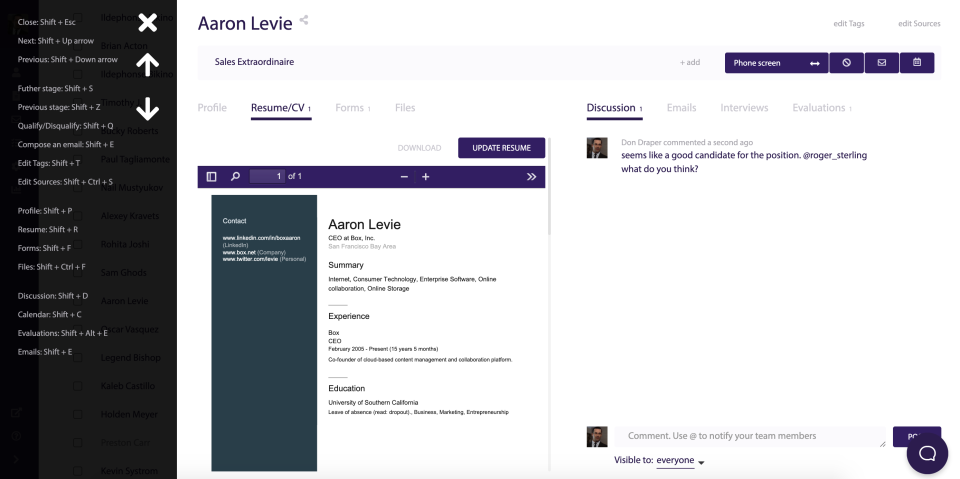
Full disclosure: 100Hires is our product, which is why it sits first on this list. Judge it against the same criteria as everything else here.
100Hires combines the three sourcing jobs in one tool. A Chrome extension captures candidates from 14 sites, including LinkedIn, GitHub, Stack Overflow, and Indeed, straight into the right job. Contact enrichment finds personal emails and phone numbers.
Multichannel outreach campaigns with email warmup handle the follow-ups.
And because it is a full applicant tracking system underneath, every sourced candidate lands in a pipeline you can actually run: interview scheduling, email templates, evaluations, and automations.
Two things about the data model matter. 100Hires does not rent you a pre-loaded pool of stranger resumes the way job boards do.
Instead, every candidate you source builds a searchable, deduplicated resume database you own, with full-text and semantic search across it.
And for contact data it deliberately holds no static database at all: it looks up personal emails in real time across multiple providers, so you are not emailing an address that went stale two job changes ago.
More on how that works in the contact-finder section below.
- What you get: Chrome extension sourcing from 14 sites, contact enrichment across 7 providers, outreach campaigns with warmup, kanban ATS, interview scheduling, AI credits on every plan
- Where it falls short: contact enrichment is a Pro-plan feature, and the enrichment providers bill their lookup costs through your own API keys
- Best for: teams of 1-200 that want sourcing, outreach, and tracking in one flat-priced tool instead of three subscriptions
Pricing (July 2026): Start $49/mo, Advanced $199/mo, Pro $399/mo, billed annually ($99, $249, and $499 month to month). Pricing is flat, not per seat: Advanced and Pro include unlimited users. 14-day free trial, no credit card.
2. LinkedIn Recruiter
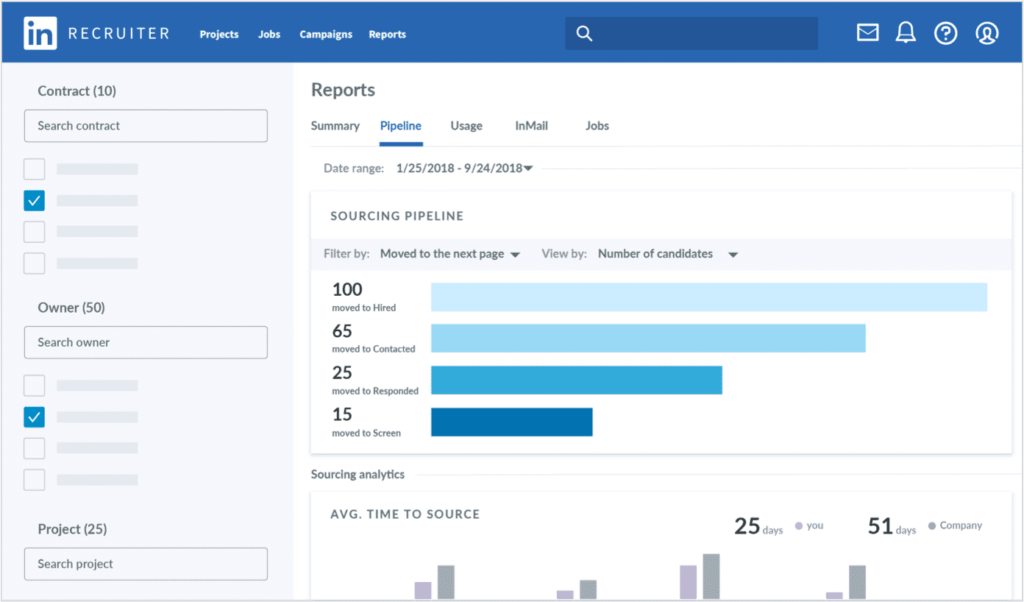
Still the reference point every other sourcing tool measures against, because it searches what candidates entered about themselves this week, not a scrape from last quarter.
Over 40 filters, Boolean search, and the largest active professional network make it the default for hard searches.
The catch is cost and the InMail channel. Recruiter Lite runs $170 per month for a single license, per LinkedIn's own help center, and caps you at 30 InMails a month with no ATS integration.
Corporate seats are quote-only; third-party estimates cluster around $750-900+ per seat per month, and we break the tiers down in our LinkedIn Recruiter cost guide.
Recruiters also report InMail reply rates in the single digits as candidates drown in templated messages.
One less-known trap: on Lite, sourced candidate data belongs to the license, so when a recruiter leaves, their pipeline and message history leave with them; only Corporate keeps data with the company.
- What you get: first-party data on the largest professional network, 40+ search filters, InMail, pipeline features on Corporate
- Where it falls short: per-seat cost scales brutally, InMail response rates keep sliding, and Lite locks your data to the individual license
- Best for: niches where LinkedIn is simply where the talent lives; veteran recruiters argue one seat pays for itself if it drives 3-5 extra placements a year
Pricing (July 2026): Lite $170/mo ($1,680/yr). Professional Services and Corporate are quote-based.
3. Pin
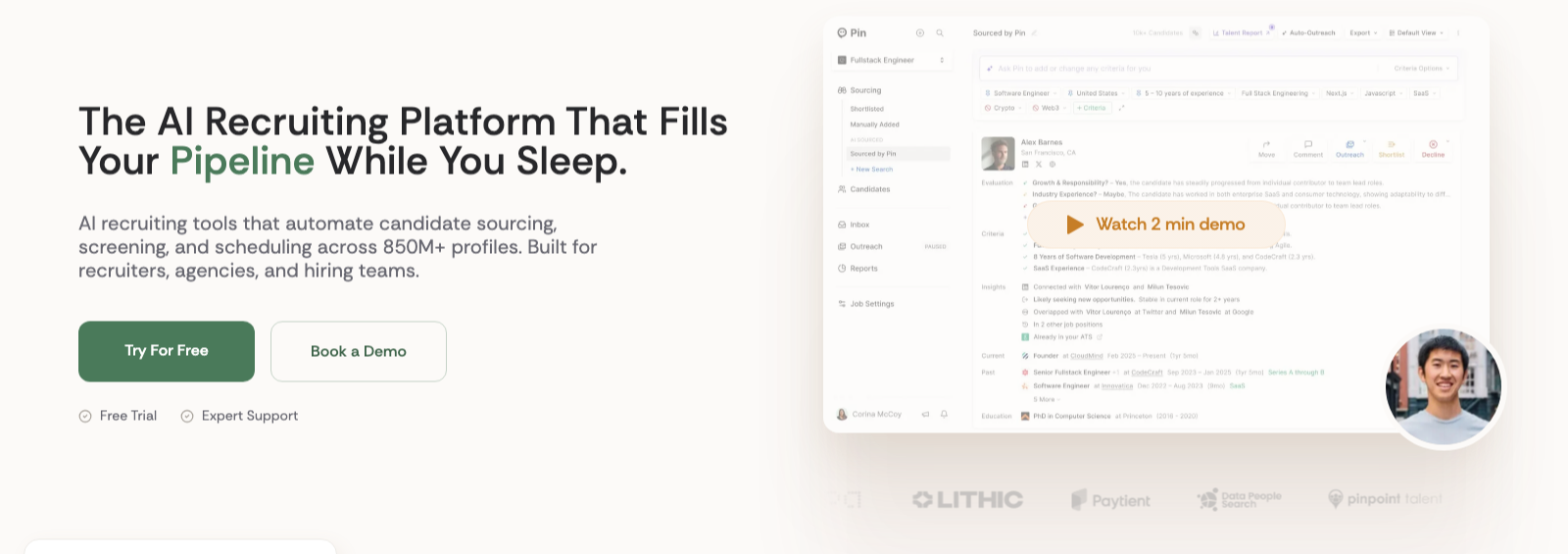
Pin is the newest tool on this list and the one recruiters kept bringing up in 2026 threads, including several who switched over from Juicebox for the lower price and looser project limits.
It is an AI sourcing platform: describe the role in plain English, get a ranked candidate list from a claimed 850M+ profile pool, then run email outreach from the same screen.
The company is young: founded in 2024, a $3M seed round led by Expa, and a small team. That cuts both ways. You get fast product iteration and startup-grade pricing, but a thinner track record than the incumbents; its G2 base is 27 reviews at 4.8.
- What you get: plain-English AI search, automated outreach, ATS integrations without per-integration upcharges, a genuine free tier of 50 sourced candidates a month with no card
- Where it falls short: young company, small review base, and enterprise-grade compliance reviews may want more history
- Best for: solo recruiters and small teams that want modern AI sourcing without a quote-gated contract
Pricing (July 2026, from pin.com): Solo $99/mo, Professional $149/mo, Business $249/mo billed annually ($179 and $299 month to month on the upper tiers). Free tier included.
4. Juicebox (PeopleGPT)
Juicebox, often searched as PeopleGPT, popularized natural-language sourcing: type the brief the way you would say it, and it builds the search.
It pulls from a claimed 800M+ profiles across 30+ sources beyond LinkedIn, including GitHub, Stack Overflow, and Reddit, and creators who test sourcing tools for a living consistently rate it among the strongest AI searches.
The complaints cluster in two places. Entry plans limit concurrent projects, which power users hit quickly, and some report stale or wrong results on deeper searches.
There was also a period where users reported LinkedIn account restrictions tied to extension use, a risk worth understanding before wiring any scraper-extension tool into your daily LinkedIn workflow.
- What you get: best-in-class natural-language search, 30+ data sources, email outreach, ATS integrations on higher tiers
- Where it falls short: project limits on entry plans, occasional data staleness, and its own pricing page currently shows conflicting Starter figures
- Best for: teams that want conversational AI search across sources LinkedIn does not cover
Pricing (July 2026): free tier; Starter's price depends on which part of Juicebox's own pricing page you read. The visible monthly card shows $139/mo, its schema data labels $99/mo as the annual price, and its title tag advertises from $119.
Treat any single Juicebox figure as directional until the vendor fixes the inconsistency; larger plans are quote-based.
5. Gem
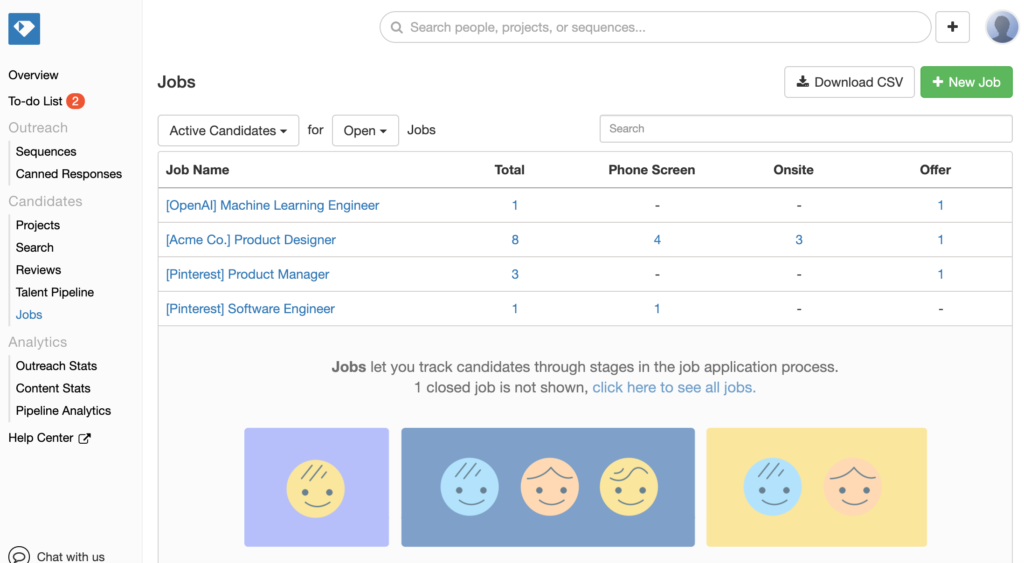
Gem earns the strongest organic word of mouth of any paid tool in recruiter communities.
Its core is a sourcing CRM layered on top of LinkedIn: capture candidates with the extension, enrich their contact details, and run automated multi-step email sequences with open and reply tracking.
Practitioners specifically praise its email-finding accuracy and follow-up automation.
A pattern practitioners repeatedly describe: pairing Gem with a LinkedIn Recruiter Lite seat, using LinkedIn for discovery and Gem for automated, personalized follow-up at scale.
The honest caveat is that Gem shines brightest as an add-on to an existing stack. Users note you get the most value when you already run LinkedIn Recruiter, a corporate email domain, and an ATS it can sync with.
A minority of users also report stale contact data on some segments, a complaint that follows every scraped-data tool in this category.
- What you get: extension-based capture, contact enrichment, sequenced outreach with analytics, CRM projects, ATS sync
- Where it falls short: assumes a LinkedIn Recruiter + ATS stack underneath it, and entry pricing effectively targets companies under 100 employees
- Best for: in-house sourcing teams that live in outreach sequences and want the analytics to prove what works
Pricing (July 2026): the Startup Program for companies up to 100 employees lists around $270/mo, discounted to roughly $130-135/mo on annual billing. Growth and Enterprise are quote-based.
6. hireEZ
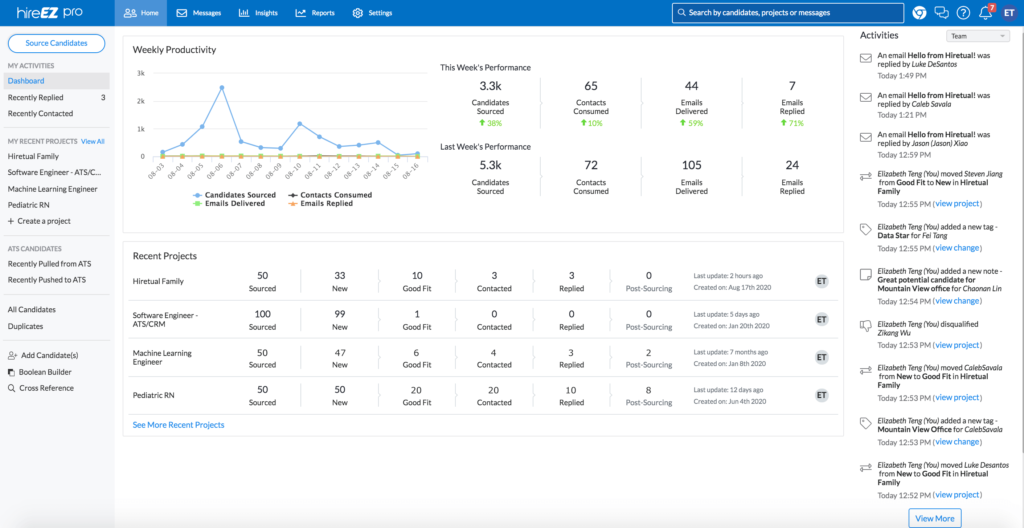
hireEZ (formerly Hiretual) is an outbound recruiting platform aimed at tech and healthcare hiring, with AI search across a claimed 1B+ profiles, an email permutator that helped pioneer automated contact-finding, and sequenced outreach.
Its newer EZ Agent runs semi-autonomous search expansion at no extra platform fee.
Older pages still repeat $169-199 per-user estimates. Those figures do not override hireEZ's current public $494/month starting price for a solo recruiter, and the current page does not disclose the billing commitment or included usage units.
On the data side, G2 reviewers flag contact-data staleness, and Reddit threads echo it with reports of decade-old email addresses surfacing in exports; hireEZ also leans work-email-first, which matters less for sales and more for recruiting, where personal inboxes convert better.
- What you get: deep tech-talent search, email permutation plus verification, sequences, market insights, agentic search on the platform fee
- Where it falls short: contact-data freshness complaints, work-email orientation, and a big gap between grandfathered legacy deals and fresh quotes
- Best for: tech and healthcare recruiting teams doing serious outbound volume
Pricing (July 2026): $494/month starting price for a solo recruiter and a 7-day trial; team and enterprise prices are not publicly listed. See our hireEZ alternatives guide and current pricing evidence.
7. SeekOut
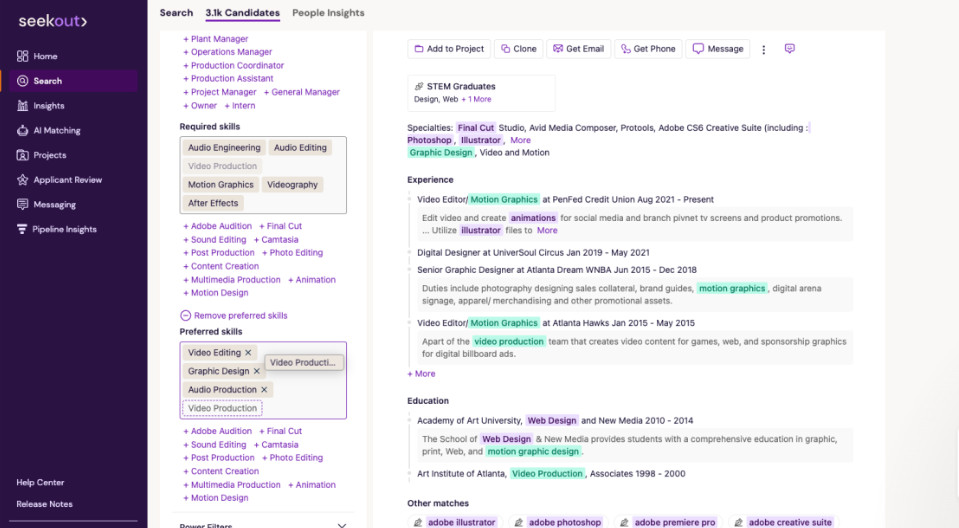
SeekOut remains the specialist for hard technical searches: security-cleared talent, underrepresented candidate filters, and deep engineering profiles assembled from GitHub, papers, and patents alongside the usual sources.
If your searches involve clearance levels or bias-reduction workflows, it still does things the generalists do not.
Two things changed since older lists.
Pricing: the $499/$999/$1,999 tier ladder is gone, replaced by a single self-serve tier called Recruit Core at $149/mo billed annually ($179 monthly) per seekout.com, with team and enterprise plans quoted.
Company: 2026 brought a CEO transition and a reported 30% workforce reduction as SeekOut pivots hard into agentic AI, so factor vendor stability into long contracts.
On data quality, practitioners are blunt: contact info from any scraped-profile tool needs verification before you send, and SeekOut gets its share of those complaints.
- What you get: technical and cleared-talent search depth, diversity filters, people insights, AI-drafted outreach
- Where it falls short: contact-data accuracy complaints from practitioners, and a turbulent 2026 on the company side
- Best for: technical, government, and diversity-focused hiring where its filters are the whole point
Pricing (July 2026): Recruit Core $149/mo billed annually or $179 month to month, 14-day trial; larger plans quote-based. Full comparison with hireEZ in our SeekOut vs hireEZ guide.
8. Fetcher
Fetcher positions itself as done-with-you sourcing: a hybrid of AI search and human curation that delivers batches of vetted candidates to your inbox on a schedule, plus outreach sequencing to engage them.
For teams that want sourcing handled rather than another search box, that service model is the draw.
It ranks on several page-one lists, but practitioner discussion is thin: in the recruiter communities we track, Fetcher appears mostly in passing tool lists rather than hands-on reviews, and its G2 base is small at 28 reviews (4.6).
Treat it as a promising service to trial rather than a crowd-verified pick.
- What you get: curated candidate batches, AI plus human vetting, email sequences, calibration from your feedback
- Where it falls short: little independent practitioner review coverage and a small G2 sample
- Best for: lean teams that want a steady sourced-candidate pipeline without running searches themselves
Pricing (July 2026, from fetcher.ai): Self-serve $115/mo, Growth $379/mo, Amplify $649/mo.
9. SourceWhale
SourceWhale is the agency favorite for outreach execution: multichannel sequences (email, LinkedIn tasks, calls) layered over whatever sourcing you already do.
Its Chrome extension works inside LinkedIn and pulls contact data by waterfalling through popular data providers.
Recruiters credit it for honesty here: it does not claim a proprietary contact database, it orchestrates the ones that exist. At 4.8 on G2 across 270 reviews, it has the strongest large-sample rating on this list.
Pricing is the friction: there is none published. The pricing page itself resolves to a demo-booking form, so budget conversations start with a sales call.
Some practitioners also report middling value relative to cost once the novelty wears off, and it shows up in more than one story about agencies auditing overlapping tool spend.
- What you get: multichannel outreach sequences, LinkedIn-native extension, contact-data waterfall, activity analytics agencies use for accountability
- Where it falls short: no published pricing at all, and mixed value reports at renewal time
- Best for: recruiting agencies running high-volume outbound who want execution tooling over another database
Pricing (July 2026): not published; demo required.
10. Apollo
Apollo is a B2B sales platform, not a recruiting tool, and it makes this list anyway because budget-minded recruiters keep discovering that its contact database plus extension deliver much of what dedicated sourcing tools charge 5-10x more for.
The common pattern: Sales Navigator or plain LinkedIn for discovery, Apollo for the contact data and sequences.
Two caveats. Its workflows and data lean work-email-first because it is built for sales prospecting, and recruiting outreach converts better on personal channels.
And its Chrome extension carries documented LinkedIn account-restriction risk; recruiters in community threads report bans tied to extension use while logged into LinkedIn, so keep the extension out of your main LinkedIn session.
- What you get: a massive B2B contact database, email sequences, dialer, enrichment, all at self-serve prices with a free plan
- Where it falls short: sales-first design, work-email bias, and real ban risk if you run its extension on LinkedIn
- Best for: recruiters comfortable adapting a sales tool to sourcing in exchange for the lowest cost per contact on this list
Pricing (July 2026): free plan; Basic $49/mo billed annually ($59 month to month); higher tiers scale by credits and features.
Finding candidate emails: how the contact-finder layer actually works
Audit failed outreach and the pattern is rarely the search or the message. It is the contact data.
The right candidate with a dead email is zero reach, and practitioners who have cycled through 8-10 email tools report the same thing: every single-source finder claims high accuracy, and every one of them still bounces a painful share of sends.
Recruiting adds a twist that B2B sales tools ignore: you usually want the personal inbox, not the work address, because a poaching pitch to a corporate inbox is somewhere between ineffective and hazardous for the candidate.
The reason single lookups fail is coverage. Each provider's database has different strengths, so experienced sourcers keep four or five finders in rotation and check them manually, one by one, until something verifies. That works.
It is also exactly the kind of repetitive lookup a machine should run.
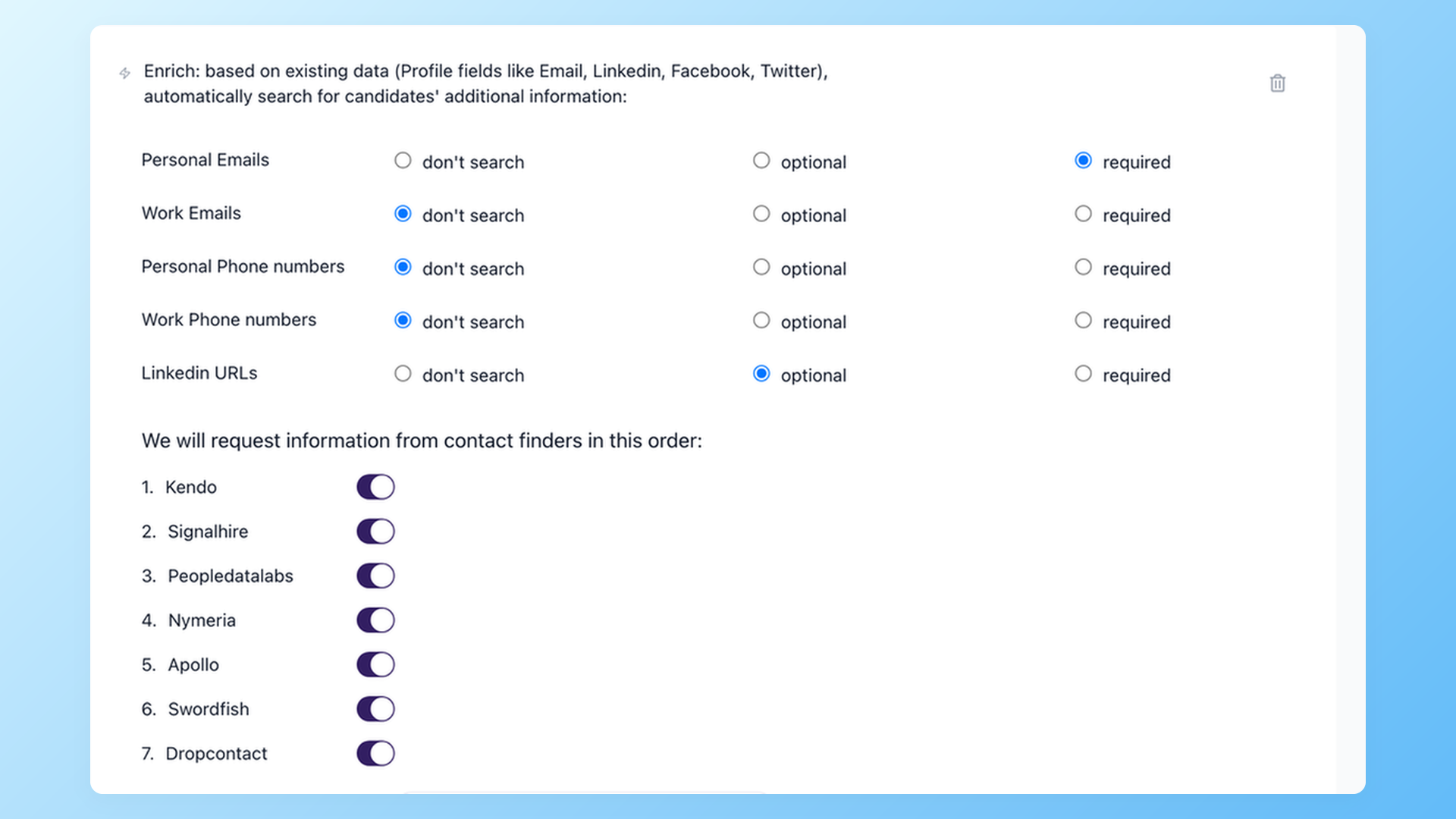
That is what Contact Finder in 100Hires automates.
It runs a waterfall across seven providers (Apollo, SignalHire, Swordfish, People Data Labs, Nymeria, Kendo, Dropcontact): if the first lookup returns nothing, the next provider tries, until a personal email or phone number comes back.
Found contacts are validated through ZeroBounce before any send, saved to the candidate record, and the whole thing can run automatically as a pipeline-stage automation, so candidates entering your sourcing stage get enriched without anyone clicking anything.
A LinkedIn URL is the most reliable input. The waterfall is configurable: you set the provider order, run lookups one by one or all at once, and define stop conditions so it quits calling providers the moment one returns a verified hit.
On success, an automation can move the candidate straight to your outreach stage, so enrichment feeds the pipeline without manual triage. In our internal benchmark, the waterfall found 37% more personal emails than a single-provider lookup.
It runs on your own provider API keys, so lookup costs pass through at cost, and it is included in the Pro plan.
The full mechanics are on the Personal Email Finder page.
If you prefer standalone finders, the two that come up most in recruiter threads are SignalHire and ContactOut. SignalHire has a free tier with limited credits; paid entry typically lands between $57 and $71 a month depending on credit volume.
ContactOut gives 5 free emails a day, with Email at $49/mo and Email + Phone at $99/mo as of July 2026. Many roundups still quote its old $99/$199 list prices.
One recruiter-reported caveat applies to the whole extension category: LinkedIn detects some scraper extensions, and temporary restrictions have been reported first-hand for several tools.
Enrichment that works from a URL through provider APIs, rather than scraping inside your LinkedIn session, does not carry that particular risk.
For the full third-party landscape, see our LinkedIn Recruiter alternatives guide, which profiles the contact-finder category in depth.
Free sourcing tools and workarounds
Before you buy anything, know what free gets you in July 2026. Pin's free tier includes 50 sourced candidates a month. Apollo has a permanent free plan.
ContactOut gives 5 free emails a day, and SignalHire hands out a small monthly credit allowance. 100Hires has a 14-day trial rather than a free tier.
Between free and a full Recruiter seat sits Sales Navigator at about $99 a month, the downgrade path many recruiters take: you keep LinkedIn's search depth and pair it with a contact finder for reach.
The classic zero-budget techniques still work too.
Boolean X-ray search (searching site:linkedin.com/in plus your keywords straight in Google) surfaces profiles no tool subscription required, and joining shared LinkedIn groups lets you message members without InMail credits.
One compliance note recruiters themselves raise: scraping personal contact details via X-ray tricks sits in murky territory under GDPR if you are hiring in Europe, so know your jurisdiction before you build a workflow on it.
And if your company is under about 20 people, honest advice from the community is that you may not need a paid sourcing tool at all: post well, source manually, and spend the budget on the roles instead.
How to choose a sourcing tool
Match the tool to your situation rather than the feature list:
- Solo recruiter or tiny team: Pin Solo, Apollo, or LinkedIn Recruiter Lite if your market lives on LinkedIn
- In-house SMB team that wants one system: 100Hires or Gem, depending on whether you want the ATS built in or already have one
- Agency running outbound at volume: SourceWhale or Gem, with a hard look at total stack cost
- Technical, cleared, or diversity-focused search: SeekOut, with AmazingHiring as a niche alternative for developer sourcing
- Enterprise with procurement muscle: LinkedIn Recruiter Corporate or hireEZ, quoted
Whatever the size, weigh the same six criteria. Data freshness, because scraped profiles age fast and recruiters report large error rates in scraped contact data. Verified-contact hit rate, measured on your own roles during the trial, not the vendor's claim.
Price transparency, since half this market hides pricing behind demos. ATS integration that pushes data both ways. LinkedIn ban risk if the tool runs as a scraper extension.
And data ownership: whether sourced candidates accumulate in a database you keep when you cancel, or evaporate with the license.
The hit-rate test is worth being specific about. During any trial, take 20 real candidates from a live role, enrich them, and count verified personal emails and bounces.
Vendor accuracy claims rarely survive that test unchanged, and the hit rate in your niche is the only number that matters.
Budget note for larger teams: once you leave self-serve tiers, expect quoted enterprise contracts across this category to land in the $8,000-30,000 per seat per year range.
If none of the specialists fit, that last criterion is where an all-in-one like 100Hires quietly wins: everything you source stays yours, in your own searchable database, on a flat price.
Conclusion
Sourcing tooling in 2026 fails in two predictable places: contact data that has gone stale, and outreach that never reaches an inbox. Whatever you pick from this list, trial it against those two failure points with your real roles.
Verify prices on the vendor's page rather than trusting any listicle, including this one; we dated every figure above for exactly that reason.
If you want the whole loop in one tool, 100Hires combines Chrome-extension sourcing, waterfall contact enrichment, warmed-up outreach, and a full recruiting software stack at a flat price. Start a free 14-day trial and test it on a live role.
FAQs
What tools do recruiters use to source candidates?
Most recruiters combine three layers: a search layer (LinkedIn Recruiter or an AI aggregator like Pin, Juicebox, or SeekOut), a contact-finding layer (Apollo, SignalHire, ContactOut, or a waterfall like 100Hires Contact Finder), and an outreach layer with sequencing and warmup.
All-in-one platforms collapse those layers into one subscription.
What is better than LinkedIn Recruiter for sourcing?
Nothing fully replaces first-party LinkedIn data, but for most teams the question is cost.
AI aggregators like Pin ($99/mo) and Juicebox reach candidates who are inactive on LinkedIn, and a Recruiter Lite seat plus a contact finder covers many workflows at a fraction of a Corporate seat, which third-party estimates put around $750-900+ per month in 2026.
How do recruiters find candidates' email addresses?
With contact-finder tools that match a profile (usually a LinkedIn URL) to a personal email or phone number.
Because every provider has partial coverage, experienced sourcers query several providers in sequence.
100Hires automates that as a waterfall across seven providers with ZeroBounce validation, which found 37% more personal emails than single-provider lookups in our internal benchmark.
Are free sourcing tools any good?
Good enough to start. Pin includes 50 free sourced candidates a month, Apollo has a permanent free plan, ContactOut gives 5 free emails a day, and Boolean X-ray search on Google costs nothing.
Free tiers cap volume quickly, but they let you validate a workflow before paying for it.
What is the difference between a sourcing tool and an ATS?
A sourcing tool finds people who have not applied; an ATS manages candidates through your hiring process.
They meet in the middle: sourced candidates need a pipeline, which is why sourcing tools sell ATS integrations and why some platforms, 100Hires included, build both into one system.
What are the best sourcing tools for recruiters?
Based on our July 2026 comparison: 100Hires for all-in-one sourcing plus ATS, LinkedIn Recruiter for first-party data, Pin for budget AI sourcing, Gem for sourcing CRM and sequences, SeekOut for technical and diversity search, and hireEZ for outbound tech recruiting at scale.
The right pick depends on team size, stack, and whether you need contact data, search, or both.
Try 100Hires for free
No credit card. 14-day trial. Forbes Advisor #1 ATS for SMBs.