
Jobvite vs Greenhouse 2026: structured hiring vs recruitment engagement
Jobvite vs Greenhouse comes down to one question: do you want hiring built around structure, or around engagement?
Greenhouse organizes recruiting into a repeatable process. Interview kits, scorecards, and governance sit at the center, and the whole platform pushes teams toward consistent, defensible decisions.
Jobvite wraps the applicant tracker in a recruitment marketing and candidate engagement suite. It puts native CRM, campaigns, referrals, and texting first, and it is sold by Employ Inc alongside JazzHR and Lever.
One thing to know before you read on: the results for this search mix Jobvite's own comparison page with software directories and editorial reviews. Jobvite runs a page arguing against Greenhouse; Greenhouse has no matching page. What follows is a neutral read, drawn from current product documentation, 2026 review data, and practitioner discussions.
Jobvite vs Greenhouse at a glance
The hiring playbook, in your inbox
One email a week - benchmarks, AI screening tactics, and short interview templates from the 100Hires team. No product pitches.
What each one optimizes is what tells them apart. Here is the head-to-head, with the reasoning in the sections that follow.
| Criterion | Jobvite | Greenhouse |
|---|---|---|
| Best for | Mid-market and enterprise teams that want CRM, recruitment marketing, and hiring in one modular suite | Scaling and enterprise teams that want structured, auditable hiring |
| Core idea | Recruiting as marketing: attract, nurture, convert | Recruiting as a repeatable, governed process |
| Structured hiring and scorecards | Available through the AI Interview Companion, but not the product's center of gravity | Core DNA: interview kits and auto-assigned scorecards |
| CRM and recruitment marketing | Broader native marketing suite, though independent CRM scores are mixed | CRM inside the structured pipeline, and reviewers rate it competitively |
| Candidate experience | Branded career sites, mobile apply, texting, nurture | Clean application flow, structured and transparent interviews |
| AI in 2026 | AI Interview Companion and Talent Fit, governed by IBM watsonx across the Employ portfolio | Native voice-AI interviewing (Ezra), a six-feature AI wave, and public bias audits |
| Integrations | Partner integrations across HRIS, payroll, background checks, video, calendar | Hundreds of pre-built integrations plus an open API |
| Pricing model | Custom quote, core ATS plus modules | Custom quote across Core, Plus, and Pro |
| G2 rating | 4.0 from about 660 reviews | 4.4 from about 3,900 reviews |
| Capterra rating | 4.1 from about 570 reviews | 4.5 from about 760 reviews |
| Free trial | No, demo only | No, demo only |
| Implementation | Multi-week, module dependent | Formal, multi-phase project |
Below are the reasons behind those rows, plus two 2026 developments most comparisons still miss. If you already know the shape of your decision, jump to who each one fits.
Feature-by-feature winners and tradeoffs
Neither tool wins everything. The split follows what you are trying to optimize, so here is where each one pulls ahead and where the evidence says it is closer than the marketing suggests.
Structured hiring and interview consistency
Winner: Greenhouse. Interview kits, scorecards that auto-assign when you schedule, standardized rubrics, and a four-point recommendation scale (per Greenhouse's documentation) are the product's spine.
Reviewers on G2 and Capterra single out scorecards and interview plans as the features they would miss most.
Jobvite can run structured interviews through its AI Interview Companion, but the suite is designed around engagement, not process rigor. If consistent, auditable evaluations are the reason you are switching, Greenhouse is built for it out of the box.
CRM, recruitment marketing, and candidate nurture
Contested. This is the ground Jobvite markets hardest: native CRM, multi-touch campaigns, automated talent rediscovery, and social publishing. On TrustRadius, Jobvite scores 9.7 for publish-to-social against Greenhouse's 7.3, its one clear structural win.
Here is the catch. G2's own category comparison reports that reviewers rate Greenhouse higher than Jobvite in candidate relationship management, and no recent review reinforces a Jobvite CRM edge.
Jobvite sells the broader marketing suite, then, but on independent CRM scores the two sit closer than the pitch implies.
AI and screening
Greenhouse has the momentum edge. It acquired a live voice-AI interviewer (Ezra) and announced six more AI capabilities, most still in beta or on the roadmap. The next section covers the detail.
Jobvite offers its AI Interview Companion and Talent Fit scoring today, but Employ takes a deliberately cautious public stance on AI and develops those features across its portfolio using IBM watsonx.
Governance splits between Greenhouse's public statuses and audits and Employ's watsonx controls.
Watch the difference between what is generally available and what is still on a roadmap.
Reporting, analytics, and integrations
Greenhouse wins on integrations; reporting is roughly even. Greenhouse lists hundreds of pre-built integrations and an open API, a real advantage if your stack is wide or you want developer controls.
Reporting is a weakness for both. TrustRadius puts them within half a point (7.5 to 7.0), and Greenhouse draws its own 2026 complaints about reporting being hard to use.
Jobvite advertises 60-plus dashboards, yet complex reporting is its single most common review gripe too. Call it a modest Greenhouse edge on a feature neither has nailed.
Candidate experience has different strengths on each platform
No winner: Greenhouse has fresher evidence. Both genuinely deliver here. Jobvite brings branded career sites, mobile save-and-resume, texting, and pre-application nurture.
Greenhouse brings a clean application flow and structured, transparent interviews that candidates can follow.
The only real asymmetry is timing. Greenhouse's candidate-experience praise shows up in current 2024 to 2026 reviews, while Jobvite's strongest candidate-side reviews are from 2018 and 2019.
Recent reviews support Greenhouse's case more strongly, but they do not prove its candidate experience is actually better.
Reviews and who actually uses each
Greenhouse leads the aggregate scores across the three review sites we checked: 4.4 on G2 versus 4.0, 4.5 on Capterra versus 4.1, and 8.4 on TrustRadius versus 7.1. It also carries far more review volume, which makes its average more stable.
The demographics break a common myth. The companies in Jobvite's reviewer base are generally larger than those in Greenhouse's, with about half of Jobvite's reviewers at 1,000-plus employee firms against roughly a quarter of Greenhouse's. Neither is an SMB tool.
Both serve mid-market and enterprise buyers.
The product changes most comparisons miss
If you are reading a comparison written before mid-2026, it is missing the two developments that should shape this decision.
None of the ranking pages we could reach covered Greenhouse's Ezra acquisition, its MCP, or its June 2026 launch, and two more results were behind bot walls we could not open.
Greenhouse went all in on structured AI
Greenhouse announced its acquisition of Ezra AI Labs on May 5, 2026 and closed it on May 27. Ezra is a voice-AI interviewer that runs structured, on-demand screening conversations at the top of the funnel, and it keeps publishing monthly independent bias audits.
It stays available as a standalone product too.
On June 10, Greenhouse announced six more AI capabilities. The one worth understanding is the Greenhouse MCP, now in open beta.
MCP lets a recruiter manage the applicant tracker through an AI assistant such as Claude or ChatGPT, creating candidates and retrieving data with conversational commands instead of clicking through screens. It is an early sign of where enterprise trackers are heading.
Greenhouse also became the first applicant tracker to integrate LinkedIn's Hiring Assistant, which LinkedIn says saves recruiters about 1.5 hours per role. Treat that number as a vendor claim, not a measured result.
Keep the statuses straight. Ezra is live. The MCP and a new analytics chart builder are in open beta. A notetaker was slated for mid-July, report insights for August, and two agent features for later in the year.
All of this quietly answers the claim on Jobvite's own comparison page that Greenhouse leans on third-party integrations for basic AI. That is no longer true, and Greenhouse's current pricing page now lists Talent Matching in the entry Core tier.
Jobvite is one of three trackers under Employ Inc
Jobvite remains an actively sold product in Employ Inc's portfolio, which also includes JazzHR for smaller teams and Lever for growth-stage companies. Employ positions Jobvite as its sophisticated, enterprise tier.
In February 2026, Jerry Jao became Employ's CEO, and he said the portfolio now serves more than 26,000 companies.
The AI is built at that portfolio level. Employ develops Talent Fit scoring and the AI Companions under IBM watsonx governance, then releases them across JazzHR, Lever, and Jobvite, though availability differs by product.
The AI Interview Companion is generally available now; the screening and sourcing companions are marketed but have not yet shipped under the Jobvite brand.
In practice, Jobvite follows Employ's shared AI roadmap, with features released across all three products. That is a governance strength and a real point of confusion, since practitioners regularly ask whether the three brands are being kept separate.
For the record, Jobvite is based in the United States, operated by Denver-based Employ Inc.
Greenhouse is built around structured hiring
Greenhouse assumes you want hiring to be repeatable and easy to audit. That assumption runs through everything.
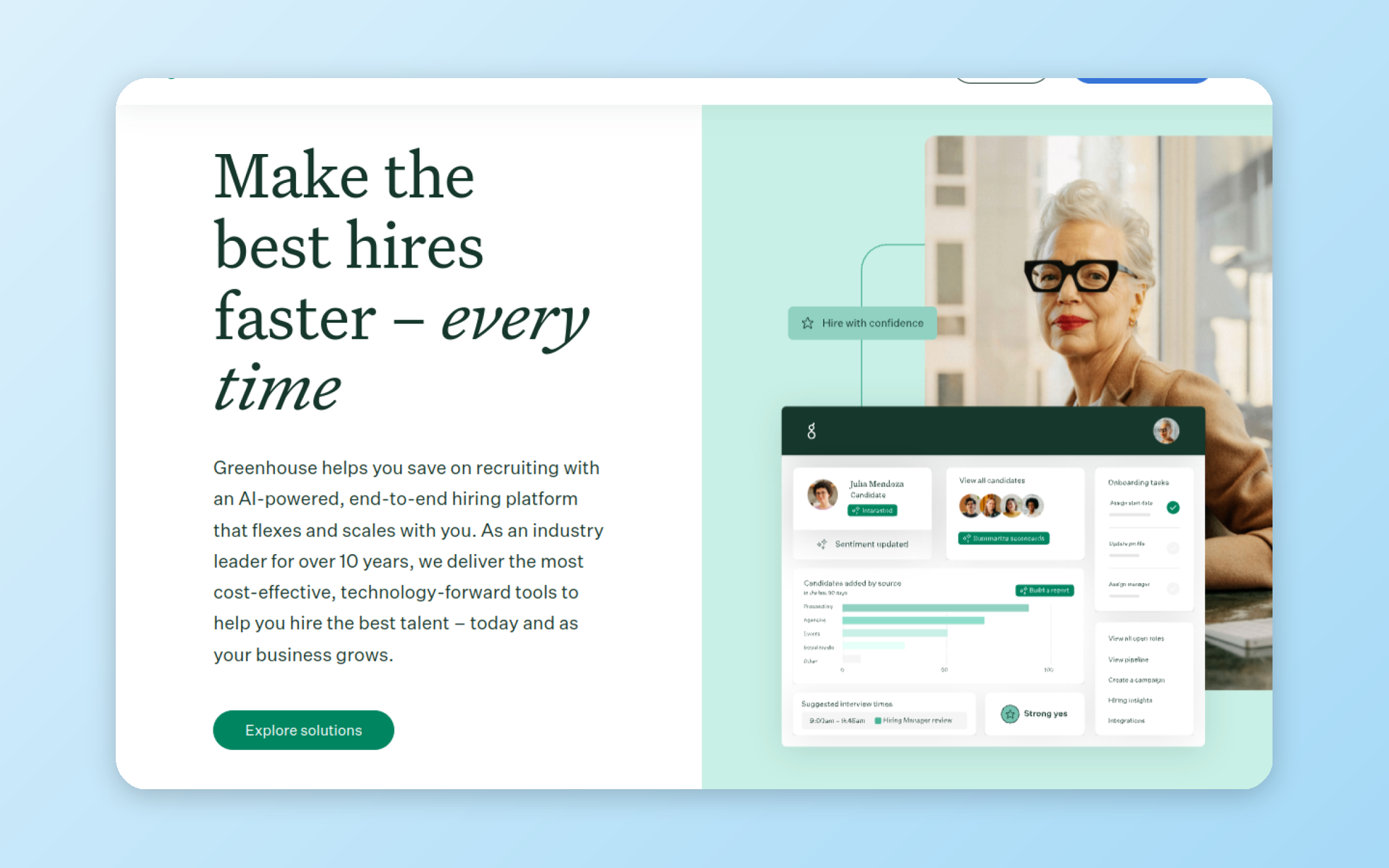
Interview kits and scorecards assign themselves when you schedule an interview. A four-point recommendation scale keeps feedback comparable across interviewers.
Governance and permissions let a large team stay consistent, and the integration marketplace and open API make it the hub of a wide recruiting stack. Among the vendors here, Greenhouse also has by far the strongest analyst and executive presence.
It is not friction free. Power users have complained loudly since a 2024 interface change, with one long-time admin describing routine actions that suddenly needed several more clicks. Its own reporting drew fresh 2026 reviews calling it hard to use.
Cost and implementation burden also deter smaller teams. Jobvite is not the small-team default, though; its reviewer base skews even larger.
You hear both sides in real buying conversations. Recruiters call Greenhouse the gold standard they wish they could keep, then leave it at renewal because the price outgrew the team. Structured interviewing itself is not a Greenhouse quirk, by the way.
It is one of the better-supported ideas in hiring research, and groups like SHRM recommend structured interviews built around consistent, job-related questions.
Jobvite is built around recruitment engagement
Jobvite treats recruiting like a marketing funnel. The goal is to attract, nurture, and convert candidates, and Jobvite carries features for each stage.
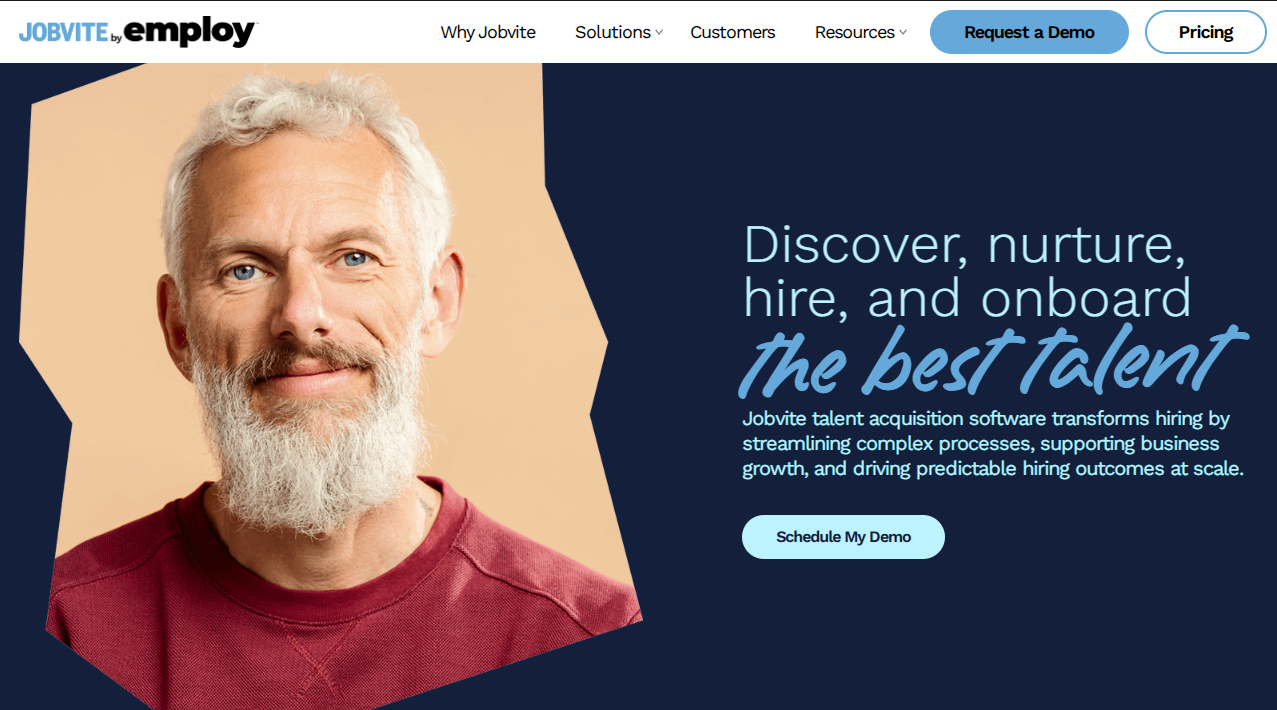
You get native CRM and recruitment marketing campaigns, branded career sites built to convert more applicants, an employee referral engine, candidate texting, job broadcasting, internal mobility, and the 60-plus analytics dashboards Jobvite advertises.
You buy it in modules, so you can start with the core tracker and add only what you need. That suits high-volume and compliance-heavy enterprise programs, which is where Employ aims it.
The weak spots are real. There are fewer recent independent reviews of Jobvite than of Greenhouse, so its current practitioner record is quieter, not absent, and not a sign of active dislike.
The most recent independent review we found is a blunt implementation warning about a rollout that never fully launched. Reporting is a common complaint, and Jobvite's brand visibility faded even before Employ formed as its parent company in 2022.
Watch the CRM claim in particular. Jobvite markets its CRM breadth as a headline strength, yet the independent scores do not uniformly back a win over Greenhouse there, so weigh the demo against the review data.
Pricing is quote-only for both platforms
Neither vendor publishes prices. The plan and licensing models below are official; every dollar figure is buyer-reported or directory-reported and directional. Treat each number as a data point, not a quote you will get.
- Official model. Both use custom pricing. Greenhouse sells Core, Plus, and Pro, and its pricing page ties the quote to plan tier, hiring volume, and organizational complexity. Jobvite sells a core tracker plus modules and licenses by employee count, and its product terms include a renewal cap around inflation plus 5 percent, subject to order-form exceptions.
- What buyers report. Buyer-reported Greenhouse data from PriceLevel centers on a median annual contract near $12,250, with deals ranging from roughly $5,000 to $36,000 by company size and enterprise contracts running past $70,000. Buyers also say Greenhouse quotes track their headcount. Jobvite has no reliable public range at all.
- Individual contracts. These are single anecdotes, not typical pricing. One team pays Greenhouse about $11,000 a year at roughly 25 employees, rising to $14,000 with AI added; another was quoted $27,000 at 190 employees. On the Jobvite side, a 1,000-employee nonprofit reported a renewal moving from $65,000 to $85,000.
- Directory estimates. These disagree with each other, which is the point. Jobvite shows up as $400 a month on one directory and $500 on another; Greenhouse appears as $6,500 to $12,500 a year on a third. They are republished and old, so use them only to see how little the directories agree.
Two cautions. Do not read the low $5,000 to $6,000 Greenhouse figures as a typical entry price; they are small-deal or older data points, and the reported median sits closer to $12,000.
Setup fees differ too. TrustRadius says Greenhouse requires a setup fee while Jobvite does not, so the two vendors do not charge for implementation the same way.
The better fit depends on your operating model
The choice is less about company size, since both skew toward enterprise buyers, than about what your hiring operation is missing today.
Choose Greenhouse if
- Structured hiring is the mandate, and interview consistency and auditability matter
- You have, or want to hire, a recruiting-ops owner to configure kits, scorecards, and governance
- You need a deep integration marketplace and developer controls
- You want AI positioned around transparency and human decision ownership
- You can absorb enterprise implementation weight
The caveat: budget and interface friction get real once your team drops below the scale Greenhouse is priced for.
Choose Jobvite if
- Recruiting is a full marketing and engagement function, not just a pipeline
- You want CRM, recruitment marketing, career sites, referrals, texting, and analytics in one modular suite
- You run high-volume or heavily regulated hiring
- You prefer to buy modules incrementally rather than all at once
- Portfolio-level AI governance through watsonx appeals to you
Watch out for: a thinner independent user voice, older interface complaints, and implementation that can run long.
100Hires covers the self-service operational gap
We make 100Hires. It was not part of the independent evidence used for the Jobvite and Greenhouse comparison, so verify what follows on G2 or Capterra rather than taking our word for it.
Here is where it fits. Both products ask for a particular commitment: Greenhouse needs someone to configure its structure, and Jobvite needs a willingness to procure modules one at a time.
If you have neither, and you hire in bursts rather than continuously, both platforms may hand you more system than you need. That is the gap 100Hires is built for.
You get transparent pricing from $49 a month on the annual Start plan, with a 14-day trial and no credit card. AI Score and AI Copilot are included in every plan rather than restricted to a higher tier, as parts of Greenhouse's AI are on Plus and Pro.
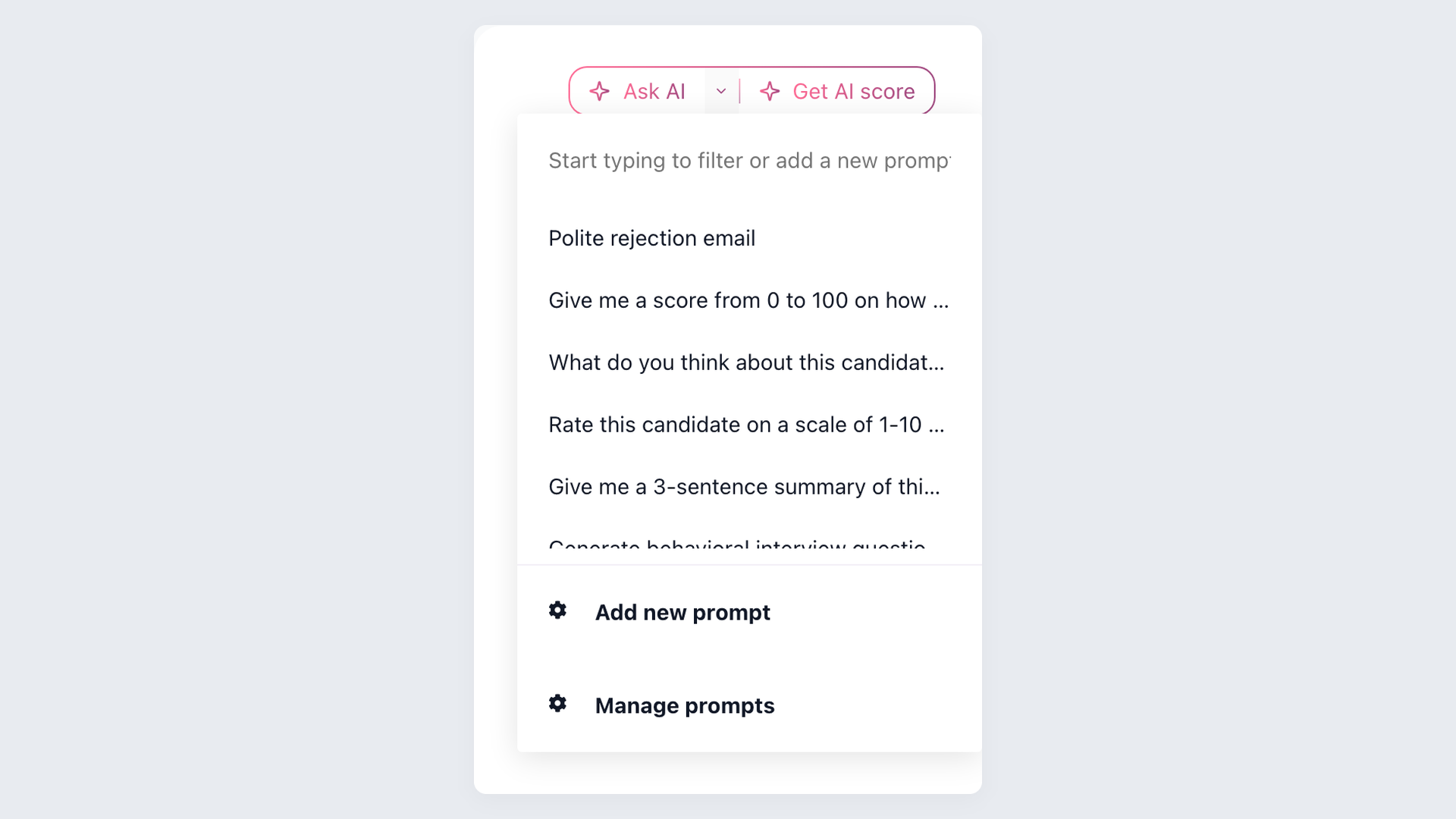
AI Score rates each candidate from 0 to 100 against your own criteria, with a per-criterion breakdown; AI Copilot answers plain-English questions using the candidate and job information already in 100Hires.
Forbes Advisor named 100Hires best for startups and small businesses at 4.8 out of 5.
The limits are just as clear. 100Hires is not built for 500-plus employee enterprise workflows, its integration catalog is smaller (33 listed on G2), and its reporting and governance are lighter than Greenhouse's.
If you need that enterprise depth, one of the two platforms above will serve you better. If you want structured screening and outreach without an enterprise contract, start a free trial and see whether it fits your workflow.
Frequently asked questions
Which is better for a small team, Jobvite or Greenhouse?
Neither, honestly. Both Jobvite and Greenhouse lean mid-market and enterprise. Jobvite's reviewer base actually skews larger, with about half at 1,000-plus employee companies against roughly a quarter for Greenhouse, so a small team usually pays for structure or breadth it will not use. That is the gap 100Hires fills, with structured screening and AI scoring from $49 a month on the annual Start plan and a 14-day free trial.
Who owns Jobvite and Greenhouse?
Jobvite is owned by Employ Inc, which also runs JazzHR and Lever, and Jerry Jao became Employ's CEO in February 2026. Greenhouse is majority owned by the private equity firm TPG, following its 2021 investment. Both remain actively developed. If ownership or portfolio shuffles make you wary of a long enterprise buying process, 100Hires runs on a self-serve trial you can start without a sales call.
Is Greenhouse or Jobvite cheaper?
Neither publishes prices, so a clean comparison is hard. Buyer-reported Greenhouse contracts center on a median near $12,250 a year and climb well past $70,000 at enterprise scale, while Jobvite has no reliable public range at all. If price transparency matters to you, 100Hires lists its plans openly from $49 a month, so you know the number before you talk to sales.
Do Jobvite or Greenhouse offer a free trial?
No. Both Jobvite and Greenhouse are demo-only, so you have to book a sales call to see the product in your own workflow. 100Hires runs a 14-day free trial with no credit card required, so you can test AI Score and AI Copilot on real candidates before committing.
What ATS is similar to Jobvite and Greenhouse but simpler?
100Hires covers the same core hiring work, structured evaluations, AI screening, and candidate management, without the enterprise implementation project or the quote-only pricing. It is aimed at teams that want to move fast rather than configure a suite. If you are weighing other pairings, our Workable vs Greenhouse and Jobvite vs SmartRecruiters comparisons cover adjacent options.
Try 100Hires for free
No credit card. 14-day trial. Forbes Advisor #1 ATS for SMBs.