Workable vs Greenhouse: which ATS actually fits your team in 2026
Workable and Greenhouse keep landing on the same ATS shortlist, and they rarely belong there together.
One sells a fast start: published prices, a 15-day trial, and a system you can run yourself the same week. The other sells structured hiring depth for mid-market and enterprise teams, behind a sales call and a guided rollout.
So the real Workable vs Greenhouse question is not which tool has more features. It is which stage your company is at, and whether you want to buy software or adopt a hiring operating system.
To settle it, we read the freshest 2026 reviews on Capterra and G2, both vendors' own documentation and pricing pages, and dozens of practitioner threads. Here is what the evidence says, starting with the short version.
Workable vs Greenhouse at a glance
The hiring playbook, in your inbox
One email a week - benchmarks, AI screening tactics, and short interview templates from the 100Hires team. No product pitches.
| Criteria | 100Hires | Workable | Greenhouse |
|---|---|---|---|
| Entry price | public $49/mo annual ($99/mo month-to-month) | public $299/mo | custom quote |
| Free trial | 14 days, no card | 15 days, no card | none |
| Setup | same-day, self-serve | self-serve | guided implementation |
| AI model | AI Score and AI Copilot on monthly AI credits bundled into plans | Workable Agent, paid per credit | base AI on all tiers, advanced AI on Plus and Pro |
| G2 rating | 4.8 (1,341 reviews) | 4.4 (705 reviews) | 4.4 (3,923 reviews) |
| Capterra rating | 4.9 (1,157 reviews) | 4.4 (661 reviews) | 4.5 (763 reviews) |
| Best for | SMBs under ~200 employees | SMB and mid-market teams that want self-serve speed | structured hiring at 500+ employees |
Ratings above come from G2 and Capterra as of July 2026. Prices come from each vendor's public pricing page on the same date; Greenhouse publishes tier names only, no numbers.
The bottom line: Workable wins on speed to launch and price transparency. Greenhouse wins on structured hiring depth and reporting scale.
And if your team is under roughly 200 employees, both may have more platform features than you need; that gap is exactly what 100Hires was built for.
Which should you pick at your company stage
Most comparison pages describe personas in prose. A table is faster. Find your row.
| Your situation | Pick | Why |
|---|---|---|
| First ATS, under 50 employees | 100Hires or Workable | Both launch self-serve in a day; choose based on budget ($49 vs $299 entry, annual) and whether you need Workable's sourcing database |
| 50-200 employees, steady hiring, no recruiting ops role | 100Hires or Workable | No implementation project, no admin burden; Greenhouse depth would sit unconfigured |
| 200-500 employees, dedicated TA team, building structured process | Greenhouse becomes justifiable | Interview kits and scorecards start paying for the setup effort at this scale |
| 500+ employees with a recruiting ops function | Greenhouse | Its natural habitat: 26% of its G2 reviewers work at 1,000+ employee companies, compared with 2% for Workable |
| Hiring slowed or company got smaller | Re-evaluate everything | You may be paying for depth your team no longer needs; see the right-sizing section below |
The reviewer-size split in that fourth row comes from G2 review-demographic data we track, and it tells the whole story: these two products pull from different ends of the market and only overlap in the 100-500 employee band.
Workable: what real users say
Where Workable shines
Speed is the headline. Workable publishes its prices, hands you a 15-day trial without a card, and lets a non-technical HR manager go live without a consultant. In fresh Capterra reviews from 2026, onboarding and support come up as consistent strong points.
G2's comparison data backs that up with sub-scores: reviewers rate Workable ahead of Greenhouse on ease of use (9.0 vs 8.5), ease of setup (8.6 vs 8.1), and ease of admin (8.8 vs 8.4) as of July 2026.
The feature set covers more ground than most SMB tools: one-click posting to 200+ job boards, a sourcing database Workable says holds 400 million profiles, e-signatures, and video interviews (sold as a paid add-on).
Recruiters in community threads describe it as simple, quick, and easy for executives to read.
Where Workable falls short
The most repeated complaint in 2026 Capterra reviews is AI screening accuracy. Reviewers describe scores that skip parts of the job description, rankings weighted toward attributes the hiring team never prioritized, and CV assessments they had to re-check by hand.
Teams we talk to at 100Hires echo the same doubt about how smart the scoring feels in practice.
Reliability gripes recur too: job-board integrations that occasionally fail to post paid ads, and email sending slow enough that some recruiters send messages manually instead.
Watch the bill as well. The $299 entry price is honest, but video interviews, texting, and assessments are paid add-ons, and the Workable Agent AI screener bills per credit on top of any plan. Reporting depth gets flagged as thin by reviewers scaling past basic pipelines.
Two more facts for specific buyers: Workable hosts data in US data centers only, which EU employers need to check against their compliance posture, and a handful of candidates have reported impersonation abuse involving its application flow in community threads.
Greenhouse: what real users say
Where Greenhouse shines
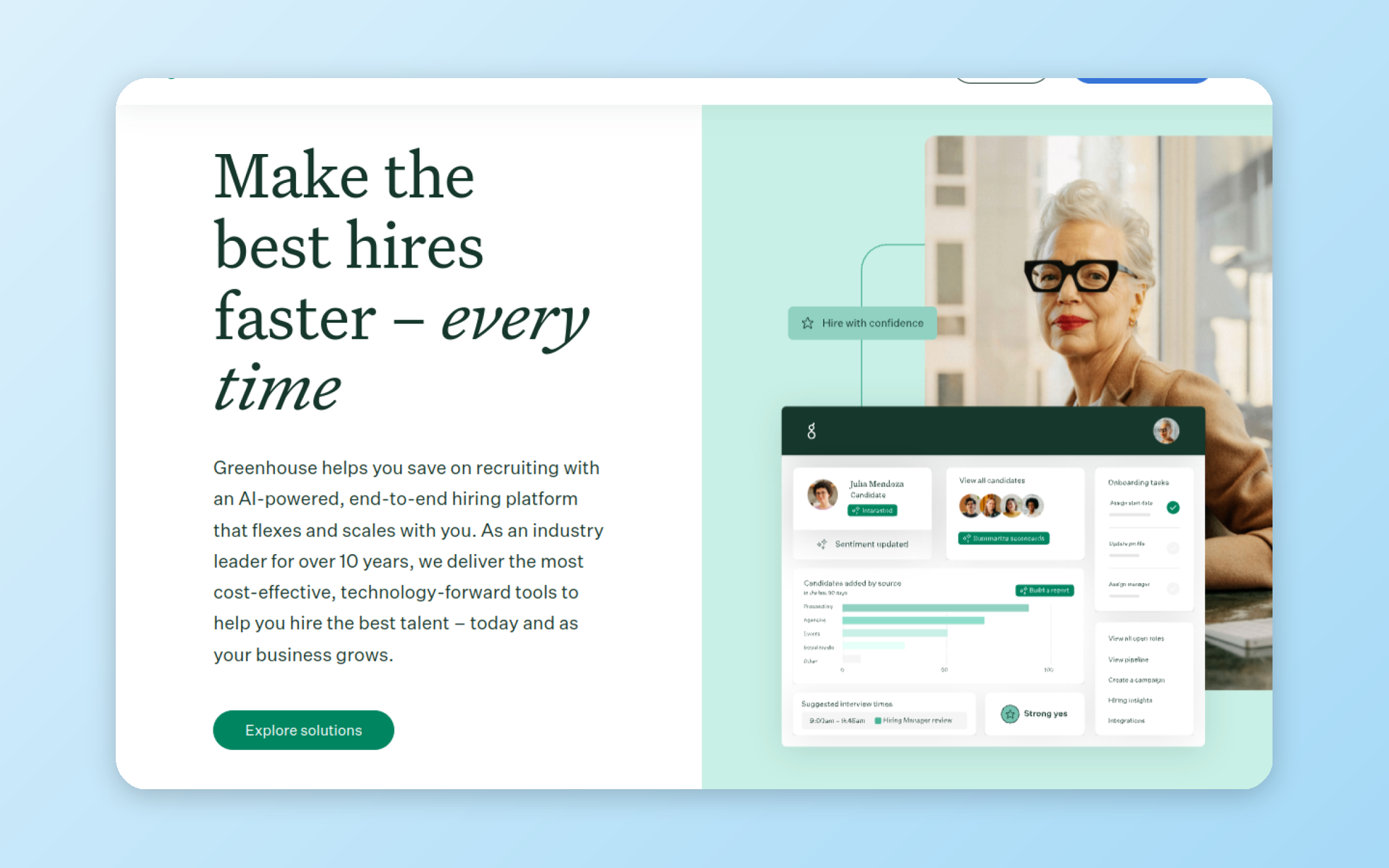
Greenhouse's edge over Workable is process depth. Interview kits, scorecards, and role-specific evaluation stages enforce a consistent hiring bar across every interviewer, in a way Workable does not attempt.
That depth is why companies adopt it, and why setup takes longer.
Practitioners keep bringing up one candidate-facing detail unprompted: applicants apply right on the job page, no account creation, no click-through maze. Recruiters cite it as a sign of how much the product thinks about candidate experience.
Support holds up at scale. In fresh Capterra reviews, Greenhouse support draws positive mentions at a higher rate than Workable's, a surprise given how much larger its customer deployments run.
And the product is moving again on AI. Greenhouse's own documentation confirms base AI tools are available on every tier, and the company announced five new AI capabilities in June 2026, rolling out through the third quarter.
Greenhouse says it serves 7,500+ companies, including HubSpot, Coinbase, and the NFL.
Where Greenhouse falls short
The sharpest complaint in 2026 reviews targets reporting. Reviewers describe the analytics experience as dated and rigid, and in recent Capterra feedback the criticism was heavily one-sided, with only occasional praise for the high-level reports.
For a product positioned on data-driven hiring, that stings.
Usability splits by role. Recruiters and admins who live in the system daily call it intuitive.
Hiring managers who touch it weekly describe extra clicks and buried actions, and even long-time daily users pushed back publicly when a recent UI update turned one-click actions into four.
Then there is the buying experience. Greenhouse publishes no prices; its own pricing page answers the cost question with an invitation to contact sales.
Buyers on Reddit's recruiting community report quotes from $6,000 to $27,000 per year depending on headcount, and there is no trial to test before that conversation.
Implementation is a formal, guided, multi-phase project per Greenhouse's own docs. For a 500-person rollout that structure is a feature. For a 40-person team it is overhead.
Feature-by-feature: where each one wins
Pricing and what you actually pay
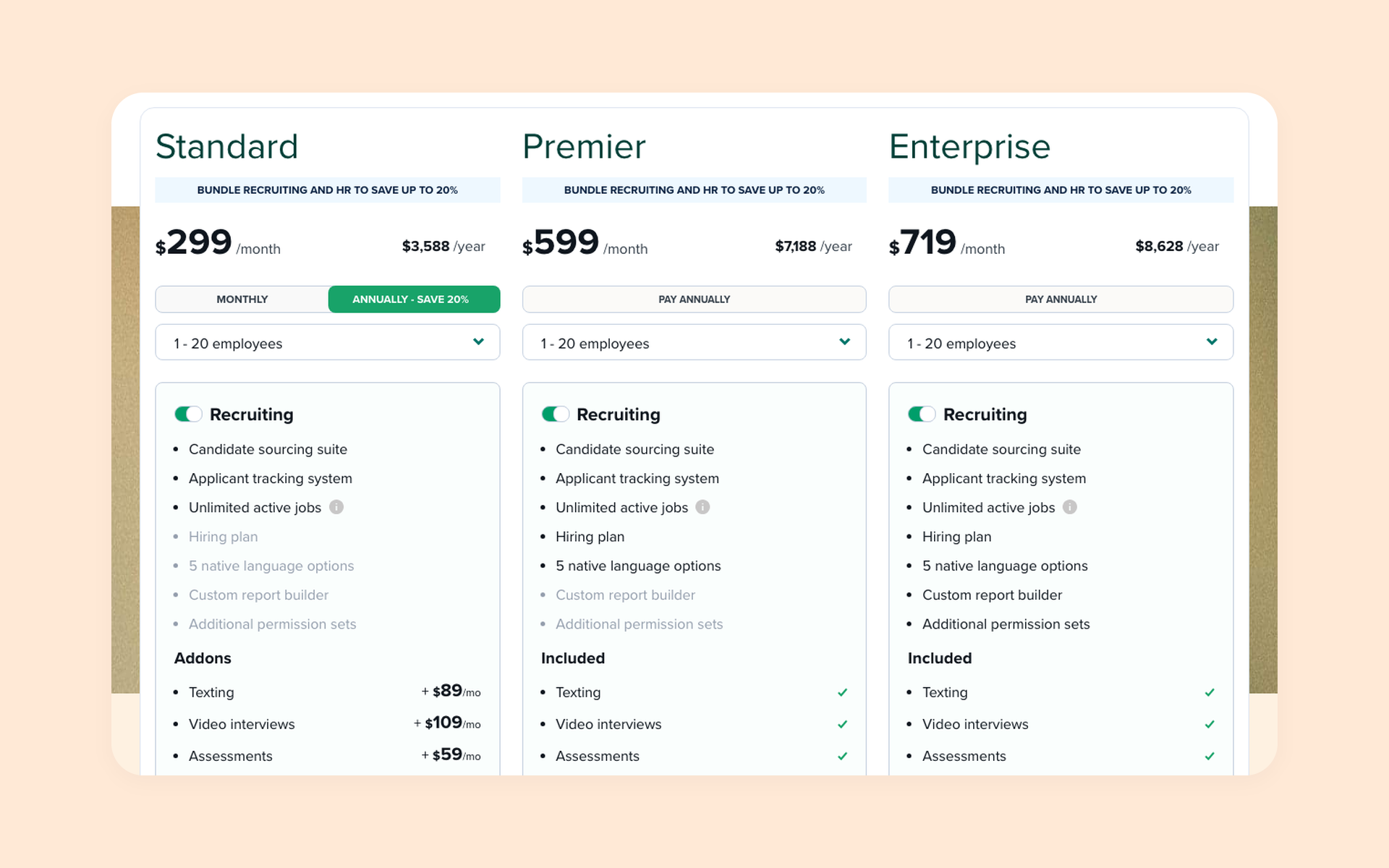
Workable's pricing page lists $299, $599, and $719 per month tiers as of July 2026. Greenhouse's page lists tier names (Core, Plus, and Pro) and no prices. That difference in disclosure shapes the entire buying experience.
The honest caveat cuts both ways. Workable's real bill grows with add-ons and AI credits, so the sticker is a floor, not a ceiling.
Greenhouse's negotiated quote bundles most of its AI and features into one number, so buyers report totals from $6,000 for small teams to $27,000 per year around 190 employees.
Winner: Workable for price discoverability. Value for money at scale is a tie that depends on your negotiation.
AI features and how you pay for them
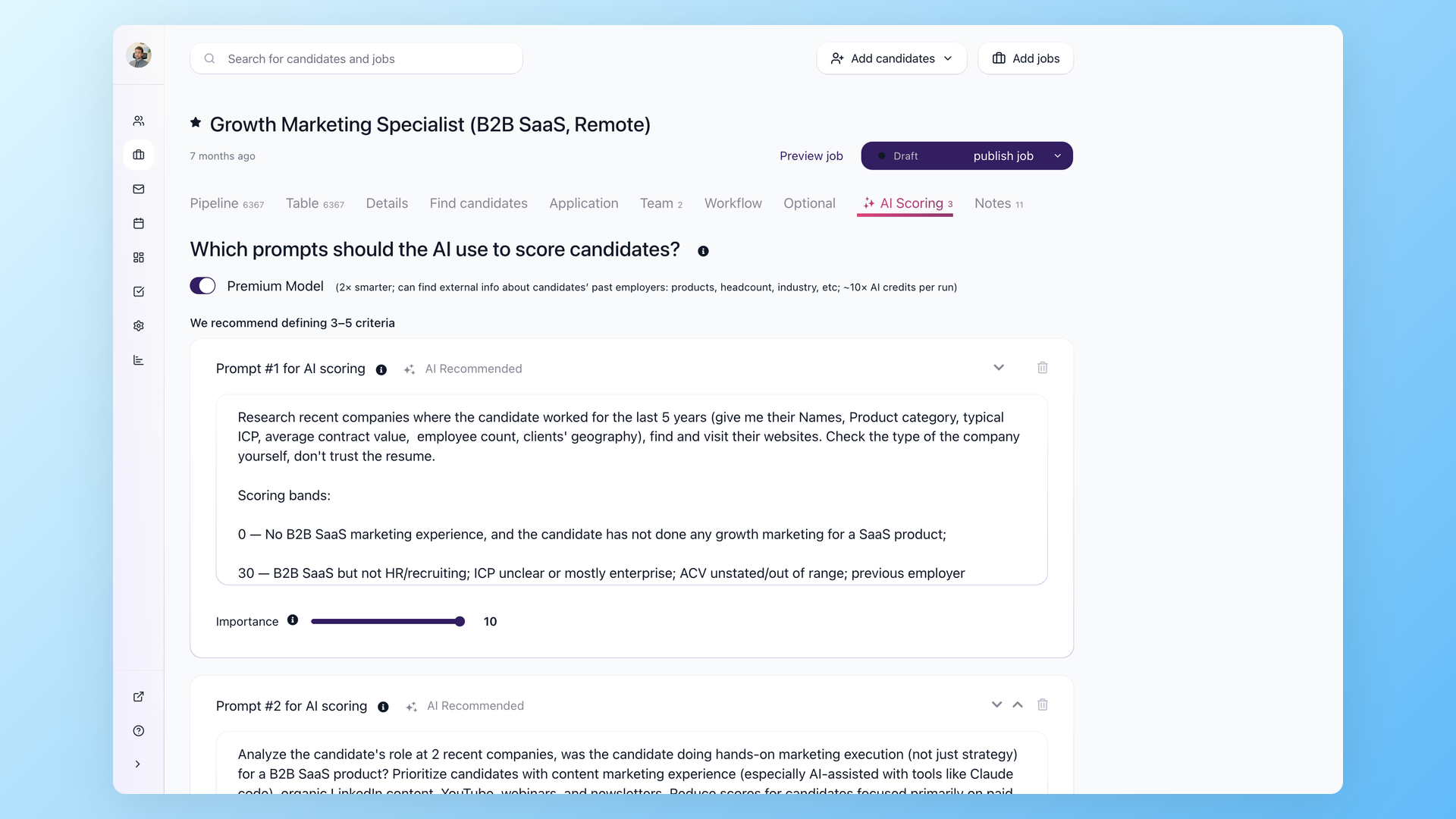
Nobody in the top search results compares this, and it changes the math. Workable charges for AI by usage: the Workable Agent screener runs on credits, priced around $0.095 to $0.12 per credit with 3,000 free to start, on top of any plan. Screen heavily and the meter runs.
Greenhouse folds AI into tiers. Scorecard summaries, interview question suggestions, and notes summarization are available on every tier, per its documentation.
Talent Matching and natural-language reporting need Plus or Pro, resume anonymization needs Pro, and Sourcing Automation is a separate add-on.
Neither model is wrong. Credits fit spiky hiring; bundles fit predictable enterprise budgets. Just price your actual screening volume before choosing.
Winner: depends on volume. High-volume screening on credits gets expensive; light usage makes Workable's model cheaper than an enterprise contract.
Candidate experience
Good news first: neither tool forces candidates to create an account to apply. Both vendors' docs confirm login-free application flows. Greenhouse adds an optional MyGreenhouse portal, an account-based layer for candidates who want to track their applications across employers.
Practitioner sentiment tilts toward Greenhouse here: the apply-on-the-job-page flow keeps earning unprompted compliments from recruiters. Workable counters with a mobile-first apply experience and wide job distribution to 200+ boards.
Winner: Greenhouse, narrowly, on apply-flow polish.
Reporting and analytics
Greenhouse has the deeper toolkit, and it is getting deeper: Greenhouse Analytics entered open beta in June 2026 with calculated fields and an AI chart builder, per its release notes.
The catch, per fresh reviews, is that day-to-day users find the current reporting experience dated and inflexible.
Workable promotes a refreshed reporting suite, yet reviewers repeatedly call its reports thin once teams need more than pipeline counts. Both vendors know this is a weak spot; only one of them has an enterprise data model underneath.
Winner: Greenhouse on depth, with a real modernization caveat its own users keep raising.
Implementation and onboarding
Workable is self-serve: trial on Monday, live pipeline by Friday, no implementation team involved. Greenhouse runs a guided, phased implementation with training, per its own onboarding docs, and you meet sales before you meet the product.
Match the path to your team. A recruiting ops lead rolling out scorecards across a dozen departments wants the guided path. An office manager filling a handful of roles this quarter does not.
Winner: Workable for speed, Greenhouse for enterprise rollouts.
Integrations and ecosystem
Greenhouse claims 400+ pre-built integrations plus an open API, and it maintains a public monthly release-notes archive going back years.
Workable's own marketing videos cite 270+ integrations, but it publishes no count on its partner page, and product updates appear only inside the logged-in app.
Winner: Greenhouse, on both catalog size and public transparency.
Pricing breakdown by team size
| Company size | 100Hires (public) | Workable (public + usage) | Greenhouse (reported quotes) |
|---|---|---|---|
| ~10 employees | $588-$1,188/yr | $3,588/yr entry | rarely quoted; reported ~$6,000/yr floor |
| ~50 employees | $2,388/yr (Advanced annual) | $3,588-$7,188/yr + add-ons | reported $6,000-$12,000/yr |
| ~200 employees | $2,388-$4,788/yr | $7,188-$8,628/yr + add-ons and AI credits | reported $15,000-$27,000/yr |
| ~500 employees | usually outgrown; see limitations below | $8,628/yr + usage | custom quote, reported $45,000/yr and up |
100Hires and Workable figures are public list prices as of July 2026. Greenhouse figures are estimates assembled from buyer-reported quotes in community threads and our own published research; treat them as ranges to sanity-check a quote, not list prices.
The pattern to notice: Workable's curve is visible upfront and creeps with usage. Greenhouse's is negotiated and tracks headcount. Full 100Hires plans are on our pricing page.
Are you still the right size for your ATS
In sales conversations at 100Hires we keep meeting the same two teams, and no comparison article seems to cover either one.
The first adopted Greenhouse at 600 employees, shrank to under 200, and still pays enterprise money for scorecard workflows that have sat unconfigured since the recruiting ops lead moved on.
The product did not get worse. The company stopped being the kind of customer Greenhouse is built for.
The second dropped Workable to fold hiring into an HR suite bundle and save money, lost the recruiting features they actually used, and came back shopping within a year.
Hiring volume moves more than software contracts do; national hires data from the Bureau of Labor Statistics swings year to year, and your ATS should match this year's volume, not your peak. Right-sizing down is not failure. It is just buying for the company you are now.
When neither Workable nor Greenhouse is the right fit
Full disclosure: 100Hires is our product, and it did not show up in any of the external channels we analyzed for this keyword.
We include it for one reason: teams under roughly 200 employees that want structured hiring and AI screening without an enterprise contract or a usage meter fall into the gap between these two tools, and that is exactly the segment we build for.
Verify us independently on G2 or Capterra.
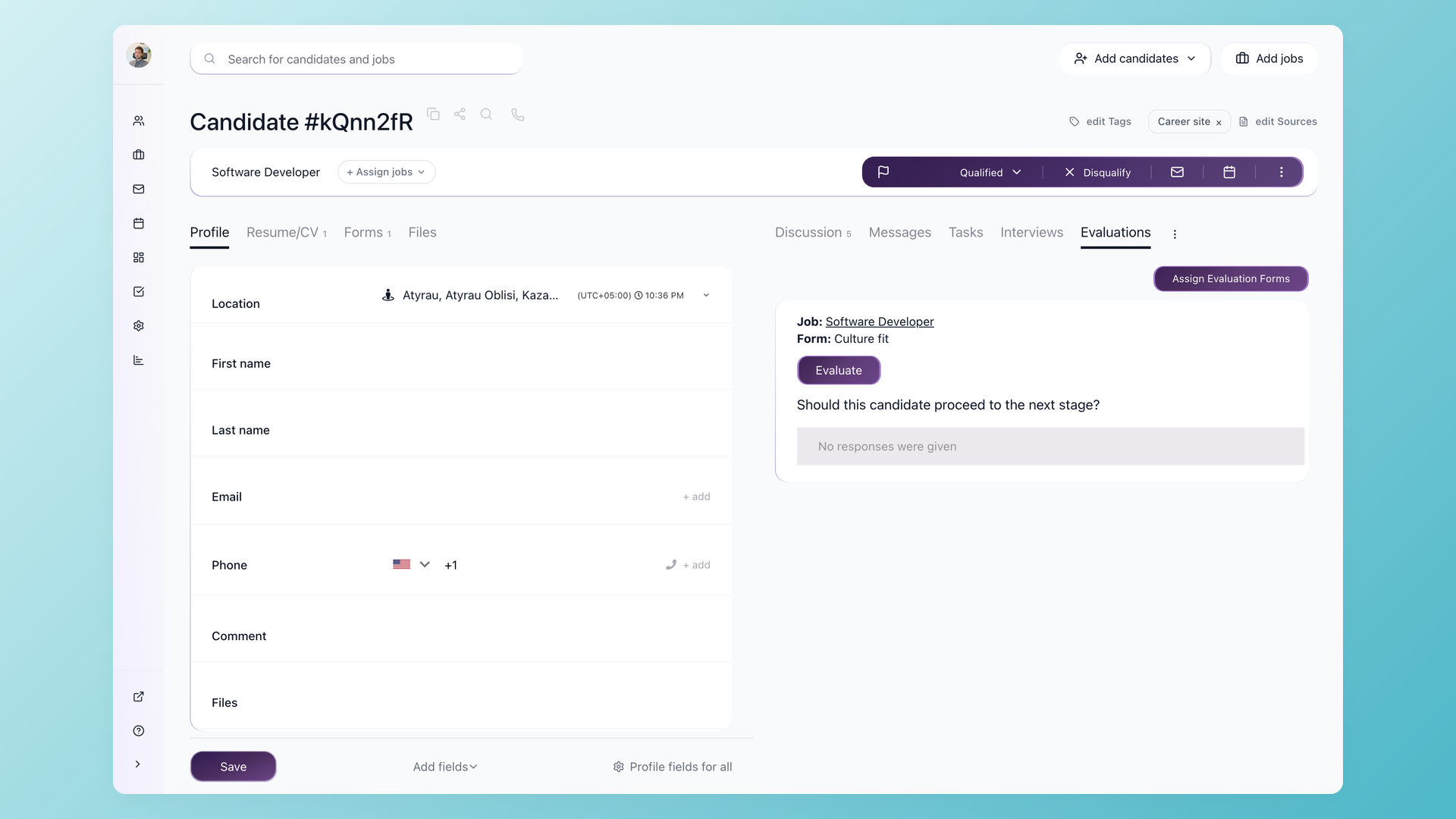
Here is the concrete fit. AI Score ranks every applicant against criteria you define per job, running on monthly AI credits that come bundled with every plan, so there is no separate credit pack to buy the way Workable Agent requires.
AI Copilot works alongside AI Score to summarize and analyze candidates, and AI Email Composer drafts the outreach.
The proof is third-party: Forbes Advisor named 100Hires the best ATS for startups and small businesses, and reviewers rate it 4.8 on G2 across 1,341 reviews and 4.9 on Capterra as of July 2026.
Pricing is public and flat: from $49/mo billed annually ($99/mo month-to-month), with unlimited users on the Advanced plan, a 14-day trial without a card, and same-day setup.
And the honest limits: 100Hires is not built for 500+ employee structured-hiring programs, it has no outbound sourcing suite in the same class as Greenhouse's Sourcing Automation, and its integration catalog is smaller than either tool's.
If those are your requirements, buy the tool built for them.
If they are not, start a free 14-day trial and run it against your next real opening.
FAQ
Is Workable cheaper than Greenhouse?
Usually, yes. Workable publishes plans from $299/mo, and Greenhouse sells custom quotes that buyers report starting around $6,000/yr and climbing with headcount. Add-ons and AI credits can narrow the gap at high volume. For small teams, 100Hires undercuts both with public plans from $49/mo billed annually ($99/mo month-to-month) and monthly AI Score credits bundled in, no separate credit packs.
Does Greenhouse have a free trial?
No. Greenhouse offers demos through its sales team, with pricing disclosed in the quote. Workable has a 15-day trial, and 100Hires gives you 14 days with no credit card, so you can test AI Score on a live job before paying anything.
What are the cons of using Workable?
Fresh 2026 reviews flag AI screening accuracy as the top complaint, followed by occasional job-board integration failures, slow email sending, thin reporting, and add-on costs that grow the real bill. Data is hosted in US data centers only. Teams that mainly want sharper screening often shortlist 100Hires for AI Score, with monthly credits bundled into every plan.
Is Greenhouse a good ATS?
For structured hiring at 500+ employees, it is one of the best: deep scorecards, strong support, and an active 2026 AI roadmap. Reviewers do describe its reporting interface as dated, and there is no public pricing or trial. Smaller teams often get the structure they need from 100Hires without the enterprise contract.
What ATS is similar to Greenhouse?
Ashby and Lever are the closest rivals recruiters actually debate, and we compared both in our Ashby vs Greenhouse and Lever vs Greenhouse breakdowns. For smaller teams, 100Hires covers the same structured-hiring basics, scorecards included, at SMB pricing.
Greenhouse vs Workable: which is better for a small business?
Between the two, Workable is the better fit: self-serve setup, public pricing, and a trial beat a quote-only enterprise product for small teams. That said, many small businesses need fewer platform features and more screening help, which is where 100Hires fits, with AI Score, unlimited users on Advanced, and plans from $49/mo billed annually ($99/mo month-to-month).
Try 100Hires for free
No credit card. 14-day trial. Forbes Advisor #1 ATS for SMBs.