
Workable vs ZipRecruiter 2026: ATS or job board? - 100Hires
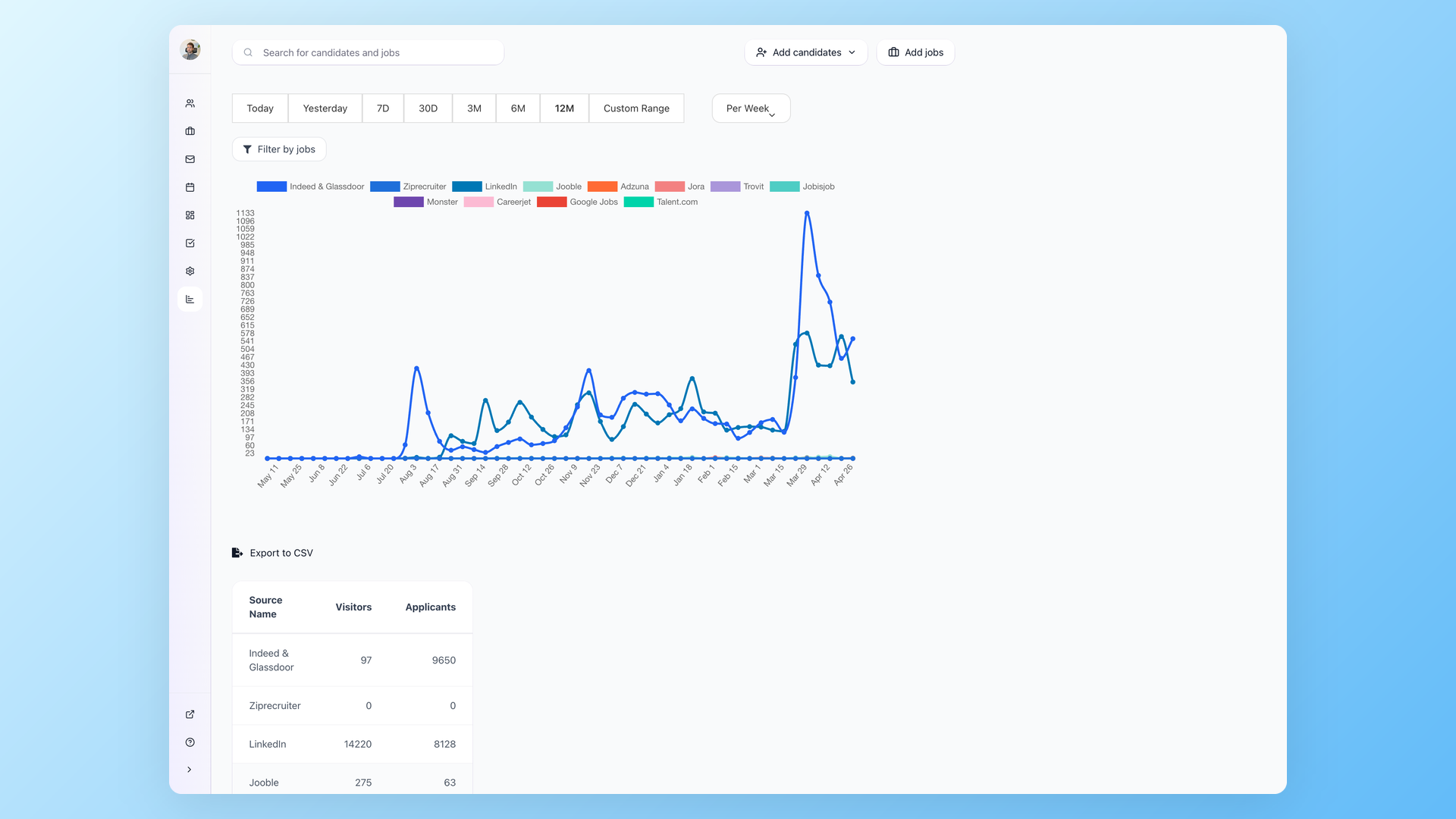
If applicant flow is the bottleneck, upgrading your ATS may not fix it. If the process stalls after applicants arrive, another job board may only create more applications to organize.
That is the real Workable vs ZipRecruiter decision. Workable is the fuller applicant tracking system. ZipRecruiter is primarily a job marketplace with lighter applicant-management tools.
Choose by the layer you are missing: structured hiring operations, applicant reach, or both. Lean teams that need outbound sourcing and follow-up have a fourth option in 100Hires.
We reviewed current product material, ZipRecruiter's public filings, employer discussions, product demonstrations, and 100Hires documentation. User reports and vendor outcomes are treated as directional, not universal.
Workable vs ZipRecruiter at a glance
The hiring playbook, in your inbox
One email a week - benchmarks, AI screening tactics, and short interview templates from the 100Hires team. No product pitches.
Workable is the stronger choice for running a repeatable hiring process. ZipRecruiter is the stronger choice when a specific role needs marketplace reach and your current workflow is already sufficient.
Using both is a valid outcome. Workable can remain the system of record, and ZipRecruiter can supply reach, provided one tool owns each posting and every application returns to a defined workflow.
| Criteria | 100Hires | Workable | ZipRecruiter |
|---|---|---|---|
| Primary category | ATS with distribution and outreach | Full ATS and sourcing suite | Job marketplace with light applicant management |
| Best for | Lean teams combining inbound and outbound recruiting | Structured, collaborative hiring operations | Applicant reach for defined roles and markets |
| System of record | Yes | Yes | Suitable for lighter employer workflows |
| Direct marketplace reach | No, distributes to external boards | No, distributes through external channels | Yes, this is its core role |
| Pipeline depth | Full candidate pipeline | Full candidate pipeline | Review, rating, and status handling |
| Automation and outreach | Workflow automation and multistep outreach | Recruiting automations and sourcing | Matching and candidate invitations |
| Pricing visibility | Current pricing page | Public, selector-dependent prices | Flexible structures, no verified public dollar rate |
| Trial | 14 days, no credit card | 15 days, no credit card | No current trial term verified for this article |
| Main limitation | Not a marketplace and cannot guarantee demand | More system and budget than a simple reach need requires | Not verified as equal to a full ATS in workflow depth |
- Choose Workable when stages, interviews, collaboration, reporting, and a durable candidate record are the constraint.
- Choose ZipRecruiter when applicant reach is the constraint and your existing process can handle the response.
- Use both when you need a full ATS plus a marketplace channel for selected openings.
- Consider 100Hires when a lean team wants ATS workflow, distribution, automation, and outbound outreach together.
This table is not a scorecard. A “yes” in two columns can describe very different depth. For example, applicant handling in a marketplace is not automatically equal to a configurable hiring pipeline.
The reverse is true. Workable includes sourcing and distribution; ZipRecruiter includes employer workflow. Compare each product's center of gravity and the depth your team will actually use.
The distinction separates distribution from demand. An ATS may publish a job to an external channel, but the channel still controls its audience, visibility rules, sponsored products, and applicant supply.
The key difference is a hiring system versus a reach channel
The products overlap in job publishing and applicant handling. That narrow overlap is why they appear in the same search, but it does not make them substitutes for the same buying job.
Workable organizes the hiring operation: jobs, profiles, pipelines, interviews, evaluations, communication, automation, and reporting. Distribution sits inside that broader system.
ZipRecruiter starts from the other side. Its core role is matching employers with job seekers through a marketplace, then helping employers invite, review, rate, contact, and advance applicants.
ZipRecruiter does use ATS language. In ZipRecruiter's public filing, it describes applicant capture and status management for employers without an established process.
So “job board versus ATS” is a useful shortcut, but “marketplace with light applicant management versus full ATS” is more accurate. Our recruiting software guide explains the wider category.
The practical test is simple: if applications already arrive but the team loses context after intake, evaluate the ATS layer. If the pipeline is orderly but too quiet, evaluate the reach layer.
If both problems exist, sequence still matters. Stabilize the application destination and review process before adding volume, then add reach with source tracking turned on from the first campaign.
This prevents a common false conclusion. A channel can look weak when follow-up was slow. An ATS can look weak when too few suitable applicants entered it. Measure each layer on the job it controls.
Workable is the fuller ATS for structured hiring
Workable is designed to hold the process together after a role is approved. Current product material covers candidate profiles, custom pipelines, scheduling, calendar sync, interview kits, reporting, automations, talent CRM, and API access.
That breadth matters when recruiters, hiring managers, and interviewers need one view of a candidate. It matters when the team wants consistent stages and decisions across several vacancies.
A full ATS earns its place by reducing operational ambiguity. The recruiter should know the next step, the interviewer should know what to evaluate, and the hiring lead should see why a candidate advanced.
- Before the trial: map one real approval, interview, offer, and rejection path.
- During the trial: invite the managers who will actually review candidates.
- After the trial: check reporting, candidate search, exports, and the integrations the process depends on.
Workable supports sourcing and job distribution. Those capabilities do not turn it into a marketplace. They bring acquisition channels into a broader ATS workflow.
That distinction affects ownership. The job, application form, stage history, interview evidence, and final disposition can live in Workable even when an external board introduces the applicant.
The tradeoff is that a full system asks for more budget and implementation attention than a simple job-ad need. Teams should test one representative role with the people who will review, interview, and report on candidates.
Practitioner evidence raises questions worth testing: filtering effort, customization, reuse of candidates from closed jobs, and rigidity as a process grows. These are directional concerns, not defects every customer will experience.
Workable fits when the missing layer is a durable hiring operation. If that category is right but Workable is not, compare other Workable alternatives against the same real workflow.
Do not evaluate only the recruiter view. Ask a hiring manager to score a candidate, find interview context, request a change, and explain the final decision. The system must work for occasional users too.
ZipRecruiter prioritizes reach with light applicant management
ZipRecruiter's employer value begins with access to its marketplace. A job can trigger matching, candidate invitations, distribution, and employer search of a job-seeker database.
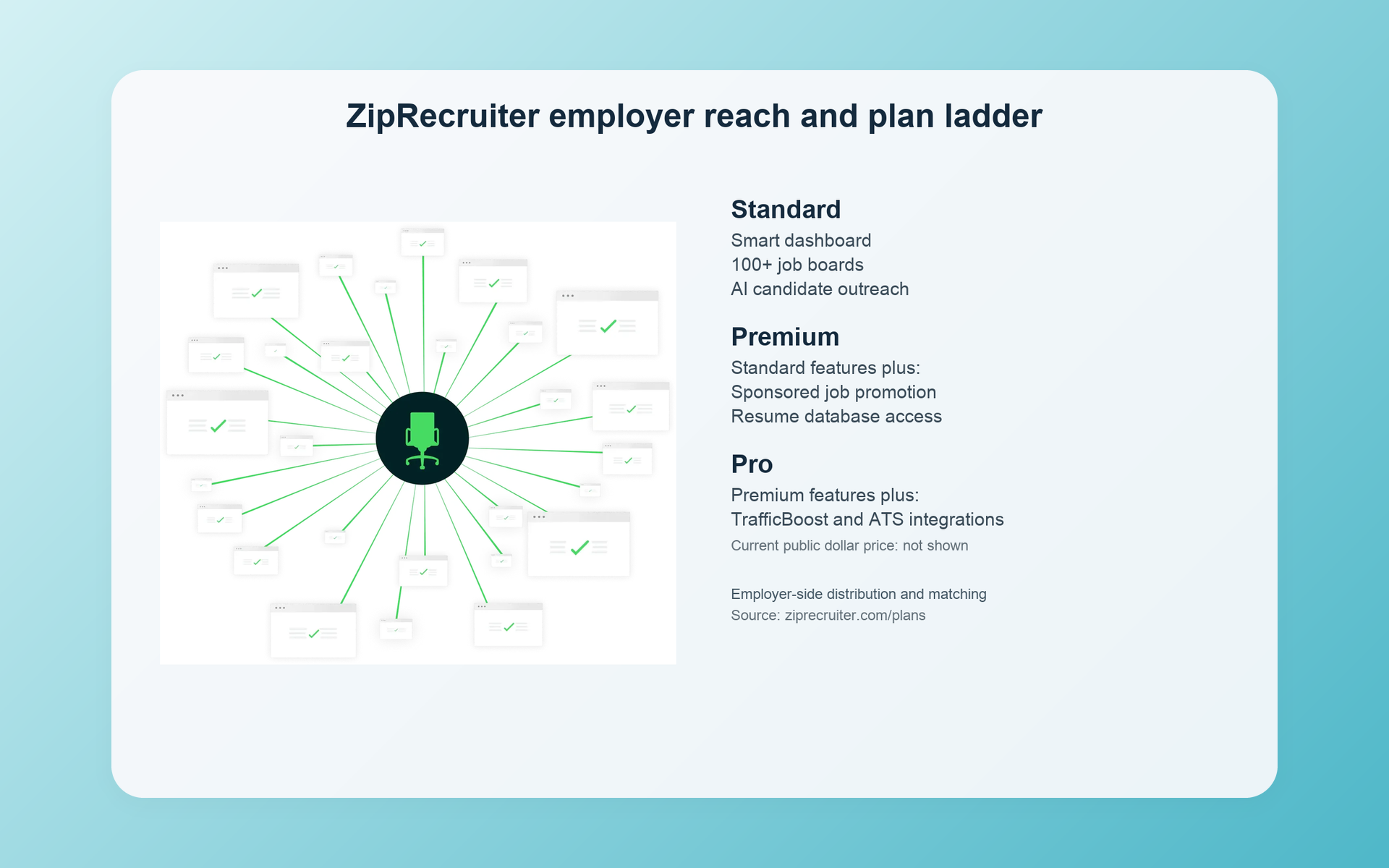
Its filing describes applicant capture, review, rating, status changes, and movement toward hire. That can be enough for an owner or small team with a short, simple process.
ZipRecruiter can sit alongside an ATS. Its filing says applicants can populate certain third-party ATS workflows, so an employer can use the marketplace for acquisition without making it the long-term candidate record.
The evidence reviewed for this article does not establish the same depth in custom hiring workflows, shared evaluation, automation, reporting, onboarding, or integrations that Workable documents.
That is a scope boundary, not a claim that an unverified feature is absent. Direct ZipRecruiter product pages were blocked during research, so current product claims come from its public filing rather than incomplete web captures.
Employer reports about applicant quality were mixed and role-specific. Results can change with location, title, pay, job details, budget, and how quickly the team reviews and contacts applicants.
Judge a marketplace with downstream metrics rather than impressions alone. Count applicants who meet the minimum criteria, interviews scheduled, offers accepted, recruiter review time, and total channel spend.
- Which roles and locations are included in the test?
- What does the quoted term buy: time, access, postings, or performance?
- Where will applications and source data land?
- Who will review and contact applicants during the campaign?
ZipRecruiter fits when net-new reach is the purchase. If you are comparing the mechanics of multiposting, feeds, and source control, start with our job distribution software guide.
Set a response-time target before the test begins. Marketplace value is hard to judge if promising applicants wait in a queue as the team debates who owns the first response.
Workable vs ZipRecruiter feature by feature
The most useful feature comparison follows the applicant from acquisition into the hiring process. It distinguishes verified capabilities from assumptions based on a category label.
| Criteria | 100Hires | Workable | ZipRecruiter |
|---|---|---|---|
| Applicant reach | External-board distribution | External-board distribution and sourcing | Direct marketplace reach |
| Candidate workflow | Full pipeline | Full pipeline | Light applicant handling |
| Screening focus | Job-specific AI Score and workflow rules | Structured ATS evaluation | Marketplace matching, review, and rating |
| Communication | Stage automation and multistep outreach | Scheduling and ATS communication | Invitations and applicant contact |
| Reporting | Pipeline and source attribution | ATS reporting | Marketplace and applicant handling context |
| Best fit | Lean inbound plus outbound teams | Structured hiring teams | Employers prioritizing reach |
Job distribution and applicant reach
Edge: ZipRecruiter for direct marketplace reach. ZipRecruiter is the only product in this comparison whose primary category is the marketplace itself.
Workable and 100Hires can send jobs into external channels, then keep applicants tied to an ATS record. That solves distribution and workflow, but it does not guarantee demand on any board.
This distinction matters when a vendor lists many destinations. A distribution connection tells you where a job may appear. It does not prove how many qualified applicants a role will produce there.
For a fair test, give every channel the same role definition and qualification rules. Then compare progression beyond the application rather than the top-of-funnel count alone.
Candidate records, pipelines, and collaboration
Edge: Workable for full ATS depth. It is built around structured stages, candidate profiles, interview activity, and a shared process across the hiring team.
100Hires is a full pipeline option for lean teams that want candidate tracking alongside distribution and outreach. We base this description on current 100Hires product documentation.
ZipRecruiter documents review, rating, and status management. That may serve a simple employer workflow, but its public filing does not establish Workable-level collaboration and process depth.
A system of record should make old decisions usable. Before buying, test whether the team can find a past candidate, understand the prior evaluation, and consider that person for a new role without rebuilding context.
Screening and matching
Different jobs: ZipRecruiter helps match and invite marketplace candidates. Workable helps a team screen and evaluate people inside a structured hiring process.
100Hires AI Score adds a 0 to 100 job-specific screening signal inside its pipeline. It can help prioritize review, but it is not proof that one platform produces better hires.
The buyer should test both steps separately. First, does the channel find plausible applicants? Second, can the hiring system apply consistent criteria and preserve the evidence behind each decision?
Use a sample of accepted and rejected profiles during evaluation. Check whether the ranking or screening logic helps reviewers focus without hiding borderline candidates who deserve human judgment.
Scheduling and candidate communication
Edge: Workable for repeatable team communication. Current official scope includes scheduling and calendar sync inside the ATS workflow.
ZipRecruiter's filing supports direct invitations, applicant contact, and status changes. A current vendor social post describes scheduling, but we did not treat that post as an independently verified product claim.
100Hires supports stage-triggered communication and multistep outreach. That is useful when follow-up must continue after the application, or when the team recruits passive candidates.
The workflow test should include handoffs. Schedule an interview, change a time, notify the right teammate, move the candidate, and confirm that the next message uses the current status rather than an old one.
Automation and outbound outreach
Fit: Workable or 100Hires for broader workflow automation. Workable documents recruiting automations and sourcing inside its wider platform.
100Hires combines workflow actions, nurture sequences, enrichment, and outbound outreach for lean recruiting teams. These are owned-product facts, not findings from the external Workable and ZipRecruiter comparison.
ZipRecruiter's filing centers on distribution, matching, search, and candidate invitations. It does not establish a broad ATS automation engine, but that evidence gap should not be read as proof that no automation exists.
Automation should remove predictable handoffs without making decisions invisible. During a trial, inspect the trigger, conditions, action, owner, stop rule, and audit history for each workflow that touches a candidate.
Reporting and source attribution
Edge: the ATS layer. A marketplace can generate applicants, but a system of record should show what happened after each channel delivered them.
Workable documents reporting as part of its current ATS scope. 100Hires reports applicant sources and pipeline outcomes, which is why the source-attribution view opens this article.
The ZipRecruiter filing does not establish comparable ATS reporting depth. That is another evidence boundary, not a claim that the platform lacks employer analytics.
A useful source report connects channel, application, qualification, interview, offer, and hire. If those stages live in separate exports, the team may optimize for cheap applications instead of useful hiring outcomes.
Integrations, account ownership, and data flow
Verdict: inspect the mechanics, not the integration badge. A connection can still leave posting, billing, application, and status ownership in different places.
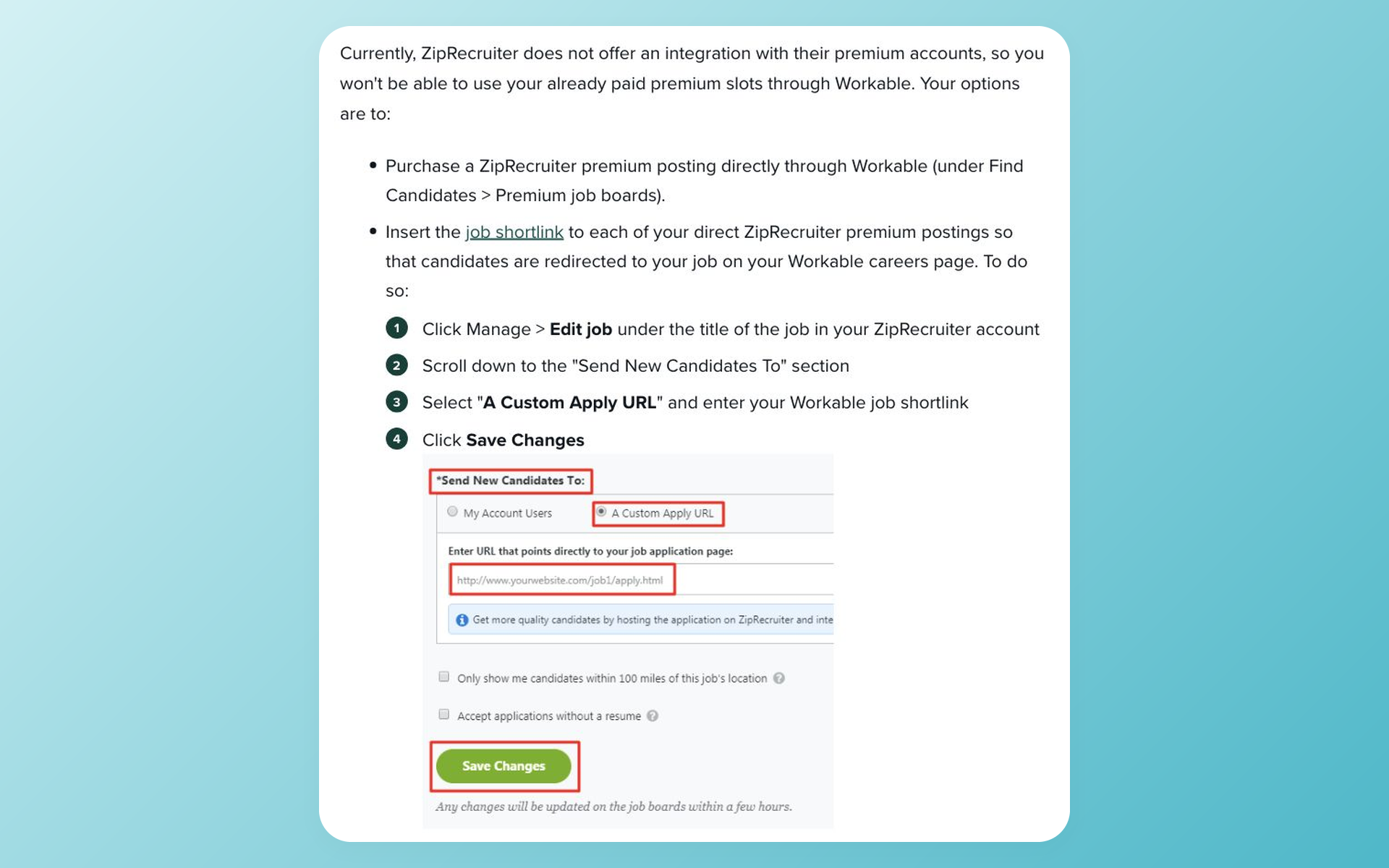
Workable says a separately purchased ZipRecruiter premium account cannot supply premium slots inside Workable. An employer can instead purchase a ZipRecruiter premium posting through Workable.
Another route is to post directly in ZipRecruiter and use a Workable job shortlink as the apply URL. Workable documents hiring signals for eligible ZipRecruiter postings.
Those documented signals include received, contacted, interview, offered, hired, and rejected statuses for eligible candidates. Workable says each signal is sent once per candidate.
That can improve feedback between the ATS and marketplace, but it does not replace a full-path test. Confirm that the posting type and account setup you plan to use qualify.
Before launch, ask four questions: who owns the post, which account funds premium reach, where the application lands, and which system records the final status?
Pricing is not a like-for-like monthly comparison
Workable prices a broader hiring system. ZipRecruiter describes flexible marketplace and recruitment-marketing structures. A single monthly-price row would compare different units.
| Criteria | 100Hires | Workable | ZipRecruiter |
|---|---|---|---|
| Public price visibility | Public, currency-localized pricing | Public selector-dependent pricing | No current official dollar price captured |
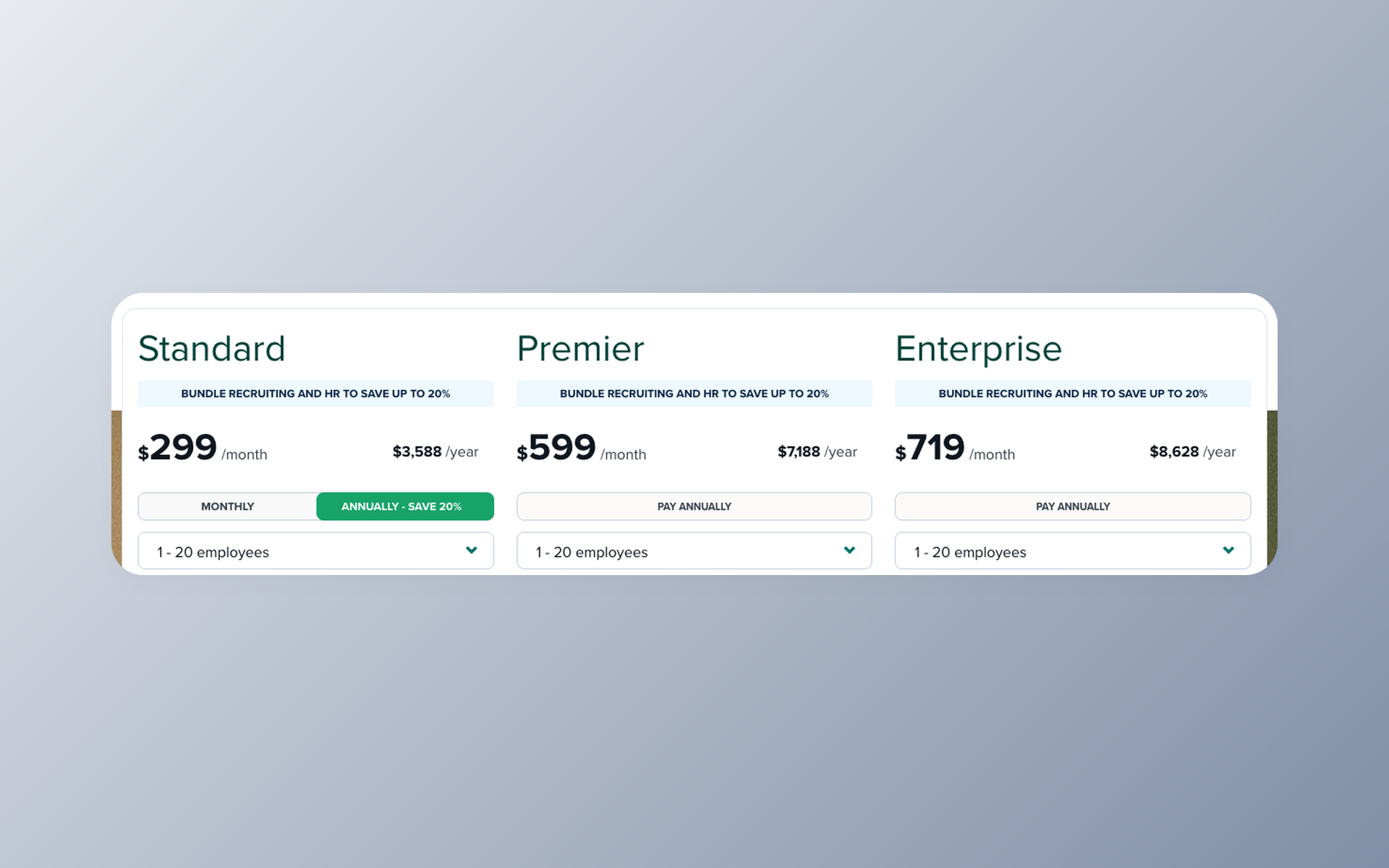
| Entry plan | Start: $99 monthly, or $49 monthly equivalent when billed annually ($588 annual total, derived) | Standard: $299 monthly equivalent when billed annually ($3,588 annual total, derived) | Flexible flat-rate or performance-based structure; dollar rate not published in the filing |
| Middle plan | Advanced: $249 monthly, or $199 monthly equivalent when billed annually ($2,388 annual total, derived) | Premier: $599 monthly equivalent when billed annually ($7,188 annual total, derived) | Term and campaign scope determine the quote |
| Top public plan | Pro: $499 monthly, or $399 monthly equivalent when billed annually ($4,788 annual total, derived) | Enterprise: $719 monthly equivalent when billed annually ($8,628 annual total, derived) | Performance-based pricing is available for sophisticated campaigns |
| What the spend buys | ATS, distribution, automation, and outreach | Full ATS and sourcing suite | Marketplace reach and employer tools |
| Trial | 14 days, no card | 15 days, no card | No current term verified for this article |
| Extra-spend question | External sponsored placement when needed | Paid-board products and add-ons | Campaign scope, term, and performance model |
For a company with 1 to 20 employees, the Workable Recruiting-only view captured in July 2026 showed Standard at $299, Premier at $599, and Enterprise at $719 per month when billed annually.
Workable documented a 15-day trial without a credit card. Confirm the employee selector, billing view, included products, and add-ons before budgeting.
ZipRecruiter's filing describes flat-rate terms typically ranging from one day to one year, plus performance-based pricing for more sophisticated campaigns. It does not publish a dollar rate there.
We excluded historical daily rates, user-reported fees, and conflicting third-party plan prices. Ask for the term, access rules, campaign unit, cancellation mechanics, and what happens to applicant data when the contract ends.
- ATS cost: subscription, billing cadence, included users, modules, and add-ons.
- Reach cost: sponsored placement, campaign term, access unit, and role-level budget.
- Operating cost: recruiter review time, duplicate work, and manual reporting between systems.
- Exit cost: export access, data retention, and the work required to change the system of record.
An occasional employer with a working spreadsheet may value a bounded reach test first. A team running several concurrent searches may get more value from fixing the ATS layer before increasing applicant volume.
A team that needs both should budget the full stack. The Workable subscription and any separate ZipRecruiter campaign solve different problems, so neither price alone represents the total recruiting workflow.
Procurement should separate recurring system cost from variable acquisition cost. That makes it possible to reduce a campaign after a role closes without dismantling the candidate record and hiring process.
The July 2026 100Hires USD view showed Start, Advanced, and Pro at $99, $249, and $499 monthly, or $49, $199, and $399 per month with annual billing. Check the live pricing page for your currency.
100Hires offers a 14-day trial without a credit card. Sponsored marketplace spend remains separate when a role needs it.
The right choice follows your hiring bottleneck
Headcount alone is a weak decision rule. Hiring frequency, the number of collaborators, review capacity, source measurement, and the systems already in place tell you more.
Write the bottleneck in one sentence before requesting demos. “We need more qualified applicants for this role” leads to a different test than “we cannot see who owns the next hiring step.”
- Do enough plausible applicants reach the team now?
- Can reviewers find one current record for every candidate?
- Do stages, interviews, communication, and decisions follow a repeatable process?
- Can you connect each source to interviews, offers, and hires?
- Do you rely only on inbound applicants, or must recruiters run outbound outreach?
Choose Workable when the hiring process is the constraint
Choose Workable when several people need structured stages, interviews, evaluations, automations, reports, and a durable candidate record.
This is a purchase of a full hiring system. Test it with a real role and the actual hiring team, then check whether the workflow reduces handoffs without making common tasks harder.
Workable is less compelling when the process already works and the only shortage is applicants. In that case, funding another workflow layer may leave the original reach problem untouched.
Picture a growing team running several roles through different managers. The ATS creates one process without requiring every manager to maintain a separate sheet or inbox.
Choose ZipRecruiter when applicant reach is the constraint
Choose ZipRecruiter when your existing process can absorb more applications and you want to test its marketplace for a particular role, location, and budget.
Run a bounded test. Track the source, plausible applicants, interviews, offers, hires, recruiter time, and spend. Raw application volume is not the same as qualified yield.
ZipRecruiter's own applicant tools may be enough for a straightforward hire. Repeated hiring, multiple reviewers, cross-source reporting, and candidate reuse are signs that a separate ATS may add value.
This works well for one defined opening where the employer can respond quickly and measure the channel against a clear qualification bar. Start narrow enough to learn which result came from the marketplace.
Use Workable and ZipRecruiter when both constraints matter
Use both when Workable should run the process and selected openings need ZipRecruiter reach. This is a normal layered stack, not a compromise between two equivalent products.
The combined option fails when responsibilities stay implicit. Duplicate postings, split applicant records, unclear billing, and incomplete attribution can erase the benefit of the connection.
The pair fits a team with an established Workable process that needs extra reach for selected jobs. The ATS remains stable as the board becomes a measured acquisition channel, not a second candidate database.
How to use both without fragmenting hiring
Set the operating rules before publishing the first job. A short test is cheaper than reconciling two applicant histories after a campaign is active.
- Name the system of record. Use Workable or another ATS as the canonical candidate history.
- Assign one posting owner. Decide whether the vacancy is activated through Workable or directly through ZipRecruiter.
- Define the application destination. Confirm where each applicant lands and whether a Workable shortlink is required.
- Verify source and status data. Move a test applicant through the workflow and confirm attribution before scaling spend.
Keep the account boundary in view. A separate ZipRecruiter premium account does not become a set of premium slots inside Workable. A ZipRecruiter premium posting purchased through Workable is a different path.
Run one controlled applicant through the full path. Verify the source label, profile fields, resume, application answers, status changes, notifications, and final disposition in the system of record.
Then test an edit and a closure. Confirm which system updates the live posting, how quickly the change appears, and whether closing the source leaves the candidate history available to the hiring team.
100Hires follows the same architectural idea. Its ZipRecruiter integration distributes a job and returns applicants to the ATS pipeline with source reporting.
That is native distribution wording, not a claim of formal certification. The board supplies marketplace reach; the ATS supplies the shared process and record.
When neither fits: 100Hires for workflow and outreach
Disclosure: 100Hires publishes this article, and 100Hires is our product. It is relevant when a lean team needs more than marketplace reach but wants ATS workflow, distribution, and outbound recruiting together.
100Hires puts AI Score and AI Recruitment Copilot inside candidate pipelines with source attribution, workflow automation, and multistep outreach. AI Score is a 0 to 100 screening signal.
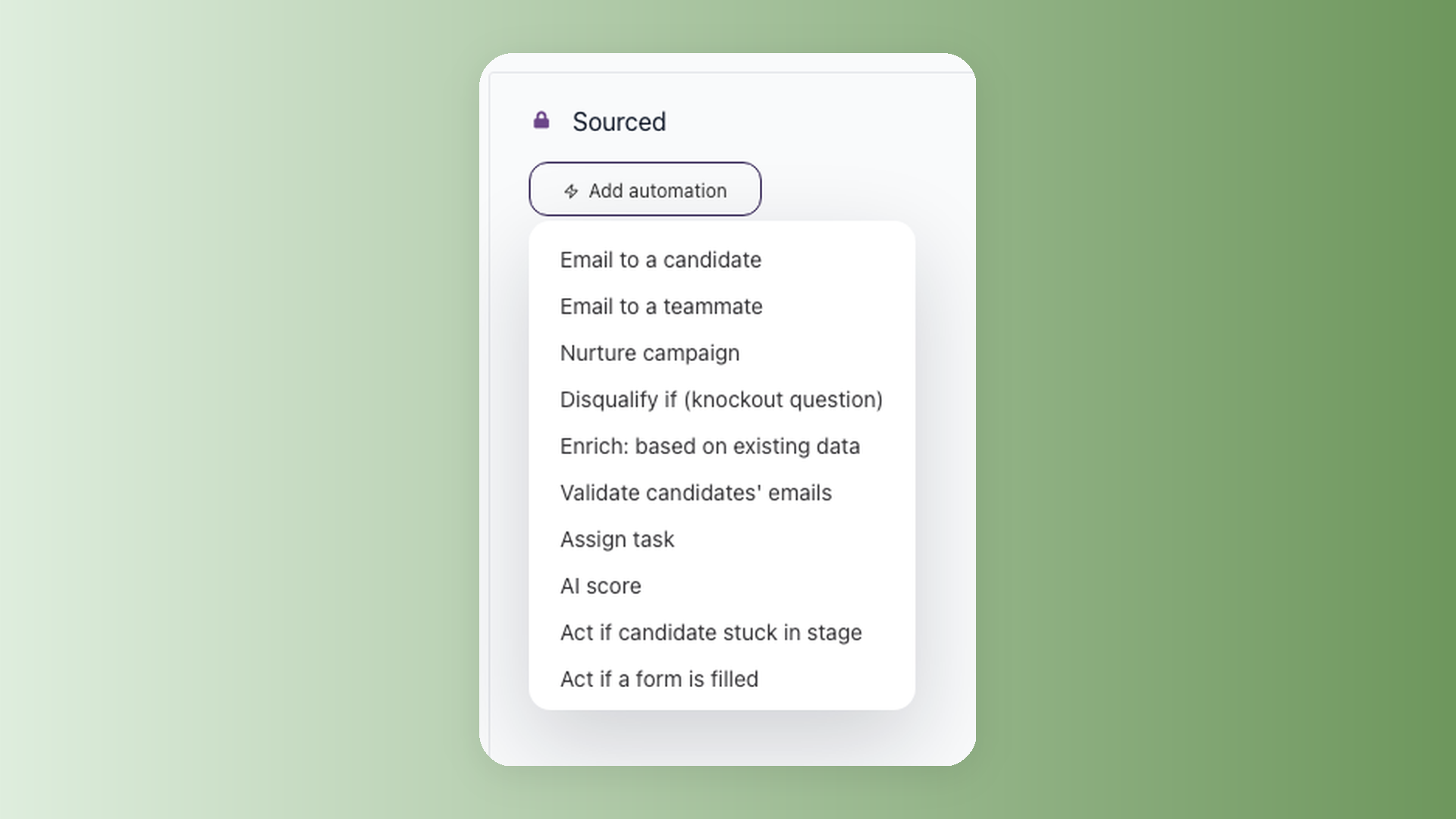
The fit is strongest for founders, agencies, first HR hires, and lean recruiting teams, often in organizations below 500 employees. It can support inbound applicants and outbound follow-up in one recruiting system.
- Use the ATS pipeline to keep applicants and sourced candidates in one process.
- Use source attribution to compare external channels after applicants enter the workflow.
- Use automations and nurture sequences when manual follow-up is the bottleneck.
- Use AI Score and AI Recruitment Copilot as review aids, not autonomous hiring decisions.
The limitation is equally important: 100Hires is not an employment marketplace. It can distribute jobs and organize applicants, but it cannot manufacture demand or replace sponsored placement when a role needs it.
It is not the automatic answer for every enterprise process. Teams with complex global suites, deeply customized approvals, or specialized compliance workflows should validate those requirements directly.
A useful trial should include one inbound applicant, one sourced candidate, one automated follow-up, one hiring-manager review, and one source report. That tests the combined workflow instead of isolated feature screens.
Review 100Hires pricing, then start a 14-day trial if you want to test the workflow with your own hiring process. No credit card is required.
Frequently asked questions
Is Workable better than ZipRecruiter for employers?
Workable is better for employers that need a full ATS and structured hiring workflow. ZipRecruiter is better when marketplace reach is the main need. 100Hires, our product, is another ATS option for lean teams that need distribution and outreach, but it does not replace ZipRecruiter's marketplace demand.
Is ZipRecruiter a full applicant tracking system?
ZipRecruiter documents ATS functionality for employers without an established process, including applicant review, rating, and status management. The current evidence does not establish Workable-level workflow depth. 100Hires is our full-pipeline option, with the separate limitation that it is not a marketplace.
Can Workable post jobs to ZipRecruiter?
Yes. Workable can provide a ZipRecruiter premium posting purchased through Workable; a separate paid ZipRecruiter account cannot supply premium slots inside Workable. 100Hires supports ZipRecruiter distribution with applicants returning to its pipeline, without claiming formal partner certification.
Can a small employer use ZipRecruiter without an ATS?
Yes. ZipRecruiter's applicant tools may be enough for a simple process with few reviewers. A separate ATS becomes more useful for repeated hiring, collaboration, reporting, and candidate reuse. 100Hires offers a 14-day ATS trial, but it does not supply marketplace demand by itself.
What should I use if I need ATS workflow and applicant reach?
Use Workable with ZipRecruiter when Workable should remain the system of record, or choose an ATS that distributes to ZipRecruiter. 100Hires is our option for source attribution, automation, and outreach in one ATS; paid marketplace reach remains a separate board decision.
Workable vs ZipRecruiter becomes easier once you name the stalled layer. Choose Workable for structured hiring operations, ZipRecruiter for reach, or both when ownership and attribution are clear.
Choose 100Hires when a lean team wants ATS workflow, distribution, automation, and outreach together. Review where your last hiring process stalled, then test the product or channel that fixes that specific bottleneck.
Written by Alex Kravets, founder of 100Hires. Alex has spent over a decade building recruiting software and talking with hiring teams about the tools they use day to day.
Try 100Hires for free
No credit card. 14-day trial. Forbes Advisor #1 ATS for SMBs.