
Workable vs Lever: pricing, AI, and which one actually fits in 2026
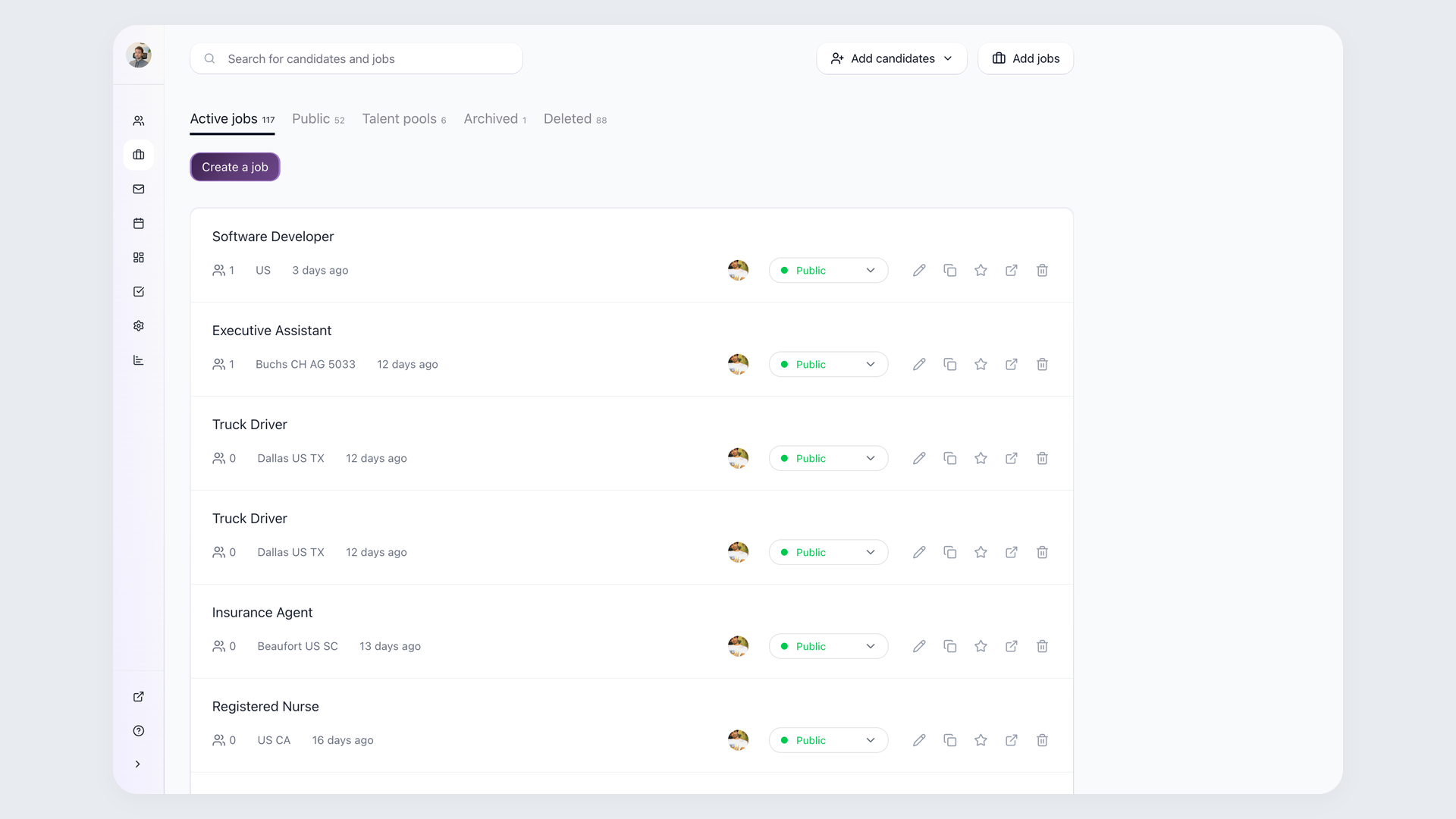
Here is the short version. Workable is the SMB all-in-one with a published price, a self-serve trial, and 200+ job boards wired in. Lever is the mid-market ATS with a built-in CRM and quote-only pricing, owned by Employ Inc.
They rarely land on the same shortlist. Each one fits a different kind of team. So this is a fit test, not a feature war.
Quick note on method. We checked both vendors' pricing and product pages, fresh Capterra and G2 data, 12 video transcripts (10 on-topic), 213 Reddit posts, 100 LinkedIn posts, and our own sales-call notes on July 12, 2026.
One thing stood out. Almost nobody compares these two head-to-head anywhere. That gap is the clue: they serve different buyers.
Workable vs Lever at a glance
The hiring playbook, in your inbox
One email a week - benchmarks, AI screening tactics, and short interview templates from the 100Hires team. No product pitches.
The table adds 100Hires, our own ATS, as a third lane. Lever publishes no pricing and offers no trial, so smaller teams comparing the two often need one. More on that at the end.
| Criteria | 100Hires | Workable | Lever |
|---|---|---|---|
| Entry price | public, $49/mo billed annually | public, $299/mo (Standard, 1-20 employees, annual) | custom quote (buyer-reported ~$7,000/yr entry) |
| Free trial | 14 days, no card | 15 days, no card; excludes the Workable Agent | none, demo only |
| Pricing model | flat tiers, unlimited users on Advanced | per-employee brackets plus paid add-ons | custom annual contracts |
| Built-in CRM | talent pools included | sourcing suite plus a light Talent CRM | full CRM (LeverTRM), the core strength |
| AI | AI Score + AI Copilot on every plan, credits bundled | Workable Agent add-on, billed per AI credit, 3,000 free to start | assistive AI bundled in Core Platform, governed with IBM watsonx |
| Job boards | 13 named boards from one screen | 200+ syndication network | posts via partner integrations |
| G2 | 4.8 (1,353 reviews) | 4.4 (705 reviews) | 4.3 (2,117 reviews) |
| Capterra | 4.9 (1,163 reviews)* | 4.4 (661 reviews) | 4.6 (654 reviews) |
| Best for | SMB teams up to ~200 employees | sub-200 teams that want speed and reach | 50-200+ teams hiring on relationships |
*Review counts on Capterra syndicate across the Gartner Digital Markets network, so they overlap with sister sites.
Bottom line: pick by team size and sourcing model, not by feature count. Workable wins on speed and a public price. Lever wins on relationship-driven hiring.
If both columns already feel heavy for your team, start a 14-day 100Hires trial and read the final section first. Fair warning: 100Hires is an SMB tool, not a mid-market replacement.
Which size team each one fits
Choose by stage, not by brand. That is the one rule this comparison keeps returning to.
Workable's sweet spot sits under roughly 200 employees. Practitioners on Reddit describe it fitting somewhere in the 50-300 band. One recruiter at a 75-person company wrote that it stopped being fit for purpose as their hiring grew more layered.
The pattern repeats. Teams love it early. Then they press against its workflow limits as they scale.
Lever skews larger. In frozen G2 reviewer data from around early 2024, 82% of its reviewers came from 51-1,000 employee companies, against 68% for Workable. Lever's own marketing speaks to teams hiring 50 or 500 people.
Our read from buyer reports: Lever makes the most sense for 50-200+ employee companies hiring under about 150 people a year, with candidate nurture at the center.
Size alone does not settle it, though. The two products fail in mirror-image ways. That is where the real decision lives.
What Workable gets right, and where it falls short
Speed is the headline. Workable publishes its prices, hands you a 15-day trial without a card, and lets a non-technical HR manager go live without a consultant.
Ease of use is its most consistent review theme. On the G2 sub-scores Workable's own comparison page cites, it leads Lever on ease of use (9.1 vs 8.7) and onboarding (8.3 vs 7.5). The independent video walkthroughs we watched land on the same verdict.
Reach is real too. Workable syndicates postings to 200+ job boards and claims 270+ integrations. It has grown into a broader HR platform with texting, video interviews, and performance modules.
Its AI story is the loudest in this pair. The Workable Agent, launched in March 2026, sources, screens, and qualifies candidates on its own against a claimed 400M-profile database.
Forbes named Workable its Best AI-Powered Recruiting Platform for 2025, per Workable's own AI page.
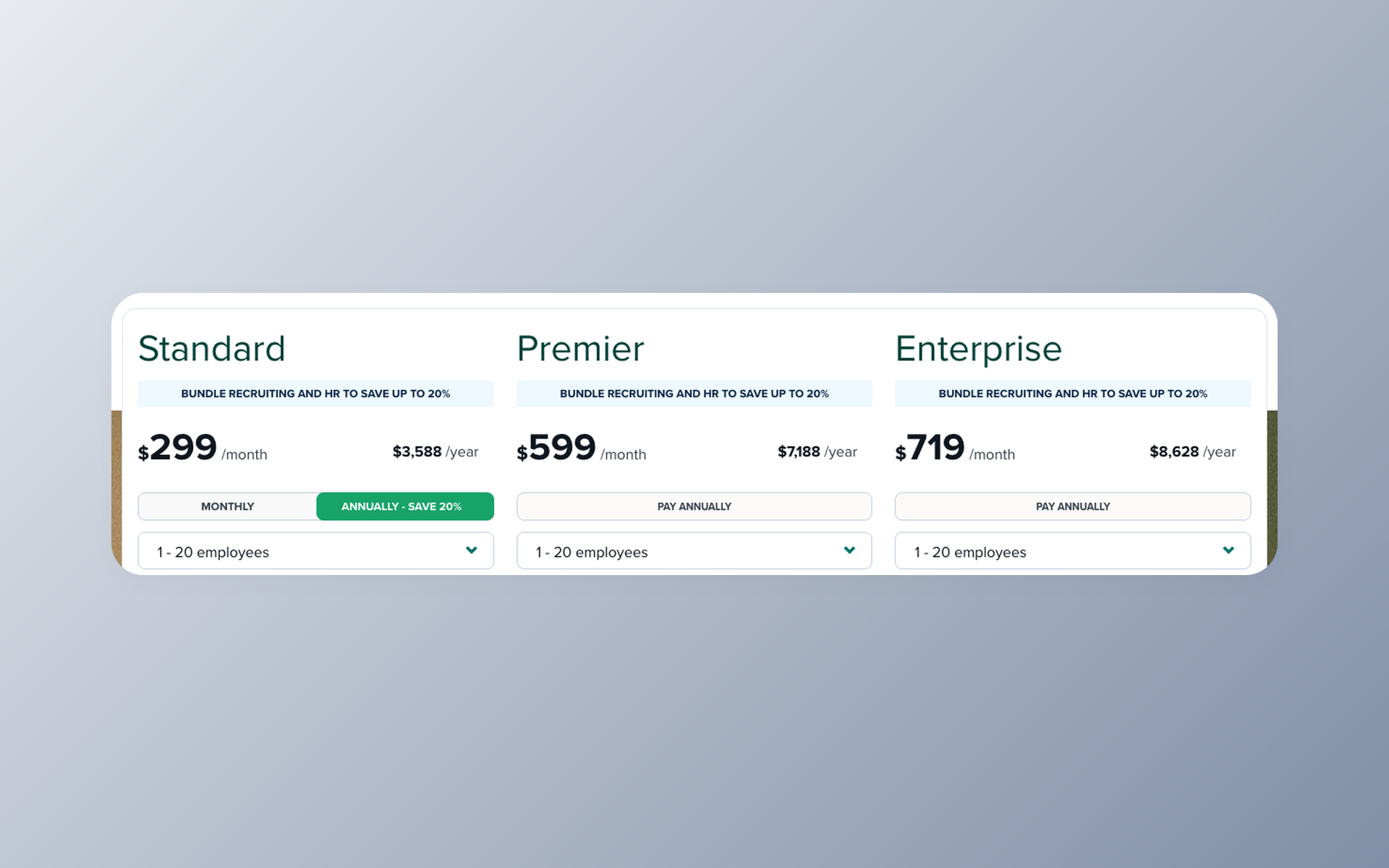
Now the bill. The $299 entry price is honest. But texting ($89/mo), video interviews ($109/mo), assessments ($59/mo), and performance reviews ($39/mo) are paid add-ons.
The Agent bills separately too. According to Workable's pricing page, paid accounts include 3,000 AI credits, then credit packs run $600 per 5,000 (up to $4,750 for 50,000), and credits expire after one year.
AI screening accuracy is the most repeated complaint in Workable's 2026 Capterra reviews. Reviewers there describe scores that skip parts of the job description.
On our own demo calls, one team two months into Workable said its candidate ratings felt inaccurate enough to re-check by hand.
Three more caveats sit in the record. Reviewers scaling past basic pipelines call the reporting thin. Practitioners on Reddit say the product gets rigid as their teams grow.
And support runs chat-first. Two separate switch-away prospects told us they could never get a person on a call.
One check for EU employers: our July 2026 research and our own sibling comparison both describe Workable hosting data in US data centers only, so confirm the current setup against your compliance rules before you commit.
A handful of candidates have also reported impersonation abuse through its application flow in community threads, which we cover in the FAQ.
The switch-away pattern is steady. Across at least eight 2025-2026 prospects on our own calls, the driver was price plus stagnation, not a missing feature. Verdict: the fastest path from zero to posting for a sub-200 team that accepts add-on economics.
What Lever gets right, and where it falls short
Lever answered a real question early. Why buy a separate CRM to nurture candidates you already met? LeverTRM still owns that answer. Nurture campaigns, multi-channel outreach, and engagement tracking come built in, not bolted on.
Collaboration is the second strength. The deepest independent video review we found praises shared candidate profiles, structured feedback, and mass email across pipelines.
One veteran recruiter who demos ATSs for a living ranks Lever near the top for ease of use and candidate experience.
There is a distinct mechanic here too. Lever builds one profile per candidate and matches that profile to all open roles, not just the job they applied to. For teams that re-engage past applicants, that is the point of a CRM-led ATS.
Implementation is its strongest reviewed card. On Capterra, 95% of 125 implementation mentions are positive, and teams report going live in two to three weeks.
The flip side starts with pricing. Lever publishes no numbers; its own FAQ directs buyers to request a custom quote, and there is no free trial. Buyer-reported contracts start around $7,000 a year for small teams.
Renewals creep. One team told us their roughly $10,000 contract came back at $11,000, plus another $5,000 for a support package.
Reporting is the loudest complaint cluster: 38% of 68 Capterra reviewer mentions on reporting are negative. In a People Managing People hands-on review, Visual Insights dashboards took four to six hours to refresh and could be shared only as PDF or image files.
Flexible custom reporting sits in a paid module called Data Explorer. One buyer told us they keep a separate finance spreadsheet by hand for figures Lever will not surface.
Then the mechanical gaps. There is no mobile app; we checked both app stores in July 2026. Rebooking a self-scheduled interview means deleting the meeting and starting over.
Support also moved from live chat to tickets, a change one long-time customer said happened without them really noticing.
The AI story is catching up, not leading. Screening, interview summaries, and fraud signals now ship inside the Core Platform, framed around IBM watsonx governance.
The paid Talent Fit add-on drew a rough reception from practitioners, and we found no independent video demo of Lever's AI anywhere as of July 2026.
Verdict: Lever fits 50-200 employee teams hiring under about 150 people a year with candidate nurture at the center. Skip it if you need same-day custom reporting, a mobile app, or a price before a sales call.
Feature by feature: six quick verdicts
Side by side, dimension by dimension.
Job posting and distribution
Workable pushes to 200+ boards from one screen and manually approves every posting to block spam. Lever posts through partner integrations; a People Managing People hands-on review reported one aggregator taking roughly one to two weeks to activate. Winner: Workable.
Sourcing and CRM
Lever owns the built-in relationship layer: nurture, rediscovery, Boolean search, a Chrome extension. Workable counters with AI search across its claimed 400M profiles and a lighter Talent CRM of its own.
Lever's comparison page says Workable has no CRM; Workable's product tour disagrees.
The difference is depth. Winner: Lever for relationship sourcing, Workable for cold-volume search.
AI features
This is a difference in packaging, not raw technology. Workable sells a separate autonomous Agent, priced per credit, marketed loudly, with real accuracy complaints in reviews and on our calls.
Lever folds assistive AI into the platform, frames it around governance, and markets it so quietly that independent demos do not exist. One approach is broad but metered; the other is bundled but quiet. Winner: Workable on breadth and momentum, with the credit meter as the catch.
Reporting and analytics
Lever draws the bigger complaint cluster: slow-refreshing dashboards and custom reporting behind a paid module. Workable reviewers call its reporting thin but usable for basic pipelines.
Lever's own comparison page claims Workable reports refresh up to 24 hours behind, though that is a rival's claim, not an audit. Winner: tie leaning Workable for small teams. Reporting-heavy teams should look past both.
Ease of use and setup
Workable goes live the same week, self-serve. Lever takes two to three weeks, per Capterra reviewers, with a smooth, well-reviewed rollout and a learning curve gentler than most enterprise tools. Winner: Workable for speed to live, Lever a close second.
Integrations
The counts are vendor claims that fight each other. Workable claims 270+. Lever's comparison page claims 360+ for itself in one table and over 300 in the body copy, and gives Workable roughly 100.
Our own count of Lever's public marketplace found about 180 partner listings in July 2026. Winner: nobody on numbers. Check the three to five integrations you actually run before signing.
Pricing: what you will actually pay
Labels matter here. "Published" means the vendor prints the number. "Buyer-reported" means real customers shared it. "Quote-only" means the vendor will not say.
| Team size | 100Hires (published) | Workable (published) | Lever (buyer-reported, 2026) |
|---|---|---|---|
| ~10 employees | $49-$99/mo | $299/mo (1-20 bracket, annual) | ~$7,000/yr |
| ~50 employees | $199-$249/mo | $299-$599/mo by tier, bracket scales with headcount | $7,500-$12,000/yr |
| ~200 employees | $399-$499/mo | higher employee brackets, quote for the exact figure | ~$12,000-$19,000/yr |
| ~500 employees | above our lane; see honest limits below | Enterprise tier, $719/mo base at the smallest bracket | ~$37,000-$72,000/yr |
Workable's grid rewards small teams. Standard, Premier, and Enterprise run $299, $599, and $719 per month at the 1-20 employee bracket. Annual billing includes a 20% discount, and the add-ons and AI credits from earlier stack on top of any tier.
Watch the drift too. Third-party reviews still quote Workable at $129 to $399 a month from older vintages. The current page starts at $299. Any figure you read about either tool, this article included, deserves a date check.
Lever's wide range reflects negotiation. Buyer reports at 200 employees run $12,000 to $19,000 a year. Never sign the first quote, and get your renewal cap in writing.
For contrast, 100Hires pricing is flat and public at every tier. That is the lane the other two leave open under about 200 employees.
Who owns Workable and Lever
Ownership shapes roadmaps, so it belongs in the decision.
Employ Inc has owned Lever since August 2022, alongside two other recruiting products in its portfolio. Employ appointed a new CEO in February 2026 and a new CTO days later.
The practical result is a pooled roadmap. Recent AI scoring and identity-verification features shipped across the whole portfolio at once, including a July 2026 identity-verification partnership. It cites a Gartner projection that 1 in 4 applicants could be fake by 2028.
A shared roadmap has an upside: features arrive faster, and Employ publishes research from across its 6,640-customer base.
The visible cost is brand identity. Several lever.co pages now redirect into employinc.com, and on our demo calls, buyers are regularly unsure which products belong to which company.
Workable stays independent. It reports 35,000+ customers across 100+ countries by its own count, with ISO 27001 and SOC 2 certifications published. One product, one roadmap, no parent-company portfolio math.
Who should choose Workable, who should choose Lever
Choose Workable if:
- You are under about 200 employees and want a price on a page and a trial today
- Your hiring is post-and-filter: inbound volume across many job boards, then screen down
- You want the most aggressive AI in the pair and accept credit-billed economics
- Add-on line items do not bother you as long as the base price is public
Choose Lever if:
- You are a 50-200+ person company hiring under about 150 people a year
- Sourcing runs on relationships: nurture pools, re-engagement, referrals
- You are fine with a buying process of quotes, demos, annual contracts, and negotiation
- Collaboration depth matters more to you than reporting depth
And if you read both lists thinking you will outgrow the first tool and the second will out-price you, that gap is real. It is the next section.
When neither one fits: the AI-first lane for smaller teams
Full disclosure: 100Hires is our product, and it did not appear in any of the external channels we analyzed for this keyword.
We include it for one reason. Teams under roughly 200 employees keep falling into the gap this article maps: Workable's add-ons and credit meters on one side, Lever's quote gate on the other.
In one 2026 sales call, a team two months into Workable said it was re-checking inaccurate AI ratings by hand and wanted good scoring that stayed simple and affordable.
That is the brief 100Hires builds against. AI Score ranks every applicant against criteria you define per job, on monthly AI credits bundled with every plan: 100 on Start, 1,000 on Advanced, 5,000 on Pro with annual billing.
AI Copilot summarizes and analyzes candidates on demand.
The credits come bundled rather than sold as a separate add-on, so AI screening is part of the plan you already pay for.
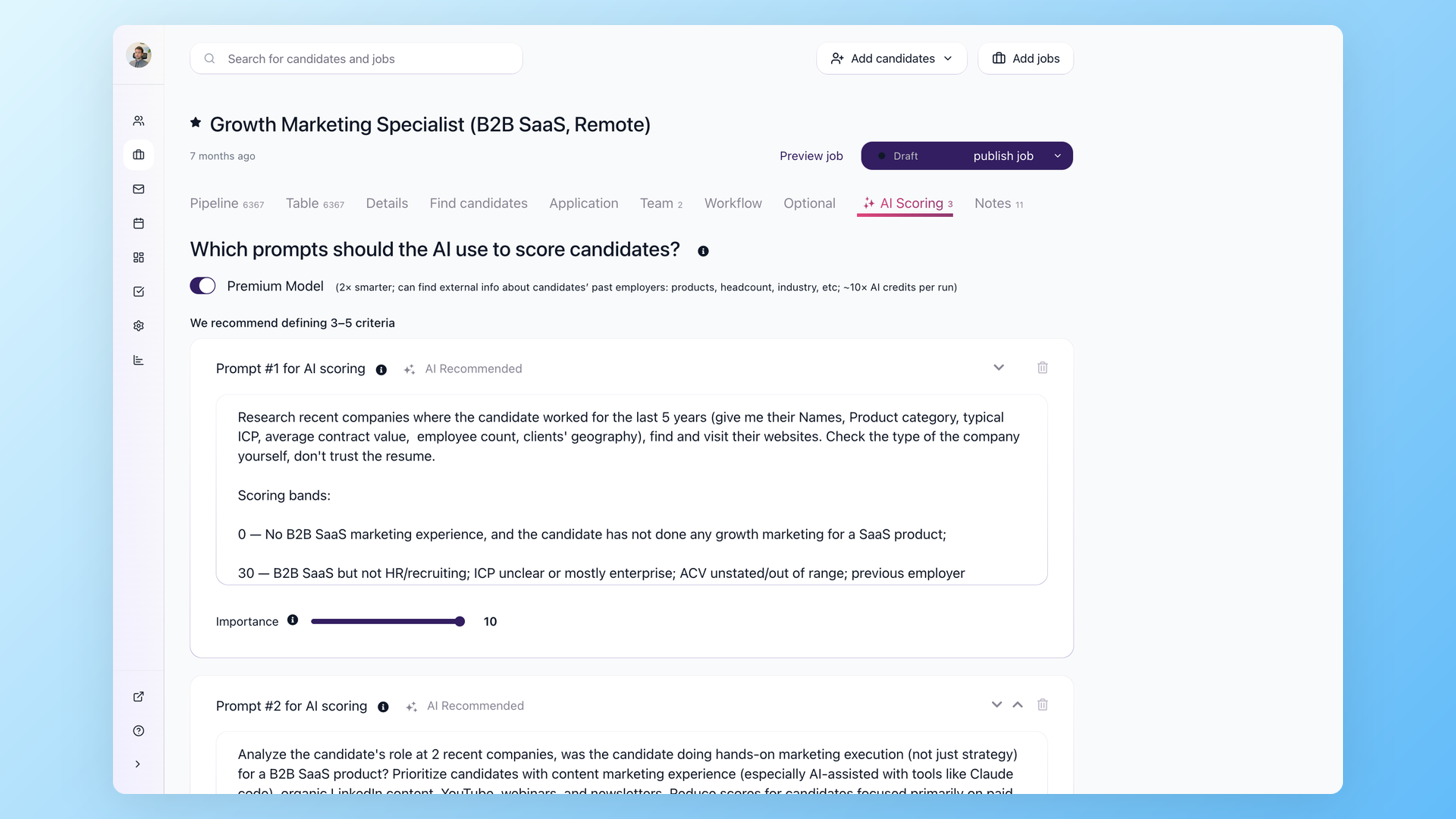
Evaluation Forms keep interview feedback structured. Trackable links show which sourcing channel each candidate came from. Postings go out to 13 named job boards, and the Advanced plan includes unlimited users.
Pricing is public and flat: from $49/mo billed annually ($99 month-to-month) up to $399-$499 for Pro, with a 14-day trial, no card required, and same-day setup. Your data stays in the account after the trial ends.
The honest limits: 100Hires is not built for 500+ employee structured-hiring programs, its integration catalog is smaller than either tool's, and its 13 named job boards are a fraction of Workable's 200+ network. If those are your constraints, stay in the lanes above.
Verify us independently on G2 or Capterra, then try the 14-day trial against your live requisitions. Comparing tools by using them beats comparing them by reading about them, including reading this.
For neighboring matchups, see our other Workable comparison and our other Lever comparison.
FAQ
Is Workable trustworthy?
As a business, yes: Workable reports 35,000+ customers, publishes ISO 27001 and SOC 2 certifications, and manually approves job postings to block spam. Separately, some candidates reported impersonation abuse through its application flow in late 2025 community threads, so employers should verify where applications come from. The same verification advice applies to any vendor, 100Hires included: check current G2 and Capterra reviews before you buy.
How much does Lever cost?
Lever publishes no pricing; its own FAQ routes buyers to a custom quote, and there is no free trial. Buyer-reported 2026 figures run from about $7,000 a year for small teams to $37,000-$72,000 at around 500 employees, with renewal increases a recurring theme. If you want to see a price before a sales call, 100Hires lists every plan publicly from $49/mo and lets you test the product for 14 days first.
Who owns Lever, and is it still independent?
No. Employ Inc has owned Lever since August 2022, together with two other recruiting products in its portfolio (Workable is not one of them; it remains independent). Employ appointed a new CEO in February 2026, and features now ship portfolio-wide, including identity verification added in July 2026. The practical read for a buyer: Lever's roadmap is shared across three products, so ask where your priorities sit in that queue. 100Hires builds one product, which is worth weighing if roadmap focus matters to you.
What is the Workable Agent and what does it cost?
The Workable Agent is an autonomous sourcing and screening add-on launched in March 2026. It works on any Workable plan and is billed per AI credit: paid accounts include 3,000 credits to start, then packs run $600 per 5,000, and the 15-day trial excludes the Agent entirely. 100Hires takes the opposite approach: AI Score and AI Copilot come bundled with monthly credits on every plan, so AI screening is not a separate meter.
Can I switch between Workable and Lever easily?
Migration is a real decision factor, not an afterthought. In one 2025 community thread, a 330-employee team that moved from Lever to Workable described the early weeks as underwhelming. Lever's custom reporting sits behind a paid module, so check which fields you can export before signing. 100Hires imports candidates free through CSV files and resume uploads, with paid help available for automated imports if your data is messy.
Try 100Hires for free
No credit card. 14-day trial. Forbes Advisor #1 ATS for SMBs.