
Lever pricing and total cost in 2026 - 100Hires
The Lever quote is only one line in the budget.
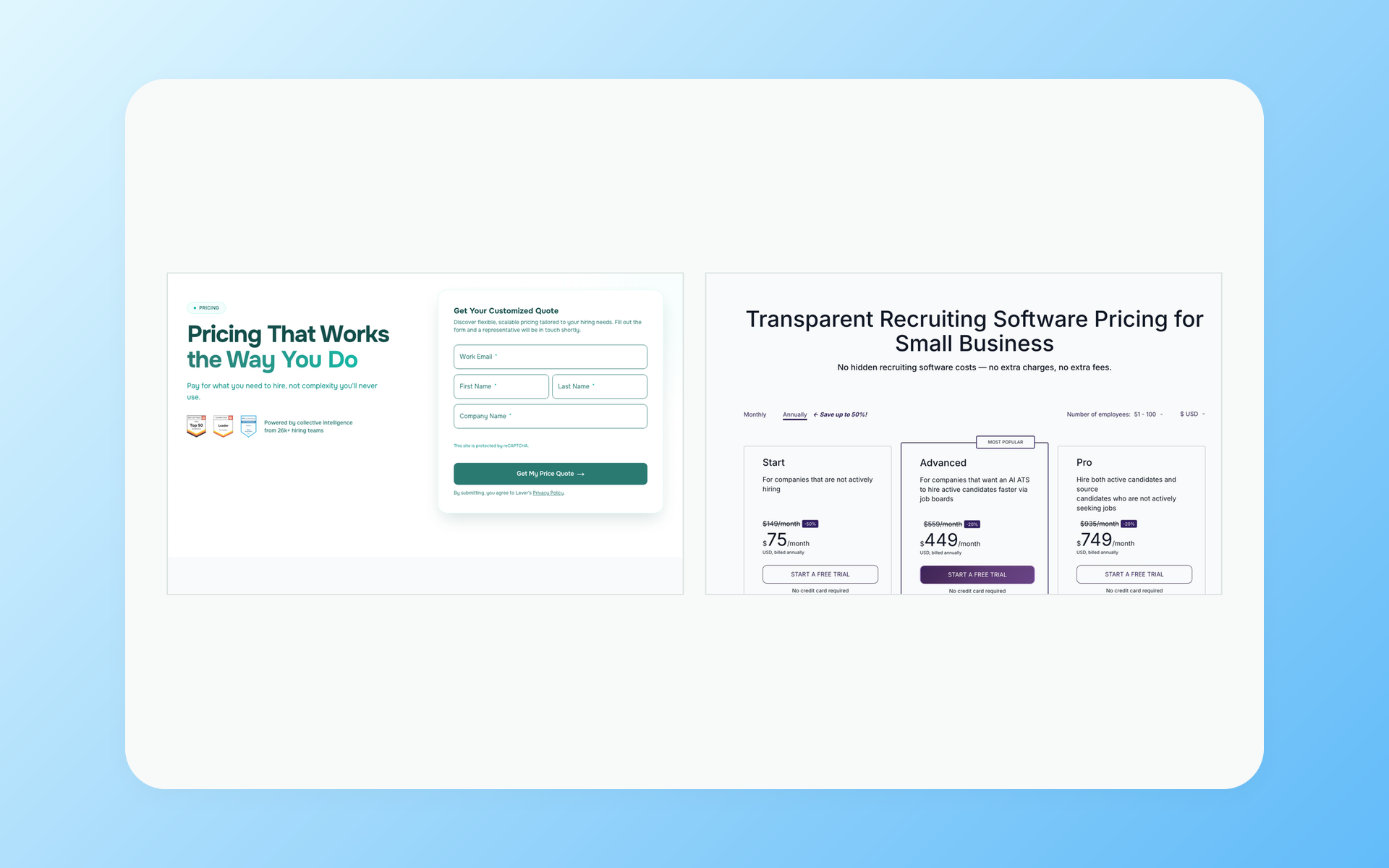
Lever pricing starts with a custom quote, not a numeric list price. Lever says it tailors each quote to organization size and hiring needs.
This guide shows what that quote may cover, which costs are not public, and how to compare it with a fixed 75-employee hiring scenario. Reported figures stay separate from official pricing, so you can use them as questions rather than mistake them for a rate card.
Lever pricing at a glance
The hiring playbook, in your inbox
One email a week - benchmarks, AI screening tactics, and short interview templates from the 100Hires team. No product pitches.
Lever's public answer is a custom quote. No current subscription amount, seat rate, requisition rate, implementation fee, or contract total appears on its pricing page.
| Criteria | 100Hires | Lever |
|---|---|---|
| Public numeric price | Start, Advanced, and Pro publish numeric prices with USD base values | Custom quote |
| ATS and CRM | Plan limits and features are public | Described as core; usage limits are not public |
| Analytics | Public plan feature list | Core wording, with deeper package access unresolved |
| Integrations | Public product and integration pages | Key integrations described as core; named scope and fees are not public |
| Implementation | Plan and service wording is public | Most customers are fully implemented within weeks, not months; fee and service scope are not public |
| Optional capabilities | Public plan comparison | Named add-ons exist; amounts are not public |
Need a number before a sales call? Review the current 100Hires plans. The full plan-by-plan comparison appears later in this guide.
The direct answer
Lever says pricing depends on organization size and hiring needs. Its public material does not explain how employee count, users, open jobs, annual hires, candidate records, locations, or modules are weighted.
A useful request names all of those inputs. The seller can then quote your actual operating model instead of a vague company profile.
How to read every number in this guide
- Official: shown on a current Lever or 100Hires public page.
- Derived: simple arithmetic from a public amount, such as a monthly equivalent multiplied by 12.
- Procurement benchmark: a dated transaction summary that does not reveal a matching contract scope.
- Buyer-reported: one employer's account, with its known context and missing fields.
A directory can repeat the same estimate across many pages. Repetition does not turn it into Lever's official price.
What the Lever quote can cover
Lever presents a broad core product. The contract still controls the exact edition, allowances, user rights, and services you receive.
| Cost layer | Publicly described | Confirm in the order form |
|---|---|---|
| ATS | Core applicant tracking | Users, active jobs, candidate records, storage, offers, and approvals |
| Recruiting CRM | Core CRM | Campaign access, contact volume, messaging, and fair-use limits |
| Analytics | Reporting and analytics | Visual Insights, Data Explorer, Report Builder, roles, exports, and BI access |
| Integrations | Key integrations and a broad marketplace | Named connectors, API/webhooks, custom mapping, partner fees, and maintenance |
| AI | Screening, fraud signals, and interview transcript/summary wording | Edition, allowance, paid feature status, and usage policy |
| Add-ons | Candidate Insights, VONQ screening, and Onboarding are named add-ons | Price, billing unit, prerequisites, and setup work |
ATS and recruiting CRM
Lever describes ATS and CRM as part of the core. That makes it more than a database for applicants: the commercial discussion can cover candidate relationships, rediscovery, nurture work, and collaboration across the hiring team.
The public page does not give numeric limits for users, jobs, candidates, storage, campaigns, or messages. Ask for those fields in the quote.
If your team is still deciding where ATS ends and CRM work begins, this overview of recruiting software for ATS and CRM workflows gives you a practical scope checklist.
Analytics and reporting
Lever says reporting and analytics are part of the core product. Public package evidence points to Visual Insights across several labels and to a relationship between Data Explorer and Enterprise or Advanced Analytics.
That is not enough to price your reporting use case. Ask which dashboards, custom builders, exports, user roles, retention periods, and BI connections sit inside the quote. Our recruitment analytics guide can help you define the fields before the demo.
Integrations, AI, and optional capabilities
Lever's marketplace covers analytics, assessments, background checks, communication, HR systems, job boards, onboarding, scheduling, sourcing, SSO, and video interviews. A listed partner does not prove that its subscription, setup, or custom mapping is included in Lever's price.
AI needs the same care. Lever's pricing page describes unlimited interview transcripts and summaries in its core wording. The public Help Center identifies the Unlimited version as a paid feature.
Ask the seller to resolve that difference in the order form and list the allowance for every AI capability.
The organizational factors that can affect a Lever quote
Only two quote drivers are explicit on Lever's current pricing page: organization size and hiring needs. Other inputs below are procurement-reported factors or questions raised by the package structure.
| Potential factor | Evidence | What to ask |
|---|---|---|
| Organization size | Official | Which employee count and band apply? |
| Hiring needs | Official | Do jobs, hires, candidates, regions, or workflow depth affect price? |
| Active requisitions | Procurement-reported | Is there a contracted job or requisition allowance? |
| User seats | Procurement-reported | How are recruiter, manager, interviewer, admin, and reporting users billed? |
| Contract term | Procurement-reported | What changes between one-year and multi-year terms? |
| Modules and services | Public add-ons; price effect unknown | Which line items are recurring, one-time, or usage-based? |
| Security and region | Commercial effect not public | Which controls, residency choices, and service levels affect scope? |
Official quote inputs
Turn `organization size` into an exact employee count and a country list. Turn `hiring needs` into recruiter users, hiring-manager users, active jobs, annual hires, new candidate records, hiring regions, and required workflows.
This does not recreate Lever's formula. It gives the account team enough detail to return a quote that can be checked against the contract.
Send the same brief to every seller. Ask each one to separate recurring software, one-time services, outside subscriptions, and any usage charge. That gives finance four comparable totals instead of four feature decks.
Procurement-reported and unresolved inputs
Vendr identifies employee count, active requisitions, user seats, contract term, and selected modules as possible cost factors. Lever does not publish those mechanics, so treat each one as a question.
Run the same check on analytics edition, API access, custom mapping, migration, training, premium support, data residency, sandbox access, and renewal terms. A blank public price is not proof that an item costs extra. It means the public material cannot settle the question.
Total cost goes beyond the ATS subscription
Total cost extends beyond the recurring license. It can include one-time services, outside subscriptions, staff time, contract overlap, renewal changes, and exit work.
Build the budget in layers: recurring software, one-time vendor services, third-party tools, internal labor, and transition or exit. A zero in one layer should come from the proposal, not an assumption.
| Cost object | Put this in writing |
|---|---|
| Subscription | Annual recurring price, billing unit, included usage, and payment schedule |
| Analytics | Dashboard edition, builders, exports, roles, data retention, and BI access |
| Integrations and API | Named connectors, API/webhooks, partner accounts, mapping, and maintenance |
| Implementation | Configuration, project hours, testing, launch support, and acceptance criteria |
| Migration | Records, attachments, notes, history, deduplication, validation, and final sign-off |
| Training and support | Training sessions, response times, named contact, escalation, and premium coverage |
| Optional features | Add-on price, prerequisites, allowance, and setup |
| Renewal and exit | Uplift cap, notice date, removal rights, export format, assistance, and deletion terms |
| Internal labor | Data cleanup, process design, permissions, training, adoption, and reporting ownership |
Implementation, migration, and training
Lever says most customers are implemented within weeks, not months. That describes timing. It is not a fee, deadline, service-level agreement, or migration promise.
Ask who configures stages, permissions, templates, approvals, integrations, and reports. For migration, list every object you expect to move. Candidate rows are one part; attachments, notes, email history, offers, audit history, and duplicate handling can create much more work.
Use an ATS implementation plan to assign owners and acceptance tests. If historical data matters, define the ATS data migration scope before either seller prices the project.
Migration quotes need a counting method. Record the number of candidates, jobs, attachments, notes, offers, and years of history. Then state which objects need validation and which can remain in a read-only archive.
Training needs a deliverable too. `Training included` can mean one admin session or role-based sessions for recruiters, managers, and interviewers. Put the audience, hours, recordings, materials, and follow-up support in the service description.
Integrations, support, and external subscriptions
A connector can create three cost owners: Lever, the partner, and your internal team. Job-board media, assessments, background checks, e-signature, scheduling, HRIS, and video tools may need outside subscriptions.
Custom mapping and ongoing maintenance may need staff or consulting time.
Support deserves its own line. One anonymized 85-employee buyer reported a separate support amount during a renewal discussion.
The contract details were incomplete, so the report cannot establish Lever policy. It does show why `What support is included?` belongs in the quote request.
Renewal and exit
The cheapest first year can become an expensive second year if the agreement leaves growth and renewal undefined. Ask for the uplift cap, notice window, expansion price, and right to remove an unused module.
Exit terms matter on day one. Confirm the export format, assistance, retention window, deletion confirmation, and any transition fee. Add the cost of contract overlap if the old and new systems must run together.
What reported Lever cost figures can and cannot tell you
Reported numbers can orient a buying team. They cannot replace a quote when company size, users, modules, services, region, and term differ.
Dated procurement context
A Vendr page captured on July 18, 2026 displayed 318 purchases and a $15,400 median annual payment. It showed a $6,714 low, a $51,864 high, and a $15,399 average contract value.
The page did not expose the organization, seats, requisitions, modules, implementation, support, region, or term behind a matching purchase. A snapshot collected one day earlier showed 273 deals instead.
The change means the data provide procurement context only, not a Lever rate or a quote for this scenario.
Isolated buyer reports
| Reported figure | Known context | What is missing |
|---|---|---|
| $7,500 for a basic ATS | Reddit employer under 100 FTE | Users, modules, term, services, and renewal outcome |
| About $40,000 per year | Reddit employer | Company size and full contract scope |
| $6,000 above Greenhouse at first | Reddit buyer; quote was partly negotiated | Like-for-like modules, users, term, and services |
| Nearly $2,000 below Ashby per year | Small company hiring about 30 people per year | Full scope and contract terms |
| About $10,000 current spend, a reported $11,000 renewal increase, and $5,000 support | Anonymized 85-employee buyer | Currency, seats, modules, billing basis, and written order form |
| $50,000 quote | Separate anonymized buyer shortlist | Company, package, services, region, and term |
The buyer reports point in opposite directions. One small employer found Lever cheaper than Ashby, and another buyer received an initial Lever quote above Greenhouse. You can inspect the first Lever and Ashby buying discussion and the separate reporting and quote discussion.
Do not add the endpoints, average them, or call them a range. Their contradiction is the lesson: scope and negotiation matter.
The $7,500 report is not a public floor. It names a basic ATS and a company below 100 FTE, yet it leaves out users, modules, services, term, and renewal result. The $40,000 report is not a ceiling for the same reason.
The anonymized 85-employee case is useful for a different reason. It separates current spend, a reported renewal increase, and support. Keep those lines separate in your own budget and ask which one is recurring.
The $50,000 quote has no company or package scope. It proves that a buyer heard that figure, nothing more. Do not use it to predict an enterprise deal or to judge the fixed scenario below.
The same 75-employee scenario across Lever and 100Hires
A fair comparison holds the operating assumptions constant. Here is the scenario used for every row:
- 75 employees
- 2 recruiters and 6 hiring managers, for 8 users
- 8 active jobs and 25 hires per year
- 1,000 new candidate records per year
- ATS plus recruiting CRM, standard reporting, email/calendar, and common job-board integrations
- USD, tax excluded, one-year horizon
| Product or plan | Monthly billing | Annual-equivalent monthly | Annual total | Scenario result |
|---|---|---|---|---|
| 100Hires Start | $149 | $75 | $900 derived | Does not fit: up to 3 jobs, 100 candidates, and 1 user |
| 100Hires Advanced | $559 | $449 | $5,388 derived | Fits the stated jobs, candidates, and users |
| 100Hires Pro | $935 | $749 | $8,988 derived | Fits; adds enrichment, outreach, onboarding support, and annual migration wording |
| 100Hires Enterprise | Custom quote | Custom quote | Custom quote | Request the same scenario with required security, SSO, BI, custom features, integrations, and reports |
| Lever | Custom quote | Custom quote | Custom quote | Request a written quote for the same inputs and every TCO line |
These 100Hires figures use the live 51-100 employee band. Annual totals multiply the displayed monthly equivalent for annual billing by 12. Enterprise appears for completeness but remains custom quote, so it is excluded from the numeric conclusion.
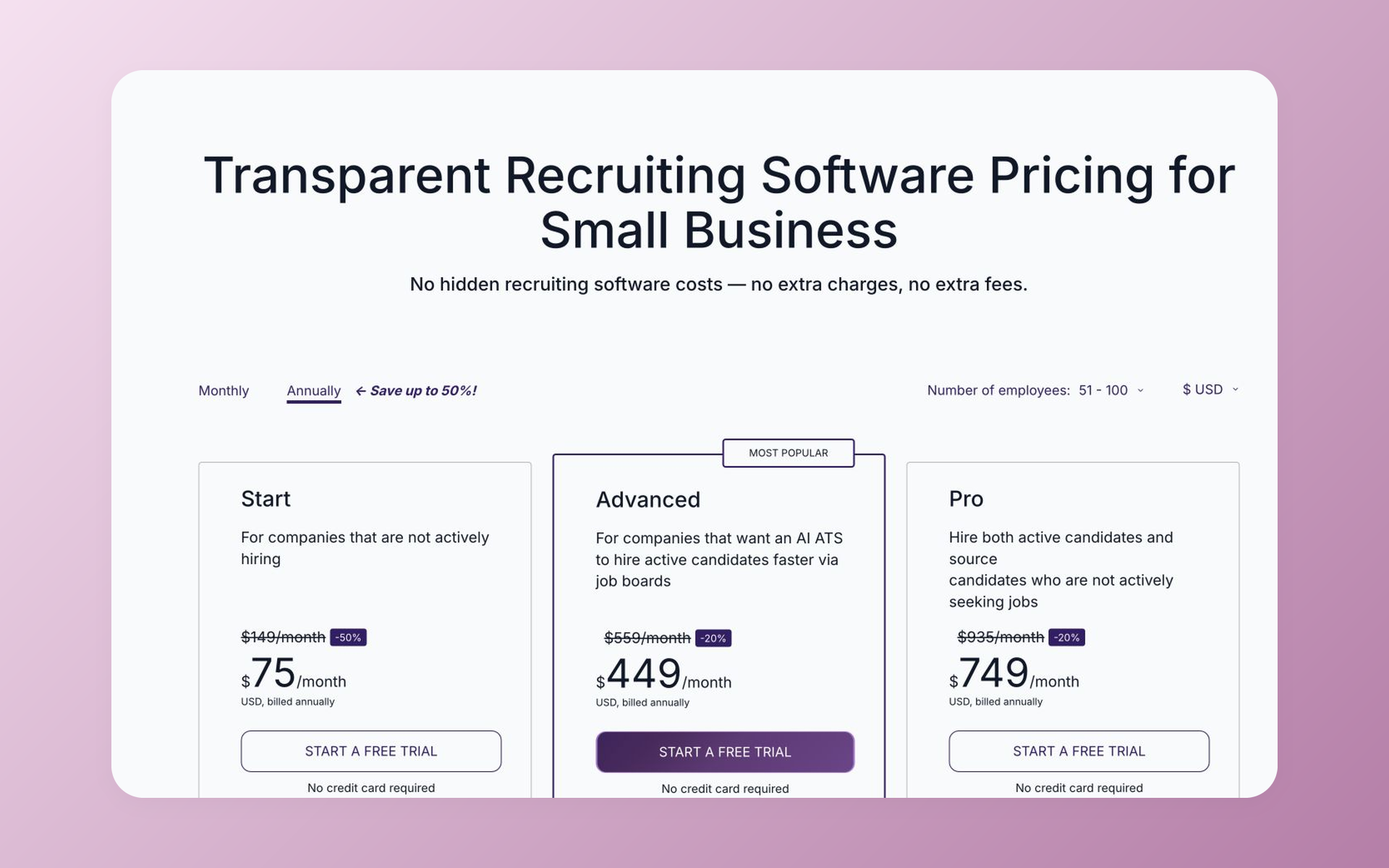
Annual prepayment is the primary comparison basis. Monthly prices remain visible so a buyer can see the cost of a shorter commitment. Taxes, paid job advertising, and outside vendor subscriptions are excluded from every row.
The scenario does not assume AI-credit usage, so plan AI-credit limits are outside this comparison. Check the live pricing page if AI volume affects your choice.
The captured 100Hires page retained USD base values even when its default state displayed EUR. Check the live page for your localized currency before approval.
Disclosure: 100Hires publishes this comparison and sells the product. The 100Hires amounts come from the public 51-100 employee pricing band.
Our Reddit, YouTube, podcast, X, and LinkedIn research found no retained independent 100Hires practitioner comparison. This guide does not claim equal popularity or parity with every Lever enterprise control.
Why Start does not fit
Start has the lowest public annual total, yet it is not the right comparison plan. The scenario needs eight users and eight active jobs. Start permits one user, three jobs, and 100 candidates.
Using its $900 annual total as the 100Hires answer would be entry-price cherry-picking. A sound comparison rules it out.
Why Advanced and Pro fit differently
Advanced fits the stated volume because its public limits allow unlimited jobs, candidates, and users. It is the simpler public budget for a team that needs shared ATS and CRM work.
Pro fits the same volume and adds sourcing, enrichment, outreach, onboarding support, and migration wording for annual contracts. Those additions do not prove that Pro matches Lever's full analytics, integration, security, or service scope.
Review the live 100Hires pricing and limits, or start a 14-day trial if a public, self-service evaluation fits your buying process.
What 5, 25, and 100 users reveal about Lever pricing
Lever does not publish a per-user rate. A team-size table can still show the contract questions that change as access spreads.
| Users | Lever price | Access questions | Expansion term to request |
|---|---|---|---|
| 5 | Custom quote | Full recruiter versus manager access; admin rights | Price for the next recruiter and manager user |
| 25 | Custom quote | Interviewer access, report visibility, permissions, and training | User-type definitions and volume bands |
| 100 | Custom quote | SSO, regional roles, reporting-only users, service accounts, and support | Expansion price, organization-size threshold, and renewal treatment |
Ask for the expansion unit before signing
Do not assume every person counts as the same seat. Separate full recruiters, hiring managers, interviewers, admins, reporting-only users, and service accounts.
Ask whether each user type changes price and what happens at the next organization-size or hiring-volume threshold. The answer belongs in the commercial schedule, not in a spreadsheet built from a directory estimate.
At five users, permission design may matter more than seat count. At 25, training and report visibility spread across more teams. At 100, SSO, regional roles, service accounts, support, and audit needs can become part of the commercial scope.
Those are operating questions, not a price formula. Ask Lever to quote the current group and the next planned group so the agreement shows the cost of growth.
When Lever can justify the custom quote
A custom quote is not automatically a bad deal. It can make sense when the buying team needs a broad enterprise scope and has the procurement capacity to document it.
Choose Lever for complex enterprise scope
Lever deserves a serious look when the organization values ATS and relationship-led recruiting in one platform, advanced analytics paths, a large partner ecosystem, enterprise security work, and guided implementation.
The value depends on the signed package. Validate the dashboards, connectors, user rights, services, support, security controls, and renewal terms that matter to your team.
If Greenhouse is on the shortlist, use our Lever vs Greenhouse comparison to prepare a second set of questions.
Choose transparent self-service pricing when speed matters
100Hires is easier to budget before a conversation. Advanced and Pro publish the amounts needed for the shared scenario, and a team can begin a trial without negotiating the first-year price.
That transparency does not prove a lower total cost, and it does not establish parity with every Lever enterprise feature. Teams whose quote, scope, or sales process does not fit their needs can compare more alternatives to Lever.
Put these questions in the Lever quote request
A clear request makes quotes easier to compare and leaves fewer commercial decisions before implementation begins.
- What is the annual recurring price, billing unit, payment schedule, and minimum term?
- Which recruiter, manager, interviewer, admin, and reporting users are included?
- Which jobs, candidate records, storage, CRM campaigns, messages, and regions are included?
- Which analytics edition, dashboards, builders, exports, roles, and BI connections are included?
- Which named integrations, API/webhooks, custom mappings, and partner subscriptions are included?
- What configuration, migration, testing, training, and launch support are included?
- What support channel, response target, named contact, and escalation path apply?
- What do Candidate Insights, VONQ screening, Onboarding, Career Site Builder, and expanded AI usage cost?
- What uplift cap, expansion price, renewal notice, module-removal right, and price protection apply?
- What export format, exit help, retention window, deletion confirmation, and transition fee apply?
Use a complete applicant tracking system scope so every seller prices the same workflows. If a line item affects use, launch, renewal, or exit, get its inclusion and expansion price in writing.
The security and supplier-risk question
Ask how the vendor documents security requirements and manages technology supply-chain risk. The current NIST supply-chain-risk guidance gives procurement teams a neutral framework for that question.
It does not review Lever or 100Hires, and it does not support any product price or compliance claim.
Frequently asked questions
How much does Lever cost in 2026?
Lever publishes no numeric list price in 2026. It gives a custom quote based on organization size and hiring needs. For a public comparison, 100Hires Advanced is $5,388 per year and Pro is $8,988 per year on annual billing for the 75-employee scenario; only a scoped Lever quote can support a direct cost comparison.
Does Lever charge per user?
Lever does not publish a per-user rate. Procurement research identifies seats as a possible pricing factor, so ask how recruiter, manager, interviewer, admin, and reporting-only users affect the contract. 100Hires makes its public user limits visible: Start has one user, and Advanced and Pro list unlimited users.
Are Lever ATS and CRM included?
Lever's current public wording describes ATS and CRM as core, but numeric usage limits and campaign allowances are not shown. 100Hires publishes plan limits and presents its recruiting software around shared ATS, candidate, and outreach workflows; buyers should compare each required workflow in writing.
Are Lever analytics and integrations included?
Lever describes reporting, analytics, and key integrations as core. Exact dashboards, Data Explorer access, API rights, partner subscriptions, and custom mapping are not publicly priced. 100Hires gives buyers public recruitment analytics and integration pages that can serve as a written comparison checklist.
Does Lever charge for implementation?
Lever does not publish an implementation fee. Its statement that most customers are fully implemented within weeks, not months, is not a price, service-level agreement, or migration promise. 100Hires Pro includes onboarding support and language about migration for annual contracts, so compare the exact records, training, testing, and launch work in both proposals.
Lever can justify a custom quote when its enterprise recruiting scope and services match the organization's needs. For the fixed scenario here, 100Hires Advanced and Pro offer public one-year budgets without claiming that either is cheaper than an unseen Lever quote.
Start a 14-day 100Hires trial to test a public self-service plan with your own jobs, users, and candidate workflow.
Try 100Hires for free
No credit card. 14-day trial. Forbes Advisor #1 ATS for SMBs.