
JazzHR vs Greenhouse: which ATS fits your team in 2026
If you are on JazzHR and eyeing Greenhouse, or pricing Greenhouse and wondering whether a lighter tool would do, here is the practical split.
JazzHR fits lean teams that want published, low pricing and a fast setup. Greenhouse fits teams scaling into structured, multi-stakeholder hiring who can absorb a custom quote.
The gap between them is mostly price transparency and workflow depth, not quality. Both are real, dedicated applicant tracking systems. The choice comes down to how much hiring structure you need and how much you want to pay for it.
To settle it we read the top practitioner threads (a JazzHR vs Greenhouse discussion on r/humanresources ranks first for this search), both vendors' public pages, and dozens of buyer conversations from our own sales calls, all pulled in July 2026.
Quick disclosure before the numbers: 100Hires is our product. It appears in the tables as a reference point and gets its own section, limitations included, near the end. Here is the shape of the decision at a glance.
JazzHR vs Greenhouse at a glance
The hiring playbook, in your inbox
One email a week - benchmarks, AI screening tactics, and short interview templates from the 100Hires team. No product pitches.
The fastest read before the detail: one publishes its prices, one does not, and they are built for teams of different sizes.
| Criteria | 100Hires | JazzHR | Greenhouse |
|---|---|---|---|
| Built for | SMB hiring with built-in AI screening | SMB hiring on a tight budget | structured hiring at scale |
| Entry price | public, from $49/mo billed annually ($99 month-to-month) | public, $1,000/yr billed annually (about $83/mo) | custom quote, not publicly shown |
| Plan limits | 3 jobs, 100 candidates, 1 user on Start; unlimited above | unlimited users on every plan; job caps by tier | not publicly shown |
| AI in the workflow | AI Score and AI Copilot on every plan | Talent Fit on Plus and up | baseline AI on all tiers, advanced features gated to Plus and Pro |
| Structured evaluation | Evaluation Forms on every plan | lighter scorecards | scorecards and interview kits (its signature) |
| Free trial | 14 days, self-serve, no card | granted after a demo | none found; sales conversation first |
| G2 rating | 4.8 (1,353 reviews) | 4.4 (858 reviews) | 4.4 (3,924 reviews) |
| Capterra rating | 4.9 (1,163 reviews) | 4.3 (492 reviews) | 4.5 (763 reviews) |
| Best for | small teams that want AI screening at SMB price | budget-first small teams hiring constantly | growing teams that need structured, multi-stakeholder hiring |
Ratings come from G2 and Capterra as of July 2026, and published prices from each vendor's own pages on the same date. Greenhouse lists no public price on any tier, so those cells stay blank by necessity, not by omission.
The bottom line: JazzHR wins on published low pricing and a quick start. Greenhouse wins on hiring structure and depth once your process spans many interviewers. 100Hires is the pick when you want AI screening and structured evaluation at JazzHR's price class.
The table hints at it; your stage makes the call.
Which one fits your stage
Most comparison pages describe buyer types in prose. A table is faster. Match your team to a row.
| Your situation | Pick | Why |
|---|---|---|
| You want AI screening and structured evaluation at an SMB price | 100Hires | AI Score and Evaluation Forms run on every plan, including the $49/mo entry tier |
| First ATS, tight budget, mostly tracking applicants | JazzHR | Published low tiers and unlimited users mean the bill tracks your plan, not your headcount |
| 50+ headcount, structured multi-stakeholder hiring, budget for a quote | Greenhouse | Scorecards, interview kits, and reporting depth earn their keep once many interviewers share a process |
| Already on JazzHR and hitting feature ceilings | Compare depth before you jump | Greenhouse is a real step up in structure and price; an AI-first tool may close the gap for less |
| Downsized and Greenhouse feels like overkill | Re-evaluate against your volume | When hires per quarter drop, a lighter tool may be all the process you need before renewing an enterprise contract |
Your stage sets the context. Buyer experience adds the detail, starting with JazzHR.
What JazzHR users actually report
Set the marketing aside. Here is the candid signal from recruiters on r/humanresources, review sites, and buyers on our own sales calls.
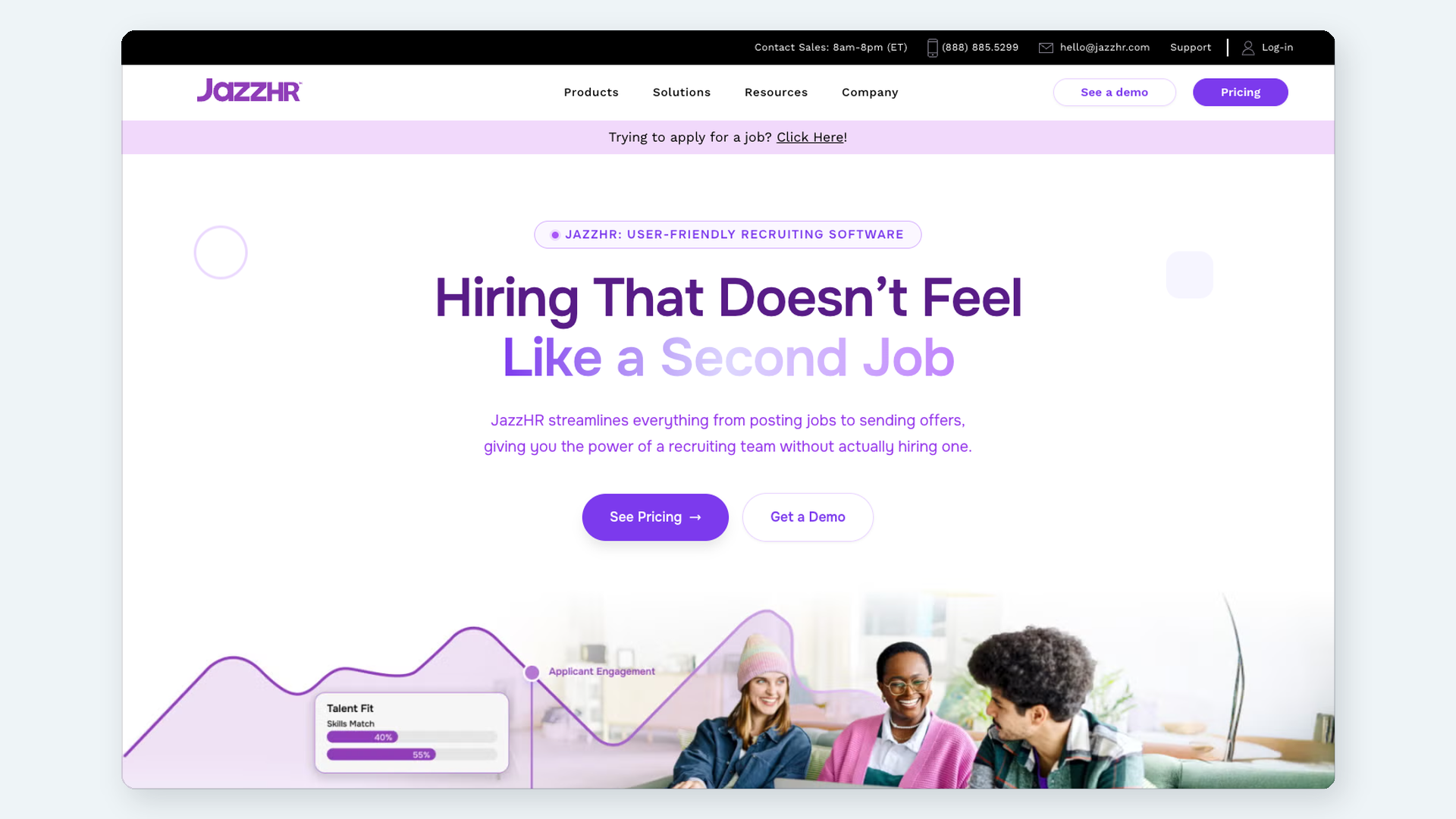
On value, JazzHR is the reference point. It is the option people reach for when the budget is tight, often described as a fraction of the price of the next tier up.
In practice, buyers we spoke with were paying roughly $250 to $330 a month before add-ons, and they liked that the number was knowable in advance.
Ease of use is the other consistent point of praise. Hiring managers pick it up without training, and recruiters call the day-to-day flow intuitive.
One buyer told us they had used JazzHR for three or four years before shopping around, which says something about the stickiness of a simple tool.
The strain shows up as teams push past basic applicant tracking. The product feels thinner as teams need more advanced workflows. Recruiters describe a weak, partly deprecated API with no direct resume export, so one team built a daily email workaround to get candidate files out.
Bulk actions frustrate people too: clearing out unqualified applicants means selecting them one at a time and clearing a captcha on each delete, which turns a five-minute cleanup into an afternoon.
Reporting has sharp edges at the margins. A staffing buyer running evergreen roles told us the way JazzHR structures always-open positions makes it hard to see a true count of openings or to report time to hire back to a client.
Another described sponsoring a role on LinkedIn through JazzHR and getting a duplicate posting that looked unprofessional to candidates.
The pattern that pushes people to shop is price increases. Across several 2024 to 2026 sales calls, the story repeated: a renewal quote came in higher, the extra cost was hard to justify against the feature depth, and the team started testing alternatives.
Renewal uplift, more than any missing feature, is what puts JazzHR buyers in the market. Greenhouse buyers describe a different set of trade-offs.
What Greenhouse users actually report
Greenhouse is the tool teams tend to pay up for, so read its trade-offs against what JazzHR gives up in the other direction.
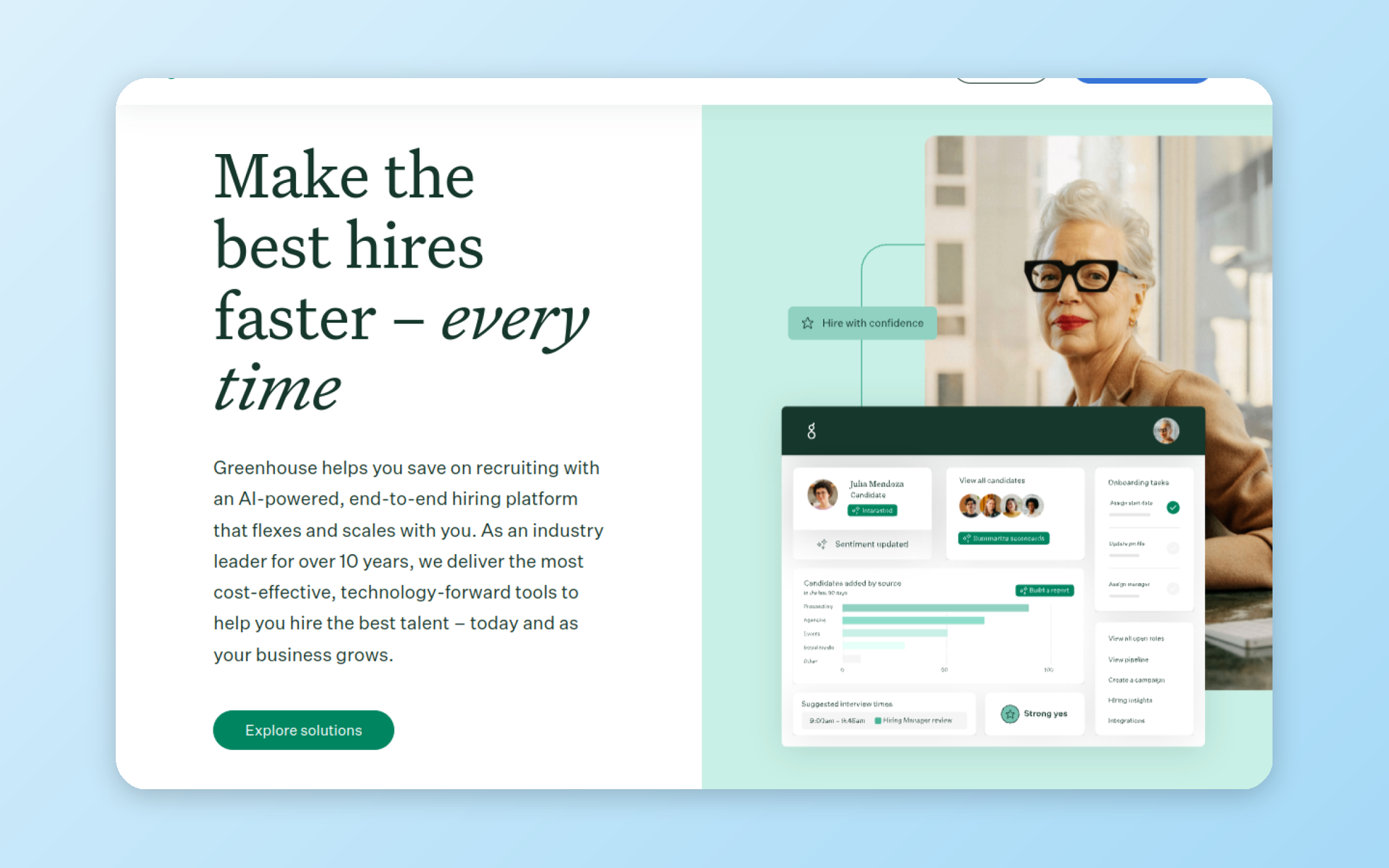
Start with the strength, since it is the reason people leave JazzHR for it. Greenhouse built its identity on structured hiring: scorecards, interview kits, and a defined process that many interviewers can share.
Its own talent team frames structured interviewing as a philosophy, not a feature, and buyers who want that rigor find JazzHR's lighter scorecards do not match it.
Structured interviews are consistently linked to fairer, more predictive hiring, which is the case Greenhouse makes well.
That depth carries a cost that JazzHR's published tiers make plain by contrast. Greenhouse does not publish plan pricing. Buyers report paying somewhere between roughly $6,500 a year at the low end and well past $30,000 a year at scale.
One 25-person team told us their renewal ran about $11,000 a year, rising to around $14,000 once AI functionality was added. Every figure here is buyer-reported; Greenhouse itself publishes nothing.
Reporting draws a specific complaint from power users. In aggregate the analytics get praised, but the people who lean on them describe exporting data to a spreadsheet to get the view they need, which they trace to how the underlying data is modeled.
Treat that as practitioner opinion rather than a settled fact, but it comes up often enough to note.
Implementation is the other JazzHR contrast. Where JazzHR is quick to set up, Greenhouse buyers describe a multi-month rollout that wants a dedicated admin to configure and maintain.
That is a fair trade for a large, structured team, and a poor one for a lean shop that just needs to move candidates through stages.
Regret runs in both directions, which is worth saying plainly. Some downsized teams find Greenhouse is more software than they now need and go looking for something lighter. Some teams that left JazzHR miss how simple it was.
Neither tool is a mistake; each fits a different size and shape of hiring. Put those experiences on one grid and the winners by axis become clear.
JazzHR vs Greenhouse feature by feature
One axis at a time, with a plain verdict on each.
Pricing transparency. JazzHR publishes its tiers; Greenhouse routes every buyer through a sales quote. For anyone who wants to budget before a call, this is not close. Winner: JazzHR.
Structured hiring and scorecards. Greenhouse's interview kits and scorecards are its signature, and buyers who need many interviewers scoring against the same rubric find JazzHR's version lighter. Winner: Greenhouse.
Reporting and analytics. Greenhouse goes deeper, though power users describe friction around exporting data to spreadsheets. JazzHR's reporting is thinner still, and evergreen roles strain it further. On depth, Winner: Greenhouse.
AI in the hiring workflow. Greenhouse ships baseline AI on all tiers. Talent matching and natural-language report filters require Plus or Pro, and resume anonymization is Pro-only. JazzHR's Talent Fit is gated to Plus and up.
Greenhouse has the broader AI surface, but both hold the useful pieces behind higher tiers, which is exactly the gap 100Hires targets later. Winner: Greenhouse on breadth, with a caveat.
Ease of use and setup speed. JazzHR stands up fast and stays intuitive for hiring managers. Greenhouse asks for a multi-month implementation and an admin to run it. For a lean team, Winner: JazzHR.
Migration and switching effort. JazzHR buyers tend to expect a one-to-two-week switch; treat that as a buyer expectation, not a measured onboarding time, since neither vendor publishes concrete migration steps. Greenhouse migrations are heavier and admin-dependent.
On expected switch speed for a small team, Winner: JazzHR.
Integrations. Greenhouse lists a catalog of 400 or more integrations plus an open API. JazzHR ships a smaller set alongside more than a dozen free job boards. For a team with an existing stack to connect, Winner: Greenhouse.
Scale ceiling. Greenhouse is built for 200-plus headcount and complex, multi-brand hiring. JazzHR is built for the small end. Winner: Greenhouse for scale, JazzHR for SMB. Most of these trade-offs come back to price, so let us put real numbers on the table.
Pricing: published tiers versus custom quotes
This is the defining axis, in full. Two of these three vendors let you budget from a public page; one does not.
| Plan | Monthly price | Annual equivalent / mo | Annual total | Billing basis | Scope and limits |
|---|---|---|---|---|---|
| 100Hires Start | $99 (displayed) | $49 (derived) | $588 (derived) | monthly or annual | 3 jobs, 100 candidates, 1 user, 100 AI credits/mo |
| 100Hires Advanced | $249 (displayed) | $199 (derived) | $2,388 (derived) | monthly or annual | unlimited jobs, candidates, users; 300-1,000 AI credits |
| 100Hires Pro | $499 (displayed) | $399 (derived) | $4,788 (derived) | monthly or annual | everything in Advanced plus sourcing and advanced security; 3,000-5,000 AI credits |
| JazzHR Hero | $110 (displayed) | $83 (derived) | $1,000 (displayed) | annual, monthly option | unlimited users; job and candidate caps not publicly shown |
| JazzHR Plus | $350 (displayed) | $290 (derived) | $3,480 (displayed) | annual, monthly option | unlimited users; up to about 200 active jobs (see note); candidate cap not publicly shown |
| JazzHR Pro | not publicly shown | $459 (derived) | $5,508 (displayed) | annual | unlimited users; other limits not publicly shown |
| JazzHR Enterprise | not publicly shown | not publicly shown | not publicly shown | custom | limits not publicly shown |
| Greenhouse Core | not publicly shown | not publicly shown | not publicly shown | custom quote | limits not publicly shown |
| Greenhouse Plus | not publicly shown | not publicly shown | not publicly shown | custom quote | limits not publicly shown |
| Greenhouse Pro | not publicly shown | not publicly shown | not publicly shown | custom quote | limits not publicly shown |
A note on JazzHR's figures: its main pricing page shows Hero at $1,000 a year, its reseller page shows $1,788, and the Plus active-job cap differs (200 versus 30) between the two. All figures are dated July 2026.
What buyers report paying for Greenhouse. Since the vendor publishes nothing, the only numbers available are anecdotal.
Buyers describe a range from roughly $6,500 a year at entry to more than $30,000 a year at scale, with the 25-person team mentioned earlier landing near $11,000 to $14,000.
Read these as buyer-reported estimates, not official pricing.
Add-ons shift JazzHR's real cost too: job packs run $49 to $99 a month, candidate texting starts around $39 a month, and nonprofits get a 10 percent discount.
The takeaway is simple: you can budget JazzHR and 100Hires from public pages, and Greenhouse requires a sales conversation. One more thing the public pages do not tell you is who actually builds JazzHR's AI.
What Employ ownership means for JazzHR's Talent Fit
Here is a footnote most comparisons skip. JazzHR is owned by Employ Inc., which also owns Lever and Jobvite. JazzHR's Talent Fit AI is shared across all three products and governed by IBM watsonx, per Employ's own statements in late 2025.
The takeaway for a buyer is narrow but useful: Talent Fit is shared across JazzHR, Lever, and Jobvite under Employ's IBM watsonx governance. That is neither good nor bad on its own, but it is worth knowing when you weigh JazzHR's AI against a tool whose AI is its own core focus.
When neither fits: an AI-first middle option
As disclosed up top, 100Hires is ours. It also did not appear in any of the external channels we analyzed for this keyword, so judge this section accordingly.
Here is the gap the two incumbents leave. JazzHR gates its AI behind Plus, and Greenhouse reserves its advanced AI for Plus and Pro and keeps its full price behind a sales call.
If you want AI screening included on the entry plan alongside structured evaluation, neither entry point gives it to you.
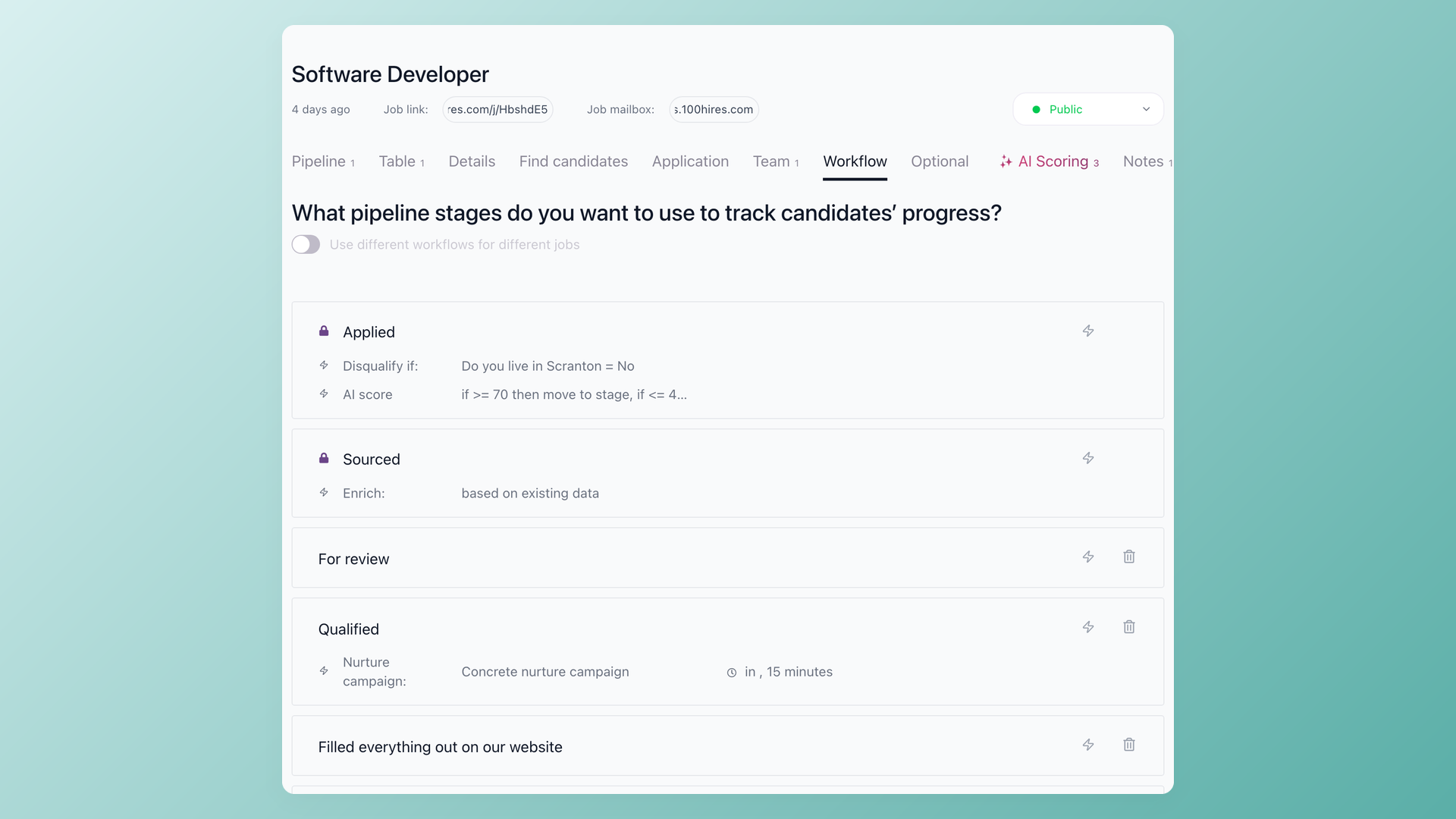
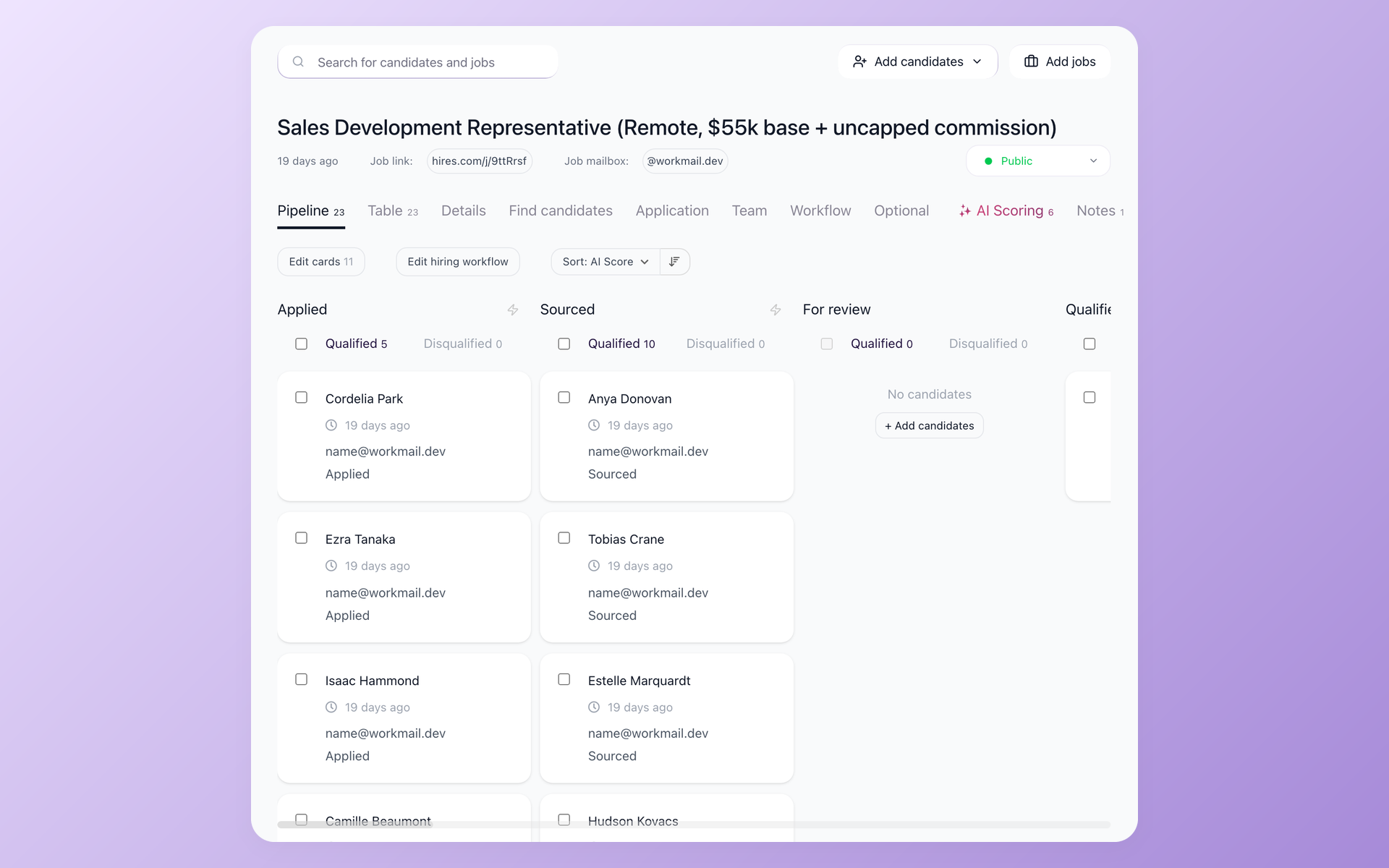
100Hires was built for that gap. AI Score reads every resume against your job and scores it on arrival. AI Copilot drafts outreach and answers questions about your pipeline.
Evaluation Forms keep interview feedback structured, assigned per job and scored per criterion, which is the structured-feedback counterpart to Greenhouse scorecards. Trackable links show which sourcing channel actually delivers, and jobs post to more than a dozen boards.
Plans start at $49 per month billed annually ($99 month-to-month).
On migration, the part both incumbents answer vaguely, 100Hires runs standard scripts to move data from popular ATS systems on request; you tell the team your current tool and your candidate and job counts.
Self-serve CSV import handles the rest, and it runs AI screening at the import stage, so candidates are scored before they even enter your pipeline.
Forbes Advisor lists 100Hires as Best for Startups and Small Businesses in its applicant tracking system roundup, and it holds 4.8 on G2 (1,353 reviews) and 4.9 on Capterra (1,163 reviews).
The limitations, stated plainly: 100Hires is a newer, smaller brand, and it barely registers in the practitioner threads where JazzHR and Greenhouse are household names, so you are trusting the product more than the crowd.
It ships fewer native integrations than Greenhouse's catalog, and it is not built to run 1,000-person, multi-brand structured hiring at Greenhouse's depth. The $49 Start plan caps at 3 open jobs and 1 user.
If hiring is the bottleneck and AI screening is why you are shopping, start the free trial or book a demo and compare it against both tools in an afternoon. For a related matchup, see how Workable stacks up against Greenhouse.
FAQ
The questions that come up most on a JazzHR versus Greenhouse evaluation, answered directly.
Is JazzHR cheaper than Greenhouse?
For most small teams, yes. JazzHR publishes its tiers, starting at $1,000 a year (about $83 a month) with unlimited users. Greenhouse quotes every buyer privately, and buyers report paying several thousand to tens of thousands a year. If a published, low starting price is the priority, 100Hires begins lower at $49 per month billed annually, with AI screening included.
How much does Greenhouse cost?
Greenhouse does not publish pricing on any tier; every plan is a custom quote. Buyers report a wide range, from roughly $6,500 a year at entry to more than $30,000 a year at scale, with a 25-person team citing about $11,000 to $14,000. Treat those as buyer-reported estimates. If you want a number you can see before a sales call, 100Hires lists its prices publicly from $49 per month.
Does JazzHR have AI?
Yes. JazzHR offers Talent Fit, an AI resume-scoring feature, on its Plus and Pro plans. Talent Fit is shared across parent company Employ's products (JazzHR, Lever, and Jobvite) under IBM watsonx governance. 100Hires includes AI Score and AI Copilot on every plan, including the entry tier.
Is Greenhouse worth it for a small team?
It depends on how much hiring structure you need. Greenhouse's scorecards and interview kits pay off when many interviewers share a rigorous process, but for a small team hiring occasionally, the custom-quote price and multi-month setup are often more than the job requires. 100Hires offers structured Evaluation Forms and AI screening at a published SMB price as a middle option.
Can you migrate from Greenhouse to JazzHR, or off either tool?
Both vendors handle migration through their teams and describe the steps only vaguely in public, so expect a scoped project rather than a one-click export. 100Hires runs standard migration scripts for popular ATS systems on request, and its CSV import runs AI screening at the import stage, so candidates arrive already scored.
JazzHR vs Greenhouse for structured hiring?
Greenhouse leads here; structured hiring with scorecards and interview kits is its signature, and JazzHR's scorecards are lighter by comparison. If you want structured evaluation without Greenhouse's price and setup, 100Hires offers Evaluation Forms assigned per job and scored per criterion on every plan.
Whichever way you lean, match the tool to your stage and budget, and shortlist an AI-first option if you want structured evaluation without an enterprise quote.
Try 100Hires for free
No credit card. 14-day trial. Forbes Advisor #1 ATS for SMBs.