
Indeed Single-Source Feed Policy 2026: Dates and What to Do
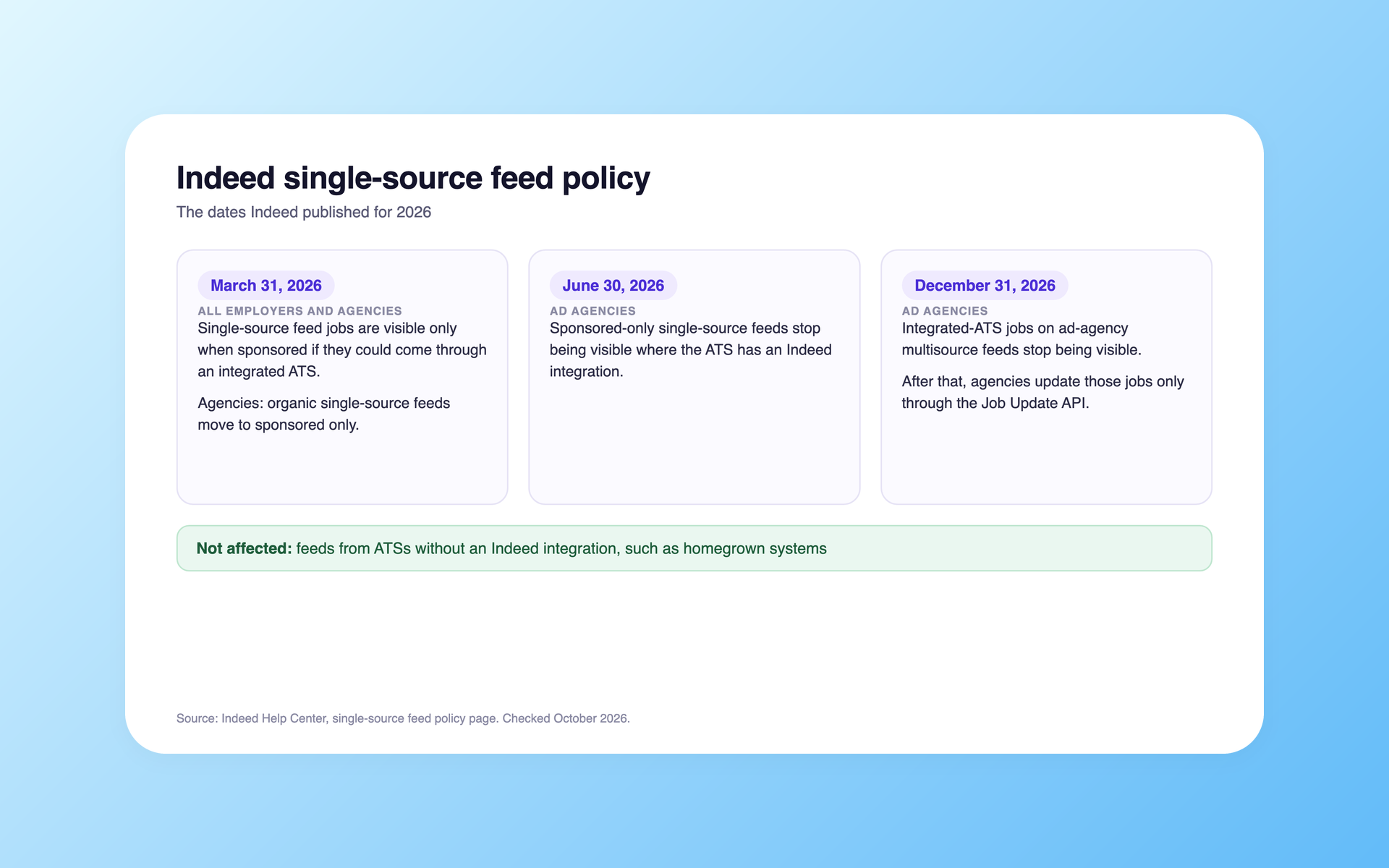
Indeed's single-source feed policy says that from March 31, 2026, jobs sent through a single-source XML feed are shown for free only if they could not come through an integrated ATS.
If your ATS is integrated with Indeed, Indeed says you must post through that integration. Feeds from ATSs without an Indeed integration are not affected. The next date on Indeed's schedule is December 31, 2026, and it concerns ad agencies.
If the number of applicants from Indeed dropped this spring, check how your jobs reach Indeed before you rewrite a single job ad.
This guide walks through the dates on Indeed's policy page, who each date applies to, what the policy does not say, and how to check your own jobs.
Last verified: October 2026 against Indeed's policy page.
Key takeaways
The hiring playbook, in your inbox
One email a week - benchmarks, AI screening tactics, and short interview templates from the 100Hires team. No product pitches.
- The rule: on Indeed's published schedule, single-source feed jobs that could come through an integrated ATS are visible only when sponsored from March 31, 2026.
- Integrated ATS: you must post through the integration. Homegrown and non-integrated systems are not affected.
- Agencies: a separate, older rule applies. Staffing and recruitment firms sponsor their jobs in most markets except Japan and Puerto Rico.
- Next date: December 31, 2026 is the next scheduled step. It concerns ad agencies and the Job Update API.
- No guarantee: no route promises free visibility. Indeed can require sponsorship for any or no reason.
The dates in Indeed's published schedule
Indeed lists the dated steps on its policy page. The table below sticks to what that page says.
| Date | Who | What Indeed's page says changes |
|---|---|---|
| Until March 30, 2026 | Employers that already have an integrated ATS | Indeed no longer accepts new single-source feeds from them, including feeds a third party or an agency built |
| March 31, 2026 | All employers | Jobs sent through single-source feeds are visible only when sponsored, where the jobs could come through an integrated ATS |
| March 31, 2026 | Agencies | Organic single-source feeds move to sponsored only, if the ATS has an Indeed integration |
| June 30, 2026 | Ad agencies | Sponsored-only single-source feeds are no longer visible, if the ATS has an Indeed integration |
| December 31, 2026 | Ad agencies | Jobs from integrated ATSs on ad-agency multisource feeds are no longer visible. After that, agencies manage those jobs only through the Job Update API |
Treat dates that have passed as entries in the published schedule. Indeed's page has not been updated since February 2026, so confirm your own case with your Indeed account manager.
Under Indeed's single-source feed policy, an employer whose ATS integrates with Indeed must use that integration to post. Feeds from ATSs without an Indeed integration are not affected.
100Hires received an Indeed partner notice in June 2025, and HR Dive covered the policy on March 31, 2026.
Who the policy affects, by how your jobs reach Indeed
The policy turns on two questions: how your jobs reach Indeed, and whether your ATS is integrated with Indeed. The dates in this table are Indeed's published dates.
| Sender | If your ATS is integrated | If it is not | Date that matters | What to do |
|---|---|---|---|---|
| Direct employer posting through an integrated ATS | Post through the integration. On Indeed's schedule, a parallel single-source feed for the same jobs is sponsored only | Not applicable | March 31, 2026 | Consolidate each job under the integration |
| Employer with its own XML feed | On Indeed's schedule, feed jobs are visible only when sponsored, and no new single-source feeds are accepted | Not affected, per Indeed | March 31, 2026 | Move the jobs to the integration |
| Homegrown or non-integrated system | Not applicable | Not affected, per Indeed | None published | Keep the current setup, request Job Sync access, or move to an integrated ATS |
| Staffing or recruitment agency | Sponsor jobs in most markets, through any route (older rule) | Same rule | No official start date | Budget for sponsorship |
| Ad agency sending client jobs | Feed changes on all three dates, then a move to the Job Update API | Our reading: the integration rule does not apply | December 31, 2026 | Follow Indeed's migration steps |
| Software platform posting for many employers (our reading) | Aggregators are not allowed and distributor jobs are sponsored only | Same | None published | Become a partner, or post through an integrated ATS per client brand |
Direct employers posting through an integrated ATS
Indeed says employers with an integrated ATS must post through the integration. On Indeed's schedule, jobs carried by a parallel single-source feed are visible only when sponsored from March 31, 2026.
Indeed's Terms of Service add a second trigger. A job you post directly needs sponsorship when your other jobs already get organic visibility through a feed, an API, a career site or an ATS.
So list every route each job takes: an old feed, a second ATS, a direct post. If one job reaches Indeed through more than one route, post it only through the integration. That removes a conflict. It does not guarantee free visibility.
Employers that send their own XML feed
If your ATS has an Indeed integration, Indeed's schedule makes your feed jobs visible only when sponsored from March 31, 2026. Indeed has stopped accepting new single-source feeds from employers in that position.
The fix is to post those jobs through the integration. If your ATS has no Indeed integration, Indeed's page says your feed is not affected.
In one 2026 sales call, a UK ATS vendor that works with local authorities on care hiring described losing free feed visibility and looking for an integrated route for its clients' jobs.
Homegrown and non-integrated systems
Indeed names homegrown systems and ATSs like Taleo as examples of setups the policy does not affect. You have three paths, and each carries a trade-off.
- Keep the current setup. Nothing changes under this policy, though Indeed's other visibility rules still apply.
- Request Job Sync API access as a direct employer. Indeed opened it to direct employers on July 31, 2026. A Developer Agreement and Indeed's approval are still required.
- Move to an integrated ATS. You trade your own feed for the ATS's integration.
None of these comes with a visibility promise. For the technical side, see which Indeed APIs exist and who can use them.
Staffing and recruitment agencies
The feed policy is not the main rule for agencies. Indeed's page on third-party recruiters and aggregators says staffing, recruitment and placement firms can post if they sponsor their jobs.
That rule covers most markets except Japan and Puerto Rico. Indeed's Terms say the same for RPOs and other recruitment-based companies, and switching to a different ATS does not change it.
Indeed gives no start date. Third-party reports date it to early 2019 for the US and Canada and May 2024 for most other markets. Plan a sponsorship budget, and never try to hide agency status.
Ad agencies that manage client job feeds
Ad agencies face the next date on the schedule. Indeed's published schedule lists three ad-agency steps for March 31, June 30 and December 31, 2026. Each applies where the client's ATS has an Indeed integration.
After December 31, an agency updates those jobs through the Job Update API. The ATS creates and expires each job, and the agency edits its fields and campaigns. Job Update calls are free.
Indeed's migration order: list the jobs, stop organic duplicates, keep sponsored-only duplicates during the move, add your metadata, move campaigns, then stop the sponsored duplicates.
Software platforms that post jobs for many employers
This section is our reading. Indeed does not allow aggregators, and distributor content appears only when sponsored. Its ATS multisource feed integration requires at least ten clients, a paid product that has already launched, and no free tier or trial that posts jobs.
That leaves four options: apply to become an Indeed ATS partner, which Indeed decides case by case; post through an integrated ATS's API with a separate company account for each client brand; accept sponsored-only distribution; or stop pursuing organic visibility on Indeed.
100Hires gives each client a separate company account with that client's own Indeed and LinkedIn employer pages, and you manage the accounts through the 100Hires API. If that model fits your platform, talk to us.
What the policy does not say
Three misreadings of this policy keep circulating. None of them matches Indeed's page.
- It does not end XML feeds. Feeds from non-integrated systems are untouched, and Indeed still documents its XML feed format.
- It is not written as a one-source-per-employer rule. Indeed does want each job to appear once, and its aggregation page names preventing duplicate or conflicting listings as a reason to use the ATS integration.
- It does not say every ATS job loses organic visibility. It targets single-source feeds where an integration exists.
Two older rules get blamed on this policy too. The first is the agency sponsorship rule covered above.
The second is the free job post limit: in the 12 countries Indeed lists, three free direct posts per calendar month, each shown for up to 30 days. ATS-fed jobs do not usually count toward your three direct posts, and free visibility is not guaranteed either.
Indeed says free jobs may get less visibility over time. For the direct route and its limits, see how to post a job on Indeed.
How to check whether the policy hit your jobs, step by step
Work through these five steps in order. Each one narrows down where the problem sits.
Step 1: list every route your jobs take to Indeed
Write down how each job reaches Indeed: through an ATS integration, an XML feed, direct posting in your Indeed account, an ad agency, or a job distributor. A second route for the same job, set up earlier, may still be active.
Step 2: check your ATS in the Integrations Hub
Search for your ATS in Indeed's directory of ATS partners. If your jobs come from an ATS but you are not using its integration, Indeed tells you to contact your account manager.
Step 3: consolidate jobs that reach Indeed twice
If one job reaches Indeed through more than one route, post it only through your integrated ATS. Treat this as a conflict fix, not a visibility guarantee.
Step 4: measure with two sources, kept apart
If your ATS has an applicants-by-source report, use it to count Indeed applicants by job. Indeed's employer dashboard shows impressions and clicks for jobs linked to your account. Keep the two sources separate, and do not judge visibility by searching for your own job.
Here is an example. Say a team has 40 open jobs, averaging 9 Indeed applicants per job per month in February and 3 in April.
A drop like that does not tell you the cause on its own. It tells you where to look: the route first, then the job's sponsorship status in the Indeed dashboard, then the job content.
Step 5: decide per job type
For each group of jobs, choose one of three options: sponsor the jobs on Indeed, post them through your integration, or put more effort into other job boards. Hard-to-fill roles may justify sponsorship when high-volume roles do not.
Common mistakes we see
These come from our curated review of 549 sales-call transcripts from June 2025 to October 2026. The counts are distinct calls in which customers raised the issue, not market estimates.
- Switching ATS to get free agency posting. In 27 calls, customers described agency classification or said Indeed required sponsorship under its agency rules. A new ATS does not change the agency rule.
- Running a feed and an ATS for the same jobs. Two routes create a conflict. Pick one per job.
- Reposting the same job to refresh it. Indeed treats copies as duplicates. Edit the existing job instead.
- Judging visibility by searching for your own job. Customers described lost organic visibility in 25 calls. Indeed says search results are personalized, so check applicants and impressions instead.
- Assuming an integrated ATS means free, unlimited reach. This came up in 17 calls, and it is not what Indeed promises.
If a job shows a warning in your dashboard, read why Indeed flags a job or makes it sponsored only.
What an integrated ATS gives you, and what it does not
Moving from your own feed to an integrated ATS changes how jobs reach Indeed. It does not change who pays for visibility.
| Criterion | Own XML integration | Integrated ATS (100Hires shown) |
|---|---|---|
| How jobs reach Indeed | Indeed ingests your XML feed | Varies by ATS. 100Hires pushes each job through Indeed's Job Sync API |
| Indeed Apply | Added to your feed as Indeed Apply data, if you build it | On for every job 100Hires sends to Indeed |
| Hiring-status updates to Indeed | A separate Disposition Sync integration, depending on your build | Included through 100Hires Disposition Sync |
| Sponsorship | Set and paid in the Indeed dashboard, or through an integration Indeed supports | Varies by ATS. In 100Hires, set and paid in the Indeed dashboard |
| Free visibility | Not guaranteed. Feed jobs are sponsored only on Indeed's schedule where an integrated ATS exists | Not guaranteed |
100Hires is listed in Indeed's ATS partner directory and sends jobs through Job Sync, not a feed. With 100Hires, you configure and pay for sponsorship in the Indeed employer dashboard, never inside the ATS.
The limits matter just as much. Check flags and sponsorship requirements in the Indeed dashboard. 100Hires does not use the Job Update API, so it is not a migration tool for ad agencies. And 100Hires does not make agency jobs free.
Frequently asked questions
What is Indeed's single-source feed policy?
It is Indeed's rule for feeds that carry one employer's jobs. On Indeed's published schedule, from March 31, 2026, those jobs show only when sponsored if an integrated ATS could send them. 100Hires sends jobs through Indeed's Job Sync API, not a feed.
Does the policy mean Indeed no longer accepts XML feeds?
No. Feeds from ATSs without an Indeed integration are not affected, and Indeed still documents XML feeds. The policy targets single-source feeds where an integration exists. If you post through 100Hires, there is no feed for you to maintain.
How do I know if my ATS is integrated with Indeed?
Search Indeed's ATS partner directory, or ask your Indeed account manager. US clients can check the Integrations Hub inside their Indeed account. 100Hires is listed in Indeed's ATS partner directory.
What changes for agency feeds on December 31, 2026?
On Indeed's schedule, jobs from integrated ATSs on ad-agency multisource feeds stop being visible, and agencies then update those jobs through the Job Update API. 100Hires does not use the Job Update API; agencies sponsor 100Hires jobs in their own Indeed account.
Can a staffing agency get free Indeed visibility by switching ATS?
No. Indeed's agency rule is older and separate: staffing and recruitment firms sponsor their jobs in most markets except Japan and Puerto Rico, through any route. 100Hires sends jobs from companies set up as staffing agencies as agency jobs, and sponsorship happens on Indeed.
We run a platform that posts jobs for many employers. What are our options?
Indeed bars aggregators. The practical options are partner approval, an integrated ATS with one account per client brand, or sponsored-only distribution. 100Hires supports per-client company accounts through its API.
What to do this week
Map every route your jobs take to Indeed and check your ATS in the partner directory. Then put December 31, 2026 on the calendar if an ad agency manages any of your Indeed jobs.
If you need one place to post jobs to Indeed and manage hiring across several brands, book a 100Hires demo.
Try 100Hires for free
No credit card. 14-day trial. Forbes Advisor #1 ATS for SMBs.