iCIMS vs Greenhouse: enterprise ATS compared for 2026
Here is the short answer most comparison pages bury: iCIMS and Greenhouse are not really neighbors. iCIMS is built for large, complex, high-volume hiring. Greenhouse is built for mid-market teams that want structured interviews and a recruiter-friendly product.
The reviewer data makes the gap concrete. On G2, 56% of iCIMS reviews come from enterprise companies over 1,000 employees, while two-thirds of Greenhouse reviews come from mid-market companies of 1,000 or fewer. You are not picking between two similar tools.
You are picking a company-size segment first, and a feature set second.
To write this comparison, we read both vendors' 2026 release notes, review data from G2, Capterra, and TrustRadius, dozens of practitioner threads, and our own demo-call transcripts, where Greenhouse contracts come up with real dollar figures attached.
Few sources compare this pair head to head, so we concentrated the scattered evidence in one place.
iCIMS vs Greenhouse at a glance
The hiring playbook, in your inbox
One email a week - benchmarks, AI screening tactics, and short interview templates from the 100Hires team. No product pitches.
Sixty seconds of context before the details. The third column is 100Hires, our own ATS, included for teams that land on this comparison and discover both tools are a size too big.
| iCIMS | Greenhouse | 100Hires | |
|---|---|---|---|
| Best for | Enterprises, 1,000+ employees, high-volume and regulated hiring | Mid-market, roughly 100 to 1,000 employees, structured hiring | SMBs and startups under 500 employees |
| G2 rating | 4.2 (989 reviews) | 4.4 (3,925 reviews) | 4.8 (1,353 reviews) |
| Capterra rating | 4.3 (824 reviews) | 4.5 (763 reviews) | 4.9 (1,163 reviews) |
| Pricing | Custom quote | Custom quote | Public, from $49/mo (Start, annual) - see pricing |
| Free trial | None | None | 14 days, no credit card |
| Typical implementation | 3 to 6 months (reported) | 6 to 12 weeks (reported) | Same-day, self-serve |
| AI | ICIMS Coalesce AI; Frontline AI is a paid add-on | Greenhouse AI; key features gated to Plus and Pro tiers | AI Score and AI Copilot on every plan |
| Release schedule | 3 seasonal releases per year | Monthly release notes | Continuous |
Ratings this close hide a real segmentation gap. The rest of this article unpacks who each tool actually serves, what they cost in practice, and where each one wins.
Hiring for a team under 500 people? You can skip ahead: start a free 14-day trial of 100Hires and compare it against both quotes you are about to request.
Which ATS fits your company stage
Company size predicts satisfaction with these two tools better than any feature checklist. Here is the pattern from reviewer demographics and practitioner threads.
| Your situation | Better fit | Why |
|---|---|---|
| Under 100 employees | Neither | Both are quote-priced, sales-led, and sized for dedicated recruiting teams. Lighter tools cover this segment for a fraction of the cost |
| 100 to 500, growing tech or professional hiring | Greenhouse | Structured hiring discipline without enterprise overhead; fast rollout |
| 500 to 1,000, scaling recruiting function | Greenhouse (Plus or Pro) | Scorecard governance and reporting hold up at this scale |
| 1,000+, multi-brand or multi-country | iCIMS | Deep configurability, many languages, enterprise HRIS connectors |
| High-volume hourly or regulated hiring | iCIMS | Frontline hiring tools, compliance depth, audit trails |
One third-party analysis puts the dividing line at hiring volume: teams making 500+ hires a year are a better fit for iCIMS, and teams making under 300 professional hires land comfortably on Greenhouse. Our read of the review data supports that split.
iCIMS: the enterprise talent cloud
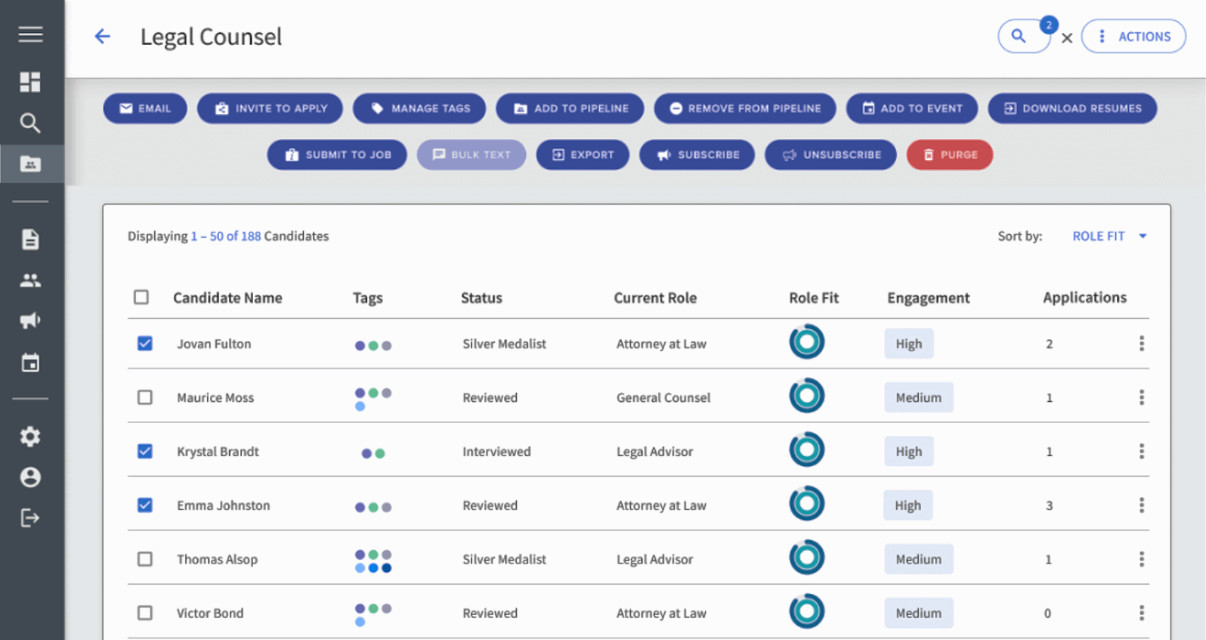
iCIMS calls its platform a talent cloud, and the name is accurate. The ATS sits inside a suite: CXM (its candidate relationship product), onboarding, employer branding, and a marketplace of roughly 750 integration partners.
Where iCIMS shines
Configurability is the word that keeps coming up in reviews. Enterprise buyers on TrustRadius who evaluated both tools picked iCIMS for reporting depth, workflow automation, and the ability to shape the system around complex, multi-entity hiring.
The integration story is enterprise-grade. iCIMS maintains bi-directional connectors to Workday, SAP SuccessFactors, UKG, ADP, and Oracle HCM, the systems large HR stacks already run on. Those HRIS integrations are a clear advantage over lighter competitors.
High-volume hiring is the home turf. iCIMS runs The Cheesecake Factory's hiring of 40,000+ people a year on the platform, and its new High Volume Hiring module arrives in the Summer 2026 release. For hourly and frontline recruiting at scale, few tools compete seriously.
Compliance teams get real oversight tooling. The one Greenhouse-to-iCIMS switch we found in practitioner threads happened for exactly this reason: the talent-acquisition ops team wanted oversight of recruiter activity, plus resume keyword search across the database.
Where iCIMS falls short
The user interface is the most consistent complaint in every channel we checked, from 2022 threads through 2026 reviews. Practitioners describe it as dated and click-heavy.
The recurring advice: iCIMS works well when a dedicated HRIS analyst runs it, and frustrates teams without one.
Price increases come up often as a switch trigger, and so does product fatigue. Multiple long-term customers in recruiting forums describe demoing replacements, including one ten-year customer who cited eroding support and a dated interface as the final push.
The add-on economics are confirmed by iCIMS itself. Its Spring 2026 release FAQ states that Offer Management is priced separately and that Frontline AI is an additional purchase on top of the core ATS.
Budget planning should assume the base contract is a starting point, not the total.
The same vendor FAQ acknowledges functional gaps: hiring automations cannot trigger on field updates, including custom fields, and calendar integration needs full read-write access with a five-connection cap.
Vendor-acknowledged limits like these carry more weight than any forum gripe.
Greenhouse: structured hiring for the mid-market
Greenhouse built its brand on one idea: hiring decisions improve when every interviewer scores candidates against the same criteria. The product, the marketing, and the 2026 AI roadmap all extend that idea.
Where Greenhouse shines
Scorecards and interview kits are the signature feature set. On our own demo calls, a prospect comparing tools singled out one detail: Greenhouse lets you define competencies once, then assign them to interviewers per role.
No rebuilding scorecards from scratch for every opening.
Recruiters like using it. Greenhouse beats iCIMS on ease of use, ease of setup, ease of admin, and quality of support in G2's head-to-head comparison data, and TrustRadius usability scores point in the same direction.
The ecosystem is open by design. Independent analysis counts more than 400 pre-built Greenhouse integrations, and its API tiers let recruiting-ops teams connect AI tooling without a services engagement.
One practitioner ranking of ATS platforms by API openness put Greenhouse and Ashby in the top tier for exactly this reason.
The product moves fast in 2026. Greenhouse acquired Ezra AI Labs, a voice-AI interviewing startup, in May 2026, and has released or announced AI features monthly: a chart agent in June, an AI notetaker in July, and report insights for August.
Greenhouse holds ISO 42001 certification, too, for AI governance.
Where Greenhouse falls short
Reporting is the gripe that unites fans and critics. Even customers on the highest tier describe exporting to SQL or spreadsheets to build the reports they actually need. Greenhouse is adding AI reporting tools to close this gap, but the complaint has persisted for years.
The 2024 interface update landed badly with long-time users. Threads from that period describe more clicks to reach scorecards and bulk actions that became harder to find. Some of that was discoverability rather than removed features, but the sentiment stuck.
Criticism of the product's pace grew through 2025. A visible slice of the practitioner community describes the core product as stagnant and names Ashby as the modern replacement. The 2026 AI drive looks like Greenhouse's response to that criticism.
AI and several headline features are tier-gated. Talent Matching and natural-language report filters need Plus or Pro. Resume anonymization needs Pro. Sourcing Automation is a separately priced add-on.
Small teams report sticker shock too: one hiring manager described rejecting a five-figure quote to staff 100 to 200 temporary contract roles.
Feature by feature: where each one wins
Structured hiring and evaluation
Greenhouse treats structured interviewing as the product's core. Scorecards, interview kits, and competency frameworks are native, mature, and central to how the tool wants you to work.
The honest caveat from reviewers: hiring managers skip scorecards unless leadership enforces them. The tool gives you the structure; adoption is still a management problem.
iCIMS supports evaluations, but its center of gravity is workflow, compliance, and volume. Interview science is not the pitch. If you want interviewers scoring against a shared rubric on day one, Greenhouse gets you there with less setup. Winner: Greenhouse.
Configurability, compliance, and high-volume hiring
iCIMS handles multi-brand career sites, many languages, hourly hiring flows, and audit-grade oversight. Healthcare systems and government contractors show up repeatedly in its reviewer base.
The trade-off, per review synthesis: heavily configured setups make troubleshooting and upgrades harder than lighter tools. Every custom field and workflow rule you add is one more thing that needs an owner when the next release arrives.
Greenhouse offers solid EEOC and DEI reporting, but it is built around professional salaried roles. Ask yourself whether your biggest hiring challenge is 5,000 hourly workers across 80 locations or 50 engineers a year. The first is iCIMS territory. Winner: iCIMS.
AI capabilities
iCIMS brands its AI portfolio as ICIMS Coalesce AI.
Under that umbrella: an AI Sourcing Agent that searches your existing candidate database, free for CXM and CRM customers. Frontline AI is a paid add-on for hourly hiring, Copilot drafts emails, and a Digital Assistant is expected to reach general availability in Winter 2026.
One fresh detail from iCIMS's own release FAQ: the sourcing agent runs on Anthropic's Claude models.
Greenhouse groups these under the Greenhouse AI banner, and its 2026 release pace is aggressive: the Ezra acquisition for voice-AI interviewing, monthly feature drops, and an MCP layer that lets approved AI agents work with live hiring data inside permission controls.
Both vendors gate meaningful AI behind tiers or add-ons. Winner: Greenhouse for its faster release pace; iCIMS for frontline-specific AI.
Integrations and ecosystem
iCIMS brings roughly 750 marketplace partners plus deep, bi-directional enterprise HRIS connectors. Greenhouse brings a broad integration catalog plus the API openness that recruiting-ops practitioners rank highest.
One TA director who ran a public ATS evaluation in 2026 picked Greenhouse and named its integration ecosystem as the deciding factor.
The same practitioner API ranking that rates Greenhouse highest puts iCIMS in its lowest tier, noting that API access tends to involve paid implementation consultants. Winner: tie, split by need. ERP-grade HRIS depth favors iCIMS; open self-serve ecosystem favors Greenhouse.
Reporting and analytics
Here is the irony of this matchup. iCIMS reporting is deep but needs an admin's skill to build the reports. Greenhouse reporting is the platform's most-cited weakness, yet its usability everywhere else keeps users happy.
The scores capture the split. An independent scorecard from Integral rates iCIMS 9 of 10 on reporting against Greenhouse's 7. TrustRadius per-feature scores put both at 7.5. Reporting depth on one side, ease of access on the other.
There is a clean way to test this in a demo. Ask each vendor to build the same executive dashboard live, change one field, and schedule the report to go out weekly, all without a consultant on the call. The tool that stalls is telling you what your first year will feel like.
Neither delights. iCIMS gives more reporting depth if you have an analyst. Greenhouse is relying on AI reporting features to close the gap. Winner: iCIMS, narrowly.
Candidate experience and what the ATS actually does
First, the myth worth killing: neither iCIMS nor Greenhouse auto-rejects resumes by keyword. Recruiters across dozens of threads confirm the only automatic rejection in either tool comes from knockout questions the employer configures.
EEOC guidance makes employers responsible for their selection procedures, and human review remains the norm.
Application friction differs, though. One r/recruitinghell user timed 250 job applications and found modern ATS flows measurably faster than legacy enterprise ones.
A recruiting leader in another thread reported applications dropping to a fifth of their previous volume after a forced move from Greenhouse to a legacy enterprise system.
iCIMS-hosted application flows often require candidates to create an account, a documented drop-off point. Greenhouse applications are login-free. Winner: Greenhouse.
Want to see how a modern SMB pipeline handles this? Book a 15-minute 100Hires demo and watch the candidate flow end to end.
What iCIMS and Greenhouse actually cost
Neither vendor publishes prices. Both sell through demos and custom quotes, and neither offers a free trial. Every dollar figure below is either a third-party estimate or a real contract we observed, labeled as such.
For iCIMS, third-party 2026 pricing guides disagree wildly. PeopleManagingPeople and AvaHR report starting prices around $1,700 per month. SoftwareFinder reports tiered annual pricing near $9,000 for companies up to 100 employees.
Guides aimed at larger buyers report $15,000 to $80,000+ per year, with implementation adding $15,000 to $65,000. Procurement data from Vendr shows contracts from $14,500 up to $635,000.
The spread itself is the lesson: iCIMS pricing depends heavily on modules, headcount, and negotiation. One implementation consultancy advises budgeting 20% to 40% above the base contract once CRM, onboarding, and texting modules are added.
For Greenhouse, reported entry pricing runs $6,000 to $15,000 per year for small and mid-size teams, with Plus commonly reported at $20,000 to $40,000 and Pro at $70,000 and up.
We can add a real data point from our own 2026 demo calls: a 25-person company shared that it pays about $11,000 per year for Greenhouse and was quoted nearly $14,000 to add the AI package.
| Vendor | Price visibility | Reported range (third-party guides) | What drives the number up |
|---|---|---|---|
| iCIMS | No public price | Around $9,000/yr entry to $80,000+/yr; procurement data shows contracts up to $635,000 | Headcount, added modules (CRM, onboarding, texting), implementation ($15,000 to $65,000) |
| Greenhouse | No public price | $6,000 to $15,000/yr entry; Plus $20,000 to $40,000; Pro $70,000+ | Tier (Plus or Pro), Sourcing Automation add-on, seat count |
| 100Hires | Public price | Start $49/mo, Advanced $199/mo, Pro $399/mo (all billed annually) | Plan tier and AI credit volume; self-serve, no implementation fee |
Treat every iCIMS and Greenhouse figure as a reported estimate, not a quote. The ranges tell you whether a first offer is high, but the vendor number is the only one that counts.
When you do get quotes, compare them across the same six line items: annual subscription, implementation, required modules, support tier, renewal caps, and data migration. Two quotes with the same headline price can differ by tens of thousands once those line items are added.
Company trajectory: which vendor is the safer bet
Software choices are three-to-five-year bets, so the vendors' 2026 news matters as much as their features.
iCIMS is owned by Vista Equity Partners and named Mark Thompson, previously its CFO, as CEO in May 2026 alongside a rebrand. It also cut European staff in 2024 and acquired Apli, an AI hiring bot.
None of that is a red flag on its own, but buyers signing multi-year contracts should track ownership and leadership changes like these.
Greenhouse acquired Ezra AI Labs, released or announced AI features each month, and published new benchmark research.
Its own 2026 Benchmark Report says recruiters now manage 411% more applications than in 2022, with recruiting teams 55% smaller, which explains the direction of its roadmap.
Balance matters here: plenty of enterprise software thrives under private equity, and iCIMS keeps putting out three seasonal releases a year. The practical question is which matters more to you, faster product development or enterprise stability.
There is a practical hedge either way. If a vendor's ownership makes you nervous over a three-year term, ask for a price-cap clause on renewals and a documented data-export path before you sign. Both protect you regardless of who owns the company next year.
Who should choose iCIMS, and who should choose Greenhouse
Choose iCIMS if most of these are true:
- You employ 1,000+ people or hire hourly workers at high volume
- You have a dedicated HRIS or TA-ops admin to run the system
- You need bi-directional Workday, SAP, UKG, ADP, or Oracle integration
- You operate in a regulated industry with audit requirements
- A 3-to-6-month implementation is acceptable
Choose Greenhouse if these sound like you:
- You employ roughly 100 to 1,000 people and hire mostly salaried roles
- Structured, consistent interviewing is the culture you want to build
- Recruiter experience and fast rollout matter more than deep configuration
- You want an open API and a large self-serve integration ecosystem
- Monthly product updates beat seasonal release cycles for your team
One reality check before you request either quote: a large share of teams researching this comparison sit below both tools' sweet spot.
When neither fits: teams under 500 employees
Full disclosure: 100Hires is our product, and it did not appear in any of the external channels we analyzed for this keyword. We include it for one reason.
Teams under 100 employees, and teams up to 500 that do not need Greenhouse's structure or an enterprise buying process, fall into the gap between these two tools. That is exactly the segment we build for.
Both iCIMS and Greenhouse assume a dedicated recruiting function, a sales-led buying process, and a budget that starts around five figures. If you hire 5 to 50 people a year, you may pay for capabilities you will not use.
Independent reviewers back that up. Forbes Advisor named 100Hires the best ATS for startups and small businesses, and Capterra named it Best AI Applicant Tracking System.
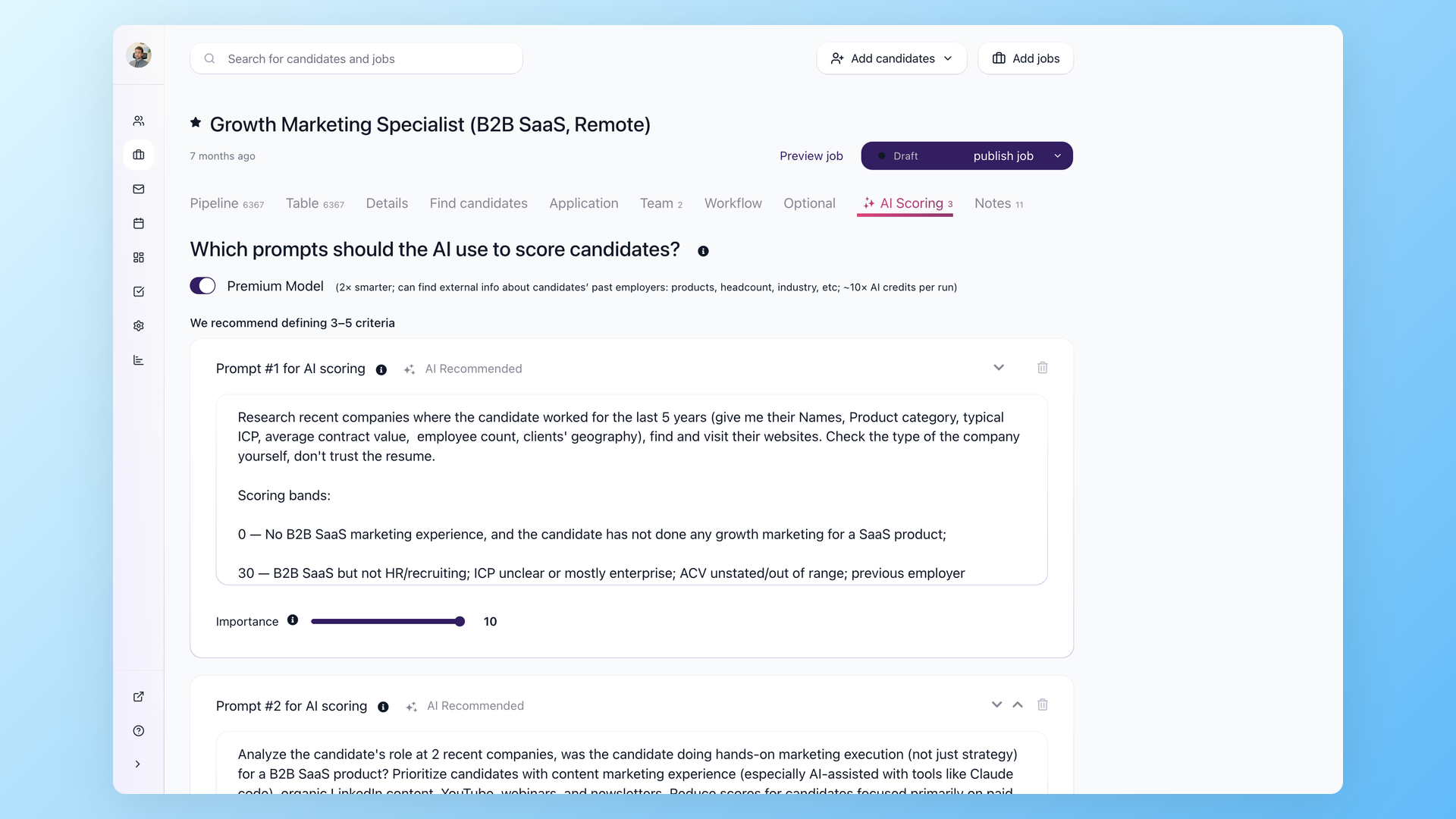
The AI is native, not a tier upgrade. AI Score ranks incoming candidates against your job criteria on every plan, with no add-on fee.
Evaluation Forms give small teams the same structured feedback discipline Greenhouse sells, built into the product rather than reserved for higher tiers.
Then the practical part: pricing is public, from $49 per month on the Start plan billed annually, with a 14-day trial and same-day self-serve setup. No demo required to see a number.
The honest limits: 100Hires is not built for 1,000-employee compliance programs, multi-country hourly hiring, or ERP-grade HRIS integration. That is iCIMS territory, and if you are there, our enterprise recruiting software guide compares that tier directly.
For a wider market survey, see our best ATS software roundup.
Verify us independently on G2 (4.8 from 1,353 reviews) or Capterra (4.9 from 1,163), then try 100Hires free for 14 days.
FAQ
Is iCIMS cheaper than Greenhouse?
Usually not. Neither vendor publishes pricing. Third-party 2026 guides place iCIMS near $9,000 per year at the low end and Greenhouse near $6,000. Enterprise iCIMS contracts can reach six figures. 100Hires publishes plans from $49 per month billed annually.
Is iCIMS a legit company?
Yes. iCIMS reports more than 4,400 companies worldwide as customers, including about a quarter of the Fortune 500, and Vista Equity Partners owns it. Mark Thompson became CEO in May 2026. It serves much larger employers than SMB-focused tools such as 100Hires.
What ATS is similar to Greenhouse?
Practitioners often compare Greenhouse with Ashby and Lever. Ashby is the most common Greenhouse alternative buyers weigh; see our Ashby vs Greenhouse comparison. Teams under 500 can use 100Hires for structured hiring with public pricing.
Does iCIMS or Greenhouse automatically reject resumes?
No. Neither tool rejects resumes by keyword. Automatic rejection comes from employer-set knockout questions. AI can rank applicants, but recruiters decide. In 100Hires, AI Score orders candidates for human review.
How long does iCIMS take to implement compared to Greenhouse?
Reported timelines put iCIMS at 3 to 6 months and Greenhouse at 6 to 12 weeks. Implementation time grows with configuration depth and the number of integrations. Self-serve SMB tools shorten this dramatically: 100Hires accounts are typically live the same day.
Try 100Hires for free
No credit card. 14-day trial. Forbes Advisor #1 ATS for SMBs.