BambooHR vs Greenhouse in 2026: Features, pricing and fit - 100Hires
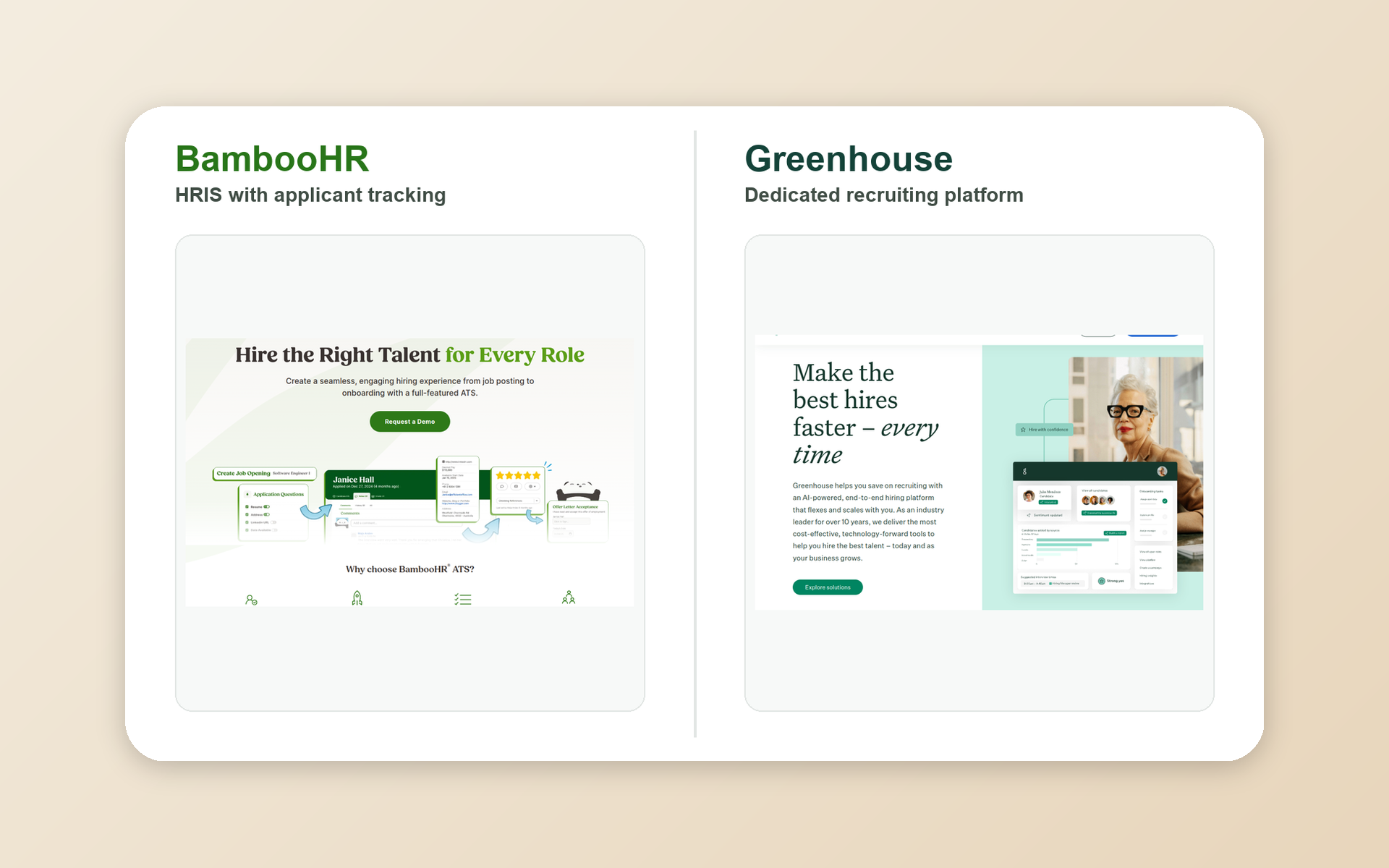
Choose BambooHR when HR records, payroll-adjacent work, time off, and onboarding drive the purchase.
Choose Greenhouse when structured interviews, recruiting reports, governance, integrations, sourcing, and automation drive the purchase.
Use both when Greenhouse should own pre-hire work and BambooHR should receive the hired employee record.
BambooHR vs Greenhouse at a glance
The hiring playbook, in your inbox
One email a week - benchmarks, AI screening tactics, and short interview templates from the 100Hires team. No product pitches.
Use this comparison to assess those paths against workflow depth, HR scope, pricing, outreach, reporting, implementation, and the limits of the handoff between the two systems.
Neither product fits every team. The right purchase depends on which system should own recruiting, which should own employee data, and how much process control your hiring team needs.
The fastest way to read this comparison is to start with the work each product is designed to handle. The table includes a third recruiting option so teams can test the category choice, not just two logos.
Quick comparison table
100Hires publishes this comparison and is one of the products covered below.
| Criteria | 100Hires | BambooHR | Greenhouse |
|---|---|---|---|
| Category | Recruiting-focused ATS | HRIS and people platform with an ATS | Recruiting-first ATS and hiring platform |
| Best fit | Lean teams seeking focused recruiting tools | HR teams buying one broader people system | Recruiting teams seeking process depth and control |
| Recruiting depth | Screening, pipelines, sourcing, outreach, nurture, scheduling, and automation | Core hiring path with plan-specific open-job caps | Deep workflows, structured hiring, reporting, and governance |
| HR breadth | Not an HRIS | Employee records, time off, onboarding, and wider HR operations | Not a payroll or broad employee-record HRIS |
| Structured hiring | Questionnaires, knockout questions, profiles, notes, and team review | Practical collaboration and candidate evaluation | Interview plans, scorecards, criteria, guidance, approvals, and analytics |
| Sourcing and outreach | Sourcing, enrichment, multichannel sequences, and nurture | Job distribution and recruiting communication inside the HR suite | Sourcing CRM, outreach, nurture, texting, AI, and broad distribution |
| Pricing access | Public dollar plans for Start, Advanced, and Pro | Public plan prices with company-size rules | Custom quote; dollar amount not publicly shown |
| Public trial | 14 days, no card, with stated usage limits | not publicly shown in the reviewed pricing evidence | not publicly shown in the reviewed pricing evidence |
| Implementation path | Public signup, with onboarding and migration support on qualifying Pro terms | Broader HR rollout; Elite features add implementation time | Requirements, migration, configuration, training, and change ownership |
| Main limitation | No HRIS; no claim of Greenhouse governance or ecosystem parity | Recruiting reports, permissions, and workflow depth may become constraints | Custom buying path, plan gates, and more setup work |
The four-line verdict
- 100Hires: consider the publisher-owned option when a lean team wants a focused ATS without a full HR suite or heavier governance stack.
- BambooHR: choose it when HR administration is the main job and its recruiting limits fit your hiring plan.
- Greenhouse: choose it when hiring structure, reporting, governance, integrations, and recruiter control are the main job.
- Both: use Greenhouse before hire and BambooHR after hire when the defined handoff covers your data needs.
Review 100Hires pricing or start the 14-day no-card trial if the fourth path matches your buying brief.
The category difference decides most of the comparison
BambooHR and Greenhouse overlap in hiring, yet they start from different systems of record. That difference shapes almost every feature, price, and implementation tradeoff.
BambooHR is HRIS-first with a real ATS
BambooHR centers employee data and HR operations. Hiring sits beside onboarding, documents, time off, performance work, and other people processes instead of living in a separate recruiting stack.
Its ATS is real. Teams can create openings, distribute jobs, collect applicants, move candidates through stages, send automated email, offer self-scheduling, prepare offers, and collect e-signatures.
Source and funnel reports, talent pools, mobile access, notes, and hiring-team collaboration cover the core path from applicant to employee. Core, Pro, and Elite allow 5, 25, and 50 open jobs.
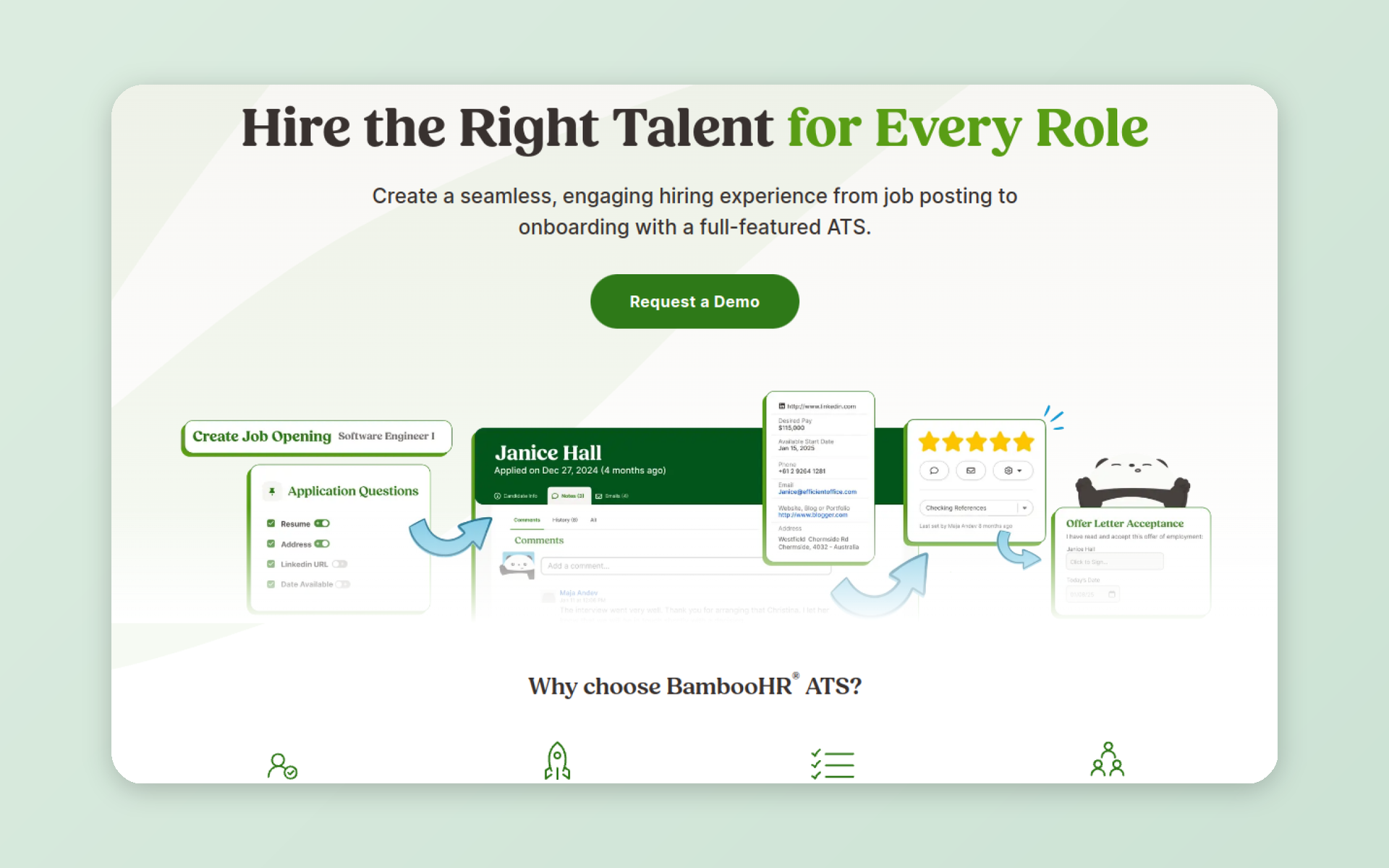
Those caps describe simultaneous openings, not a hard employee-size limit. A small company with many concurrent roles may reach a cap sooner than a larger company with occasional hiring.
Application questions and stage movement can screen a straightforward applicant pool. Teams that need deeper process control may prefer Greenhouse interview plans, gated controls, and recruiting analytics.
This breadth can suit a generalist HR team that wants fewer systems and a clean post-offer transition. The boundary appears when recruiting needs richer permissions, deeper reports, or more flexible process governance.
Greenhouse is ATS-first with deeper process control
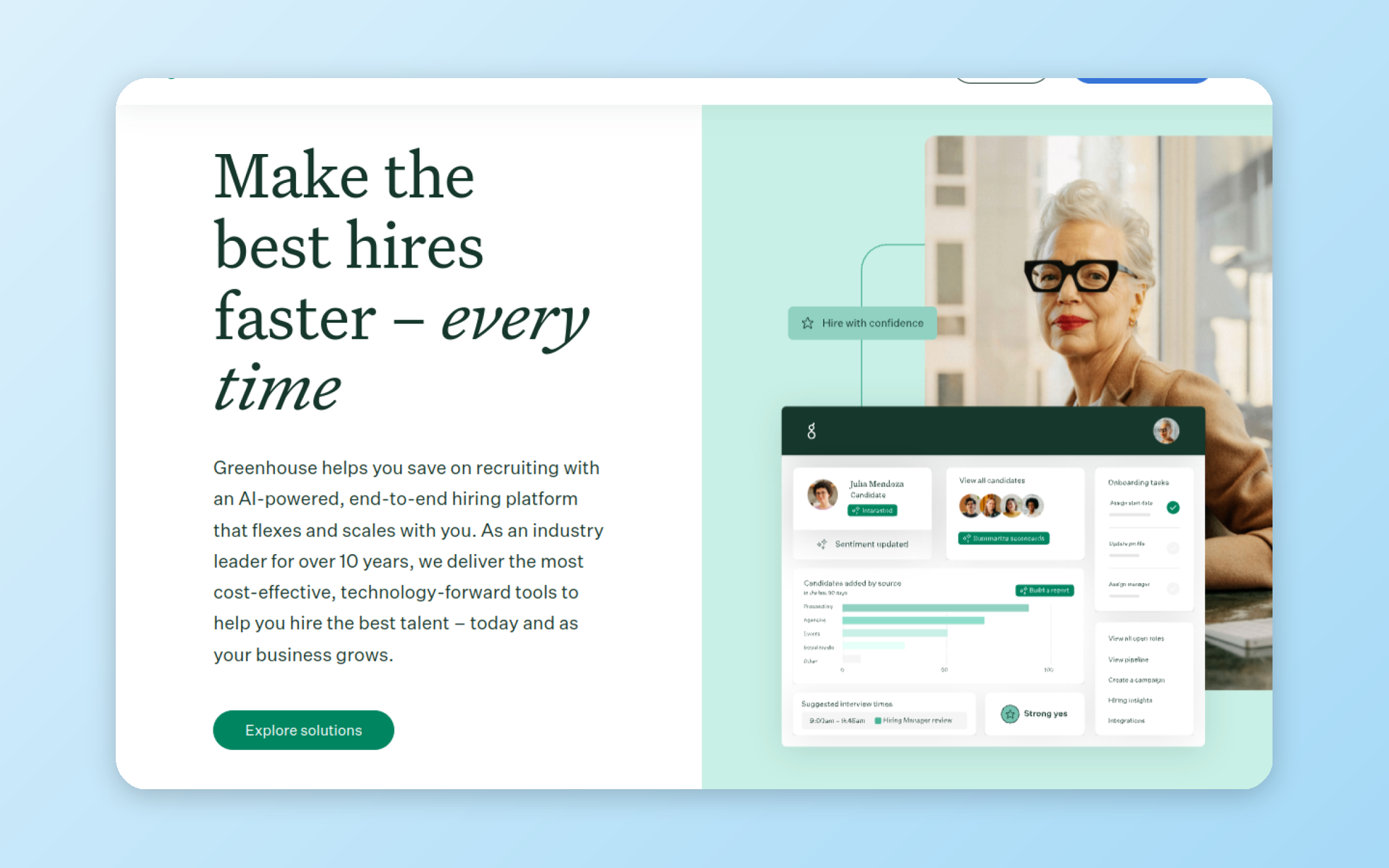
Greenhouse starts with requisitions, candidates, interview plans, scorecards, decisions, and recruiting data. Core includes sourcing CRM, scheduling, reports, SSO, talent matching, and structured interview tools.
Plus adds gated email automation, texting, auto-actions, AI report filters, BI tools, and identity controls. Pro adds resume anonymization, application limits, audit logs, a developer sandbox, and sandbox controls.
Practitioners often value its familiar recruiter workflow, clear candidate records, consistent scorecards, and organized reporting. Those strengths explain why Greenhouse remains a serious choice for structured hiring.
The tradeoff is operating work. A sound rollout may require process mapping, migration, configuration, stakeholder input, training, and clear ownership after launch.
Plan gates make it important to define requirements early. A team may like a feature seen in a demo, then learn that its automation, identity, reporting, or governance need may map only to Plus or Pro.
Greenhouse depth pays off when recruiters and hiring managers follow the same process across roles. Teams that need only posting and light applicant tracking may buy more system than they use.
Recruiting workflow and structured hiring
Both products can move an applicant toward an offer. Greenhouse gives the recruiting team more control over how evidence is gathered, scored, approved, and reported.
BambooHR covers the core recruiting path
A BambooHR hiring team can open a job, add application questions, publish it, review candidates, use stages, schedule interviews, send email, collect feedback, issue an offer, and move the hire into onboarding.
Talent pools preserve people for later roles. Offers and e-signatures keep the final pre-hire steps near the employee record that HR will manage next.
That continuity matters when the same small HR group handles recruiting and post-hire administration. It reduces the need to operate a dedicated ATS for a straightforward pipeline.
- Map the busiest hiring month rather than the average one. Count concurrent openings, approval steps, interviewer groups, report requests, and permission needs.
- A simple pipeline can still be disciplined. Test whether BambooHR gives the team enough control when roles, locations, and decision makers multiply.
Greenhouse wins on structured hiring depth
Greenhouse supports role-specific interview plans, scorecards, defined criteria, interviewer guidance, feedback collection, approvals, and recruiting analytics in a more detailed process layer.
A structured interview format can improve consistency when each candidate receives predetermined questions and a common rating scale.
Greenhouse gives teams a stronger software layer for that method. The tool does not define good criteria on its own, so hiring leaders still need to assign competencies, train interviewers, and review scorecard quality.
- A recruiter can set the interview plan, assign criteria, prepare interviewers, collect scorecards, route approvals, and examine where candidates leave the funnel.
- The debrief receives common evidence instead of scattered notes. The result still depends on timely feedback and criteria that reflect the actual job.
This is the clearest head-to-head win for Greenhouse. BambooHR supports evaluation, yet Greenhouse offers more control for teams that treat structured hiring as an operating discipline.
Where 100Hires fits in the workflow
100Hires covers job pipelines, knockout questions, questionnaires, candidate profiles, collaboration, scheduling, and AI-assisted resume screening.
Owned 100Hires capabilities include AI Copilot for candidate summaries and analysis, AI Email Composer, and resume parsing. These claims describe the publisher's product, not an independent comparative finding.
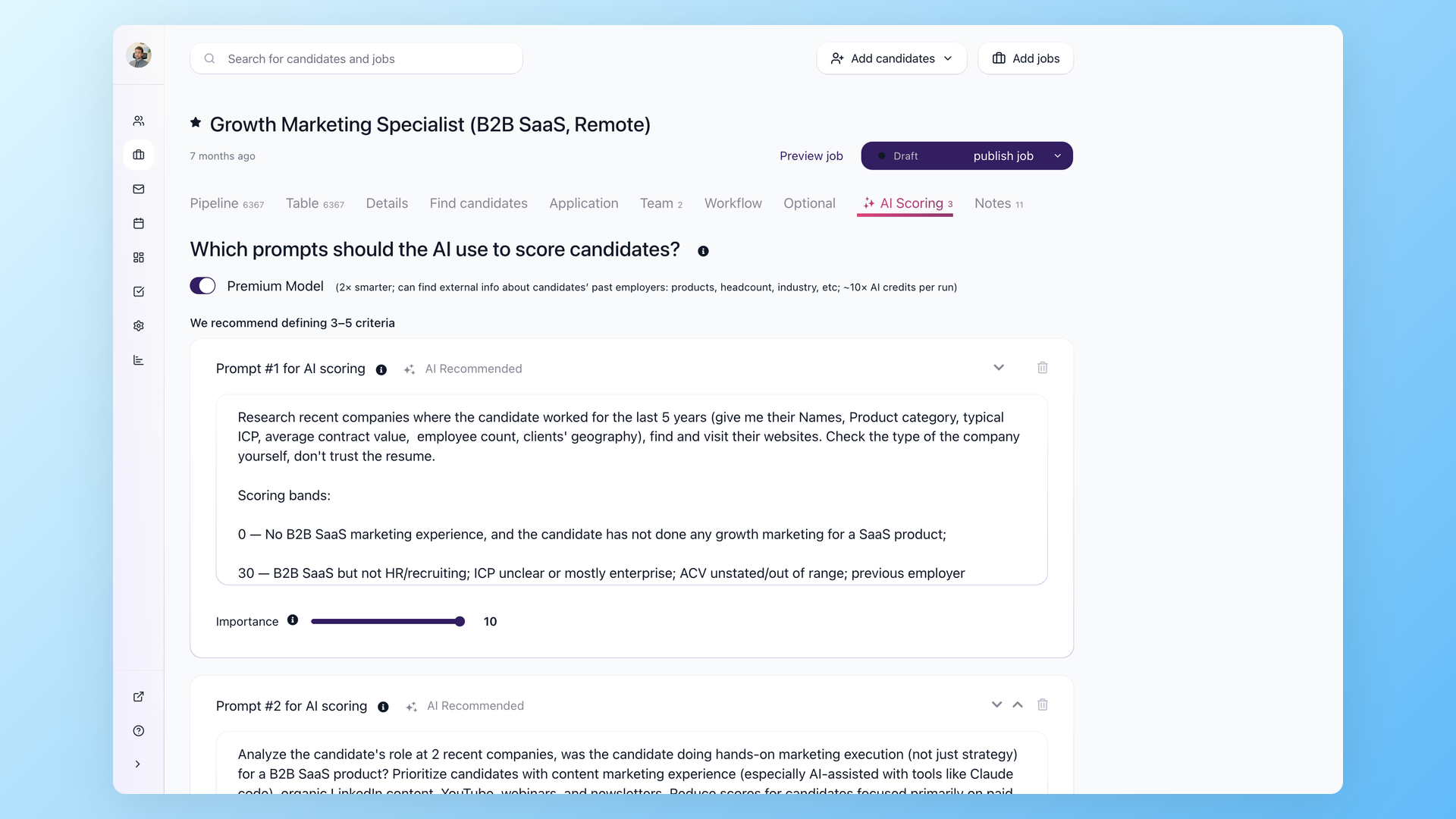
AI Score sorts candidates against written role criteria for review. It can underrate non-standard profiles, leaves every candidate visible, and never replaces human judgment.
- Reviewers can inspect lower-scoring profiles, revise unclear criteria, and compare the ranking with real interview evidence.
- Use knockout questions for clear job requirements, route uncertain cases to review, and keep a person responsible for the final decision.
100Hires is a recruiting-focused ATS, not an HRIS. It does not claim Greenhouse enterprise-governance or ecosystem parity.
Sourcing, outreach, automation and AI
This area is not a clear point of difference between the products. Greenhouse and 100Hires both cover sourcing, outreach, nurture, automation, AI-assisted work, and job distribution in different packages.
Greenhouse combines recruiting depth with plan-gated automation
Greenhouse pairs its sourcing CRM with outreach, nurture, texting, automated actions, AI-assisted recruiting, and wide job distribution. Its platform extends beyond applicant storage.
Greenhouse states that it has 500+ prebuilt integrations and access to 1,000+ job boards in 19 languages. Those figures describe different units and should not be combined into one ecosystem score.
- Several email, texting, action, reporting, identity, and governance capabilities begin on Plus or Pro. Map required workflows to a quoted plan.
- Broad distribution may matter to global teams, but catalog size does not prove results for a given role. Check the boards, languages, source tracking, and posting rules you will use.
BambooHR favors HR workflow continuity
BambooHR automates practical HR and recruiting steps through alerts, approvals, reminders, email, offers, onboarding tasks, and scheduled work. Job distribution connects hiring to the same HR platform.
BambooHR's documented automation focuses on rules and HR workflows. Teams evaluating recruiter-facing AI should test the exact tools and plan available.
Teams that rely on inbound applications and clean HR handoffs can test whether this model fits. Teams running sustained passive-candidate campaigns should test the outreach workflow closely.
100Hires favors a compact sourcing-to-follow-up loop
100Hires brings sourcing, candidate import, contact enrichment, nurture, and email, SMS, or voicemail sequences into the ATS. Follow-ups can stop when a candidate replies.
Email carousel and warmup support the sending workflow. Teams can connect this with screening, scheduling, talent pools, and candidate outreach.
- Contact enrichment fills gaps before a sequence starts. Email, SMS, voicemail, and tasks can form one follow-up plan.
- Nurture can carry qualified people into later openings. The loop reduces movement between a sourcing tool, inbox, spreadsheet, calendar, and ATS.
Greenhouse overlaps with much of this scope. For 100Hires, the distinction is fit, public plan data, and self-serve trial access, not exclusive access to AI, nurture, outreach, or distribution.
Reporting, integrations and the BambooHR-Greenhouse handoff
A combined stack works when each system has a clear job. Greenhouse can own the recruiting record, and BambooHR can own the employee record after hire.
When using both makes sense
In this model, recruiters manage requisitions, sourcing, interview plans, scorecards, feedback, approvals, and the hiring decision in Greenhouse.
Once a candidate is marked hired, the Greenhouse Recruiting integration can export key profile and employment data into BambooHR. HR then continues onboarding and employee administration there.
- The handoff can reduce duplicate entry at the candidate-to-employee boundary. It does not prove continuous, broad, real-time, or bidirectional synchronization.
- The two-system path is valid when recruiting depth is worth a separate system and HR wants continuity after the offer.
A practical handoff test should cover the employee identifier, contact data, job details, start date, documents, correction rules, and the person who resolves a failed export.
Ask where each report will live after the transfer. Recruiting funnel history belongs in Greenhouse; employee lifecycle reporting belongs in BambooHR.
The Onboarding export has narrower limits
The separate Greenhouse Onboarding export into BambooHR is one-way and manual. Reports cannot be exported, and each employee profile can be exported only once.
Those limits belong to the Onboarding path. They do not erase the separate Greenhouse Recruiting hired-candidate handoff described above.
Reporting and ecosystem tradeoffs
Greenhouse has the edge for recruiting-process reports, governance, and ecosystem breadth. BambooHR is stronger for HR lifecycle continuity and reports tied to the wider employee record.
- BambooHR states that its platform has 150+ integrations. Greenhouse states 500+ prebuilt integrations. The counts use different scopes.
- Confirm authentication, field mapping, trigger direction, update behavior, error handling, report access, and the owner of each correction.
100Hires supports recruiting reports and common integrations for a lighter third path. It should not be read as a claim of ecosystem parity with Greenhouse or HR-data breadth equal to BambooHR.
BambooHR vs Greenhouse pricing
The 2026 pricing picture has one clear contrast: BambooHR and 100Hires publish dollar amounts, and Greenhouse publishes plan structure with custom pricing.
Complete public pricing table
Amounts below use the current public evidence in the approved research package. Arithmetic annual totals are marked derived and are not separate vendor quotes.
| Product | Plan | Monthly amount | Annual-equivalent monthly amount | Annual total | Scope and limits | Billing basis | Displayed versus derived status |
|---|---|---|---|---|---|---|---|
| 100Hires | Start | $99/month | $49/month | $588/year, derived | Up to 3 jobs, 100 candidates, 1 user, and 100 monthly AI credits | Monthly or billed annually; USD, 1-20 employee band | Monthly and annual-equivalent displayed; annual total derived |
| 100Hires | Advanced | $249/month | $199/month | $2,388/year, derived | Unlimited jobs, candidates, and users; 300 monthly AI credits on monthly billing or 1,000 on annual billing | Monthly or billed annually; USD, 1-20 employee band | Monthly and annual-equivalent displayed; annual total derived |
| 100Hires | Pro | $499/month | $399/month | $4,788/year, derived | Unlimited jobs, candidates, and users; 3,000 monthly AI credits on monthly billing or 5,000 on annual billing; outreach and enrichment scope | Monthly or billed annually; USD, 1-20 employee band | Monthly and annual-equivalent displayed; annual total derived |
| 100Hires | Enterprise | not publicly shown | not publicly shown | not publicly shown | Advanced governance and custom scope; exact limits not publicly shown | Contact sales | Plan displayed; dollar amounts not publicly shown |
| BambooHR | Core | $10 PEPM above 25 employees; company pricing starts at $250/month for 25 or fewer | not publicly shown | $120 per employee/year above 25, derived; $3,000/year small-company starting floor, derived | 5 open jobs | Per employee per month above 25; small-company starting price at 25 or fewer | Monthly amount displayed; annual totals derived |
| BambooHR | Pro | $17 PEPM above 25 employees; plan amount for 25 or fewer not publicly shown | not publicly shown | $204 per employee/year above 25, derived; small-company plan total not publicly shown | 25 open jobs | Per employee per month above 25; small-company plan quote required | Monthly PEPM displayed; annual total derived |
| BambooHR | Elite | $25 PEPM above 25 employees; plan amount for 25 or fewer not publicly shown | not publicly shown | $300 per employee/year above 25, derived; small-company plan total not publicly shown | 50 open jobs; added implementation time for Elite features | Per employee per month above 25; small-company plan quote required | Monthly PEPM displayed; annual total derived |
| Greenhouse | Core | custom quote; dollar amount not publicly shown | not publicly shown | not publicly shown | Sourcing CRM, interview kits, scorecards, scheduling, reports, SSO, and talent matching | Customized to hiring needs | Plan displayed; dollar amounts not publicly shown |
| Greenhouse | Plus | custom quote; dollar amount not publicly shown | not publicly shown | not publicly shown | Core plus email automation, texting, auto-actions, AI report filters, BI, and identity controls | Customized to hiring needs | Plan displayed; dollar amounts not publicly shown |
| Greenhouse | Pro | custom quote; dollar amount not publicly shown | not publicly shown | not publicly shown | Plus plus resume anonymization, application limits, audit log, developer sandbox, and sandbox controls | Customized to hiring needs | Plan displayed; dollar amounts not publicly shown |
BambooHR's $250 monthly figure is a company-level starting price for organizations with 25 or fewer employees. Public pricing evidence does not assign that floor to every named plan, so Pro and Elite small-company amounts remain not publicly shown.
The 100Hires figures use the USD selector and the 1-20 employee band. A different band, currency, or billing cycle may change the displayed amount and AI-credit allowance.
A Greenhouse quote should name the plan, included capabilities, contract term, implementation scope, support level, renewal terms, and any paid services. The public page does not show a price in dollars.
What price alone misses
- 100Hires: select the employee band, billing cycle, AI credits, and required scope. No controlled evidence proves the fastest implementation.
- BambooHR: price the employee system, required modules, headcount rules, and recruiting caps together.
- Greenhouse: include the quoted plan, migration, configuration, interview-plan work, training, and ongoing ownership.
- Both: include the second contract, handoff ownership, report boundaries, and any connector work.
The cheapest subscription can cost more if the team keeps duplicate spreadsheets or buys missing workflow tools. A higher price may make sense when it replaces systems and removes clear manual work.
What practitioners report
Practitioner discussions reinforce the category split, but they do not produce a representative winner. The patterns below are directional, not survey results.
BambooHR's fit changes with hiring complexity
- Practitioners describe clean administration, employee records, onboarding, and a usable recruiting module as useful to smaller HR teams.
- Concerns can arise when teams need deeper report customization, finer permissions, more open roles, or a more controlled interview process.
That is a fit shift, not proof that the ATS lacks value. A team with straightforward hiring may prefer one HR system over a dedicated recruiting stack.
Opinions about pricing vary by package and company needs. Some small teams see value in the bundled HR scope; others question the cost once the required tier or modules change.
Greenhouse earns both loyalty and scrutiny
- Users often credit familiar workflows, scorecards, candidate visibility, reporting organization, collaboration, and a polished application path.
- Other accounts raise UI changes, navigation, analytics friction, cost, configuration, and features left unused in narrower hiring programs.
Detailed criticism can reflect how much recruiting work depends on the platform. The practitioner accounts reviewed here include positive process evidence and detailed operating complaints about Greenhouse.
One person's navigation complaint does not cancel another team's process gain. Treat each account as a workflow clue, then test the same task with your recruiters and hiring managers.
Implementation quality changes the experience. Clear stages, ownership, interview plans, and handoffs matter as much as the feature list when coordinators and hiring managers use the system each day.
Who should choose BambooHR, Greenhouse, both or 100Hires
Choose the option that addresses the main workflow problem. Each option has a clear fit and a clear reason to look elsewhere.
- Which system must hold the recruiting record?
- Which system must hold the employee record?
- Which controls, reports, integrations, and outreach steps are mandatory?
- What buying, rollout, and ongoing administration can the team support?
Choose BambooHR when HR operations drive the purchase
BambooHR fits teams replacing spreadsheets or disconnected HR tools that need employee records, onboarding, time off, and straightforward hiring in one platform.
Look past it when recruiting depth, fine-grained governance, complex reports, or a large structured interview program is the primary constraint.
Validate the open-job cap against peak hiring and confirm that HR users can build the exact funnel and source reports leaders expect.
Choose Greenhouse when hiring structure drives the purchase
Greenhouse fits recruiting teams that need repeatable interview plans, scorecards, collaboration, reports, sourcing, automation, integrations, and stronger process governance.
Look elsewhere when the company mainly needs a broad HRIS or cannot justify a custom buying process, plan gates, implementation work, and ongoing process ownership.
Ask an everyday recruiter and a hiring manager to complete their normal tasks in the trial or demo. Familiar-looking depth has value only when the team can operate it.
Use both when the handoff is enough
Use Greenhouse for pre-hire recruiting and BambooHR for post-hire employee administration when the defined candidate-to-employee handoff covers the required data.
Use a different setup when the business expects broad bidirectional synchronization, wants one vendor contract, or cannot assign clear ownership at the system boundary.
Run a sample hire through the real field map before rollout. A successful test is stronger evidence than a marketplace listing or a general integration claim.
Choose 100Hires when neither category fits
100Hires fits lean teams seeking a focused ATS for screening, sourcing, outreach, nurture, scheduling, distribution, and recruiting automation with public plan data and a trial.
It is not the fit for payroll, benefits, or a general HRIS. It makes no claim of Greenhouse-level enterprise governance, audit depth, job-board catalog size, or integration breadth.
Test one role from posting through follow-up and review. Pay close attention to AI criteria, deliverability, user permissions, reporting, and any external board that is central to the search.
See 100Hires in action if that boundary matches your team, or use the public trial to test one live recruiting workflow.
Frequently asked questions
Does BambooHR integrate with Greenhouse?
Yes. Greenhouse Recruiting can export hired-candidate data into BambooHR. The separate Greenhouse Onboarding export is one-way, manual, report-limited, and one-time per profile. 100Hires is a separate recruiting option, not a broad sync layer.
Is BambooHR a full applicant tracking system?
BambooHR has a real ATS with jobs, stages, distribution, scheduling, offers, reports, talent pools, and plan caps. It is lighter than Greenhouse for structured recruiting. 100Hires is another focused ATS path for lean teams.
Is Greenhouse an HRIS?
No. Greenhouse is recruiting-first and is not the payroll, benefits, time-off, or broad employee-record system that BambooHR is built to be. 100Hires is likewise recruiting-focused rather than an HRIS.
Which is better for a small company?
Company size alone does not decide it. Choose BambooHR for HR breadth, Greenhouse for recruiting depth, or 100Hires when a lean team needs a focused ATS with public plan data. Test the main workflow and limits before buying.
When should a team choose 100Hires instead?
100Hires, the publisher's product, fits lean teams that need screening, sourcing, outreach, nurture, and automation without buying an HRIS. It does not claim payroll, benefits, or Greenhouse enterprise-governance parity.
Final verdict
BambooHR is the better fit when one HR platform should carry straightforward recruiting into employee administration. Greenhouse is the better fit when structured hiring, recruiting reports, governance, integrations, sourcing, and automation deserve their own system.
Use both when the defined hired-candidate handoff is enough. Consider 100Hires when a lean team needs a focused ATS and accepts its HRIS, governance, and ecosystem limits.
Map the primary workflow need, verify the exact integration fields, and test the required workflow. If neither category fits, compare the public 100Hires plan or book a demo before committing.
Try 100Hires for free
No credit card. 14-day trial. Forbes Advisor #1 ATS for SMBs.