
Workable vs Tellent Recruitee in 2026 - 100Hires
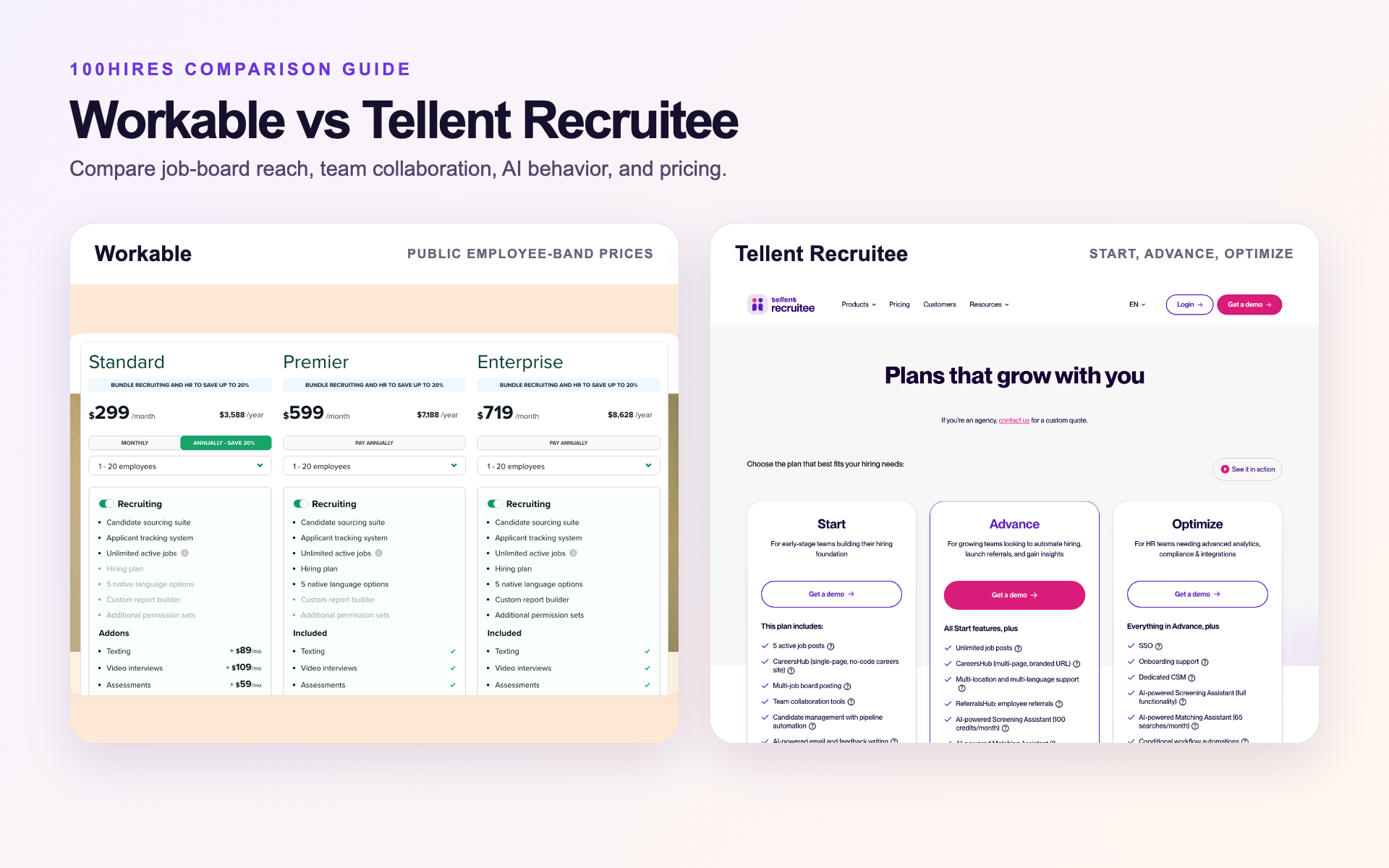
Choose Workable for verified job-board reach and public pricing. Choose Tellent Recruitee when collaborative workflow design matters more.
Both systems can run a complete hiring process for an SMB or mid-market team. The choice rests on fit, not the longest feature list.
This comparison covers distribution, sourcing, team workflow, AI behavior, pricing, and trials. It then explains where the publisher-owned 100Hires product may suit a lean internal hiring team.
Workable vs Tellent Recruitee at a glance
The hiring playbook, in your inbox
One email a week - benchmarks, AI screening tactics, and short interview templates from the 100Hires team. No product pitches.
Use this table to find the first product to test. Each cell reflects official material reviewed in July 2026, with first-party 100Hires evidence labeled.
| Decision factor | 100Hires, publisher-owned alternative | Workable | Tellent Recruitee |
|---|---|---|---|
| Best fit | Lean direct-employer teams that want AI tools inside the candidate workflow | Teams that value broad distribution, sourcing reach, and visible prices | Teams that value configurable shared workflows and hiring-manager participation |
| Job distribution | 13 named job-board integrations in first-party product documentation | More than 200 free and paid boards and social sites in the vendor-documented network | Free LinkedIn Basic Jobs, paid campaigns, feeds, and API-based routes |
| Collaboration | Team mentions, evaluation forms, pipelines, and stage automation in first-party documentation | Four named roles, stage evaluations, scorecards, visibility controls, and plan-based permissions | Roles, notes, mentions, tasks, evaluations, scheduling, referrals, and configurable pipelines |
| AI behavior | AI Score, AI Recruitment Copilot, and AI Email Composer, based on first-party product evidence | Basic AI features plus premium Workable Agent for Agent-enabled workflows | Criteria-based screening without suitability rankings or top-candidate lists; users can filter and sort results |
| Public pricing status | Start $99 monthly or $49/month billed annually; Advanced $249 or $199; Pro $499 or $399. Enterprise scope is public, but pricing is not shown | Public employee-band prices | Dollar prices are not shown; monthly payment is possible, with a one-year minimum and 20% annual-payment discount |
| Trial | 14-day trial with no card; external-board and AI quotas apply | 15-day Standard trial with no card | 18-day Advance trial with email, job, and board-promotion limits |
| Main tradeoff | Owned evidence needs first-party disclosure; resume-based AI cannot judge missing evidence | Employee-band prices and premium Agent packaging need close review | Public dollar prices are absent, and current independent user evidence is thin |
Want to review the alternative? Check the current 100Hires pricing page and product scope before you compare commercial terms.
The table is a routing tool, not a score. Start with the row tied to the problem your team faces most often, then test that claim in a configured account.
A feature can sit behind a higher plan, credit model, connected account, or contract term. Record the plan, access rule, reviewer role, and extra cost for each required capability.
The short answer
Workable is the safer first shortlist choice when distribution breadth, sourcing depth, and price visibility drive the purchase.
Its official material documents a network of more than 200 free and paid boards and social sites. Workable offers searchable sourcing alongside job distribution.
The vendor publishes three prices for the 1-20 employee selector. A buyer can start a budget conversation before speaking with sales, though larger employee bands use different values.
Tellent Recruitee is the stronger first choice when hiring-manager participation shapes the process. Its official product story puts shared work and configurable pipelines near the center.
Team roles, tasks, notes, mentions, evaluations, scheduling, referrals, and activity records create a clear structure for shared hiring. Workable covers much of that ground too.
The difference is product emphasis. Tellent Recruitee treats collaboration as the operating model, not a side feature attached to distribution.
Price may break the tie, but the public record cannot prove that Tellent Recruitee costs less. Its English pricing page showed package scope without dollar amounts in the July 2026 capture.
For a 2026 shortlist, ask which daily bottleneck costs your team more: getting roles and prospects into the system, or getting hiring managers to review them in a consistent way.
Do not start with a weighted score. First remove any product that fails a required board, contract, data, or review-control need.
Use the score only after the hard constraints pass. This keeps a large set of minor features from hiding one deal-breaking workflow gap.
Choose Workable when reach and price visibility lead the decision
Workable suits a team that recruits across regions, expects several sourcing routes, and needs a public price grid for an early budget check.
Its broader recruiting and HR product scope may matter to teams that want onboarding and employee-data capabilities from one vendor. That breadth can add value, but it can add buying questions too.
Choose Tellent Recruitee when team workflow leads the decision
Tellent Recruitee suits a growing team that wants each role, stage, review, and handoff to be part of a shared process.
Its Screening Assistant may suit buyers who want AI support without system-made suitability rankings or top-candidate lists. Human review remains part of the design.
How the two platforms approach recruiting
The products overlap on core ATS work. Their center of gravity is different.
Workable is the broader recruiting engine
Workable connects job creation, distribution, sourcing, screening, scheduling, evaluation, offers, onboarding, reporting, and adjacent HR work.
That scope fits a direct employer that wants one vendor to cover more of the journey from opening approval to new-hire setup.
Distribution is the clearest anchor. The official board network is broad, and sourcing tools extend the search beyond inbound applicants.
The product does not stop at applicant tracking. Talent CRM features, candidate search, scheduling, offer workflows, and onboarding make it closer to a recruiting suite.
That breadth has a cost question. Employee count changes the plan price, and Workable Agent sits outside the basic package as a premium add-on.
A 2026 small-company discussion mentioned Workable as a solid option for lean setups. It was not a controlled comparison.
Other practitioner posts raised price, reporting, CRM fit, and AI needs. Those mixed accounts help form demo questions, but they do not verify current features.
Workable's broad scope can simplify vendor management for a small HR team. The same scope can make evaluation harder when recruiting is the team's only need.
Ask the vendor to separate core recruiting, premium add-ons, Agent credits, and adjacent HR modules in the proposal. That makes the intended package easier to compare.
Data ownership deserves a live test too. Export a candidate sample, a report, and a hiring activity record before the trial ends.
Tellent Recruitee is the collaboration-centered ATS
Tellent Recruitee connects CareersHub, job creation, candidate profiles, pipelines, scheduling, evaluations, reporting, and marketplace connections.
Its shared-work model is more visible. Hiring roles, notes, mentions, tasks, evaluations, referrals, and activity records keep participation inside the candidate record.
Configurable pipelines let the team shape stages around each hiring process. Automation can move routine work forward when a candidate changes stage.
Employer-brand tools sit beside that workflow. CareersHub and job-page controls may matter to teams that want recruiting operations and candidate-facing pages under one roof.
Current independent Tellent Recruitee evidence is thin, so this comparison does not infer a common user view.
That evidence gap makes reference checks more important. Ask how employee growth changes a quote and renewal.
We found no direct practitioner head-to-head between Workable and Tellent Recruitee. The evidence volumes are unequal, so this article does not name a sentiment winner.
Tellent Recruitee fits best when managers record decisions in the ATS. A late review can still break the shared record if the discussion moves back to chat or email.
During the demo, add a late reviewer, change a score, create a confidential note, and reopen a candidate's record. These awkward cases expose the quality of the shared record.
Ask how template changes affect open jobs. Teams need to know whether a process edit updates existing pipelines or applies only to new roles.
Job boards and sourcing reach
Workable wins this section on verified breadth. The fine print matters more than the headline alone.
What Workable's 200+ network means in practice
Workable's official help center documented more than 200 free and paid job boards and social sites worldwide in the July 2026 research capture.
The total describes a network. It does not promise more than 200 free placements from one click.
Some destinations accept free listings. Premium placements can carry separate spend, and some routes require a connected employer account.
An independent walkthrough showed free-board choices, premium boards, and account connections in the interface. The official help material is the source for the count and product facts.
Test the countries and sources used for live roles. For each route, confirm whether it is a free feed, paid campaign, or connected employer account.
A route can appear available yet stall when nobody owns the employer account or spend. Inspect whether source tags, screening answers, and candidate records arrive intact.
Workable pairs job distribution with searchable sourcing for outbound work.
That is a vendor count, not proof of unique, current, or reachable prospects for your roles. Test search filters and contact paths with a real vacancy.
How Tellent Recruitee publishes jobs
Tellent Recruitee supports several publishing routes. Official help covers LinkedIn Basic Jobs, paid campaigns, XML feeds, and API connections.
LinkedIn Basic Jobs offers a free route, subject to LinkedIn's own handling. Paid campaigns add targeted reach where a free listing is not enough.
Feeds and API links give larger teams another path. Their value depends on setup, destination rules, and the fields each board accepts.
The current research did not find a Tellent Recruitee board total that matches Workable's network measure. It would be wrong to use a marketplace count instead.
Tellent Recruitee has separate figures for partners, marketplace articles, integrations, and apps or services. They measure different inventories and are omitted here.
For either vendor, map the exact job distribution route before signing. Record the board, country, spend, account owner, and application path.
Run the board audit with one common role and one hard-to-fill role. A broad network may serve the first yet miss the specialist source that matters for the second.
- Coverage: confirm the exact country and board
- Route: identify free feed, paid campaign, or connected account
- Data: inspect source tags and screening-answer transfer
- Control: record who owns spend and posting changes
- Quality: review relevant applicants, duplicates, and suspected fraud
This audit separates reach from applicant quality. Neither official network size nor a user migration story can predict the right source mix for every role.
Collaboration and hiring workflows
Tellent Recruitee wins on collaboration-first design. Workable still gives teams a mature set of roles and evaluation controls.
Workable collaboration is structured and permission-led
Workable names four hiring-team roles: Recruiter, Hiring Manager, Hiring Contributor, and Candidate Reviewer.
The roles create a base for access and responsibility. Premier and Enterprise add 55 customizable permissions in the official material reviewed in July 2026.
Candidate evaluation can happen by stage. Team members can add ratings, comments, and scorecards without turning every reviewer into a full process owner.
Visibility controls help separate sensitive comments from the wider hiring group. This can matter for compensation, internal moves, or executive searches.
The structure may suit a team that wants central recruiting ownership with bounded input from managers. It keeps permissions tied to roles and stages.
Test how your current approval chain maps to those roles. A named role may still need permission changes on higher plans.
Tellent Recruitee makes team participation the product story
Tellent Recruitee builds the daily record around shared activity. Notes, mentions, tasks, evaluations, and scheduling live near candidate work.
Configurable pipelines help each team define its own stages. Roles and scoped access give different participants a place in that process.
Evaluation forms bring structure to feedback. Mentions can pull a manager into one decision without making that person monitor the whole pipeline.
Tasks make ownership visible. Real-time activity gives recruiters a record of what happened before the next handoff.
Referrals and scheduling extend participation beyond the core recruiting team. That makes the product attractive when hiring is a shared company habit.
The official evidence does not prove faster adoption or better hiring outcomes. A demo should test manager behavior, not the mere presence of a comment box.
For a fair collaborative hiring test, give both systems the same job, scorecard, reviewers, access rules, and approval path.
Watch for missed reviews, duplicate notes, hidden feedback, and unclear ownership. Count the clicks needed to open context, submit an evaluation, ask a question, and see the decision.
Repeat the test on mobile if managers review away from a desk. Each reviewer should know what is visible, what is private, and which action changes candidate status.
AI screening and automation take different paths
Workable Agent can take recruiting actions. Tellent Recruitee Screening Assistant evaluates stated criteria without assigning suitability rankings or creating top-candidate lists.
Workable Agent is the more agentic choice
Workable includes basic AI-assisted functions in its recruiting product. Workable Agent is a separate premium add-on.
In Agent-enabled workflows, Agent can source, screen, engage, score, and move candidates through pipeline steps.
Those ranking, scoring, and pipeline actions do not describe every Workable job by default. They belong to Agent-enabled use.
Agent applies across all active agentic jobs in the account and cannot be limited to a selected job set. Admins can disable AI features at the account level.
Agent records actions and adds explanations to candidate activity. Buyers should test what evidence appears behind each score and move.
The official page checked in July 2026 said each paid account starts with 3,000 Agent credits. It listed Evaluate at one credit, Source at two, and Chat at ten.
Workable notes that credit use can vary by action. Include both bundle cost and expected consumption in the commercial comparison.
Account-wide scope is a major buying detail. A team that wants an agent on one hard role, but nowhere else, cannot treat Workable Agent as a per-job switch.
Tellent Recruitee keeps screening assistive
Tellent Recruitee uses a different control model. Start lists AI help for email and feedback writing.
Advance lists Screening Assistant, AI Writer, Matching Assistant, and 100 AI credits per month in the official package capture.
Screening Assistant checks up to six job-specific criteria. It does not assign suitability rankings or create top-candidate lists, although users can filter and sort by screening results.
A recruiter must review its output. The assistant helps organize evidence against selected criteria, then leaves the decision with people.
That is not a weaker copy of Agent. It is a separate choice about how far software should act inside the hiring process.
A team may prefer criteria-based support without suitability rankings for policy, trust, or review design. Another team may value ranked queues and automated movement more.
Demo the same borderline resumes in each product. Ask what evidence appears, who can change criteria, and how a reviewer records disagreement.
Define the human review before you buy
Write down who reviews AI output, who can change criteria, and who can reverse an action. Set that control before automation reaches live candidates.
NIST's voluntary AI Risk Management Framework treats clear human-AI roles and documented oversight as core guidance.
The framework is voluntary guidance, not law, and it is not a product endorsement. NIST has not evaluated any product in this comparison.
Match the review to the action. Drafting an email needs a different check from scoring a person or moving a candidate to a new stage.
Run a controlled pilot with known resumes, including clear matches, clear misses, unusual paths, sparse evidence, and conflicts. Have two reviewers compare cited evidence and proposed actions.
Test how to stop activity, reverse a move, correct criteria, and document a changed decision. Start without automatic rejection and route uncertain cases to review.
Pricing and trial comparison
Workable gives buyers visible dollar values. Tellent Recruitee gives buyers package scope and billing terms, then requires a quote for dollars.
We rechecked prices, plan scope, and billing terms on July 15, 2026. Workable values are for the 1-20 employee selector, while Tellent Recruitee prices require a quote.
| Product | Plan | Monthly price | Annual equivalent | Annual total | Scope and limits | Billing basis | Displayed or derived |
|---|---|---|---|---|---|---|---|
| Workable | Standard | $299/month | $299/month | $3,588/year | Unlimited active jobs subject to fair use | 1-20 employees; monthly or annual billing | Monthly price, annual equivalent, and annual total displayed |
| Workable | Premier | $599/month | $599/month | $7,188/year | Unlimited active jobs subject to fair use | 1-20 employees; monthly or annual billing | Monthly price, annual equivalent, and annual total displayed |
| Workable | Enterprise | $719/month | $719/month | $8,628/year | Unlimited active jobs subject to fair use | 1-20 employees; monthly or annual billing | Monthly price, annual equivalent, and annual total displayed |
| Tellent Recruitee | Start | Not publicly shown | Not publicly shown | Not publicly shown | Five active job posts | Employee count affects price; monthly payment possible; one-year minimum; annual payment gets 20% discount | Scope displayed; dollar prices absent |
| Tellent Recruitee | Advance | Not publicly shown | Not publicly shown | Not publicly shown | Unlimited job posts; 100 AI credits/month | Employee count affects price; monthly payment possible; one-year minimum; annual payment gets 20% discount | Scope displayed; dollar prices absent |
| Tellent Recruitee | Optimize | Not publicly shown | Not publicly shown | Not publicly shown | Everything in Advance; full Screening Assistant; 65 Matching Assistant searches/month; SSO; onboarding support; Dedicated CSM; conditional automations; fairness tools; requisition approvals; unlimited custom fields; sandbox; BI integrations | Employee count affects price; monthly payment possible; one-year minimum; annual payment gets 20% discount | Scope displayed; dollar prices absent |
| 100Hires | Start | $99/month | $49/month | $588/year | Up to three jobs, 100 candidates, one user; 100 AI credits/month | USD monthly or annual billing | Monthly and equivalent displayed; total derived |
| 100Hires | Advanced | $249/month | $199/month | $2,388/year | Unlimited jobs, candidates, and users; 300 monthly-billing or 1,000 annual-billing AI credits/month | USD monthly or annual billing | Monthly and equivalent displayed; total derived |
| 100Hires | Pro | $499/month | $399/month | $4,788/year | Unlimited jobs, candidates, and users; 3,000 monthly-billing or 5,000 annual-billing AI credits/month | USD monthly or annual billing | Monthly and equivalent displayed; total derived |
| 100Hires | Enterprise | Not publicly shown | Not publicly shown | Not publicly shown | Everything in Pro; enhanced security, privacy, governance; SSO; dedicated account manager; requisition approvals; BI connection; custom features and integrations; custom compliance and reports | Custom commercial terms | Scope displayed; dollar prices absent |
100Hires publishes monthly and annual prices
100Hires lists Start at $99 monthly or $49 per month billed annually. The $588 annual total is derived from the displayed annual equivalent.
Advanced is $249 monthly or $199 per month billed annually. Pro is $499 monthly or $399 per month billed annually. Their derived annual totals are $2,388 and $4,788.
Advanced and Pro include unlimited jobs, candidates, and users. Their AI credit limits vary by plan and billing period.
Enterprise adds security, privacy, governance, SSO, account management, requisition approvals, BI connection, custom integrations, compliance, and reports. It requires a quote.
Workable publishes prices by employee band
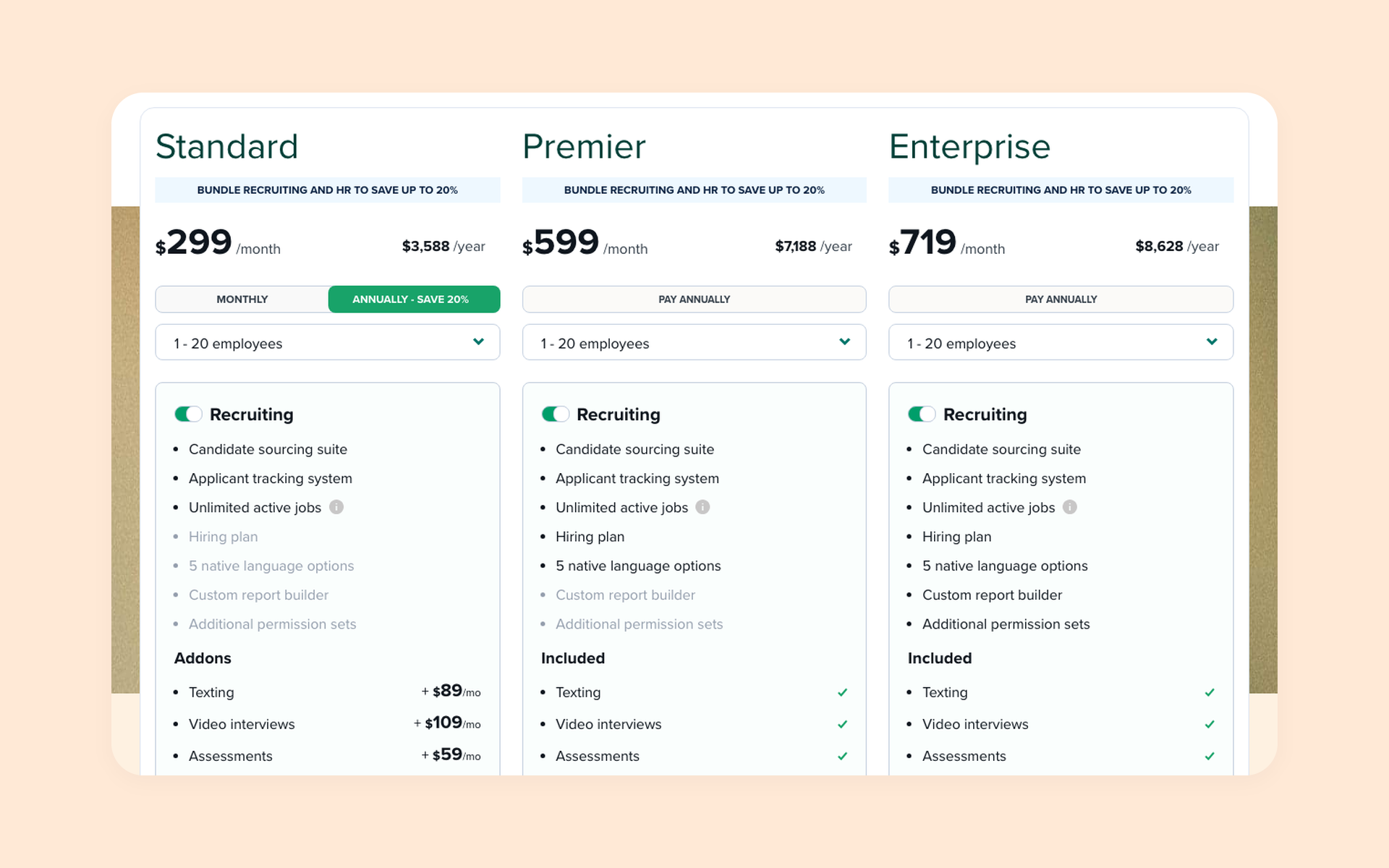
For 1-20 employees, Workable displayed Standard at $299 per month and $3,588 per year. The page showed both values.
Premier displayed $599 per month and $7,188 per year. Enterprise displayed $719 per month and $8,628 per year.
The monthly prices, annual-equivalent figures, and annual totals were vendor-displayed.
Workable offers higher employee bands. The 1-20 values cannot be projected onto them.
Recruiting plans list unlimited active jobs subject to fair use. Ask how fair use applies to your hiring pattern and whether seasonal peaks need review.
Premium add-ons can change total cost. Workable displayed separate monthly amounts for texting, video interviews, assessments, and performance reviews in the research capture.
Workable Agent has its own credit economics. Include expected sourcing, evaluation, and chat activity in the budget if Agent is part of the intended workflow.
Tellent Recruitee publishes scope, not dollar prices
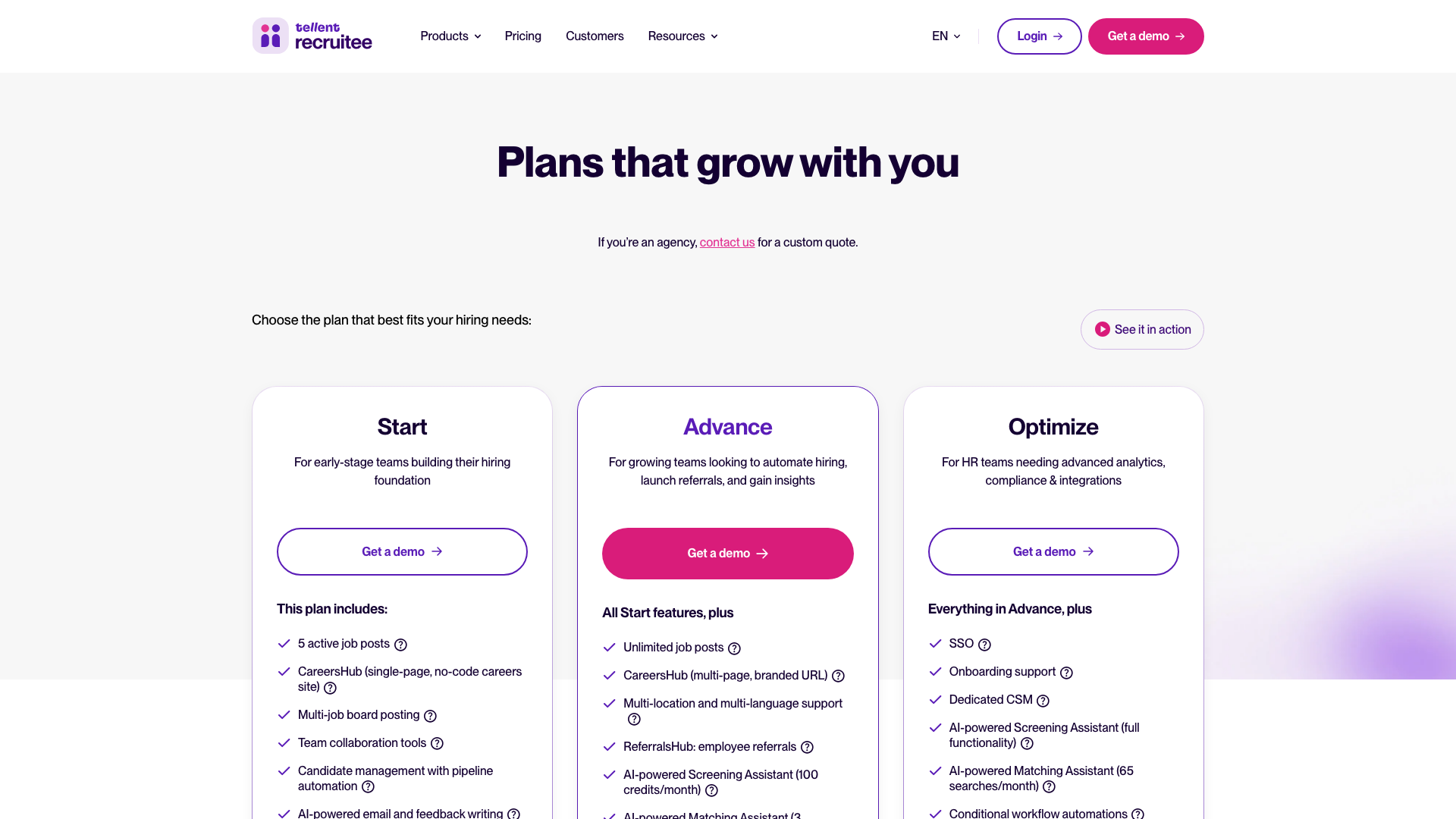
Start listed five active job posts. Advance listed unlimited job posts and 100 AI credits per month.
The English page did not show a dollar amount for Start, Advance, or Optimize. Monthly price, annual equivalent, and annual total remain unavailable without a quote.
Price varies with plan, employee count, and billing period. That makes a quote necessary for a valid cost comparison.
The official billing material stated a one-year minimum contract. Monthly payment was possible, and annual payment carried a 20% discount.
Those terms describe payment timing and commitment, not the hidden base price. A 20% discount cannot reveal the total without a quoted starting amount.
Optimize adds full Screening Assistant, 65 Matching Assistant searches per month, SSO, onboarding, a dedicated CSM, conditional automations, fairness tools, approvals, custom fields, sandbox, and BI integrations.
Ask for the first-year total, renewal basis, included AI credits, active-job rules, onboarding charges, and any marketplace costs in one written quote.
Trials are not directly equivalent
Workable offered a 15-day trial with the complete Standard feature set and no credit card in the July 2026 official capture.
Tellent Recruitee offered an 18-day Advance trial that did not convert into a paid subscription on its own.
The Tellent Recruitee trial allows up to 50 emails and five published jobs. It excludes free-board promotion.
Tellent Recruitee gives three extra calendar days, but the limits narrow the test. Workable gives fewer days with the full Standard feature set.
100Hires offers a 14-day trial with no credit card. It allows up to ten external-board candidates across the account, and AI features use tiered quotas.
A useful trial should mirror one live hiring process. Import a safe sample, build the real stages, invite actual reviewers, test the intended board route, and review the resulting audit trail.
Compare total commitment, not the headline month. Include the selected employee band, contract length, billing timing, add-ons, credits, and any setup work.
Ask both vendors which values can change at renewal. A public entry value and a private quote can use different rules as the company grows.
Give each vendor the same employee count, active-role pattern, reviewer group, sourcing needs, and expected AI use. This improves quote parity and can expose a plan change before legal review.
Who should choose each ATS
Choose by the constraint that appears every week. A scorecard can hide the operating difference that your team will feel each day.
Choose Workable if distribution and sourcing are the bottleneck
Workable fits a direct employer hiring across several countries or channels. Its documented board network gives the buyer a broader verified starting point.
It fits teams that want inbound distribution and searchable sourcing in the same system. The wider recruiting suite may cover offers, onboarding, and adjacent HR work.
Public employee-band prices help procurement set an early range. The quote can then focus on band changes, add-ons, fair use, and Agent credits.
Picture a 60-person software company hiring in the United States and Europe. The team needs regional boards, outbound search, scheduling, and a visible budget starting point.
Workable belongs near the top of that shortlist. The demo should verify each required board and show how candidates from different routes enter one record.
Workable may be more than a lean team needs when recruiting is its only requirement. Include premium Agent costs in the proposal if the workflow depends on it.
Test reporting and CRM behavior with your real process. Current practitioner posts raised both topics, though those posts do not prove a universal gap.
Choose Tellent Recruitee if hiring-manager participation is the bottleneck
Tellent Recruitee fits a growing team that needs managers to review candidates, complete evaluations, and own tasks inside a shared workflow.
It fits teams that want custom funnels without turning every participant into a recruiter. Notes, mentions, activity, and role controls support bounded participation.
Screening Assistant may suit a team that wants criteria checks without system-made suitability rankings, while keeping ordering and selection with human reviewers.
Picture a 120-person services company with department heads who hire a few times each year. Recruiting needs a repeatable process, yet managers need clear tasks and context.
Tellent Recruitee is worth testing for that workflow. The trial should cover manager invitations, evaluation forms, reminders, activity history, and pipeline changes.
Tellent Recruitee's commercial fit cannot be judged from public pricing alone. Get a written first-year and renewal quote before comparing value.
Independent current user evidence is sparse. Ask for references that match your team size and process, then verify the answers against a configured trial.
Neither profile makes the other product wrong. Workable can support shared hiring, and Tellent Recruitee can publish jobs through several routes.
The fit verdict reflects each product's clearest verified strength. It is not a claim that the competing product lacks the feature.
If both profiles sound plausible, run parallel demos around one vacancy. Give each vendor the same candidate sample and the same manager handoff.
End each demo with an export and a cost recap. The best fit should leave a clear process record and a commercial explanation your team can repeat.
100Hires is the AI-first alternative for lean hiring teams
Disclosure: 100Hires publishes this comparison, and the product evidence in this section comes from first-party 100Hires documentation.
100Hires is another option for lean direct-employer teams that want AI tools inside the ATS candidate workflow.
Where the AI-first workflow is different
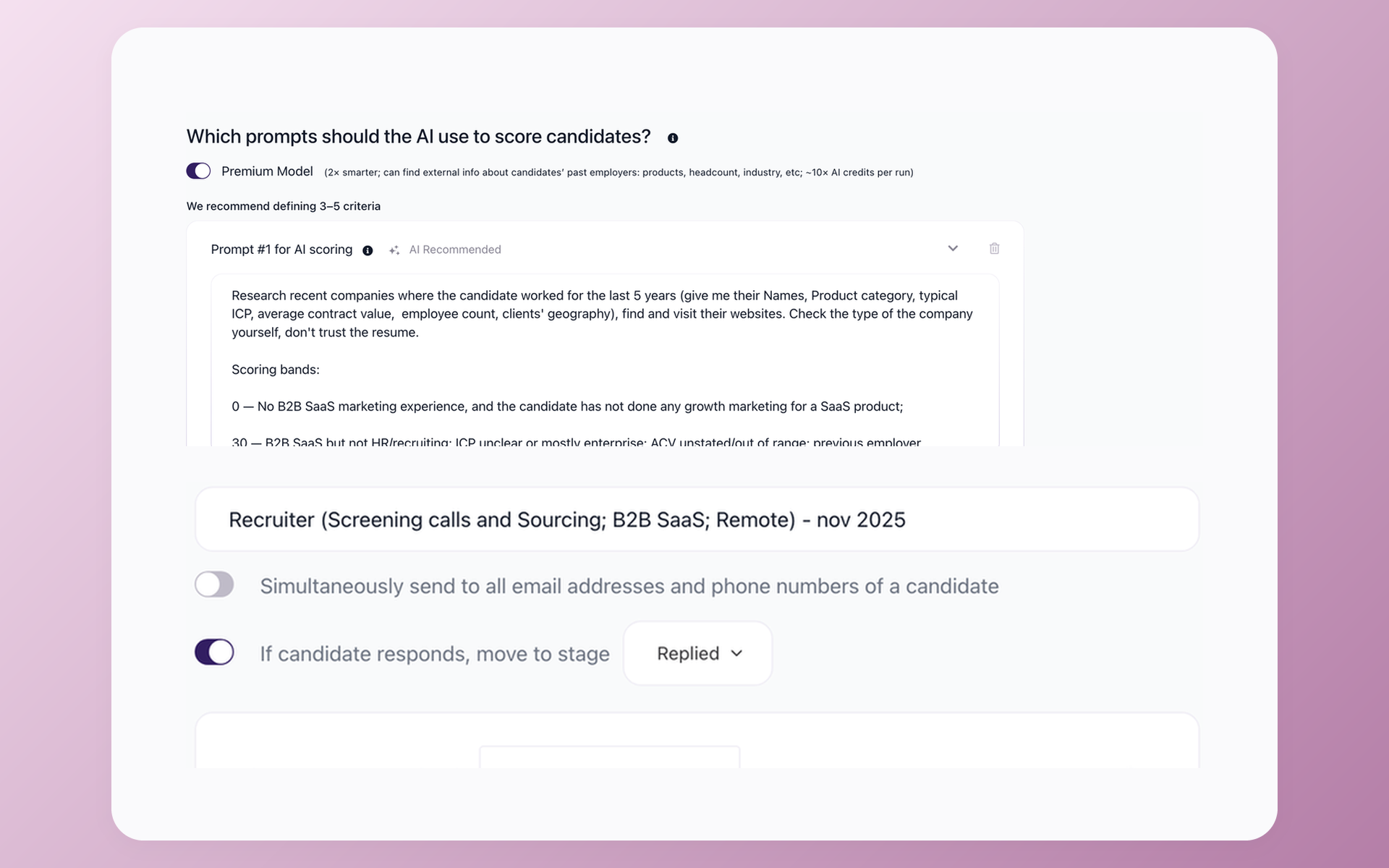
AI Score reviews resume evidence against job criteria. It gives recruiters a structured starting point for review rather than a final hiring decision.
AI Recruitment Copilot appears in the candidate activity record as part of the first-party 100Hires workflow.
AI Email Composer supports candidate communication. The aim is to keep drafting near the candidate record and recruiting context.
These tools form a connected AI recruiter workflow. They differ from an account-wide agent and from criteria-based screening without system-made suitability rankings.
Customizable pipelines, team mentions, evaluation forms, and stage automation support the ATS layer around those AI tools.
Nurture sequences, enrichment, and email or calendar sync support follow-up work, according to first-party product documentation.
This is a specific fit claim, not a claim of universal superiority. A team may need Workable's verified distribution breadth or Tellent Recruitee's collaboration-centered package.
The honest limitations
Resume-based AI can assess only evidence present in the resume. It cannot judge communication ability or any qualification the candidate did not document.
Interviews and human judgment remain necessary. A score should help a reviewer find evidence, not replace the conversation that tests it.
100Hires documents 13 named job-board integrations, which is not parity with Workable's network of more than 200 boards and social sites.
100Hires Enterprise lists enhanced security, privacy, governance, SSO, account management, requisition approvals, BI connection, custom integrations, compliance, and reports. Pricing requires contact with sales.
100Hires publishes Start, Advanced, and Pro prices, plus quote-based Enterprise packaging. Its 14-day trial requires no card, with external-board and AI quotas.
Start, Advanced, and Pro use the no-card free-trial path. Advanced and Pro also offer a live demo, while Enterprise uses Contact Sales.
Compare workflow fit, evidence quality, and current commercial terms. Owned documentation can explain the product, but it is not independent proof.
A lean team may value having scoring, candidate guidance, and email drafting close to the candidate record.
The benefit depends on review discipline. Recruiters still need clear criteria, clean candidate data, and a recorded reason for each decision.
Test how the AI behaves when a resume lacks a requested detail. A useful response should surface the missing evidence, not invent a confident conclusion.
Review current 100Hires scope
Compare the documented AI workflow with your own role and review process. Then inspect current 100Hires product information before making a commercial comparison.
For wider category context, use the recruiting software guide to frame requirements before a vendor demo.
Final verdict
Pick Workable when verified distribution reach, searchable sourcing, and public employee-band prices matter most.
Pick Tellent Recruitee when configurable collaboration and human-reviewed screening without system-made suitability rankings fit your operating model.
Consider 100Hires when a lean internal team wants AI Score, AI Recruitment Copilot, and AI Email Composer inside candidate work.
That third choice comes with a clear disclosure and a real limit: resume-based AI cannot assess evidence the resume does not contain.
No product is best in every category, so match the first trial to the weekly bottleneck. Then use the current 100Hires pricing page to assess the disclosed alternative.
How we researched this comparison
We reviewed two sets of DataForSEO queries, official pricing and help material, video transcripts, Reddit discussions, podcasts, social posts, repository sources, and prior 100Hires work.
The video set contained ten transcripts, split across the two products. Official sources controlled current feature, plan, trial, board, and AI claims.
Practitioner material helped identify questions about price, onboarding, workflow, sourcing, and migration. It did not replace vendor documentation for product facts.
No direct practitioner head-to-head was found. Workable had much richer current discussion, and Tellent Recruitee evidence was thinner or older.
That gap prevents a fair sentiment winner. It does not prevent a feature or fit comparison grounded in current official evidence.
We did not claim independent hands-on product testing. Tutorial material helped explain interface mechanics, and official pages supplied the factual record.
We rechecked prices, trials, credits, limits, discounts, and board totals on July 15, 2026.
This article does not link to competitor domains. Its external links are limited to public practitioner threads and NIST guidance.
The research hierarchy was simple. Current official material controlled product facts, neutral guidance supported the oversight note, and practitioner posts supplied questions for buyers.
Older sources were retained only when their age added useful context. No old price, review score, implementation promise, or outcome metric was carried into the verdict.
Frequently asked questions
Is Workable better than Tellent Recruitee?
Workable leads on verified distribution breadth and visible employee-band prices, but neither is better for every team. Tellent Recruitee leads on collaboration-centered configuration. 100Hires is a publisher-owned alternative with AI Score, which still needs human review.
Which has better job-board distribution?
Workable has the stronger verified breadth claim, with more than 200 free and paid boards and social sites in its documented network. Routes vary by board and spend. 100Hires documents 13 named job-board integrations.
Is Tellent Recruitee cheaper than Workable?
Public evidence cannot establish that because Tellent Recruitee does not show dollar prices. Workable starts at $299 for 1-20 employees. Publisher-owned 100Hires lists Start at $99 monthly or $49 per month billed annually.
Does Tellent Recruitee rank candidates with AI?
It does not assign suitability rankings or create top-candidate lists, although users can filter and sort by screening results. Human review remains required. 100Hires AI Score uses resume evidence and cannot assess qualities missing from it.
Does Workable rank candidates with AI?
Premium Workable Agent can score, rank, and take pipeline actions across all active agentic jobs. That does not describe every basic Workable workflow. 100Hires AI Recruitment Copilot is a different first-party tool in candidate work.
Which ATS is better for collaborative hiring?
Tellent Recruitee puts more product focus on configurable team workflows. Workable still offers named roles, scorecards, and visibility controls. Publisher-owned 100Hires supports team mentions and evaluation forms, based on first-party documentation.
Try 100Hires for free
No credit card. 14-day trial. Forbes Advisor #1 ATS for SMBs.