
Workable vs Betterteam: Which is better in 2026? - 100Hires
Workable is the stronger choice for a full recruiting process. Betterteam is the simpler, lower-cost choice for posting jobs and managing the first applicant steps.
This is not a choice between two equally deep applicant tracking systems. Workable carries hiring from sourcing through offers and reporting. Betterteam concentrates on distribution and a lighter candidate dashboard.
Choose Workable for recurring roles, several reviewers, structured stages, interviews, offers, reports, and integrations. Choose Betterteam when one person can run a straightforward hire and broad job posting matters most.
Workable vs Betterteam at a glance
The hiring playbook, in your inbox
One email a week - benchmarks, AI screening tactics, and short interview templates from the 100Hires team. No product pitches.
| Field | Workable | Betterteam |
|---|---|---|
| Comparable entry plan | Standard Recruiting-only, 1-20 employees | Solo |
| True month-to-month USD | $360/month | $39/month |
| Annual-commitment USD equivalent | $299/month | $19.50/month |
| Annual cost | $3,588/year, displayed | $234/year, displayed |
| Pricing basis | Employee band plus Recruiting-only scope | Monthly job-post allowance |
| Hiring scope | Full ATS and sourcing | Job distribution plus light applicant management |
| Entry allowance or limit | Unlimited active jobs subject to fair use; no public user or candidate cap captured | 1 monthly job post, up to 25 monthly candidates, 1 user |
The price gap is real, but so is the scope gap. Workable's entry comparison uses Recruiting-only scope. Betterteam Solo buys one monthly job post and a much narrower applicant-management allowance.
Betterteam describes its job limits three ways across official pages: monthly posts, active syndicated jobs, and jobs open at the same time. Ask how those limits interact before choosing a plan.
The real difference: full ATS vs posting-led hiring
Workable is built to run recruiting from sourcing through the offer. Its current product documentation covers career pages, applicant tracking, configurable stages, interview kits, scorecards, reports, offers, approvals, and permissions.
That depth matters after applications arrive. A recruiter can assign work, collect structured evaluations, move candidates through a defined process, prepare an offer, and report on the result without changing systems.
Betterteam starts from a different job. It distributes openings, receives applicants in one dashboard, and supports ratings, notes, decisions, resume downloads, mobile management, and CSV export.
That is real applicant management. It is still lighter than Workable's workflow, collaboration, reporting, sourcing, and offer stack.
The practical question is simple: do you need software to run recruiting from start to finish, or mainly to publish a job and keep the resulting applications organized?
If the full ATS feels like more than you need, compare these Workable alternatives for SMBs before accepting the extra cost.
Choose Workable or Betterteam
Choose Workable if
- You hire across several roles or departments.
- Hiring managers need structured evaluations and controlled access.
- Your process includes multiple stages, interviews, approvals, and offers.
- You need sourcing, automation, reports, or a documented integration ecosystem inside the ATS.
- Your budget can absorb employee-band pricing and possible add-ons.
Choose Betterteam if
- You hire occasionally or run a low-complexity process.
- One accountable user can manage applicants.
- Broad distribution matters more than workflow customization.
- A simple dashboard covers your ratings, notes, and decisions.
- You can work within the plan's posting and candidate allowances.
Neither list makes one product universally better. Betterteam can be the smarter purchase for one straightforward opening. Workable earns its higher price when the process itself needs structure.
If Betterteam looks close but the limits do not, review other Betterteam alternatives before committing to a larger posting plan.
What Workable gets right, and where it costs more
Workable's biggest advantage is continuity. The same record can support sourcing, application review, interviews, structured feedback, an offer, and later reporting. A team does not need to rebuild context at each step.
That continuity helps when hiring is shared. Roles and permissions can separate what a recruiter, hiring manager, executive, or interviewer may see and do. Scorecards create a repeatable evaluation instead of a loose message thread.
Reporting is built into the product instead of left to a spreadsheet. Recruiting reports refresh every 1.5 hours. HR-package reports use a 30-minute cadence. Higher-tier reports cover hiring plans, performance, and offer details.
The product has room to grow beyond basic tracking. Official pages document career pages, candidate sourcing, integrations, e-signature offers, approval groups, texting, video interviews, assessments, and performance reviews.
The catch is packaging. Texting, video interviews, assessments, and performance reviews are separate paid add-ons on the 1-20 employee Standard band. Agent activity introduces another usage meter through AI credits.
Employee-band pricing creates a second variable. A company may keep the same workflow and pay more as headcount crosses a band. HR-only, Recruiting-only, and the combined bundle have different prices.
A small set of recent community discussions gave mixed signals. Some users liked Workable's interface and month-to-month option. Price structure, stage flexibility, support access, reporting, and export completeness affected other shortlists.
That is not a universal score. A trial should answer the actual concerns: can your team change stages without help, get the needed report, reach a person when blocked, and export complete records for a later migration?
Workable is strongest when the company will use the depth. If the buyer only needs one job distributed and one person to review applications, much of that system may sit idle.
What Betterteam gets right, and where it stays light
Betterteam makes the first steps of posting a job easier to understand. Pick a posting allowance, publish an opening, receive candidates in one dashboard, review the application, and record a decision.
That focus is useful for an owner or HR generalist who does not want to design a recruiting system. A smaller feature surface usually means fewer permissions, report settings, automation rules, and integrations to configure.
The dashboard is not empty. It keeps an applicant timeline, ratings, notes, decisions, requisition IDs, billing status, invoices, device controls, mobile access, and downloadable resumes.
Betterteam Relevance adds a small prioritization layer. Its three labels can help an owner decide where to start reviewing. The applicant record keeps the eventual decision visible.
The entry price makes sense in that context. Solo costs $39 month to month and includes one monthly job post. An annual commitment reduces the equivalent to $19.50 per month, with a displayed $234 annual total.
Account ownership is the first constraint to verify. One user can be attached to an account according to Betterteam's current Help Center. That does not establish a normal multi-user workflow.
Process depth is another constraint. The public evidence does not show Workable-style configurable workflows, structured interview kits, offer approvals, recruiting reports, or a broad outbound sourcing layer.
Plan interpretation needs a close look too. Monthly posts, active syndicated jobs, and simultaneous openings may create different constraints. A demo should show what happens when jobs overlap or reopen within the same month.
Betterteam is not a failed version of a large ATS. It is a narrower product. The buyer should decide whether that narrowness removes unnecessary work or removes capabilities the next hiring cycle will need.
Job posting and applicant volume
Both products can get a job in front of candidates. Workable puts distribution inside its recruiting suite and displays a network of more than 200 boards. That count is a vendor claim, not a guarantee of placement on every board.
Betterteam makes distribution the center of the product. Its official copy promotes posting across hundreds of boards, with applications flowing back into a single dashboard.
Board count is only the first half of the buying decision. It does not tell you whether a posting will be accepted, how a paid board behaves, where candidates come from, or how much screening work follows.
High reach can produce a new bottleneck. Once a role attracts hundreds of applicants, the valuable features are filtering, ownership, communication, evaluations, and a reliable record of each decision.
That is where Workable's depth starts to matter. Betterteam remains attractive when the hiring owner can review the incoming pool without a larger workflow.
For a closer look at the mechanics, see how to post jobs to multiple job boards and track their source from one place.
Applicant tracking and collaboration
Workable handles the full hiring record
Workable combines candidate profiles, pipelines, interview kits, scorecards, reports, roles, permissions, offers, and an audit trail. Each hiring-team member can submit one evaluation per candidate at each stage.
Premier and Enterprise add more control. Those tiers can customize four hiring roles across 55 permissions and support sequential offer approvals. Some reporting moves behind the higher tiers.
This model suits a recruiter who needs consistent feedback from several people. The ATS is not merely a list of applicants. It is the shared operating record for the hire.
Betterteam keeps the first steps simpler
Betterteam's dashboard includes an applicant timeline, ratings, notes, decision history, requisition IDs, mobile controls, CSV export, and a bulk ZIP download of resumes for each job.
Solo shows up to 25 candidates per month. Premium shows unlimited candidates. The public page we captured did not show candidate caps for Plus, Business, Enterprise, or Corporate.
The account model deserves a direct check. Betterteam's Help Center says one user can be attached to an account. Separate free sub-accounts have isolated dashboards and do not share data.
That conflicts with homepage language about team discussion and shared scoring. Before purchase, ask Betterteam to demonstrate exactly how several reviewers work in the current product.
A deeper applicant tracking system becomes useful when resumes, messages, notes, evaluations, and stage history need to stay in one record.
Screening and AI
Workable uses a credit-based Agent
Workable Agent can evaluate candidates, source passive profiles, and handle candidate chat. The published meter uses one credit for an evaluation, two for a source action, and ten for a chat interaction.
Its scoring can use up to 14 job-specific criteria and normalize the result to a 0-100 scale. That creates a richer screening layer than a simple label, plus a usage cost to monitor.
The Standard card displays 3,000 free AI credits. Additional packs start at $600 for 5,000 credits. Purchased credits expire after one year and are non-refundable.
Workable's 15-day Standard trial requires no card, but it does not include Workable Agent. A buyer who wants to test the AI workflow should confirm what evaluation access is available.
Betterteam keeps AI screening narrow
Betterteam Relevance labels an applicant as Match, Limited Match, or Not a Match. Betterteam describes that label as an initial signal, not a final hiring decision.
A label may be missing during resume processing or when the applicant did not include a resume. The feature can help prioritize review, but it is not an autonomous screening workflow.
Whichever system you choose, employers remain responsible for how software affects employment decisions. The EEOC's employment and AI resource explains the federal anti-discrimination context.
This is a product comparison, not legal advice. Review the rules that apply to your locations and hiring process.
Automation, outreach, reporting, and integrations
Workable is the clearer fit when the system must keep working after a job goes live. It documents recruiting automations, sourcing, messaging, candidate-source reports, offers, and a broad partner ecosystem.
Its recruiting reports update every 1.5 hours. HR reports update every 30 minutes. Hiring-plan and performance reports require Premier Recruiting.
Automation still needs an owner. Workable says an automation can fail when its specified sender loses the required permission before the trigger runs.
Offers are available across plans and can include up to five documents. Sequential offer approvals are a Premier and Enterprise feature.
Betterteam covers a narrower set of tasks: posting, notifications, applicant decisions, account controls, CSV export, and ZIP resume export. Its public integration evidence is less detailed than Workable's.
That does not prove Betterteam has no integrations. It means the buyer should verify each required connection instead of assuming an enterprise-style marketplace.
For a small company, that difference can be healthy. A focused posting tool has less to configure. It becomes restrictive only when follow-up, sourcing, reporting, or cross-team work needs to happen in the same system.
Trials, support, and switching costs
A trial should test the workflow you plan to buy, not a polished sample job. Workable offers a 15-day Standard trial without a card, but the trial excludes Workable Agent.
That distinction matters if AI sourcing or screening is part of the business case. Ask how the team can test Agent, how many credits a normal role consumes, and what happens when the included balance is exhausted.
For Betterteam, confirm the current trial directly. We could not confirm a current public trial length.
Support is harder to compare from public pages. Recent buyers ask about implementation access, post-sale ownership, and whether help stays in chat or reaches a person. We did not find enough evidence to give either product a reliable support rating.
Use the trial to create a real role, invite the actual reviewers, move test candidates, send a message, produce a report, and export the records. That sequence reveals more than a feature checklist.
Test portability with a sample export. Check whether it includes profile fields, resumes, messages, notes, evaluations, and stage history, and whether each file stays matched to the right candidate.
Betterteam documents CSV export and a ZIP resume download by job. Ask both vendors to show how those records move into another system before the contract starts.
Before signing, ask both vendors six questions:
- Which limits apply to open jobs, monthly posts, candidates, and users?
- Which features in the demo require a higher tier, add-on, or credit pack?
- How do reviewers collaborate without sharing credentials?
- What data, attachments, and activity history can be exported?
- Who helps when a board connection or automation fails?
- What changes when headcount or hiring volume crosses the current plan?
The answers often decide the purchase before a long feature comparison does. They expose the real operating model, the likely bill, and the work required if the company changes systems later.
Run the test with the people who will use the system. A recruiter may value a clean pipeline. A hiring manager may care about quick feedback. An owner may focus on price, reporting, and access to help.
For Betterteam, the one-user rule should be part of that test. For Workable, test the permissions and paid boundaries. The best demo is the one that makes the limits visible before they affect a live hire.
Workable vs Betterteam pricing
Compare the same cost horizon first. Then compare what each number buys. Workable changes price by employee band and product scope. Betterteam changes price by monthly job-post allowance.
Workable pricing for 1-20 employees
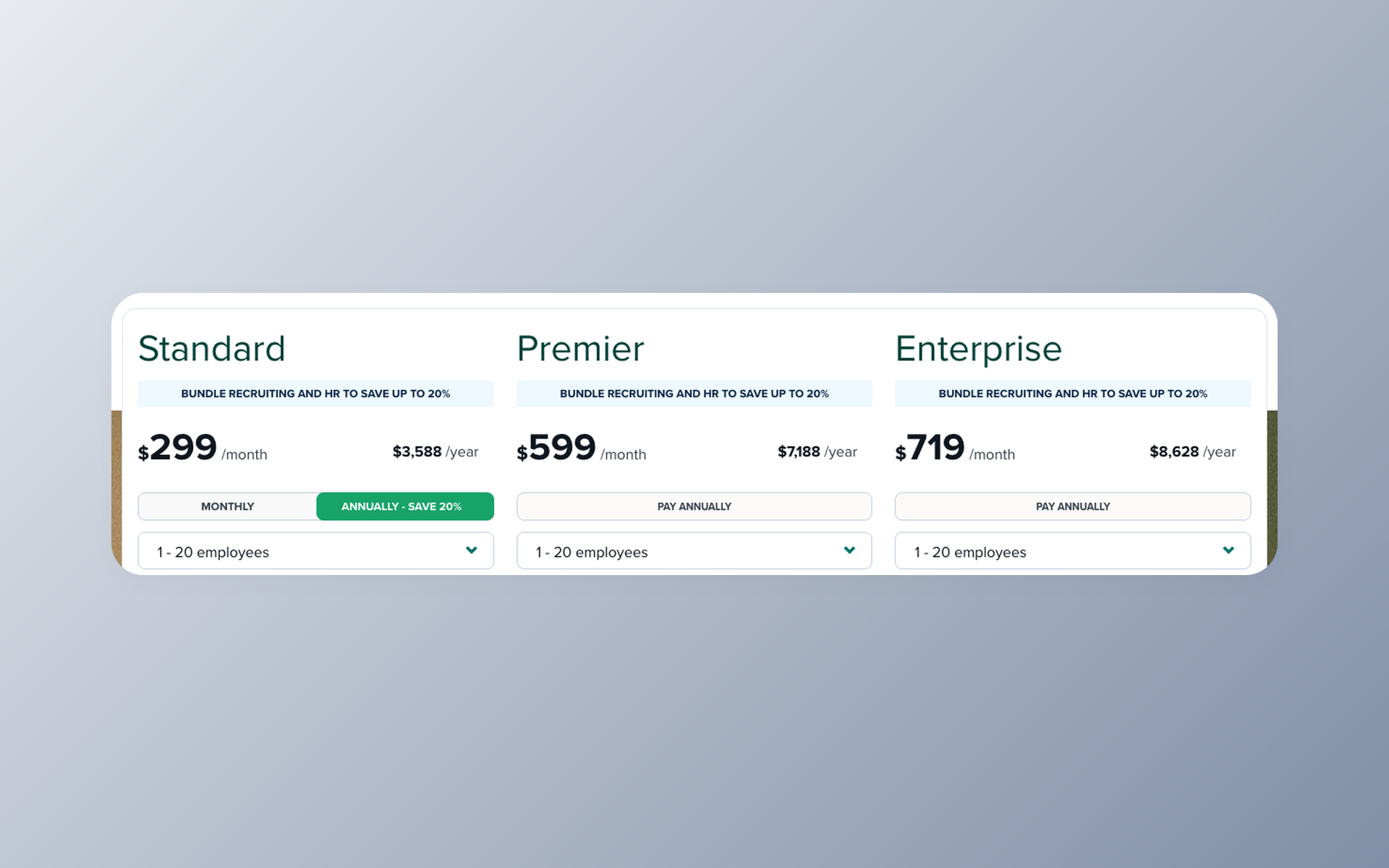
Scope note: USD prices come from Workable's public selector, checked for this update for the 1-20 employee band. Annual-equivalent prices require annual billing. Add-ons are excluded, and no public user or candidate caps appeared in the captured grid.
| Plan and scope | True monthly | Annual-equivalent | Annual cost |
|---|---|---|---|
| Standard Recruiting-only | $360 | $299/month | $3,588 displayed |
| Standard HR-only | $120 | $99/month | $1,188 displayed |
| Standard Recruiting+HR | $430 | $359/month | $4,308 displayed |
| Premier Recruiting-only | Not publicly shown | $599/month | $7,188 arithmetic equivalent |
| Premier HR-only | Not publicly shown | $239/month | $2,868 arithmetic equivalent |
| Premier Recruiting+HR | Not publicly shown | $749/month | $8,988 arithmetic equivalent |
| Enterprise Recruiting-only | Not publicly shown | $719/month | $8,628 arithmetic equivalent |
| Enterprise HR-only | Not publicly shown | $289/month | $3,468 arithmetic equivalent |
| Enterprise Recruiting+HR | Not publicly shown | $899/month | $10,788 arithmetic equivalent |
The most common pricing error is to pair $430 with $299. Those figures belong to different scopes. For 1-20 employees, $430 is the true-monthly Recruiting+HR bundle. $299 is the annual-equivalent Recruiting-only price.
Workable increases price across employee bands. The captured public selector ran from 1-20 through 801-1,000 employees. Companies above 1,000 did not receive a public numeric state.
Standard Recruiting includes unlimited active jobs, subject to fair-use limits. We did not find public user or candidate caps in the captured pricing grid.
Add-ons change the practical bill. For the 1-20 Standard band, Texting is $89 per month, video interviews $109, assessments $59, and performance reviews $39.
Betterteam pricing
Scope note: USD prices come from Betterteam's public pricing page, checked for this update. Annual-equivalent prices require annual billing. Job counts are monthly-post allowances; active-job and simultaneous-opening semantics remain unresolved.
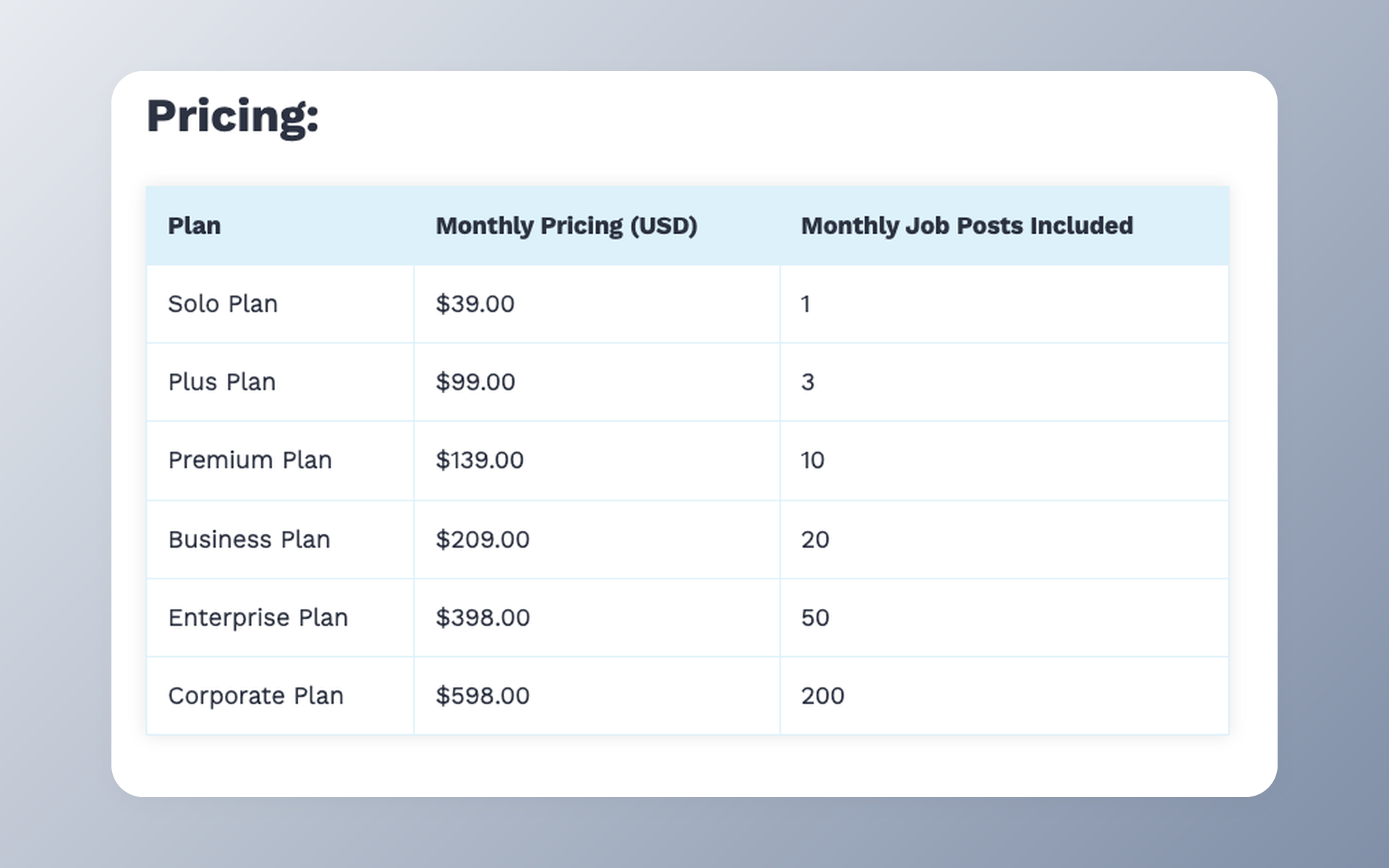
| Plan | True monthly | Annual-equivalent | Annual total | Monthly job posts |
|---|---|---|---|---|
| Solo | $39 | $19.50/month | $234 | 1 |
| Plus | $99 | $49.50/month | $594 | 3 |
| Premium | $139 | $69.50/month | $834 | 10 |
| Business | $209 | $104.50/month | $1,254 | 20 |
| Enterprise | $398 | $199/month | $2,388 | 50 |
| Corporate | $598 | $299/month | $3,588 | 200 |
Solo includes one user and up to 25 candidates per month. Premium shows unlimited candidates. Public candidate caps for Plus, Business, Enterprise, and Corporate were not captured.
Betterteam's annual totals and monthly equivalents are clear. The operational allowance is less clear. The pricing page, About page, and Help Center use different job-limit language.
Do not assume 10 monthly posts means the same thing as 10 active jobs. Ask whether closing one job frees the allowance, whether unused monthly posts roll over, and how simultaneous openings are counted.
The practical result is straightforward. Betterteam costs less for a posting-led workflow. Workable charges more for the operating system around the hire.
SMB decision map
| Hiring pattern | Better fit | Why |
|---|---|---|
| One simple role, one owner, light process | Betterteam | Lower entry price and posting-led workflow |
| Recurring roles with several reviewers | Workable | Structured stages, evaluations, permissions, and reports |
| High applicant volume after broad posting | Workable | Deeper screening and workflow controls |
| Need multi-step outbound recruiting | Neither by default | Evaluate a full ATS with built-in outreach after the pair verdict |
| Need the lowest setup burden | Betterteam, after a limit check | Simpler scope, but account and job-limit semantics need confirmation |
Use the map as a fit check, not a promise about implementation time. A clean migration, board approval, permissions, and the number of reviewers can change how quickly either system becomes useful.
The decision changes as the company grows. A light tool can serve the first few hires well and still create a second migration once reporting, automation, and shared ownership become necessary.
Final Workable vs Betterteam verdict
Workable wins on ATS depth. Betterteam wins on entry price and posting simplicity.
Choose Betterteam for occasional, lower-complexity hiring managed by one accountable user. Its dashboard is enough when the job is to distribute an opening, review applicants, record decisions, and make one hire.
Choose Workable for recurring, staged, collaborative hiring. Its higher price makes sense when sourcing, structured reviews, interviews, offers, permissions, reporting, and integrations must live in the same ATS.
The correct purchase depends on workflow depth, not the longest feature list. Buy the lighter product if it solves the whole job. Buy the full ATS before the process outgrows a posting dashboard.
When neither fits: 100Hires
Disclosure: 100Hires publishes this comparison. We built 100Hires as an AI-first full ATS for SMBs that need structured applicant tracking, workflow automation, and outbound recruiting in one system.
100Hires is a separately scoped option for teams that need full applicant tracking plus automated outreach. Its public entry price sits between Betterteam Solo and Workable's Recruiting package.
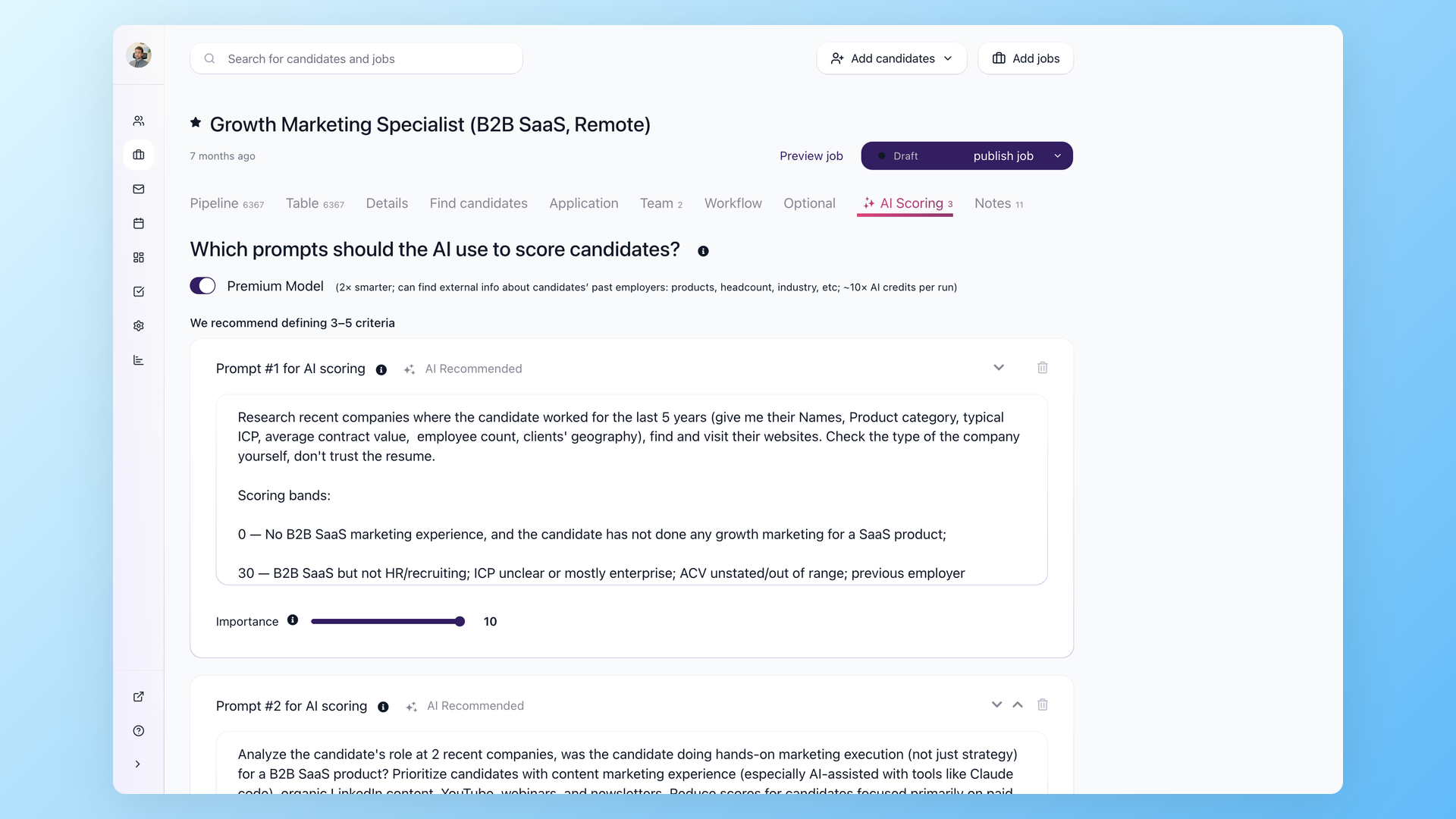
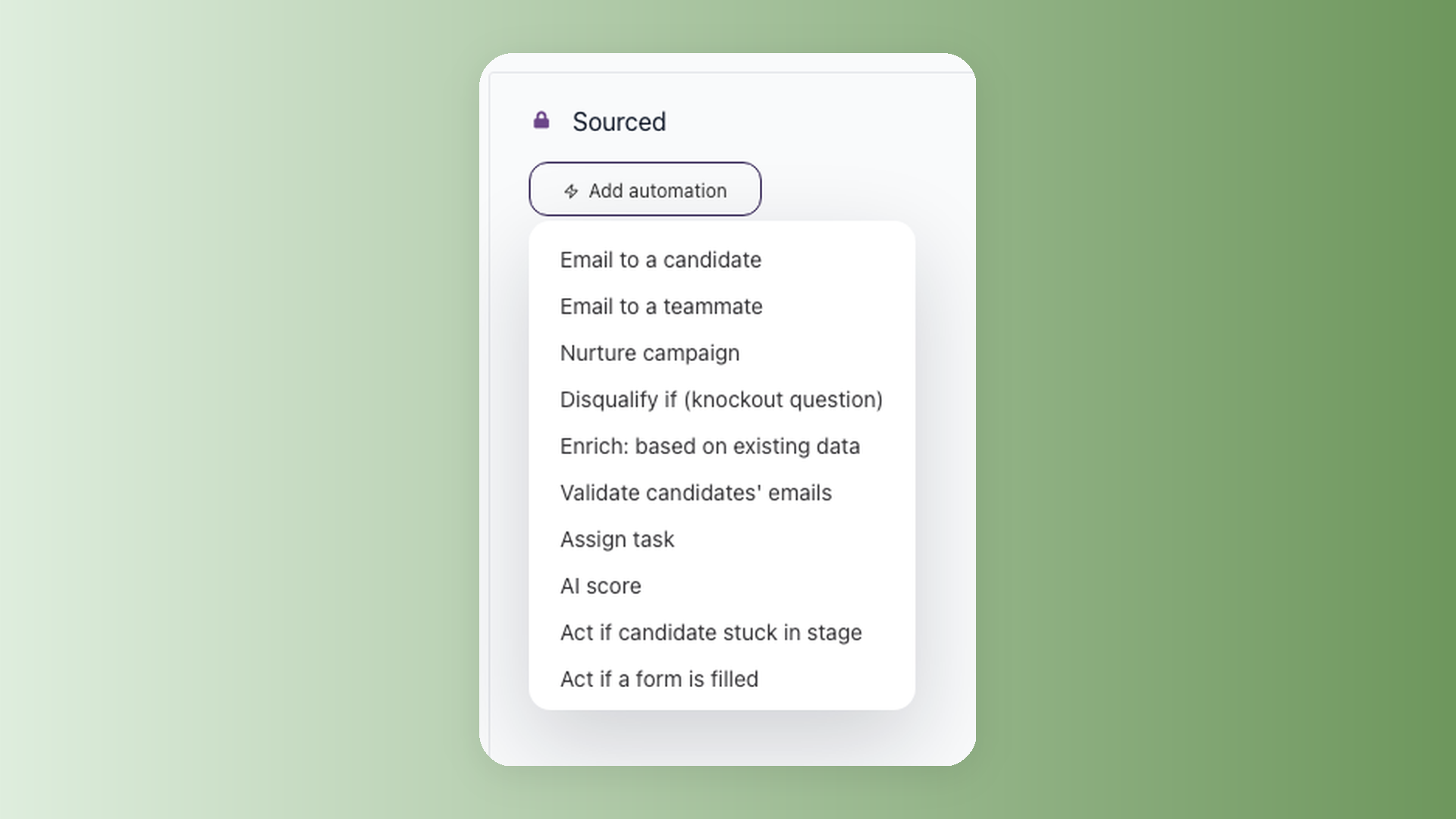
Start supports up to 3 jobs, 100 candidates, and 1 user. Advanced supports unlimited jobs, candidates, and users, then adds workflow automation and a larger AI allowance.
Pro adds Contact Finder, multichannel campaigns, and email warmup. That is the relevant path when outbound recruiting matters as much as processing inbound applicants.
100Hires public plan pricing
Scope note: USD prices come from the current public 100Hires pricing payload. Annual-equivalent prices require annual billing. Annual totals below are derived arithmetic, not displayed totals.
| Plan | True monthly | Annual-equivalent | Derived annual total | Scope and limits |
|---|---|---|---|---|
| Start | $99/month | $49/month | $588 as $49 x 12 | Up to 3 jobs, 100 candidates, 1 user |
| Advanced | $249/month | $199/month | $2,388 as $199 x 12 | Unlimited jobs, candidates, and users; workflow automation |
| Pro | $499/month | $399/month | $4,788 as $399 x 12 | Advanced scope plus Contact Finder, multichannel campaigns, and email warmup |
Three-tool entry-plan pricing parity
| Field | Workable | Betterteam | 100Hires |
|---|---|---|---|
| Comparable entry plan | Standard Recruiting-only, 1-20 employees | Solo | Start |
| True month-to-month USD | $360/month | $39/month | $99/month |
| Annual-commitment USD equivalent | $299/month | $19.50/month | $49/month |
| Annual cost at annual-equivalent rate | $3,588 displayed | $234 displayed | $588 derived as $49 x 12 |
| Pricing basis | Employee band and Recruiting scope | Monthly job-post allowance | Jobs, candidates, users, and feature scope |
| Included hiring scope | Full ATS and sourcing | Job distribution plus light applicant management | Full ATS with AI tracking; outreach begins on Pro |
| Entry allowance or limit | Unlimited active jobs subject to fair use; public user and candidate caps not shown | 1 monthly post, up to 25 monthly candidates, 1 user | Up to 3 jobs, 100 candidates, 1 user |
| Important caveat | Do not mix Recruiting-only with HR or bundle prices | Monthly posts, active jobs, and simultaneous openings are unresolved | The Start plan's billing label conflicts with its displayed monthly price; use the public numeric prices and do not claim a discount |
The annual 100Hires total in the table is arithmetic: $49 multiplied by 12. We do not publish an annual discount percentage. The current pricing page presents the annual discount inconsistently.
Review 100Hires pricing for the current plan details, or see how the broader recruiting software for SMBs handles the process.
If the scope matches, you can create a free account. The trial lasts 14 days, requires no card, and includes all features with a 10-candidate cap for external job-board applicants.
Frequently asked questions
Is Betterteam a full applicant tracking system?
Betterteam has light applicant tracking: a dashboard, timeline, ratings, notes, decisions, exports, and Relevance labels. Workable covers the hiring process from sourcing through the offer. 100Hires is the disclosed full-ATS alternative for SMBs.
Is Workable worth the higher price for a small business?
It can be, when several people run recurring, staged hiring and need sourcing, evaluations, offers, reports, and integrations. If that depth is too costly, 100Hires Start or Advanced offers a different full-ATS scope with public pricing.
Which is better for posting one job?
Betterteam may be the better value if one user can run a simple process within the posting and candidate limits. 100Hires Start is the disclosed full-ATS option when the same hire needs structured tracking beyond posting.
Can multiple people use Betterteam?
Betterteam's current Help Center says one user per account. Its homepage uses collaboration language, so confirm the workflow before buying. For comparison, 100Hires Advanced includes unlimited users.
Which has better automation and outreach?
Workable has deeper ATS automation and a credit-based Agent. Betterteam stays closer to posting and light tracking. The disclosed 100Hires Pro plan adds Contact Finder, multichannel campaigns, and email warmup.
How do Workable, Betterteam, and 100Hires prices compare?
Monthly / annual-equivalent prices are Workable Recruiting-only $360/$299, Betterteam Solo $39/$19.50, and 100Hires Start $99/$49. Workable does not publish user or candidate caps. Betterteam allows 1 post/25 candidates/1 user; 100Hires allows up to 3 jobs/100 candidates/1 user.
Try 100Hires for free
No credit card. 14-day trial. Forbes Advisor #1 ATS for SMBs.