SmartRecruiters vs ZipRecruiter: ATS depth or candidate reach in 2026 - 100Hires
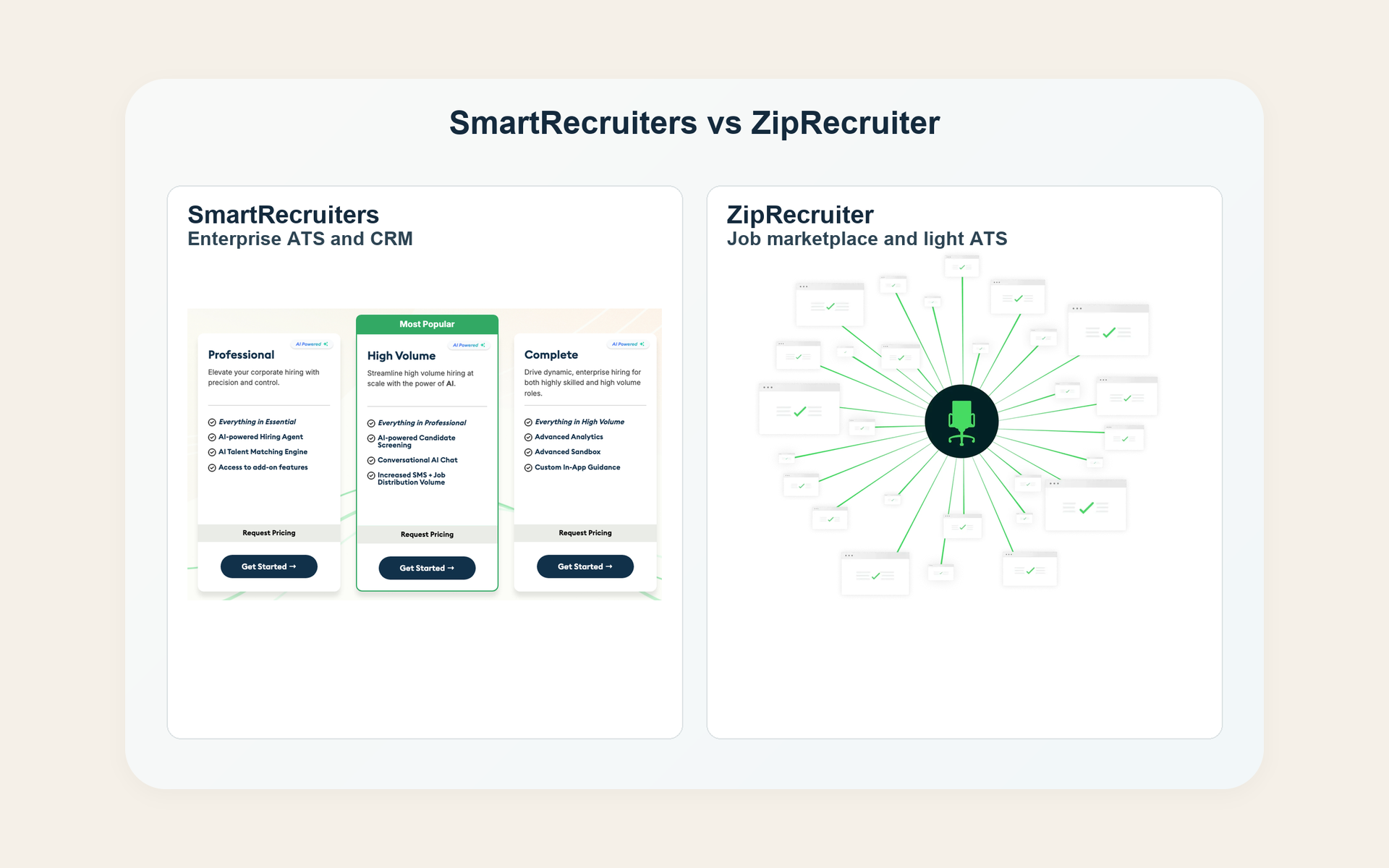
SmartRecruiters and ZipRecruiter can appear on the same shortlist, but they solve different parts of hiring.
Choose SmartRecruiters for enterprise ATS depth. Choose ZipRecruiter for candidate reach with a lighter employer workflow.
Use both when SmartRecruiters owns the record and ZipRecruiter remains a hiring channel.
This comparison looks at workflow, reach, screening, reporting, integrations, governance, pricing, and combined use. The right choice depends on the layer your hiring stack lacks.
The quick verdict separates ATS depth from candidate reach
The hiring playbook, in your inbox
One email a week - benchmarks, AI screening tactics, and short interview templates from the 100Hires team. No product pitches.
SmartRecruiters runs structured recruiting operations. ZipRecruiter brings candidates into the funnel through an employment marketplace and distribution product.
- Choose SmartRecruiters when you need one governed record for jobs, candidates, interviews, feedback, reporting, and integrations.
- Choose ZipRecruiter when reach, matching, resume search, and quick applicant review are the missing pieces.
- Use both when SmartRecruiters can own the workflow and ZipRecruiter can supply candidate reach.
Full disclosure: 100Hires is our product. This comparison includes a column for 100Hires. The buyer verdict remains SmartRecruiters versus ZipRecruiter.
| Criteria | 100Hires | SmartRecruiters | ZipRecruiter |
|---|---|---|---|
| Primary buying job | ATS and workflow for smaller and midsize teams | Enterprise ATS, CRM, and recruiting system of record | Employment marketplace and distribution with light applicant handling |
| Best-fit need | Pipeline, automation, distribution, and outreach in one ATS | Configurable workflows, reporting, integrations, and governance | Fast candidate reach, matching, resume search, and simpler review |
| System-of-record depth | Built for its target segment | Strongest fit of the compared pair | Light applicant workspace, not equal enterprise depth |
| Candidate reach | Uses distribution channels but is not a marketplace | Distributes jobs and connects to channels | Core strength, with an official vendor claim of 100+ board distribution |
| Applicant workflow | Pipelines, records, automation, and collaboration | Stages, interviews, feedback, permissions, and reporting | Screening questions, ratings, filters, and pre-qualification |
| Governance | Smaller and midsize operations, not global-suite parity | Best fit for complex enterprise governance | Lighter employer workflow |
| Pricing visibility | Public Start, Advanced, and Pro figures; Enterprise contact sales | Essential shows a starting amount without a public unit or cadence; other packages contact sales | Standard, Premium, and Pro names are public; dollar prices are not publicly shown |
| Combined-stack role | Can act as the ATS with ZipRecruiter as a channel | Can own the record with ZipRecruiter as a channel | Can feed reach into an ATS workflow |
If neither category fits neatly, compare 100Hires plan scope and public pricing.
SmartRecruiters owns the recruiting system of record
SmartRecruiters fits companies that need one enterprise recruiting workflow across teams, roles, and regions. Its value starts after a candidate enters the process.
Enterprise workflow depth is the reason to choose it
A recruiting system of record keeps the job, candidate history, stage, interview, feedback, message, and source in one place. That is the core job of a full applicant tracking system.
SmartRecruiters covers ATS, CRM, onboarding, job distribution, scheduling, messaging, reporting context, integrations, and plan-specific AI. Recruiters and hiring managers can work from a durable shared record.
The buyer test is whether every hiring decision must stay searchable after a role closes. If it must, the record layer carries more value than the posting channel.
This depth matters when hiring spans many teams. Permissions, process consistency, regional needs, and source reporting become operating requirements, not optional extras.
Enterprise depth brings implementation and adoption work
Practitioner evidence centers on process design, field mapping, user sync, permissions, and adoption after launch. These tasks need clear owners and time from recruiting, HR systems, and hiring teams.
Map the current process before a demo. List every field owner, approval, handoff, region, and report that the new system must support.
A smaller team may pay for controls it does not need. It may face more setup than a simple hiring process can justify.
For a broader look at lighter options, see these SmartRecruiters alternatives. The next question is whether the real gap is workflow or candidate demand.
ZipRecruiter owns candidate reach
ZipRecruiter fits employers that need more candidate reach and can work with a simpler review flow. It is an employment marketplace with distribution and light applicant handling.
Reach, matching, and resume access are the core value
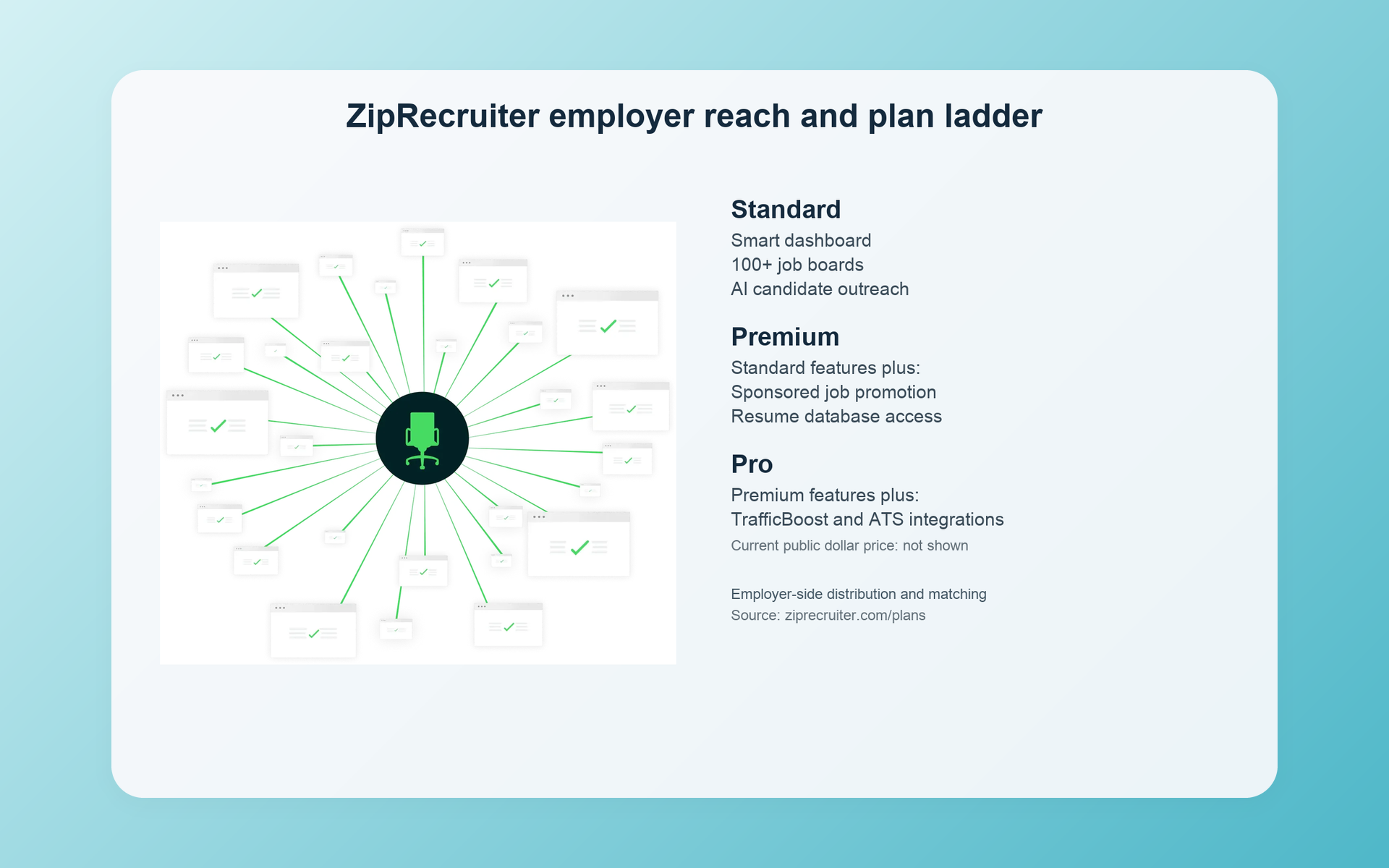
ZipRecruiter makes distribution the main buying reason. Its official vendor claim says one posting can reach 100+ job boards.
The product adds matching, candidate invitations, and searchable resume access. That can help a recruiter who has a job ready but lacks enough people to review.
This layer can reduce manual reposting and passive waiting. Its value still depends on the roles, locations, screening rules, and sources already in use.
Reach is not proof of applicant quality. Employer anecdotes vary by role, market, job detail, spend, and screening, so measure qualified applicants and eventual hires by source.
Applicant handling stays lighter than an enterprise ATS
Employers can use screening questions, pre-qualification, filters, ratings, and applicant review. Those tools may support a simple process of posting a job, screening applicants, and contacting them.
The boundary appears when records must move into another ATS. Resume export, intake, duplicate handling, source attribution, and status history can create manual work if the handoff is vague.
Test a full application before purchase. Follow it from the job post to the recruiter record, then check the source, attachments, screening answers, and status.
Ask what happens to resumes and applicant access after cancellation. Treat employer reports as prompts for contract review, not proof of a current policy.
SmartRecruiters vs ZipRecruiter differs by buying criterion
There is no useful overall winner. Each product wins only when its layer matches the gap in your stack.
SmartRecruiters wins when the system of record is missing
Choose SmartRecruiters for durable records, structured stages, collaboration, permissions, interviews, feedback, and enterprise recruiting operations.
ZipRecruiter can store and review applicants in a lighter workspace. The research does not show equal depth for a process that must span roles, teams, regions, and reports.
ZipRecruiter wins when candidate reach is missing
Choose ZipRecruiter for marketplace reach, matching, invitations, resume search, and broad job distribution. Employers often place it beside other channels or an existing ATS.
Track qualified yield and source of hire. A large applicant count can still leave recruiters with a small useful pool.
Applicant workflow depends on process complexity
SmartRecruiters has the edge for pipelines, team collaboration, interviews, feedback, and a lasting history. ZipRecruiter can fit a simple workflow that ends after screening and direct contact.
Ask where review ends. If hiring activity must survive across open roles, recruiters, managers, and reports, the enterprise ATS layer matters more.
Screening and AI solve different parts of the funnel
SmartRecruiters places plan-specific AI inside the recruiting workflow. ZipRecruiter uses marketplace matching, outreach, screening questions, filters, and pre-qualification before employer review.
These are different jobs, so equal AI depth should not be assumed. At first, route AI-screened candidates to a human review queue rather than automatic rejection.
Teams can use the NIST AI Risk Management Framework to structure questions about inputs, human checks, monitoring, and controls. NIST has not evaluated these products.
SmartRecruiters wins for recruiting reporting depth
SmartRecruiters is the better fit for cross-stage reporting, source attribution, and governance context inside the recruiting record.
ZipRecruiter metrics are channel inputs. They do not replace a full record of stages, outcomes, communication, and hiring history across the company.
A channel report can show traffic and applications. Recruiting leaders still need one place to connect those sources with interviews, offers, hires, and later analysis.
Integration choice depends on the stack owner
SmartRecruiters has the edge for enterprise integration architecture. Its official developer material documents an OAuth assessment flow, and official SAP material confirms its current enterprise context.
ZipRecruiter fits when an ATS exists and the need is a clean source handoff. Its official ATS-partner evidence names SmartRecruiters, which supports combined use.
Before purchase, trace job creation, apply routing, duplicate handling, status updates, and source data. A named partner relationship does not answer each workflow question.
SmartRecruiters wins when governance is the buying constraint
SmartRecruiters fits complex permissions, regional processes, localization needs, and enterprise change management. Configuration and adoption need accountable owners.
ZipRecruiter's lighter model may be the better fit when those controls are unnecessary. Simpler is useful when the process is simple.
Document the controls that matter before comparing plans. Otherwise, a buyer may treat unused enterprise depth as value or miss a needed approval path.
Using both wins when one system owns the handoff
A combined stack can work if SmartRecruiters owns jobs, candidate history, stages, messages, reporting, and governance. ZipRecruiter can supply reach, matching, invitations, and resume access.
Set one posting owner and one application destination. Preserve source attribution through the transfer.
Document which system owns status and communication history. Confirm retention, cancellation, and applicant-access terms before signing.
Run this handoff with a test role and test candidate. The exercise can expose missing fields, duplicate records, broken source labels, or unclear team ownership.
Pricing is not a clean side-by-side comparison
The products use different pricing models. SmartRecruiters sells enterprise packages, ZipRecruiter shows plan names without current public dollars, and 100Hires publishes several plan prices.
SmartRecruiters exposes a starting amount without a usable billing unit
SmartRecruiters Essential displays a starting amount of $14,995. The page does not publicly show a monthly price, annual-equivalent price, annual total, unit, or cadence for that amount.
It lists Essential inclusions such as ATS, CRM, onboarding, SMS messaging, job distribution, and dynamic scheduling.
Do not treat that amount as annual, monthly, per user, or per company. Professional, High Volume, and Complete are contact-sales packages with no public dollar fields in the approved evidence.
ZipRecruiter plan names are public but current dollar prices are not
ZipRecruiter names Standard, Premium, and Pro. Its current official pages do not publicly show dollar prices for those plans.
Old videos, directories, social posts, and individual billing stories give conflicting figures. None is sound current pricing.
Request current terms and confirm renewal, cancellation, applicant access, resume access, and data retention. Compare the full contract, not an old monthly estimate.
Every public price uses the same comparison fields
The table uses the same eight fields for every plan. When a public field is missing, the table states “not publicly shown.”
| Product and plan | Monthly | Annual-equivalent | Annual total | Scope | Limits | Billing basis | Displayed versus derived |
|---|---|---|---|---|---|---|---|
| 100Hires Start | $99 | $49 | $588 | ATS workflow for a small team | 3 jobs, 100 candidates, 1 user, 100 monthly AI credits | Monthly or prepaid annual | Monthly and annual-equivalent displayed; annual total derived |
| 100Hires Advanced | $249 | $199 | $2,388 | ATS workflow plus automation | Unlimited jobs, candidates, and users; automation; 1,000 monthly AI credits | Monthly or prepaid annual | Monthly and annual-equivalent displayed; annual total derived |
| 100Hires Pro | $499 | $399 | $4,788 | Sourcing, enrichment, and outreach | 5,000 monthly AI credits | Monthly or prepaid annual | Monthly and annual-equivalent displayed; annual total derived |
| 100Hires Enterprise | not publicly shown | not publicly shown | not publicly shown | Enterprise security and governance | not publicly shown | Contact sales | Contact-sales status displayed; no dollar value derived |
| SmartRecruiters Essential | not publicly shown | not publicly shown | not publicly shown | ATS, CRM, onboarding, SMS messaging, job distribution, and dynamic scheduling; displayed starting amount $14,995 | Low SMS and job-distribution limits; exact quantities not publicly shown | not publicly shown | Starting amount displayed; no monthly, annual-equivalent, or annual total derived |
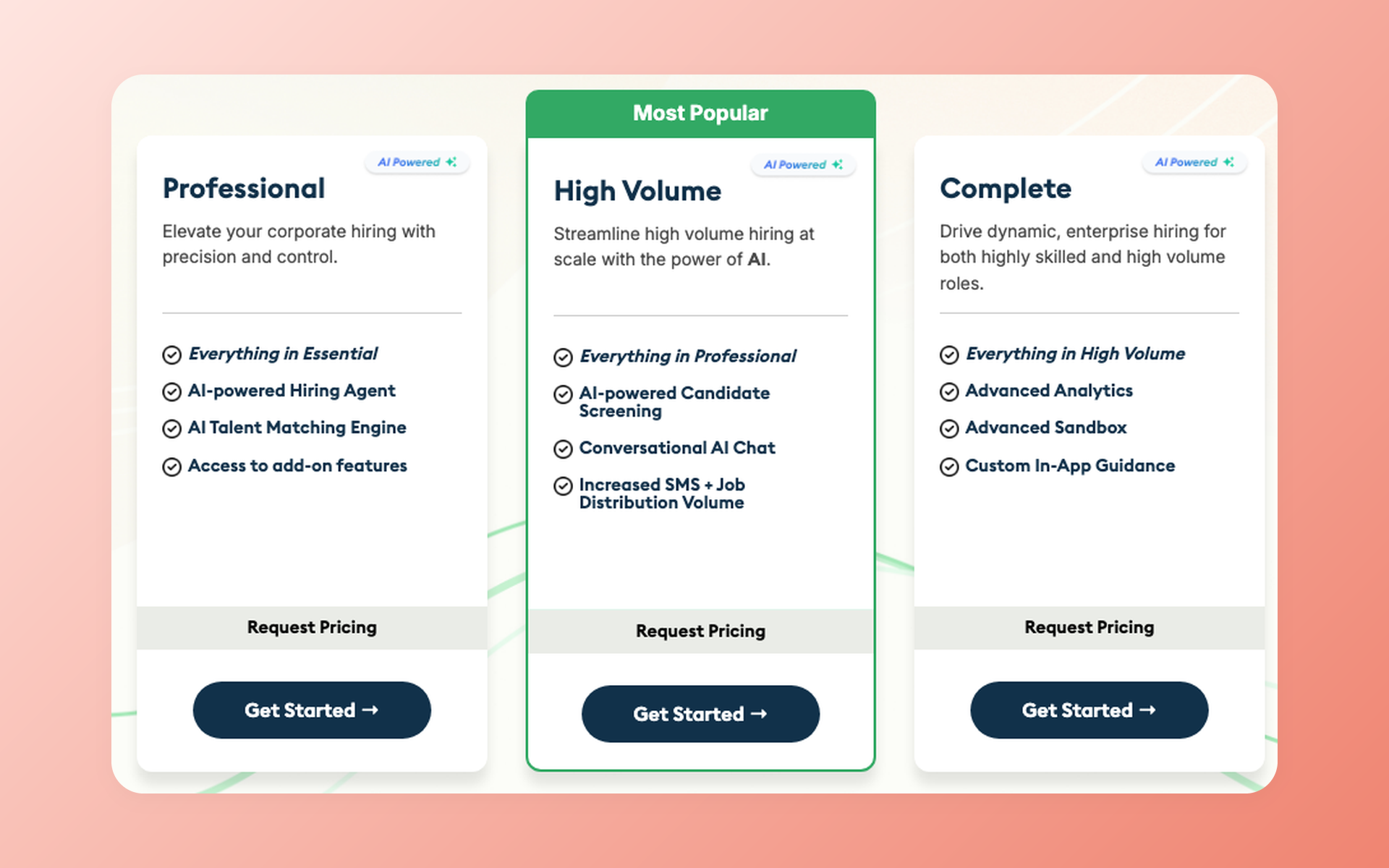
| SmartRecruiters Professional | not publicly shown | not publicly shown | not publicly shown | Everything in Essential plus AI-powered Hiring Agent, AI Talent Matching Engine, and access to add-ons | Medium SMS and job-distribution limits; exact quantities not publicly shown | Contact sales | Contact-sales status displayed; no dollar value derived |
| SmartRecruiters High Volume | not publicly shown | not publicly shown | not publicly shown | Everything in Professional plus AI-powered Candidate Screening and Conversational AI Chat | High SMS and job-distribution limits; exact quantities not publicly shown | Contact sales | Contact-sales status displayed; no dollar value derived |
| SmartRecruiters Complete | not publicly shown | not publicly shown | not publicly shown | Everything in High Volume plus Advanced Analytics, Advanced Sandbox, and Custom In-App Guidance | High SMS and job-distribution limits; exact quantities not publicly shown | Contact sales | Contact-sales status displayed; no dollar value derived |
| ZipRecruiter Standard | not publicly shown | not publicly shown | not publicly shown | Employer dashboard, 100+ job-board distribution, and proactive AI candidate outreach | Applications are not limited; job-slot quantity not publicly shown | not publicly shown | Plan name and scope displayed; no dollar value derived |
| ZipRecruiter Premium | not publicly shown | not publicly shown | not publicly shown | Standard features plus sponsored or paid job promotion and resume database access | Applications are not limited; job-slot quantity not publicly shown | not publicly shown | Plan name and scope displayed; no dollar value derived |
| ZipRecruiter Pro | not publicly shown | not publicly shown | not publicly shown | Premium features plus TrafficBoost and ATS integrations | Applications are not limited; job-slot quantity not publicly shown | not publicly shown | Plan name and scope displayed; no dollar value derived |
100Hires annual totals are arithmetic derived from displayed annual-equivalent monthly rates. SmartRecruiters and ZipRecruiter amounts were not derived.
100Hires offers a 14-day trial with no credit card. No verified trial duration is stated here for SmartRecruiters or ZipRecruiter.
The right choice is SmartRecruiters, ZipRecruiter, or both
Choose by the missing layer, not by a generic feature total. Each path needs a different buying test.
Choose SmartRecruiters when recruiting operations need one governed record
Choose SmartRecruiters when configurable workflows, collaboration, interviews, permissions, reporting, integrations, and regional governance are purchase requirements.
Assign owners for data mapping, configuration, user sync, change management, and adoption. Candidate demand will still come from connected channels.
Ask implementation vendors to show your hardest regional process. A polished default workflow says little about the custom rules your team must run each day.
Choose ZipRecruiter when reach is the immediate constraint
Choose ZipRecruiter when you need distribution, matching, resume search, and simple applicant review, or when an ATS already owns the process.
Set a source-of-hire measure before launch. Review qualified yield by role and market, then compare it with the cost and recruiter time for that channel.
Get current commercial terms in writing. Include renewal, cancellation, data access, and applicant retention.
Use a short measurement window for each role type. Keep the channel only when qualified yield and recruiter effort support the spend.
Use both when workflow and reach need separate owners
ZipRecruiter's official ATS-partner evidence names SmartRecruiters. That supports a stack where SmartRecruiters is the record owner and ZipRecruiter is the reach channel.
- Define which system creates and publishes each job.
- Send applications to one destination and preserve the original source.
- Keep status, messages, notes, and interview history in the record owner.
- Write down retention, resume access, renewal, and cancellation terms.
The integration matters, but ownership matters more. A connector cannot fix two teams keeping different versions of the same candidate record.
When neither fits: where 100Hires sits
Full disclosure: 100Hires is our product. It did not appear in the external community or social evidence collected for this keyword.
100Hires covers ATS workflow without enterprise-suite scope
100Hires is an ATS and workflow option for smaller and midsize teams. It keeps pipelines, candidate records, collaboration, source attribution, automation, and distribution in one recruiting workspace.
Higher plans add sourcing, contact enrichment, and outreach. ZipRecruiter can remain a channel inside this recruiting software workflow.
This is owned-product evidence, not external consensus. It fits teams that need more workflow than a marketplace workspace but less enterprise scope than SmartRecruiters.
AI assists review and drafting but does not make the hiring decision
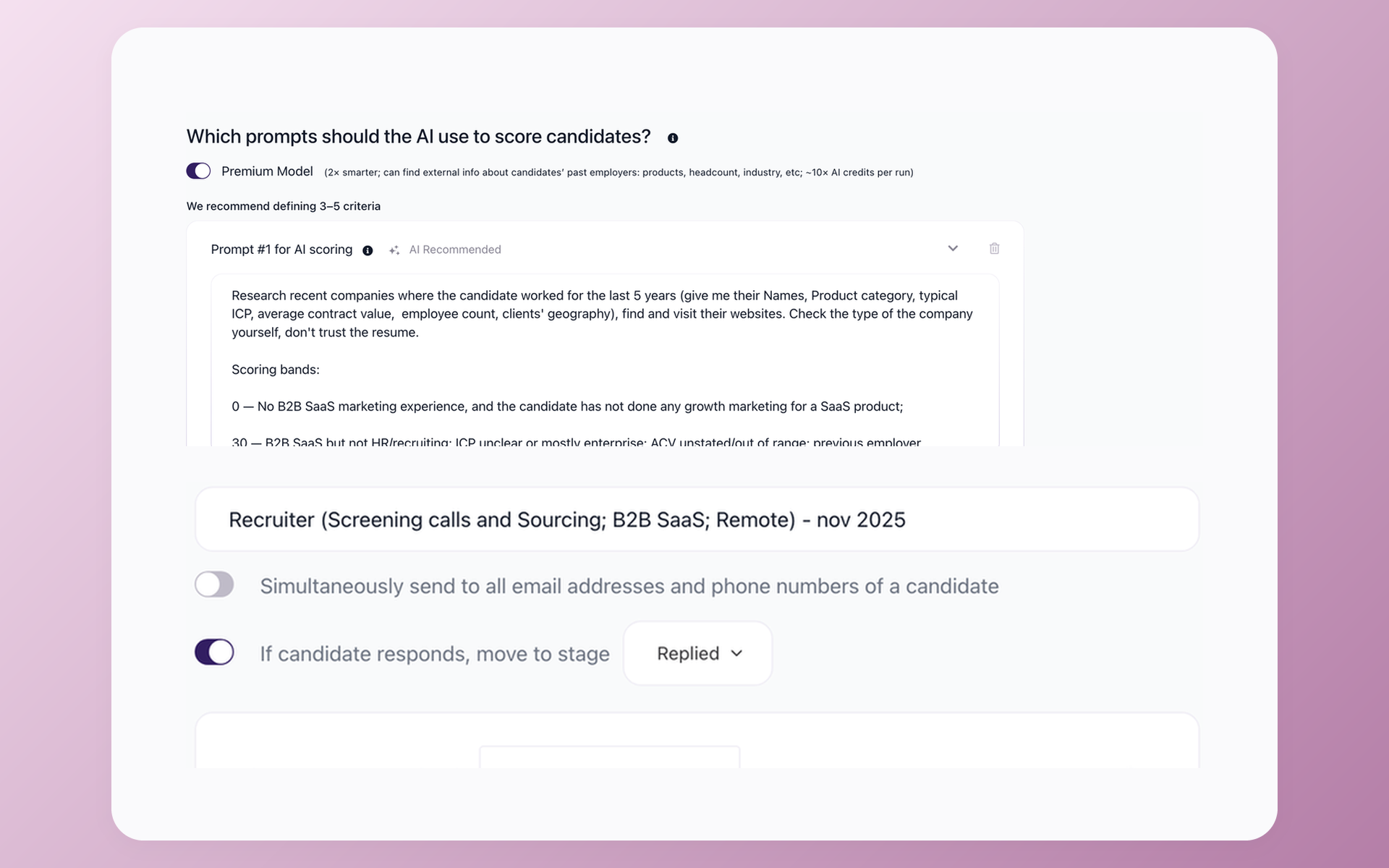
AI Scoring produces a 0-100 total and per-criterion scores from configured job criteria. It supports review and does not prove accuracy.
AI Copilot can use candidate and job context. It does not make autonomous hiring decisions.
AI Email Composer drafts and rewrites copy. It does not autonomously send.
AI-powered resume parsing supports multiple uploads, preview, and import. It does not guarantee every file or field.
Feature access and credits vary by plan and are limited. Early AI screening should route candidates to a human review queue, not automatic rejection.
Clear limits define the fit
100Hires is not a job marketplace, not a resume database, not a global governance suite, and not at enterprise ecosystem parity.
It does not generate ZipRecruiter candidates by itself. Start is capped at 3 jobs, 100 candidates, 1 user, and 100 monthly AI credits.
Smaller and midsize teams can start a 14-day 100Hires trial with no credit card.
Frequently asked questions clarify the remaining choices
The short answers follow the same distinction: enterprise workflow, candidate reach, or a connected stack.
Is SmartRecruiters better than ZipRecruiter?
Is SmartRecruiters better than ZipRecruiter?
SmartRecruiters is better for an enterprise recruiting record. ZipRecruiter is better for marketplace reach. 100Hires offers ATS pipelines and automation for smaller teams, so no option wins every use case.
Is ZipRecruiter an applicant tracking system?
Is ZipRecruiter an applicant tracking system?
ZipRecruiter has screening, ratings, filters, pre-qualification, and applicant review. It lacks the enterprise record depth shown by SmartRecruiters. 100Hires supplies candidate records and configurable pipelines for smaller teams.
Can SmartRecruiters and ZipRecruiter be used together?
Can SmartRecruiters and ZipRecruiter be used together?
Yes. SmartRecruiters can own the record and ZipRecruiter can supply reach. 100Hires can serve as an ATS for smaller teams that retain ZipRecruiter as a channel.
How much do SmartRecruiters and ZipRecruiter cost?
How much do SmartRecruiters and ZipRecruiter cost?
SmartRecruiters Essential shows a $14,995 starting amount without a public unit or cadence. ZipRecruiter shows plan names without public dollars. 100Hires publishes plan prices and offers a 14-day trial with no credit card.
Which option is better for a small business?
Which option is better for a small business?
ZipRecruiter can fit a small employer focused on reach. SmartRecruiters fits a more complex operation. 100Hires adds ATS automation and a human review queue for AI-screened candidates, but Start limits jobs, candidates, users, and credits.
Final recommendation depends on the missing layer
Choose SmartRecruiters for enterprise ATS depth, ZipRecruiter for candidate reach with lighter applicant handling, or both with one record owner. 100Hires can fit smaller and midsize teams that need ATS workflow plus distribution.
Try 100Hires for free
No credit card. 14-day trial. Forbes Advisor #1 ATS for SMBs.