
SignalHire Competitors & Alternatives in 2026: Credit Costs and Accuracy

SignalHire is a contact-data tool, not an applicant tracking system. It finds verified emails and phone numbers for people you have already identified, usually through a Chrome extension sitting on top of LinkedIn.
Getting that category right matters, because people searching for alternatives are looking for two completely different things and the wrong shortlist wastes a month.
The first group wants the same job done cheaper or with better hit rates: contact data, priced per credit. The second group has realised that finding an email was never the bottleneck, and what they actually need is somewhere to track, screen and message the people they found.
This guide splits those apart, with real credit prices rather than a contact-sales form.
What SignalHire charges, and where the credits go
The hiring playbook, in your inbox
One email a week - benchmarks, AI screening tactics, and short interview templates from the 100Hires team. No product pitches.
SignalHire publishes its rates, which is more than several competitors do. Figures below come from SignalHire's pricing page, checked on 25 July 2026.
| Plan | Monthly billing | What you get |
|---|---|---|
| Free | $0 | 5 or 10 credits, no card required. Installing the extension adds 10 free credits a month |
| Emails | From $69 per month | Email-only reveals, credit tiers scaling to roughly $79 to $163 per month |
| Phones | From $69 per month | Phone reveals, higher tiers to about $327 per month |
| Emails and Phones | From $69 per month | Bundled reveals, annual billing cuts the effective rate to about $57 to $63 |
Two details in the fine print decide whether this is cheap or not.
First, credits are consumed per reveal, not per successful reveal in the way buyers assume, so a low hit rate on a niche audience quietly doubles your effective cost per usable contact.
Second, the unlimited packages carry a note that a fair-usage policy restricts excessive use. Unlimited is not unlimited, and that is worth asking about before you commit annually.
Why teams look elsewhere
SignalHire's own review profile explains most of the searches. It holds 4.0 on G2 across about 70 reviews and 4.3 on Capterra across 34, with 3 out of 5 on Trustpilot. Those are small review bases, and they are split rather than mediocre.
One 2026 vendor analysis put numbers on the split: 51 percent five-star, 12 percent one-star. That distribution is the signature of inconsistent data coverage. It works well for some audiences and badly for others, which is exactly what recruiters report.
A recruiter in r/recruiting hiring PICC-line nurses, an unusually narrow healthcare niche, described the trade-off that brings people to SignalHire in the first place:
Their situation is the common one: LinkedIn and Indeed credits already maxed out, so a second sourcing platform is needed.
SignalHire made their shortlist alongside SeekOut, Gem, ZoomInfo and BetterLeap specifically because it costs considerably less while claiming better accuracy.
Whether that claim holds depends entirely on the audience, which is the point of the test further down this page.
Capterra reviewers echo the pattern from the other side: accurate email and phone data and strong customer service as the pros, occasional missing contacts as the recurring con.
There is a more uncomfortable observation from a separate r/Recruitment thread about sourcing spend, and it applies to this whole category rather than to SignalHire specifically. An in-house corporate recruiter wrote:
Their argument is that most of these products resell overlapping LinkedIn-derived data behind different interfaces, and that the practical result is the same candidates receiving outreach from a dozen recruiters using a dozen different tools.
If that is true, and the volume of overlapping outreach most candidates receive suggests it partly is, then switching from one contact-data vendor to another buys you a different interface and a different price, not a different candidate pool.
Which is the argument for looking at the second group below.
What the review base actually complains about
Aggregated review mining across SignalHire's G2 and Capterra base, roughly 41 and 32 reviews respectively, produces a clearer signal than any single post. Four complaints dominate, and only one of them is about accuracy.
- Contact accuracy, by far the most cited. Raised around 14 times, with users reporting that a meaningful share of revealed emails and phone numbers do not work.
- Unused credits expiring, raised around 7 times. Credits do not roll over at the end of a subscription period, so a quiet month is money lost rather than banked.
- Cost against the free allowance, raised around 6 times. Ten free credits is not enough to evaluate coverage properly before paying.
- Credits deducted on failed lookups. Raised less often but the most consequential for budgeting, because it means your effective cost per usable contact is higher than the headline rate.
That last two points matter more than the accuracy complaint on its own. If a credit is consumed whether or not a usable contact comes back, and unused credits expire, then hit rate on your specific audience determines your real cost, not the plan price.
Company background
SignalHire was founded in 2015 and is based in Warsaw, Poland. It claims a database of more than 800 million professional profiles indexed across 40-plus data sources, with real-time verification at the moment of reveal rather than a static database lookup.
The real-time model is the honest explanation for both the good and bad reviews: verification at request time gives fresher data than a stale cache, and also produces misses when a person's current details are not findable at that moment.
Group A: contact-data tools that do the same job
Nymeria
The closest like-for-like on price and model. Published tiers run $39 per month ($390 a year), $79 per month ($790 a year) and $159 per month ($1,590 a year), with credits differing per tier. Chrome extension plus bulk enrichment.
Best for solo recruiters and small teams who want predictable monthly cost.
SeekOut
A different class of product: a talent search engine with its own candidate index rather than a reveal tool bolted onto LinkedIn.
Self-serve Recruit Core is $149 per month paid annually upfront ($1,788 a year), or $179 billed monthly, and the vendor advertises 1 billion-plus candidate profiles with volume pricing above that.
Choose it if search and diversity filtering matter more than raw contact credits. It is roughly double SignalHire's entry cost, and it is doing more than SignalHire does.
ContactOut
Strong on personal email coverage, which is often the difference-maker for passive candidates who ignore work addresses. Sales plans are advertised at unlimited users for $299; recruiter plans are quoted per team, so ask for the credit allowance in writing.
Apollo, Lusha and RocketReach
All three are viable, all three are sales-first products used by recruiters.
Note the practical difference when you evaluate them: Apollo's economics are credit-based and published in its plan comparison, while Lusha and RocketReach gate their pricing pages behind interstitials or logins, so you are negotiating rather than comparing.
Their databases skew toward B2B decision-makers, which is excellent for sales prospecting and uneven for hourly, clinical or trades hiring.
hireEZ and Gem
Sourcing platforms with outreach sequencing layered on, and both meaningfully more expensive than a credit tool. Both now publish an entry price: hireEZ lists $494 per month for solo recruiters, and Gem publishes $99 to $149 per user per month.
Larger team and enterprise packages are still quoted individually. Worth a look only if you want sequencing and analytics as well as contact data.
One caution from a hiring lead in r/recruiting who piloted Gem's AI features as an existing customer: after giving the team access, nobody endorsed using it for applicant review.
LinkedIn Recruiter
The upstream source for much of this data. Not published by LinkedIn, but third-party consensus puts Recruiter Lite around $170 per month per seat and Recruiter Corporate between roughly $9,000 and $15,000 per seat per year.
Only sensible if you need InMail volume and the native graph rather than exported contacts.
Group B: when contact data was never the real problem
This is the group most comparison pages ignore. If your workflow is: find profile, reveal email, paste into a spreadsheet, send an email from your inbox, chase manually, then the contact tool is the small part of the job. The expensive part is everything after the reveal.
An applicant tracking system with enrichment built in collapses those steps: the contact is revealed into a candidate record that already has the pipeline, the sequences, the notes and the reporting attached.
| What you need | Buy this | Rough cost |
|---|---|---|
| Cheaper credits, same workflow | Nymeria | From $39 per month |
| Better search and filtering | SeekOut | $149 per month annually |
| Personal emails for passive candidates | ContactOut | $299 for unlimited sales seats, recruiter plans quoted |
| Sequencing and analytics too | hireEZ or Gem | Quote only |
| The whole pipeline, enrichment included | 100Hires Pro | $399 per month annually |
How to run the only test that settles this
Every vendor claims the highest accuracy. The claim is unfalsifiable in the abstract and trivial to check on your own audience. Take 50 real names from a role you are actually hiring for, not a demo list the vendor picks.
- Sign up for free tiers or trial credits on two or three tools. Most give you enough to cover 50 lookups.
- Run the identical 50 names through each. Same spelling, same companies, same order.
- Count usable contacts, not reveals. A reveal that bounces or reaches a switchboard is a failure that still cost you a credit.
- Divide the plan price by usable contacts. That number, not the sticker price, is your real cost per contact.
- Repeat for a second role if your hiring spans very different audiences. Coverage on senior engineers tells you nothing about coverage on warehouse supervisors.
Teams that do this usually find the ranking differs from every published comparison, including this one, because it depends entirely on who you are trying to reach.
Our verdict
If you like SignalHire and only want a better rate, negotiate before you migrate. Annual billing already drops the effective monthly cost to roughly $57 to $63, and switching credit vendors costs you a month of learning a new extension for a marginal saving.
If accuracy on a niche audience is the problem, the fix is not a cheaper credit tool. Vendors reselling the same underlying dataset will miss the same people.
Test two tools on the same 50-name list before signing anything, and measure usable contacts rather than reveals. This one test is worth more than any comparison article, including this one.
If you are pasting revealed contacts into a spreadsheet, buy the workflow instead. That is the case where changing category, rather than changing vendor, actually changes your week.
Where 100Hires fits, and where it does not
100Hires is an applicant tracking system with contact enrichment and outreach included, not a standalone data vendor.
Published plans: Start at $49 per month billed annually ($99 monthly) for up to 100 candidates a month. Advanced at $199 annually ($249 monthly) with unlimited jobs, candidates and users.
Pro at $399 annually ($499 monthly) is the tier that adds sourcing tools and contact enrichment.
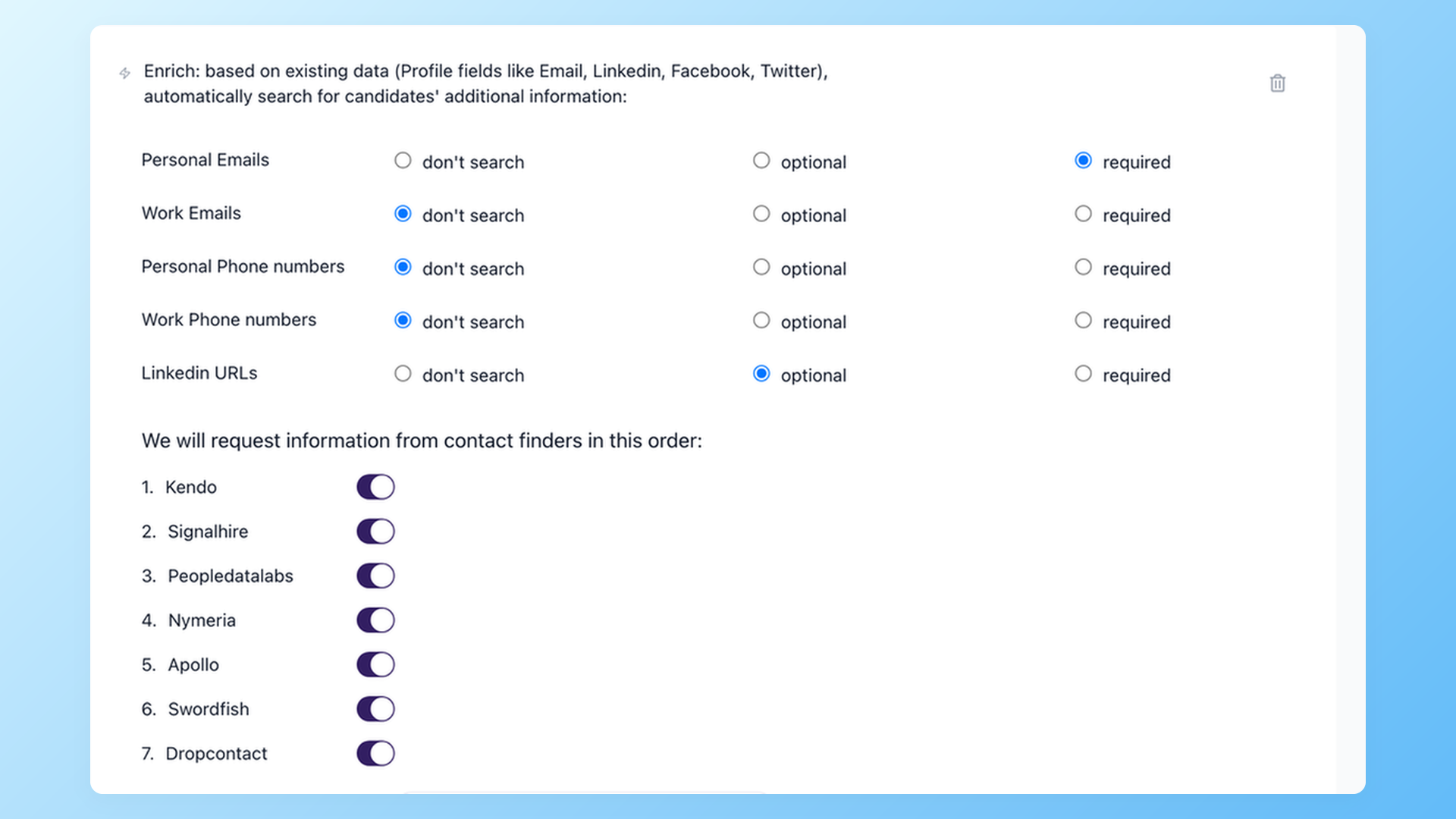
The free trial can post to job boards, so the sourcing-to-pipeline loop is testable before you pay. Capterra rating is 4.9 from more than 1,100 reviews as of July 2026.
100Hires is the wrong choice if:
- You want a pure contact-data vendor. If your job is to reveal thousands of contacts a month and push them into someone else's system, a credit tool like Nymeria or SignalHire is cheaper and more focused. Our enrichment exists to fill candidate records, not to be resold as a database.
- You are prospecting for sales, not hiring. Apollo, Lusha and ZoomInfo are built for that and their data is better for it.
- You need the deepest niche coverage. For very narrow clinical or trades audiences, no single vendor wins. Run a bake-off on your own name list.
- You already own an ATS you are happy with. Then you need a credit tool, not a second system of record.
If the pattern above sounds familiar, reveal, paste, chase, lose track, see 100Hires pricing or start a free trial. If you want the pure-sourcing comparison instead, our SeekOut alternatives and LinkedIn Recruiter alternatives guides go deeper on that side.
Frequently asked questions
How much does SignalHire cost?
SignalHire has a free tier at $0 with 5 or 10 credits, plus 10 free credits a month if you install the browser extension. Paid plans start around $69 per month on monthly billing for email-only, phone-only or bundled reveals, with credit tiers rising to roughly $163 for emails and $327 for phones. Annual billing brings the effective rate down to about $57 to $63 per month. Unlimited packages carry a fair-usage restriction.
Is SignalHire an ATS?
No. SignalHire finds and verifies contact details. It does not manage job postings, pipelines, interview scheduling, structured screening or hiring-team collaboration. If you are tracking candidates in a spreadsheet next to SignalHire, the missing piece is an applicant tracking system, not a different data vendor.
Which SignalHire alternative is cheapest?
Nymeria, at $39 per month or $390 a year on its entry tier, is the cheapest published like-for-like option. SignalHire's own free tier is cheaper still for very low volume, and several competitors offer free credit allowances that are enough to test coverage on a small list.
Why is contact data accuracy so inconsistent between tools?
Because most vendors draw on overlapping upstream sources, then differ in how they verify. SignalHire verifies at the moment of the request, which produces fresher results and more outright misses than a cached database. The practical consequence is that accuracy varies by audience rather than by vendor quality, so the only reliable comparison is testing two tools against the same list of names and counting usable contacts.
Do sourcing tools all use the same LinkedIn data?
Not identically, but the overlap is substantial, and recruiters notice. In-house recruiters describe the category as largely the same underlying dataset behind different interfaces, with the practical result that the same candidates are contacted by many recruiters using many tools. That is a reason to compete on speed of follow-up and quality of messaging rather than on which reveal tool you own.
Try 100Hires for free
No credit card. 14-day trial. Forbes Advisor #1 ATS for SMBs.