
SeekOut Competitors & Alternatives in 2026: Search Depth vs Credit Cost

SeekOut is a talent search engine, not an applicant tracking system. It maintains its own index of candidate profiles and lets you search it with filters that LinkedIn does not offer, then reveals contact details and pushes people into outreach.
Getting that category right is the whole job on this page. People land here from two different places: some want a cheaper way to search and reveal, others have realised that finding candidates was never their bottleneck.
Those two problems have opposite answers, and shortlisting across them wastes a quarter.
What SeekOut costs
The hiring playbook, in your inbox
One email a week - benchmarks, AI screening tactics, and short interview templates from the 100Hires team. No product pitches.
SeekOut publishes a self-serve tier, which most of this category does not. Figures from SeekOut's pricing page, checked on 25 July 2026.
| Plan | Price | Notes |
|---|---|---|
| Recruit Core, annual | $149 per month, paid annually upfront | $1,788 a year, first dedicated recruiting seat |
| Recruit Core, monthly | $179 per month | Annual billing saves $360 a year |
| Custom tiers | Roughly $10,000 to $30,000 a year (third-party) | Volume-based pricing above self-serve |
The vendor advertises access to more than 1 billion candidate profiles. Reviews are strong: 4.7 on Capterra across about 188 reviews.
The gap between $1,788 and $10,000-plus is the thing to understand. The self-serve seat is a genuine product, not a trial, but the moment you need multiple seats, ATS integrations or volume, you enter a negotiated contract with a different shape.
What users say
SeekOut's reputation among recruiters who do genuinely hard sourcing is good, and the praise is specific rather than generic. From an r/recruiting thread comparing it with hireEZ:
Their experience working niche engineering, product and design roles at a fintech was that profile cloning, finding people similar to someone you already rate, changed how those searches ran.
Profile cloning, finding people similar to someone you already like, is the kind of feature that matters when the role is narrow and boolean strings stop working. That is SeekOut's home ground.
The same thread is instructive about the category's economics, because it is mostly people describing sourcing tools repricing them. One recruiter left hireEZ after a jump from $2,500 to about $12,000 a year.
Another said the platform was enjoyable but significantly overpriced now.
SeekOut's $149 self-serve seat exists precisely because of that dynamic: it is the answer to a market where solo recruiters were being priced into enterprise contracts they did not want.
What reviewers say SeekOut is actually for
Aggregated review mining across both major review sites puts SeekOut's strengths in a clear order, and the ranking is useful because it tells you which job it is worth paying for.
- Diversity and hard-to-find talent, the top strength. Reviewers consistently credit it with surfacing candidates they could not find elsewhere. This is the single most common reason teams buy it.
- Time saved in sourcing. Saved searches and AI-drafted outreach.
- Profile completeness. Aggregating LinkedIn, GitHub and other sources into one candidate view.
- Market intelligence. Talent-market insight behind the profiles rather than just the profiles.
Read that list against your own reason for shopping. If you are here because credits cost too much, note that nothing in the top four is about price, and the cheaper tools further down this page do not do the first item at all.
The uncomfortable truth about this category
Before you switch sourcing tools, read what an in-house corporate recruiter wrote in a thread about a firm spending roughly $1M a year across LinkedIn Recruiter and three sourcing platforms:
Their argument is that most of these products resell overlapping LinkedIn-derived data behind different interfaces, and that the result is the same candidates being contacted by many recruiters using many tools.
SeekOut is one of the few products in this category with a genuine claim to a distinct index rather than a reskinned aggregation, which is part of why it retains advocates.
But the general warning holds: switching aggregators often buys a different interface and price rather than a different candidate pool.
The only comparison that settles it is one you run on your own roles. Take 50 real names from a live requisition, run them through two or three tools using trial credits, and count usable contacts rather than reveals. Divide the plan price by that number.
That figure, not the sticker price, is your real cost per contact, and it varies enormously by audience.
When the self-serve seat stops being enough
The most common surprise with SeekOut is not the $149 price, it is discovering which things sit above it. Four triggers push teams from self-serve into a negotiated contract, and it is worth knowing them before you build a workflow that depends on one.
- A second recruiter. Self-serve is described as the first dedicated recruiting seat. Team access changes the conversation.
- ATS integration. Pushing candidates automatically into your pipeline, rather than exporting and importing, is typically where the enterprise conversation starts.
- Volume. The vendor advertises volume-based pricing above the self-serve tier, which means sustained heavy usage will be noticed and repriced.
- Advanced filters and analytics. The capabilities that make SeekOut distinctive on hard roles are also the ones most likely to sit in higher tiers.
None of that is unreasonable. It matters because the jump from $1,788 a year to a five-figure contract is not incremental, and a team that has built its sourcing habits around a cheap seat has weak negotiating footing when the quote arrives.
The practical move is to ask, before you adopt it widely, what the second seat costs and what the ATS integration costs. Getting those two numbers early turns a future surprise into a planned decision.
A note on what these tools cannot fix
Every product on this page helps you find and contact more people. None of them changes what happens next, and for most teams that is where the actual loss occurs.
If your reply rate is low, a bigger candidate pool multiplies the same low rate. If sourced candidates go cold because nobody followed up in week two, a better search index does not help.
If two recruiters unknowingly contact the same person, that is a tracking problem rather than a data problem.
Before spending anything on this category, measure three numbers from your last completed search: how many people you contacted, how many replied, and how many were still in play after fourteen days. If the drop is at reply, buy better messaging and sequencing.
If it is after fourteen days, buy a pipeline. Only if you genuinely could not find enough people to contact is a search tool the right purchase.
Alternatives, split by what you actually need
Group A: you need search and reveal, just cheaper
SignalHire. A reveal tool rather than a search engine, with a free tier and paid plans from about $69 per month. Cheapest sensible option if you already have a source of candidates and only need contact details.
Reviews are split, at 4.0 on G2 and 3 out of 5 on Trustpilot, which reflects accuracy varying by audience.
Nymeria. The floor on price: $39, $79 and $159 per month tiers. Chrome extension plus bulk enrichment. Predictable monthly cost for a solo recruiter.
hireEZ. The closest competitor on capability, with search, reveal and sequencing together. Its own site lists solo recruiters starting at $494 per month, with third-party list rates of $169 to $250 per seat and a Vendr median contract near $13,000 a year.
Multiple long-term users report both price increases and a decline in contact accuracy, so verify data quality on your own roles first.
LinkedIn Recruiter. The upstream source. Not published by LinkedIn; third-party consensus puts Recruiter Lite near $170 per month per seat and Corporate between roughly $9,000 and $15,000 per seat per year.
Group B: you need sequencing and a CRM around the sourcing
Gem. Published at $99 to $149 per user per month, with a Vendr median annual contract around $24,900, and an ATS added in September 2025.
One existing customer piloted its AI on applicant review, gave the team access, and reported that nobody endorsed using it.
Group C: the reveal was never the bottleneck
100Hires. An applicant tracking system with sourcing and enrichment built in, from $49 per month. This is the right group if your workflow is find, reveal, paste into a spreadsheet, email from your inbox, then lose track. Details and honest limits below.
Side by side
| Option | Entry price | What it is | Published? |
|---|---|---|---|
| SeekOut | $149 per month annually | Talent search engine | Yes, self-serve tier |
| hireEZ | $494 per month solo | Search plus outreach | Entry only |
| SignalHire | Free, then about $69 per month | Contact reveal | Yes |
| Nymeria | $39 per month | Contact reveal | Yes |
| Gem | $99 to $149 per user per month | Sourcing CRM plus ATS | Yes |
| LinkedIn Recruiter | About $170 per month Lite | The upstream graph | No |
| 100Hires Pro | $399 per month annually | ATS with enrichment | Yes |
Our verdict
If you do niche technical sourcing, SeekOut's self-serve seat is hard to beat at $149 a month. Nothing cheaper matches the search depth, and the profile-cloning workflow is a real advantage on hard roles.
If you are being quoted a custom contract, get a competing number first. The jump from $1,788 to five figures is where the negotiation actually happens, and hireEZ's published solo rate gives you a concrete anchor.
If accuracy on your audience is the complaint, test rather than switch. Coverage is audience-specific across this whole category. Run the 50-name test before signing anything.
If you are managing candidates in a spreadsheet next to your sourcing tool, change category rather than vendor. That is the case where a different sourcing product changes nothing about your week.
Where 100Hires fits, and where it does not
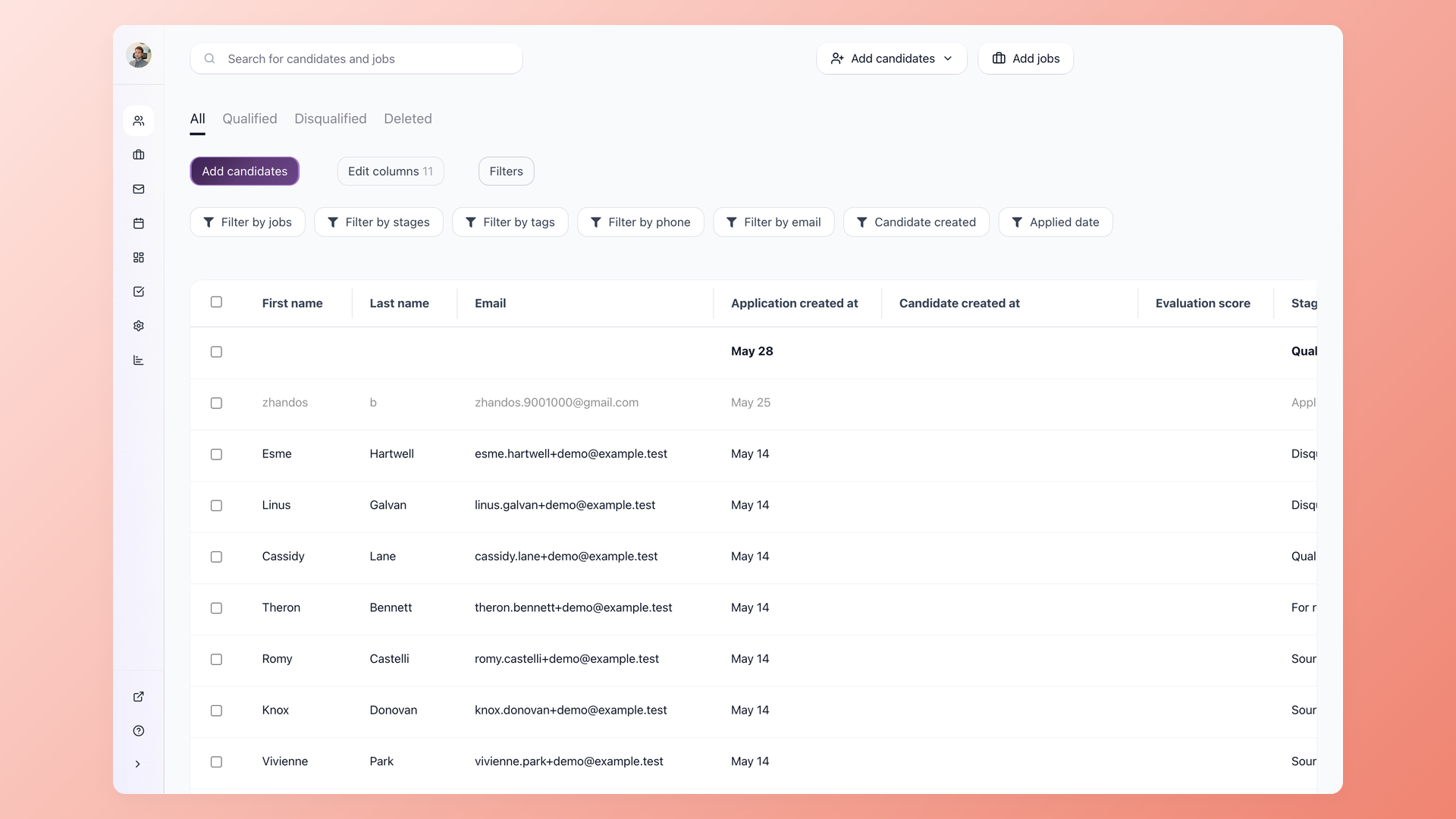
100Hires is an applicant tracking system with contact enrichment and multichannel outreach included, not a talent search engine. Start is $49 per month billed annually ($99 monthly) for up to 100 candidates a month.
Advanced at $199 annually ($249 monthly) covers unlimited jobs, candidates and users. Pro at $399 annually ($499 monthly) is the tier that adds sourcing tools and contact enrichment. Capterra rating is 4.9 from more than 1,100 reviews as of July 2026.
100Hires is the wrong choice if:
- External search depth is the job. SeekOut indexes and filters a billion profiles. We search your pipeline and enrich contacts, which is not the same product and we will not pretend it is.
- Diversity sourcing filters are a requirement. SeekOut is genuinely strong here and it is a common reason teams buy it.
- You need very high reveal volume. A dedicated credit tool such as Nymeria or SignalHire is cheaper per contact if reveals are the whole workload.
- You already run an ATS you like. Then you need a sourcing tool, not a second system of record.
- You are an agency selling into client accounts. Loxo or Recruit CRM combine sourcing with client-side workflow.
Where we fit is the team whose sourcing works and whose follow-up does not. See 100Hires pricing or start a free trial. For the narrower comparisons, see our hireEZ alternatives and SignalHire alternatives guides.
Frequently asked questions
How much does SeekOut cost?
SeekOut publishes a self-serve Recruit Core seat at $149 per month paid annually upfront, which is $1,788 a year, or $179 per month billed monthly. Annual billing saves $360 a year. Above the self-serve tier, pricing is volume-based and negotiated, with third-party reports putting custom contracts between roughly $10,000 and $30,000 a year.
Is SeekOut an ATS?
No. SeekOut is a talent search engine: it finds candidates in its own index, reveals contact details and supports outreach. It does not manage job postings, application pipelines, interview scheduling, structured screening or hiring-team collaboration. If you are tracking candidates in a spreadsheet alongside SeekOut, the missing piece is an applicant tracking system rather than a different sourcing tool.
SeekOut or hireEZ?
They are close competitors. SeekOut publishes a $149 monthly self-serve seat and has strong advocacy for niche technical roles, particularly its profile-cloning workflow. hireEZ combines search with outreach sequencing and starts at $494 per month for solo recruiters on its own site. Several long-term hireEZ users have reported both large renewal increases and declining contact accuracy, so test data quality on your own roles before committing to either.
What is the cheapest SeekOut alternative?
Nymeria at $39 per month is the cheapest published option, and SignalHire has a free tier with paid plans from about $69 per month. Both do considerably less than SeekOut: they reveal contact details but do not provide a comparable search index or filtering. If search depth is why you use SeekOut, these are not replacements, they are a downgrade you should choose deliberately.
How do I compare sourcing tools fairly?
Run the same 50 real names from a live requisition through each tool using free trials or trial credits, then count usable contacts rather than reveals, since a bounce still consumes a credit. Divide each plan price by usable contacts to get your true cost per contact. Repeat for a second, different role if your hiring spans distinct audiences, because coverage on senior engineers tells you nothing about coverage on field technicians.
Try 100Hires for free
No credit card. 14-day trial. Forbes Advisor #1 ATS for SMBs.