
Recruiterflow API in 2026: endpoints, keys, webhooks, and how 100Hires compares
Recruiterflow has a real public API: 126 documented endpoints covering candidates, jobs, contacts, deals, and placements.
The short version from its own docs: API keys are issued by their support team, the spec covers GET and POST only, webhooks fire manually per the published help center, and rate limits are not documented anywhere.
Those answers are scattered across a Swagger shell and three help-center articles, so we collected them in one place.
We read the live spec, the pricing page, and every API help article on July 16, 2026. Here is the full picture of the Recruiterflow API, followed by a comparison with the 100Hires API using the same checklist.
One disclosure before the table: 100Hires is our product. We hold both APIs to the same standard, and we flag the spots where Recruiterflow is genuinely stronger.
Here is the snapshot. The rest of the article explains each row.
| Criterion | 100Hires | Recruiterflow (published docs) |
|---|---|---|
| Spec access | Self-serve JSON at api.100hires.com/v2/openapi.json | Swagger UI shell at recruiterflow.com/api |
| OpenAPI version | 3.1.0, spec version 2.0.0 | 3.0.0, spec version 0.0.1 |
| Endpoints | 89 paths, 133 operations | 126 paths, 126 operations |
| HTTP verbs | GET, POST, PUT, PATCH, DELETE | GET and POST only |
| Webhook management | 8 API endpoints, event-driven | None in the spec; UI-configured, fired manually |
| Getting a key | Self-serve on every paid plan | Issued by their team via support |
| Documented rate limits | Documented per endpoint | Not documented |
| Error documentation | At least one 4xx on all 133; 401 on 132, 429 on 130 | 200 on 123/126; 4xx on 7 operations; no 401 or 429 |
| Versioning | /v2 base path | Unversioned paths, no changelog in the reference |
| Agency CRM objects (deals, placements) | Not available | Native APIs: 12 deal and 6 placement operations |
| Entry price | $49/mo flat (Start, annual) | $119/user/mo (annual) |
The hiring playbook, in your inbox
One email a week - benchmarks, AI screening tactics, and short interview templates from the 100Hires team. No product pitches.
Start a free 14-day 100Hires trial – no credit card. API keys are self-serve in Settings > Integrations on every paid plan.
Getting a Recruiterflow API key
Access is the first wall a developer hits, so we start there.
Recruiterflow’s help center states that keys for the public API are issued by their team, not generated from a settings screen. You ask through the in-app chat or by email, describe your workspace and the integration you plan to build, and the team sends a key back.
The help article says what to include in the request: the workspace the key is for and a short description of what you plan to build, such as a custom careers page or jobs widget. Budget for the round-trip before you schedule the work.
Integration vendors describe the same flow in their own setup guides. Metaview tells customers to contact Recruiterflow support and to allow up to 48 hours for activation. Hireguide’s January 2024 guide points users to the in-app chat and says the first sync can take a few hours.
Merge’s account-linking guide opens with the same request step.
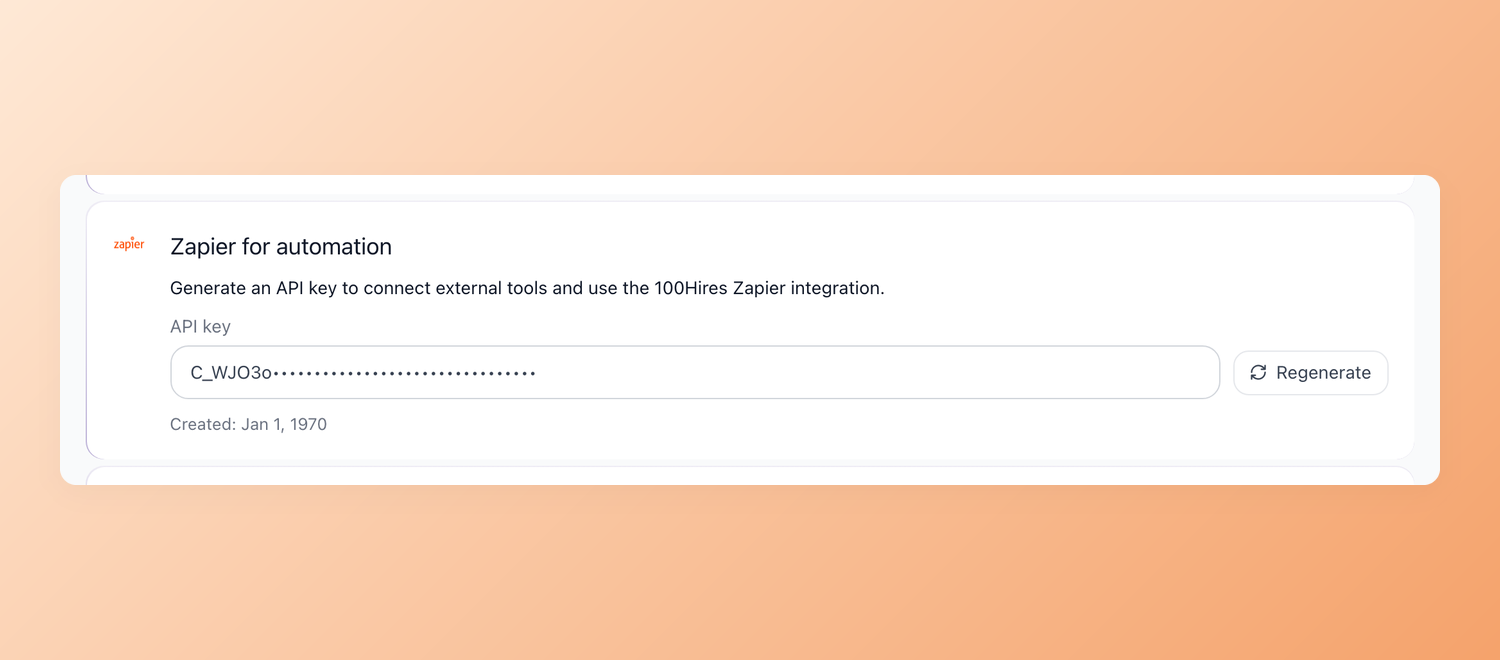
There is one self-serve credential: the Zapier key. That one you generate yourself under Settings > Integrations > Zapier. It is a separate credential from the RF-Api-Key header the REST API expects, and the two are easy to conflate.
Plan availability is simpler than it used to be. The current pricing page lists API access as a feature of the Platform plan: $119 per user per month billed annually, or $149 month to month. AIRA, the second plan, does not show pricing publicly.
Reviewer videos from 2022 through 2026 describe API access as a Pro or Enterprise gate under the older tier structure. Treat those as history, not the current rule.
These are separate points: Recruiterflow’s docs say that support issues the keys, and Truto, a platform that resells Recruiterflow connectivity, describes the typical customer as an agency with 10 to 50 recruiters.
For that buyer, waiting for support to issue a key may not be a problem. For a developer evaluating APIs on a deadline, the delay matters.
We see the same signal on our own demo calls: developer-minded buyers treat API access as a qualifying question and ask for the documentation early in their evaluation.
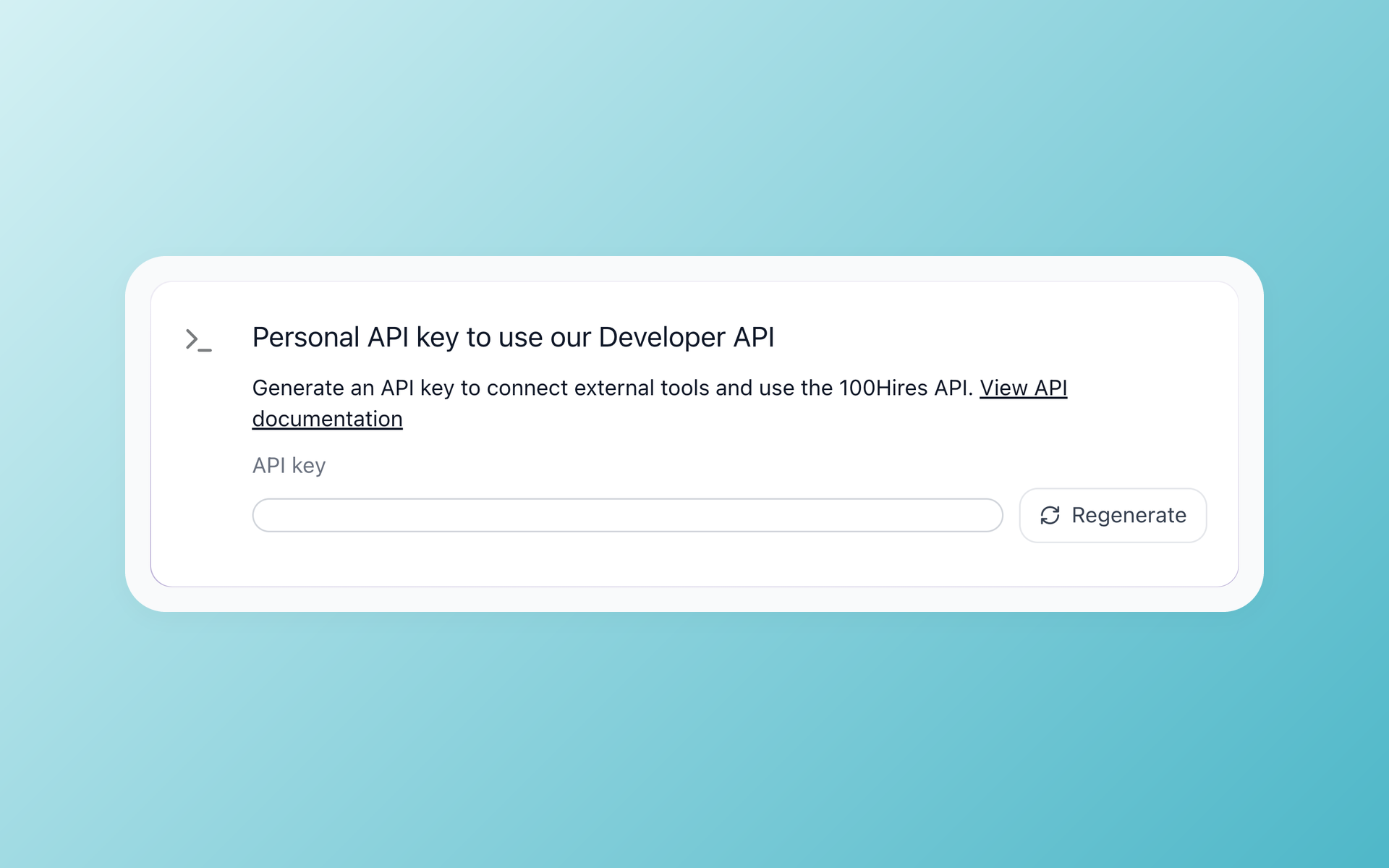
For comparison, 100Hires lets you create a key in Settings > Integrations on any paid plan, once your account is verified. The full flow is in our REST API guide.
Once the key arrives, here is what it opens.
Inside the Recruiterflow API: what the published docs show
The reference lives at recruiterflow.com/api, a Swagger UI shell that loads a 290KB spec file. The spec is OpenAPI 3.0.0 and labels itself version 0.0.1. OpenAPI is the standard machine-readable format for REST APIs; the current release is 3.2.
The file documents 126 paths, every one under an unversioned /api/external/ prefix, with one HTTP method per path: 75 GETs and 51 POSTs.
There are no PUT, PATCH, or DELETE verbs anywhere. Updates and deletions are POST calls to action paths such as candidate/update and notes/delete.
Pagination is documented for list endpoints: the current_page parameter starts at 1, and items_per_page has a maximum of 100.
Object coverage is broad and shaped for agencies: candidates, jobs, contacts, companies, deals with 12 operations, placement records with 6, and note-creation endpoints on candidates, contacts, clients, and jobs. The endpoints spread across 10 Swagger tag groups.
Authentication uses an RF-Api-Key header. The spec’s prose says the header is mandatory on every request. The machine-readable schema marks it required on 3 of 126 operations, the three deal endpoints.
A code generator reads the schema, not the prose, and may generate client methods that treat the key as optional for the other 123 operations.
Credit where due: Recruiterflow publishes a public reference, unlike many agency ATS vendors, and its native API covers more objects than third-party integration platforms expose.
One API on paper, two in practice
There is a second API surface: a Power BI reporting feed with its own header (powerbi-api-key), its own key screen, and five flat endpoints for candidates, jobs, stage movements, deals, and placements. It caps at 100 records per page and serves data uncached.
The main reference never mentions it. A developer discovers the feed through a help-center article, not the docs. The objects overlap the REST API, so this is a navigation problem rather than a capability gap. You still need to know both surfaces exist to plan an integration.
What can developers build with that API?
What you can build with it, and where the edges are
The object list supports the integrations an agency actually needs:
- Candidate sync: create and update candidates, contacts, and companies from sourcing tools or spreadsheets
- Commercial pipeline: create deals, move deals through stages, and record placements when deals close
- Notes in context: push call summaries onto candidates, contacts, clients, and jobs
- Reporting: pull candidates, jobs, deals, placements, and stage movements into BI via the Power BI feed
Does it hold up in production? The strongest endorsement of the Recruiterflow API comes from Recruiterflow’s own podcast.
In a 2021 episode, the co-founder of a technical staffing firm described connecting Airtable, Zapier, and Python scripts to the API to build a homegrown auto-sourcing tool and BI dashboards for candidate supply and demand, with the ATS serving as the underlying system of record.
He said the setup took about a year to mature. The ceiling is real.
For teams that never touch code, the stronger story is Recipes, the built-in no-code rule engine. A long-term user on Reddit reports running 25 to 30 recipes at once for Slack reminders, follow-ups, and stage updates.
Vendor webinars from the same era claim hundreds of thousands of recipe-driven actions automated in a single year. Take vendor stats as vendor stats; the Reddit thread above is the independent signal.
The edges show up in the spec itself:
- Activity feed gaps: the activity-fetch endpoint excludes notes, calls, emails, and calendar activity by its own description
- POST-shaped writes: no idempotent PUT semantics, which makes retry logic and generated clients clumsier
- Pagination cap: list endpoints stop at 100 items per page on both API surfaces
- Limited middleware coverage: Merge maps 10 Recruiterflow objects, Unified.to maps 7, and Truto maps 6; none maps notes, first-class interview records, or placements
That last point matters more than it looks. Plenty of HR tools connect to Recruiterflow through Merge or Truto rather than directly, so those object maps decide what a third-party integration can sync.
The native API has notes, interview-adjacent records, and placements. Go through middleware and you get less than the API itself offers.
The sharpest capability question for an integration developer is eventing. Webhooks get their own section.
Recruiterflow webhooks: manual firing per the published docs
Recruiterflow’s help center describes custom webhooks this way: a workspace admin creates each webhook in the UI and ties it to one of five entity types (candidate, contact, job, company, or deal). The webhook fires when a user clicks “Send to…” on an individual record.
The same article states there are no automatic event-based triggers in this integration.
The spec tells the story from the other side: the word webhook appears zero times in 290KB. There is no endpoint to create, list, or manage webhooks programmatically.
Based on the published docs and help center as of July 2026, integrations that need new-application or stage-change events must poll the API or use Zapier as a bridge. If event capabilities exist beyond the published docs, they are not documented publicly.
This matters when rate limits are undocumented: a polling integration must plan its request volume without published limits.
The largest difference is webhook support. Webhooks are managed through the API itself: 8 endpoints at company and job level, secret rotation included. Our Zapier integration sits alongside, with 3 triggers, 3 actions, and 8,000+ connected apps.
Webhooks are one gap in the docs. The docs have a few more.
Recruiterflow API documentation: what’s there and what’s missing
Everything in this section is machine-verifiable from the spec file:
- The spec labels itself version 0.0.1, and its paths carry no version segment
- 113 of 126 operations carry the boilerplate line “Auto generated using Swagger Inspector” – the docs read as captured traffic, not an authored reference
- A 200 response is documented on 123 of 126 operations; only 7 operations document any 4xx (400 on 7, 404 on 3, 403 on 1, some documenting two codes); no operation documents a 401, a 429, or any 5xx; 3 operations have no response block at all
- Rate limits are not documented anywhere: not in the spec, not on the pricing page, not in the help center
- The reference has no changelog or version history; Recruiterflow runs a general product-updates feed elsewhere, but nothing versions the API
The absence of rate-limit documentation does not prove that no limit exists. It means the public docs do not tell you the numbers before you test or ask support.
The product-updates feed linked from their help center is a general release feed. The API reference has no version history, and the public docs do not identify a separate channel for API breaking changes.
Two things keep the picture fair. First, the help-center API collection holds exactly 3 articles (Zapier, custom webhooks, and a custom careers page guide), so what documentation exists is a short read.
Second, the bigger caveat: in September 2025 Recruiterflow’s co-founder announced a rebuilt API V2 with expanded endpoints and consistent schemas.
The public reference does not mention V2 as of July 2026, and the docs do not show whether the unversioned paths now use the rebuilt API.
Everything in this article reflects what a developer can read today.
One more observation from researching this piece: search Reddit, X, YouTube, or LinkedIn for developer discussions of this API, and you find almost nothing.
Most of the public material consists of setup guides from integration vendors. That is why this article relies on the spec itself.
Same checklist, our side of the fence.
Applying the same checklist to the 100Hires API
100Hires is our product, so hold us to the same standard. The receipts are one click away: the full spec sits at api.100hires.com/v2/openapi.json, readable before you ever talk to us.
The numbers: 89 paths and 133 operations across all five HTTP verbs (64 GET, 36 POST, 12 PUT, 3 PATCH, 18 DELETE), on a versioned /v2 base path. Webhooks are first-class: 8 management endpoints at company and job level, with list, create, delete, and secret rotation.
Keys are self-serve. After your account is verified, you can generate a key in Settings > Integrations on any paid plan. Keys are per-user and individually revocable, so a departing teammate’s key dies without rotating everyone else’s.
Rate limits are documented, and 132 of 133 operations include request examples.
Every operation includes error documentation: a 401 on 132 operations, a 429 on 130, a 403 on 128, a 400 on 61, and a 404 on 83.
By the same standard, 100Hires has gaps too: only 2 operations document a 201, and 5xx behavior is undocumented, the same gap found in the Recruiterflow docs.
The AI functionality is available through the main API, not a separate product. Scoring criteria are configurable per job through the API, and the ai_score field comes back in application list responses.
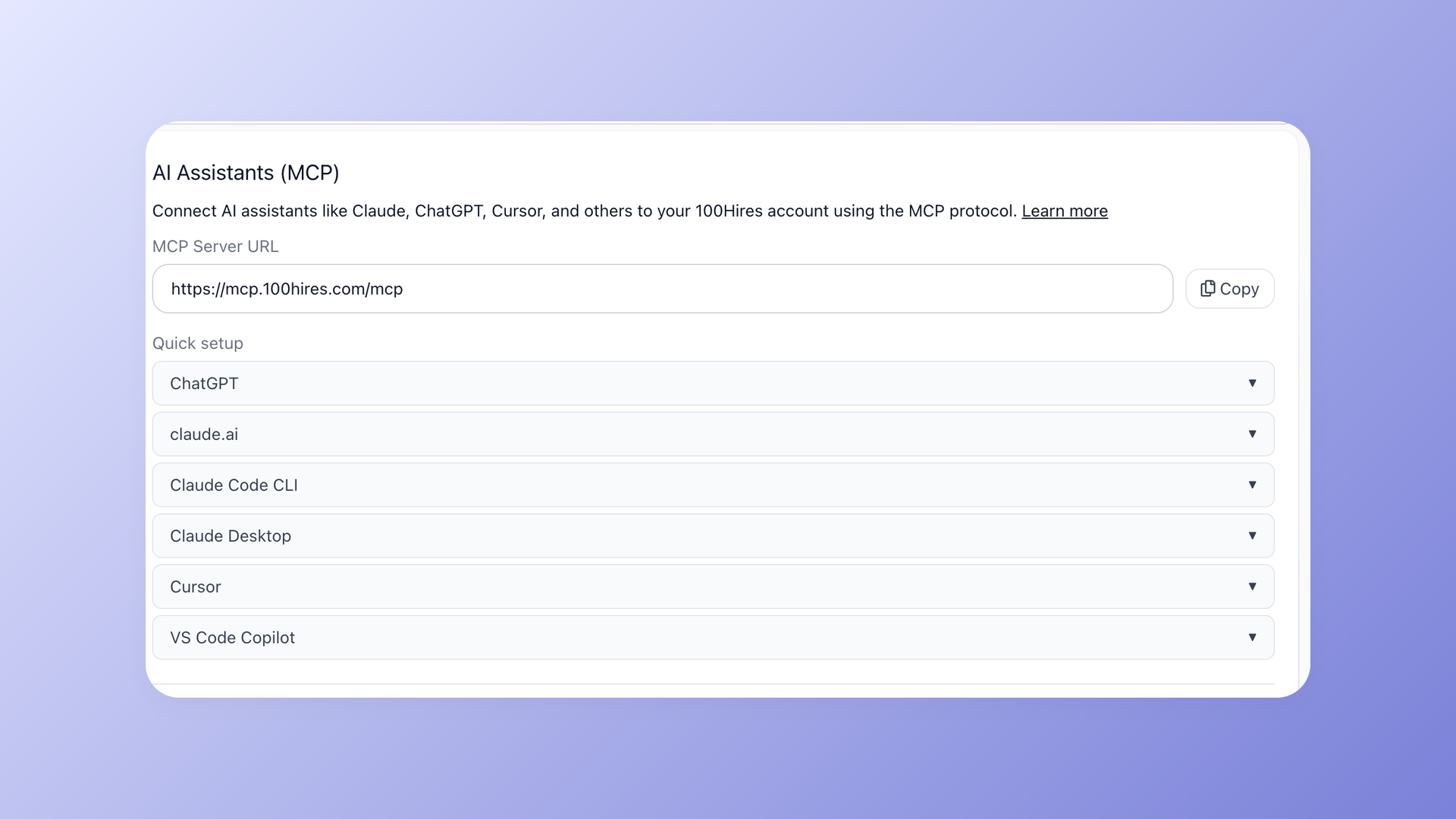
On top of that sits the MCP server. 100Hires ships a native MCP server, which means you can run your pipeline from Claude, ChatGPT, or Cursor. The server is ours; judge it against the spec.
One Personal API key works across the REST API, the Zapier app, and the MCP server. There is no separate credential to request for any of them.
Our API guide covers these use cases:
- Two-way candidate sync: between 100Hires and your CRM or internal tools
- Job publishing: one POST creates the job, its application form, and its hiring workflow together
- Stage automation: move candidates as scorecards and evaluations come in
- BI exports: pipe applications and evaluation results into dashboards
- AI triage: agents that score and route applications with your own rules
For example, when Linc Healthcare left BetterTeam, the company moved 25 jobs and roughly 13,800 candidates into 100Hires entirely through this API. The write-up is in our REST API guide.
Pricing is flat per company, not per seat: Start at $49 per month billed annually ($99 monthly), Advanced at $199 ($249), Pro at $399 ($499), and every plan includes API access. See the 100Hires pricing page for the full breakdown.
Recruiterflow’s Platform plan at $119 per user per month billed annually works out to $1,190 per month for a 10-recruiter agency.
Now the honest limitations. 100Hires is an ATS, not an agency CRM. There are no deals, placements, or client-contact objects in our API.
A search firm that runs commercial pipelines on those Recruiterflow objects cannot move that data into equivalent objects in 100Hires. HRIS coverage is thin as well: Gusto is the one native HR integration, and other HRIS tools connect through Zapier.
The developer checklist, side by side
- Verbs: all five HTTP verbs vs GET and POST
- Webhooks: 8 API endpoints vs UI-configured manual firing in the July 2026 public docs
- Keys: self-serve vs support-issued
- Spec: open JSON vs Swagger shell
- Versioning: /v2 vs unversioned
- Pricing: flat per company vs per user
Which one fits depends on what you are wiring up.
Choosing between the Recruiterflow API and the 100Hires API
Build on Recruiterflow if you live in its agency model. Deals, placements, and client workflows are native objects there, and the Recipes engine covers most day-to-day automation without code.
The podcast example shows that a determined team can build an extensive custom setup with the API. A support-issued key and an API limited to GET and POST are workable constraints for an internal integration that you build once.
Build on 100Hires if the integration is the point: writes across all five HTTP verbs, event-driven webhooks you manage from code, a spec you can read before signing anything, and MCP for AI-agent workflows.
Pricing is another difference: the bill does not scale with headcount. For a team of 5 to 15 people automating hiring, that combination is hard to beat.
The tiebreaker is evaluation cost. On one side you write to support, describe the project, and wait for a key. On the other, you read the spec tonight without talking to anyone. If your build is exploratory, start where the docs are open.
Comparing platforms rather than APIs? Our staffing agency software page covers the agency fit, and our competitor API series runs this same checklist on other applicant tracking systems.
Ready to test it? Read the spec at api.100hires.com/v2/openapi.json today, then start the free 14-day trial; keys are self-serve on every paid plan.
Whichever side you land on, these are the questions developers ask us next.
Frequently asked questions
Does Recruiterflow have an API?
Yes. The public reference at recruiterflow.com/api documents 126 endpoints, all GET or POST, per the July 2026 spec. 100Hires publishes 133 operations across all five HTTP methods at https://api.100hires.com/v2/openapi.json.
How do I get a Recruiterflow API key?
Recruiterflow’s help center says public API keys are issued by their team: request one through in-app chat or by email and describe what you plan to build. The separate Zapier key is self-serve. 100Hires keys are self-serve in Settings under Integrations on every paid plan.
Does Recruiterflow have webhooks?
Per its published docs as of July 2026, webhooks are configured in the UI by admins and fire when a user clicks Send to on a record. No automatic event triggers are documented, and the API has no webhook endpoints. 100Hires manages webhooks through 8 API endpoints at company and job level.
How much does the Recruiterflow API cost?
API access is listed as a feature of the Platform plan: $119 per user per month billed annually or $149 month to month. AIRA pricing is not publicly shown. 100Hires includes API access on every paid plan: Start at $49 per month billed annually, Advanced at $199, Pro at $399. See https://100hires.com/pricing for details.
Is there a Recruiterflow API V2?
The co-founder announced a rebuilt API V2 in September 2025. The public reference does not mention V2 as of July 2026, and the public docs do not show whether it has been deployed. The 100Hires API is versioned at /v2 with a machine-readable OpenAPI 3.1 spec.
Start your 100Hires trial and read the spec today. API keys are self-serve on every paid plan once your account is verified.
Try 100Hires for free
No credit card. 14-day trial. Forbes Advisor #1 ATS for SMBs.