
Jobvite vs LinkedIn Talent 2026: ATS or Recruiter - 100Hires
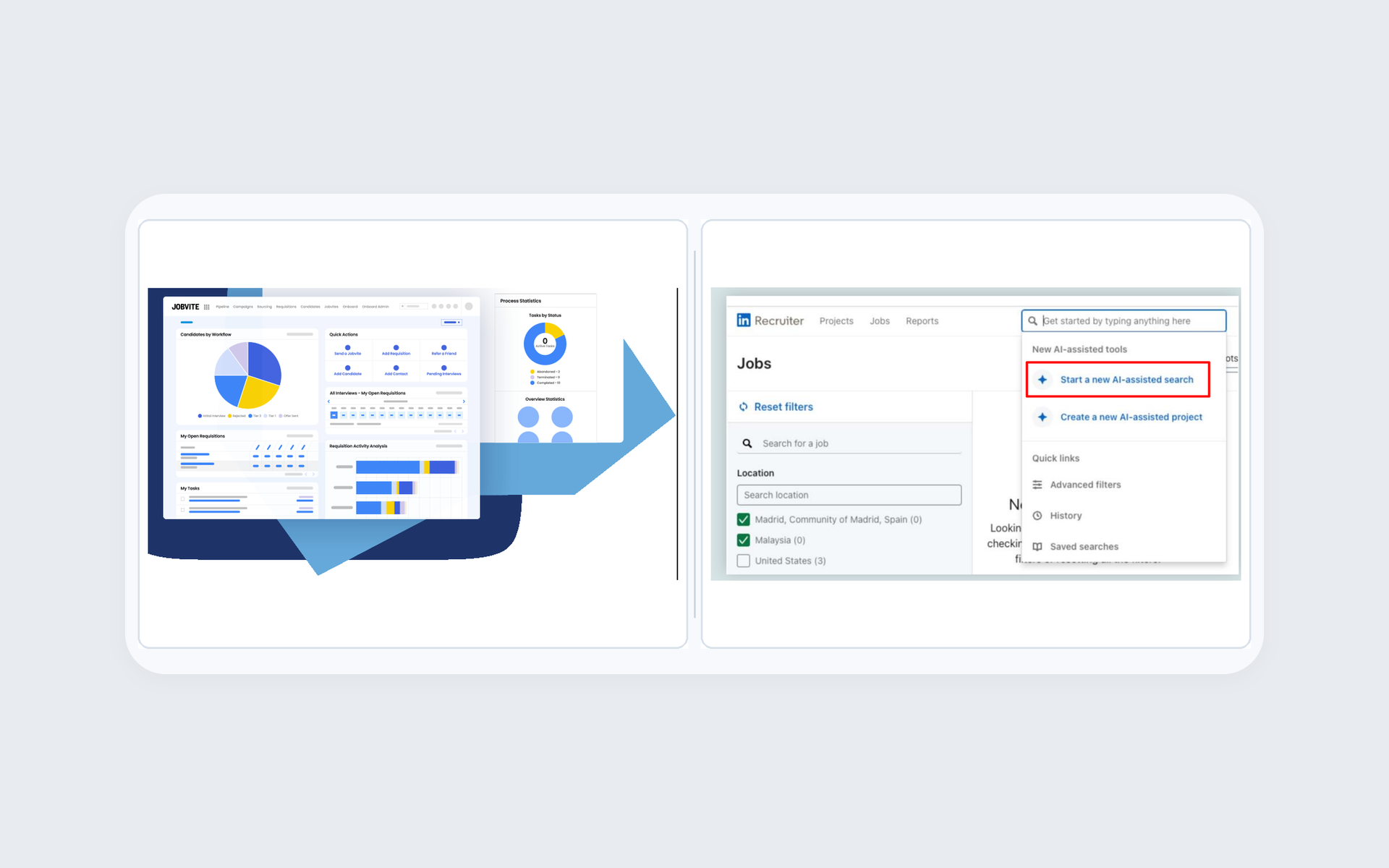
Jobvite and LinkedIn Recruiter are built for different parts of hiring. Jobvite is the ATS and operations layer; Recruiter is the professional-network sourcing and outreach layer. This article treats LinkedIn Recruiter as the current product for the legacy LinkedIn Talent term.
LinkedIn Talent Hub stopped being available on December 31, 2024. The direct verdict: choose Jobvite for ATS operations, Recruiter for network sourcing and outreach, or both when the team needs both layers.
Quick comparison shows three stack choices
The hiring playbook, in your inbox
One email a week - benchmarks, AI screening tactics, and short interview templates from the 100Hires team. No product pitches.
Fund the layer your hiring process lacks. An ATS fixes weak records and operating control. A sourcing product widens access to passive talent. A lean team may need a smaller combined workflow instead of two enterprise contracts.
A team tracking candidates in spreadsheets gets more value from a system of record than from another search channel. Requisitions, interview notes, offers, and onboarding need a controlled home before sourcing volume grows.
A team with a sound ATS can make the opposite choice. If the current database is thin and hard-to-fill roles need passive candidates, Recruiter's search and InMail may solve the more urgent gap.
Disclosure: 100Hires publishes this comparison. It appears here as a limited option for lean teams, not as a replacement for LinkedIn's professional network or a fit for every enterprise implementation.
| Criteria | 100Hires | Jobvite | LinkedIn Recruiter |
|---|---|---|---|
| Scope | ATS workflow, AI-assisted evaluation, LinkedIn import, enrichment, and plan-dependent outreach automation for lean teams. Search is narrower than Recruiter. | ATS-led recruiting suite covering applicant and recruiting operations. | Professional-network search, sourcing projects, InMail, collaboration, and ATS connectors. It is not a full ATS. |
| Best fit | Lean in-house teams and small agencies seeking a simpler combined workflow. It does not cover every large-enterprise deployment. | Mid-sized and enterprise teams that need governed ATS and recruiting operations. | Teams that have a system for managing records and need passive-talent discovery and network outreach. |
| ATS | Yes, with structured candidate records and workflows. Enterprise controls depend on plan and contract. | Yes. This is the core system-of-record layer. | No. Sourcing projects and pipelines do not replace full applicant tracking. |
| Network sourcing | LinkedIn import through a Chrome extension, with less search breadth and no ownership of LinkedIn's network. | Connector-supported access, with no comparable professional-network database. | Core strength. Recruiter Corporate lists 40+ filters. |
| Outreach | AI Email Composer, mailbox workflow, Pro contact enrichment, and plan-dependent nurture automation. | Candidate messaging, recruitment marketing, email, and SMS campaigns, subject to quoted modules and entitlements. | InMail, templates, projects, and collaboration. Results vary by role, saturation, sender, and message. |
| Public pricing visibility | Numeric Start, Advanced, and Pro prices. Enterprise is a custom quote. | Custom quote. Amounts are not publicly shown. | Corporate is a custom quote. Lite has public prices but is a narrower product. |
| Integration role | Lean workflow using LinkedIn import and external services, not the Jobvite connector set. | ATS system of record connected to Recruiter through named LinkedIn connectors. | Network sourcing layer connected to ATS and CRM records. |
| Limitation | Narrower search, no LinkedIn network ownership, plan dependency, and incomplete coverage of some large-enterprise needs. | No LinkedIn network breadth, quote-led pricing, and implementation or reporting fit that needs buyer testing. | Not a full ATS. Corporate is quote-led, Lite lacks key scope, and practitioner views on search quality are mixed. |
If you know which layer is missing, skip to the decision framework. If the labels still feel blurred, the next section clears up the product names.
Jobvite vs LinkedIn Recruiter in 2026 is the current comparison
In 2026, the keyword carries an old product label. The current buying question is Jobvite versus LinkedIn Recruiter, not Jobvite versus the retired Talent Hub.
LinkedIn Recruiter is the current comparison product
Recruiter is a sourcing and engagement product. Its features cover search, projects, saved candidates, candidate pipelines, InMail, team collaboration, sourcing reports, AI features, and links to supported ATS and CRM products.
That scope is substantial, yet it stops short of a full applicant record. It does not own requisitions, offers, onboarding, career-site operations, or company-wide ATS reporting in the way an ATS does.
Recruiter projects organize sourced profiles and team activity. An ATS record supports the formal hiring process after interest turns into an application. Similar-looking pipelines do not make the products interchangeable.
Talent Hub, Talent Insights, LinkedIn Jobs, and Talent Solutions are separate labels
Talent Hub was LinkedIn's ATS. It stopped being available on December 31, 2024, so old comparison pages that still rank can send buyers toward a product that is no longer sold.
- Talent Insights: a workforce-intelligence product, not the sourcing product compared here.
- LinkedIn Jobs: the adjacent job-posting product.
- Talent Solutions: the family name for LinkedIn hiring products, not one tool.
Those labels explain why search results look inconsistent. They should not be folded into a feature score against Jobvite.
Talent Hub's retirement did not retire Recruiter, LinkedIn Jobs, or Talent Insights. It removed one ATS product. Buyers still need to judge each remaining product by its current scope and contract.
Jobvite owns the ATS and recruiting operations layer
Choose Jobvite when the missing layer is a durable applicant record and controlled recruiting process. Current Jobvite pages use both Jobvite and Evolve naming, and Jobvite remains an Employ Inc. brand.

The ATS record runs from requisition through onboarding
Jobvite can hold requisitions, applicant records, pipeline stages, interview activity, candidate feedback, offers, and onboarding work. It gives recruiting teams one record from job approval to the new hire handoff.
Career sites, referrals, scheduling, source tracking, and operational reports sit around that record. This is the practical difference from Recruiter projects: the ATS carries the hiring process, not just the sourcing activity.
A useful Jobvite trial follows one requisition from approval through offer. Ask a recruiter, coordinator, hiring manager, and reporting owner to complete their normal work without a prepared demo path.
Recruitment marketing, reporting, automation, and AI widen the operating layer
Jobvite extends into CRM, recruitment marketing, candidate acquisition through career sites, candidate matching, chatbots, scheduling, interview support, and candidate communication. Its marketing tools cover email, SMS, and automated nurture campaigns.
Jobvite states that its suite has 60+ dashboards and reports and 300+ integration partners. These are vendor claims, and a buyer should confirm the exact modules, reports, connectors, and service terms in the proposed contract.
Reporting deserves a separate test. Rebuild a weekly funnel report, a source-quality view, and an aging-requisition review with your own fields. That exercise shows whether the quoted setup matches the team's operating rhythm.
Jobvite fits governed operations, with quote-led and adoption tradeoffs
Jobvite is a logical fit for mid-sized and enterprise teams that need onboarding, reporting, career-site operations, and structured controls. It does not supply LinkedIn's professional-network breadth.
Pricing is available by custom quote. Ask working recruiters and hiring managers to test reporting, navigation, daily candidate movement, manager feedback, and implementation support before a long contract.
Teams comparing adjacent ATS options can compare more Jobvite alternatives.
LinkedIn Recruiter owns professional-network sourcing and outreach
Choose Recruiter when the ATS works, yet the team lacks access to passive professional profiles and a focused network outreach process. Its value begins before an applicant enters the ATS.
Search, projects, and InMail define the Recruiter workflow
Recruiter Corporate provides full-network search, 40+ filters, projects, saved searches, recommendations, and candidate pipelines. Recruiters can move from a role brief to a project, save profiles, and contact candidates through InMail.
Corporate includes 150 InMails per month per seat. Templates and shared projects support repeat work, but access does not guarantee replies. Results depend on the role, target pool, sender, timing, and message quality.
Practitioner views split sharply. Some teams depend on the network reach; others question filter accuracy, stale profiles, response, and cost. Test a real role with current search criteria and outreach before signing.
Build the search test from a filled role whose requirements are known. Compare the results with people the team hired, rejected, and missed. This gives filter quality a job-level reference instead of a generic impression.
Then run a small outreach test with approved messaging. Review replies, declines, follow-up work, and ATS handoff quality. Network access and recruiter execution both affect the result.
Collaboration, reporting, AI, and ATS connections extend the sourcing layer
Teams can share profiles, add project collaborators, review pipeline activity, and use sourcing reports. Current Corporate documentation lists 28+ ATS partners.
Recruiter adds AI-assisted work across projects, search, messages, and applicant review. Hiring Assistant is a separate add-on for eligible Recruiter and RPS+ customers, with gradual availability. It is not baseline Recruiter performance.
Recruiter Corporate and Recruiter Lite are different buying decisions
Corporate is the full product compared with Jobvite and has custom pricing. Lite reaches up to third-degree connections, uses 20+ filters, includes 30 monthly InMails and 10 alerts, caps accounts at five seats, and excludes CRM Connect.
The public Lite price does not reveal Corporate cost. See LinkedIn Recruiter Lite vs Recruiter for the tier differences.
Feature winners change with the hiring layer
A single score hides the products' core difference. The better choice changes with the record, sourcing, outreach, or operating task in front of the team.
ATS records and recruiting operations favor Jobvite
Jobvite wins for requisitions, applicant records, interviews, offers, onboarding, career sites, and ATS reporting. Those workflows need a company record that persists after a sourcing project ends.
100Hires can cover structured records and workflows for lean teams, with enterprise controls varying by plan and contract. Recruiter is not a full ATS and should not be scored as one.
Professional-network sourcing and passive outreach favor LinkedIn Recruiter
Recruiter wins for professional-network discovery, passive profiles, advanced search, sourcing projects, and InMail. It gives a sourcer a broader starting pool than either ATS offers by itself.
100Hires can import known LinkedIn profiles and support later outreach, but its search is narrower and it does not own the network. Jobvite depends on external sourcing channels and supported connectors for this layer.
Recruitment marketing, onboarding, and ATS analytics favor Jobvite
Jobvite wins for candidate campaigns, career-site operations, onboarding, and ATS-level analytics. Recruiter reports on sourcing work, but it does not hold the full hiring record needed for offer and onboarding reports.
100Hires offers automation and workflow reporting for lean teams. Buyers with deep governance, custom BI, or broad global reporting needs should test the relevant plan and contract rather than assume full enterprise coverage.
AI and evaluation depend on the task and require human review
There is no universal AI winner. Jobvite applies AI to ATS work such as matching, messaging, scheduling, and interview support. Recruiter applies AI to sourcing projects, search, messages, and applicant review.
100Hires supports AI resume parsing, AI Scoring, AI Copilot, and AI Email Composer. Public pricing does not assign each feature to a named plan, so buyers should confirm access.
Keep people accountable for the decision. Test automated and manual methods against the job, review outcomes, and monitor nondiscriminatory use. The EEOC explains the general rules for employment tests and selection procedures.
Public price visibility and lean consolidation favor 100Hires
100Hires offers public pricing and may reduce tool fragmentation for a lean team that needs ATS records, import, enrichment, outreach, and automation in one workflow.
The tradeoff is narrower search, no ownership of LinkedIn's network, plan-dependent sourcing functions, and incomplete coverage of some large-enterprise deployments. Jobvite and Recruiter Corporate are available by custom quote.
The Jobvite plus LinkedIn Recruiter stack joins records with network sourcing
The feature verdicts point to a two-layer stack. LinkedIn's current partner table lists a broad Jobvite connector set, but each capability has its own setup, entitlement, and data-flow rules.
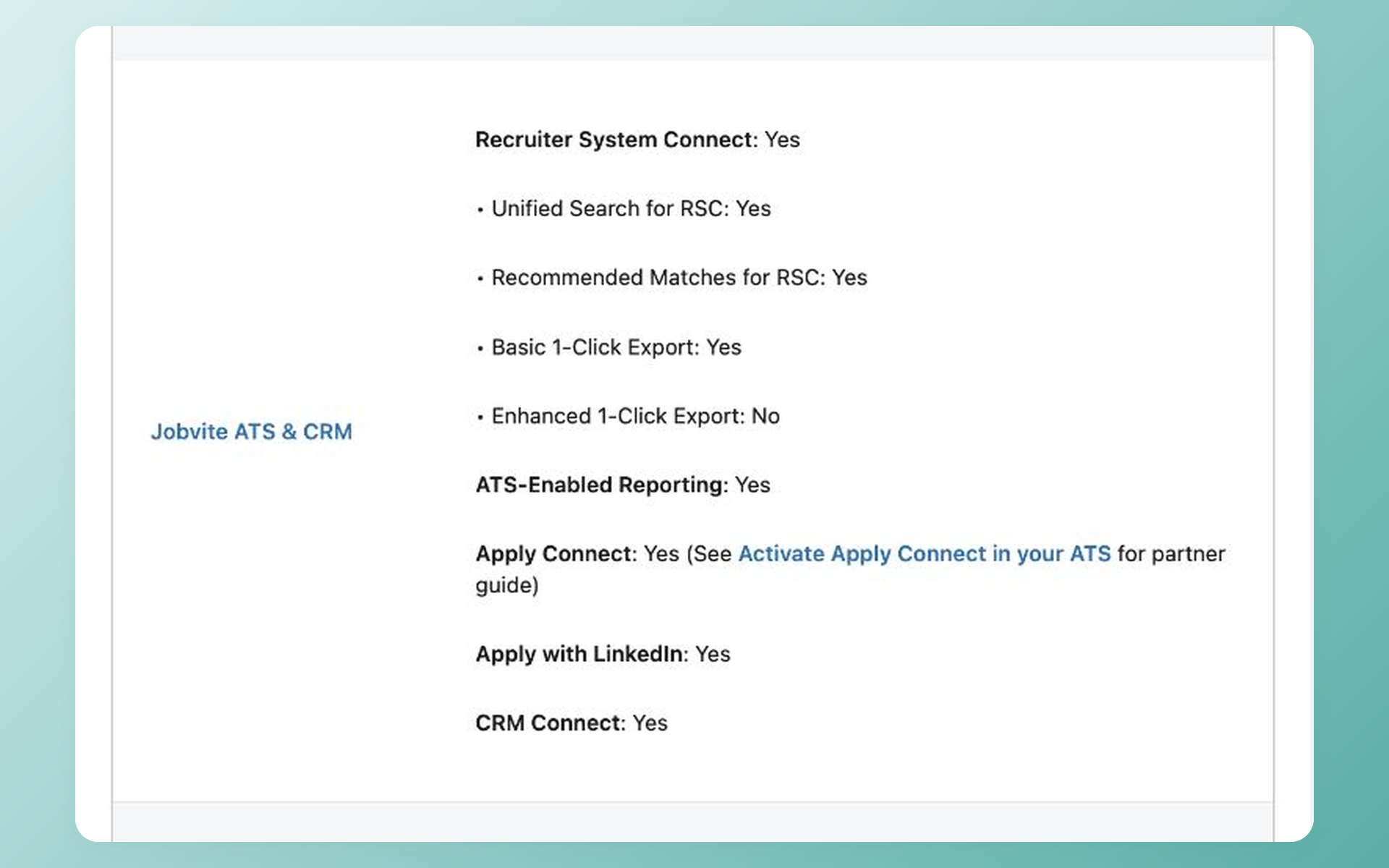
The Jobvite row has eight supported capabilities and one unsupported capability
| Integration capability | Jobvite ATS and CRM support |
|---|---|
| Recruiter System Connect | Yes |
| Unified Search | Yes |
| Recommended Matches | Yes |
| Basic 1-Click Export | Yes |
| Enhanced 1-Click Export | No |
| ATS-Enabled Reporting | Yes |
| Apply Connect | Yes |
| Apply With LinkedIn | Yes |
| CRM Connect | Yes |
The single No matters. Basic 1-Click Export is supported, but Enhanced 1-Click Export is not. Older pages may use stale labels, so the current partner row should guide the purchase review.
Separate dependencies and data flows make this more than a simple sync
- RSC: Recruiter System Connect can share candidate, job, and application data across Recruiter and Jobvite, subject to setup and entitlement.
- Unified Search and Recommended Matches: both require RSC plus 1-Click Export.
- Export: Jobvite supports Basic 1-Click Export, not Enhanced 1-Click Export.
- Apply Connect: this exposes LinkedIn profile highlights and skills during applicant review. A LinkedIn Recruiter license is required for these profile details.
- Apply With LinkedIn: this handles LinkedIn application data and needs at least one eligible Recruiter seat or a Paid Job Slot. Lite is excluded.
- CRM Connect: this is unavailable on Lite and has its own privacy, export, and synchronization rules.
LinkedIn documents 300 CRM Connect exports per user per month. It says historical sync commonly takes 2 to 48 hours and ongoing sync runs about every 15 minutes.
Those figures describe CRM Connect documentation, not a universal Jobvite service promise. Member opt-out, privacy choices, record reconciliation, and reactivation limits can affect what appears in each system.
A common flow starts with a Recruiter search, adds a profile to a project, and sends outreach. Once the person enters the hiring process, Jobvite becomes the controlled record for review, interviews, and later stages.
Shared context can help a sourcer see prior ATS history and avoid duplicate outreach. The available context depends on the enabled connector, data permissions, matching logic, and whether the member permits the relevant use.
Assign someone to manage the connector. That person should review failed matches, duplicate rules, field mapping, access changes, sync timing, and user training after launch rather than treating setup as permanent.
The combined stack fits teams that need both layers
Use both when sourcers need Recruiter's network discovery and recruiters need Jobvite's applicant record, interview flow, onboarding, and reporting.
The handoff can share candidate context, but the team must test duplicate handling and history preservation for the selected connector and contract.
The value depends on connector setup, license scope, implementation effort, data rules, and total contract cost. Treat the stack as software that requires configuration, not as a complete, instant, or universally bidirectional sync.
Before choosing both, compare the full stack cost.
Pricing and total-stack cost depend on tier and contract
Two enterprise layers can mean two contracts, connector entitlements, implementation work, and separate administration. Public prices reveal only part of that cost.
The complete parity table separates displayed prices from derived totals
The values below reflect visible pricing checked on July 15, 2026. 100Hires prices are current visible entry values tied to company-size pricing. Recruiter Lite prices can vary by region.
| Product or plan | Monthly billing | Annual equivalent per month | Annual total | Scope and limits | Billing basis | Evidence label |
|---|---|---|---|---|---|---|
| 100Hires Start | $99 | $49 | $588 | Up to 3 jobs, 100 candidates, 1 user, and 100 monthly AI credits | Company-size pricing; current visible entry values | Monthly and annual equivalent displayed; annual total derived |
| 100Hires Advanced | $249 | $199 | $2,388 | Unlimited jobs, candidates, and users; automation, knockout questions, custom career-site domain; 300 monthly AI credits on monthly billing or 1,000 on annual billing | Company-size pricing; current visible entry values | Monthly and annual equivalent displayed; annual total derived |
| 100Hires Pro | $499 | $399 | $4,788 | Advanced scope plus contact enrichment, multichannel outreach, email warmup, and annual-contract migration; 3,000 monthly AI credits on monthly billing or 5,000 on annual billing | Company-size pricing; current visible entry values | Monthly and annual equivalent displayed; annual total derived |
| 100Hires Enterprise | Not publicly shown | Not publicly shown | Not publicly shown | Pro scope plus enhanced security, SSO, requisition approvals, BI, and custom work | Custom quote | Public classification |
| Jobvite | Not publicly shown | Not publicly shown | Not publicly shown | ATS-led recruiting suite; modules, implementation, and entitlements require a quote | Custom quote | Public classification |
| LinkedIn Recruiter Corporate | Not publicly shown | Not publicly shown | Not publicly shown | Full Recruiter tier; current Help lists 40+ filters, 150 InMails per month per seat, and 28+ ATS partners | Custom quote | Public classification |
| Recruiter Lite, 1 license | $170 displayed | $140 derived | $1,680 displayed | Up to third-degree network, 20+ filters, 30 InMails per month, 10 alerts, and no CRM Connect | Per license | Monthly and annual total displayed; annual equivalent derived |
| Recruiter Lite, licenses 2 to 5 | $270 per license displayed | $222.50 per license derived | $2,670 per license displayed | Same Lite scope, with a maximum of five seats | Per license | Monthly and annual total displayed; annual equivalent derived |
Recruiter Lite appears here for context. Its public amounts are not Recruiter Corporate pricing, and its network reach, filters, InMail allowance, seat cap, and connector access are narrower.
Total-stack cost includes more than the visible license line
Compare seat count, Corporate versus Lite scope, Jobvite modules, implementation, connector eligibility, paid job slots, data migration, reporting needs, support, and internal administration.
Do not fill missing figures with third-party estimates or buyer anecdotes. Ask each vendor for the same scope, contract term, service level, data-migration work, and connector setup so the quotes can be compared.
Build one price worksheet for every option. Separate required licenses from optional modules, then record contract length, renewal terms, implementation work, data migration, training, support, connector fees, and internal administration.
For the combined stack, identify which Recruiter tier and Jobvite modules make each planned connector eligible. A low headline price has little value if the chosen tier omits the workflow that justified the purchase.
100Hires is easier to budget from public figures. Its narrower network, plan-dependent functions, and enterprise boundaries can still make Recruiter, Jobvite, or the combined stack necessary.
The right choice follows the missing workflow
Company size helps narrow a shortlist, but the broken workflow should decide which layer gets funded first. Use a live role and real users to test each path.
Write down the current problem before any demo. Name the missing record, search step, handoff, report, or control. A precise gap keeps attractive features from displacing the buying reason.
Choose Jobvite first when the ATS layer is missing
Start with Jobvite if applicant records live in spreadsheets, requisitions lack control, interview activity is scattered, or offers, onboarding, and reporting lack one owner.
Recruiter may remain useful for passive sourcing. Check Jobvite's quoted modules, implementation plan, reporting fit, connector entitlements, and adoption among recruiters and hiring managers.
Choose LinkedIn Recruiter first when network sourcing is missing
Start with Recruiter if the ATS works but sourcers cannot find or engage enough passive professional talent. Test search quality, profile freshness, InMail workflow, collaboration, and reporting on a current hard-to-fill role.
Recruiter will not replace requisitions, complete applicant records, offers, onboarding, or company-wide recruiting operations. The existing ATS must continue to handle that work.
Use both when sourcing reach and governed records are required
Choose Jobvite plus Recruiter when the business needs network discovery and a controlled hiring record. Map the named connectors to the workflow rather than accepting a vague sync claim.
Review implementation, entitlements, duplicate handling, privacy choices, record ownership, reporting, and total contract cost. Run a test from search through ATS review before rollout.
Consider 100Hires when a lean team wants one operational workflow
Evaluate 100Hires if a lean in-house team or small agency needs ATS records, LinkedIn import, contact discovery, email outreach, scheduling, and automation at public prices.
Its search is narrower, it does not own LinkedIn's network, features depend on plan, and it does not meet every large-enterprise governance, reporting, or implementation need.
100Hires is a disclosed right-size option for lean teams
100Hires publishes this article. The product belongs in the comparison as a separate option for lean teams, not as a surprise winner or a substitute for LinkedIn's professional network.
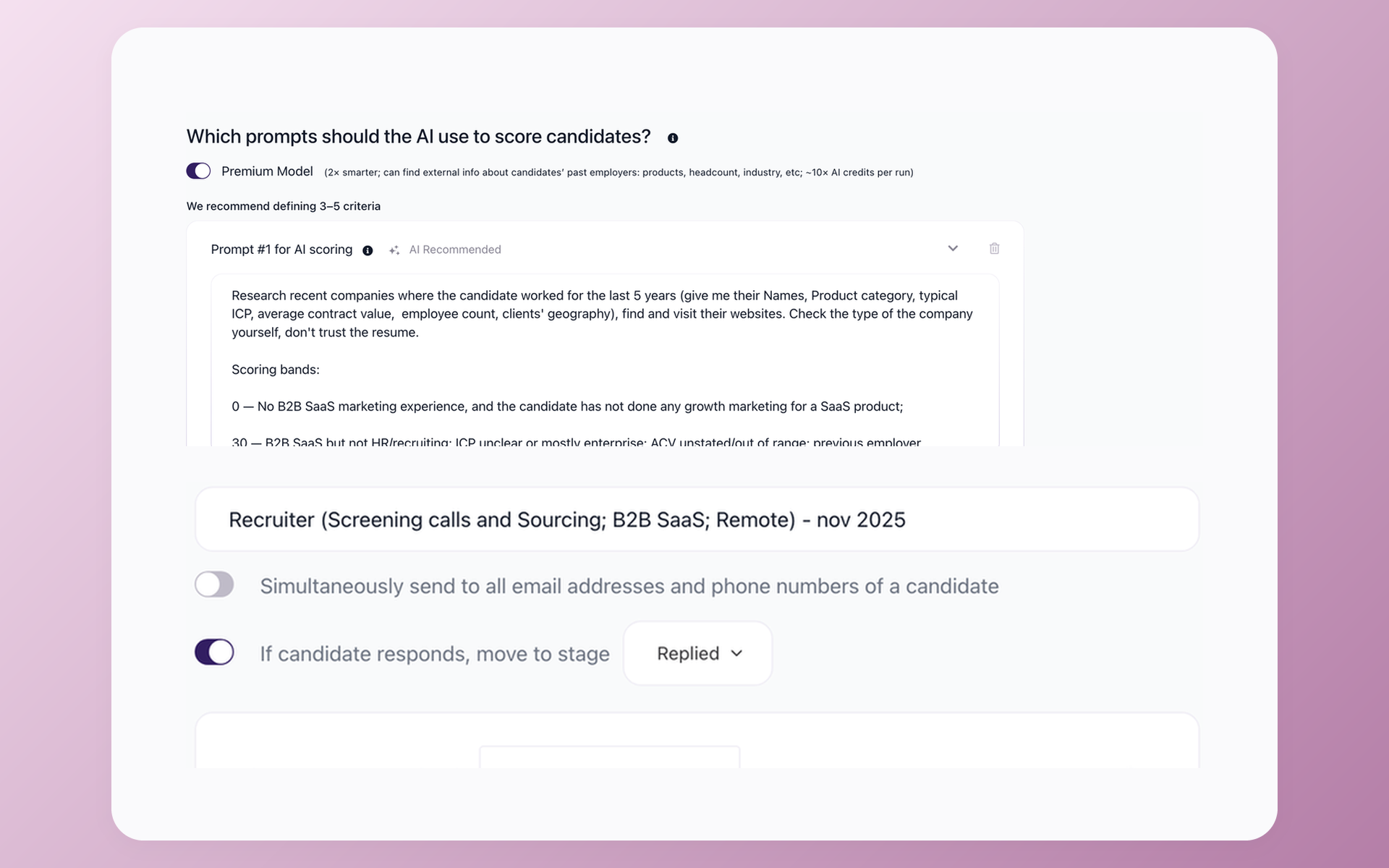
100Hires fits between spreadsheets and a layered enterprise stack
A lean recruiting team can keep candidate records, jobs, pipeline work, sourcing follow-through, outreach, and coordination in one system. That can reduce handoffs among a spreadsheet, contact tool, mailbox, and ATS.
The strongest fit is a team that values a shorter operating path more than maximum network breadth. It can import a profile, enrich permitted contact data, start outreach, and keep later activity beside the candidate record.
The fit has firm limits. 100Hires has narrower search, does not own LinkedIn's network, ties some functions to specific plans, and does not cover every enterprise governance or implementation model.
AI features support recruiter review across the candidate record
AI resume parsing turns uploaded resumes into structured candidate fields. AI Scoring checks a profile against custom criteria, and AI Copilot can use the resume, notes, emails, forms, application answers, and job context.
AI Email Composer drafts and revises candidate messages from that context. These tools support recruiter review; they should not be presented as making final hiring decisions without human review.
Public pricing does not itemize each AI feature by plan. Confirm access, credit use, workflow behavior, permissions, and review steps for the chosen contract.
LinkedIn import, enrichment, and nurture cover a narrower sourcing workflow
A Chrome extension can import a known LinkedIn profile into 100Hires. The team can enrich contact details, work from connected mailboxes, use trackable links, and place candidates into nurture automation.
Contact enrichment is available on Pro, and nurture automation depends on the plan. The public pricing page does not assign LinkedIn import to a plan.
Importing a known profile is not equal to Recruiter's professional-network search, advanced filters, projects, or InMail access. Teams that need that reach may still pair an ATS with Recruiter.
Public pricing comes with plan and enterprise boundaries
Start, Advanced, and Pro have public prices; Enterprise is custom quote. Readers can see 100Hires pricing for current plan details.
Security, SSO, requisition approvals, BI, migration, custom reporting, and integrations vary by plan or contract. Those boundaries make 100Hires a fit question, not the universal answer.
Frequently asked questions
Is LinkedIn Talent Hub the same as LinkedIn Recruiter?
No. Talent Hub was an ATS and stopped being available on December 31, 2024. Recruiter is for network sourcing and outreach. 100Hires has an ATS workflow and LinkedIn import, but its search is narrower and it does not own LinkedIn's network.
Can LinkedIn Recruiter replace Jobvite?
No. Recruiter handles sourcing projects and InMail, not Jobvite's full ATS record, offers, or onboarding. 100Hires adds AI resume parsing to lean ATS workflows, but has narrower sourcing and fewer large-enterprise deployment options.
Does Jobvite integrate with LinkedIn Recruiter?
Yes. Jobvite supports RSC, Unified Search, Recommended Matches, Basic 1-Click Export, ATS-Enabled Reporting, Apply Connect, Apply With LinkedIn, and CRM Connect. Enhanced 1-Click Export is not supported. Dependencies apply, and Lite lacks CRM Connect. 100Hires uses LinkedIn import, not this set.
Which costs less, Jobvite or LinkedIn Recruiter?
Public evidence cannot identify a universally cheaper option because Jobvite and Recruiter Corporate are available by custom quote. 100Hires publishes plan prices, but contact enrichment is available on Pro and enterprise needs can lead to a custom contract.
When should a team consider 100Hires instead?
Consider 100Hires for a lean ATS workflow with AI Scoring, LinkedIn import, enrichment, and outreach. Contact enrichment is available on Pro, and nurture automation depends on the plan. Search is narrower, 100Hires does not own the network, and some enterprise needs fall outside the product's scope.
To compare a two-layer Jobvite-plus-Recruiter stack with a leaner ATS workflow that includes LinkedIn import, enrichment, and outreach, book a demo. Fit still depends on search breadth, governance, reporting, and implementation needs.
Try 100Hires for free
No credit card. 14-day trial. Forbes Advisor #1 ATS for SMBs.