LinkedIn Recruiter Lite vs Recruiter: which one fits your hiring in 2026
Is a $170 per month Recruiter Lite seat enough, or do you need the full LinkedIn Recruiter contract your sales rep keeps quoting?
Here is the short answer. Recruiter Lite is LinkedIn's self-serve sourcing seat: $170 a month, 30 InMails, 20+ search filters, and search that stops at your 3rd-degree network.
LinkedIn Recruiter, the full product, is a quote-only contract with 150 InMails per seat, 40+ filters, and search across the entire member base.
LinkedIn never publishes the full Recruiter price. Third-party contract trackers put it between $9,000 and $15,000+ per seat per year, and recruiters report quotes far above that range.
Every number in this comparison was checked against LinkedIn's own help center and product pages in July 2026. Where a figure is LinkedIn's marketing claim or a third-party estimate, it is labeled as one.
The last sections cover the cheaper Premium Business tier, the retired "LinkedIn Lite" app people keep searching for, and what to do with candidates after you find them.
Recruiter Lite vs Recruiter at a glance
The hiring playbook, in your inbox
One email a week - benchmarks, AI screening tactics, and short interview templates from the 100Hires team. No product pitches.
The table below compares the two tiers most buyers are choosing between. All rows come from LinkedIn's published pages unless marked otherwise.
| Recruiter Lite | LinkedIn Recruiter (Corporate) | |
|---|---|---|
| Price | $170/month single license, $1,680/year on annual billing | Quote only. Third-party estimates: $750-1,080/month per seat |
| Extra licenses | $270/month per license (licenses 2-5) | Negotiated per contract |
| Max seats | 5 | No published cap |
| Network access | 1st to 3rd-degree connections plus shared groups | Entire LinkedIn network (930M+ members) |
| Profile views | 2,000 unique profiles per day | Unlimited |
| Search filters | 20+ | 40+, including Open to Work and More Likely to Respond spotlights |
| InMails per month | 30 per seat, top up to 70 extra, bank up to 120 | 150 per seat |
| Bulk InMail | No | Yes, up to 25 messages at once |
| Free job posts | 1 per seat purchased (up to 5) | Included per contract |
| AI features | None | AI-assisted search and messages; Hiring Assistant as a paid add-on |
| ATS integration | No | Yes, 28+ ATS partners via Recruiter System Connect |
| Collaborator licenses | No | 20 free collaborator licenses per license |
| Reporting | Basic reporting and analytics | Advanced analytics |
| Candidate data owned by | The individual purchaser | Your company |
| Free trial | 30 days, card required | No public trial |
LinkedIn's own positioning matches the table. Lite is "best suited for individuals, self-employed recruiters and small businesses with light hiring needs." The full product exists for dedicated talent teams that source every week and need the whole network.
The gap between $2,040 a year and a five-figure contract is where the real decision lives. The rest of this article walks through each row, then gives you a volume-based answer.
There are four Recruiter tiers (and two name traps)
Most comparison articles treat this as a two-product choice. LinkedIn actually sells four Recruiter tiers, and knowing the middle two exist can change your quote.
- Recruiter Lite: the self-serve tier above. The only one with a published price.
- Recruiter Professional Services (RPS): built for staffing agencies. 100 InMails per seat, 40+ filters, 3rd-degree search plus 30 out-of-network profile unlocks a month. Quote only.
- RPS+: the newer agency tier. 140 InMails per seat, 50 out-of-network unlocks, business development tools, and access to the Hiring Assistant add-on. Quote only.
- Recruiter Corporate: the in-house enterprise tier. 150 InMails per seat, full network access, ATS integrations. Quote only.
Two name traps to avoid before you compare anything. First, "Hiring Assistant" and "Hiring Pro" are different LinkedIn AI products with confusingly similar names. Hiring Assistant is the AI sourcing agent sold as an add-on to Corporate and RPS+ contracts.
Hiring Pro is a separate AI tool for small businesses that post jobs occasionally.
Second, "LinkedIn Lite" was never a recruiting product at all. It gets its own section near the end.
What each tier costs
Recruiter Lite pricing (official)
Lite is the one tier you can buy with a credit card and cancel any time. Per LinkedIn's own tier comparison, a single license runs $170 per month, or $1,680 per year on annual billing.
Licenses two through five cost $270 per month each, or $2,670 per year per license.
Note the math on that annual discount: $170 x 12 is $2,040, so paying yearly saves $360. And note the team pricing quirk: your second seat costs more than your first.
There is a 30-day free trial. It requires a card and converts to a paid plan automatically unless you cancel at least one day before renewal.
Full Recruiter pricing (quote only, so treat every number as an estimate)
For RPS, RPS+, and Corporate, LinkedIn's pricing row reads "Contact our Sales team." Nothing is published. Aggregators that track LinkedIn contracts estimate $750 to $1,080 per seat per month, or roughly $9,000 to $15,000+ per year.
Real-world reports stretch that range in both directions. One executive recruiter who held a seat for over a decade cited about $650 a month before canceling in 2026.
On r/recruiting, the first recruiter at a 20-person startup shared a quote of $46,000 to $50,000 per year for one seat, a company page, and ten job slots.
In 2025 sales and onboarding calls, several 100Hires customers independently put a standard seat at around $10,000 a year. The spread is the point: LinkedIn negotiates every contract, so two companies of the same size can pay very different prices for the same product.
InMail top-ups and credit economics
InMail credits behave the same way across tiers, and the fine print matters. A credit is refunded only if the recipient accepts, declines, or replies within 90 days. Silence burns the credit. Follow-up messages consume an extra credit up front.
On Lite you can buy up to 70 extra InMails a month and bank a maximum of 120 per seat. Cancel your subscription and the whole balance drops to zero. Credits never transfer between LinkedIn products.
One more data point worth knowing before you budget: in 2025, recruiters on Recruiter contracts reported the per-InMail top-up price jumping from $3 to $21. That figure comes from practitioner reports, not from LinkedIn, but two unrelated sources described the same increase.
Feature by feature: where Lite runs out
Network reach and profile views
This is the difference recruiters cite most. Lite shows you people within your 1st, 2nd, and 3rd-degree network, plus members of your shared groups. Full Recruiter searches all 930M+ LinkedIn members regardless of connection distance.
Lite users compensate by sending connection requests all week to widen their visible pool. That works, slowly. If your candidates cluster in a niche where you are already well connected, the 3rd-degree wall matters less.
If you recruit across industries or geographies, it is the single best reason to upgrade.
Lite adds a hard ceiling of 2,000 unique profile views per day. Full Recruiter has none.
Search filters and spotlights
Lite includes 20+ filters: titles, locations, industries, years of experience, and the essentials. Full Recruiter doubles that to 40+ and adds spotlights, the behavioral filters that surface candidates flagged Open to Work or More Likely to Respond.
YouTube tutorials disagree about whether Lite can filter by Open to Work, and the confusion is understandable given how often LinkedIn shuffles features. The official answer as of July 2026: spotlights are not included in Lite.
You will see the green banner on individual profiles, but you cannot filter a search by it.
Boolean search works on both tiers. Recruiters grumble that its quality has slipped in recent years, on both tiers alike, so it is not an upgrade argument either way.
InMails and bulk outreach
The allowances are 30 per month on Lite versus 150 per seat on Corporate. The workflow difference is bigger than the numbers. Full Recruiter sends bulk InMail to up to 25 candidates at once with templates.
On Lite, the bulk button is visible but inactive; every message goes out one at a time.
LinkedIn's help center states it plainly: bulk InMail is only available on Recruiter contracts.
Budget against reply rates, not send volume. LinkedIn has historically cited a 30-40% response rate across the platform. Recruiters in 2025 and 2026 report numbers under 10% for cold InMail, and a 30-InMail month at a 10% reply rate is three conversations.
That math decides whether either tier pays for itself.
Job posts: the per-seat rule
A widely repeated claim says Recruiter Lite includes one job post per month. That is wrong.
The official Recruiter Lite overview states the number of free job postings you can run at once equals the number of seats you purchased, up to five.
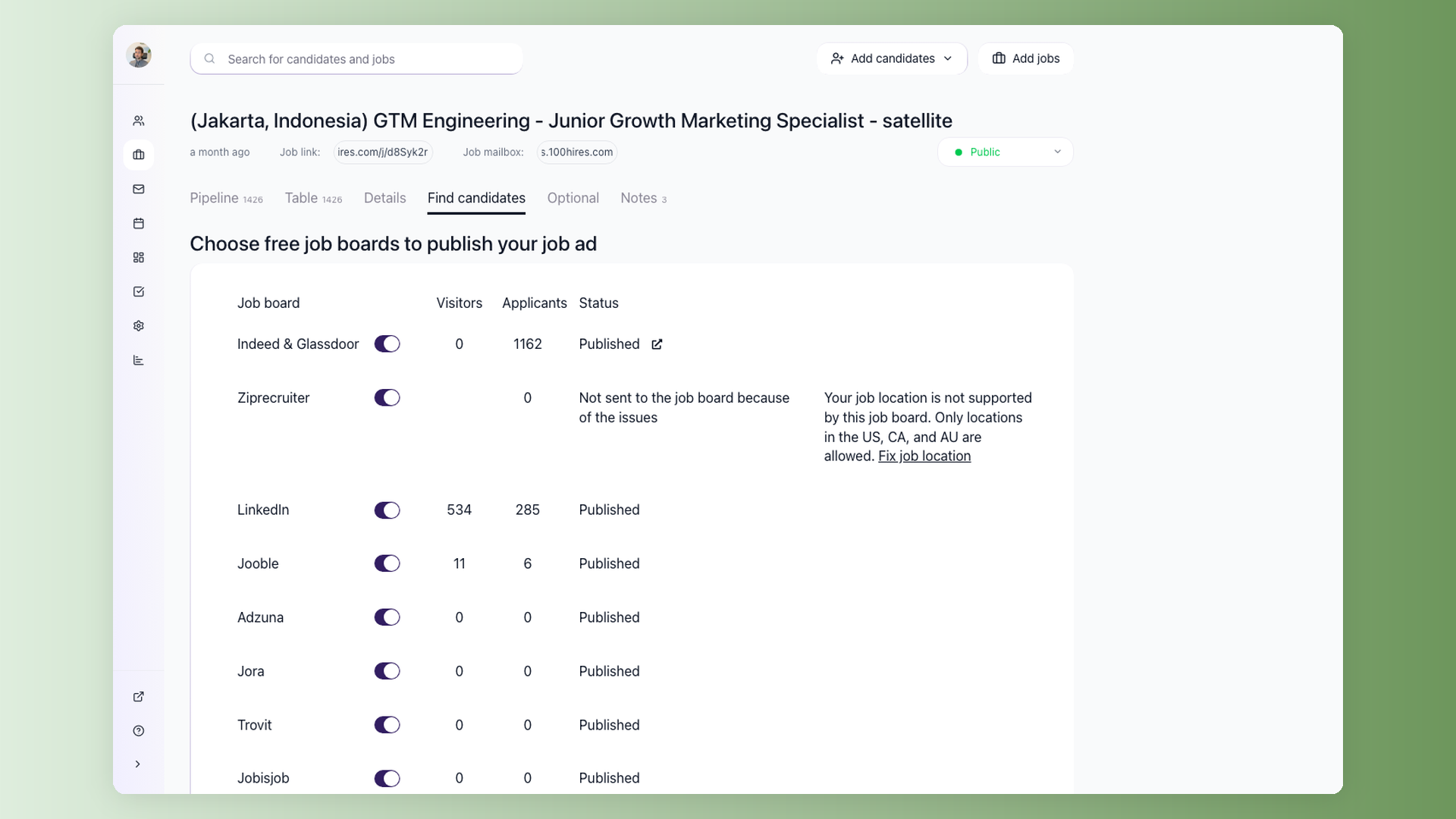
Those posts still follow LinkedIn's free-post mechanics: each one is paused from search results after 14 days, and applicant caps apply. Paying for Lite does not lift the free-post rules, which catches buyers off guard.
Some purchase Lite expecting a job-posting product and hit "free job post limit" errors with no clear explanation.
Recruiter Lite is a sourcing seat, not a job advertising product. If posting reach is what you need, promoted posts or a multi-board distribution setup solve that problem for far less than either Recruiter tier.
Team collaboration and ATS integration
Lite is a single-player tool. Two Lite seats at the same company cannot see each other's talent pools or share projects, a limitation customers discover only after buying the second seat.
Full Recruiter is built for teams: shared projects, pipeline visibility, and 20 free collaborator licenses per license so hiring managers can review candidates without paid seats.
The integration story is just as one-sided. Recruiter System Connect links full Recruiter to 28+ ATS partners at no extra fee, syncing candidate records both ways. Lite has no ATS integration of any kind. Whatever you source there gets exported or retyped by hand.
AI features: what is real on each tier
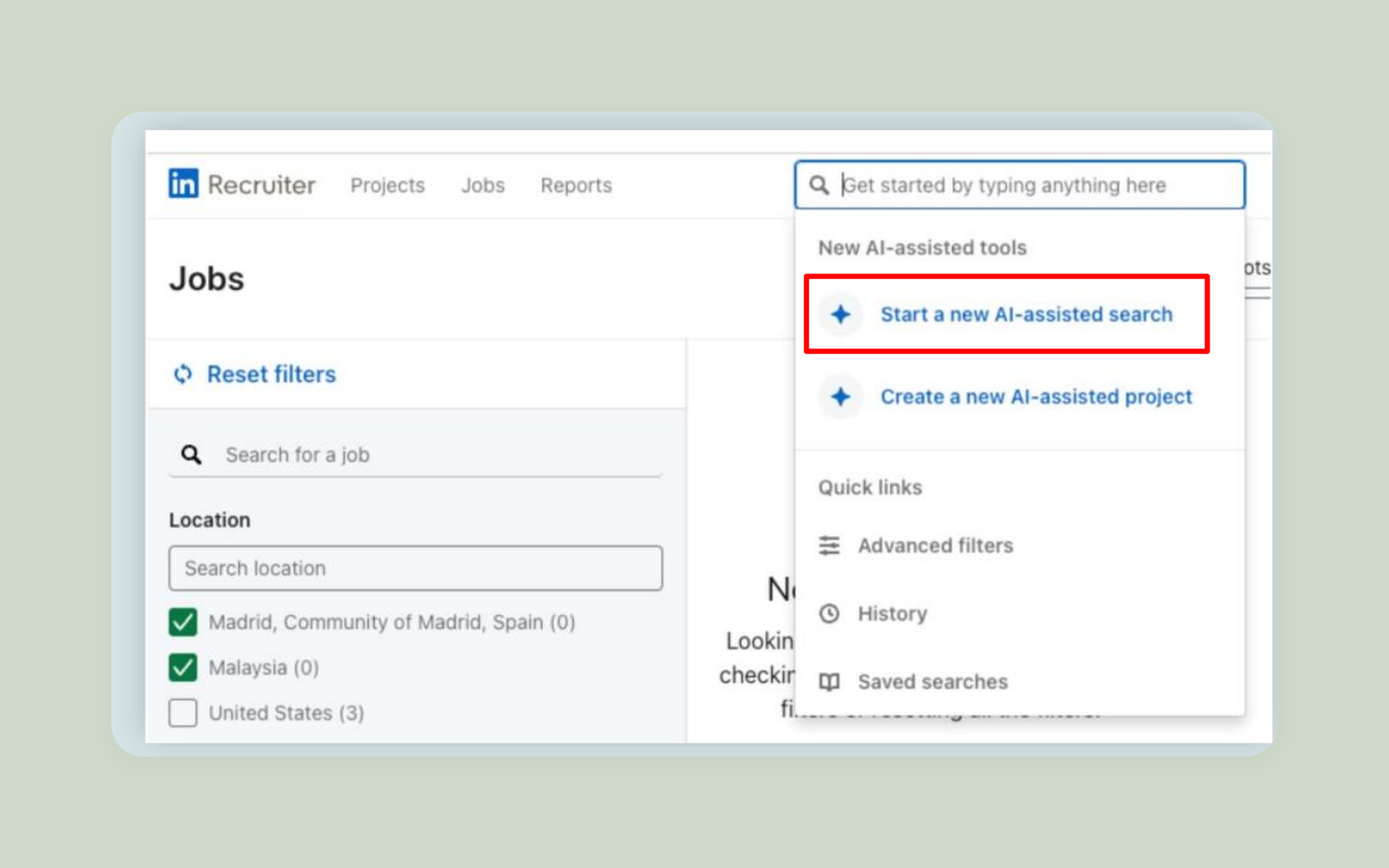
Lite includes none of LinkedIn's AI features. No AI-assisted search, no AI-drafted messages, no Hiring Assistant. Full Recruiter includes AI-assisted search and messaging, and Corporate or RPS+ customers can buy Hiring Assistant, the autonomous sourcing agent, as an add-on.
LinkedIn's claims for Hiring Assistant are striking: recruiters review 81% fewer profiles, see 66% higher InMail acceptance, and save 1.5 hours per role. Treat all of these as LinkedIn's own marketing numbers.
Much of the excitement on LinkedIn itself comes from paid partnership posts repeating the same statistics word for word.
Hands-on reviews are more mixed. Users describe title suggestions that miss the role's context entirely and a usage-based "capacity" pricing model that even LinkedIn reps struggle to explain.
If Hiring Assistant is the reason you are considering an upgrade, ask for a live pilot on your own roles before signing.
Data ownership and what happens when you cancel
Here is the difference nobody puts in the sales deck. On Lite, the account data belongs to the individual purchaser, not the company. On RPS and Corporate contracts, LinkedIn states the data is owned by and stays with your company.
The consequences are concrete. If your Lite-holding recruiter leaves, their projects, messages, and candidate lists leave with them.
Some users report the same thing at subscription end: let Lite lapse and your InMail history and pipelines are gone the next day, whether or not you renew later.
LinkedIn's help center confirms the mechanics: a deleted Recruiter profile permanently removes its messages and data. For a solo recruiter this is an annoyance. For a business, it means your candidate history sits inside a subscription you rent, on terms you do not control.
What recruiters actually say about each
Read a month of r/recruiting threads and a pattern emerges. The complaint is rarely the feature gap. It is the price trajectory.
Recruiters who negotiated Corporate contracts in 2019 describe seats around $10,000 and promoted job slots at $1,800. The same buyers now report $12,000 seats and $2,300 slots, with renewal quotes climbing every year.
One high-engagement thread frames the complaint as paying enterprise prices for outdated profiles, weak filters, and single-digit reply rates.
The defense is just as consistent, and worth taking seriously. Experienced sourcers say they find every niche candidate on LinkedIn, that search quality complaints are often a skill issue, and that one placement pays for the seat several times over.
Agency owners running full desks treat the cost as table stakes.
Both camps agree on the trend line, though: response rates have fallen. Several recruiters tie it to scam and spam pollution on the platform, with candidates increasingly unable to tell legitimate outreach from fraud.
When outreach effectiveness drops and the price rises, the value question writes itself.
Which should you choose: a volume-based answer
Strip out the feature lists and the decision comes down to hiring volume and team shape.
Choose Recruiter Lite if, as a rough rule of thumb, you are a solo recruiter or a team of one to two, filling up to roughly ten roles a year, sourcing mostly within an industry where you are already connected.
You get recruiter-grade filters and a modest InMail budget for about $2,000 a year.
Choose full Recruiter if recruiting is a team sport at your company: 20+ open roles, multiple recruiters sharing pipelines, hiring managers reviewing candidates, an ATS that should sync automatically, and roles that require searching far beyond your own network.
Consider Sales Navigator instead of Lite if you already have an ATS and need LinkedIn prospecting reach instead of recruiter workflow features. Our LinkedIn Recruiter Lite vs Sales Navigator comparison breaks down the seat decision, including search signals, messaging, and the handoff into your ATS.
Choose neither if you make one or two hires a year. A free LinkedIn account, one active free job post, and a personal network will usually get you there. LinkedIn's own tools are enough at that volume, and the money is better spent elsewhere.
LinkedIn Premium Business vs Recruiter Lite
This pairing confuses more buyers than any other, and the answer is short: Premium Business is not a recruiting product.
Premium Business costs $69.99 a month, or $539.88 a year. LinkedIn raised the price from $59.99 in April 2026, so most articles you will find still quote the old number.
It is a professional networking subscription: unlimited browsing, its own set of advanced search filters, company insights, LinkedIn Learning, and 15 InMails a month.
What it does not have is the recruiter workflow: no candidate projects or pipeline, no recruiter filter package, no job posting allowance, no bulk messaging, and no path to an ATS.
| Premium Business | Recruiter Lite | |
|---|---|---|
| Price | $69.99/month | $170/month |
| InMails per month | 15 | 30 |
| Search | Unlimited browsing, general filters | 20+ recruiter filters, saved searches with alerts |
| Hiring workflow | None | Projects, candidate pipeline, daily recommendations, job posts per seat |
Buy Premium Business if you are a founder doing occasional warm outreach and company research. Once you are running a real candidate pipeline, even a small one, Recruiter Lite is LinkedIn's entry point.
Premium Career, at $39.99 with 5 InMails, is the job-seeker product and not relevant here at all.
A small footnote that says a lot about relying on any single vendor's numbers: as of July 2026, LinkedIn's own Premium Business page claims 365 days of who-viewed-your-profile history in its headline and 90 days in its FAQ.
When a platform contradicts itself on its own pricing page, verify anything that matters to you before buying.
LinkedIn Lite vs LinkedIn Recruiter: sorting out the name
"LinkedIn Lite" was a lightweight version of the LinkedIn mobile app built for low-bandwidth markets. LinkedIn retired it in 2022. It was never a recruiting product, and it has nothing to do with Recruiter Lite.
If you searched "LinkedIn Lite vs LinkedIn Recruiter," you almost certainly meant Recruiter Lite vs Recruiter, which is everything above.
If you meant free LinkedIn vs Recruiter: a free account gives you profile browsing within limits and one active free job post, and the Recruiter products add search depth, InMail, and pipeline tools on top.
Where 100Hires fits alongside LinkedIn sourcing
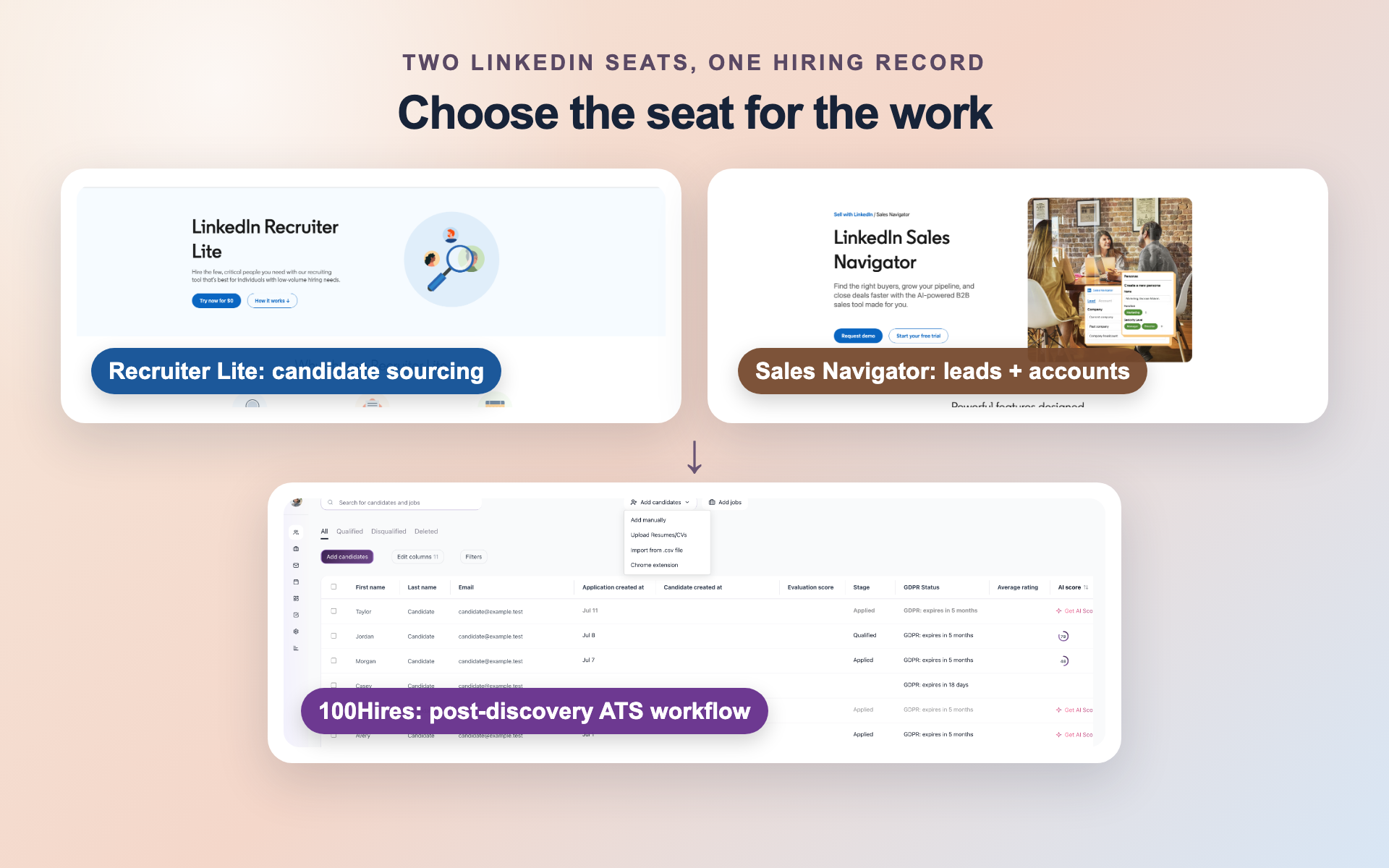
Whichever tier you land on, a Recruiter seat solves sourcing. It does not manage hiring. Interviews, evaluations, follow-ups, offer stages, and the candidate database your company owns all live somewhere else, and for most teams that somewhere is an ATS.
The boundary matters, so here it is stated honestly. 100Hires posts jobs to LinkedIn as one of 13 named boards from a single dashboard, using LinkedIn's free listings. It is not a Recruiter System Connect partner and it does not sync InMail.
If your team sources through Recruiter and InMail, keep doing that; 100Hires runs the job posting and everything after a candidate shows up.
The data-ownership gap from earlier is where the pairing earns its keep. Candidates sourced into a Lite seat are stored in an individually owned subscription and can disappear if that subscription lapses. Candidates in your ATS sit in a company-owned, searchable database.
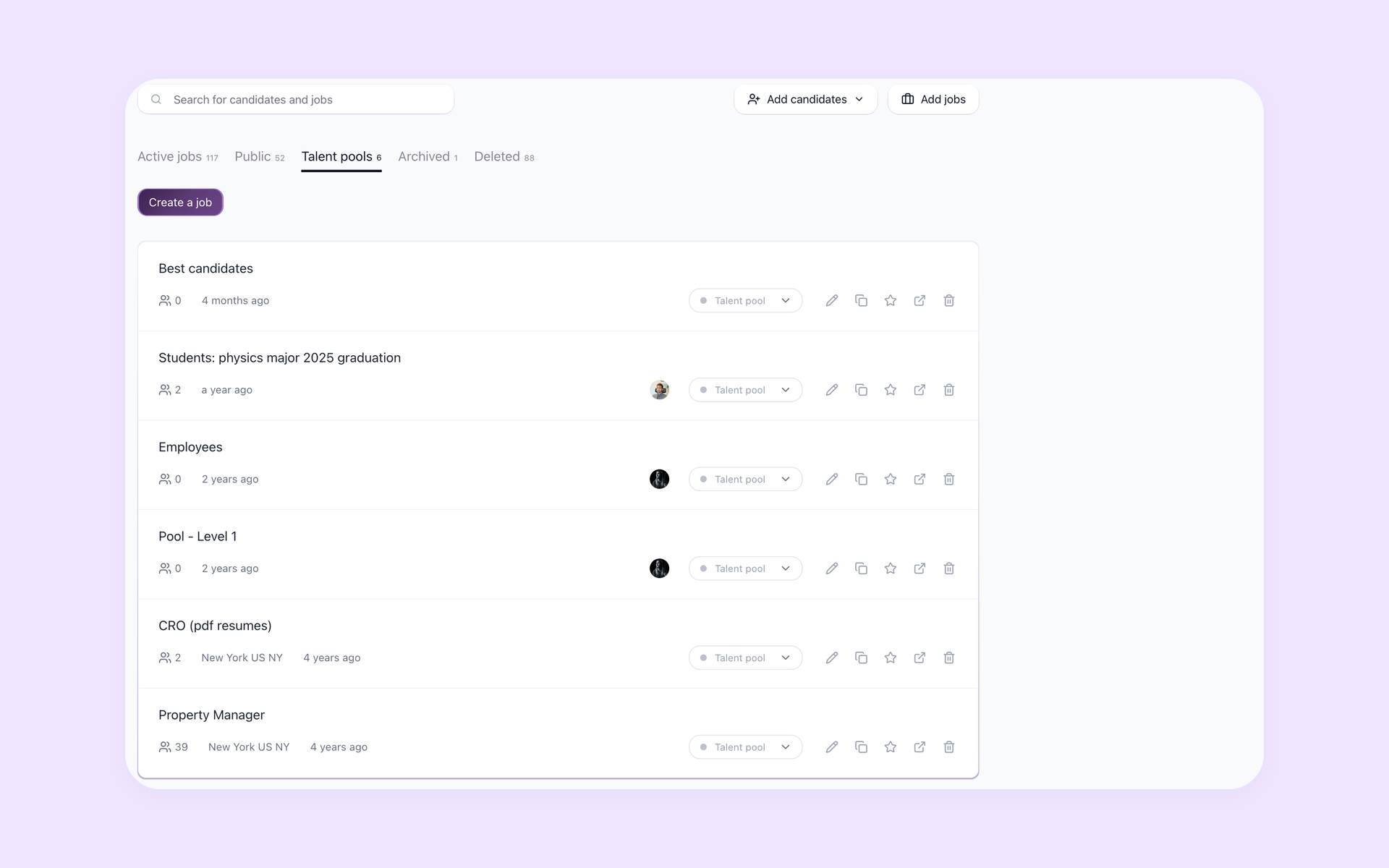
In 100Hires, Talent Pools hold sourced candidates for future roles, so this year's silver medalists are next year's shortlist instead of a lost InMail thread.
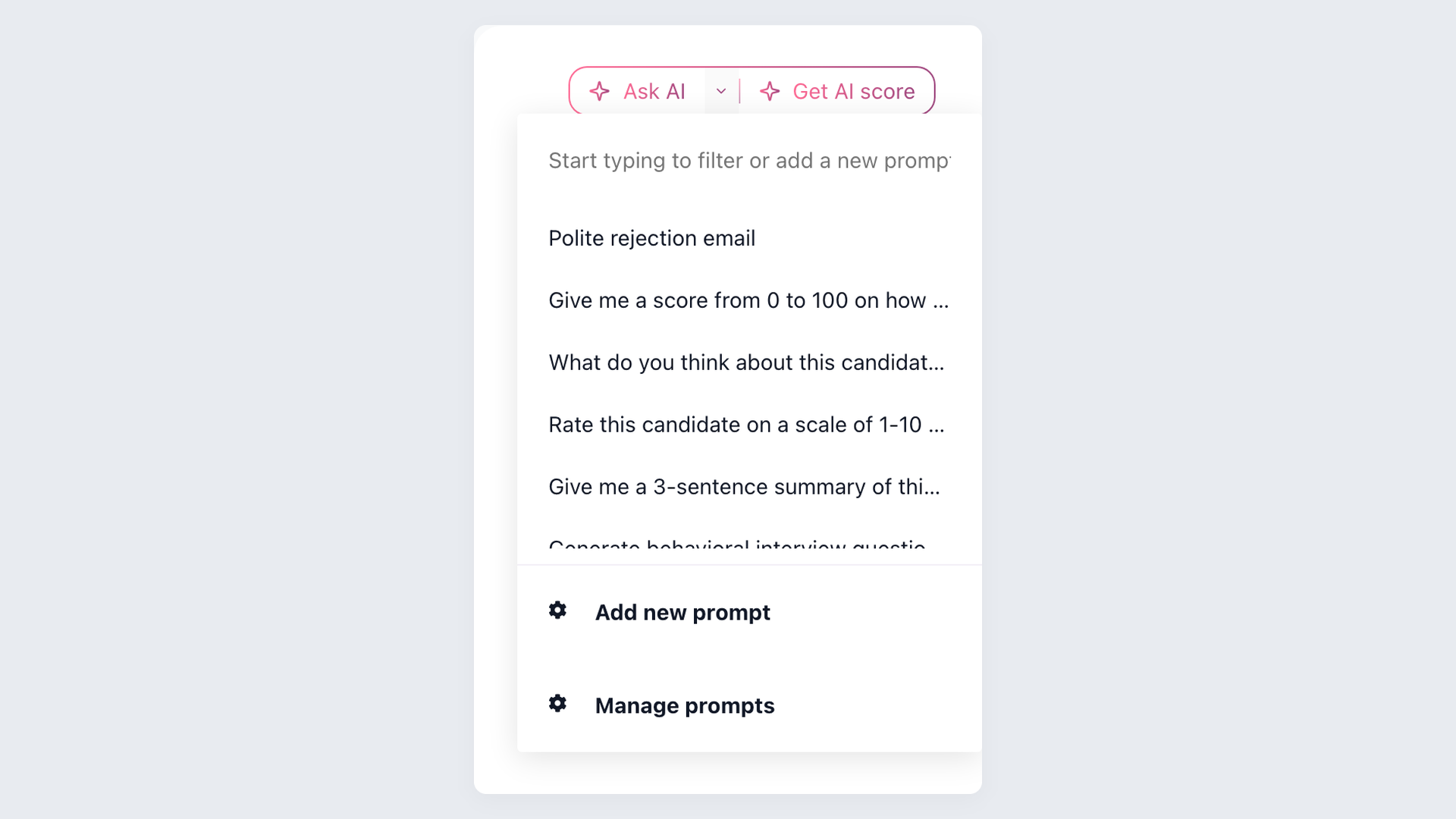
The rest of the stack replaces the duct tape Lite users describe on YouTube: ChatGPT tabs for message drafts, calendar reminders for follow-ups, spreadsheets for pipeline. AI Copilot drafts outreach and answers questions using information in the candidate's record.
AI Score ranks inbound applicants in your ATS as they apply. Trackable links show which sourcing channel converts.
A Chrome extension imports LinkedIn profiles with email enrichment, and recruiters we work with consistently see better reply rates on personal email than on LinkedIn messages.
For the cost comparison, one customer story does the math better than we can: how L&W Recruiting retired a $10K/year LinkedIn seat.
In Jeff Roberts' words: "10 grand a year, that's just a LinkedIn account, which I don't feel the need to have at this point." His jobs now reach Indeed and LinkedIn through 100Hires, and the seat is gone.
To be clear about limits: 100Hires does not replicate LinkedIn's search index, and there is no free plan. 100Hires pricing starts at $99 a month ($49 a month billed annually) with a 14-day trial.
If you mainly use Recruiter for posting jobs and storing candidates, compare that cost against a dedicated ATS. If you depend on Recruiter search every day, keep it and pair it with 100Hires.
FAQ
Is LinkedIn Recruiter Lite worth it?
Worth it for solo recruiters and small teams filling up to about ten roles a year within their extended network: $170/month buys 30 InMails, 20+ filters, and 3rd-degree search. Not worth it if you need full-network reach, collaboration, or data your company owns. Many Lite buyers pair the seat with an ATS like 100Hires so sourced candidates land in a company-owned pipeline with AI Score ranking applicants.
Does LinkedIn still have Recruiter Lite?
Yes. As of 2026, Recruiter Lite is sold self-serve as a monthly ($170) or yearly ($1,680) subscription with a 30-day free trial. Talk of it "shutting down" traces back to a 2021 product-line change, not a discontinuation. If you only need LinkedIn for job posting rather than sourcing, an ATS like 100Hires posts to LinkedIn's free listings plus 12 other boards without any Recruiter subscription.
How many job postings do you get with Recruiter Lite?
One free job post per seat purchased, up to five, running simultaneously. The often-quoted "one job per month" is wrong; LinkedIn's help center confirms the per-seat rule. Each post still follows free-post mechanics, including the 14-day pause from search results. Teams that need more posting reach use 100Hires to distribute one job to LinkedIn and 12+ other boards at once, with no per-board fee.
What is the difference between LinkedIn Recruiter and LinkedIn Premium?
LinkedIn Premium (Career at $39.99/month, Business at $69.99/month) is a networking subscription with 5 or 15 InMails and no hiring workflow. Recruiter products (Lite at $170/month and full Recruiter priced by quote) add recruiter filters, candidate projects, 30 to 150 InMails, and ATS integration with full Recruiter. For managing applicants, an ATS such as 100Hires covers the pipeline side at $99/month with any LinkedIn plan.
Can Recruiter Lite integrate with an ATS?
No. Recruiter System Connect, LinkedIn's ATS integration layer, is available only on full Recruiter contracts. With Lite, sourced candidates are exported or entered by hand. A common setup is Recruiter Lite for sourcing plus 100Hires as the system of record: its Chrome extension imports LinkedIn profiles with contact enrichment, and its job posting pushes openings to LinkedIn's free listings automatically.
Try 100Hires for free
No credit card. 14-day trial. Forbes Advisor #1 ATS for SMBs.