
Hireology Competitors & Alternatives in 2026: Multi-Location Hiring Compared

Hireology is built for a specific kind of company: multi-location businesses hiring hourly and skilled staff across many sites, with retail automotive and healthcare as its strongest verticals. It serves more than 10,000 businesses and holds a 4.5 out of 5 average.
That focus is the reason it works well for the companies it fits, and the reason the wrong buyers end up looking for alternatives.
Most searches for Hireology alternatives come from one of three places: the price at your location count, integration friction with the systems you already run, or hiring managers at individual sites who will not use it.
What Hireology costs
The hiring playbook, in your inbox
One email a week - benchmarks, AI screening tactics, and short interview templates from the 100Hires team. No product pitches.
Hireology does not publish rates. Its pricing page, checked on 5 August 2026, describes packages without numbers and routes you to sales.
Third-party pricing research puts the entry tier around $249 per month, with higher tiers reaching roughly $499 per month. Treat those as directional: this is a quoted product, and multi-location pricing generally scales with locations, users or both.
That is the first question to settle before comparing anything. Ask whether your quote scales by location, by user, or by hiring volume. A twelve-site dealer group and a twelve-person head office can receive very different numbers for the same nominal plan
and the scaling mechanism determines what your bill looks like in two years, not the headline rate.
What users report, ranked by frequency
Hireology has a substantial review base, a large Capterra review base. Aggregated review mining puts the complaints in a consistent order, and the ranking is more useful than any single review because it tells you which frictions are common rather than personal.
- Integration difficulty, the top complaint. Connecting Hireology to existing HRIS and ATS systems is repeatedly described as harder than expected. For a multi-location business with payroll and scheduling already in place, this is the one to test first.
- Interface complexity, and specifically that hiring managers find it confusing. In a distributed model your users are site managers, not recruiters, so this matters more here than it would elsewhere.
- Email deliverability. Messages sent through the system landing in spam or being missed. In hourly hiring, where response windows are short, a candidate who never sees your email is a lost hire.
- Reference-check constraints. Limits on modifying or finalising reference checks once started.
- Report delivery delays, which slows decisions in a process that depends on speed.
- Limited personalisation of automated messages, and cost concerns, around 4.
- Learning curve, mobile limitations and fraud-detection false positives. The last one is worth noting if your sites share devices or connections, since that is what tends to trigger it.
The strengths are equally clear and worth weighing against the above.
Reference checking is the single most-praised capability, described as saving substantial time against chasing referees directly, followed by better-informed hiring decisions.
Read those two lists together and a pattern emerges: Hireology is strong at structured, repeatable screening and reference work, and weaker at fitting into a stack you already own and at being pleasant for occasional users.
Company background
Hireology was founded by recruiting professionals who built the product around distributed hiring rather than corporate recruiting.
Its purpose-built retail automotive offering is the clearest expression of that: dealer groups hiring technicians, advisors and sales staff across many rooftops have workflow needs that a general ATS does not address.
That specialisation is a genuine advantage and a genuine constraint. If you are a dealer group or a multi-site healthcare provider, a vendor that already understands your hiring shape saves months.
If you are a single-site company or an office-based business, you are paying for vertical depth you will not use.
The multi-location questions a generic comparison will not ask
Multi-location hiring breaks most ATS evaluations because the buyer and the user are different people. Head office signs the contract; site managers do the hiring. Five questions surface that gap before you commit.
- Can a site manager run a hire end to end without calling head office? Post, screen, schedule, offer. If any step routes back to a central team, your locations will work around the system rather than in it.
- What does a manager see, and not see, across other sites? Some businesses want managers sharing a candidate pool across nearby locations; others need strict separation. Both are legitimate, and the default rarely matches either.
- How are candidates routed when someone applies to the wrong site? In hourly hiring this happens constantly. Manual reassignment at volume is a real administrative cost.
- Does reporting roll up by region and by role? Head office usually needs both dimensions, and per-site reporting that cannot aggregate is the most common gap.
- What happens on mobile? Site managers are rarely at a desk. Limited mobile functionality is a documented complaint here, so test it on a phone rather than on a laptop demo.
Answer those five with the vendor's actual product rather than their pitch deck, and the shortlist usually narrows to two.
Speed matters more than features in hourly hiring
One consideration outranks almost every feature comparison in this segment: time to first contact.
Hourly candidates commonly apply to several employers in the same sitting and accept the first credible offer, so a system that responds in minutes beats a better-featured system that responds in days.
Two of the complaints above bear directly on that. Emails landing in spam and delayed report delivery both extend the gap between application and contact, and both are worth measuring rather than assuming.
Before you evaluate anything, get the current number from your own data: median hours from application to first human contact, by location. Then hold every vendor to improving it. If a demo cannot show you how it would, the features do not matter.
Which problem are you solving?
| Your situation | Shortlist | Why |
|---|---|---|
| Multi-location hourly hiring, price is the issue | WizeHire, CareerPlug, Workstream | Same buyer, different cost structure |
| Very high hourly volume | Fountain, Paradox | Built for throughput and automated screening |
| Integration friction with your HRIS | Whichever your HRIS already integrates with | Ask the HRIS vendor first, not the ATS vendor |
| You are actually a single-site or office business | 100Hires, JazzHR, Breezy HR | You do not need multi-location machinery |
| Hiring managers will not adopt it | Pinpoint, Teamtailor | Strongest hiring-manager experience |
Alternatives worth shortlisting
CareerPlug
The closest competitor on positioning: franchise and multi-location SMB hiring, with a strong presence across franchise brands. Quote-only with a twelve-month billing commitment, so confirm the term before you compare monthly numbers.
WizeHire
Aimed at small businesses that want guidance as well as software, with hiring coaching alongside the ATS. A reasonable fit if your site managers need help writing adverts and structuring interviews rather than just a system to log candidates in.
Fountain
Purpose-built for high-volume frontline and hourly hiring, with automated screening, scheduling and mobile-first candidate flows. Quote-only. The right answer if your bottleneck is throughput rather than structure.
Paradox
Conversational AI for screening and scheduling, strong in hourly retail, hospitality and logistics. Quote-only. Different mechanism from Hireology, same objective of removing manual screening from site managers.
Workable
Published pricing at $299, $599 and $719 per month in the 1 to 20 employee band, plus add-ons for texting ($89), video interviews ($109), assessments ($59) and performance ($39). Texting matters for hourly hiring, so price that add-on in rather than out.
Widest job-board reach in this group.
BambooHR
Worth naming because multi-location businesses often want HR records and hiring together. Publishes $10, $17 and $25 per employee per month, with a flat rate from $250 per month at 25 employees or fewer. Its hiring module is lighter than a dedicated ATS.
JazzHR and Breezy HR
The transparent-pricing options for smaller operations: JazzHR at $1,000 to $5,508 a year, Breezy with a free tier and paid plans from $157 per month. Neither is built for multi-location hiring specifically.
100Hires
Published plans from $49 per month with AI screening included. Detail and honest limits below.
Our verdict
If you are a dealer group or multi-site healthcare provider and it works, stay and negotiate. Vertical fit is worth real money, and the vendors that understand automotive or clinical hiring at site level are few. Take a competing quote to renewal rather than starting a migration.
If integration is the complaint, solve it from the other end. Ask your HRIS, payroll and background-screening vendors which applicant tracking systems they support natively.
That list eliminates options faster than any feature comparison, and integration friction is the single most-cited problem with this product.
If site managers will not use it, that is an adoption problem before it is a vendor problem. Test any replacement with an actual site manager, not a recruiter, and watch them complete a full hire unaided.
Interface complexity for hiring managers is the second most-cited complaint here, and it is the one most likely to repeat elsewhere.
If your email deliverability is poor, check before you switch. Sender authentication and domain configuration cause more of this than the platform does, and it follows you to the next system if unfixed.
Where 100Hires fits, and where it does not
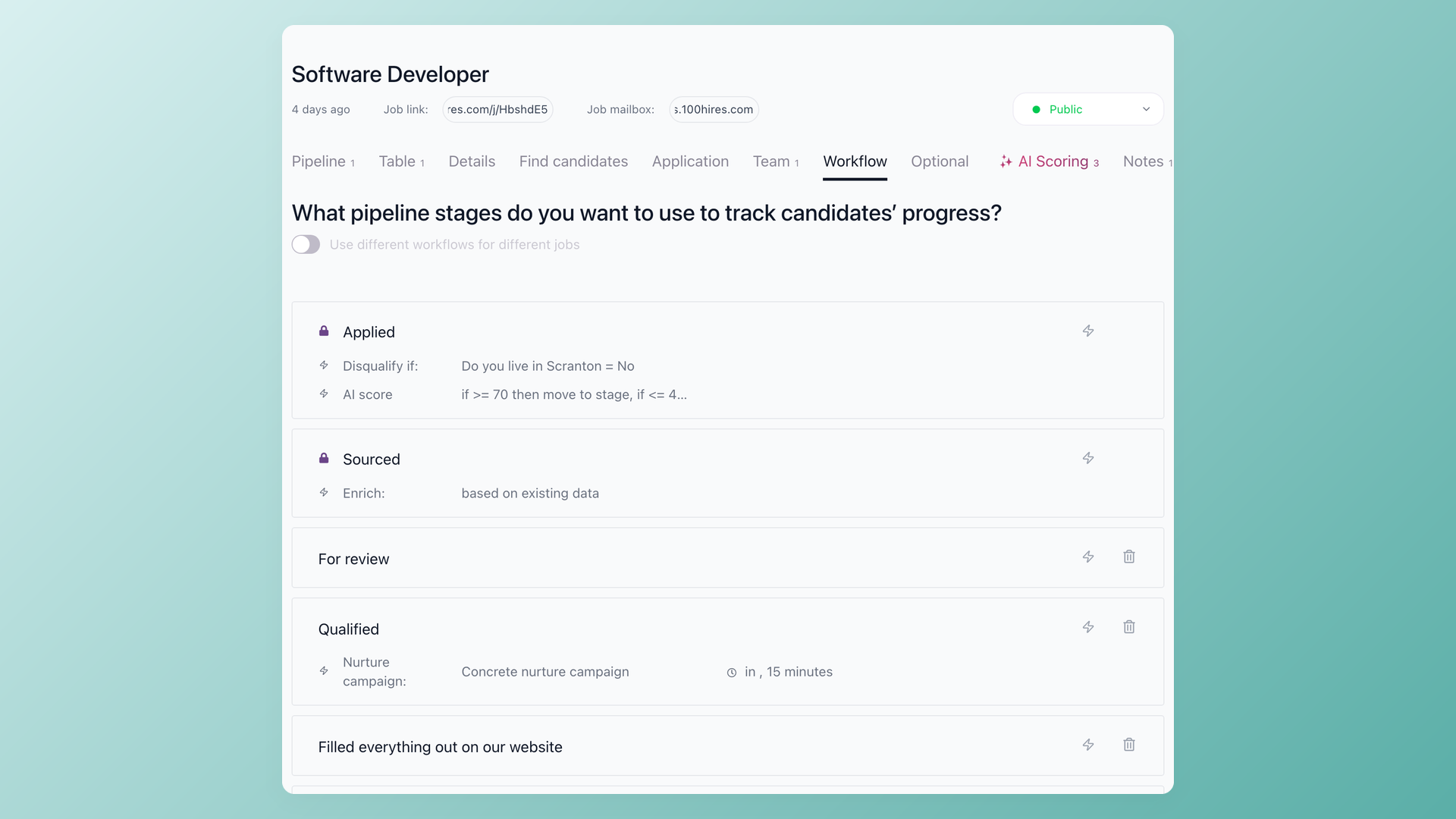
100Hires is an applicant tracking system for small and mid-sized in-house teams. Start is $49 per month billed annually ($99 monthly) for up to 100 candidates a month.
Advanced at $199 annually ($249 monthly) covers unlimited jobs, candidates and users, plus automated emails, a custom domain and knockout questions. Pro at $399 annually ($499 monthly) adds sourcing and contact enrichment.
Capterra rating is 4.9 from more than 1,100 reviews as of July 2026.
100Hires is the wrong choice if:
- You hire across many locations with site-level workflows. Per-location permissions, rooftop reporting and manager hierarchies are what Hireology and CareerPlug are built for, and they do it better than we do.
- You need automated reference checking. That is Hireology's most-praised capability. We do not provide it natively.
- You are hiring at genuine hourly volume. Fountain and Paradox are built for that throughput and will outperform a general ATS.
- You need retail automotive or clinical-specific workflows. Vertical depth is a real product feature, not marketing.
- You want HR records and hiring from one vendor. BambooHR or a similar HRIS covers that; we do hiring only.
Where we fit is the company that bought multi-location hiring software and turned out to be a single-site or office-based business. See 100Hires pricing or start a free trial. For the closest comparisons, see our CareerPlug alternatives and Fountain alternatives guides.
Frequently asked questions
How much does Hireology cost?
Hireology does not publish rates and quotes each customer. Third-party pricing research puts the entry tier around $249 per month and higher tiers around $499 per month, but multi-location pricing generally scales with locations, users or both. The important question is which of those your quote scales on, because that determines your cost in two years rather than the headline monthly figure.
Who is Hireology actually built for?
Multi-location businesses hiring hourly and skilled staff across many sites, with retail automotive and healthcare as its strongest verticals. It serves more than 10,000 businesses. If you are a single-site company or an office-based business, you are paying for vertical depth and multi-location machinery you will not use, which is the most common reason the wrong buyers go looking for alternatives.
What do users complain about most?
Integration difficulty with existing HRIS and ATS systems is the most frequent complaint, followed by an interface that hiring managers find confusing, and emails sent through the system landing in spam. Reference-check constraints, report delivery delays and limited personalisation of automated messages follow. Its most-praised capability by a wide margin is automated reference checking.
What is the closest alternative to Hireology?
CareerPlug is the closest on positioning, serving franchise and multi-location SMB hiring, though it is quote-only with a twelve-month billing commitment. WizeHire suits smaller operations that want coaching alongside the software. If your real problem is hourly hiring volume rather than multi-location structure, Fountain and Paradox are built for that specifically.
Should I switch if hiring managers will not use the system?
Test the replacement with an actual site manager before deciding. Hiring-manager interface complexity is among the most-cited complaints about Hireology, and it is also the complaint most likely to repeat with a different vendor, because the underlying problem is that occasional users will not learn any system. Watch someone complete a full hire unaided in a trial, and treat that as the deciding evidence.
Try 100Hires for free
No credit card. 14-day trial. Forbes Advisor #1 ATS for SMBs.