Ashby vs Lever 2026: analytics-first vs CRM-first ATS, compared - 100Hires
Ashby and Lever are both premium recruiting platforms aimed at startups and scale-ups, but they solve two different problems. Ashby is analytics-first, built for teams that want to measure every step of hiring.
Lever is CRM-first, built for teams that nurture long-term relationships with candidates over long hiring cycles.
This guide compares them on pricing, analytics, sourcing, AI, support, and migration, and it shows where each one falls short.
This comparison draws on both vendors' own docs, review sites, practitioner discussions, and our own demo calls with teams evaluating these platforms or moving off Lever.
One difference most comparison pages skip: Ashby is an independent, venture-backed company, and Lever is one of three sibling brands owned by Employ Inc. That shapes what you are buying in ways we get into below.
Ashby vs Lever at a glance
The hiring playbook, in your inbox
One email a week - benchmarks, AI screening tactics, and short interview templates from the 100Hires team. No product pitches.
The table adds 100Hires, our own ATS, as a third column. Neither Ashby nor Lever offers a free trial, and Lever hides its pricing, so smaller teams weighing the two often want a leaner third option. More on that at the end.
| Criterion | 100Hires | Ashby | Lever |
|---|---|---|---|
| Best for | SMB and startup teams up to ~200 employees | data-driven tech teams, 50-500 employees | nurture-led mid-market teams, 100-1,000 employees |
| Core strength | AI scores that trigger automations, public pricing | analytics that replace a BI tool | built-in candidate CRM and nurture |
| Pricing model | published, flat per-plan | published entry, seat-based above it | quote-only, per-seat |
| Entry price | $49/mo (Start, billed annually) | $400/mo (Foundations, up to 100 employees) | custom quote (buyer-reported ~$7,000/yr and up) |
| Free trial | 14 days, no card | none | none |
| Analytics | built-in reports and AI Score | best-in-class, deepest tiers cost extra | pre-built dashboards, 4-6 hour refresh lag |
| CRM and nurture | talent pools and outreach | native sourcing, less passive nurture | LeverTRM, its home turf |
| AI approach | 0-100 AI Score with threshold automations | Meets or Does Not Meet per criterion | numeric Talent Fit, IBM watsonx governance |
| Ownership | independent | independent, VC-backed | Employ Inc (with Jobvite, JazzHR) |
| G2 rating | 4.8 (1,341 reviews) | ~4.7 (107-114 reviews) | 4.3 (2,117 reviews) |
| Implementation | same day | 2-4 weeks, self-serve | 2-3 weeks |
Here is the 30-second version. Ashby was built analytics-first, so its reporting engine is the foundation, not a bolt-on. Lever was built CRM-first, so nurturing long-term relationships with candidates is native, not an add-on.
Pick Ashby if reporting depth will change your hiring decisions and someone on your team owns configuration. Pick Lever if candidate nurture sits at the center of how you hire. Look for something leaner if both feel over budget or over-built for your size.
That split shows up everywhere, from two independent practitioner reviews to Google's own AI summary, which is why the rest of this guide goes past it.
Who owns each platform, and how big a team each fits
Ashby is independent and venture-backed. It came out of Y Combinator, raised a $50M Series D in July 2025, releases product updates close to weekly, and reports 4,000+ customers. One company, one product, full attention on it.
Lever has been owned by Employ Inc since August 2022, alongside JazzHR and Jobvite. You are buying one of three sibling products that share a pooled roadmap. Some Lever customers report slower innovation and support changes since the acquisition.
On Reddit, buyers rarely name Employ Inc at all. They describe it by feel instead: a company that got bought out a few years ago and has drifted since.
There is a counterpoint, though. Employ appointed a new CEO in February 2026 and a new CTO days later, and it now ships shared AI scoring and identity-verification features across all three brands at once. The parent is investing, not just consolidating.
A shared roadmap cuts both ways.
Size is the next filter. Neither tool is the default early-stage pick anymore. In a 2026 census of 800+ startups by hiring-data tracker ConnectHum, 335 of them used Ashby and 97 used Lever, a directional read from one vendor's methodology, but a telling gap.
| Company size | The realistic pick | Why |
|---|---|---|
| Under ~50 employees | Neither, honestly | Both are premium annual contracts built for more structure than you have. This is the lane a leaner tool covers. |
| 50-200, scaling tech startup | Ashby | Its sweet spot, if analytics drive your decisions and someone owns admin. |
| 100-1,000, nurture-led | Lever | Its sweet spot, with a soft ceiling near 150-200 hires a year. |
| 500+, or high hiring volume | Look wider | Both strain past roughly 150-200 hires a year. This is where teams start weighing Greenhouse or Workday. |
Both increasingly compete for the same 50-500-employee market, just from different starting prices. Ashby starts from a published $400 a month, Lever from a sales-led quote.
Ashby: what it does well and where it frustrates teams
Best for: 50-500 employee tech teams that will use analytics every week and have someone to own admin. If that sounds like a stretch, weigh some Ashby alternatives before you commit.
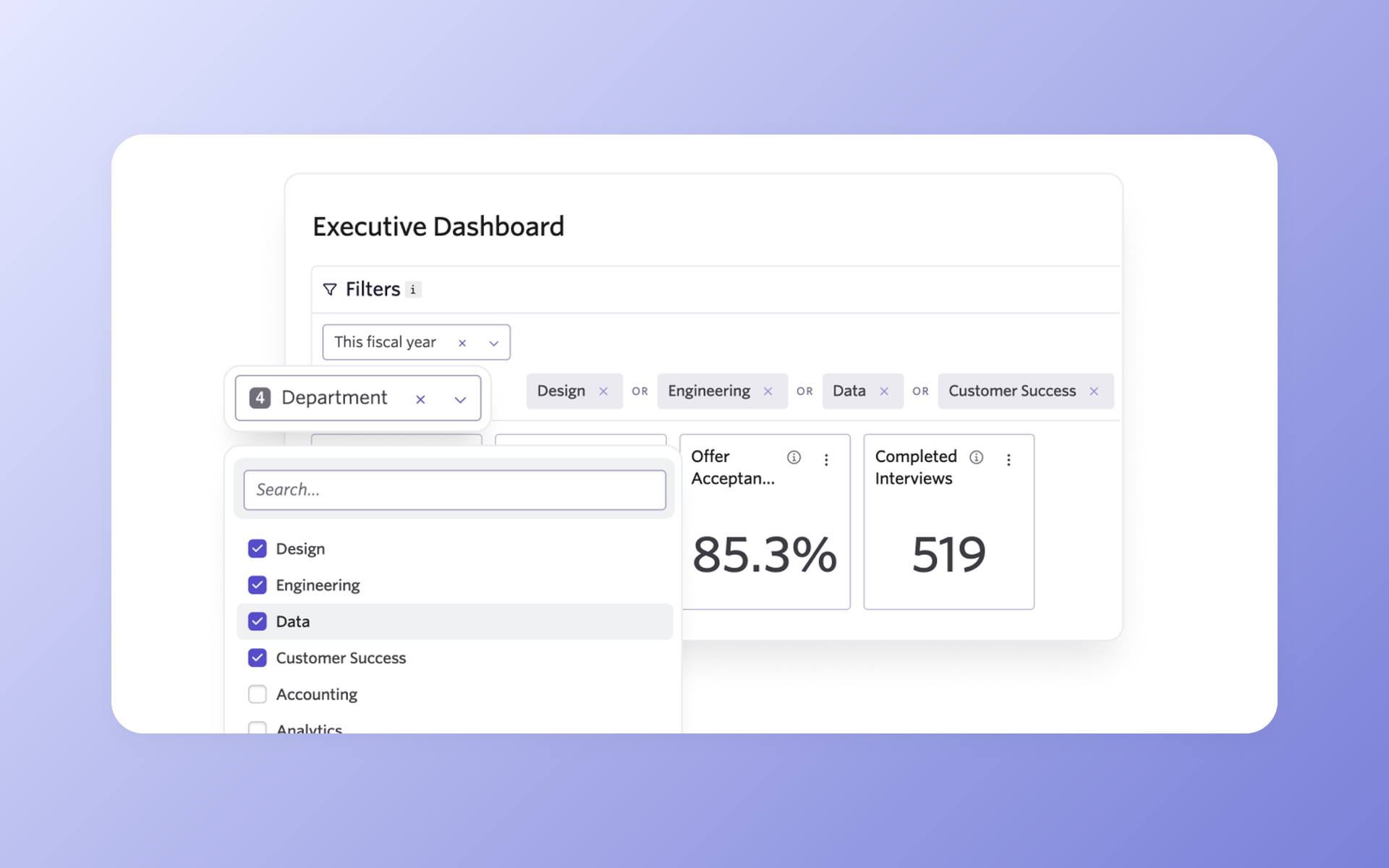
Ashby's strongest card is analytics that genuinely stand in for a business-intelligence tool. You can build a report on almost any field and assemble dashboards with no export to a separate platform. This is the single most-cited advantage across every source we read.
It replaces several separate tools, too. Teams that switch often drop Calendly, a standalone sourcing tool, and their scheduling integrations, since Ashby handles those natively.
One widely-cited reviewer calls its AI-native sourcing Chrome extension the best ATS extension they have tested, and Ashby releases updates nearly every week.
The friction is real and worth knowing before you sign. Ashby has a steep learning curve.
One reviewer counted 14 tabs in the interview-scheduling settings alone, and buyers describe layers of configuration nested inside other layers, enough that a dedicated recruiting-ops owner often ends up managing it.
Then there are the features locked to higher tiers, which surprise teams on the entry plan. Per Ashby's own docs, custom candidate and job fields, custom dashboards, and quality-of-hire reports all require the Plus tier or higher.
Conditional emails and global application questions sit at the Enterprise level. A Foundations customer can hit that wall fast.
Filter design draws complaints too, though the common "no boolean search" claim is outdated. Ashby has shipped boolean operators; the gripe now is that its nested-dropdown filter UX feels clunkier than a plain boolean field.
Onboarding gets mixed marks: Ashby markets dedicated customer success and fast implementation, and some buyers rave about it, yet others report rough onboarding and thin post-migration support. Verify the support terms for your plan.
Verdict: Ashby is the pick when reporting depth changes decisions and you have an admin owner. Skip it if your team wants a simple system, or your headcount is about to triple faster than your patience for configuration.
Lever: what it does well and where it frustrates teams
Best for: 100-1,000 employee teams whose pipeline runs on candidate nurture and who want hiring managers to adopt the tool without training. If nurture is not your bottleneck, a few Lever alternatives may fit better.
Lever's best trait is an intuitive interface that hiring managers actually adopt in days rather than weeks. Its native ATS-plus-CRM data model is the real draw: nurture campaigns, talent pools, and multi-channel outreach come built in, not bolted on.
Lever answered a real question early, why buy a separate CRM to nurture candidates you already met, and LeverTRM still owns that answer.
It offers a public integration marketplace you can browse without a sales call, provides 24/7 support, and gets strong implementation marks: 95% of Capterra implementation mentions are positive, with teams going live in two to three weeks.
Third-party integrations can fill gaps, too.
One team we found stayed on Lever precisely for that reason: a partner integration improved their day-to-day workflow enough to make switching unnecessary.
Reporting is the loudest complaint. About 38% of Capterra reporting mentions are negative, Visual Insights dashboards can lag four to six hours before they refresh, and you can only share a dashboard as a PDF, PNG, or JPEG.
Reviewers have described Data Explorer, Lever's deeper reporting layer, as an extra-cost add-on, though Lever's current page lists it as included in every subscription. The packaging appears to have changed, so confirm it in your quote.
Other gaps come up often: no native sourcing and weak resume parsing, a per-seat price that raises costs for teams with many occasional users, no mobile app, and no way to reschedule a self-booked interview without deleting and rebooking it.
Our own demo calls add fresh detail. Teams looking to move off Lever tell us support is slow to resolve issues, and they cannot pull time-to-hire or time-to-fill data without spreadsheet gymnastics.
One recruiting lead described Lever's 2026 support change: support moved out of the base contract into a ticketing system with pre-designated contacts, and her team could not file a ticket when they got locked out.
That specific pain showed up only in our calls, nowhere in the public reviews.
Verdict: Lever fits teams where candidate nurture is central and hiring-manager adoption matters more than reporting depth. Look elsewhere if same-day reporting or a mobile app is a must-have.
Feature-by-feature: who wins each category
The at-a-glance table covers the highlights. Here is who takes each category, and why.
Analytics and reporting
Ashby lets you build a custom dashboard from almost any field and measure quality of hire with no external BI tool, though the deepest dashboards sit on the Plus tier.
Lever offers solid pre-built reporting, hampered by a four-to-six-hour refresh lag and image-only sharing (PDF, PNG, or JPEG, no live link).
Winner: Ashby, and it is not close.
CRM, sourcing, and candidate nurture
This is Lever's home turf: native nurture campaigns, talent pools, and multi-channel outreach in one data model. Ashby counters with strong native sourcing automation and that standout Chrome extension, but fewer tools for nurturing passive candidates over time.
Winner: Lever for nurture-led teams, Ashby for active outbound sourcing.
Interview scheduling
Here is a rare fact both vendors confirm on their own pages. Lever includes panel scheduling and candidate self-book links in the core subscription. Ashby's auto-scheduling and calendar holds are a paid add-on or an Enterprise feature.
The catch on Lever's side: rescheduling a self-booked interview means deleting it and starting over. Winner: Lever, for bundling scheduling into the core plan; Ashby, for more depth once you pay for the add-on.
AI approach
This is where the two genuinely part ways. Ashby's AI-Assisted Application Review returns a plain "Meets" or "Does Not Meet" for each criterion you set, with no numeric rank, and its auto-reject rules fire only at the moment a candidate applies.
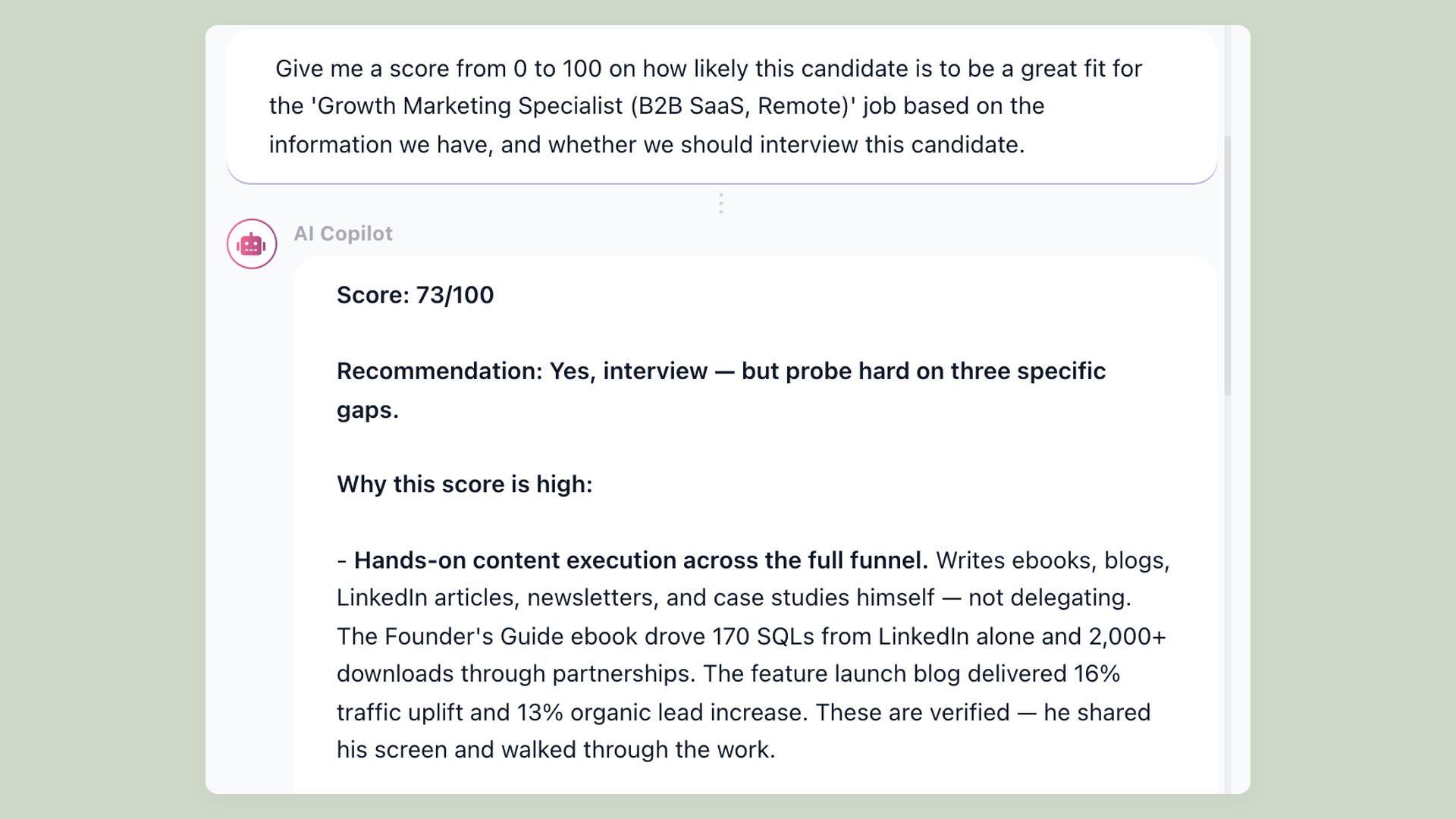
Lever's Talent Fit shows numeric fit scores, wrapped in IBM watsonx governance. A third approach exists: a 0-100 score that can trigger threshold-based automations, which we come back to below. Winner: it depends on your philosophy.
Ashby keeps a human in the loop by design; Lever gives you scored shortlists with a governance layer.
Pricing transparency and support
Ashby publishes a real entry number, $400 a month for Foundations, and has held it for about a year. Lever's pricing page shows no figures at all; you request a quote. Neither offers a free trial.
On support, both market it hard, Ashby with dedicated customer success and professional services, Lever with 24/7 coverage and those strong implementation marks.
Independent reports diverge on both, and one team told us a 2026 Lever change moved support out of the base contract, so read the fine print before you sign. Winner: Ashby on pricing transparency; support is a draw on paper.
Ashby vs Lever pricing by team size
Every figure below is labeled as published, buyer-reported, or quote-only, so you can tell a rate card from a negotiated estimate. Confirm any non-published number in your own quote.
| Team size | 100Hires (published) | Ashby (published + buyer-reported) | Lever (quote-only, buyer-reported) |
|---|---|---|---|
| ~10 employees | $49/mo, Start plan | $400/mo, Foundations | ~$7,000/yr |
| ~50 employees | $199/mo, Advanced | $400/mo, Foundations (covers up to 100 employees) | ~$7,500-12,000/yr |
| ~200 employees | $399/mo, Pro | seat-based, hiring managers count (~$14,600/yr average SMB contract) | ~$12,000-19,000/yr |
| ~500 employees | custom | ~$59,000/yr and up | ~$37,000-72,000/yr (up to $125,000+) |
Ashby's entry price is the transparent one, but the renewal is where teams get surprised. It charges roughly $800 per "elevated seat" per year, and every hiring manager counts as a seat, not just recruiters.
One company that grew from 10 to 150 employees faced a renewal of $24,000 to $28,000 for that reason, and buyers report year-over-year increases anywhere from 15% to 90%.
Lever stays quote-only from end to end, with per-seat pricing that climbs as more people touch the system. Buyer-reported contracts run from about $7,000 a year for small teams to well past $125,000 for enterprise.
The 100Hires column is there for contrast: published flat-rate plans starting at $49 a month billed annually.
Switching from Lever or Ashby: what migration really involves
Most pages ranking for this comparison skip migration, yet "Ashby migration" is a common follow-up search. Two public accounts, a recruiter who spent four years on Lever and a talent team documenting its move at Nord Security, fill in what the vendor demos leave out.
Moving to Ashby: its migration API pulls your candidate records across, the clean and the messy alike, so a cluttered instance arrives one-to-one.
Email threads and templates do not carry over, a limit on the Lever side, and job templates, interview plans, and automations get rebuilt from scratch. Stage order cannot be reordered once set, since Ashby ties it to reporting integrity.
Teams go live in about two weeks, though the setup is largely self-serve, so plan to drive it yourself. If you are weighing this move, our guide to switching from Ashby covers the mechanics from the other direction.
Leaving Ashby is the harder door. On the Foundations plan there is no self-serve bulk export, the CSV report export sits behind the Plus tier, and bulk resume export needs a support ticket. That asymmetry is exactly why some teams describe export friction.
And migration stories run both ways: some recruiters love Ashby within weeks, others regret the move just as fast, so a trial on real requisitions beats any single testimonial.
Who should choose Ashby, and who should choose Lever
Choose Ashby if most of these fit:
- You are a 50-500 employee tech team that will use analytics every week
- You want one platform instead of a Calendly-plus-sourcing-plus-BI stack
- You run heavy active outbound sourcing
- Someone owns configuration, and you can absorb the learning curve and seat-based renewal math
Choose Lever if most of these fit:
- Candidate nurture and long-term talent pools are central to how you hire
- You want hiring managers using the tool with minimal training
- You are 100-1,000 employees hiring under ~150 people a year
- You can live with slower reporting and no mobile app
Read both lists and see a mismatch? If you need a lower entry price, less admin overhead, or AI scores that can trigger automations, there is a third path worth a look.
When neither fits: an AI-first, transparent-priced alternative
Full disclosure: 100Hires is our product, and it did not appear in any of the external sources we reviewed for this comparison. We include it for one reason. These two tools leave a specific kind of team without a good fit.
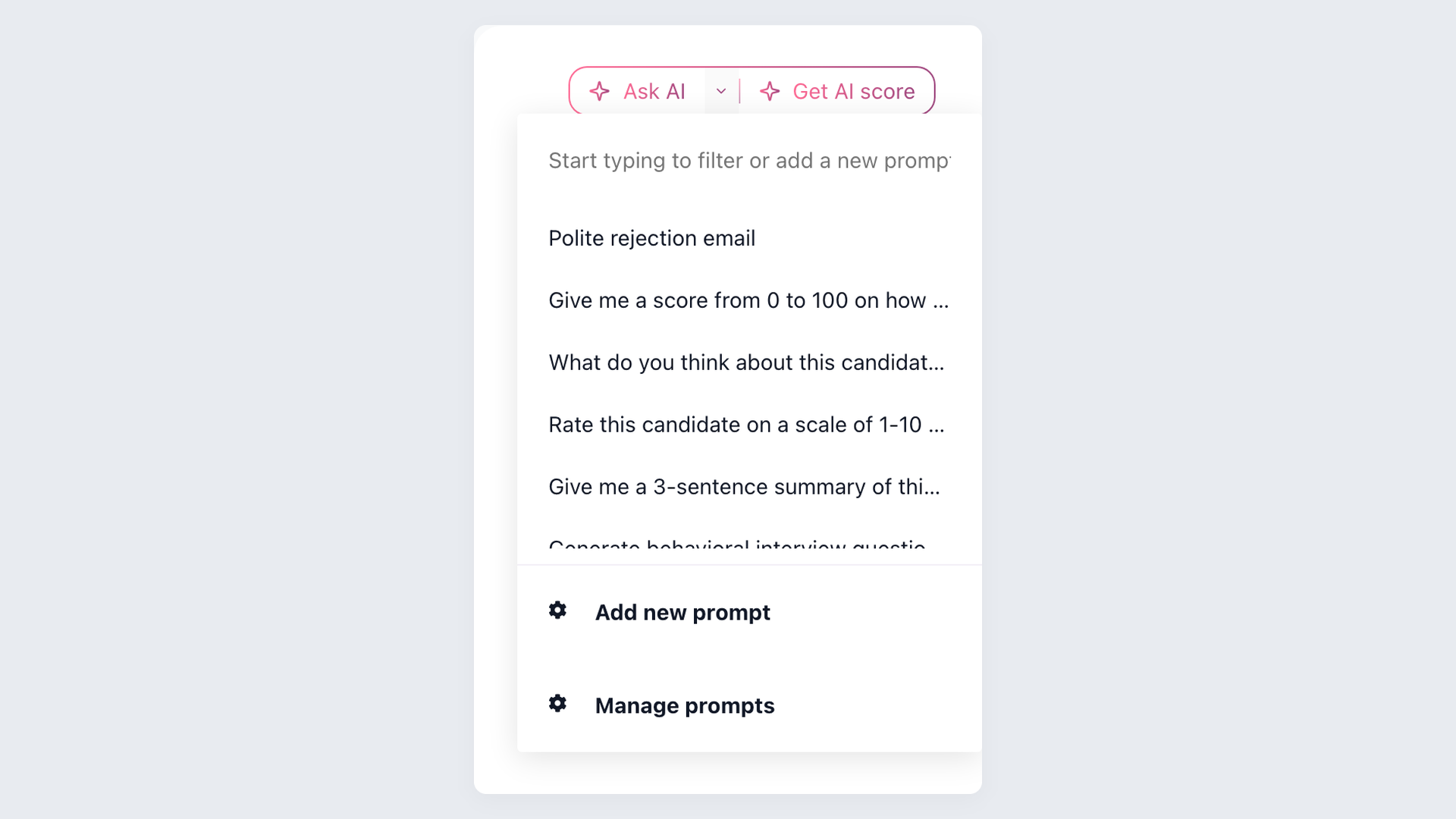
Teams that want AI scores that trigger automations, published pricing, and a 14-day trial, without a $400-a-month entry or a sales-call-gated quote, sit right between Ashby and Lever. That is the type of team 100Hires serves.
The specifics: a 0-100 AI Score, per criterion and total, with workflow automations that move or disqualify candidates when they hit a score threshold, at any step. Contrast that with Ashby's submission-only Meets or Does Not Meet, and Lever's governance-wrapped scores.
You get AI Copilot, published plans from $49 a month on Start (billed annually), and a 14-day trial. There is no free plan.
The honest limits. 100Hires is not built for 500-plus employee structured-hiring programs, its analytics are not as deep as Ashby's BI-grade dashboards, and it does not match Lever's CRM nurture depth. Its integration catalog is smaller than either tool's.
If your bottleneck is one of those, one of the two platforms above is the better call.
If it is not, check us independently on G2 or Capterra, then see 100Hires pricing or book a demo. Testing a tool against your live requisitions beats reading about it, including reading this.
Frequently asked questions
Is Ashby or Lever better for a startup?
For a scaling tech startup that will lean on analytics, Ashby is the stronger fit; for a team built around candidate nurture, Lever is. Under about 50 employees, though, both are premium annual contracts sized for more structure than an early team has, which is where a lower-priced tool like 100Hires fits, with AI screening and multi-board posting from $49 a month.
How much do Ashby and Lever cost?
Ashby publishes a $400-a-month Foundations entry price for up to 100 employees, then charges roughly $800 per elevated seat per year above it, with hiring managers counting as seats. Lever publishes no pricing at all; buyer-reported contracts run from about $7,000 a year to $125,000+. For a published rate card you can read without a sales call, 100Hires lists every plan from $49 a month billed annually.
Is Ashby an ATS?
Yes. Ashby markets itself as an all-in-one "hiring OS," which causes some confusion, but at its core it is an applicant tracking system that bundles CRM, sourcing, scheduling, and analytics on top. 100Hires is an ATS in the same category, built for smaller teams that want AI scoring and public pricing rather than an enterprise configuration project.
Should I compare Ashby and Lever with Greenhouse too?
Often, yes. Greenhouse is the third name most buyers weigh at 500-plus employees or when structured hiring and compliance matter most, so it is worth a look next to this pair. We break down both matchups in Ashby vs Greenhouse and Lever vs Greenhouse. If all three feel too heavy for your team, 100Hires is the lighter, AI-first option in the same space.
Does Ashby or Lever have better analytics?
Ashby, clearly. Its reporting engine is the foundation of the product and can replace a separate BI tool, though the deepest custom dashboards require the Plus tier. Lever's reporting is solid but slower, with a four-to-six-hour dashboard refresh. If you want AI-based scoring included on every plan rather than gated behind a tier, 100Hires builds a 0-100 AI Score into its base offering.
Can you switch from Lever to Ashby easily?
Ashby's migration API moves your candidate data across in about two weeks, but email threads and templates do not carry over, and job templates and automations get rebuilt from scratch. The setup is largely self-serve, so plan to drive it. If transparent, self-serve onboarding matters to you, 100Hires publishes its plans, gets teams started the same day, and offers a 14-day trial to test the switch before you commit.
Written by Alex Kravets, founder of 100Hires. Alex has spent over a decade building recruiting software and talking with hiring teams about the tools they actually use day to day.
Try 100Hires for free
No credit card. 14-day trial. Forbes Advisor #1 ATS for SMBs.