
Healthcare staffing software: 13 tools compared for agencies in 2026
Most healthcare staffing agencies hit the same wall early: credential spreadsheets, expiring licenses, and payroll timing get harder long before the ATS feels old.
This guide compares 13 healthcare staffing software options for agency owners: who each tool fits, what it costs where the vendor publishes a number, and what each one deliberately leaves out.
It is written for people running a healthcare or medical staffing agency: placing nurses, allied health professionals, or locum providers with client facilities.
If you are a hospital trying to manage multiple staffing vendors, you want a VMS, and we point you to that category below. If you are a clinician looking for shift apps, this is not that list either.
One thing to know before you read further: almost everything ranking for this keyword is written by a vendor that puts itself first. We build ATS software too, and our tool sits at #1 below. The difference is that every entry here lists what the tool does not do, ours included.
What healthcare staffing software is and which type you need
The hiring playbook, in your inbox
One email a week - benchmarks, AI screening tactics, and short interview templates from the 100Hires team. No product pitches.
Healthcare staffing software is the set of tools an agency uses to recruit, screen, place, and redeploy clinicians at client facilities. The term hides four very different product categories, and buyers mix them up constantly.
| Category | What it does | Who buys it | Examples |
|---|---|---|---|
| Front-office ATS/CRM | Recruiting, screening, placement pipelines, candidate re-engagement | Staffing agencies | 100Hires, Crelate, Zoho Recruit, Ceipal, JobDiva |
| Healthcare-native full suite | ATS plus credentialing, scheduling, and pay/bill in one system | Staffing agencies with contract volume | LaborEdge, BlueSky, Bullhorn Healthcare |
| Facility-side VMS | Lets a hospital manage many staffing vendors at once | Hospitals, health systems, MSPs | ShiftWise, Vemsta, Ringo |
| Scheduling and gig marketplaces | Shift filling, W-2/1099 float pools, worker apps | Facilities and clinicians | Connecteam, Shiftboard, ShiftKey, Nursa |
Only the first two categories belong in an agency's buying process. That is why apps like ShiftKey or Connecteam never appear in our ranked list: they solve a facility's shift problem, not an agency's placement problem.
Front office vs back office: the split that decides your budget
Every tool in this guide sits somewhere on one axis. The back office handles timesheets, payroll, and invoicing. The front office handles sourcing, screening, pipelines, and re-engaging past candidates: the part that decides how fast you fill an order.
The tension is real in healthcare. A placed nurse checks in and out at the facility, those hours drive your client invoice, and your payroll runs weekly against net-30 or net-60 receivables.
You either buy one suite that does all of it, or you pair a fast front-office ATS with the payroll system you already run. Both are legitimate. The mistake is paying suite prices for front-office needs, or the reverse.
The same logic applies across staffing agency software generally, but healthcare adds credentialing weight that generic tools skip.
Selling through MSPs changes what you need
In the operator interviews and staffing-industry podcasts we reviewed, the same shift came up repeatedly: more healthcare placements route through MSP programs rather than direct facility contracts.
MSPs score their vendors on submittal speed and credential completeness, and their credentialing rules often differ from what direct clients ask for.
Practical translation: a direct-hire or perm-heavy agency can often run recruiting in a plain ATS, as long as license checks and credential documents live in a defined workflow outside it.
An agency pushing travel or per-diem volume through MSP programs should ask every vendor how it handles per-client credential requirements and VMS connectivity.
A facility-side VMS is still a different purchase, even here.
Healthcare staffing software compared
In the pages ranking for this keyword when we checked, real side-by-side comparison tables were missing, so here is one. Ratings show the review count next to the score, and thin review bases are flagged rather than hidden.
| Tool | Best for | Category | Credentialing | Not included | Pricing | Reviews |
|---|---|---|---|---|---|---|
| 100Hires | Small agencies, perm + direct hire | Front-office ATS | Self-report knockout questions, pipeline stages | Credentialing compliance, scheduling, timesheets, payroll, invoicing, VMS | public $49-$399/mo flat (annual) | G2 4.8 (~1,300), Capterra 4.9 (~1,160) |
| Crelate | Boutique staffing and search firms | Front-office ATS/CRM | None native; Hire module adds onboarding docs | Full pay/bill, healthcare credential tracking | public $85-$119/user/mo | G2 4.4 (210) |
| Zoho Recruit (Staffing edition) | Budget-first small agencies | Front-office ATS/CRM | None native | Credentialing, back office; AI gated to top tier | public $25-$75/recruiter/mo (annual) | polarized reviews, large base |
| LaborEdge (Nexus) | Travel nurse and allied agencies | Healthcare-native suite | Native, tied to assignment requirements | Transparent pricing; heavier implementation | custom quote | G2 4.5 (50) |
| BlueSky Medical Staffing | Agencies and facility-side buyers | Healthcare-native suite | Native credential and compliance tracking | Transparent pricing | custom quote | G2 3.7 (11, thin) |
| Ceipal | Mid-market agencies with VMS volume | ATS + VMS integration | Native license and document workflows | No published pricing; onboarding heavier than micro-agencies need | custom quote | G2 4.6 (~1,500), Capterra 4.6 (~1,260) |
| JobDiva | Mid-market travel and per-diem shops | ATS + credential wallet | Healthcare Wallet, compact-license support | No published pricing; enterprise-skewed, dense UX | custom quote | G2 4.7 (~1,850), Capterra 4.5 (~1,180) |
| Avionté (BOLD) | Established general staffing firms | Staffing suite with back office | General staffing feature set, no healthcare edition | Healthcare-specific credentialing depth | custom quote | G2 4.3 (~400), Capterra 3.9 (~170) |
| Bullhorn (healthcare) | Large multi-vertical agencies | Enterprise ATS + healthcare layer | Credential portal, AI shift matching | SMB-friendly setup; add-ons priced separately | public $99-$165/user/mo entry, add-ons custom | G2 4.2 (~1,240) |
Five of the nine ranked tools publish no pricing at all. That is not an accident: quote-only pricing is the norm in this category, and it makes comparison shopping hard for a small agency. The transparent options are worth extra weight for that reason alone.
Want to test the front-office option first? Start a free 14-day 100Hires trial, no credit card needed.
How we picked these tools
We scored candidates on healthcare-staffing fit, small-agency practicality, pricing transparency, verified review footprint, implementation weight, and support for tracking state-level license requirements.
Tools needed at least 10 verified reviews on G2 or Capterra to be ranked; younger tools appear in the newcomers section instead.
The order favors small-agency fit and transparent pricing over raw market presence. Enterprise incumbents rank lower on purpose: they are strong products, but often too heavy for very small agencies unless contract volume justifies the implementation and add-on cost.
Full disclosure: 100Hires publishes this guide and builds the tool ranked first. In our research across search results, Reddit, YouTube, LinkedIn, and podcasts, 100Hires had zero independent third-party mentions for this exact category.
It earns the spot on fit and price, and its limitations sit in the same table as everyone else's. Judge accordingly.
The 9 best healthcare staffing software tools for agencies
Each entry below covers the healthcare-staffing fit, the strengths, the honest limitations, and the price where one exists. Start with the limitations: they reveal fit fastest.
1. 100Hires: front-office ATS for small healthcare staffing agencies
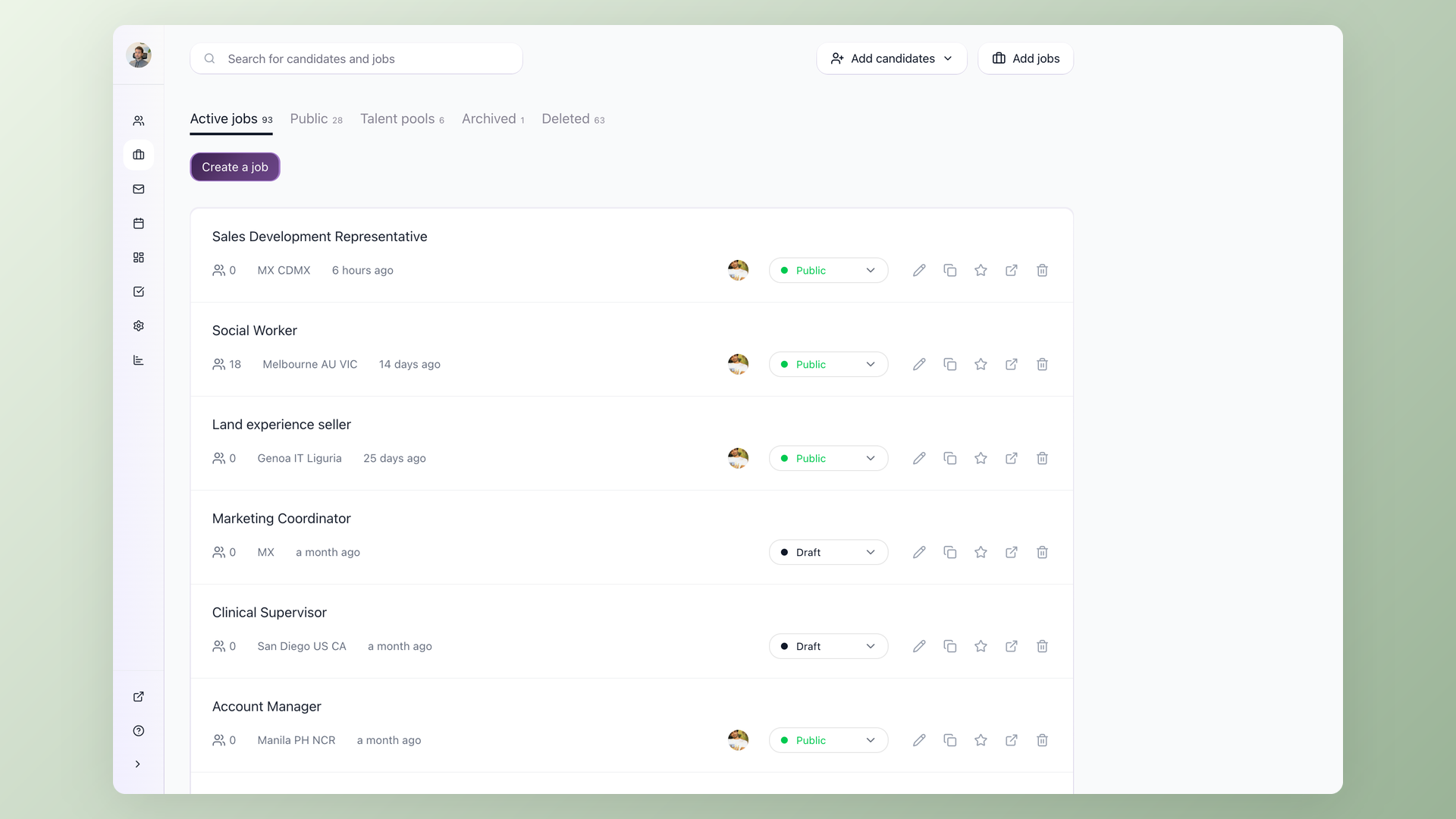
100Hires is the recruiting side of a healthcare staffing agency in one flat-priced tool. It is built for the small and mid-size shop that lives or dies on fill speed and cannot fund a dedicated systems admin.
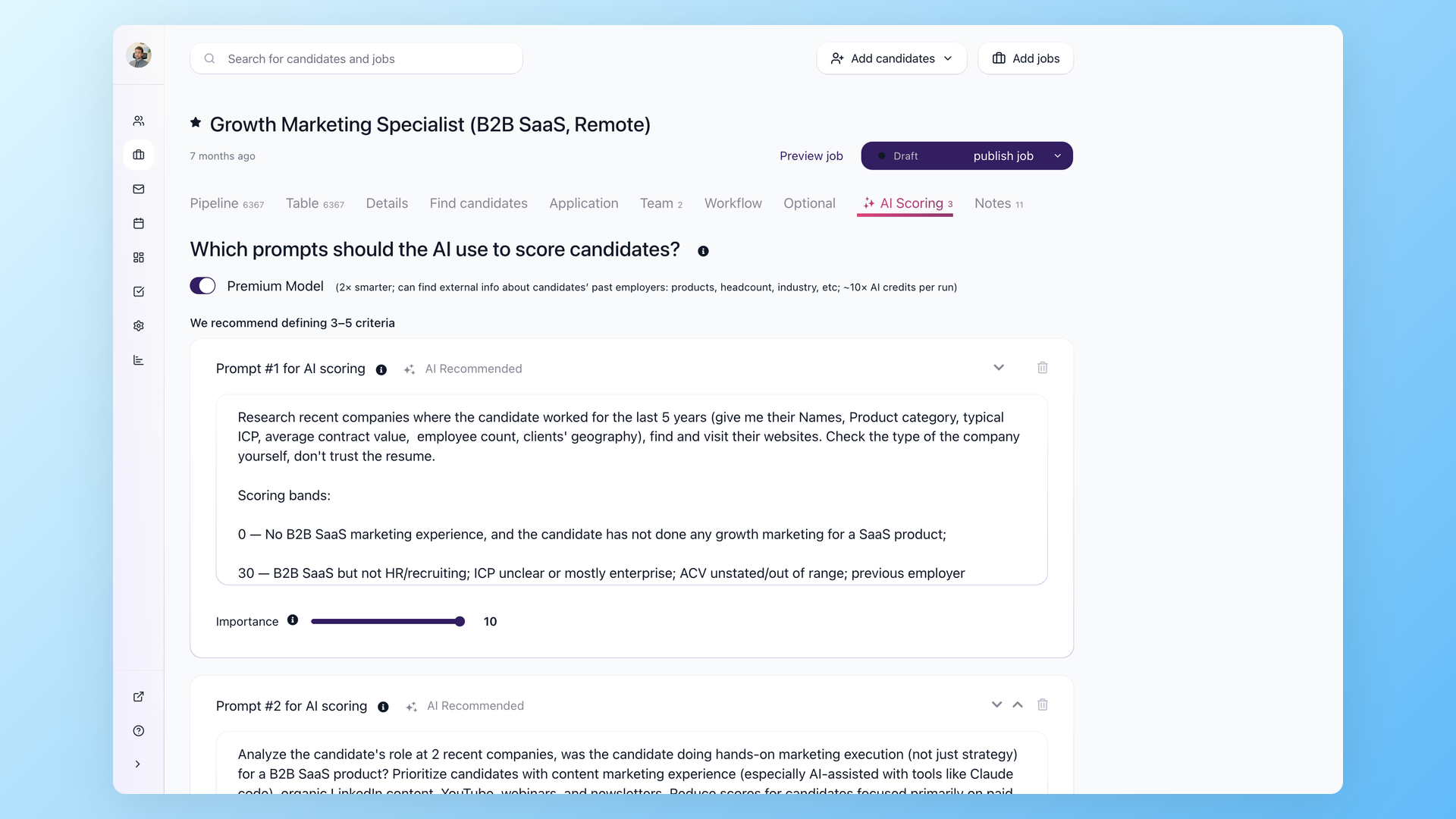
The healthcare-relevant pieces: knockout questions screen for RN license, certifications, or location at the application step, so unqualified applicants never reach a recruiter.
Pipelines are fully custom, so your stages can mirror clinical hiring: license verification call, background check, client interview, offer. AI Score ranks every applicant on arrival against criteria you define.
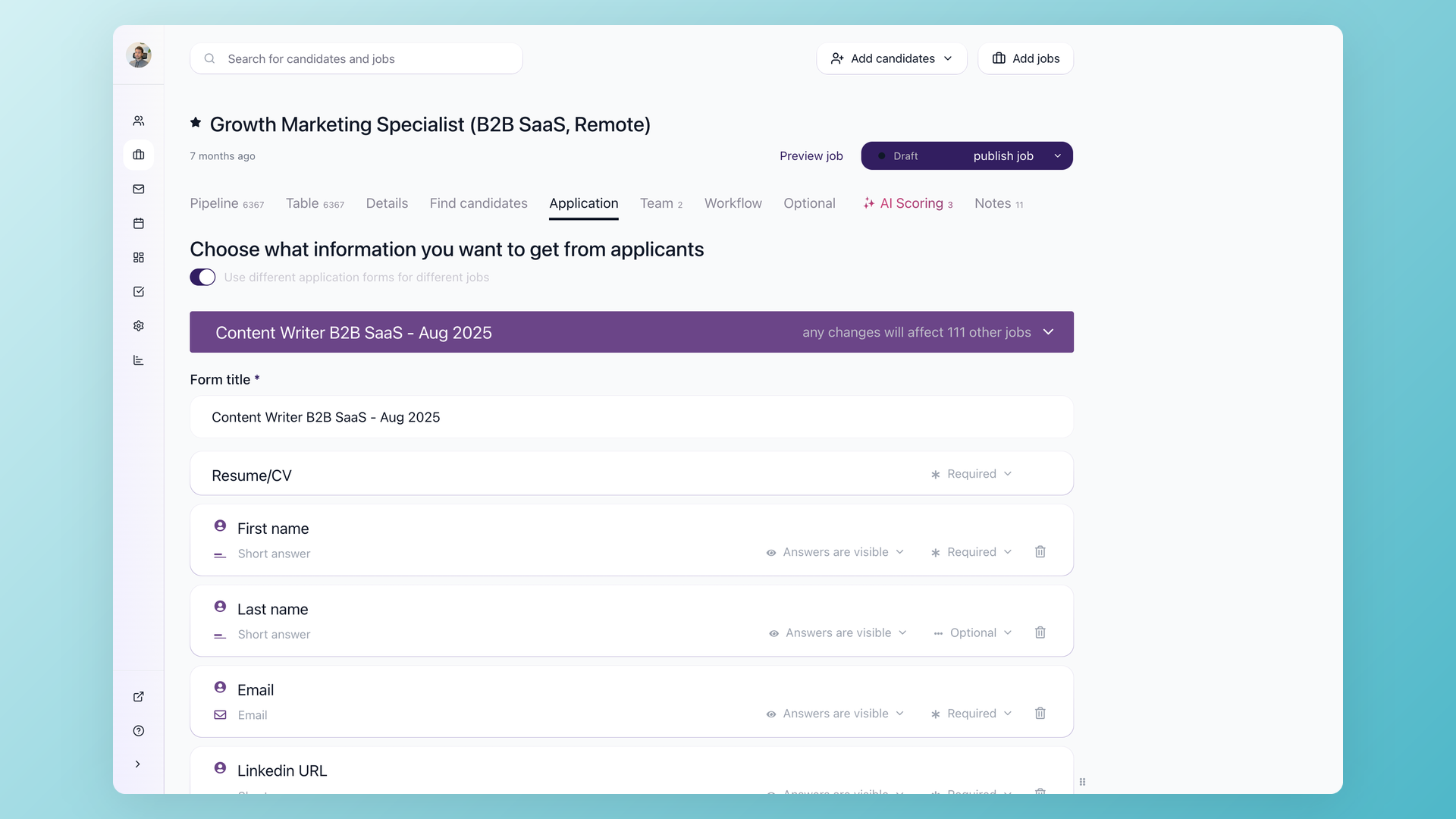
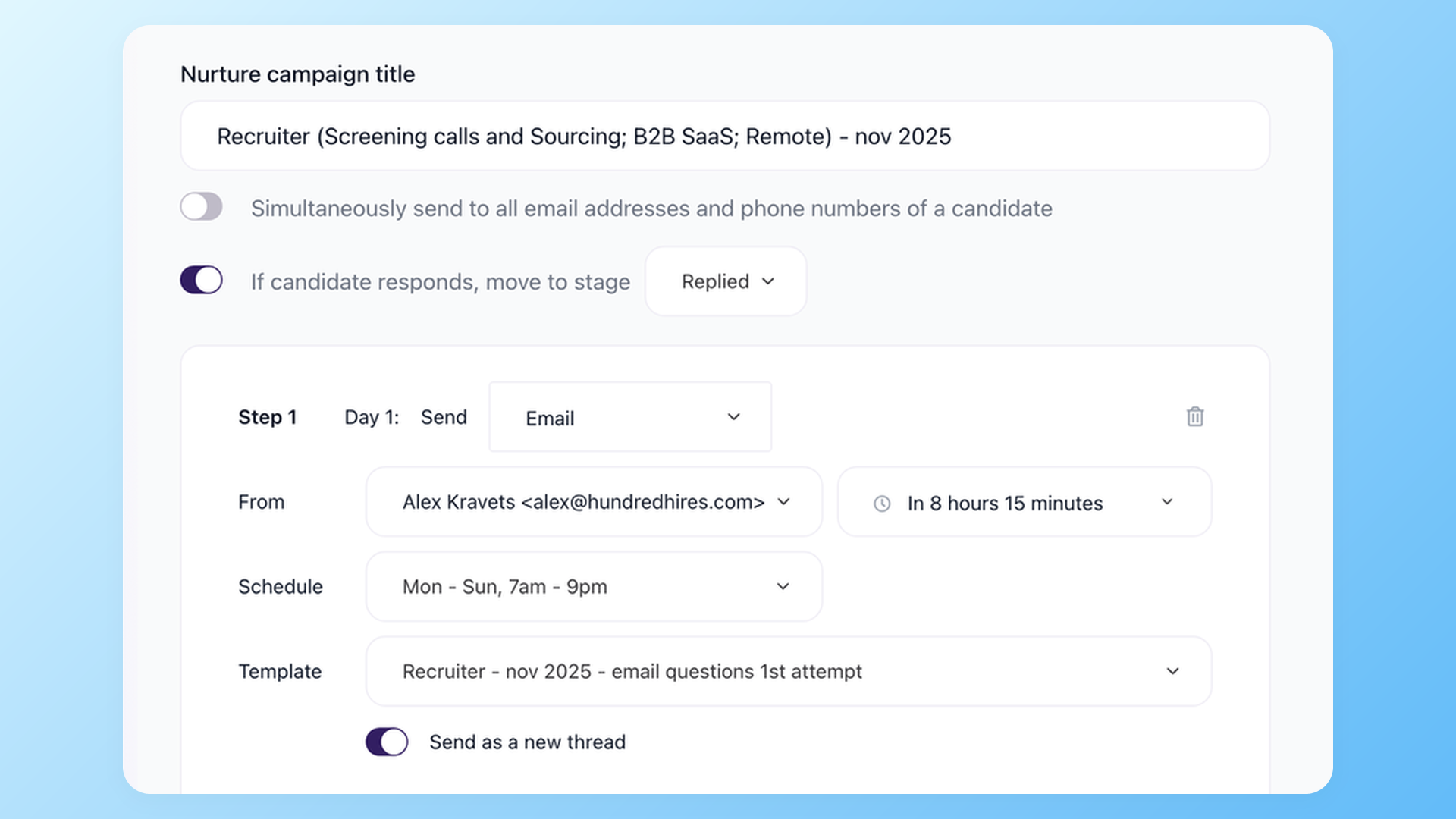
For a staffing agency, the bench matters most. Talent Pools hold your credentialed past candidates segmented by specialty and location, and Nurture campaigns re-engage them by email or SMS when a matching order lands.
Texting and calling run through a Twilio integration on the Advanced plan. Candidates book their own interviews through self-scheduling links.
Now the boundary. 100Hires does no credentialing compliance, no primary-source license verification, no shift scheduling, no timesheets, no payroll, no invoicing, no VMS connectivity.
Knockout questions collect what the candidate self-reports; verification stays your process. Agencies pair 100Hires with their existing payroll system and a credentialing workflow, connected through Zapier where useful.
Pricing is public and flat, not per-user: the Start plan is $49/mo billed annually ($99 monthly), Advanced is $199/mo annually with knockout questions and texting, and Pro is $399/mo annually with contact enrichment. See the 100Hires pricing page for current tiers.
Reviews: G2 4.8 (~1,300), Capterra 4.9 (~1,160).
Verdict: a low flat price for front-office speed in perm, direct-hire, and light contract healthcare staffing. Wrong tool if you need credentialing or pay/bill inside the same system.
2. Crelate: boutique agency ATS with the most healthcare-adjacent reviewer base
Crelate is a recruiting CRM/ATS aimed at boutique staffing and search firms, and it shows up in small-agency conversations with consistently warm sentiment. Among the generic agency platforms we analyzed, its review base carries the highest share of healthcare-adjacent firms.
Strengths: fast candidate capture from LinkedIn and email, an intuitive drag-and-drop pipeline, and add-on modules (Hire, Deliver) that extend into onboarding docs and light contractor timekeeping.
Limitations: no healthcare credential tracking, the Deliver module is light middle office rather than full pay/bill, and reviewers ding support responsiveness. Pricing is public at $85-$119/user/mo billed annually. Reviews: G2 4.4 (210).
We compared it head-to-head with Bullhorn in our Crelate vs Bullhorn breakdown.
3. Zoho Recruit Staffing edition: the budget anchor
Zoho Recruit's Staffing Agency edition is the cheapest credible entry point in this list: $25-$75 per recruiter per month on annual billing ($30-$90 if you pay monthly), with a 15-day trial and a 45-day money-back guarantee.
You get a full ATS+CRM with the Zoho ecosystem behind it. The trade-offs: AI candidate matching sits in the top tier only, and there is no native healthcare credentialing.
Reviewer sentiment splits, too. Some buyers value the deep customization; churn stories describe too much breadth and setup friction.
As of late 2025 it is not a LinkedIn Recruiter System Connect partner, so full LinkedIn sync needs a workaround. More in our Zoho Recruit vs Bullhorn comparison.
4. LaborEdge (Nexus): healthcare-native credentialing that operators actually praise
LaborEdge builds healthcare staffing technology first, not as an add-on for one industry. Its Nexus product family spans ATS, VMS, mobile, and pay modules, with credentialing tied directly to assignment requirements.
In our research it was one of the few healthcare-specific platforms that agency operators recommended organically for credentialing, particularly for travel nursing and allied health. It supports Joint Commission compliance workflows and is SOC 2 certified.
The catch: quote-only pricing, a sales process aimed more at enterprise buyers, and a product family that assumes real placement volume. Reviews: G2 4.5 (50).
5. BlueSky Medical Staffing Software: purpose-built, thin public footprint
BlueSky covers the full healthcare staffing lifecycle: credential management, compliance tracking, scheduling, timekeeping, invoicing, and payroll automation. It serves both agencies and the facility side, which makes it one of the few true all-in-ones here.
Two cautions. Pricing is quote-only, and the public review base is thin: G2 3.7 from 11 reviews, Capterra 4.5 from 2. That does not make it a bad product; it makes independent validation hard.
Demo it against LaborEdge if you want a healthcare-native suite and force both into specifics on per-client credential rules.
6. Ceipal: mid-market ATS with VMS plumbing
Ceipal is a mid-market ATS with healthcare-specific workflows: license and document tracking, automated reminders for expiring credentials, and integrations into VMS job feeds, which matters if MSP programs supply your orders.
Its review footprint is large and strong: G2 4.6 (~1,500) and Capterra 4.6 (~1,260) at last check.
The complaints cluster around resume parsing accuracy and a UI that feels dense; its reviewer base skews toward 50-1,000 employee firms, so very small teams may find the onboarding heavier than needed. Quote-only pricing.
If you are weighing it against JobDiva, we wrote up CEIPAL vs JobDiva separately.
7. JobDiva: the credential wallet play
JobDiva's healthcare layer centers on the Healthcare Wallet: clinicians carry portable credentials, apply to shifts, and submit time from a mobile app, with compact-license support built in.
Its G2 rating is the highest of the mid-market tier at 4.7 (~1,850 reviews), with Capterra at 4.5 (~1,180).
Trade-offs: the platform is enterprise-skewed (most reviewers come from larger firms), the workflow famously sprawls across many browser tabs, and pricing is quote-only.
Best fit: mid-market travel and per-diem agencies that want credential portability without buying a full suite.
8. Avionté: general staffing suite with payroll built in
Avionté's BOLD platform runs front office to back office for staffing firms, payroll and billing included. That makes it the natural pick on this list for an established firm that wants recruiting and pay/bill under one roof without going full enterprise.
The healthcare caveat: healthcare is one of the markets Avionté serves, not a product edition. We found no native license-verification or healthcare credentialing module.
Reviewers praise the front-to-back integration and flag slow performance and post-update bugs. Quote-only pricing.
Reviews: G2 4.3 (~400), Capterra 3.9 (~170).
9. Bullhorn healthcare edition: the enterprise default, wrong-sized for small shops
Bullhorn is the reference point every other tool gets compared to, and its healthcare layer is substantial: a credential self-service portal for providers, AI shift-to-provider matching, and a pay rules engine for shift differentials and guaranteed hours.
Bullhorn positions the product squarely at the largest agencies in the industry.
Small-agency operators tell a consistent story, though: not a quality problem, a sizing problem. Running Bullhorn well takes a dedicated admin, training ramps run months, and the modular add-ons (automation, analytics, onboarding, pay/bill) stack cost fast.
Entry pricing is public at $99/user/mo (Starter) and $165/user/mo (Core); the healthcare-specific pieces are quoted. Reviews: G2 4.2 (~1,240).
Verdict: a fit for large multi-vertical agencies with implementation capacity. If that is not you, start with our Bullhorn alternatives guide.
Newcomers and special cases worth watching
Four tools came up in our research that did not clear the 10-verified-reviews bar for ranking, or carry a corporate asterisk. They deserve a mention, not a rank.
- Staftr re-activates dormant candidate databases for medical staffing agencies with AI matching and credential checks. It is the only healthcare-specific tool here with public pricing ($299-$2,999/mo by database size), and it pairs with an ATS rather than replacing one. One G2 review so far.
- VARS Health is a healthcare-native suite (credentialing, compliance, scheduling, pay/bill) that ranks high in search but carries a single G2 review. Too early to judge.
- ExcelHire is an AI-agent ATS and HR platform with a healthcare staffing page and 3 G2 reviews. Watch it, do not bet the agency on it yet.
- TargetRecruit is a Salesforce-native staffing platform with a healthcare vertical, now owned by Bullhorn. Ask about roadmap and support continuity before committing.
Healthcare staffing software for nursing agencies
Nursing agencies feel every healthcare-staffing pain in concentrated form.
Licenses expire on state-board schedules, compact licensure via the Nurse Licensure Compact covers some states and not others, and each facility or MSP wants its own credential packet before a nurse walks in.
State rules vary enough that your system, whichever you pick, should track license and credential requirements per placement, and your compliance process deserves a review with counsel. No software substitutes for that.
The software decision follows placement type. Shift-based nurse staffing at volume pushes you toward a suite with native credentialing (LaborEdge, BlueSky).
Perm and direct-hire nurse placement runs well on a front-office ATS: in 100Hires, knockout questions capture RN license state and certifications at application (self-reported, verified by your process), and Talent Pools keep your credentialed bench warm for the next order.
Healthcare employers hiring their own staff have a separate playbook; see our healthcare recruiting software guide.
Whatever system you run, three operational habits separate nursing agencies that pass facility audits from those that scramble:
- Track expiration dates on licenses, certifications, and health records in one place, with automated reminders
- Keep a current credential packet per clinician, ready to send
- Log which version of each requirement matrix every client is on
Suites automate most of that. An ATS-based stack handles it with pipeline stages, document uploads on candidate profiles, and calendar discipline. Pick based on how many active contracts you juggle.
And if what you actually want is an app-based float pool filling per-diem shifts, that is the gig-marketplace category, not agency software.
How to choose without buying twice
A pattern from operator interviews and forums: agencies rarely audit their stack, they just add to it. Bolt-on sprawl is the pattern to avoid. Fewer systems that flow together beat more features you never open.
Map what a front-office ATS will not replace before you sign anything:
| Job to be done | Front-office ATS covers it? | Where it lives instead |
|---|---|---|
| Sourcing, screening, pipelines, bench re-engagement | Yes | ATS (100Hires, Crelate, Zoho) |
| Credential verification and expiry compliance | No (self-report intake only) | Credentialing tools or a suite (LaborEdge, BlueSky) |
| Background checks, drug screens | No | Screening vendors (Sterling-type) |
| Shift scheduling, timesheets | No | Suite back office or your existing tools |
| Payroll, invoicing, pay/bill | No | Payroll system, suite middle office |
| VMS order feeds | Sometimes (Ceipal, JobDiva) | Suite or VMS integration |
The small-agency stack that works: ATS + your existing payroll + a credentialing workflow. Buy the suite when contract volume makes juggling those painful, not before.
Five questions worth asking on every demo:
- How do you handle per-client credential requirement matrices, and what happens when an MSP changes theirs?
- What exactly is in the quoted price, and which modules cost extra later?
- How long until my team makes its first placement in the system, and who does the data migration?
- Can I export everything if I leave?
- Show me the workflow for re-engaging a credentialed past candidate when a new order lands.
Two more lessons from people who have done this. First, if you are launching a new agency, software is your third problem: candidate bench and cash flow (weekly payroll against net-30/60 receivables) decide survival.
Second, quote-only vendors often have room to negotiate; walk in with your seat count, placement volume, and a transparent-pricing alternative in hand.
FAQ
What is the difference between an ATS and a VMS in healthcare staffing?
An ATS is agency-side: it moves candidates through recruiting pipelines toward placement, the way 100Hires does for staffing agencies. A VMS is facility-side: a hospital uses it to distribute orders and manage many staffing vendors at once. Agencies log into their clients' VMS portals; they buy an ATS for themselves.
Does healthcare staffing software need to be HIPAA compliant?
Recruiting data (resumes, licenses, contact details) is not patient health information, so most agency workflows need strong security controls rather than full HIPAA infrastructure. Do not store PHI in a recruiting system unless the vendor explicitly supports it. 100Hires is HIPAA-ready for recruiting data: role-based access, per-job visibility, retention windows, and one-click erasure, but it is not a PHI store or a credentialing compliance system.
What is the best healthcare staffing software for a small or new agency?
Large agencies default to Bullhorn or a healthcare-native suite; small and new agencies usually need transparent pricing and same-week setup more than module depth. That points to 100Hires (flat $49-$399/mo, AI screening, texting, talent pools), Zoho Recruit's staffing edition, or Crelate, paired with your existing payroll and credentialing process. Add a suite later if contract volume demands it.
Does 100Hires handle credentialing or shift scheduling?
No. 100Hires is the front office: sourcing, AI screening, pipelines, candidate texting, and bench re-engagement. Credential verification, shift scheduling, timesheets, and payroll stay in the systems you already run, connected via Zapier where useful. The same boundary applies to temp staffing software use cases: 100Hires fills the roles, your back office runs the hours.
How much does healthcare staffing software cost?
Transparent tiers start around $25 per recruiter per month (Zoho Recruit staffing edition) and $49/mo flat for 100Hires on annual billing; per-user agency platforms like Crelate run $85-$119, and Bullhorn's entry tiers list at $99-$165 per user. Healthcare-native suites (LaborEdge, BlueSky) and most mid-market platforms quote per deal, so expect a demo before you see a number.
The bottom line
Buy the category you need, not the category the demo sells. Facility VMS tools and nurse shift apps are not agency software. Suites earn their price at contract volume.
For many small agencies before that point, a fast front-office ATS plus the systems already in place is usually cheaper and quicker to roll out.
We are the front-office option in this list, and we would rather say that plainly here than in month three of a mismatch. Try 100Hires free for 14 days or book a demo and bring a healthcare req where sourcing, screening, and re-engagement are the bottleneck.
Try 100Hires for free
No credit card. 14-day trial. Forbes Advisor #1 ATS for SMBs.