
Bullhorn Competitors & Alternatives in 2026: Agency Seat Costs Compared

Bullhorn is the default ATS and CRM for staffing agencies, and defaults get replaced for unglamorous reasons. Almost nobody leaves Bullhorn because a feature is missing.
They leave because of seat arithmetic, integration fragility, or a support experience that stopped matching the price.
This guide is written for agency owners and recruitment operations leads, not for in-house talent teams.
The distinction matters: Bullhorn's competitors are agency CRMs with client-side workflows, submittals, placements and billing, which is a different product category from an in-house applicant tracking system.
Shortlisting across those two categories is the most common mistake in this evaluation.
What Bullhorn costs
The hiring playbook, in your inbox
One email a week - benchmarks, AI screening tactics, and short interview templates from the 100Hires team. No product pitches.
Bullhorn now publishes entry pricing, which it did not historically. Figures from Bullhorn's pricing page, checked on 25 July 2026.
| Tier | Published price | Included |
|---|---|---|
| Bullhorn Starter | $99 per user per month | Applicant tracking, resume parsing, client management |
| Next tier up | $165 per user per month | Everything in Starter plus added automation and reporting |
| Enterprise | Quote only | Full platform, integrations, middle and back office |
Independent buyer research puts the realistic range higher than the published floor.
Analysis published in late 2025 found most agencies pay an estimated $99 to $315 per user per month, and a June 2026 pricing guide broke it down as entry clustering around $99, mid-market between $150 and $199, and enterprise deployments from $200 to $315 per seat.
Run that against a real agency. Twelve recruiters at the $165 tier is $1,980 a month, roughly $23,760 a year, before middle-office modules, integrations or implementation. At $250 per seat, the same team is near $36,000.
The number that actually hurts is not the rate, it is the multiplier. Per-seat pricing means every hire on your delivery team raises your software bill, and every seat you keep for a part-time researcher or an occasional user costs the same as a producing recruiter's seat.
Why agencies leave, in their own words
An r/RecruitmentAgencies thread warning new agency owners away from Bullhorn collected the pattern clearly. The complaints are operational, not functional.
One recurring theme is agencies repurposing a general CRM instead. Several report getting most of the functionality they actually use for roughly a third of the price, and describe the premium positioning as unearned for their kind of desk.
A second theme is operational drag rather than missing capability: system lag, integrations that break, and support cycles that consume more time than the recruiting work itself. Agencies describe choosing on brand recognition and paying for it later.
A 26-year headhunter in the same thread, who says he has used several systems and demoed dozens, gave the most useful endorsement of an alternative:
Their view, after a decade on the product, is that Loxo is not perfect but is among the strongest options for permanent recruitment, and that a desk can run on it plus email without additional tooling.
Competitors have noticed the pattern. Recruit CRM markets a Bullhorn-alternative webinar on the claim that over 250 of its customers switched from Bullhorn. Treat vendor numbers as marketing, but the direction of travel is real.
Review scores are respectable rather than damning: 4.2 on G2 across 1,223 reviews and 4.0 on Capterra across 1,023, with ease of use at 4.1. Capterra reviewers praise client and candidate tracking and responsive service. This is a mature product that many agencies run happily.
The dissatisfied cohort is loud because the switching cost is high.
What the review base says, in order of frequency
Forum threads skew negative by nature. Aggregated review mining across Bullhorn's G2 and Capterra base, roughly 50 and 125 reviews, gives a more reliable ranking of what actually frustrates agencies, and it lines up with the operational reading above.
- Complexity and learning curve, the top complaint. Breadth and configurability are the cause, not a defect: the same flexibility that suits large agencies is what smaller desks struggle to absorb.
- Technical glitches and slowdowns. The lag described in the thread above is not an isolated experience.
- Customer support. Consistently characterised as slow or unresponsive.
- Integration and update friction, and interface dating, around 10.
- Search functionality specifically, inside a broader feature-complaint group of. Worth noting because search is core to an agency desk.
- Cost. Notably far down the list. Agencies complain about seats when they renew, but day to day the friction they report is complexity and reliability.
That ranking should change how you evaluate replacements. If cost were the real problem, a cheaper seat would fix it. If complexity and reliability are the real problems, the test is a trial with your actual desk workflow, not a price comparison.
Company background, and why ownership matters here
Bullhorn was founded in 1999 in Boston. Art Papas is the founder and has been chief executive since 2003, which is unusual longevity in this market and a genuine point in the company's favour.
In September 2020, Stone Point Capital took a majority stake. Private-equity ownership is not a red flag by itself, but it does explain the commercial posture agencies report: disciplined pricing, seat-based expansion, and upsell into middle and back office modules.
If you are negotiating, understand that you are negotiating with a company optimising revenue per customer.
The seat audit that comes before any migration
Per-seat pricing has one useful property: it is easy to attack without changing vendors. Before you sit through four demos, spend an hour on this.
- Pull last-login dates for every licence. Anyone who has not logged in for 30 days is a candidate for removal, not a user.
- Separate producers from occasional users. Researchers, finance and directors who only read reports rarely need a full recruiter licence. Ask what a read-only or limited seat costs.
- Count seats attached to people who have left. This is more common than anyone admits, especially after a headcount change mid-contract.
- List every paid module and match it to a workflow. If nobody can name the process a module supports, it is a candidate for cancellation at renewal.
- Then take the number to renewal. Six dormant seats at $165 is about $11,880 a year, recovered with zero migration risk.
If the audit gets you to an acceptable number, stop reading. If the problems are integrations, reliability or support, no amount of seat trimming fixes those, and the list below becomes relevant.
Agency alternatives, by what you actually run
These are all agency-side systems. If you are hiring for your own company rather than placing candidates with clients, skip to the last section, because this whole list is the wrong category for you.
Loxo
The most consistently recommended Bullhorn replacement in agency forums, and the one with a genuine long-term advocate quoted above. Combines ATS, CRM, sourcing and outreach so a desk can run on one system. Best for perm and executive search. Pricing is quote-based.
Recruit CRM
Built specifically for agencies, with transparent per-user pricing, strong client-side workflows and an explicit Bullhorn-migration motion. Best for small and mid-sized agencies that want predictable per-seat cost without an enterprise contract.
Crelate
Strong on pipeline visualisation and configurable workflows, popular with boutique search firms in North America. Per-user pricing, quote-based at the higher tiers.
JobAdder
Widely adopted in Australia, New Zealand and the UK, with good job-board distribution and a straightforward per-seat model. Worth a look if your desks are outside North America.
Vincere
Agency operating system with analytics and front-to-back-office coverage. Best for agencies that want reporting depth and are prepared to spend time on configuration.
Zoho Recruit, staffing edition
The budget answer. Its agency edition is genuinely cheap, and the corporate edition publishes rates of about $25 and $50 per recruiter per month billed annually.
The trade-off is the plan ceiling on active jobs per licence and an interface recruiters describe as clunky, covered in our Zoho Recruit alternatives guide.
PCRecruiter
A long-standing, unfashionable, extremely configurable option that experienced agency users still rate. Low price relative to the market, dated interface.
Hubspot, used as a recruitment CRM
Not a recruiting product, and worth mentioning only because agencies keep doing it and reporting success.
The commenter above is describing a real pattern: for a relationship-led perm desk with modest submittal volume, a general CRM at a third of the price can cover most of the job.
You lose parsing, job-board distribution and placement tracking, so cost the workarounds honestly before committing.
Side by side
| Option | Category | Pricing model | Strongest for |
|---|---|---|---|
| Bullhorn | Agency ATS and CRM | $99 to $315 per seat per month | Scale, integrations, middle and back office |
| Loxo | Agency all-in-one | Quote | Perm and executive search on one system |
| Recruit CRM | Agency ATS and CRM | Published per user | Small and mid-sized agencies |
| Crelate | Agency ATS | Per user | Boutique search firms |
| JobAdder | Agency ATS | Per seat | APAC and UK desks |
| Vincere | Agency operating system | Quote | Reporting and back-office depth |
| Zoho Recruit | Both editions | From about $25 per recruiter | Tight budgets |
| PCRecruiter | Agency ATS | Low per user | Configurability on a budget |
Our verdict
If your complaint is seat cost, audit seats before you audit vendors. Most agencies carrying a Bullhorn bill they resent are also carrying seats for people who log in twice a month. Cutting six dormant seats at $165 saves about $11,880 a year with no migration risk at all.
If your complaint is integrations and support, migration is justified. Those are the two things that do not improve with negotiation.
Loxo is the most-endorsed replacement for perm desks; Recruit CRM is the pragmatic choice for a small agency that wants published pricing and an assisted migration.
If you are contract or high-volume staffing with timesheets and back-office needs, be careful. This is where Bullhorn genuinely earns its price, and where cheaper alternatives quietly leave you building spreadsheets around the gaps. Price the whole workflow, not the ATS.
Where 100Hires fits, and where it does not
Let us be direct, because this page would be less useful if we were not: if you are a staffing or recruitment agency, 100Hires is usually not the right tool for you. We are an in-house applicant tracking system.
We do not do client-side CRM, submittal workflows, placement and margin tracking, timesheets or agency invoicing. For an agency desk, Loxo, Recruit CRM, Crelate or Bullhorn itself are better answers.
There are two cases where teams arriving from Bullhorn do belong with us.
The first is an internal talent acquisition team that inherited Bullhorn because someone in the business had an agency background. You are paying per seat for client-side machinery you never use. An in-house ATS at $49 to $399 a month replaces it at a fraction of the cost.
The second is an RPO or embedded recruiting team hiring into one organisation, where the client relationship is a contract rather than a pipeline of accounts to sell into.
For those two cases, published plans are Start at $49 per month billed annually ($99 monthly), covering up to 100 candidates a month, and Advanced at $199 annually ($249 monthly) with unlimited jobs, candidates and users.
Pro at $399 annually ($499 monthly) adds sourcing and contact enrichment.
Capterra rating is 4.9 from more than 1,100 reviews as of July 2026.
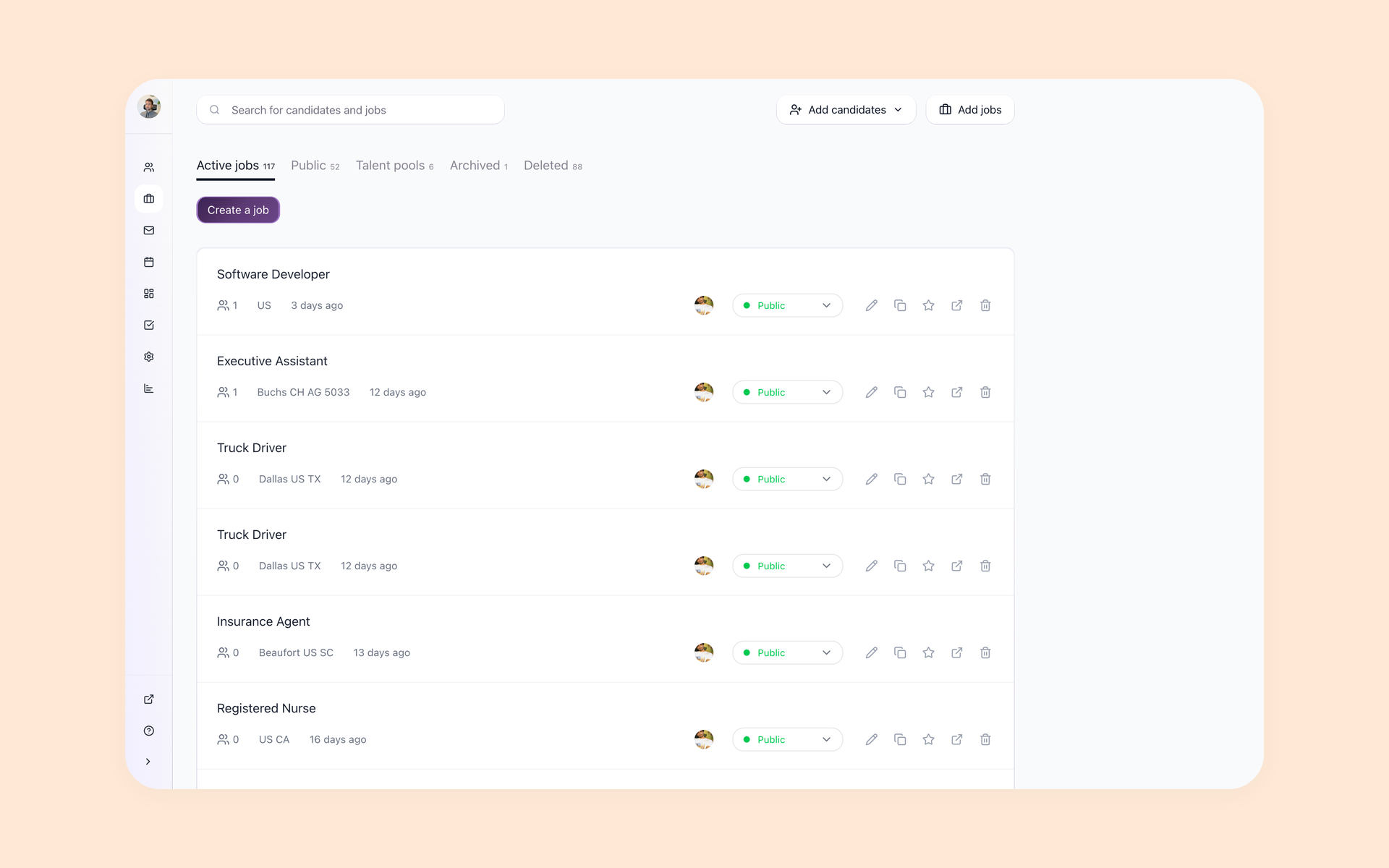
If you are in-house and paying agency-software prices, see 100Hires pricing or start a free trial. If you run an agency, take the Loxo or Recruit CRM demo instead. We would rather be useful than win a bad-fit deal.
Frequently asked questions
How much does Bullhorn cost per user?
Bullhorn publishes $99 per user per month for its Starter tier and $165 per user per month for the next tier, with enterprise pricing quoted. Independent buyer analysis in 2025 and 2026 found most agencies actually pay between $99 and $315 per user per month once tier, modules and contract size are factored in. A twelve-seat agency at the $165 tier is roughly $23,760 a year before add-ons.
What is the best Bullhorn alternative for a small agency?
Recruit CRM and Loxo come up most often. Recruit CRM publishes per-user pricing and runs an explicit Bullhorn-migration programme, which suits agencies that want a predictable number without an enterprise sales cycle. Loxo has the stronger advocacy among long-term perm recruiters, one of whom described it on Reddit as an all-inclusive system where a desk could run on it plus email and nothing else
Can you use HubSpot instead of Bullhorn?
Some agencies do, and report paying about a third of the price for most of the functionality. It works best for relationship-led permanent recruitment with modest submittal volume. What you give up is resume parsing, job-board distribution, candidate search and placement tracking, so the honest comparison includes the cost of whatever you bolt on to replace those.
Is Bullhorn worth it for contract staffing?
This is where it is hardest to replace. Timesheets, pay and bill, and middle and back office integration are areas where cheaper agency systems often leave gaps that get filled with spreadsheets. If contract placement is the bulk of your revenue, price the entire workflow including invoicing before deciding, not just the ATS seat cost.
Should an in-house recruiting team use Bullhorn?
Usually not. Bullhorn is built around agency economics: client accounts, submittals, placements and billing. An internal team pays per seat for machinery it never opens. If your team hires only into your own company, an in-house applicant tracking system will cost less and match your workflow better.
Try 100Hires for free
No credit card. 14-day trial. Forbes Advisor #1 ATS for SMBs.