
GoodTime vs Calendly in 2026: Recruiting fit - 100Hires
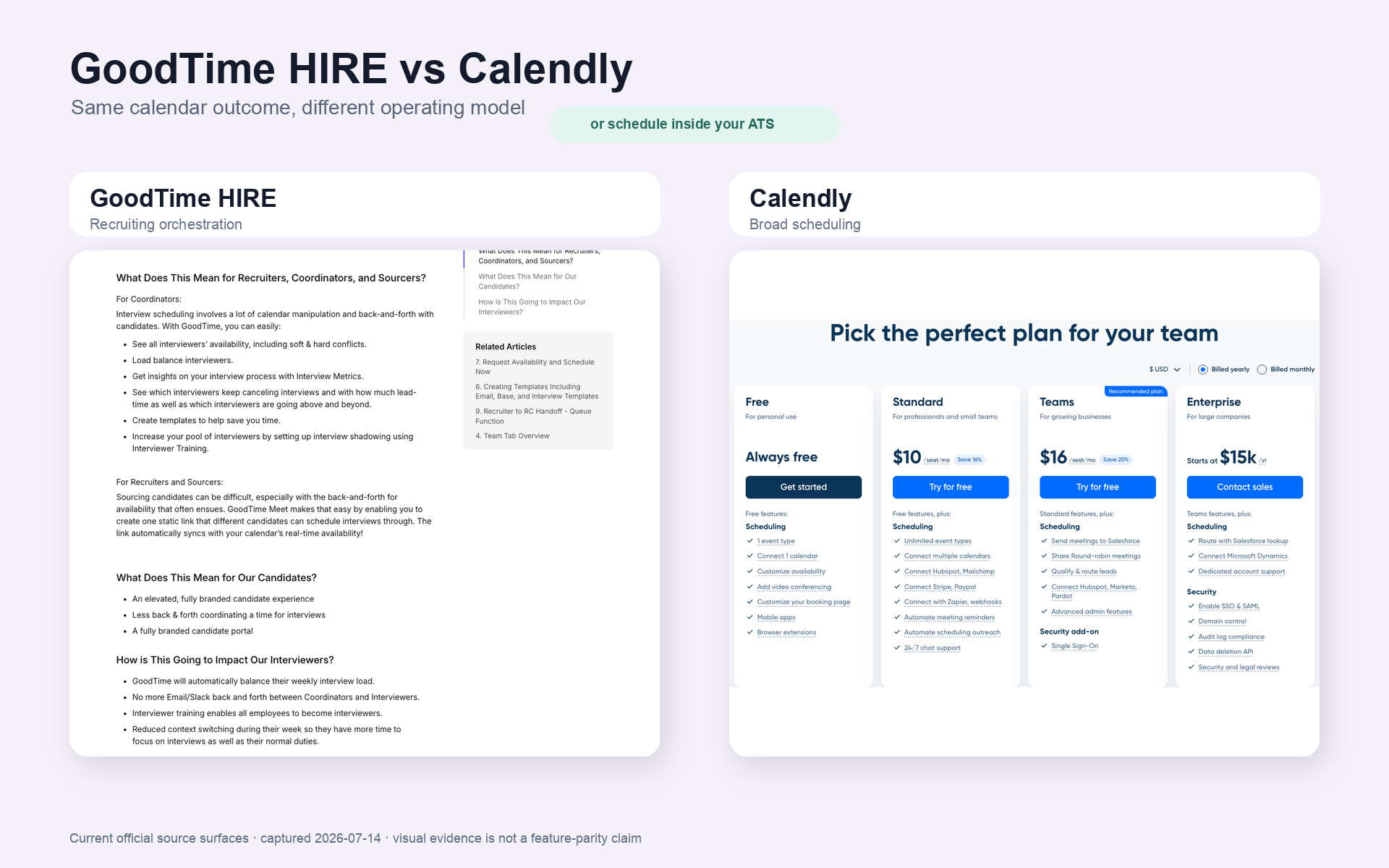
GoodTime HIRE and Calendly can both put an interview on a calendar, but they solve different scheduling jobs. GoodTime HIRE is the better fit for complex internal recruiting panels and coordinator operations.
Calendly is the better fit for simple screens and general meeting scheduling.
In this comparison, “GoodTime” means GoodTime HIRE. GoodTime MEET is a separate scheduling product. We compare workflow depth, pricing, and buyer fit, then examine when an ATS-native scheduler can remove the need for either point tool.
GoodTime vs Calendly: the short answer
The hiring playbook, in your inbox
One email a week - benchmarks, AI screening tactics, and short interview templates from the 100Hires team. No product pitches.
Choose GoodTime HIRE when interview coordination is a recruiting operation in its own right. It is designed around interviewer pools, panels, training, load balancing, metrics, candidate communication, and deep ATS connections.
Choose Calendly when the central job is to expose available times and let someone book. It handles one-to-one meetings well and extends into collective, group, and round-robin events. The same account can serve recruiting, sales, customer success, and other teams.
That category difference matters more than a raw feature count. GoodTime HIRE coordinates a recruiting process. Calendly standardizes scheduling across many kinds of meetings.
100Hires is our product. It is an ATS with candidate interview scheduling built into the recruiting record, so it represents a third architecture rather than another standalone scheduler. The external research used for this comparison did not independently review 100Hires.
At-a-glance decision table
| Decision point | 100Hires | GoodTime HIRE | Calendly |
|---|---|---|---|
| Product category | ATS with candidate interview scheduling | Recruiting interview orchestration | General scheduling platform |
| Best fit | Teams that want candidate scheduling inside the ATS | Mature TA teams coordinating complex panels and interviewer programs | Simple screens and meetings used across departments |
| Poor fit | Enterprise load balancing, interviewer training, or general sales routing | Lean teams that only need a booking link | Recruiting workflows that need deep ATS context and complex panel operations |
| ATS relationship | Scheduling stays in the candidate and job record | Deep integrations with major ATS platforms | Can connect to recruiting workflows but is not the candidate system of record |
If the 100Hires column describes the actual requirement, see how interview scheduling software built into an ATS works. The rest of this guide shows which scheduling requirements each option covers.
What GoodTime HIRE and Calendly are built to do
GoodTime HIRE is recruiting orchestration
GoodTime HIRE is built for talent-acquisition teams that coordinate many interviewers, candidates, and constraints. Its documented scope includes interviewer pools, soft and hard conflicts, load balancing, and interview templates.
Its core workflows include Interviewer Training and Interview Metrics. GoodTime's Experience+ add-on provides candidate and interviewer portals.
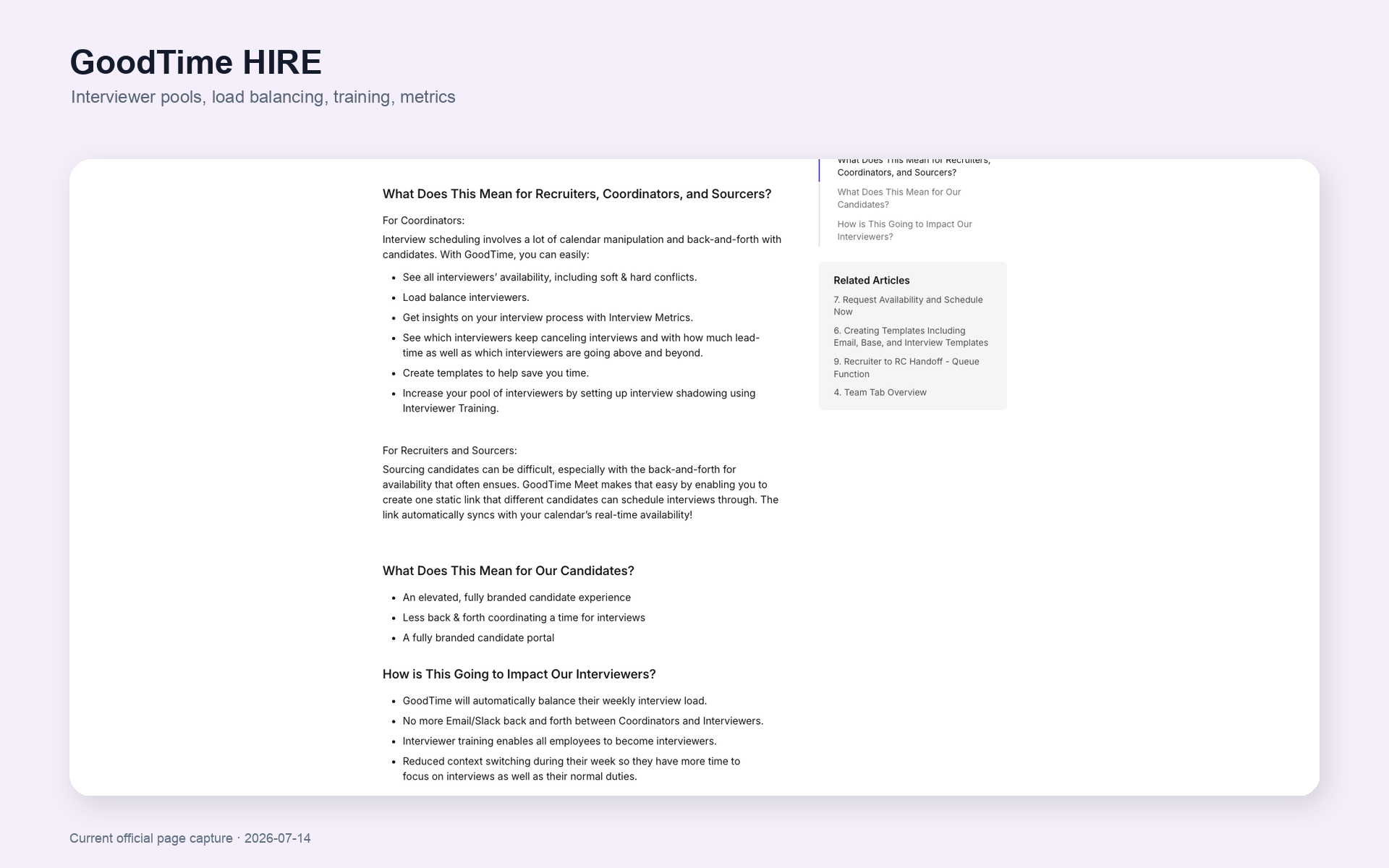
A coordinator handling a complex interview is not merely looking for an open hour. The system may need to use interviewer pools and load-balancing rules, assemble a panel, preserve the intended sequence, and keep the ATS updated.
GoodTime describes deep two-way ATS sync as part of HIRE. That makes it a specialist layer around the candidate system of record rather than the record itself. Its buying model reflects that scope: pricing is customized according to annual candidate volume, not user count.
Independent public evidence about current GoodTime workflows is thinner than its official material. We treat the documented scope as product capability, not proof that it will outperform every alternative in a live deployment.
GoodTime MEET should not be confused with HIRE. GoodTime describes MEET as a separate URL-based scheduler without an ATS integration. This article evaluates HIRE for recruiting.
Calendly is broad scheduling
Calendly starts with a simpler model: connect calendars, define availability and an event type, then share a booking page. Invitees choose an available time, and the system creates the meeting without an email chain.
Paid plans expand that model. Calendly supports reminders and workflows, group and collective events, round-robin distribution, routing, payment connections, and enterprise administration. Recruiting is one use case among many.
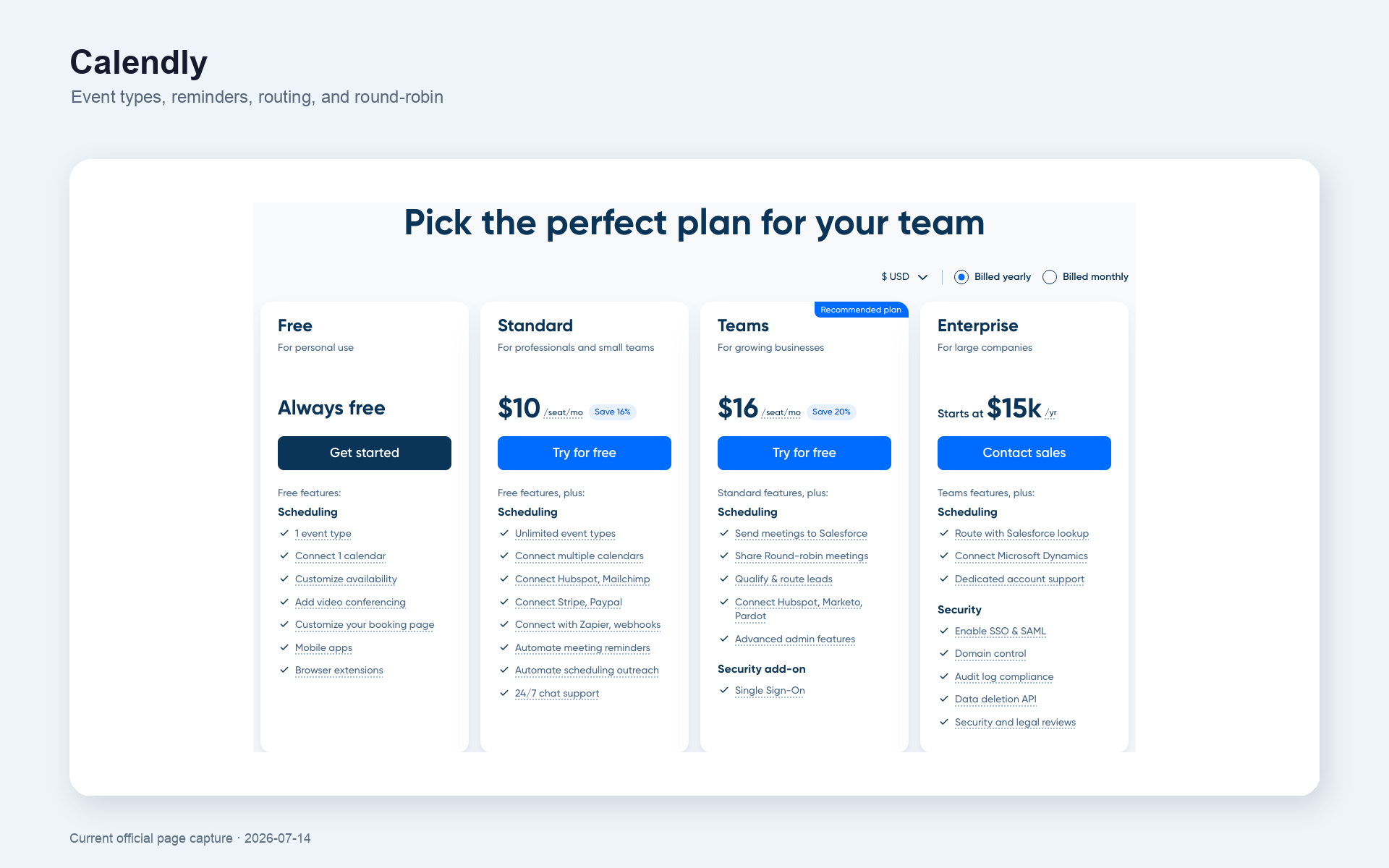
That breadth is a genuine advantage for a company seeking one scheduling standard. A recruiter can book screens, a salesperson can route leads, and a customer-success manager can offer office hours through the same platform.
Calendly is not the ATS candidate record. A successful booking does not by itself prove that the correct recruiting stage, approval, interviewer role, notes, or follow-up moved with it.
Booking links and interview orchestration solve different problems
Simple recruiter screens favor Calendly
A recruiter screen is often one candidate, one recruiter, and one calendar. Calendly fits that job cleanly. The candidate sees valid slots, chooses one, receives the meeting details, and can get automated reminders.
This removes repeated availability emails and gives the candidate immediate control. It is especially practical when the recruiter already uses Calendly for intake calls, hiring-manager conversations, or other external meetings.
Link governance still deserves attention. Practitioner discussions show that reusable recruiting links can circulate beyond the intended recipient.
One-use links, qualifying questions, validation, and an ATS stage gate can help keep a booking tied to the correct candidate and job.
That is a process control, not a claim that Calendly links routinely leak. It is simply a useful test for any link-based recruiting workflow: what happens if the URL reaches someone outside the intended stage?
Complex panels favor GoodTime HIRE
A panel changes the scheduling problem. The team may need several interviewers with distinct roles, additional eligible interviewers, time zones, buffers, meeting order, daily limits, and a fair distribution of interview work.
GoodTime HIRE is designed around those inputs. Interviewer pools and load balancing can help the operation choose from eligible people instead of depending on one fixed panel. Training state and interview metrics make the interviewer program part of the workflow.
Calendly can find overlap among multiple hosts through collective events, and its Teams plan supports round robin. Those capabilities are useful, but basic multi-host availability is not the same as managing a recruiting interviewer program.
GoodTime is the stronger fit when those recruiting-specific constraints recur at meaningful volume. A team that schedules an occasional three-person panel may not need a dedicated orchestration layer.
Collecting availability is not always the same as booking
Some teams want candidates to submit several acceptable windows before a coordinator confirms the interview team. That differs from letting a candidate select one final slot against a live calendar.
The controlled version is useful when the panel is hard to assemble, the sequence matters, or an internal approval must happen first. Recent practitioner research surfaced this exact need in a Workday-based process: collect options from the candidate, then schedule the team.
It does not prove that every interview needs orchestration. It shows why “supports self-scheduling” is too broad a comparison field. Buyers need to define who makes the final booking decision and what must be true before that decision is made.
ATS context determines whether the handoff works
A calendar event can be correct even when the recruiting workflow is wrong. The candidate might be in the wrong stage, an approval may be missing, the invitation may use an outdated template, or the next owner may not know the booking occurred.
GoodTime addresses this through deep ATS integrations and recruiting-specific orchestration. Calendly can participate through integrations and automation, but the buyer must design the boundary between the scheduler and the ATS.
An ATS-native scheduler removes that boundary for the scheduling jobs it covers. It is not automatically more capable. It can simplify governance by keeping candidate stage, job, interview, invitation, and follow-up attached to one record.
In real recruiting handoffs, the work can include converting time zones, waiting for candidate availability, checking hiring-manager calendars, and issuing invitations in a separate step.
General meetings outside recruiting favor Calendly
Sales calls, customer onboarding, partner meetings, paid consultations, office hours, and lead routing are outside GoodTime HIRE's natural category. Calendly is the logical choice when these meetings are part of the same buying decision.
This is the clearest reason not to treat GoodTime as the right choice for every team. Deeper recruiting orchestration provides little value to a revenue team that needs a public routing form and a shared scheduling standard.
GoodTime vs Calendly pricing
The products are priced on different bases. GoodTime HIRE uses a customized proposal based on annual candidate volume. Its official pricing material does not show a public dollar amount and says users are not the billing basis.
Calendly publishes self-serve plan prices. Standard starts at $10 per seat per month when billed yearly. Teams begins at $16 per seat per month for 1 to 30 seats, with lower per-seat rates at higher seat bands. Enterprise starts at $15,000 per year.
| Product | Plan | Monthly or monthly equivalent | Annual total | Billing basis | Key scope or limit |
|---|---|---|---|---|---|
| 100Hires | Start | $99 per month month-to-month; $49 per month billed annually | $588, derived | Monthly or billed annually | Up to 3 jobs, 100 candidates, and 1 user |
| 100Hires | Advanced | $249 per month month-to-month; $199 per month billed annually | $2,388, derived | Monthly or billed annually | Unlimited jobs, candidates, and users |
| 100Hires | Pro | $499 per month month-to-month; $399 per month billed annually | $4,788, derived | Monthly or billed annually | Everything in Advanced, plus Email Carousel & Warmup, contact enrichment, onboarding support, and data migration for annual contracts |
| 100Hires | Enterprise | custom quote | custom quote | Sales quote | Security, SSO, governance, BI connection, and custom work |
| GoodTime HIRE | Customized proposal | not publicly shown | not publicly shown | Annual candidate volume | Deep ATS sync and core interview-orchestration scope included in captured official material |
| Calendly | Free | $0 | $0 | No charge | 1 event type and 1 calendar |
| Calendly | Standard | $10 per seat | $120 per seat, derived | Billed yearly | Unlimited event types, workflows, reminders, and up to 6 calendars |
| Calendly | Teams, seats 1 to 30 | $16 per seat | $192 per seat, derived | Billed yearly | Round robin, Salesforce, routing, and admin controls |
| Calendly | Teams, seats 31 to 50 | $14.50 per additional seat | $174 per additional seat, derived | Billed yearly | Marginal tier. First 30 seats remain $16 per seat per month. |
| Calendly | Teams, seats 51 to 100 | $14 per additional seat | $168 per additional seat, derived | Billed yearly | Marginal tier. Earlier seats retain their applicable band rates. |
| Calendly | Teams, seats 101 to 200 | $13.50 per additional seat | $162 per additional seat, derived | Billed yearly | Marginal tier. Earlier seats retain their applicable band rates. |
| Calendly | Teams, seats 201 to 300 | $13 per additional seat | $156 per additional seat, derived | Billed yearly | Marginal tier. Earlier seats retain their applicable band rates. |
| Calendly | Teams, seats 301 or more | $12 per additional seat | $144 per additional seat, derived | Billed yearly | Marginal tier. Earlier seats retain their applicable band rates. |
| Calendly | Enterprise | $1,250 minimum, derived | Starts at $15,000 | Annual | SSO/SAML, domain control, audit controls, support, and onboarding |
The annual totals for Calendly Standard and Teams are simple multiplication of the monthly price. Teams discounts are marginal: the first 30 seats remain $16 per seat per month, and each lower rate applies only to additional seats in its stated band.
The $1,250 Enterprise monthly equivalent is derived from the published $15,000 annual starting price. Taxes, add-ons, contract terms, and implementation details can change a final quote.
Price visibility favors Calendly for fast evaluation. Value may favor GoodTime when coordinator time, interviewer allocation, and panel complexity justify specialist software. A simple screen does not improve merely by using a more specialized product.
Who should choose GoodTime, Calendly, or neither
Choose GoodTime HIRE for complex internal TA operations
GoodTime HIRE fits a mature internal recruiting team that repeatedly coordinates panels, interviewer pools, training requirements, load limits, metrics, and deep ATS workflows.
The team should have enough candidate volume and coordination costs to justify a custom annual proposal. It should know which operational constraints need automation and who will own the process after implementation.
A lean team scheduling a small number of recruiter screens may buy more software than it needs. Ask GoodTime to demonstrate a representative panel, including an eligible interviewer, a conflict, and an ATS stage update, before evaluating a polished ideal path.
Choose Calendly for simple screens and shared scheduling
Calendly fits one-to-one recruiter screens, transparent self-serve purchasing, and organizations that want the same scheduling platform across departments. Collective events, group events, round robin, and routing expand its value beyond a personal booking link.
Define the recruiting handoff before rollout. Decide how a booking maps to the candidate record, which links are reusable, which checks validate the candidate, who handles rescheduling, and which event proves that the next stage has started.
Calendly remains a strong answer when recruiting-specific coordination is light. It becomes less complete as interviewer eligibility, panel composition, training state, and recruiting analytics become central requirements.
Choose neither when the ATS already covers the job
A separate scheduler may be unnecessary when the requirement is candidate self-scheduling, interviewer availability, panels or several interviews, invitations, and calendar sync inside the ATS.
100Hires is our example of this architecture. It supports those candidate-interview functions in the recruiting record. It does not claim GoodTime HIRE's interviewer load balancing, training, recruiting analytics, or deeper orchestration.
It is focused on ATS recruiting workflows. Calendly supports broader sales, customer-success, payment, and lead-routing use cases. The advantage is fewer boundaries for a narrower recruiting job, not universal scheduling superiority.
When an ATS-native scheduler can replace a point tool
The ATS already knows the candidate, job, stage, owners, and interview plan. Keeping scheduling there can make approvals, invitations, notes, and follow-up easier to govern.
The booking becomes part of the recruiting workflow rather than a separate calendar event that must be reconciled.
This architecture works when the ATS covers the scheduling depth the team truly uses. Add a specialist scheduling tool when it solves a proven gap, such as high-volume panel optimization, interviewer-program management, or scheduling across departments that do not use the ATS.
100Hires documents self-scheduling links with available days, time ranges, duration, buffers, and advance notice. Connected calendars filter out busy times. A candidate can select a slot, after which the interview and calendar invitations are created.
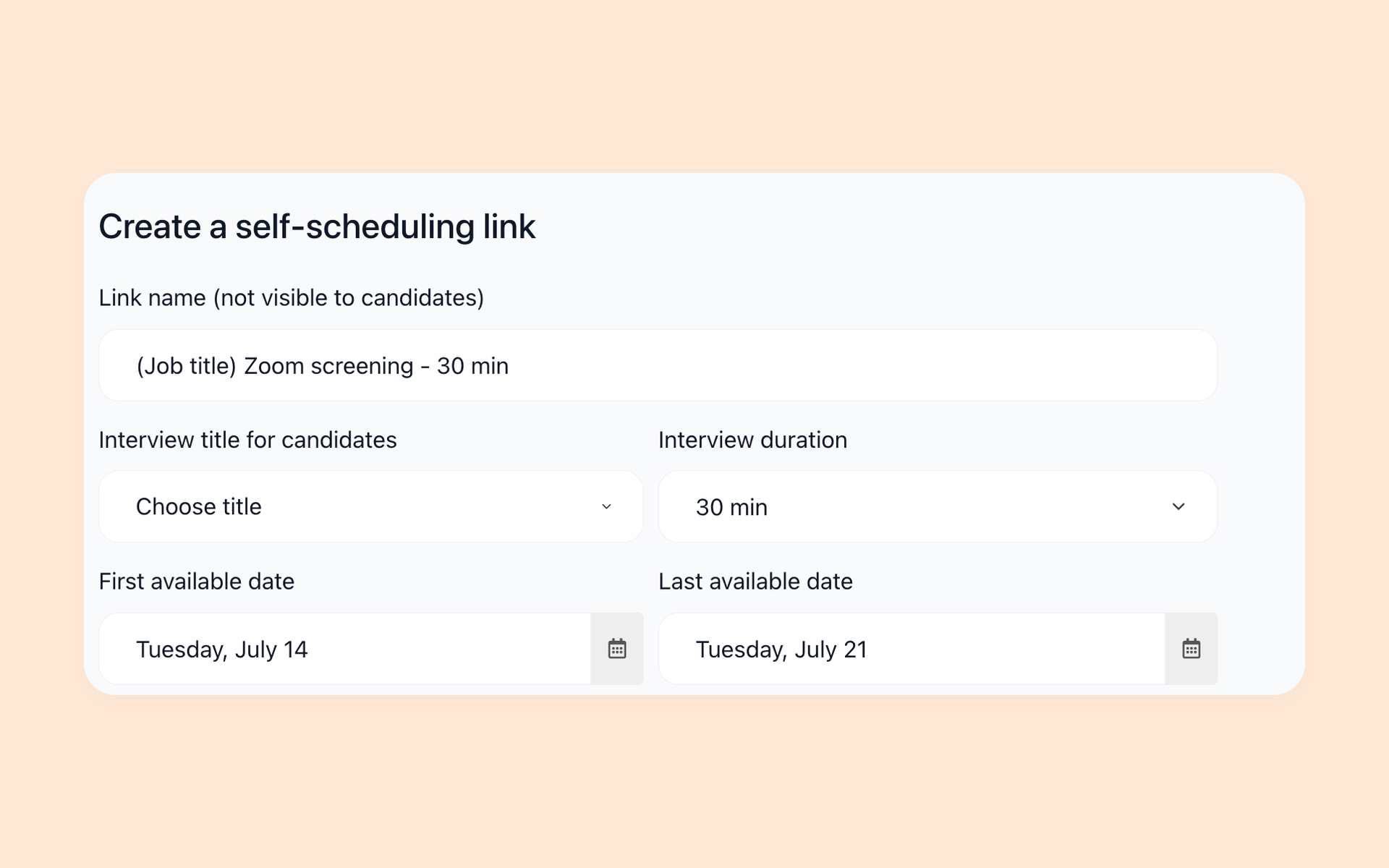
The product documents interviewer selection, panel interviews, several interviews, invitation previews, Google Calendar, and Outlook Calendar. These functions sit inside recruiting software, attached to the candidate and job.
100Hires is our product, and none of the external research streams independently reviewed it for this comparison. Its strength here is ATS-native candidate scheduling. Its limits are enterprise orchestration and general-purpose meeting breadth.
100Hires pricing status
The current 100Hires pricing page lists Start at $49 per month when billed annually or $99 per month month-to-month. Advanced is $199 per month when billed annually or $249 per month month-to-month.
Pro is $399 per month when billed annually or $499 per month month-to-month. Enterprise pricing is custom.
Scheduling software cannot fix interview design
A scheduler can find time, apply availability rules, send invitations, and reduce coordination work. It cannot decide whether interview questions measure the job, whether interviewers apply the same standard, or who owns feedback after the meeting.
The U.S. Office of Personnel Management describes structured interviews as using predetermined questions, a consistent order, and common rating standards. Those controls belong in the interview design.
Stage gates, templates, shared calendars, notes, communication standards, and prompt feedback still need owners. GoodTime, Calendly, or an ATS-native workflow can support that operating model, but none can replace it.
Frequently asked questions
Is GoodTime better than Calendly for interview scheduling?
GoodTime HIRE is stronger for complex recruiting orchestration. Calendly is stronger for simple screens and general scheduling. 100Hires can schedule candidate interviews inside its ATS, but it lacks GoodTime's enterprise depth and Calendly's general breadth.
What is the difference between GoodTime HIRE and GoodTime MEET?
GoodTime HIRE is the recruiting product for interview orchestration and deep ATS-connected workflows. GoodTime MEET is documented as a separate URL scheduler without ATS integration. 100Hires takes a different route by placing candidate scheduling directly in its ATS.
Can Calendly handle panel interviews?
Calendly supports collective events using multiple hosts' availability, plus round robin on Teams. GoodTime HIRE adds recruiting-specific pools, load balancing, and training. 100Hires supports panels and several interviews inside the ATS, without GoodTime-level orchestration.
How much do GoodTime and Calendly cost?
GoodTime HIRE uses custom pricing based on annual candidate volume. Calendly has a $0 Free plan; Standard starts at $10 per seat per month billed annually; Teams starts at $16 per seat per month billed annually; and Enterprise starts at $15,000 per year. Current 100Hires pricing starts at $49 per month billed annually or $99 per month month-to-month.
Do I need separate interview scheduling software if I use an ATS?
Not if the ATS covers the workflow you use: candidate self-booking, interviewer availability, panels, invitations, and calendar sync. 100Hires offers those functions within the ATS. Add GoodTime for deeper enterprise orchestration or Calendly for broader meeting and routing needs.
Final verdict
GoodTime HIRE is the choice for complex internal recruiting operations. Calendly is the practical choice for simple screens and scheduling reused across departments.
An ATS-native scheduler can be the better architecture when the requirement is for candidate interview scheduling already attached to the recruiting record. Teams in that third scenario can review 100Hires interview scheduling or start a free trial.
Choose that route for workflow continuity, not as a claim of full feature parity. GoodTime remains deeper for enterprise interview orchestration, and Calendly remains broader for general scheduling.
Try 100Hires for free
No credit card. 14-day trial. Forbes Advisor #1 ATS for SMBs.