
ClearCompany API
See what ClearCompany publicly documents as of July 16, 2026, what remains unverified, and what you can inspect in the current 100Hires API specification before engineering starts.
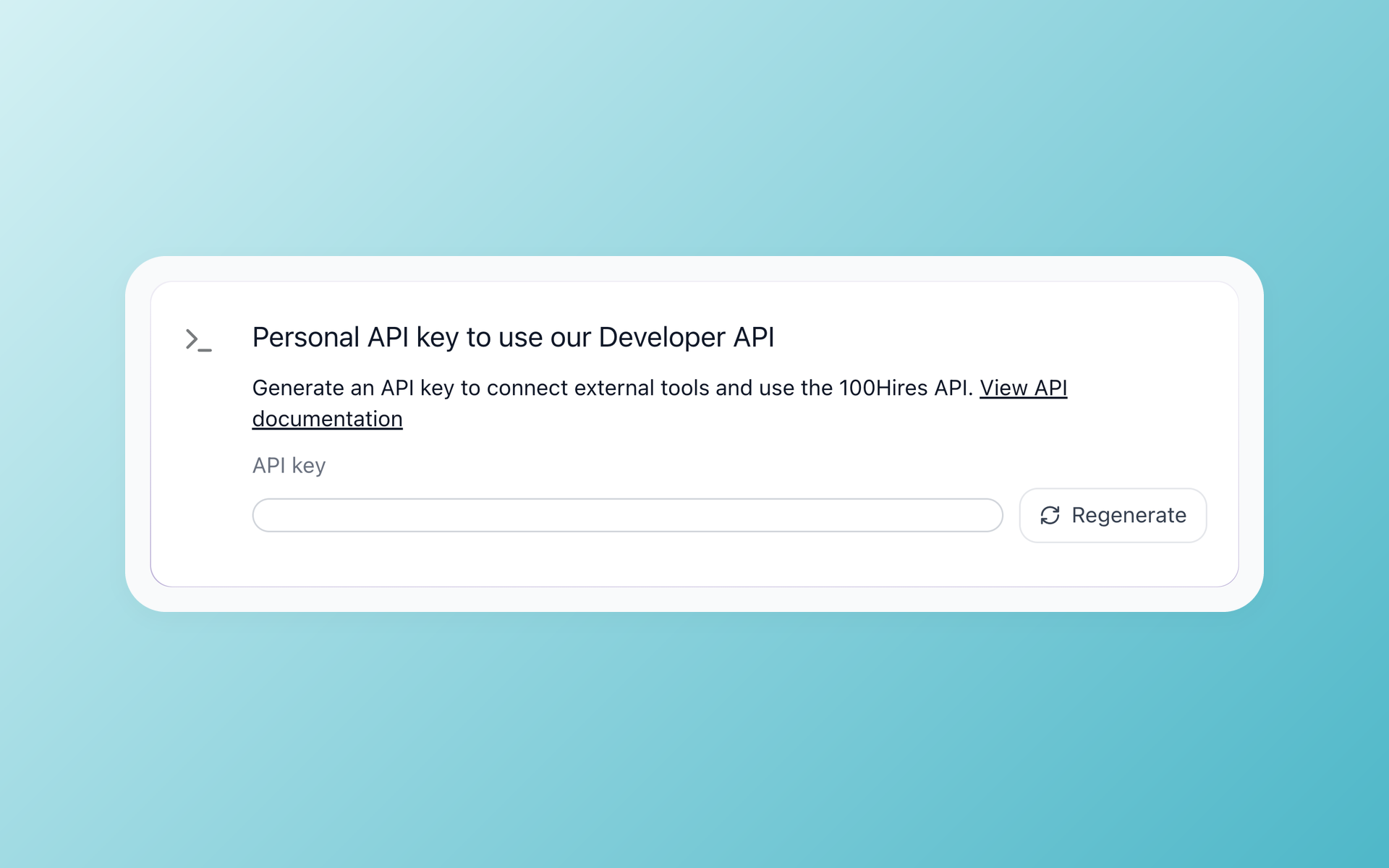
A product trial is not proof of API access; confirm that your account is entitled to a working API key.
What the public evidence does and does not show
ClearCompany's current platform overview references APIs, while its integrations page describes an integrations ecosystem.
Its public status site also tracks API Connectivity Health. Those are positive signals that API-related capabilities exist.
In the ClearCompany public sources checked on July 16, 2026, no usable current developer reference or self-service credential flow was verified. That does not mean ClearCompany has no API or that access is sales-gated.
Before implementation, ask ClearCompany for its current reference, authentication method, credentials, endpoint scope, webhook behavior, rate limits, sandbox, and commercial requirements.
A legacy v1 specification appears in search results, but it is a historical third-party copy with an old version history. Treat it as evidence that documentation existed, not as a current integration contract.
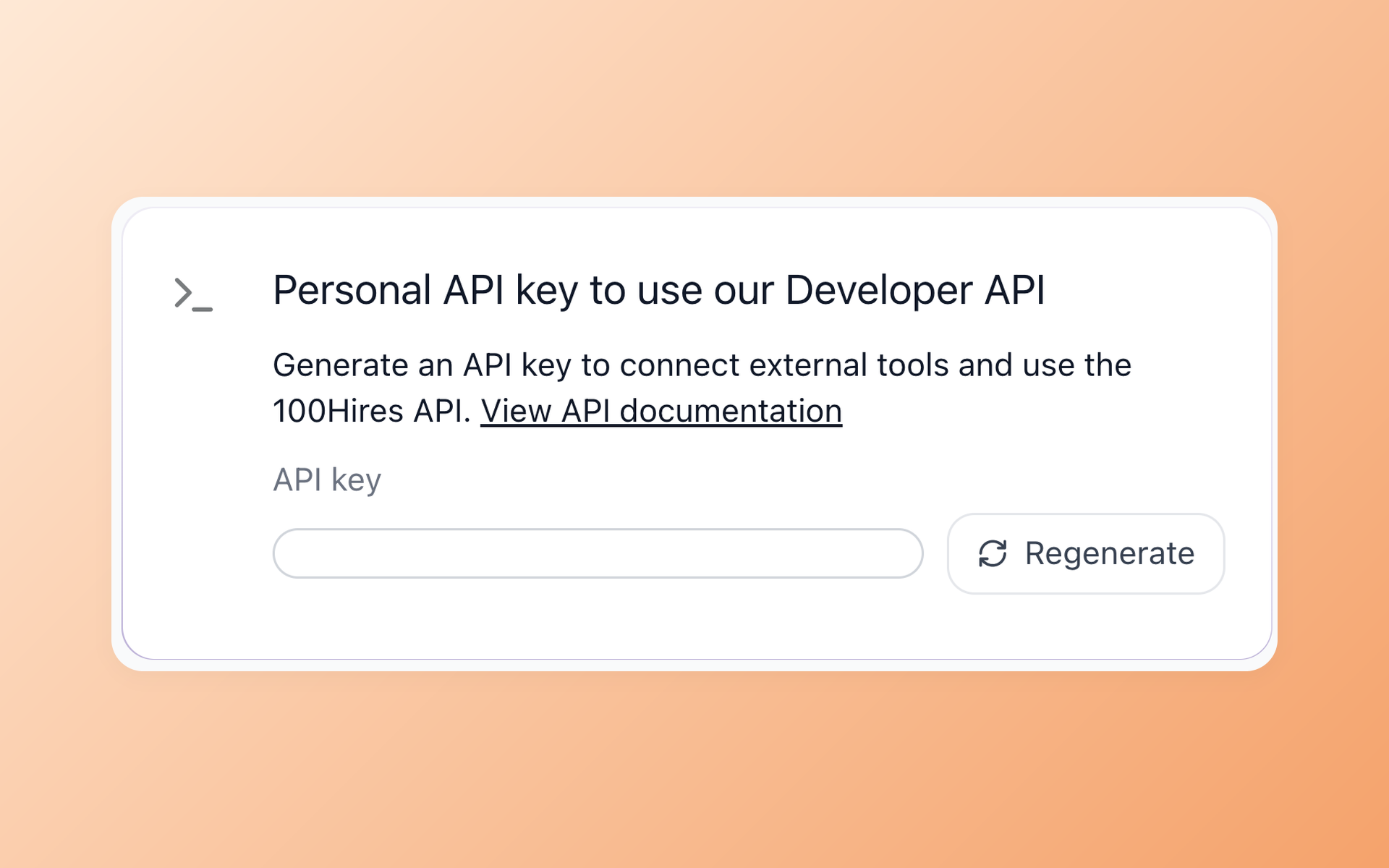
Remove credential guesswork early
Documentation directs users to Settings and Integrations. The Personal API key card shows key generation and a documentation link. It does not prove that every account has a verified company or a working key.
- Personal API key control
- API documentation link
- User-company key scope
- Account verification still applies
The public 100Hires API guide explains the documented route, links to the machine-readable specification, and says access is included with paid plans at no extra cost. Plan inclusion and working-key readiness remain separate checks.
ClearCompany API evidence compared with 100Hires
A product trial is not proof of API access; confirm that your company is verified and your account can issue a working key.
The comparison below uses the same evidence standard for both products: what a buyer can verify publicly today, not what a sales page or old document might imply.
 100Hires
What the current 100Hires API documents
On July 16, 2026, the public 100Hires OpenAPI 3.1 specification declared https://api.100hires.com/v2 as its production server and contained 89 paths and 133 operations. Those counts describe the published contract, not universal account access.
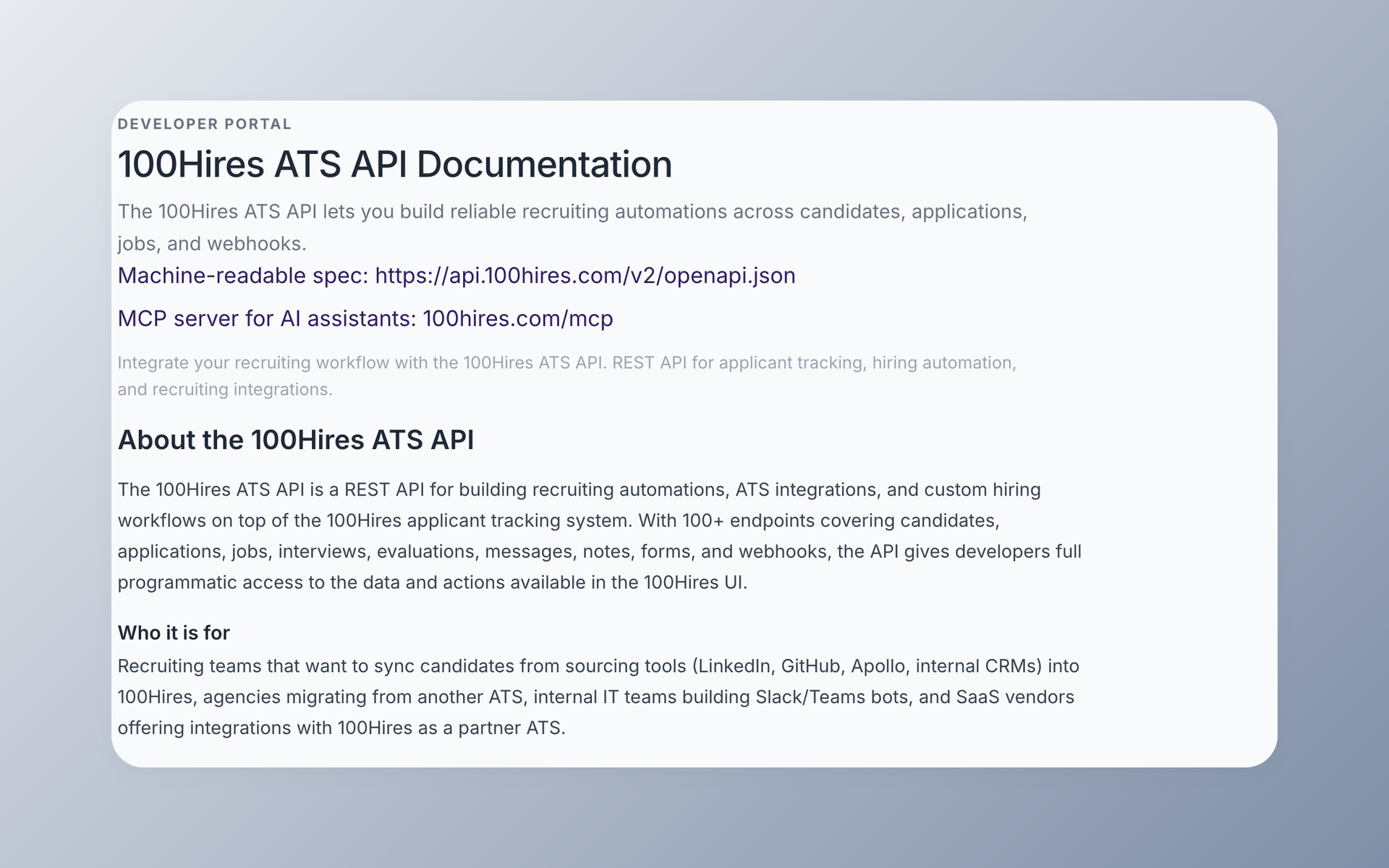
Inspect the contract before engineering starts
The 100Hires API provides a current machine-readable contract for estimation. It documents CRUD for candidates, jobs, applications, and notes, plus a limited set of recruiting workflow actions.
- OpenAPI 3.1 JSON
- 89 paths and 133 operations
- Four named CRUD resources
- Bearer authentication
The 100Hires API also documents job- and company-scoped webhooks. The documented operations let you list and create webhooks, rotate a webhook secret, and delete webhooks. No webhook URL update is documented.
HMAC-SHA256 signing uses the raw request body, and the signing secret is separate from the API key.
What to confirm before implementation
A downloadable specification reduces discovery work, but it does not remove questions about account access, permissions, or production design. The Developer API v2 overview is a useful starting point; confirm the following items for the account that will own the integration.
100Hires checks
- Working key and plan: the official API page says access is included with paid plans at no extra cost. Trial, partner, approval, sales, and universal working-key access still need confirmation.
- Key scope: a key belongs to one user-company pair; separate keys are needed across companies.
- Verification: keys for unverified companies are documented as disabled until verification.
- Field visibility: candidate values may be masked by pricing or access rules.
- New-key limit: 100 requests per 10 minutes per key, with rate-limit headers documented.
- Webhook delivery: a new-application event is explicit, but complete retry, replay, and duplicate-delivery guarantees are not.
- Error handling: the overview and detailed schemas describe validation errors differently, so inspect live responses.
ClearCompany checks
- Ask for the current official developer reference, API base, and version.
- Confirm the authentication method, credential-creation process, account-approval requirements, and any plan, partner, or sales requirements.
- Request a current matrix of candidate, requisition, job, application, note, and write-back operations.
- Confirm webhook events, signing, retry behavior, replay, and failure reconciliation.
- Document pagination, rate limits, errors, field permissions, and data masking.
- Ask whether a sandbox or test account is available and who owns technical escalation.
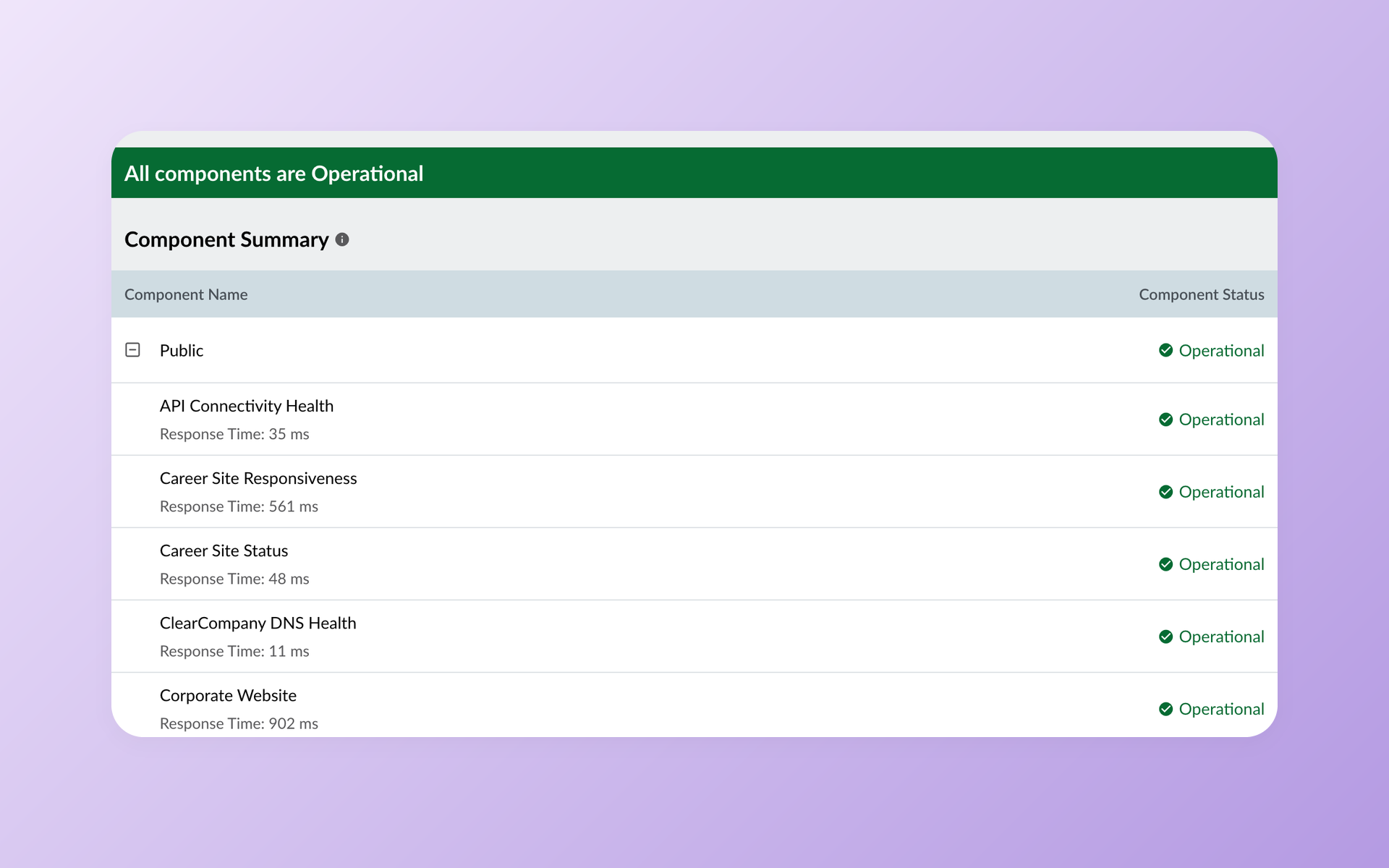
Know what to ask ClearCompany before you build
ClearCompany's official material supports API-related capability and public connectivity monitoring. In sources checked July 16, 2026, we did not verify a usable current developer reference, credential flow, endpoint contract, or commercial access policy.
- API-related capability is referenced
- Connectivity status is public
- Developer reference not verified
- Credential flow needs confirmation
A practical decision rule
If your estimate needs a current machine-readable contract, inspect the 100Hires API now.
For either vendor, confirm a working key, account verification, permissions, limits, webhook behavior, and support path before committing engineering time.
The hiring playbook, in your inbox
One email a week - benchmarks, AI screening tactics, and short interview templates from the 100Hires team. No product pitches.
Related 100Hires resources: Explore recruiting software and book a 100Hires demo.