
Candidate Matching Software
Build a shortlist you can defend: run AI Score on the applicants you choose and review every per-criterion score against your own standards.






screening candidates
response rates
time to fill
per hire
Candidate matching by hand stops working at a few hundred applicants
Post a decent role and applications arrive in the hundreds. Somebody has to read them, which often means skimming resume after resume until your eyes glaze over while a strong applicant on page nine waits behind ninety weak ones.
Recruiters who have tried built-in ranking tools tell the same story: the tool's top scorers were not actually the top candidates, so they went back to reading everything themselves. A score nobody can explain is a score nobody uses.
Keyword filters are no better. They reward whoever pasted the right words into a resume and quietly drop the career changer who called the same skill something else.
Candidate matching with AI Score: how it works
AI candidate matching scores applicants against the requirements of a role and ranks them by fit. In 100Hires, that engine is AI Score. It scores the people who applied for a job against the criteria you set for that job.
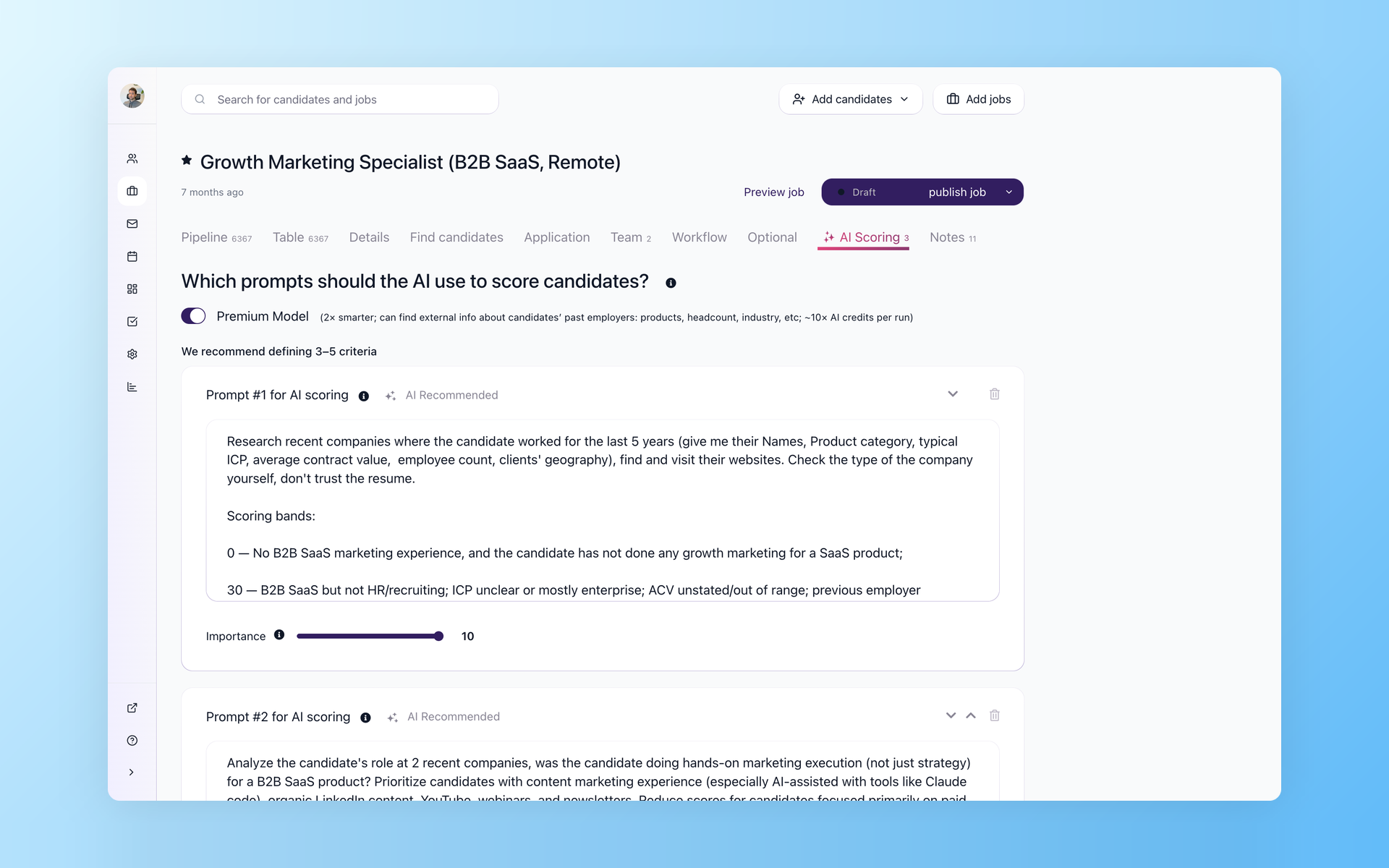
You write 3 to 5 criteria for the role in plain language and give each a weight from 1 to 10. Trigger scoring with one click, as a bulk action, or through a pipeline automation you enable.
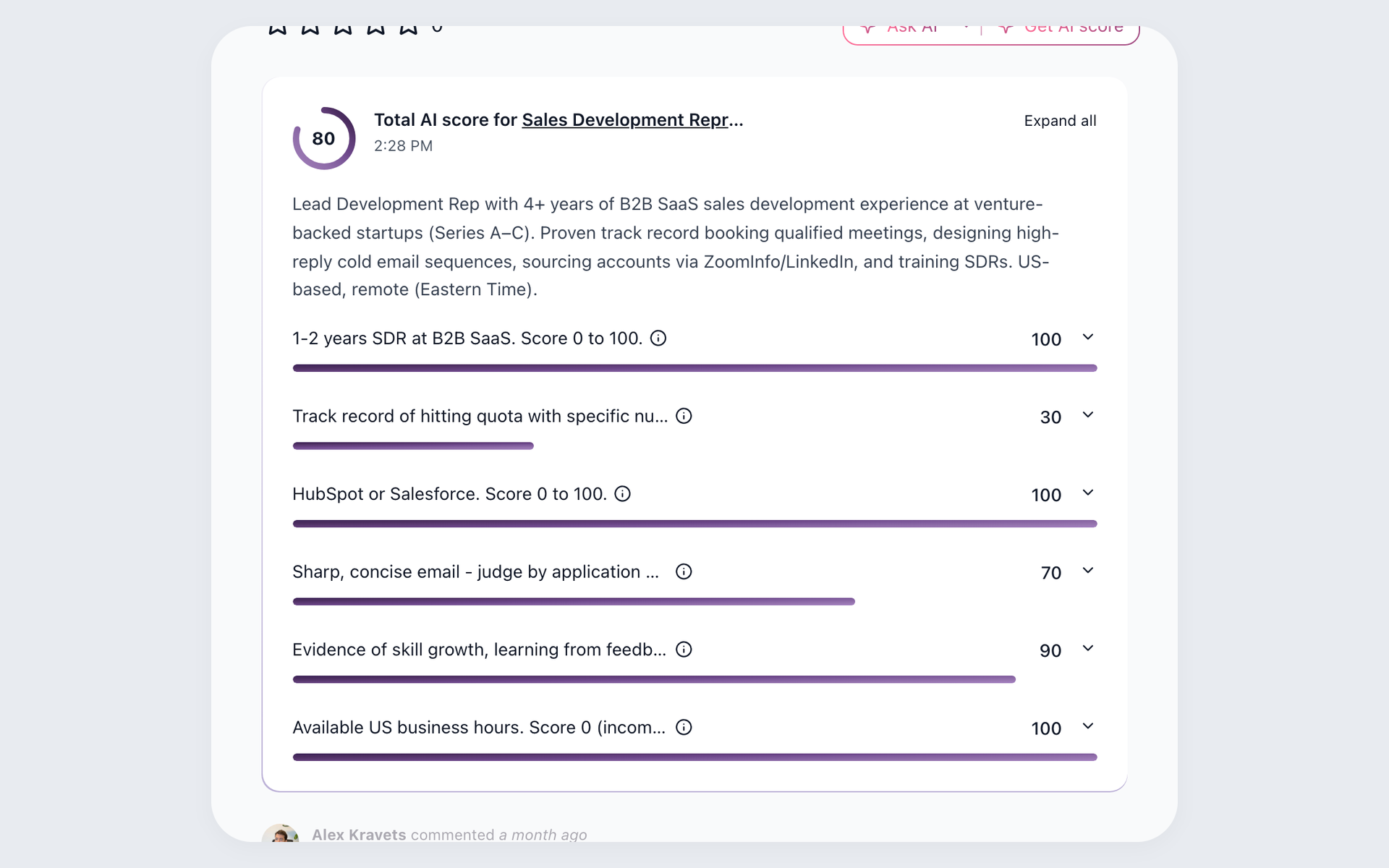
Each scored candidate gets a 0 to 100 total plus a score for each criterion, and you sort the pipeline from there.
The boundary matters: this is ranking, not sourcing. AI Score does not crawl job boards or mine an external database for new people. It helps you evaluate the applicants you already have more consistently.
It also slots into the screening you already run. Use knockout questions for hard dealbreakers and AI resume screening for intake-time resume checks. AI Score then handles the weighted judgment calls inside the same talent pipeline you manage every day.
Candidate matching in 100Hires vs a typical ATS
Many tracking systems reduce matching to a label: match, maybe, no. Here is where 100Hires differs from a typical ATS on the parts that decide whether you actually trust the number.
 100Hires
Score against your bar, not a vendor model
You define what a good candidate means for this role: 3 to 5 plain-language criteria, each with a weight from 1 to 10. AI Score rates the applicants you run it on against exactly those prompts, so the number reflects your bar for the job, not a generic model of a good resume.
- Plain-language criteria
- Weights from 1 to 10
- 3 to 5 per role
A score you can question, criterion by criterion
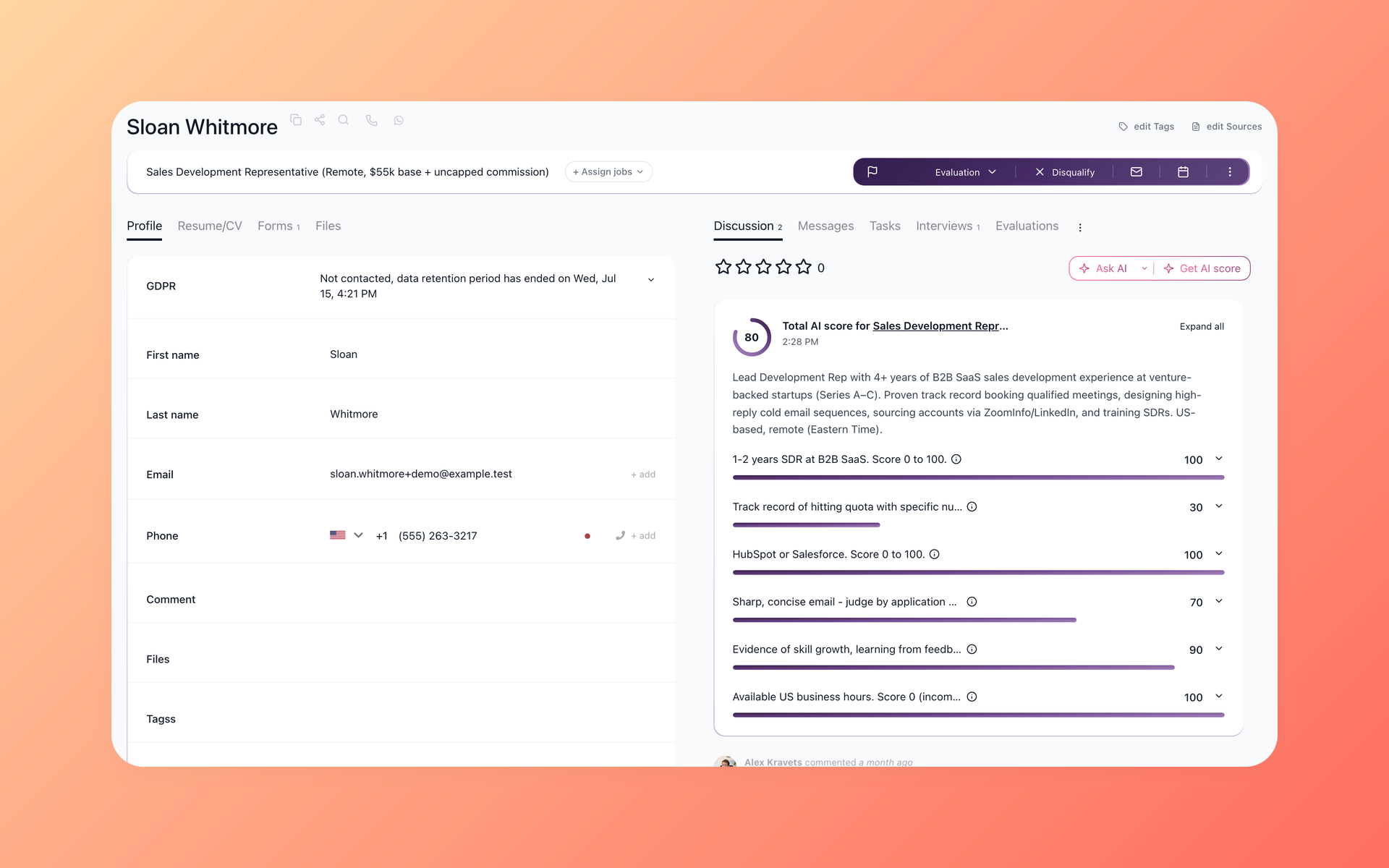
Each candidate you score gets a 0 to 100 total plus a separate score for each criterion. When a number looks off, open the breakdown, see which criterion dragged it down, and fix the prompt or the weight instead of quietly ignoring the tool. AI Score is built to be argued with.
- Visible score breakdown
- Edit criteria and re-score
- Same standard for everyone
Surface people who phrased it differently
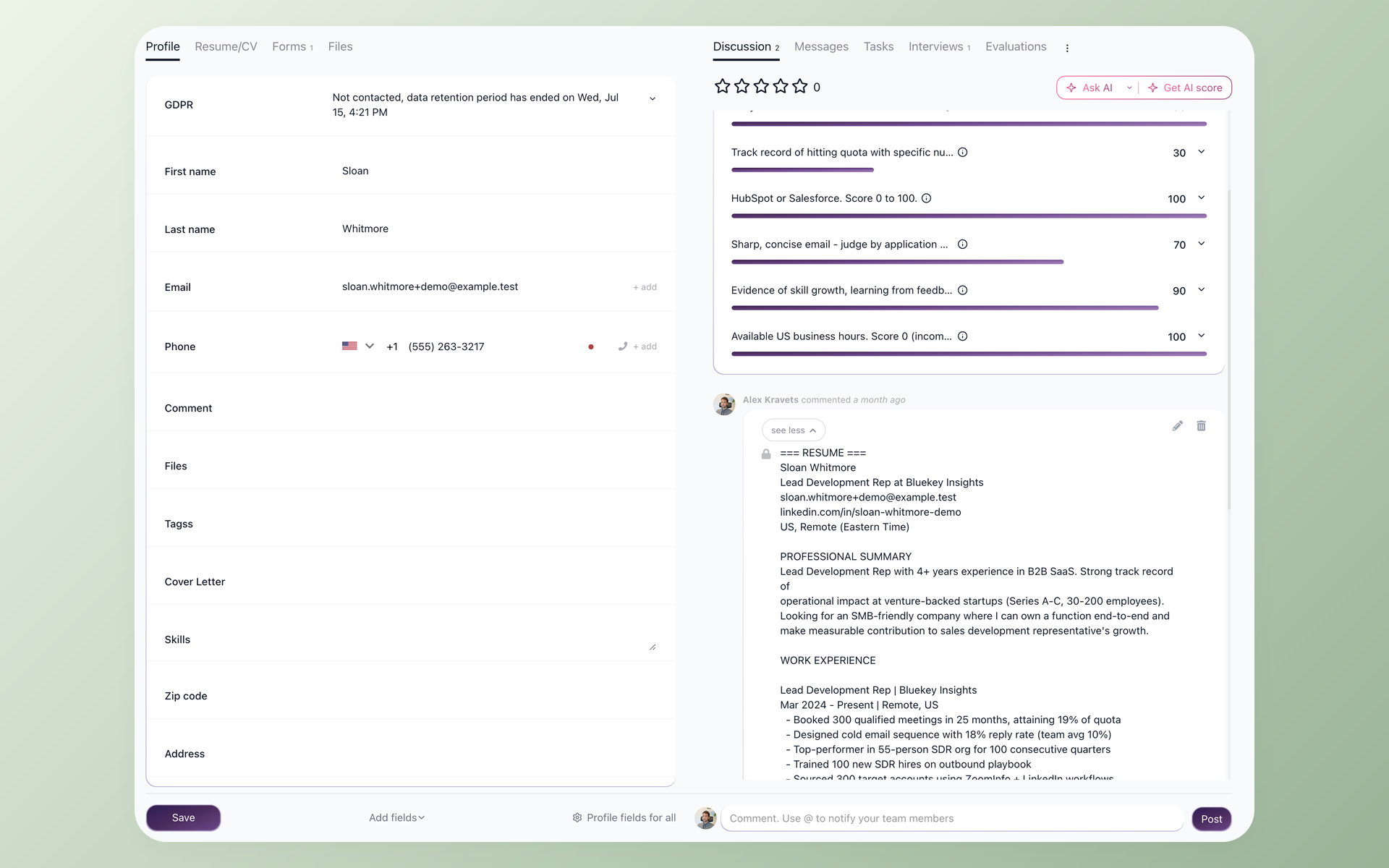
AI Score reads the whole application: resume, profile fields, questionnaire answers, evaluation forms, messages, and your team's notes. It scores for meaning against your criteria rather than matching keywords, so a strong applicant who never used your exact wording is not dropped on a keyword miss.
- Full application context
- Meaning over keywords
- Job description aware
Sort first, automate when you trust it
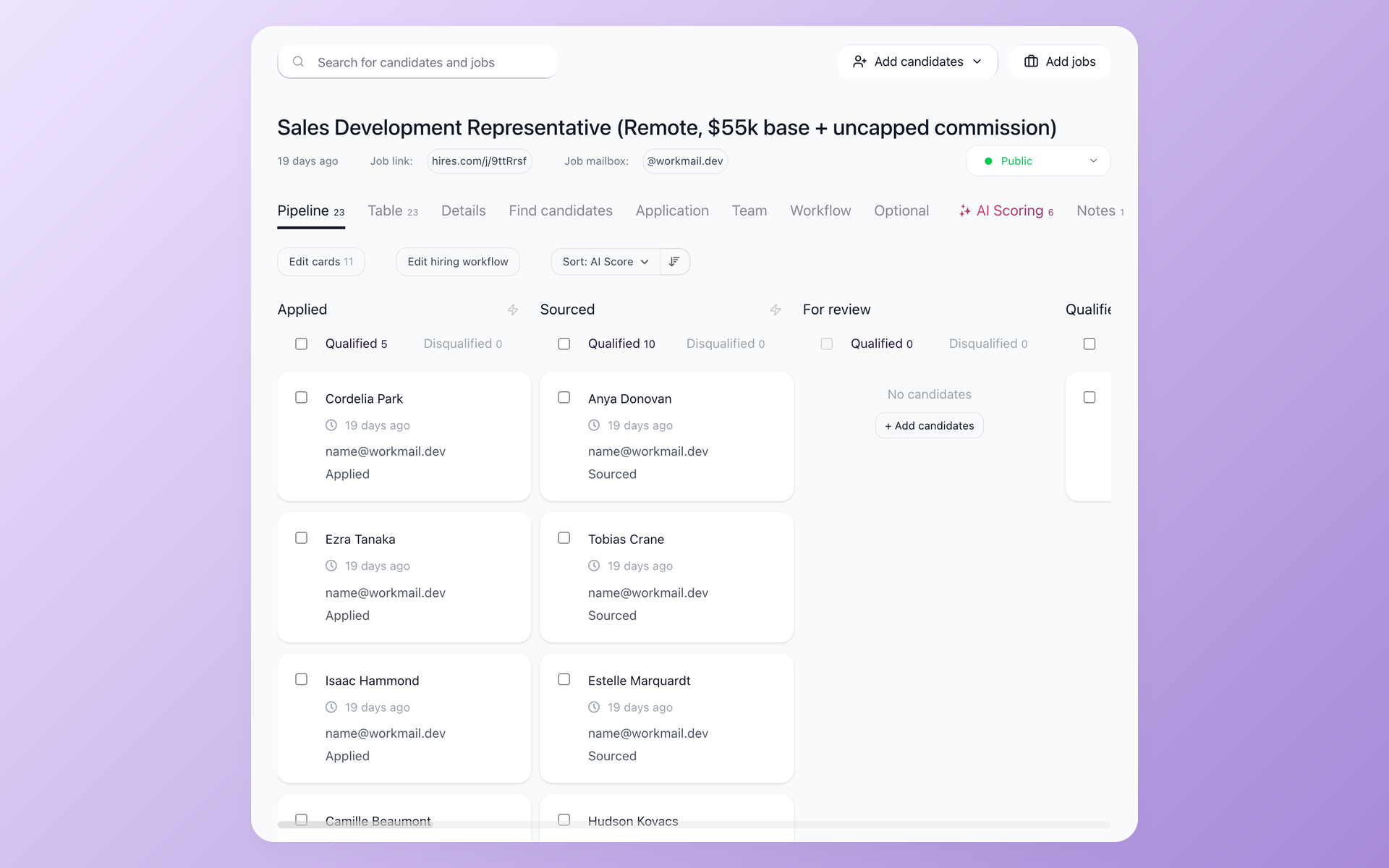
Sort the pipeline or table by AI Score and start your review from the top. Once you trust the scores, add a per-role workflow rule that moves strong candidates forward or disqualifies candidates below a threshold you set. It stays off until you turn it on, so you choose where human review sits in the flow.
- Sort pipeline by score
- Bulk scoring
- Opt-in threshold rules
Candidate matching limitations: where humans stay in charge
AI Score only assesses what the application actually contains. It cannot judge speaking accent or communication skills from a resume alone, and it cannot know anything nobody documented. It also does not go looking for candidates outside your pipeline.
100Hires does not claim a third-party bias audit. The control you get is transparency: you see how each score came together, you trigger scoring yourself, and nothing acts on a candidate until you allow it.

It solved all of my recruitment problems and offered all of the features I was looking for. It can automate most of my recruitment processes.

I’d happily recommend it to my industry peers. I’m able to use the platform with ease and don’t have to think twice about which function to use.

The system is very user-friendly. Even people with no experience will find it easy to understand its functionality.






 4.7
4.7
 4.8
4.8
How StratifyIQ screens 100 applicants in 2 hours
StratifyIQ's recruiting team gets through 100 applicants in about 2 hours with their 100Hires workflow: structured screening, evaluation forms, and pipeline views. New teams get up to speed 3x faster.
The hiring playbook, in your inbox
One email a week - benchmarks, AI screening tactics, and short interview templates from the 100Hires team. No product pitches.
Related 100Hires resources: Explore candidate tracking software.