
Bullhorn pricing 2026: 3, 10, 25 recruiters - 100Hires
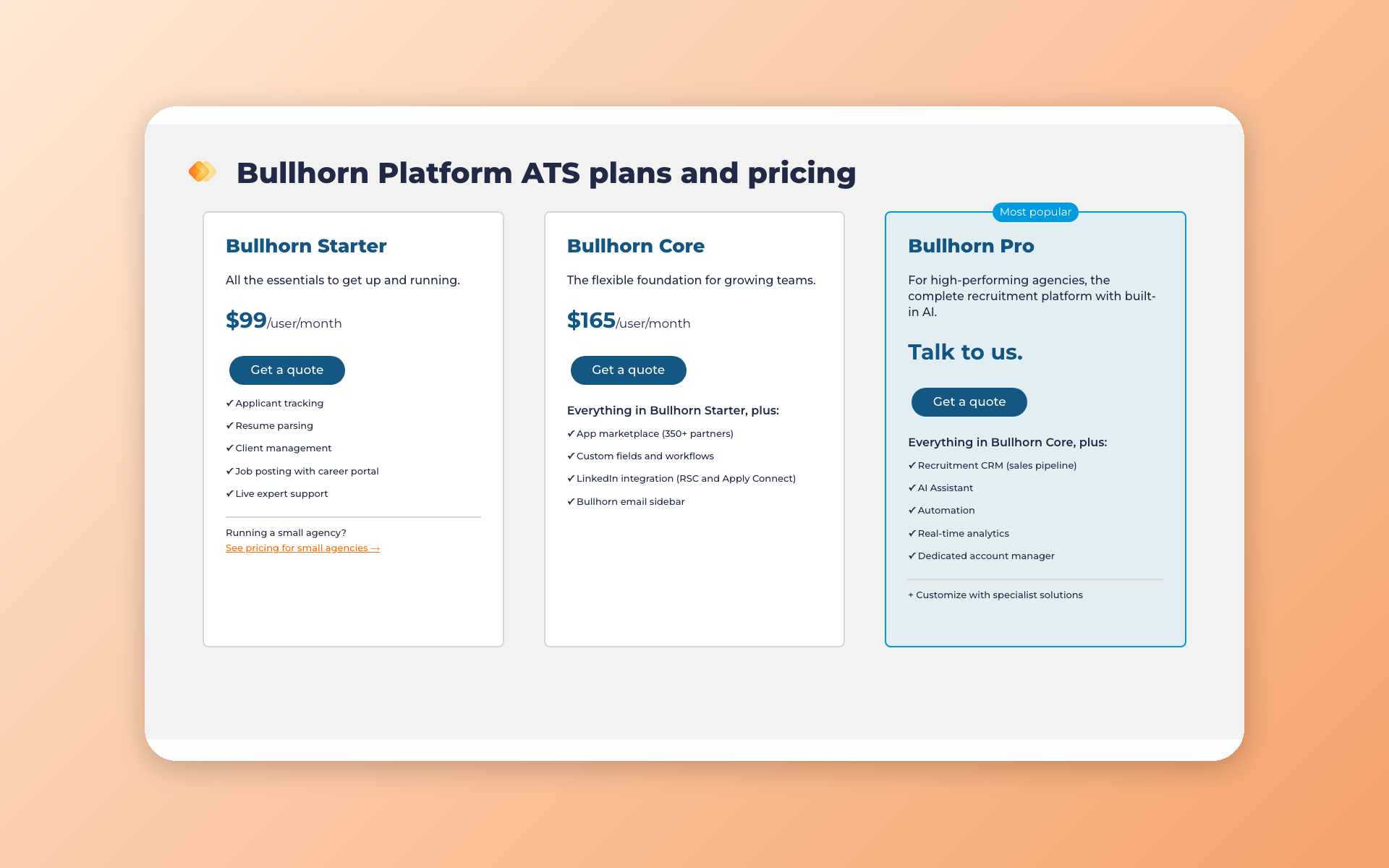
Are you comparing Bullhorn alternatives against a $165 rate or against the contract total your agency will sign?
Starter is $99 per user per month for 1-2 users, Core is $165 per user per month from 3 users, and Pro requires a custom quote.
Any team-size arithmetic in this guide is a derived subscription baseline, not an annual price, quote, contract total, or total cost.
The captured evidence shows no public Core maximum. It does not show a public user-count range for Pro.
This guide separates displayed rates, plan scope, usage units, quote-only items, and open commercial fields so you can prepare a clear pricing request.
Bullhorn pricing at a glance
The hiring playbook, in your inbox
One email a week - benchmarks, AI screening tactics, and short interview templates from the 100Hires team. No product pitches.
Bullhorn publishes two ATS unit rates and one quote-only plan. The cards do not show a ready-to-sign contract value.
| Plan | Displayed price state | Eligible users | Core inclusions | Billing and annual fields | Evidence label |
|---|---|---|---|---|---|
| Starter | $99/user/month | 1-2 users only | ATS, parsing, client management, job posting, career portal, live expert support | Not publicly shown: annual-equivalent value, annual total, billing cadence, commitment, and configured total | Displayed current first-party rate |
| Core | $165/user/month | Starts at 3 users; no public maximum captured | Starter scope plus Marketplace, custom fields and workflows, LinkedIn integration, email sidebar | Not publicly shown: annual-equivalent value, annual total, billing cadence, commitment, and configured total | Displayed current first-party rate |
| Pro | Custom quote | Public eligible-quantity range not shown | Recruitment CRM, sales pipeline, AI Assistant, automation, real-time analytics, account manager | Not publicly shown: annual-equivalent value, annual total, billing cadence, commitment, and configured total | Displayed quote state |
Public rates apply to different user quantities
Starter's rate belongs to a 1-2 user plan. It cannot serve as the public baseline for a team of 3, 10, or 25 recruiters.
Core begins at 3 users. No public maximum appeared in the captured evidence, so the table does not invent an upper limit.
Pro stays quote-only. Its public materials do not show an eligible range that would support seat-based arithmetic.
Public plan cards leave commercial fields open
A rate expressed per user per month shows the unit price. It does not prove monthly billing, annual commitment, contract length, or renewal treatment.
Discounts, implementation, migration, add-ons, taxes, and the configured total remain not publicly shown or not publicly verified.
Treat the table as a boundary map. A displayed rate tells you which unit appears on the card. The evidence label shows whether a value is displayed, derived, quoted, or absent.
That distinction keeps a displayed rate from carrying more meaning than the source can support. It gives procurement a stable starting point without turning missing fields into assumptions.
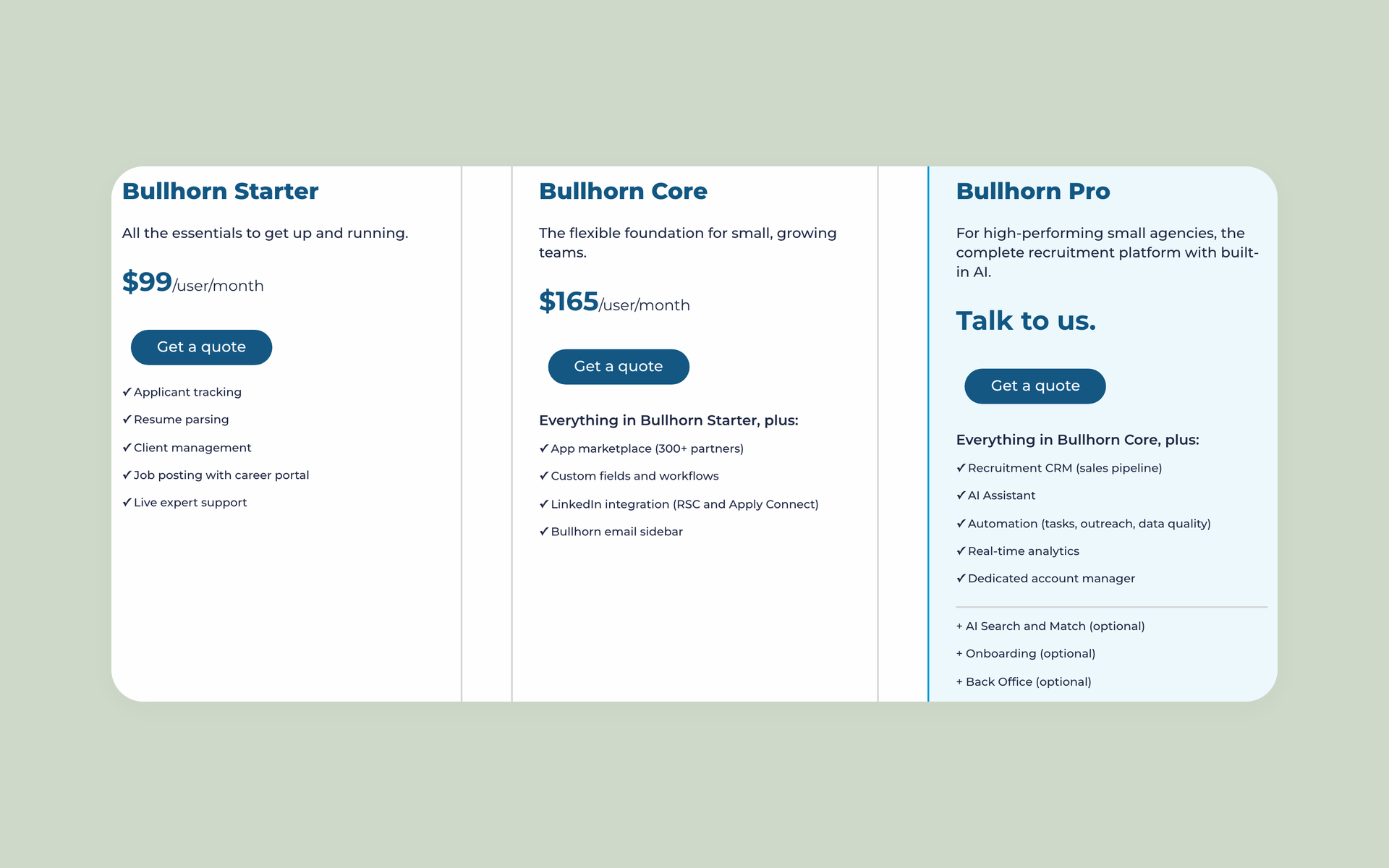
Starter, Core, and Pro cover different staffing needs
The three plans are not a simple tier progression. Each changes the eligible team size, workflow range, and amount of commercial detail to be settled in a quote.
Starter covers the basic agency workflow for 1-2 users
Starter includes applicant tracking, resume parsing, client management, job posting and a career portal, plus live expert support.
That scope gives a very small agency the core path from applicant record to client work. The 1-2 user rule stays attached to the $99 rate.
The card does not establish Marketplace access, specialist products, an annual commitment, or setup work beyond the narrow public statements covered later.
The plan makes most sense when two people can share the agency workflow without needing Core's configuration or ecosystem access. A third user changes the eligible plan, not just the seat count.
Core adds configuration and Marketplace access from 3 users
Core includes the Starter capabilities, then adds Marketplace access, custom fields and workflows, LinkedIn integration, and the email sidebar.
Bullhorn publishes Marketplace access for Core, but its current pages do not support one reliable partner-total claim. This article therefore omits a precise ecosystem count.
Neither figure proves that every connection is included, free to license, or covered by the same support team. Price each required partner in the quote.
Custom fields and workflows matter when an agency has its own stages, records, or client rules. The public rate still does not reveal the configuration effort needed to put those choices into production.
Pro adds CRM, AI, automation, analytics, and ownership
Pro lists recruitment CRM and sales pipeline features, AI Assistant, automation, real-time analytics, and a dedicated account manager.
The plan requires a custom quote, and no public user-count range was captured. A buyer needs the quote to define its exact configuration.
Similar wording does not prove that separate Amplify, Recruitment Automation, or Bullhorn Analytics products come bundled with Pro.
A Pro quote should name the product behind each AI, automation, and analytics workflow. It should state the usage allowance, service work, support owner, and recurring charge for each named item.
Core pricing scales with paid recruiter seats
Core is the only publicly priced Bullhorn plan eligible for all three comparison team sizes.
The model assumes paid recruiter users and no added scope
The model assumes 3, 10, or 25 paid recruiter users. It multiplies the displayed Core unit by the assumed seats and 12 to form a derived subscription baseline.
No implementation, migration, partner, add-on, service, tax, discount, or administrative amount enters the arithmetic.
The formula does not establish billing cadence or commitment. No public Core maximum appeared in the captured evidence.
Three Core scenarios show subscription exposure, not total cost
| Assumed paid recruiter users | Starter | Core | Pro |
|---|---|---|---|
| 3 | Ineligible; 1-2 users only | derived subscription baseline: $5,940 = $165 x 3 x 12 | Custom quote; public eligible range not shown |
| 10 | Ineligible; 1-2 users only | derived subscription baseline: $19,800 = $165 x 10 x 12 | Custom quote; public eligible range not shown |
| 25 | Ineligible; 1-2 users only | derived subscription baseline: $49,500 = $165 x 25 x 12 | Custom quote; public eligible range not shown |
Each result is a derived subscription baseline, not an annual price, quote, contract total, or total cost.
The gap between a baseline and a signed budget sits in the cost layers that the multiplication leaves out.
The difference grows with seats, but the model does not prove that the final contract follows the same curve. Discounts, user definitions, added products, and services can change the signed amount.
The displayed rate covers only one layer of Bullhorn cost
The captured public evidence does not establish a configured Bullhorn total. A cost model needs line items, not an invented TCO range.
Implementation and migration have narrow public limits
The small-agency page says that there are no setup fees, that VAT is excluded, and that live expert support is included. Those statements apply to that narrow page context.
Many small agencies may go live in as little as two weeks. This is not a universal duration for a complex migration, integration, or configuration.
Setup can import up to 15,000 Candidate, Company, and Contact records. The public scope does not define cleanup, attachments, custom objects, history, validation, or overage work.
OnRamp for Starter and Core includes one kickoff and one follow-up. Pro includes a Product Consultant and two follow-ups.
Treat ATS implementation and ATS data migration as defined workstreams with owners, deliverables, tests, and change rules.
Recurring and contract layers need line-item answers
| Cost layer | Narrow public evidence | Open commercial field | Buyer action |
|---|---|---|---|
| Base subscription and Pro | Starter $99/user/month; Core $165/user/month; Pro custom quote | Not publicly shown: billable user types, cadence, commitment, eligible Pro quantity, discounts, subtotal | Request quantities, plan, cadence, commitment, gross price, discounts, and line-item subtotal |
| Implementation and configuration | Small-agency page says no setup fees; onboarding call counts are public | Not publicly shown: extra setup, workflow design, timeline, partner work, change requests, fees | Define tasks, owners, dates, acceptance tests, and extra-service rates |
| Migration and data work | Setup imports up to 15,000 Candidate, Company, and Contact records | Not publicly shown: cleanup, mapping, files, history, custom objects, validation, overage, price | Inventory data and request written scope, exceptions, and acceptance tests |
| Training, adoption, and admin labor | Narrow onboarding calls are listed | Not publicly shown: training plan, admin owner, enablement time, change management, ongoing labor | Assign internal owners and estimate the work without a fabricated public amount |
| AI Assistant and Amplify | Pro lists AI Assistant; Amplify publishes usage units | Not publicly shown: dollar price, package inclusion, resets, overage, other AI products | Forecast usage and request included and incremental activity prices |
| Automation | Pro lists automation; Recruitment Automation is a separate product context | Not publicly shown: product price, workflow or message limits, overage, services, dependencies | Name the exact product and price each required workflow |
| Analytics | Pro lists real-time analytics; Bullhorn Analytics is separate | Not publicly shown: roles, dashboards, refresh, exports, setup, package inclusion, price | Separate plan analytics from the specialist product in the quote |
| Support tiers and SLAs | Live expert support is included; Pro lists an account manager | Not publicly shown: channels, hours, response targets, escalation, premium tiers, fees | Write the service level, owner, response target, and price into the order |
| Marketplace and partner fees | Marketplace access is displayed; a reliable current partner total is not publicly verified | Not publicly shown: licenses, connector setup, hosting, support, pass-through fees, native status | Price each partner and assign support ownership for every connection |
| Add-ons and specialist products | Several suites and products are separate contexts | Not publicly shown: prices, bundle rules, minimums, dependencies, professional services | Map every workflow to a named product and line item |
| Integrations and API | Public API documentation exists | Not publicly shown: API charges, quotas, throttling, access, environments, connector support | Confirm rights, limits, owner, support, and direct or partner charges |
| Taxes | Small-agency page says VAT excluded | Not publicly shown: applicable VAT, sales tax, withholding, other jurisdiction rules | Verify applicable VAT using the European Commission VAT rules |
| Billing, commitment, and contract term | Not publicly shown | Not publicly shown: cadence, start date, term, minimum commitment, user treatment | Put each field in the order form instead of inferring it from /user/month |
| Discounts, renewal, and price changes | No current discount or renewal rule was publicly verified | Not publicly verified: gross price, discount expiry, auto-renewal, notice, uplift, repricing rights | Record each discount, renewal date, notice window, cap, and renewal base |
| Termination, export, and data handling | No current first-party termination rule was publicly verified | Not publicly verified: early exit, export format, retention, deletion, exit services, charges | Review the contract and test a complete export before signing |
| Professional services | Public plan pages show narrow onboarding calls | Not publicly shown: rate card, work orders, travel, training, admin enablement, changes | Request rates and cap or preapprove change orders |
| Configured total | No universal configured total is public | Not publicly shown or verified: all subscription, service, partner, tax, discount, and term fields | Compare the seller-issued line items with your operating requirements |
The matrix turns an unknown Bullhorn cost into a defined set of questions. It does not pretend that missing amounts can be solved with a broad market range.
Internal labor belongs in the model. Assign an owner for workflow decisions, data quality, training, adoption, and partner coordination, but do not invent public hours or dollar estimates that the captured evidence does not support.
Put tax, discounts, renewal, and exit terms next to the subscription subtotal. A low first-period number can be hard to compare when the discount expiry, renewal base, export method, or notice window sits elsewhere.
Specialist Bullhorn products need separate scope and pricing
Product names that sound related can belong to different suites, packages, and pricing arrangements. Keep optional AI Search & Match, Onboarding, Back Office, and every other named product separate from Platform Starter, Core, and Pro.
Suites and operational products expand staffing scope
| Product or package | Captured boundary | Public price state |
|---|---|---|
| Bullhorn One | Standard scope uses ATS/CRM, Pay & Bill, and Talent Platform; captured standard package excludes Analytics, Automation, and productivity apps | Not publicly shown |
| Recruitment Cloud | Separate Salesforce-based product family | Not publicly shown on captured Bullhorn source |
| Front Office | Recruitment Cloud package context | Not publicly shown |
| 360 | Recruitment Cloud package adding time and expense, invoicing, and gross pay | Not publicly shown |
| Workforce | Separate Recruitment Cloud and workforce context | Not publicly shown |
| Onboarding | Optional product context | Not publicly shown |
| Back Office | Optional product context on the small-agency page | Not publicly shown |
| Middle Office | Separate product and pricing-page context | Not publicly shown |
| Pay & Bill | Component of the captured Bullhorn One standard solution | No separate public price captured |
| VMS Automation or VMS Sync | Current substantive first-party scope was not captured | Not publicly verified |
The separate Recruitment Cloud AppExchange Front Office Core listing shows $219/user/month, tied to license count and contract length.
That warns against treating the price as Platform Core pricing. It does not belong in a Platform plan comparison.
Bullhorn One shows why suite scope matters. Its captured standard solution uses ATS/CRM, Pay & Bill, and Talent Platform, but the captured standard package does not bundle Analytics, Automation, or productivity apps.
Recruitment Cloud follows another product path. Front Office, 360, and Workforce need their own scope and price treatment, with 360 adding time and expense, invoicing, and gross pay.
AI, automation, and analytics use separate product boundaries
| Product context | Captured boundary | Public price state |
|---|---|---|
| Amplify | Separate AI context with 1,000 activities/month | Dollar price not publicly shown |
| Recruitment Automation | Separate automation product context | Not publicly shown |
| Search & Match | Optional AI Search & Match context | Not publicly shown |
| Bullhorn Analytics | Separate product context, not proof of inclusion from Pro's real-time analytics wording | Not publicly shown |
Amplify Screen uses 3 activities per completed screen. Prospect Company Profile uses 3 activities per linked profile.
Those numbers are usage units, not dollars. Ask which allowance, reset rule, overage, and product price apply to the intended workflow.
Map each required workflow to the named recruitment automation software, allowance, implementation owner, and support path in the quote.
100Hires uses flat company pricing for the same team sizes
100Hires owns and publishes this article. No retained external discovery stream supplied independent evidence about 100Hires.
The captured UI defaulted to EUR. The figures below are current USD values from 100Hires pricing data, not figures shown on a verified US-locale pricing card.
100Hires does not provide Bullhorn-equivalent payroll, time, billing, pay/bill, workforce, back-office, VMS, or enterprise-services scope.
Current payload values cover every public 100Hires plan state
| 100Hires plan | Monthly payload value | Annual-equivalent payload value | Derived subscription baseline | Scope and public limits |
|---|---|---|---|---|
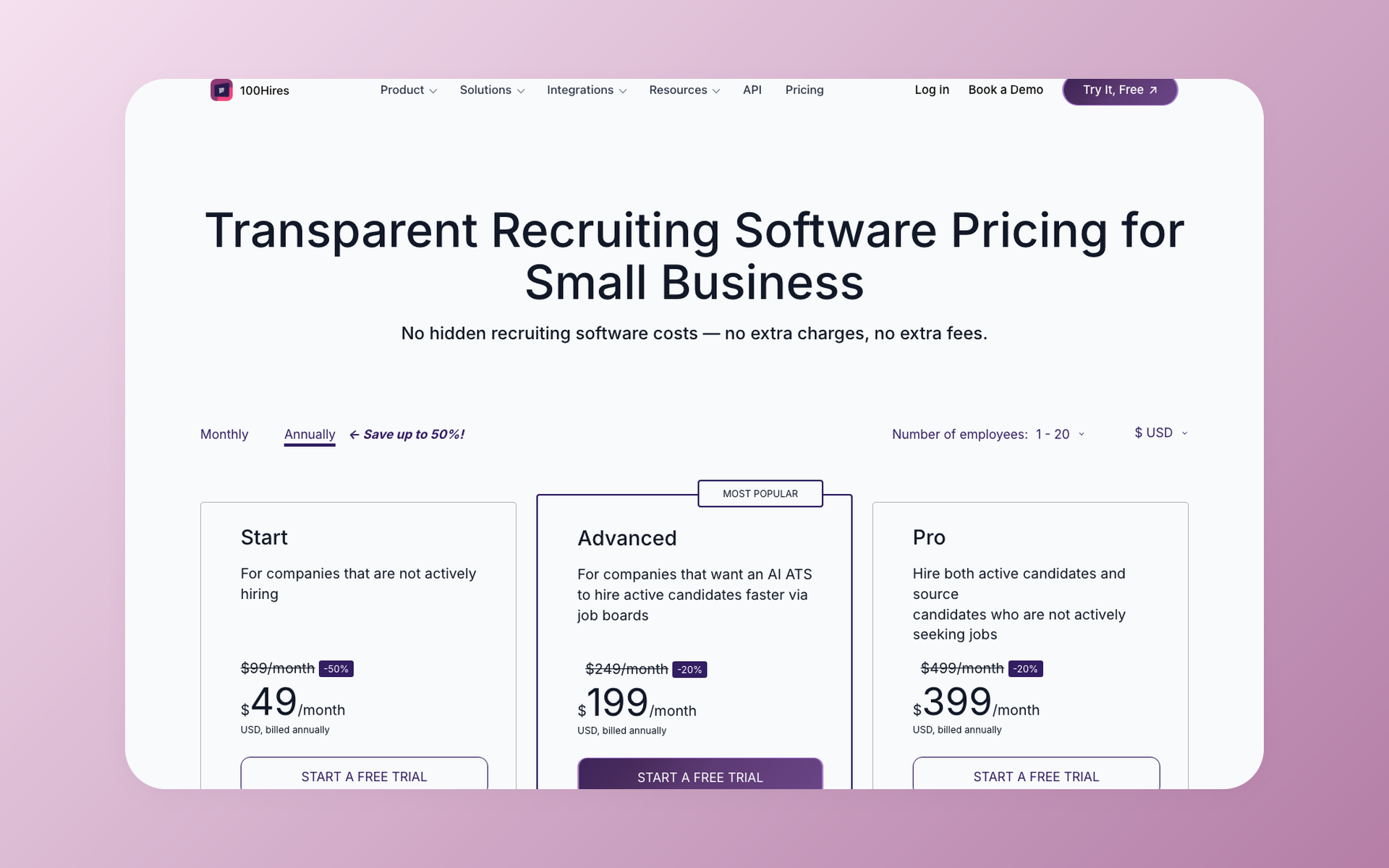
| 100Hires Start | $99/month | $49/month annual-equivalent | derived subscription baseline: $588/year = $49 x 12 | One user; 3 jobs; 100 candidates; 100 AI credits/month |
| 100Hires Advanced | $249/month | $199/month annual-equivalent | derived subscription baseline: $2,388/year = $199 x 12 | Flat unlimited-user company plan; unlimited jobs and candidates; 300 monthly-plan or 1,000 annual-plan AI credits |
| 100Hires Pro | $499/month | $399/month annual-equivalent | derived subscription baseline: $4,788/year = $399 x 12 | Flat unlimited-user company plan; 3,000 monthly-plan or 5,000 annual-plan AI credits; migration for annual contracts |
| 100Hires Enterprise | Not publicly shown | Not publicly shown | Not publicly shown | Current commercial fields not publicly shown |
Start is one-user only and ineligible at 3, 10, and 25 users. Advanced and Pro are flat unlimited-user company plans and are never multiplied by seats.
Each arithmetic result is a derived subscription baseline, not an annual price, quote, contract total, or total cost.
The flat plans cover recruiting and front-office work such as AI-assisted recruiting, automation, analytics, outreach, job workflows, and collaboration. According to current first-party evidence, the annual Pro plan includes migration.
The 3, 10, and 25 recruiter comparison is not functional parity
| Scenario | 100Hires Start | 100Hires Advanced | 100Hires Pro | Bullhorn Starter | Bullhorn Core | Bullhorn Pro |
|---|---|---|---|---|---|---|
| 3 recruiters | Ineligible; one user only | derived subscription baseline: $2,388/year, flat company plan | derived subscription baseline: $4,788/year, flat company plan | Ineligible; 1-2 users only | derived subscription baseline: $5,940 = $165 x 3 x 12 | Custom quote; public eligible range not shown |
| 10 recruiters | Ineligible; one user only | derived subscription baseline: $2,388/year, flat company plan | derived subscription baseline: $4,788/year, flat company plan | Ineligible; 1-2 users only | derived subscription baseline: $19,800 = $165 x 10 x 12 | Custom quote; public eligible range not shown |
| 25 recruiters | Ineligible; one user only | derived subscription baseline: $2,388/year, flat company plan | derived subscription baseline: $4,788/year, flat company plan | Ineligible; 1-2 users only | derived subscription baseline: $49,500 = $165 x 25 x 12 | Custom quote; public eligible range not shown |
Every figure in this comparison is a derived subscription baseline, not an annual price, quote, contract total, or total cost.
The rows do not compare equivalent scopes. 100Hires does not provide Bullhorn-equivalent payroll, time, billing, pay/bill, workforce, back-office, VMS, or enterprise-services scope.
Plan choice in 100Hires depends on job, candidate, AI-credit, migration, and other plan limits, not recruiter count alone.
Flat pricing removes seat multiplication from Advanced and Pro. It does not remove plan limits, AI-credit needs, migration choices, or the need to compare the work each product can perform.
If recruiting and front-office work match the brief, review 100Hires pricing. Teams needing the wider staffing back office should price that scope separately.
The better fit depends on staffing operating scope
Seat arithmetic answers one buying question. Operating scope decides whether the compared subscriptions can do the same job.
Bullhorn fits mature staffing operations with broader workflow needs
Bullhorn can fit a mature staffing agency that needs complex client and placement workflows, broad partner coverage, pay/bill or workforce-management options, back-office operations, and enterprise services.
Its wider product family may justify scoped implementation and a detailed quote. The value depends on the workflows the agency will use, not the plan-card rate alone.
A staffing agency software decision changes once time, payroll, billing, gross pay, or workforce operations enter the brief.
100Hires fits predictable front-office recruiting needs
100Hires can fit recruiting and front-office teams that want flat company pricing, AI-assisted recruiting, automation, analytics, outreach, job workflows, and collaboration.
The narrower product scope can mean less seat arithmetic and fewer staffing-stack decisions for that use case.
It does not provide Bullhorn-equivalent payroll, time, billing, pay/bill, workforce, back-office, VMS, or enterprise-services scope. That difference means neither product is a universal winner.
The fair choice is the product that covers the required operating model without unused scope or missing core work. Price follows that scope decision, not the other way round.
A line-item quote exposes the full contract
A plan card starts the budget. A seller-issued quote must connect products, services, commercial terms, and exit rights to the agency's operating requirements.
Scope and service line items define what the buyer receives
| Checklist area | Request in the quote or order form |
|---|---|
| Users and plan | Billable user roles, quantities, plan, product family, dependencies, included and excluded capabilities |
| Implementation | Deliverables, configuration, workflow design, owners, dates, training, acceptance tests, change-order rates |
| Migration | Record types, volumes, files, history, mappings, custom objects, cleanup, validation, overage, acceptance |
| AI and automation | Named products, included usage, reset rules, overage, workflow limits, service work, recurring price |
| Analytics | Plan analytics versus Bullhorn Analytics, roles, dashboards, refresh, exports, setup, limits, price |
| Support | Channels, service hours, response targets, escalation, account owner, premium tier, price |
| Partners and integrations | Each license, connector, setup fee, hosting charge, support owner, API right, quota, environment |
| Professional services | Rate card, work-order rules, travel, admin enablement, training, approval process, spending cap |
| Commercial basis | Billing cadence, start date, commitment, contract term, gross subtotal, tax treatment |
| Discounts | Each discount, expiry, renewal base, eligible quantity, and multi-product condition |
| Renewal and price changes | Renewal date, notice window, auto-renewal, uplift cap, indexation, repricing rights |
| Termination and data exit | Early-exit terms, export format, retention, deletion, exit services, related charges |
| Configured total | Subscription, services, partners, taxes, discounts, and total across the full term |
Ask who owns each connection and deliverable. Give every workstream a written acceptance test, and state which change creates an extra charge.
A checklist is useful only when the seller answers it inside the commercial documents. Sales-call explanations should match the order form, implementation statement, and contract.
Contract and exit terms define what the buyer can control
Commercial fields belong in the same checklist: billing, commitment, term, gross price, tax treatment, discount expiry, renewal, notice, and price-change rules.
Exit fields need equal care. Record termination rights, export format, retention, deletion, exit services, and the configured total across the full contract term.
Compare that line-item quote with the operating requirements. A unit rate cannot answer who performs the work, what gets delivered, or what happens at renewal and exit.
Bullhorn pricing FAQ
How much does Bullhorn cost per month in 2026?
Bullhorn Starter is $99 per user per month for 1-2 users, Core is $165 per user per month from 3 users, and Pro requires a custom quote. 100Hires uses current USD values from its pricing data, but the captured UI defaulted to EUR and its scope is narrower.
What is Bullhorn ATS pricing for 10 recruiters in 2026?
At 10 assumed Core seats, Bullhorn's derived subscription baseline is $19,800. 100Hires Advanced and Pro have flat derived subscription baselines of $2,388/year and $4,788/year. These are not annual prices, quotes, contract totals, or total costs; scope differs.
Does Bullhorn charge setup fees?
Bullhorn's small-agency page says no setup fees, but this does not cover every product, partner, migration, service, or configured implementation. According to current first-party evidence, 100Hires annual Pro includes migration; other plans need separate verification.
What extra costs should a Bullhorn quote include?
A Bullhorn quote should itemize implementation, migration, configuration, training, AI, automation, analytics, support, partners, integrations, API, taxes, terms, and configured total. 100Hires flat pricing reduces seat arithmetic but lacks equivalent back-office scope.
Is Bullhorn a good fit for a small staffing agency?
Bullhorn can fit a small agency when client, placement, partner, or future pay/bill needs justify the broader platform. 100Hires can fit a front-office team that values predictable pricing, AI-assisted recruiting, outreach, automation, analytics, and collaboration.
Does Bullhorn include pay and bill capabilities?
The captured Bullhorn One standard solution includes ATS/CRM, Pay & Bill, and Talent Platform, but no separate public Pay & Bill price was captured. 100Hires does not offer Bullhorn-equivalent payroll, time, billing, pay/bill, workforce, or VMS scope.
A scope-based comparison makes the next step clear
Request a current line-item Bullhorn quote for broader staffing operations, pay/bill functions, workforce-management options, complex placements, extensive partner integrations, or enterprise services.
For recruiting and front-office work, review 100Hires pricing for flat company plans, AI assistance, automation, analytics, outreach, job workflows, and collaboration. It does not replace the wider staffing back office.
Try 100Hires for free
No credit card. 14-day trial. Forbes Advisor #1 ATS for SMBs.