
Betterteam vs ZipRecruiter for employers in 2026 - 100Hires
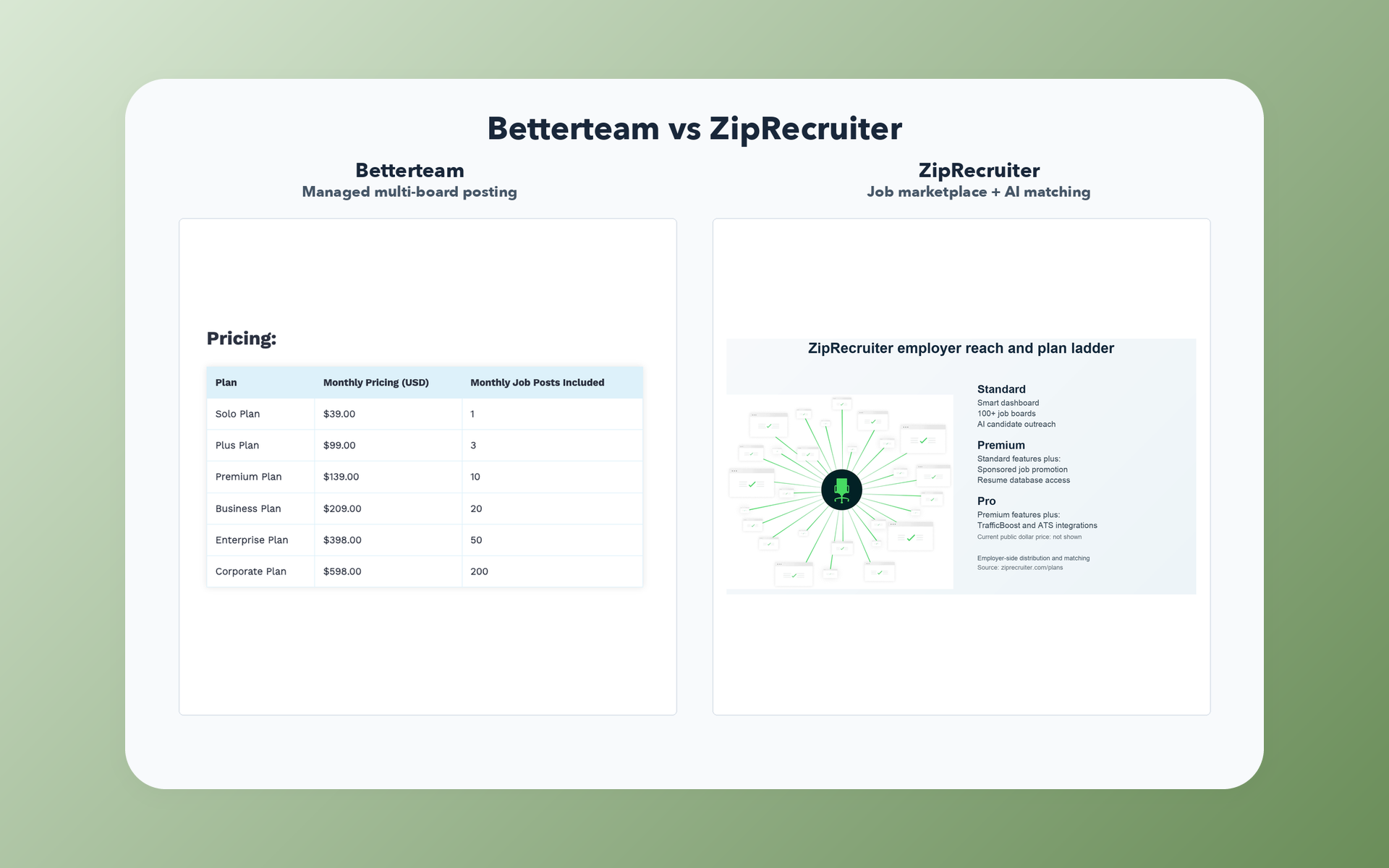
You can send one job to many sites with either product, yet the applicant journey is not the same.
Betterteam is the better fit for an SMB that wants managed multi-board posting, a light hiring dashboard, and public pricing.
ZipRecruiter is the better fit when access to its marketplace, AI matching, resume search, and candidate outreach matters more than having a public employer dollar amount displayed upfront.
This employer-focused comparison covers the operating model, applicant tools, pricing, and best-fit hiring scenarios. It treats applicant volume and applicant fit as separate questions.
Betterteam vs ZipRecruiter at a glance
The hiring playbook, in your inbox
One email a week - benchmarks, AI screening tactics, and short interview templates from the 100Hires team. No product pitches.
The pair looks similar at the posting screen. Each can distribute a job beyond one site. The difference appears in what the employer buys around that post.
Betterteam sells managed distribution with light applicant handling. ZipRecruiter adds its own marketplace, matching, search, and outreach tools.
That distinction affects the work left on the employer's desk. Betterteam reduces the effort of placing a listing. ZipRecruiter gives the employer more ways to discover and contact people.
An employer buying Betterteam can judge it mainly as a posting service with a simple intake view. A ZipRecruiter buyer must assess the marketplace, match suggestions, search access, and contact tools in the account-specific plan.
100Hires publishes this article. We include it for employers that need to manage applicants after they apply, not as a third job board.
| Decision point | 100Hires (disclosed workflow layer, not a job board) | Betterteam | ZipRecruiter |
|---|---|---|---|
| Primary job | Own screening, pipeline, follow-up, scheduling, and hiring automation | Manage multi-board posting and collect applications | Provide marketplace reach, matching, search, and outreach |
| Proprietary marketplace | This article does not claim an equivalent proprietary audience | Current pages focus on posting and applicant handling | Yes, central to the employer offer |
| Multi-board distribution | Distribution to supported boards, separate from its workflow role | Core service with 100+ board wording | Part of a broader marketplace offer with 100+ site wording |
| Matching, search, and outreach | AI Score ranks applicants already in the workflow; the resume database is built from resumes employers upload or receive through jobs | Not the main verified value | AI matching, resume search or access, and candidate invitations |
| Post-application workflow | Full recruiting workflow with screening, stages, email, scheduling, and automation | Applicant collection plus ratings, private notes, resume viewing, reports, email routing, and CSV export | Screeners, ratings, candidate invitations, ZipIntro where available, and ATS partner connections |
| Public entry price | $99-$499 monthly, or $49-$399 monthly with annual billing; Enterprise: Contact sales; dollar amount not publicly shown | $39-$598 monthly, with public annual totals | Public employer dollar amount not displayed on reviewed plan pages |
| Best-fit employer | A team that has applicants but needs workflow control | An SMB seeking simple managed posting with a visible price | An employer that values marketplace discovery and active candidate contact |
Fast verdict by need
- Choose Betterteam for managed multi-board distribution, modest posting needs, a light review dashboard, and a public starting cost.
- Choose ZipRecruiter for its marketplace, AI matching, resume search, and the ability to invite candidates to apply.
- Consider 100Hires when sourcing produces applicants but screening, follow-up, scheduling, and pipeline control create the harder problem.
The biggest difference is distribution service versus marketplace
Are you buying wider distribution, or access to a marketplace that can surface candidates and help you contact them? That question separates the two products faster than a long feature list.
Betterteam starts with the employer's listing. ZipRecruiter starts there too, then adds a proprietary audience and tools for finding people who may fit.
The purchase should follow the hiring bottleneck. A team short on posting time has a different need from a team short on qualified people it can identify and approach.
This framing keeps the comparison practical. It asks what the product changes in a weekly hiring routine, not which feature list is longer.
Betterteam manages multi-board posting
Betterteam is built around job multiposting. An employer creates a listing, the service sends it across its partner network, and applications return to a central dashboard.
Applications return to Betterteam's dashboard. Its broader hiring tools cover ratings, private notes, resume viewing, reports, email routing, and CSV export. That can be enough for many owners or office managers running a small hiring round.
Its value is delegation. The employer does not need to publish the same job separately across many sites or keep several basic applicant views open.
That focus can suit repeat local hiring. A manager can reuse a familiar posting flow, check one applicant list, and keep basic notes without setting up a complex recruiting process.
Start with a clear monthly hiring plan. Betterteam prices job-post allowances by month, so a business with uneven hiring bursts should compare its busy months with the tier limits.
Betterteam's current pages focus on job distribution and applicant handling. ZipRecruiter adds marketplace, matching, resume search, and outreach tools.
ZipRecruiter owns a candidate marketplace
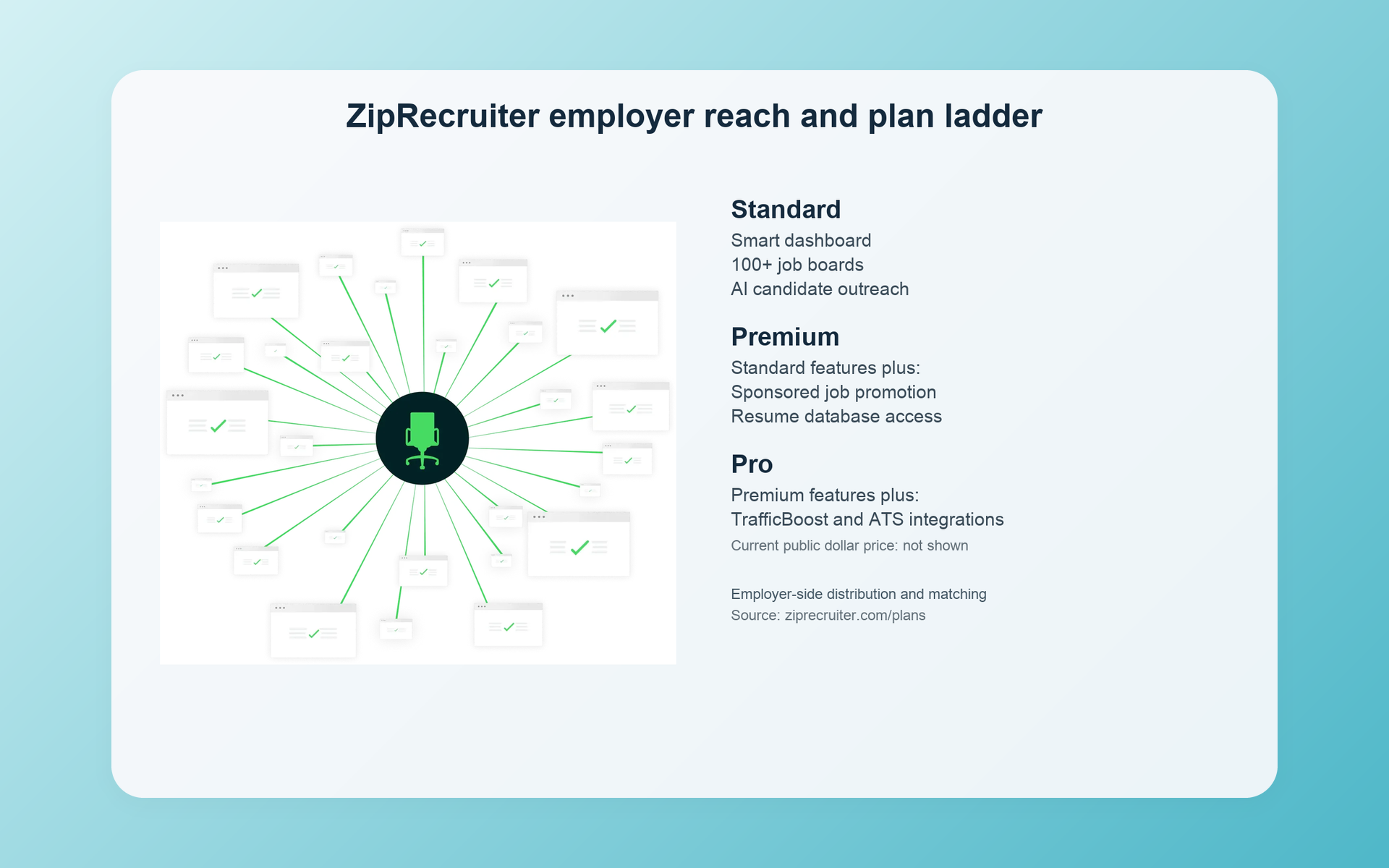
ZipRecruiter combines job distribution with its own marketplace. Its matching system looks for candidates whose stated skills and experience relate to the job.
Employers can review suggested matches, search resumes when their plan supports access, and invite selected people to apply. Screeners and ratings help sort the resulting pool.
This changes the sourcing motion. A recruiter can wait for inbound applications, search for likely fits, or use both routes in the same campaign.
Search is most useful when someone has time to review suggestions and send relevant invitations.
The employer still needs a clear job profile. Matching can organize possible fits, but it cannot repair vague requirements or settle which skills the hiring manager values most.
The tradeoff is price visibility. The official sources reviewed did not show a public employer dollar amount, universal resume limit, or universal job limit. Current ZipRecruiter Plans says candidates and applications are not limited.
Betterteam wins for simple multi-board distribution
Betterteam makes the stronger case when posting is the task the employer wants to hand off. Its public entry price makes an initial budget check easy.
The core flow is short: write the job, publish through one service, collect applicants, and review them in one place. A lean team can use that flow without buying a broad recruiting stack.
Simple does not mean weak. For a small hiring round, fewer settings can make ownership clearer. The person posting the role can see the applicant list and act without learning a large system.
Map the next few months before choosing a plan. Count the jobs you expect to publish each month, then check whether the candidate allowance on the relevant tier fits your likely intake.
Posting reach is not the same as hiring fit
Review patterns are mixed. Some employers describe easy posting and useful applicant flow. Others report low response, weak niche-role relevance, or a hiring round that produced no hire.
The same split appears in ZipRecruiter feedback. Employers value search and screening, yet some report irrelevant applicants or poor traction for a narrow role.
Capterra's Betterteam and ZipRecruiter comparison shows this range of employer experiences. Review samples differ in size, so the page is context, not proof of a winner.
Role, location, job copy, required credentials, and screening choices can change the result. A broad post may create activity without producing the right shortlist.
Use the mixed pattern as a test plan. Run a representative role, define what a qualified application means before launch, and review the shortlist against that definition.
A single success or miss should not settle every future role. A channel that works for an hourly local opening may perform differently for a licensed specialist.
What the 100+ claim does not tell you
Both vendors use 100+ distribution language. That shared phrase does not mean they use the same network or give an employer the same exposure for each role.
A board count cannot show the exact site mix for a given account, role, or region. Treat it as a description of broad distribution, not a forecast of applicant volume or quality.
Judge the service through business outcomes that matter to the role: qualified applications, interviews, accepted offers, and the staff time required to reach them.
ZipRecruiter wins for matching, search, and outreach
ZipRecruiter's clear edge is candidate discovery beyond passive posting. Its marketplace gives employers more ways to build a pool when inbound applications are not enough.
That lane has more moving parts than a posting-only purchase. Account-specific plan scope, resume access, contact tools, search habits, and match review all shape the value an employer receives.
AI matching changes the sourcing motion
After a job goes live, matching can surface candidates whose profiles appear relevant to the role. Recruiters can rate candidates, review screeners, and decide whom to contact.
Invite-to-apply tools let the employer act on those suggestions. This gives a small hiring team an outbound path without starting every search from an empty query box.
Matching is not a hiring guarantee. Skills may be missing from a profile, titles vary across fields, and a narrow local market may return a small or uneven pool.
The feature is still meaningful. It changes the employer's choice from waiting for applications to reviewing suggested people and contacting selected prospects.
An SMB should inspect a sample of suggestions for a real role. Check required skills, location, past roles, and the reason each person appears before judging the match flow.
The goal is not a perfect suggestion list. It is a reviewable pool that gives the recruiter useful people to contact without creating more review work than it saves.
Resume access may require the right plan or add-on
ZipRecruiter's official wording says resume-database access is included in many plans or sold as an add-on. It should not be treated as a universal feature for every account.
The public sources reviewed did not establish one dollar price, access limit, or renewal term for all employers. Verify which search and resume tools apply to the account, and get the terms in writing.
For a team that plans to source from a database each week, that detail can matter more than the headline board count.
Get the database terms in writing. The buying team should verify who can search, what actions consume access, which contact tools are included, and what changes at renewal.
Applicant management is useful in both, but depth differs
Neither product stops at publishing a job. Both provide employer tools for reviewing the people who respond, but each keeps that work close to its sourcing model.
The needed depth depends on hiring volume and handoffs. One manager filling two roles may need a clean list. A growing team may need stage rules, assigned work, repeat messages, and a record across many jobs.
Betterteam keeps the review loop light
Betterteam collects applications in its dashboard. Its broader hiring tools include ratings, private notes, resume viewing, reports, email routing, and CSV export.
This fits a manager who wants one shared intake view and a simple way to mark progress. It can replace an inbox-and-spreadsheet process for a modest hiring round.
The light design becomes a limit when a team needs detailed pipelines, multi-step communication, repeatable automations, or deeper reporting across many roles.
Look at the next process failure, not the current screen. If candidates often wait for replies or managers cannot see who owns each next step, the team may have moved beyond a light intake tool.
ZipRecruiter adds sourcing controls and ATS partner connections
ZipRecruiter supports screeners, candidate ratings, candidate invitations, and ZipIntro where available.
ATS partner connections can post jobs from an ATS to ZipRecruiter and support the ZipRecruiter Apply integration. Availability depends on the account and connected ATS.
This can help an employer keep job posting tied to its ATS setup. It does not make every ZipRecruiter employer plan a full ATS package.
Before relying on a connection, verify the supported posting flow, ZipRecruiter Apply availability, account requirements, and connected ATS. Document which system owns each step.
Betterteam publishes prices; ZipRecruiter does not display a public employer dollar price
Betterteam publishes US dollar prices and monthly job-post allowances. The reviewed ZipRecruiter employer plan pages do not display a public employer dollar amount.
The lowest displayed number is not a full value comparison. Each vendor charges for a different mix of posting volume, marketplace access, candidate search, and workflow depth.
Betterteam pricing in practical terms
Betterteam starts at $39 per month for one monthly job post and up to 25 candidates per month. Higher plans raise the monthly posting allowance, with candidate limits shown where published.
The public price table labels these allowances as monthly job posts. This article does not equate them to any concurrent-active-job limit.
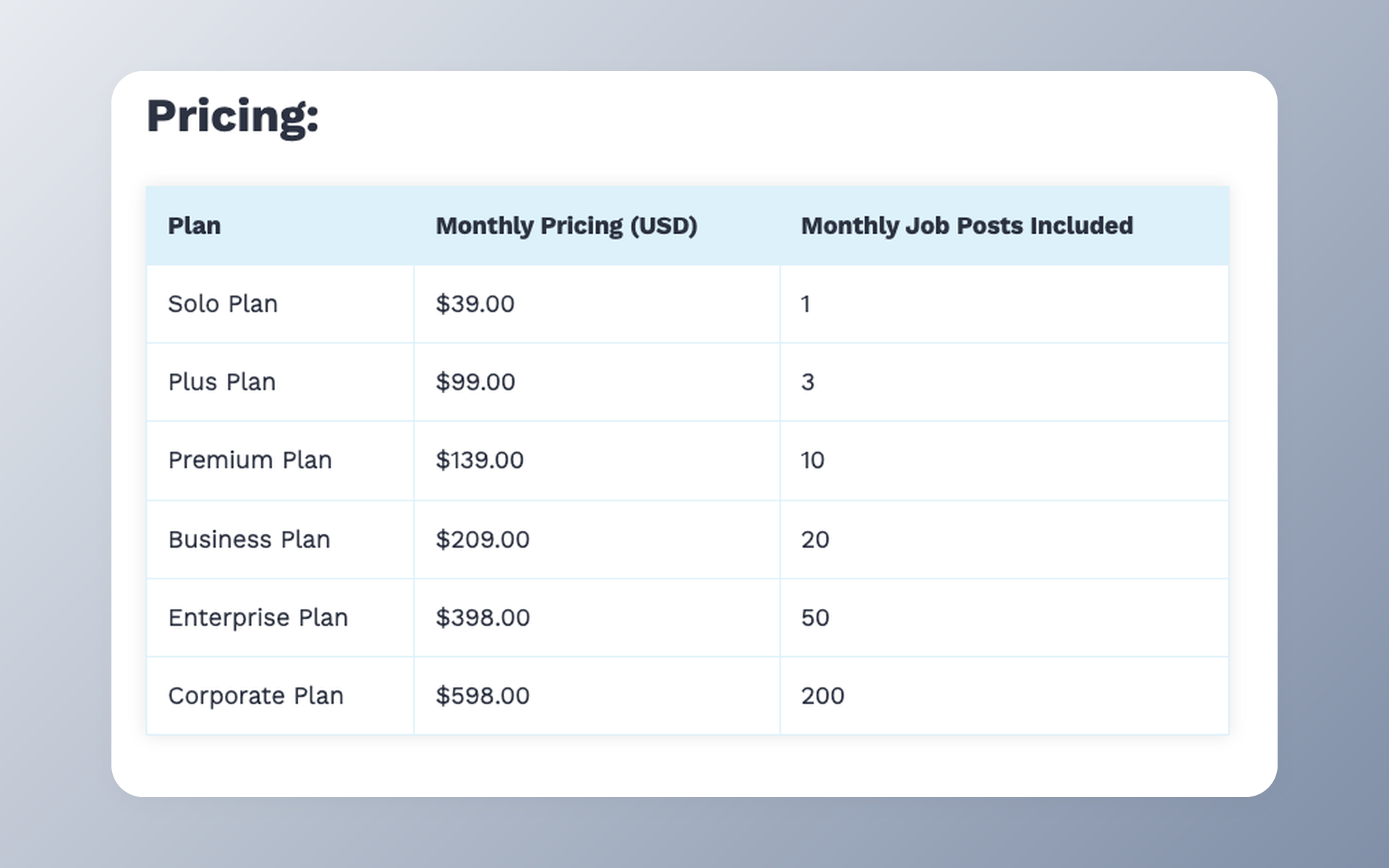
Betterteam publishes annual totals at a stated 50% discount. The monthly equivalents in the annual column below are derived from those displayed totals.
Annual prepayment cuts the effective monthly cost, but it commits the employer for a longer period. Compare that saving with the number of months in which the business expects to post.
ZipRecruiter pricing in practical terms
The reviewed ZipRecruiter employer plan pages do not display public dollar prices. They do not establish a universal annual total, job limit, user limit, or renewal term. Current employer pages describe monthly-subscription and pay-per-day options.
Resume access can be part of many plans or an add-on. If database search is a deciding feature, verify the account-specific scope directly and get the terms in writing.
- Verify which job, user, and resume limits apply to the account-specific plan.
- Confirm whether search and candidate invitations share a usage limit.
- Get the billing basis and renewal term in writing.
- Check which ATS partner connections, candidate-invitation tools, and ZipIntro options are available.
Price parity across the three paths
100Hires pricing varies with company size. The amounts below reflect the public default prices shown for this comparison.
| Vendor and plan | Monthly billing | Annual-equivalent monthly | Annual total | Scope and limits | Billing basis | Evidence label |
|---|---|---|---|---|---|---|
| 100Hires Start | $99/month | $49/month | $588 (derived) | Up to 3 jobs, 100 candidates, 1 user, 100 monthly AI credits | Monthly or prepaid annually; public default display varies by company size | Monthly and annual-equivalent displayed; annual total derived |
| 100Hires Advanced | $249/month | $199/month | $2,388 (derived) | Unlimited jobs, candidates, and users; 300 AI credits on monthly billing or 1,000 on annual billing | Monthly or prepaid annually; public default display varies by company size | Monthly and annual-equivalent displayed; annual total derived |
| 100Hires Pro | $499/month | $399/month | $4,788 (derived) | Everything in Advanced plus passive sourcing features; 3,000 AI credits on monthly billing or 5,000 on annual billing | Monthly or prepaid annually; public default display varies by company size | Monthly and annual-equivalent displayed; annual total derived |
| 100Hires Enterprise | Contact sales; dollar amount not publicly shown | Contact sales; dollar amount not publicly shown | Contact sales; dollar amount not publicly shown | Advanced privacy, security, and enterprise services; universal limits not publicly shown | Contact sales | Plan displayed; dollars not publicly shown |
| Betterteam Solo | $39/month | $19.50/month (derived) | $234 | 1 monthly job post; up to 25 candidates per month | Monthly or prepaid annually | Monthly and annual total displayed; annual-equivalent derived |
| Betterteam Plus | $99/month | $49.50/month (derived) | $594 | 3 monthly job posts; candidate cap not publicly shown in captured pricing table | Monthly or prepaid annually | Monthly and annual total displayed; annual-equivalent derived |
| Betterteam Premium | $139/month | $69.50/month (derived) | $834 | 10 monthly job posts; unlimited candidates | Monthly or prepaid annually | Monthly and annual total displayed; annual-equivalent derived |
| Betterteam Business | $209/month | $104.50/month (derived) | $1,254 | 20 monthly job posts; candidate cap not publicly shown in captured pricing table | Monthly or prepaid annually | Monthly and annual total displayed; annual-equivalent derived |
| Betterteam Enterprise | $398/month | $199/month (derived) | $2,388 | 50 monthly job posts; candidate cap not publicly shown in captured pricing table | Monthly or prepaid annually | Monthly and annual total displayed; annual-equivalent derived |
| Betterteam Corporate | $598/month | $299/month (derived) | $3,588 | 200 monthly job posts; candidate cap not publicly shown in captured pricing table | Monthly or prepaid annually | Monthly and annual total displayed; annual-equivalent derived |
| ZipRecruiter employer plans | not publicly shown | not publicly shown | not publicly shown | candidates and applications are not limited; job, user, and resume-access limits are plan-specific and not generalized here; resume access is included in many plans or sold as an add-on | Current employer pages describe monthly-subscription and pay-per-day options; verify the account's plan-specific billing basis and renewal term | Official features displayed; public employer dollars absent |
Compare the rows by what you are buying, not by the lowest number. Betterteam prices monthly posting volume, ZipRecruiter presents marketplace plan features without public employer dollar amounts, and 100Hires prices a recruiting workflow.
A fair budget comparison starts with the work the employer needs done. A cheap posting tier can be enough for one role, yet it does not buy the same search or process tools as a larger package.
Choose Betterteam when posting is the job
Betterteam fits an employer that wants a visible entry price, predictable monthly posting volume, managed distribution, and a light place to review applications.
Best-fit employer scenarios
- A local shop needs to fill one role and wants to publish through one service.
- An office manager posts several openings each month and wants applications in one dashboard.
- A lean HR team needs a shared applicant view, private notes, resume viewing, and CSV export without a large system rollout.
The fit weakens when the employer needs active marketplace search, a proprietary candidate audience, or deeper automation after applications arrive.
Before choosing Betterteam, run two checks. Make sure the monthly post allowance fits the hiring calendar, then decide whether its applicant view covers the steps your team needs in the same system.
If both answers are yes, the product's narrow focus can be an advantage. The team pays for the posting service it needs instead of a marketplace or a large workflow suite it may not use.
Teams that like the posting model but need a different workflow can review Betterteam alternatives. The right next step depends on whether distribution or applicant management is the gap.
Choose ZipRecruiter when candidate discovery is the job
ZipRecruiter fits an employer that values its marketplace, matching, resume search, and outbound contact tools and will verify account-specific plan scope and written terms directly.
Best-fit employer scenarios
- A small firm wants suggested candidates soon after publishing a job.
- A recruiter needs to search resumes and invite selected people instead of relying only on inbound applications.
- A hiring team uses an ATS and wants to verify support for posting jobs to ZipRecruiter and the ZipRecruiter Apply integration.
The fit weakens for a buyer who needs a public employer dollar amount displayed upfront or wants a low-cost distribution service without marketplace search.
Match quality can vary by role, market, and profile data. Test the actual jobs you hire for and verify which database and outreach features apply to the account-specific plan.
A useful product review should use a real requisition. Ask to see how matches are explained, how resumes are filtered, how invitations are sent, and how candidate responses are reviewed.
The marketplace case is strongest when the team will act on those tools. If the hiring routine remains passive posting, much of ZipRecruiter's distinct value may go unused.
When neither fits: use 100Hires to own the workflow
100Hires publishes this article and sells the product discussed in this section. It is recruiting software for owning the hiring process after candidates enter it.
100Hires says its resume database is built from resumes employers upload or receive through jobs rather than a pre-collected database of strangers' resumes. This article does not claim that 100Hires supplies an equivalent proprietary marketplace audience.
What 100Hires adds after applicant acquisition
100Hires keeps each candidate's resume, email, evaluations, and AI score in one record. Teams can move people through stages and keep the hiring record inside the ATS.
Knockout Questions screen for stated requirements. AI Score helps rank applicants against the job, and AI Email Composer drafts messages from resumes, interview notes, and job descriptions.
Automated follow-ups, nurture campaigns, interview scheduling, calendar connections, and workflow automation reduce repeat admin work after the first application.
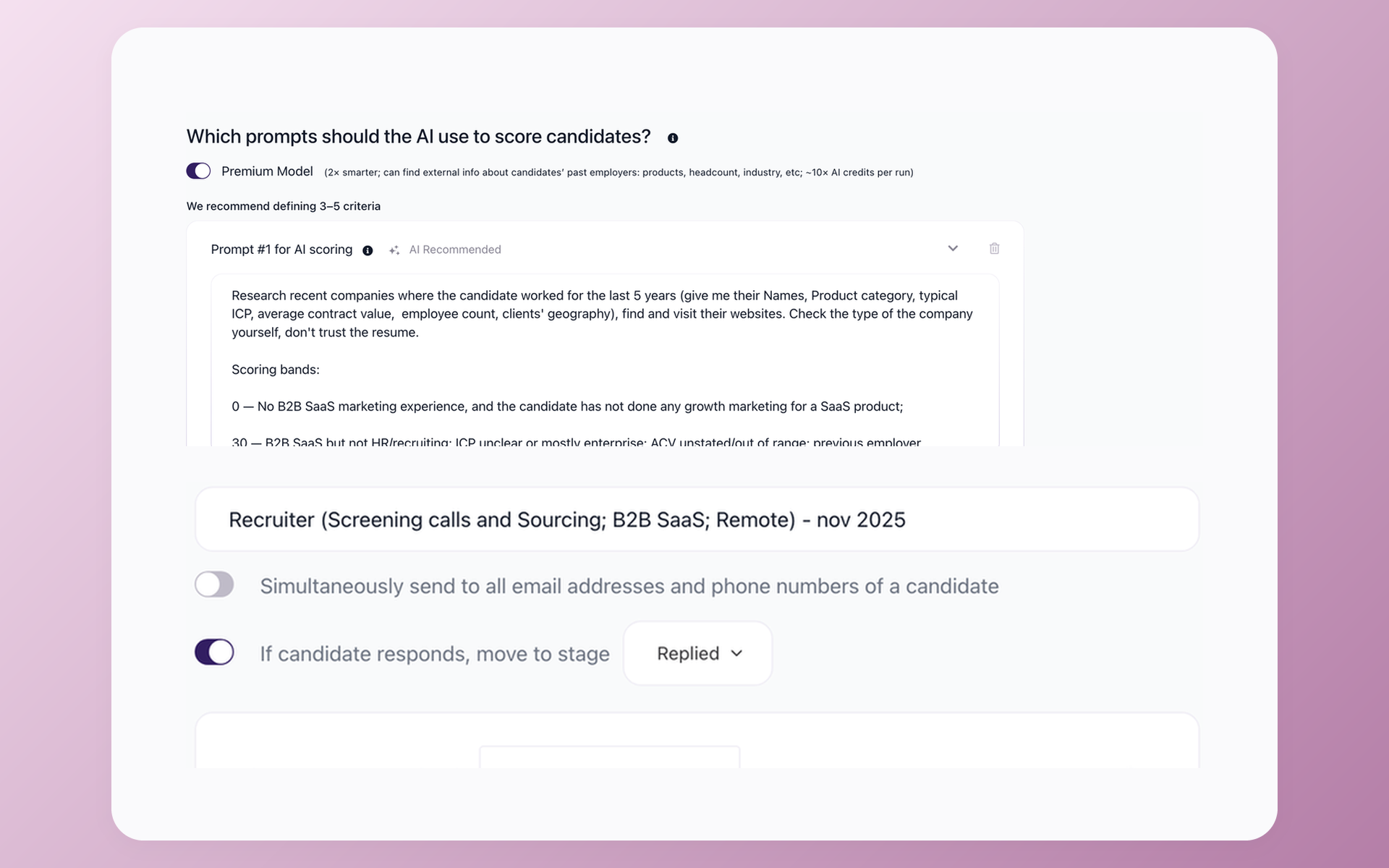
This is a different purchase from marketplace reach. It makes sense when the team already has sourcing channels but loses time to screening, reminders, scheduling, and unclear stage ownership.
A typical workflow begins when an application enters the ATS. Knockout Questions handle stated minimums, AI Score helps order review, and stage changes can trigger follow-up or scheduling work.
The strength is continuity from first review through interviews.
Current 100Hires plans and limits
The public default display has Start, Advanced, and Pro paid plans, plus Enterprise. For Enterprise, contact sales; dollar amount not publicly shown. The parity table gives each price, billing choice, limit, and AI-credit allowance.
Start covers a small team with limited jobs and candidates. Advanced removes those volume and user caps, and Pro adds passive-sourcing features with a larger AI-credit allowance.
The 14-day free trial requires no card and allows up to 10 candidates from external job boards across the account. That cap makes the trial a workflow test, not a large-volume sourcing campaign.
Company size can change the displayed amounts. Check current 100Hires pricing for the company profile you plan to use.
Where 100Hires can coexist with either channel
An ATS can manage candidates acquired through posting and marketplace channels. The sourcing product brings people in; the ATS stores records, applies stages, and coordinates the team.
If ZipRecruiter is part of the sourcing mix, the ZipRecruiter integration page covers the relevant setup path. Feature availability can depend on the connected account.
The same approach can apply to applications from Betterteam. Keep Betterteam for managed posting if it fits, then use a separate workflow layer when the light dashboard no longer matches the hiring process.
Decide which system owns each step before launch. Clear ownership prevents duplicate updates and tells hiring managers where to review, comment, and approve next actions.
Final verdict: pick the sourcing model first
Betterteam is the better pick for managed multi-board posting, a light applicant view, and public pricing. It suits an SMB that wants the posting task handled with little setup around it.
ZipRecruiter is the better pick for access to its marketplace, AI matching, resume search, and candidate outreach. It suits an employer ready to verify account-specific plan scope and written terms directly.
If applicants arrive but follow-up and pipeline ownership stay messy, the problem has moved from sourcing to workflow. That is where 100Hires becomes relevant.
Start with the bottleneck, test the product on a real role, and measure whether it reduces the work your team does. The right choice can differ across employers without making either product a weak tool.
Frequently asked questions
Is Betterteam or ZipRecruiter better for a small business?
Betterteam is better for a small business that wants managed multi-board posting, light applicant handling, and public pricing. ZipRecruiter suits marketplace search, matching, and outreach. 100Hires manages screening, follow-up, scheduling, and pipelines after intake.
Where does Betterteam post jobs?
Betterteam says it distributes jobs across a network of 100+ boards, though the exact mix can vary by role, account, and region. 100Hires manages candidate records, stages, screening, and follow-up after intake; it does not claim that distribution network.
Does ZipRecruiter include AI candidate matching?
Yes. ZipRecruiter uses AI matching to surface candidates whose stated skills and experience relate to a job, then lets employers contact selected people. 100Hires AI Score ranks applicants already inside the ATS workflow; it does not replace marketplace matching.
Is Betterteam an ATS?
Betterteam is a light applicant-tracking tool within its hiring software. It collects applications in its dashboard. Its broader tools support ratings, private notes, resume viewing, reports, email routing, and CSV export. 100Hires adds structured pipelines, AI Score, automated follow-up, scheduling, and nurture campaigns.
Can Betterteam or ZipRecruiter manage hiring after applications arrive?
Yes. Betterteam provides a light applicant view. ZipRecruiter supports screeners, ratings, candidate invitations, ZipIntro where available, and ATS partner connections. 100Hires adds Knockout Questions, automation, follow-up, and scheduling after intake.
Start a 100Hires trial if your main gap is screening, follow-up, scheduling, or pipeline control after candidates enter the process.
Try 100Hires for free
No credit card. 14-day trial. Forbes Advisor #1 ATS for SMBs.