
Betterteam vs Indeed: Which is better for employers in 2026?
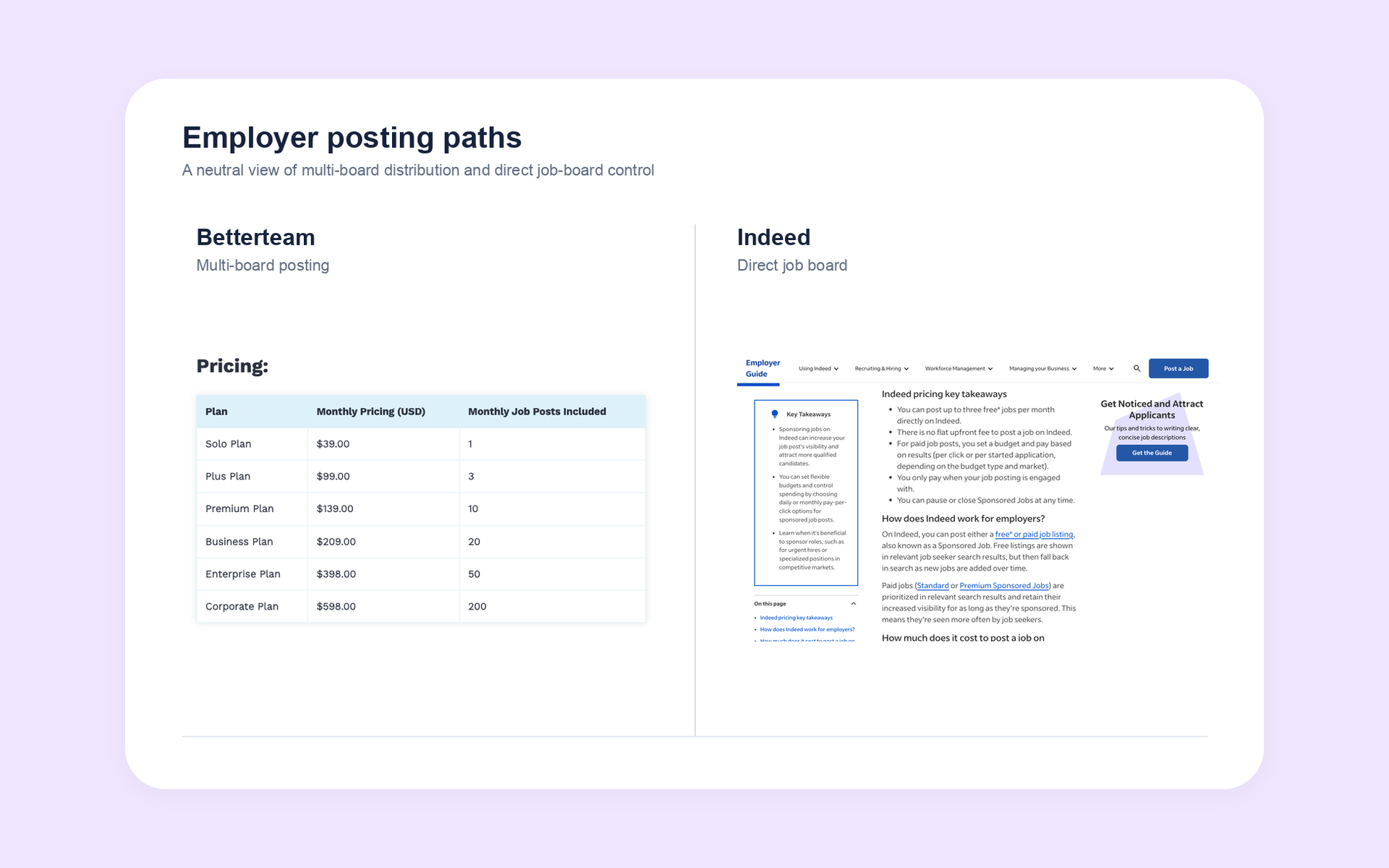
Betterteam can widen a job's reach, but direct Indeed posting gives you more control over the channel many employers care about most.
Choose Betterteam for one posting workflow across several destinations. Choose Indeed when native Indeed controls, free-post eligibility, sponsorship, and job diagnostics matter more.
These products solve different problems. This comparison shows where each one wins, what happens when Betterteam sends a job to Indeed, and when you need a full ATS after applications arrive.
Betterteam vs Indeed at a glance
The hiring playbook, in your inbox
One email a week - benchmarks, AI screening tactics, and short interview templates from the 100Hires team. No product pitches.
The short verdict turns on your first bottleneck. Betterteam reduces posting work across boards. Indeed gives an employer direct control over its own marketplace.
| Criterion | 100Hires | Betterteam | Indeed |
|---|---|---|---|
| Product type | Full ATS around posting channels | Job distribution with templates and light applicant handling | Job board and employer marketplace |
| Best fit | Teams that need pipeline, screening, reporting, and follow-up | Lean employers that want one-to-many posting | Employers focused on Indeed reach and native controls |
| Posting reach | Integrated board distribution from one ATS | Distribution is the main product | Direct access to Indeed, not a multi-board distributor |
| Control on Indeed | Some workflow around an Indeed connection; Indeed keeps platform control | Mediated and subject to current partner rules | Native dashboard, status, and sponsorship controls |
| Applicant workspace | Shared pipeline, candidate records, stages, notes, and reporting | Organized view for initial review | Employer Dashboard plus ATS connection paths |
| Screening | AI Score, knockout questions, and configurable workflow | Light applicant review | Questions and employer tools near the application |
| Pricing model | Public ATS plans from $49 per month on annual billing | Subscription by monthly job allowance | Eligible direct free posts plus sponsored campaign spend |
| Source reporting | Board-level visitor and applicant reporting | Current depth was not verified | Indeed data plus ATS-dependent sync |
| Main limit | Does not own Indeed audience, ranking, moderation, or ad auction | Less native Indeed control and lighter workflow depth | One marketplace, with board rules and variable paid spend |
100Hires is relevant only when posting feeds a longer hiring process. It is not the winner by default, and it belongs in a different category.
- Choose Betterteam for posting convenience across destinations.
- Choose direct Indeed for native Indeed control and sponsorship ownership.
- Evaluate 100Hires when you need a pipeline, source reports, screening, and follow-up around those channels.
Disclosure: 100Hires publishes this article and 100Hires is our product. See the 100Hires Indeed integration if your question extends past posting into applicant tracking.
Betterteam and Indeed solve different parts of hiring
Betterteam and Indeed overlap, but they do not start in the same place. Betterteam starts with job creation and distribution. Indeed starts with its own audience and employer marketplace.
Betterteam is the distribution layer
Betterteam is built for an employer that wants to prepare a job once and submit it across several destinations. Templates, posting allowances, and a central applicant view sit at the center of the product.
That scope is useful for a small team with no appetite for separate board workflows. The employer pays for convenience and predictable monthly posting capacity.
The current Betterteam homepage supports an organized candidate pipeline and distribution to leading boards. It did not provide an auditable current board count.
Betterteam is best described as posting-led hiring software with light applicant handling. Calling it a deep ATS would set the wrong expectation for workflow automation, reporting, and candidate relationship work.
For a wider product set, see these Betterteam alternatives.
Indeed is the destination marketplace
Indeed is where a job can appear and where candidates can find it. Direct employers can create jobs, manage status, review candidates, and control sponsorship from the Employer Dashboard.
That direct relationship matters. If an employer cares about one job's visibility, campaign spend, review status, or Indeed-specific diagnostics, the native path removes a layer between the employer and the board.
Indeed has lightweight hiring tools, yet its center of gravity remains marketplace access. It can connect to an ATS, but it does not become a full multi-channel recruiting system for every employer.
Reach can outweigh product frustration. In a 2025 r/recruiting discussion, one recruiter disliked the employer product yet saw Indeed as hard to replace for skilled-trades and blue-collar talent.
That is one practitioner's experience, not a market measurement. It shows why “Which interface is nicer?” can be the wrong buying question. Candidate reach and operating workflow are separate decisions.
Does Betterteam post jobs to Indeed?
Yes, based on dated Betterteam vendor documentation. A Betterteam support result dated January 31, 2024 said Betterteam sent jobs to Indeed and supported an Indeed Apply path.
Treat that as dated evidence, not a promise about today's account. Our fresh research requested 11 Betterteam support pages covering integration, routing, edits, board selection, reposting, and related mechanics. Every request returned HTTP 403.
We could verify Betterteam's current homepage and pricing page. We could not freshly confirm its Indeed Feed status, Indeed Apply setup, eligibility, edit timing, sponsorship controls, or exact application route.
The safe answer is narrow: Betterteam has documented an Indeed connection, and current behavior remains subject to both vendors' rules and the employer's account setup.
- The employer creates a job in Betterteam.
- Betterteam submits the job to eligible destinations.
- Each destination reviews the job under its own rules.
- Applications follow the configured apply path.
A mediated Indeed listing still follows Indeed's rules
Betterteam cannot bypass Indeed review. Indeed may review, limit, or remove jobs after automated detection or reports. Its current guidance names inaccurate locations, duplicates, uncertain legitimacy, misleading content, and unapproved application methods as risk areas.
A paid Betterteam subscription does not buy guaranteed Indeed acceptance, rank, applicant volume, or campaign performance. It buys the posting workflow that submits the job.
The distinction matters for troubleshooting. A job can be active in Betterteam yet delayed, rejected, or displayed differently on a destination. The destination's policy remains the final gate.
Pick one source of truth for each job
Do not assume that direct Indeed plus Betterteam creates double reach. Indeed's current employer guidance says duplicate listings from multiple sources are not accepted, and it discourages reposting.
Choose the system that owns the job before launch. Record where edits happen, which system closes the role, where applications land, and who controls sponsored spend.
Status hygiene matters outside Indeed too. Google's job posting structured data guidance tells publishers to remove expired jobs or set a past valid-through date.
One source of truth makes those updates easier. It reduces the chance of an open job in one system, a closed job in another, and applications arriving in an inbox nobody checks.
Posting reach, control, and applicant routing
Three questions decide most Betterteam versus Indeed purchases: how many places should receive the job, who needs native Indeed control, and where should applicant records land?
Reach winner: Betterteam for one-to-many distribution
Betterteam wins on posting convenience. A lean employer can prepare one job and use a single workflow to submit it across eligible destinations.
This saves the repeated setup of separate board forms. It can help an employer test a broader channel mix without managing every destination as a standalone project.
Distribution breadth is not equal to equal placement. Each board decides whether a job qualifies, how it appears, and how much visibility it receives. A destination name in a network is not a delivery guarantee.
Betterteam's current successful pages did not expose a reliable exact board count. For that reason, this verdict rests on workflow design, not a large headline number.
Winner for reach convenience: Betterteam. Pick it when the task is “publish once, submit broadly,” and accept that every destination keeps its own gate.
Control winner: direct Indeed for Indeed-specific actions
Direct Indeed wins when Indeed itself is the priority. The employer owns the native listing path, sees its status in the dashboard, and controls sponsorship without asking a distribution provider to relay changes.
Indeed states that direct employers may post up to three free jobs per calendar month. Each eligible job can stay live for up to 30 days under the standard rule.
A listed group of countries has an exception of up to 120 days. That exception is not a global duration and should not guide a US employer's plan.
Free status is not guaranteed. Terms, usage limits, quality rules, and Indeed discretion still apply. Employers that need more visibility can sponsor a job through the native campaign path.
Direct control helps with diagnosis. If a job needs a title change, status update, campaign pause, or account review, the employer works in the system that made the decision.
Winner for Indeed control: direct Indeed. Pick it when one marketplace matters more than broad submission convenience.
Routing winner: it depends on the configured apply path
Application routing is less tidy than the product names suggest. A job hosted directly on Indeed can use Indeed Apply. A job from a career site or ATS can appear through indexing, a feed, or an integration.
Indeed's ATS Sync can transfer job and candidate data between Indeed and a supported ATS. Apply Sync can return completed applications to an ATS. The exact fields and direction vary by connection.
Indexed jobs can appear in the Employer Dashboard, where an employer may view, edit, or sponsor them. That does not mean every indexed job behaves like a direct hosted job.
Betterteam's dated material described applicants coming through Indeed into its workflow. Our review of current official materials could not confirm that route, so test it with one real requisition before using it for every job.
- Where does the completed application first appear?
- Does the resume move with the candidate record?
- Can status and disposition data sync back?
- Which system owns edits and closure?
Winner for routing: the tested path that lands candidates in your working system. Product labels alone do not answer it.
Betterteam vs Indeed pricing
These prices buy different things. Betterteam prices posting capacity and light applicant handling. Indeed offers eligible free direct posts, then sells sponsored visibility through campaign budgets.
For teams comparing a full ATS with these posting paths, 100Hires pricing covers workflow. It does not buy Indeed traffic, acceptance, rank, or sponsored placement.
100Hires pricing for the full ATS path
The public base plan amounts below were checked on July 15, 2026. Annual totals are calculated from the annual-equivalent monthly rates.
| Plan/path | Monthly | Annual equivalent | Annual total | Scope | Limits | Billing basis |
|---|---|---|---|---|---|---|
| 100Hires Start | $99 | $49/month | $588, derived | ATS for occasional hiring | Up to 3 jobs, 100 candidates, 1 user; 100 monthly AI credits | Monthly or prepaid annual |
| 100Hires Advanced | $249 | $199/month | $2,388, derived | ATS with workflow automation and knockout questions | Unlimited jobs, candidates, and users; 300 AI credits on monthly billing or 1,000 on annual billing | Monthly or prepaid annual |
| 100Hires Pro | $499 | $399/month | $4,788, derived | Advanced plus sourcing, enrichment, outreach, warmup, and migration to an annual plan | 3,000 monthly AI credits on monthly billing or 5,000 on annual billing | Monthly or prepaid annual |
Check 100Hires pricing for the current plan display. The page has conflicting headline savings copy, so this comparison uses the actual plan amounts and makes no blanket discount claim.
The 14-day trial requires no credit card. The account can receive up to 10 candidates from external boards across all jobs during the trial, and board terms can restrict trial postings.
Start has real caps. Advanced removes job, candidate, and user limits. Pro adds passive-sourcing and outreach tools. None of those plans creates a private database of arbitrary candidates or replaces Indeed's audience.
Betterteam pricing is based on monthly job volume
Betterteam publishes six paid plans. The monthly price rises with the number of jobs the employer can post each month.
| Plan/path | Monthly | Annual equivalent | Annual total | Scope | Limits | Billing basis |
|---|---|---|---|---|---|---|
| Betterteam Solo | $39 | $19.50/month, derived | $234, displayed | Posting distribution and light applicant handling | 1 monthly job; up to 25 candidates monthly | Monthly or prepaid annual |
| Betterteam Plus | $99 | $49.50/month, derived | $594, displayed | Posting distribution and light applicant handling | 3 monthly jobs | Monthly or prepaid annual |
| Betterteam Premium | $139 | $69.50/month, derived | $834, displayed | Posting distribution and light applicant handling | 10 monthly jobs | Monthly or prepaid annual |
| Betterteam Business | $209 | $104.50/month, derived | $1,254, displayed | Posting distribution and light applicant handling | 20 monthly jobs | Monthly or prepaid annual |
| Betterteam Enterprise | $398 | $199/month, derived | $2,388, displayed | Posting distribution and light applicant handling | 50 monthly jobs | Monthly or prepaid annual |
| Betterteam Corporate | $598 | $299/month, derived | $3,588, displayed | Posting distribution and light applicant handling | 200 monthly jobs | Monthly or prepaid annual |
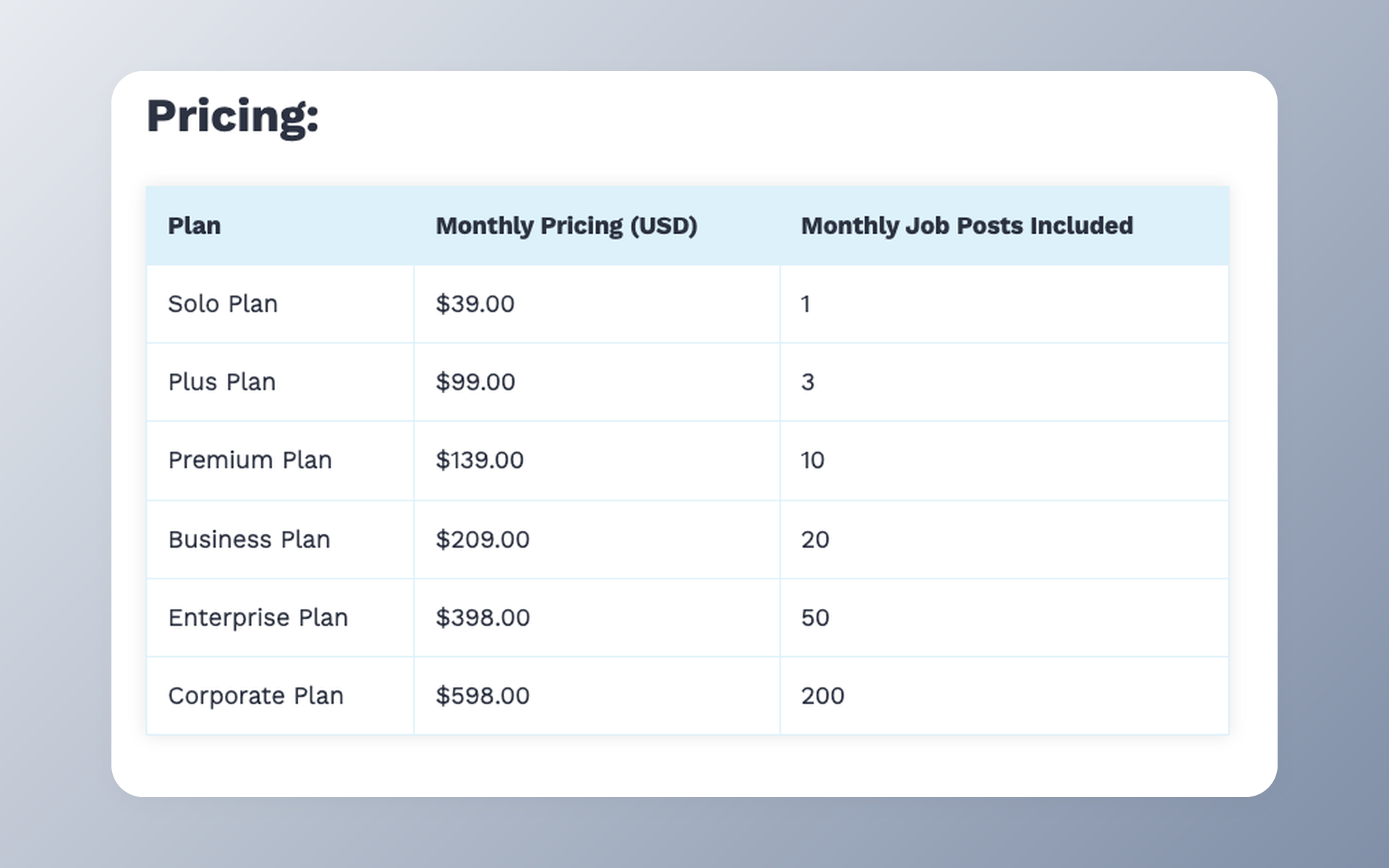
Betterteam says its annual subscriptions cost 50% less than monthly subscriptions. The annual totals above are vendor-displayed. Each annual-equivalent monthly amount is derived from that total.
The service supports billing in 105 currencies and chooses the currency based on the customer's location when they subscribe. Compare the checkout currency with the USD table before purchase.
Solo's 25-candidate limit deserves attention. A low posting price can lose value quickly if one broad job uses up the monthly applicant allowance.
Indeed pricing separates free eligibility from sponsorship
Indeed does not publish a universal subscription ladder for Sponsored Jobs in the current source set. A direct free post can cost $0 upfront when the employer and job qualify.
| Plan/path | Monthly | Annual equivalent | Annual total | Scope | Limits | Billing basis |
|---|---|---|---|---|---|---|
| Indeed eligible direct free job | $0 qualifying post | Not applicable | Not applicable | Direct job in the Indeed marketplace | Up to 3 free direct jobs per calendar month, typically live up to 30 days each | Per direct job under eligibility and quality rules |
| Indeed Sponsored Job | Not publicly shown | Not publicly shown | Not publicly shown | Paid visibility in the Employer Dashboard | Budget, eligibility, moderation, and campaign rules apply | Campaign spend under current account and market terms |
Indeed's legal terms describe charge timing, not plan prices. A card or bank account may be charged when campaign spend reaches $500 or at the start of the next calendar month, whichever comes first.
An account with prior pay-per-click sponsorship may face a $25 charge threshold. Do not read either threshold as a recommended budget or fixed package.
Indeed's legal terms say cancellation takes effect within 24 hours in most cases. Spend already incurred is not refundable. The terms say pausing a subscription or plan does not cancel it.
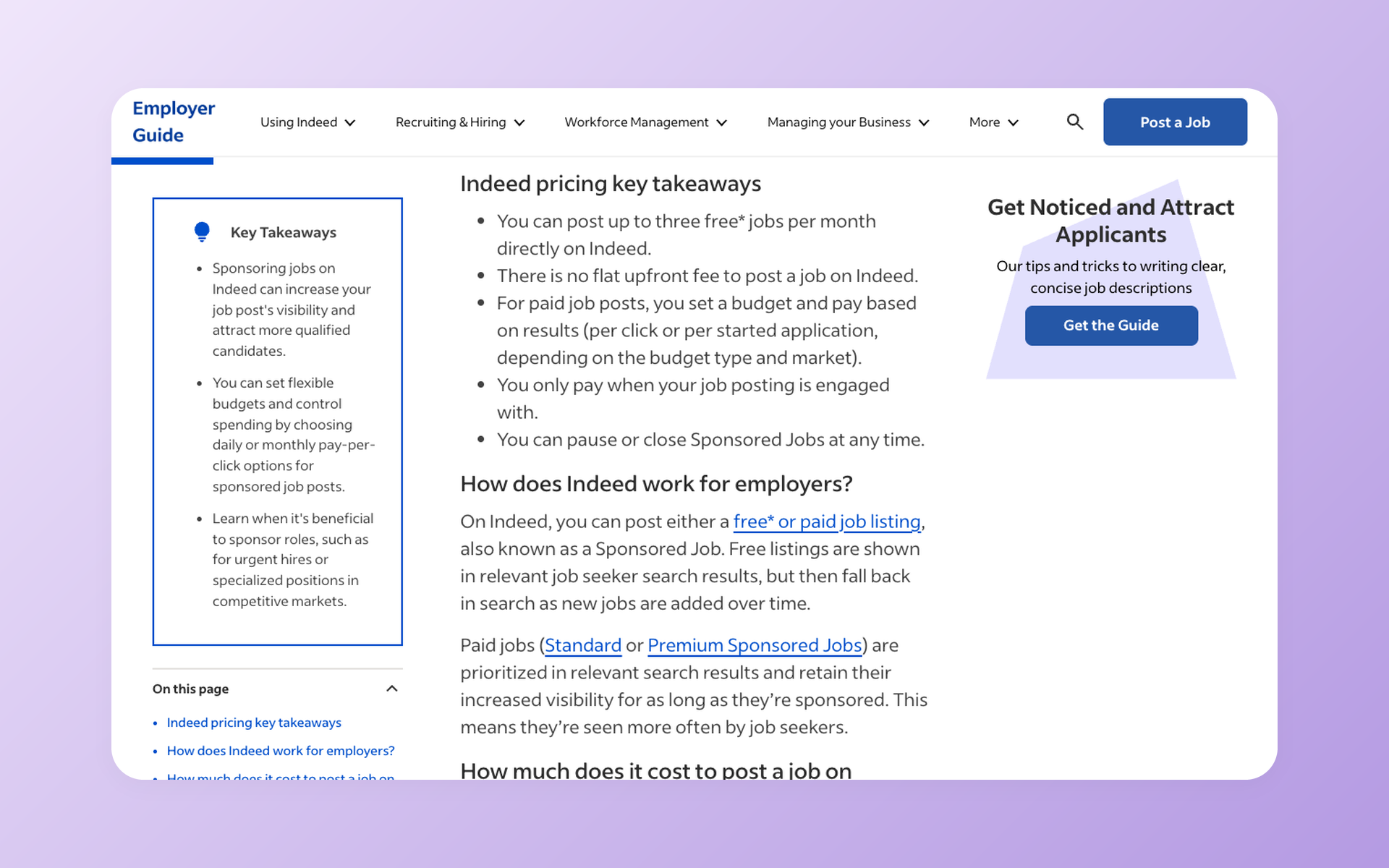
There is no honest raw-price winner. The Betterteam subscription buys distribution. Direct Indeed can start free for qualifying jobs, and sponsorship cost changes with the campaign. See our Indeed job posting cost guide for the wider budget model.
What happens after candidates apply
Posting is finished when the job goes live. Hiring is not. The next question is where the candidate record sits and how the team moves it forward.
Betterteam keeps posting and basic review together
Betterteam's central applicant view removes some inbox sprawl. A small employer can see candidates from its posting activity and handle initial review in the same product.
That is useful for one owner and a simple process. Available current Betterteam materials support an organized pipeline, not deep evidence for complex automation, advanced permissions, or full-funnel reporting.
Ask Betterteam to show your real process before purchase: reopen a candidate, assign a reviewer, find the last message, explain the source, and report what changed after an edit.
Small actions expose the boundary faster than a long feature list. If the team can complete them inside Betterteam, the lighter system may be enough.
Indeed handles its own flow and connects to ATSs
Indeed's Employer Dashboard can support a simple direct-hire process. Employers can work with applicants, messages, status, and interviews near the channel that produced the application.
A supported ATS connection changes that workflow. ATS Sync may transfer job details, questions, applications, candidate data, resumes, and disposition status. The supported data depends on the ATS.
This creates a practical split. Indeed can own discovery and an ATS can own the candidate record. The split works only when the team knows which updates travel in each direction.
Test one candidate from application to disposition. Check the resume, source, screening answers, status, messages, and close reason in both systems.
A full ATS owns the record after the click
A full ATS gives every candidate a persistent record across roles and channels. The team can use shared stages, notes, screening rules, source reports, and follow-up actions instead of rebuilding context in each board.
100Hires is our example of that layer. Its candidate tracking software keeps applications in one pipeline and records the channel tied to each candidate.
AI Score can compare a candidate with job criteria. Knockout questions can route a record for review. Source reports can compare visitors and applicants by board.
Nurture campaigns can trigger email and optional messaging steps from the candidate record. SMS needs a Twilio connection. Sequence actions and plan limits need setup before the team depends on them.
This is deeper than Betterteam's posting-led scope and broader than Indeed's native channel workflow. It carries more setup and subscription cost than a simple direct post.
Who should choose Betterteam or Indeed?
The right choice follows the work your team wants to remove. Headcount alone does not decide it.
Choose Betterteam when distribution is the bottleneck
Choose Betterteam when a small employer posts recurring roles and wants one place to prepare and submit them. Templates and posting allowances make the monthly workload predictable.
- You want one submission workflow across destinations.
- Broad reach matters more than native Indeed campaign control.
- One person can manage a light applicant process.
- Your monthly job and candidate volume fits the chosen plan.
Example: a local services company hires the same field roles in several markets. The owner wants to reuse job content, submit from one account, and review initial applications without opening several board dashboards.
Betterteam is the better fit for that employer, subject to destination acceptance. The employer should test Indeed routing before treating it as settled.
Choose direct Indeed when Indeed itself is the priority
Choose direct Indeed when the employer depends on that marketplace and wants native control over the listing. This path suits a small number of roles that can be managed in Indeed or an existing ATS.
- You need Indeed reach more than multi-board distribution.
- You want to control sponsorship in the Employer Dashboard.
- You need direct access to job status and account review.
- Your process can run in Indeed or a tested ATS connection.
Example: a regional manufacturer hires skilled trades and knows its candidates search Indeed. The recruiter wants to change the job, watch its status, and decide on sponsored spend without a distribution vendor in the middle.
Direct Indeed is the better fit for that channel. The employer can add a separate ATS when candidate volume or team handoffs outgrow the native workflow.
Use both only with a clean ownership rule
“Use both” may already describe a Betterteam job sent to Indeed. It should not mean sending the same requisition through two independent publishing paths.
The clean version uses different jobs, or one publishing system for a given job. The team documents who owns edits, closure, sponsorship, and the applicant record.
Before launch, publish one ordinary role and follow it through review. Confirm the live source, apply button, destination record, resume, and status sync. Stop the rollout if any step is unclear.
When neither tool is enough, use a full ATS
Distribution answers “Where should the job appear?” A full ATS answers “What should happen to each candidate next?”
100Hires is built for teams that need applicant intake, structured review, source reporting, workflow automation, and outreach in one ATS.
A typical inbound flow can look like this:
- Publish a job to approved channels.
- Bring applications into one candidate pipeline.
- Record the board or campaign source.
- Apply knockout questions and AI-assisted review.
- Move qualified candidates through shared stages.
- Trigger follow-up or nurture from the candidate record.
That workflow helps when broad posting creates more review work than one person can handle. It gives the team a shared record instead of separate board inboxes and private spreadsheets.
Source reporting shows the visitors and applicants from each channel. Recruiters can compare those results, then decide which channels deserve more attention or paid spend.
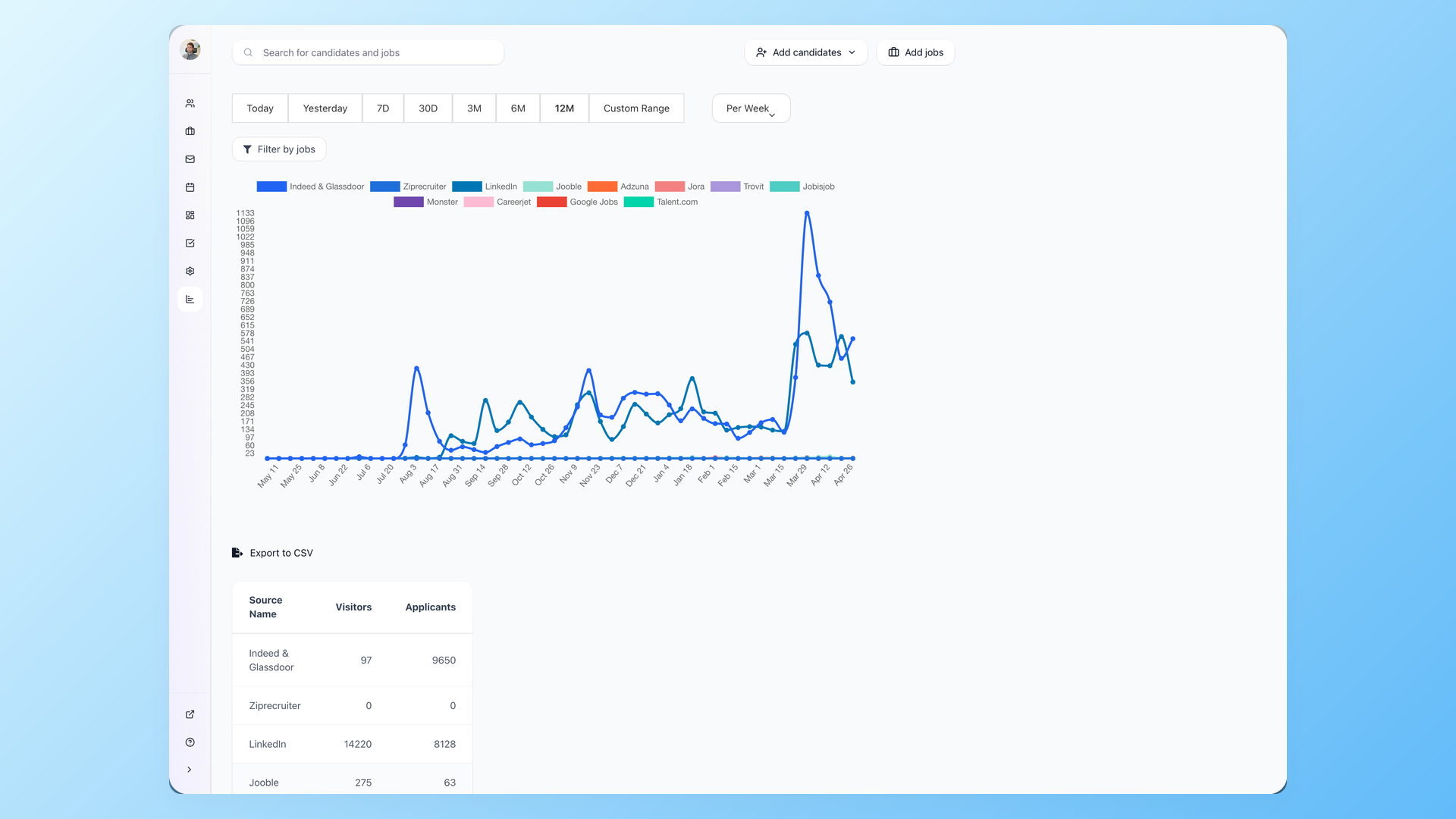
The recruitment automation software layer can connect stage changes with email, scoring, nurture, and team tasks. It needs careful setup and human review.
100Hires does not own Indeed's audience, employer account, moderation, ranking, or sponsorship auction. Sponsored placement remains an Indeed decision and bill. An ATS cannot force a job to rank or pass review.
The trial requires account verification. The Start plan caps the number of jobs, candidates, and users. AI actions use plan quotas. Pro is the plan for deeper outbound sourcing.
Test the workflow with a real job, not a polished sample. Check source capture, duplicate handling, screening, reviewer handoffs, rejection review, and follow-up before migration.
Start a 14-day 100Hires trial if the missing layer is applicant workflow. No credit card is required, and the trial caps above still apply.
Betterteam vs Indeed decision checklist
Answer these questions before opening either checkout page:
- Is Indeed the main source you want, or one destination in a broader mix?
- Do you qualify for direct free Indeed posts?
- Who needs control over sponsored spend?
- Which system will own job edits and closure?
- Could the same job reach Indeed from two sources?
- Where should applications and resumes land?
- Can the team report applicants by source?
- What happens after initial applicant review?
More answers about broad submission and simple review point to Betterteam. More answers about native job control and sponsorship point to direct Indeed.
If several answers concern pipeline stages, source reports, screening rules, reviewer handoffs, and follow-up, evaluate an ATS next to the chosen posting path.
Do not buy three overlapping paths to avoid one clear decision. One posting owner plus one candidate system is easier to operate and audit.
Run a one-job acceptance test before signing an annual contract. Use a normal role, a real location, and the application path you plan to keep. Record the publish time, final URL, apply destination, first applicant source, and close behavior.
The test will not predict candidate volume. It will expose ownership gaps. If nobody can explain where an edit starts, how it reaches Indeed, or where the application lands, the workflow needs repair before more jobs go live.
Frequently asked questions
Is Betterteam the same as Indeed?
No. Betterteam is job distribution software with templates and light applicant handling, and Indeed is a job board and employer marketplace. 100Hires is a third category: a full ATS with candidate stages, source reporting, and follow-up after applications arrive.
Does Betterteam post jobs to Indeed?
Dated Betterteam vendor documentation says it sends jobs to Indeed, but current eligibility, routing, and acceptance should be tested for your account. 100Hires has an Indeed integration and keeps received applicants in an ATS pipeline, subject to Indeed's rules.
Is it better to post directly on Indeed?
Direct posting is better when you need native Indeed job status and sponsorship controls. Betterteam is better for multi-board convenience. 100Hires can manage the pipeline around either approved path and adds board-level source reporting.
Can I post the same job through Betterteam and directly on Indeed?
Do not plan on duplicate submission. Indeed says duplicate listings from multiple sources are not accepted. Pick one publishing owner for the job. 100Hires source reporting can then show which approved channel path produced applicants.
Which is better for a small business, Betterteam or Indeed?
Betterteam fits a small business that wants one-to-many posting. Direct Indeed fits one focused on Indeed reach and native controls. 100Hires fits teams that need AI Score, knockout questions, and a shared pipeline, but Start is capped at 3 jobs, 100 candidates, and 1 user.
Final verdict
Betterteam is the better choice for distribution convenience. Direct Indeed is the better choice for control over the Indeed channel.
Betterteam reduces repeated posting work and gives a small employer a light applicant view. Direct Indeed removes the intermediary for native listing status, sponsorship, and marketplace workflow.
Neither path guarantees publication, rank, or applicants. Indeed keeps its quality rules. Betterteam's current Indeed mechanics need account-level testing, and duplicate submission can create problems.
Use 100Hires only when posting is the first step in a larger system. It adds pipeline stages, source attribution, screening, reporting, and nurture, with trial, plan, AI-credit, and board-policy limits stated above.
If that is your missing layer, try 100Hires for 14 days. If you only need Indeed reach or simple multi-board submission, choose the narrower tool and keep the workflow clean.
Try 100Hires for free
No credit card. 14-day trial. Forbes Advisor #1 ATS for SMBs.