
How Much Does It Cost to Post a Job on Indeed? (2026)
Posting a job on Indeed is free for up to 3 jobs per calendar month, and each free job stays live for up to 30 days. There is no flat fee. If you sponsor a job, Indeed charges per click or per started application against a budget you set.
There is no universal $5-a-day minimum: Indeed sets a minimum for each job and shows it when you sponsor. You are billed on the 1st of the month or when spending reaches $500, and new US accounts get a $75 credit toward their first sponsored job.
Checked October 12, 2026 against Indeed's pricing guide (updated August 19, 2026), its myths vs facts page (June 1, 2026) and Employer Help Center articles on the free post limit (June 10, 2026), pay per started application (May 4, 2026) and sponsored budgets (May 21, 2026).
Prices are for the US unless noted.
Indeed pricing at a glance
The hiring playbook, in your inbox
One email a week - benchmarks, AI screening tactics, and short interview templates from the 100Hires team. No product pitches.
| Option | What it costs | What you get |
|---|---|---|
| Free job post | $0, up to 3 direct posts per calendar month | Each job live for up to 30 days; visibility fades as newer jobs are posted |
| Sponsored Job, Standard | Your budget, paid per click or per started application; minimum set per job | Indeed says Standard gets 3X more applications than free |
| Sponsored Job, Premium | Higher budget than Standard; no published price | More top-3 placement, targeting, matched candidates, Urgently Hiring label |
| Premium Plus (beta, US) | No published price | Premium plus an AI Recruiting Assistant that invites candidates |
| Smart Sourcing (resume search) | $520 a month, or $416 a month billed yearly | 100 candidate contacts a month, 14-day free trial |
| Hiring Events | $500 minimum budget per event | In-person or virtual event with built-in advertising and screening |
| Indeed Ads and employer branding | No public price (sold through sales) | Enterprise advertising and branding products |
Free job posts on Indeed
Indeed now limits free posting (the cap was reported by the trade blog Job Board Doctor in December 2025).
According to Indeed's help article on the free job post limit, in the US you can post up to 3 jobs per calendar month directly on Indeed for free. The rules behind that number matter:
- All accounts under the same parent company share the 3 free posts.
- Paused jobs count toward the limit, and each duplicate job uses a free spot.
- The count resets at midnight on the 1st of each month, in your time zone.
- Each free job stays visible for up to 30 days. A job posted more than 30 days ago cannot be reopened for free traffic.
- Sponsored jobs do not count toward the 3.
Indeed says free posts fall back in search results as newer jobs are posted, and virtual interviewing is available on free posts (Indeed, updated May 7, 2026).
The posting steps themselves have not changed much: create an employer account, add the job details, set screener questions and publish. Our step-by-step guide to posting a job on Indeed walks through each screen.
When Indeed makes you pay to post
Many employers who expect a free post find the job marked "sponsored only". Indeed may require sponsorship when:
- You are over the 3 free posts for the month
- You are a staffing agency, RPO or other recruitment-based company (agencies can post only if they sponsor)
- The job also reaches Indeed through a data feed, career site or ATS while you post it directly
- The same job is posted in many locations, or reposted in a way that looks like a duplicate
- The company name is confidential or generic, the role is commission-only, or it requires relocation
- Indeed considers the role hard to fill (Indeed also "reserves the right" to require sponsorship for other reasons)
Feeds changed too. From March 31, 2026, jobs sent through single-source XML feeds no longer appear for free if they could be sent through an ATS integration instead. Our explainer on Indeed's single-source feed policy covers who is affected.
Jobs posted through an applicant tracking system do not use up your 3 free direct posts. Indeed can still mark any job as sponsored only, and the status shows in your Indeed dashboard. If a job was pulled or flagged, see why Indeed flags a job.
How sponsored jobs are billed
Sponsored Jobs are results-based. Depending on your budget type and market, Indeed charges either per click (PPC), when someone clicks to view the job, or per started application (PPSA), when someone clicks to apply or starts the application.
Indeed's PPSA overview says qualifying jobs are enrolled in pay per started application automatically and cannot switch back to pay per click. The price per started application is set in a live auction and, in Indeed's words, its costs depend on candidate demand.
Older guides describe a "pay per application" model where you could reject an applicant within 72 hours and not pay. Indeed ended that model on December 18, 2023, as SHRM reported, so treat any guide that still quotes it as out of date.
Minimum budgets, spending limits and invoices
Many pricing guides still say sponsored jobs start at $5 a day. Indeed's myths page (June 2026) says there is no universal flat fee or $5 minimum. The minimum is generated for each job and shown on the sponsorship page during setup.
Factors Indeed lists include how many job seekers are available in your market, how many competing jobs bid for the same placement, and the sponsorship plan you choose.
Indeed also suggests a budget based on the title, location and description. You can go lower than the suggestion, but not below the job's minimum.
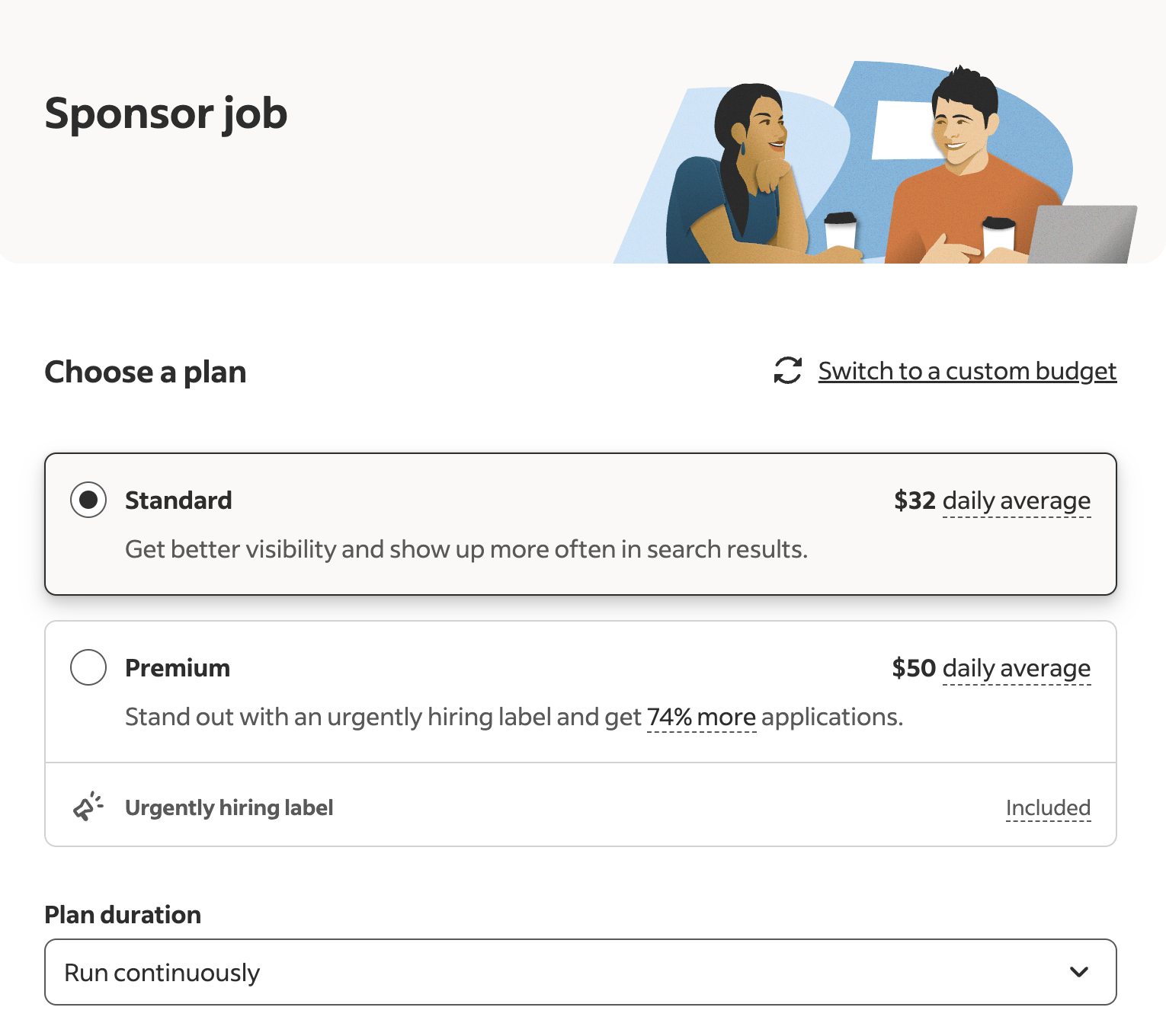
How the budget behaves, per Indeed's help center (for example its article on managing sponsored job budgets) and pricing guide:
- The daily budget is an average, not a hard cap. On a job that runs continuously, weekly spend can reach 7.5 times the daily budget. With a fixed end date, total spend is capped at the daily budget times the number of days.
- Hitting the daily limit hides the job. A sponsored job is removed from search once it reaches its daily spend limit and comes back when the budget resets the next day.
- Campaigns use one-time or monthly budgets. You can add a per-job limit. When a campaign budget runs out, its jobs stop being sponsored until the next cycle or until you add budget.
- You can stop at any time. Pausing or closing a job removes it from search and stops spending.
Billing works like this: Indeed charges you on the 1st of the month or when your account's spending reaches $500, whichever comes first.
Indeed marks the $500 early invoice as credit card only; it also accepts insertion orders, ACH, wire or check. In Indeed's own example, $650 of spend in June means $500 charged when the threshold is hit and $150 invoiced on July 1.
First-time sponsors may get an initial invoice when the balance reaches $25, which validates the payment method. New US accounts that post a job get a $75 credit for sponsoring, valid for one year.
Standard, Premium and Premium Plus
When you sponsor, Indeed offers plans with prices shown upfront for your specific job. It does not publish a price list for them.
- Standard: more frequent placement in search. Indeed says Standard gets 3X more applications than a free post.
- Premium: priced above Standard. Indeed says it appears in the top 3 results up to 2.0X more often than Standard, and adds targeting, matched candidates you can invite, an Urgently Hiring label and branding.
- Premium Plus: a US-only beta that adds a Recruiting Assistant to invite matched candidates for you.
- Custom budget: set your own amount at or above the job's minimum.
Targeting is now part of the self-serve Premium plan. Larger employers can also buy Indeed Ads and employer branding through sales, with no public price.
Other Indeed costs
Contacting candidates from Indeed's resume database is not free. It requires a paid subscription called Smart Sourcing.
According to Indeed's candidates page, the Professional plan costs $520 a month, or $416 a month billed yearly; the Smart Sourcing page puts that at $4,992 a year.
Per the Smart Sourcing page, Professional includes 100 candidate contacts a month, unused contacts roll over for 6 months, and extra contacts cost $5.20 each.
There is a 14-day free trial, and an Enterprise plan is priced by quote. Many older articles still list $120 or $300 a month; those prices are out of date.
Hiring Events have a minimum budget of $500 per event in the US, separate from Sponsored Job minimums. We found no published US price for Indeed Flex, the temporary staffing service.
What Indeed costs in practice
Because Indeed publishes no rate card, real-world figures come from third parties and employers. Treat them as ranges, not Indeed prices.
- Buyer data: Vendr reports a median of $15,000 a year across 144 Indeed purchases (February 2026). Vendr's published pricing bands appear weighted toward contract buyers, so do not treat its median as a small-employer benchmark.
- Cost per click: the same Vendr guide reports clicks from about $0.25 to $5 or more, most often $0.50 to $3.
- Monthly spend: Vendr's bands run from about $500-$2,000 a month for 1-10 roles to $8,000-$25,000+ for 50+ roles a month.
Your own number depends on role, location and competition. Estimates compiled by Peoplebox (June 2026), a vendor that sells a competing product, put rural hourly roles at the low end and nursing and tech roles at the high end.
What employers report about Indeed costs
Employer reports from late 2025 and June-September 2026 describe the following experiences. These are individual reports, paraphrased, with links:
- Higher per-job minimums. Small agencies that ran $5-a-day tests saw one job require $12 a day to sponsor (September 2026), in line with Indeed's per-job minimum.
- Budgets spent in days. Employers report budgets used up in five or six days, or a month's budget overnight (r/recruiting, September 2026, r/recruiting, September 2026), and one poster relayed a rep saying low budgets now spend early (r/recruiting, September 2026).
- More applicants, not better ones. Two recruiters said higher daily budgets brought more applications rather than better ones and went back to about $20-$35 a day (r/recruiting, September 2026, r/recruiting, September 2026).
- Small budgets can still work. Some employers report that $5 to $20 a day per job still brings enough applicants for entry-level roles (r/recruiting, June 2026).
- Multi-location employers report rising spend. An operator of 60+ restaurants reported spending rising from about $5,000 to $7,500 a month for similar results and blamed campaign pacing (r/recruiting, September 2026).
- Agencies pay to post. A small staffing agency said Indeed now charges agencies to post (r/recruiting, October 2025), which matches Indeed's policy for recruitment companies.
- Compare boards by results. One large programmatic buyer reported ZipRecruiter's cost per application at about twice Indeed's (r/recruiting, September 2026).
How to keep Indeed spend under control
- Use your 3 free posts for roles that usually fill without help, such as local entry-level jobs.
- Post each job once per location and leave it up for 30 days or more. Quick reposts and near-identical jobs can be flagged or made sponsorship-only.
- Check whether a job is marked sponsored only before you plan its budget.
- Start at the job's minimum and watch how often it hits its daily limit and drops out of search.
- Set a campaign budget or an end date so spend has a ceiling.
- Judge results by cost per qualified applicant and cost per hire, not clicks. Our guide to calculating cost per hire shows the math.
Indeed vs LinkedIn and other job sites on price
| Job site | Free option | Paid model |
|---|---|---|
| Indeed | Up to 3 direct posts a month, 30 days each | Sponsored Jobs per click or per started application; minimum set per job |
| One free job open at a time; pauses after 14 days, closes at 30 | Promoted jobs pay per click on a daily or total budget |
For head-to-head detail with other boards, see Indeed vs ZipRecruiter, Indeed vs LinkedIn and our LinkedIn job posting cost guide.
Posting to Indeed from an ATS
If you hire for more than a few roles, an applicant tracking system can publish each job to Indeed and other boards and keep every applicant in one place. That does not remove Indeed's costs: sponsorship is still paid to Indeed. Here is how it works with 100Hires.
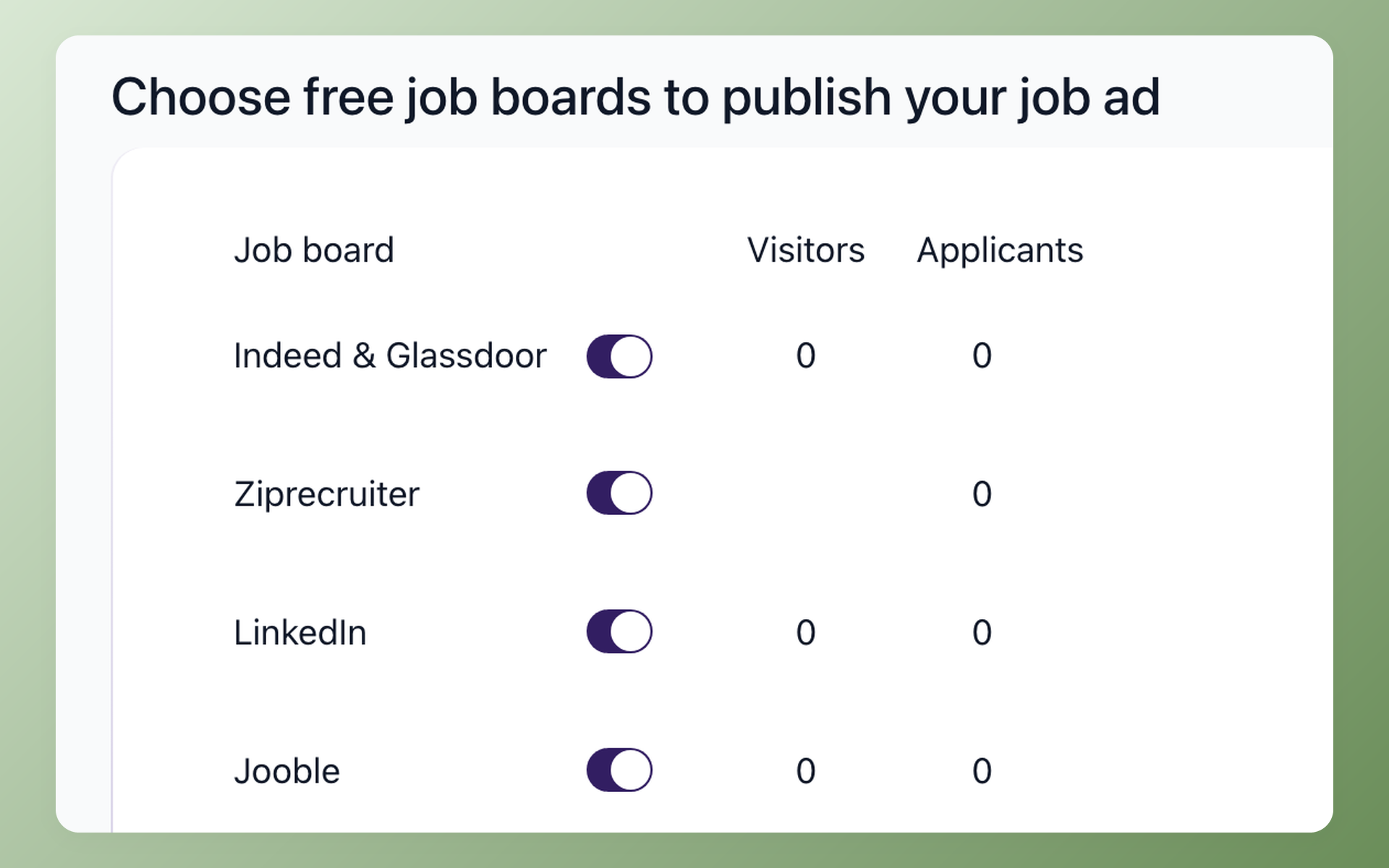
- One job, many boards. On every paid plan, 100Hires publishes a job to the boards you select from a list of 13 job boards, with no per-board fee; any sponsorship budget is paid directly to Indeed.
- Sponsoring stays with Indeed. There is no budget setting in 100Hires. You sponsor a job in your Indeed Employer Dashboard, signed in with the same email, and Indeed bills you directly.
- Timing. Your first Indeed post needs a one-time company verification by Indeed, usually 24-48 hours. After that, jobs usually appear on Indeed within a few hours.
- One pipeline. Indeed applicants arrive through Indeed Apply, and candidate status changes sync back to Indeed.
- Free posts. Jobs sent from an ATS do not use your 3 free direct posts, but Indeed can still require sponsorship for any job.
100Hires plans start at $49 a month billed annually. That Start plan covers up to 3 jobs, 100 candidates and 1 user, and Advanced and Pro add unlimited jobs and users.
The 14-day free trial needs no credit card. Indeed and Glassdoor restrict trial postings, and the whole trial account can receive up to 10 candidates from external job boards.
More on the Indeed integration and the pricing page, or start a free trial.
Frequently asked questions
Is it free to post a job on Indeed?
Yes, for up to 3 jobs per calendar month posted directly on Indeed in the US, each live for up to 30 days. The limit is shared across all accounts under the same parent company, and some jobs must be sponsored regardless. Jobs posted through an ATS such as 100Hires do not use those 3 free posts, though Indeed can still require sponsorship.
Why is Indeed charging me to post a job?
Usually because the job is over the 3-free-posts limit, comes from a staffing agency, is a repost or duplicate, uses a confidential company name, or also reaches Indeed through a feed or career site. First-time sponsors may also see a $25 invoice that validates the payment method. 100Hires reads each job's Indeed sponsorship status, but sponsorship is billed by Indeed.
Is there a minimum budget for sponsored jobs on Indeed?
Yes, but it is not a fixed $5 a day. Indeed sets a minimum for each job based on job-seeker supply, competing jobs and the plan you choose, and shows it when you sponsor. If you post through 100Hires, you set and see that budget in your Indeed Employer Dashboard.
Why is Indeed so expensive now?
Free visibility shrank when free posts were capped at 3 a month and 30 days each (reported from December 2025). Per-job minimums now depend on competition, and budgets are daily averages that can be spent quickly. Posting through an ATS like 100Hires to several boards lets you keep Indeed spend for the roles where it works.
Is posting a job on Indeed worth it?
Employer reports are mixed. Some direct employers said $5-$20 a day produced enough applicants for entry-level roles, while recruiters hiring for niche or senior roles often reported few qualified applicants (employer reports, June-September 2026). Track cost per qualified applicant and hire by board; 100Hires stores each applicant's source in the pipeline.
How much is an Indeed subscription?
Self-serve job posting has no subscription; you pay per click or per started application only when you sponsor. Resume search is the paid subscription: Smart Sourcing Professional costs $520 a month or $416 a month billed yearly, with 100 contacts a month. 100Hires includes a searchable database of your own past applicants on every plan.
ZipRecruiter or Indeed: which costs less?
Indeed offers 3 free direct posts a month and charges per click or per started application when you sponsor; our Indeed vs ZipRecruiter comparison covers ZipRecruiter's plans. Which costs less per hire depends on the role and market, so test both for 30 days. 100Hires can post one job to both from the same workflow.
Try 100Hires for free
No credit card. 14-day trial. Forbes Advisor #1 ATS for SMBs.