
Avionte API
Understand Avionte API access, credentials, authorization, API surfaces, webhooks, and operating constraints before your engineering team commits to an integration.
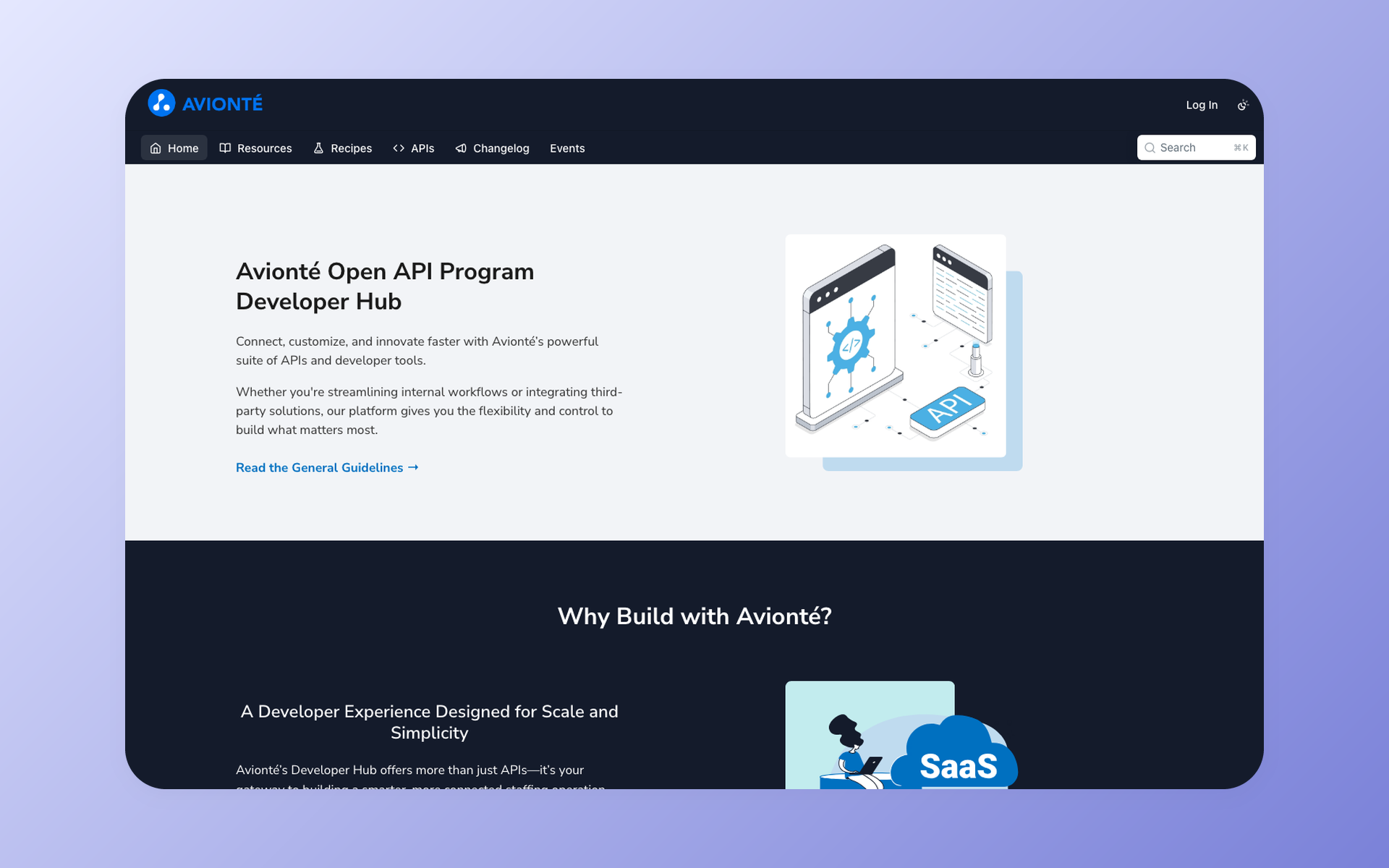
Avionte API access starts with registration
The Avionte Developer Hub provides guides, references, webhook guidance, FAQs, and changelogs. Public documentation is not production access.
Avionte's Getting Started guide separates access, authorization, and requests. The access step directs existing clients to an Avionte representative and third-party providers to the Certified Integration Partner route.
After registration, the credential package contains Tenant, Client ID, Client Secret, and API Key. Treat all four as account-specific secrets.
Before coding, confirm which API surface, tenant context, scopes, and environments are available to your account.
Avionte API credentials and authorization
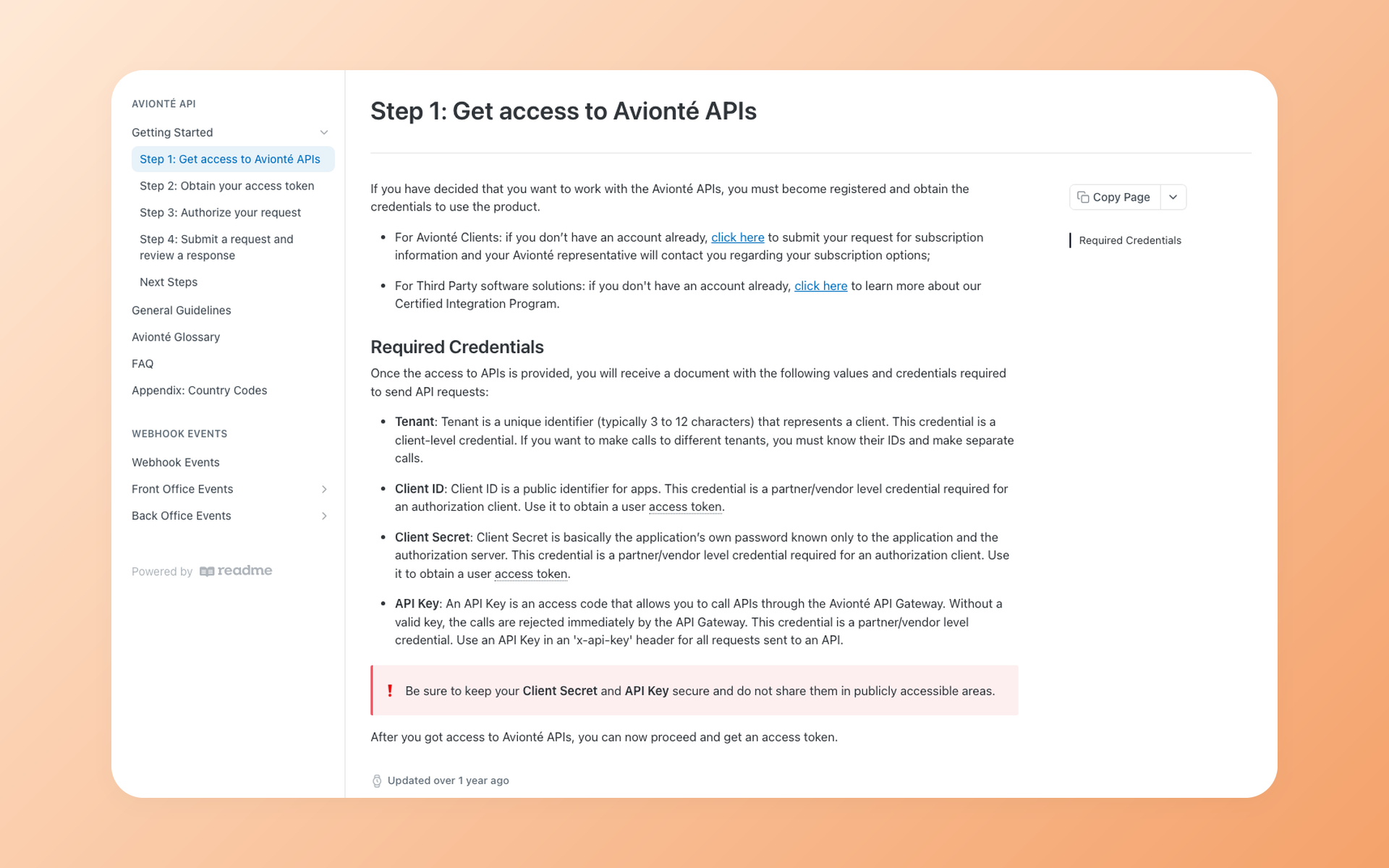
Map the access and token sequence
Avionte documents OAuth 2.0 client credentials, an API key, tenant and gateway context, and a default token lifetime of 3,600 seconds. Confirm the selected API reference before implementation.
- Tenant, Client ID, Client Secret, and API Key
- OAuth 2.0 client credentials
- Default token lifetime: 3,600 seconds
- Operation-specific tenant and gateway context
The token request uses client credentials and an API key at https://api.avionte.com/authorize/token. Headers, tenant, gateway, identifiers, and request details vary by operation.
Avionte API surfaces are not one universal contract
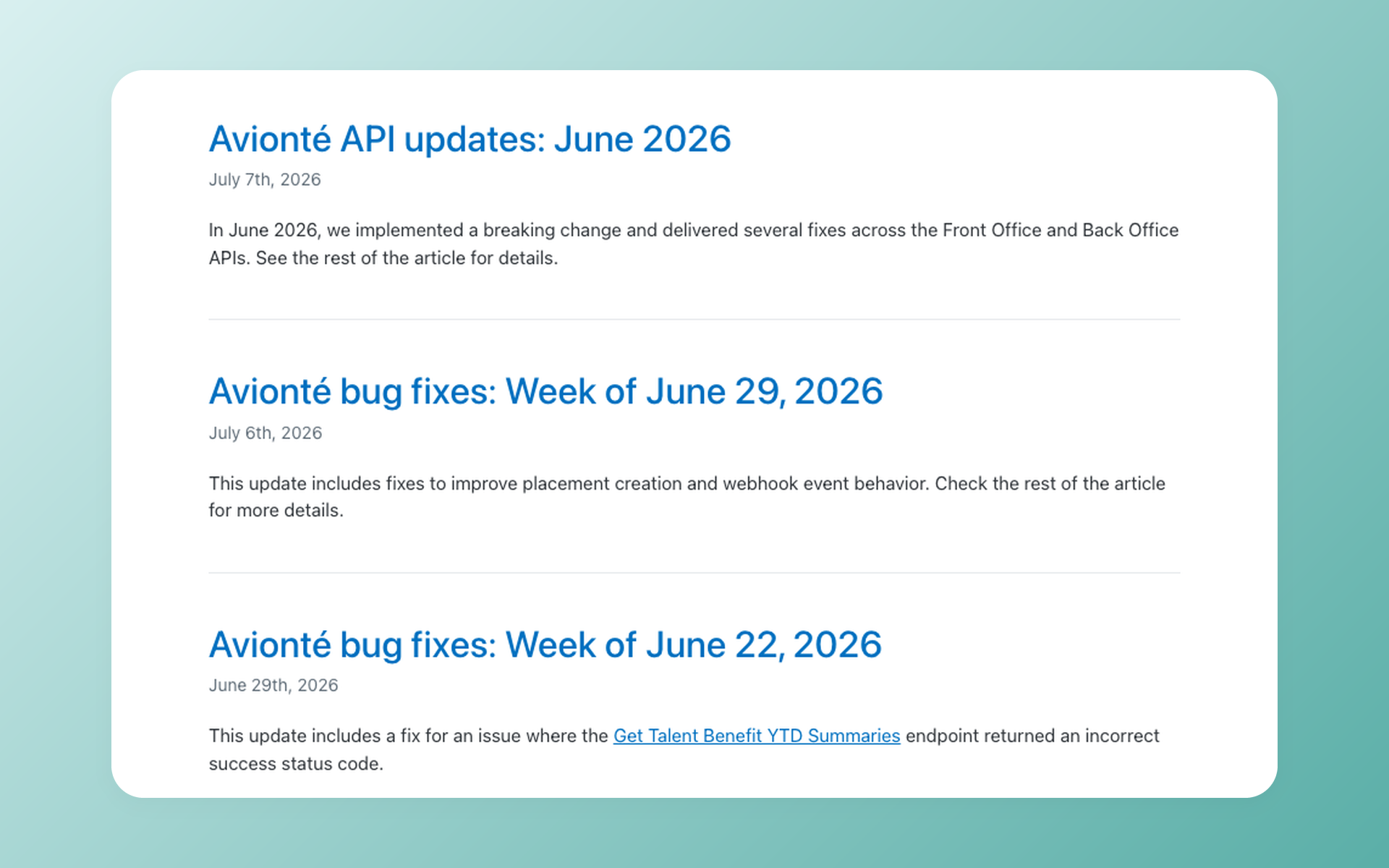
Choose the correct Avionte surface
Avionte separates Front Office recruiting and CRM from Back Office staffing, including a v3 Back Office server family. Check identifiers and requests in the current operation reference.
- Front Office for recruiting and CRM workflows
- Back Office for staffing operations
- Separate v3 production and pre-production routes
- Confirm the reference page for each operation
Current documentation identifies Front Office at https://api.avionte.com/front-office, Back Office, and v3 production and pre-production routes. API access varies by account.
Avionte API operating constraints to plan for
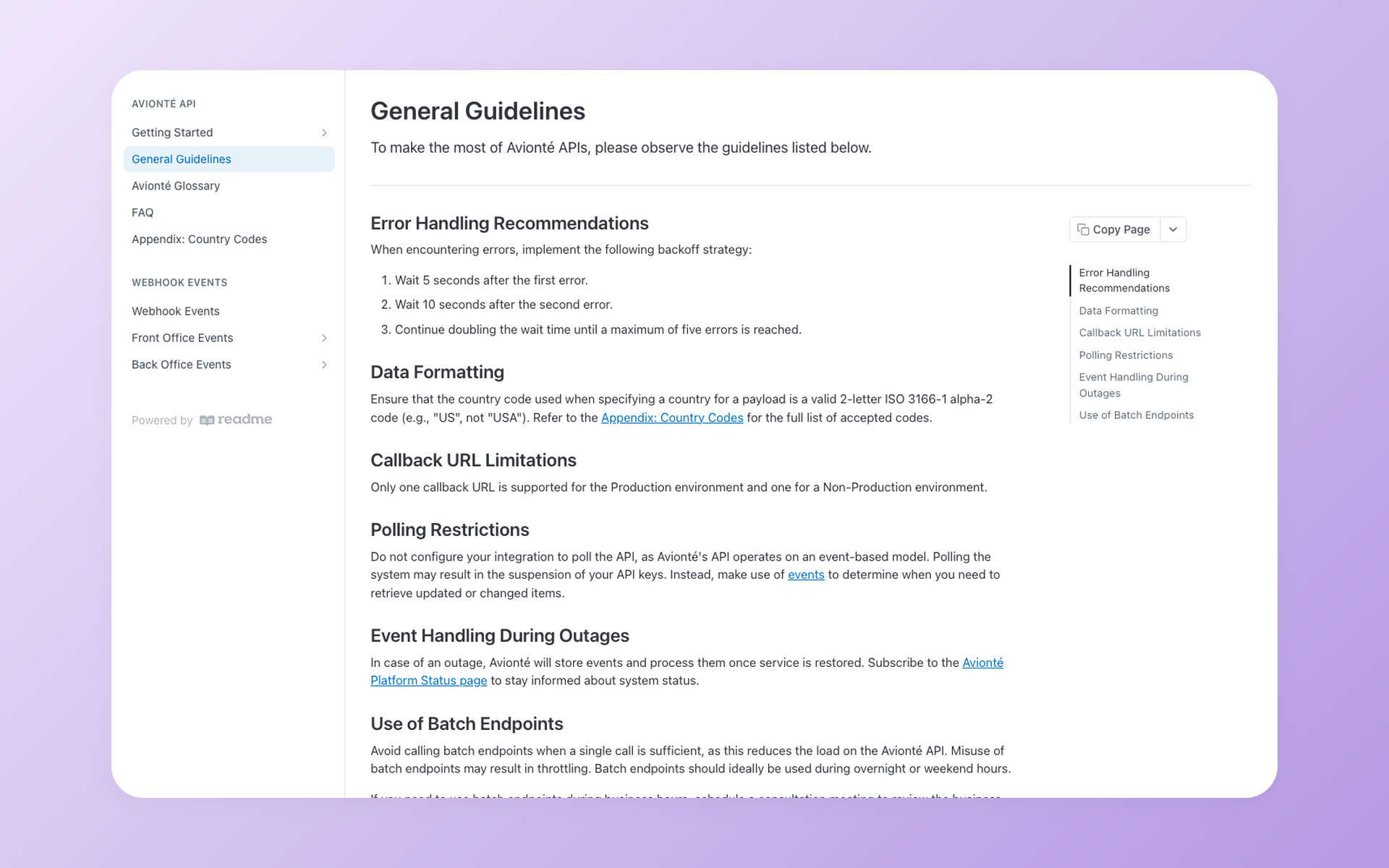
Plan for events, backoff, and change
Avionte warns against polling, publishes bulk guidance and breaking-change notices, and requires coordination to enroll callbacks.
- Polling can lead to API-key suspension
- Documented bulk guidance: 3-5 requests per second
- One Production and one Non-Production callback
- Breaking changes appear in current changelogs
Bulk guidance is 3 to 5 requests per second, typically with 100 records. Operations that require more resources may differ.
The documented backoff sequence starts at 5 seconds, then moves to 10 seconds and doubles after each subsequent error, up to a total of five errors.
Avionte documents one callback per environment, JSON POST delivery, optional X-api-key use, and HTTP 200 or 201. Confirm event triggers, response handling, and reconciliation.
Avionte says it stores outage events for processing after service returns. Its Platform Status page remains the operating reference; this is not an uptime or delivery guarantee.
Teams evaluating event-driven recruiting can inspect the documented 100Hires webhooks integration. Keep each vendor's signing, retry, replay, and subscription rules separate.
Avionte API and 100Hires API v2 comparison
This comparison covers recruiting ATS data and workflows only. It excludes the full Avionte staffing platform and does not imply 100Hires back-office parity.
| Capability | 100Hires API v2 | Avionte API |
|---|---|---|
| Public developer contract | OpenAPI 3.1 JSON | Public hub, guides, and operation-specific reference pages |
| Production access | Paid plans; company verification required | Registered client or partner route |
| Authentication | Bearer key tied to a specific user and company | OAuth 2.0, API key, and tenant context |
| Recruiting data | CRUD for candidates, jobs, applications, and notes | Operation-specific Front Office references |
| Application workflow | Move, advance, hire, reject, unreject, and transfer actions | Confirm operation coverage in the selected API reference |
| Webhook setup | API registration for job and company scopes | Coordinated event and callback enrollment |
| Webhook verification | HMAC-SHA256 signing | X-api-key when required; confirm event details |
| Published limit evidence | New keys: 100 requests per 10 minutes | Documented bulk guidance: 3-5 requests per second |
| Change visibility | Live OpenAPI and current help documentation | Public changelog with breaking-change notices |
| Staffing back office | Not a payroll or staffing back-office replacement | Separate Back Office API families |
| API commercial terms | Included with paid plans; no separate add-on or per-request fee | Price and approval timing are not published in the sources reviewed |
| Start plan | USD $99/month billed monthly; USD $49/month billed annually; USD $588/year, derived; 3 jobs, 100 candidates/month, 1 user | Not published in the sources reviewed |
| Advanced plan | USD $249/month billed monthly; USD $199/month billed annually; USD $2,388/year, derived; unlimited jobs, candidates, and users | Not published in the sources reviewed |
| Pro plan | USD $499/month billed monthly; USD $399/month billed annually; USD $4,788/year, derived; unlimited jobs, candidates, and users | Not published in the sources reviewed |
The limits use different scopes and units: Avionte gives bulk guidance, while 100Hires documents an initial per-key limit. They do not rank performance.
100Hires API v2 exposes the recruiting contract
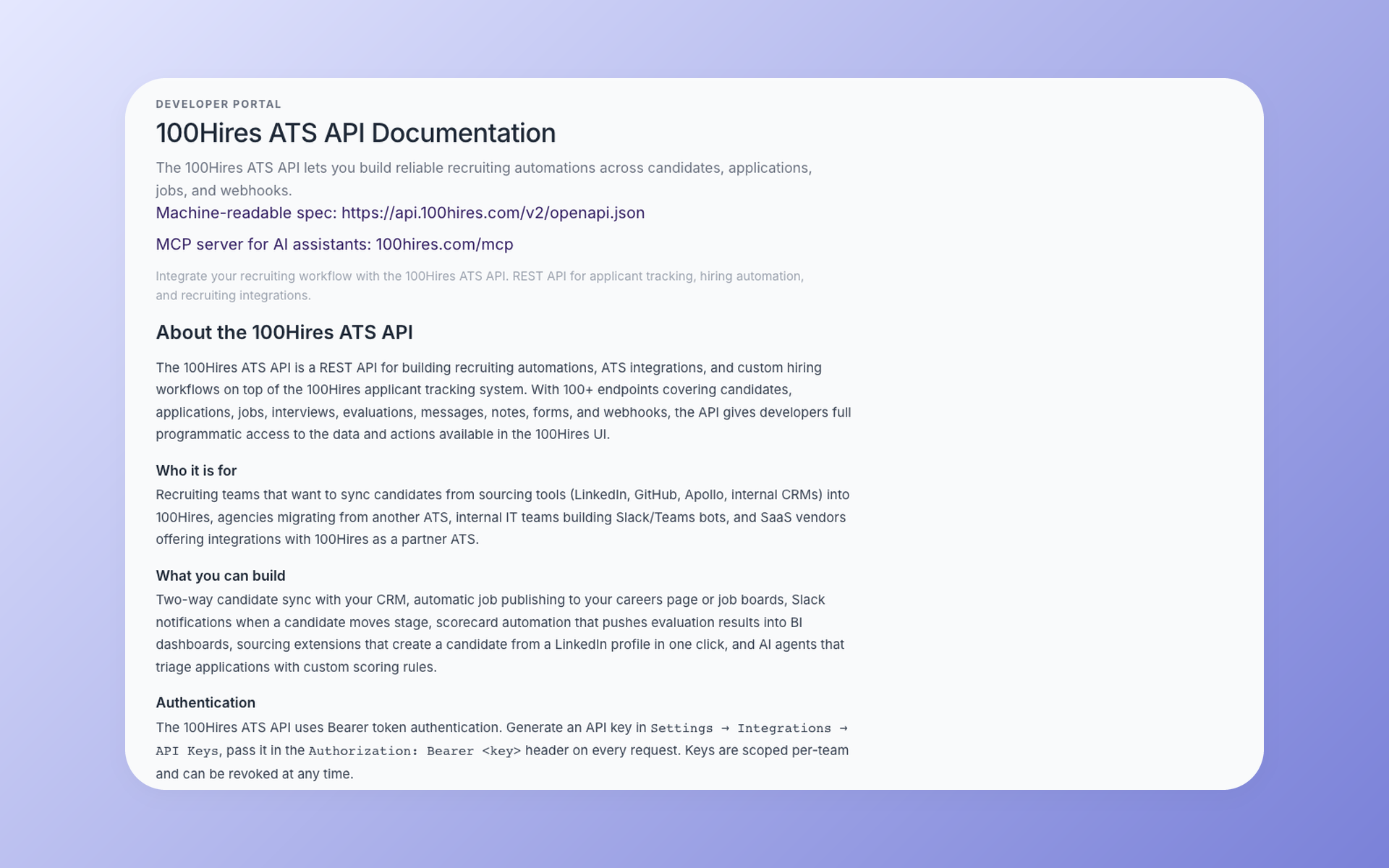
Inspect the API before implementation
Use the public 100Hires API v2 contract to scope the integration. Confirm account verification, field access, and responsibility for production work.
- 89 paths and 133 operations
- Candidate, job, application, and note CRUD
- Job and company webhook management
- Bearer authentication and company verification
The OpenAPI 3.1 contract lists 89 paths and 133 operations across candidates, jobs, applications, notes, workflow actions, and webhooks. Its bearer key is tied to a user and company. Paid plans include API access without a separate add-on or per-request fee.
Connect API data to recruiting outreach and automation
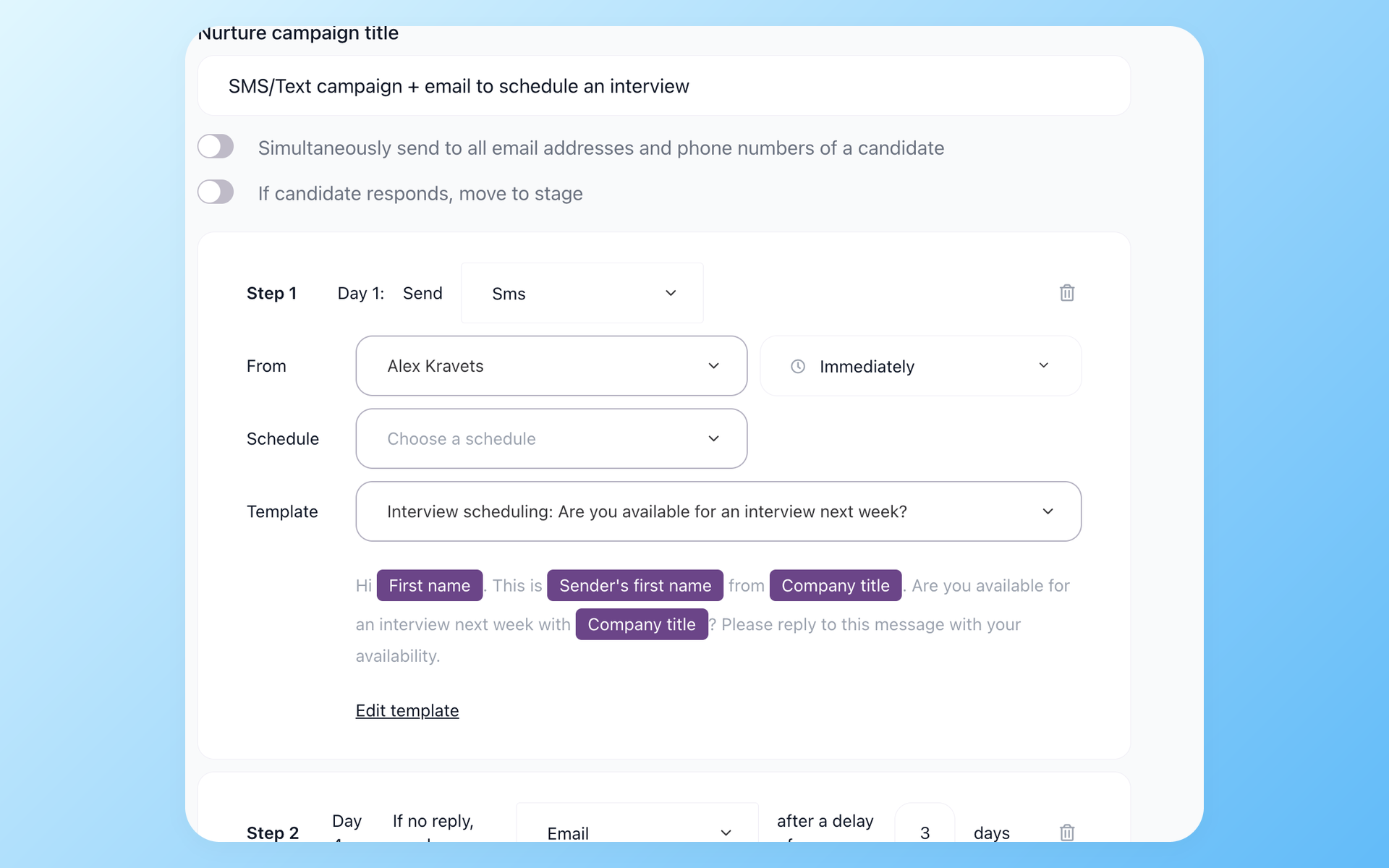
Keep follow-up inside the recruiting workflow
Recruiters can use documented 100Hires candidate and application data in messages, templates, nurture campaigns, stages, and workflows. The integration alone does not guarantee outreach results.
- Message and template workflows
- Candidate and application context for nurture campaigns
- Recruitment automation around documented records
Review candidate outreach workflows and recruitment automation software. Treat API access, configuration, deliverability, consent, and team responsibilities as separate implementation checks.
What to confirm before engineering starts
For every operation, record the owner, environment, identifiers, permissions, expected volume, failure-handling process, and support contact.
Avionte checks
- Access owner: identify the Avionte representative or Certified Integration Partner contact responsible for registration and credential issuance.
- Surface and environment: confirm Front Office, Back Office, or the applicable v3 server family for every operation.
- Context and scope: record tenant provisioning, identifiers, headers, gateway requirements, permissions, and field behavior for each operation.
- Events: document subscription enrollment, callback authentication, event coverage, response codes, replay, reconciliation, and outage handling.
- Traffic plan: map batch sizes, polling avoidance, backoff, concurrency, error handling, and any exceptions for more demanding operations.
- Change control: monitor the changelog, assign someone to manage breaking changes, and test affected operations before deployment.
- Commercial terms: confirm pricing, certification requirements, sandbox access, approval timing, support ownership, and escalation paths directly with Avionte.
100Hires checks
- Entitlement: verify that the account is on a paid plan, the company is approved, the key works, and which specific user and company the integration will use.
- Field visibility: test the required fields in production; access or pricing rules may limit which candidate data is visible.
- Initial limit: plan around 100 requests per 10 minutes for a new key and confirm any higher-volume arrangement with support.
- Webhook scope: verify job and company registration, secret rotation, HMAC-SHA256 validation, event coverage, and reconciliation.
- Delivery assumptions: do not invent a retry schedule, replay contract, or delivery guarantee that the public documentation does not provide.
- Ownership: decide which environment and account will be used for production access, and assign responsibility for monitoring and the support process.
100Hires API v2 covers recruiting ATS data and workflows. It does not replace Avionte payroll, billing, benefits, timekeeping, VMS, or staffing back-office functions.
The hiring playbook, in your inbox
One email a week - benchmarks, AI screening tactics, and short interview templates from the 100Hires team. No product pitches.
Related 100Hires resources: Explore recruiting software.