
ZipRecruiter pricing in 2026: plans and costs - 100Hires
ZipRecruiter pricing has no universal public employer dollar rate, so the real bill begins with the offer inside your account.
This guide explains the buying paths, slot math, trial questions, sourcing costs, and two budget scenarios for 2026. It leaves unknown ZipRecruiter rates as inputs instead of filling gaps with old estimates.
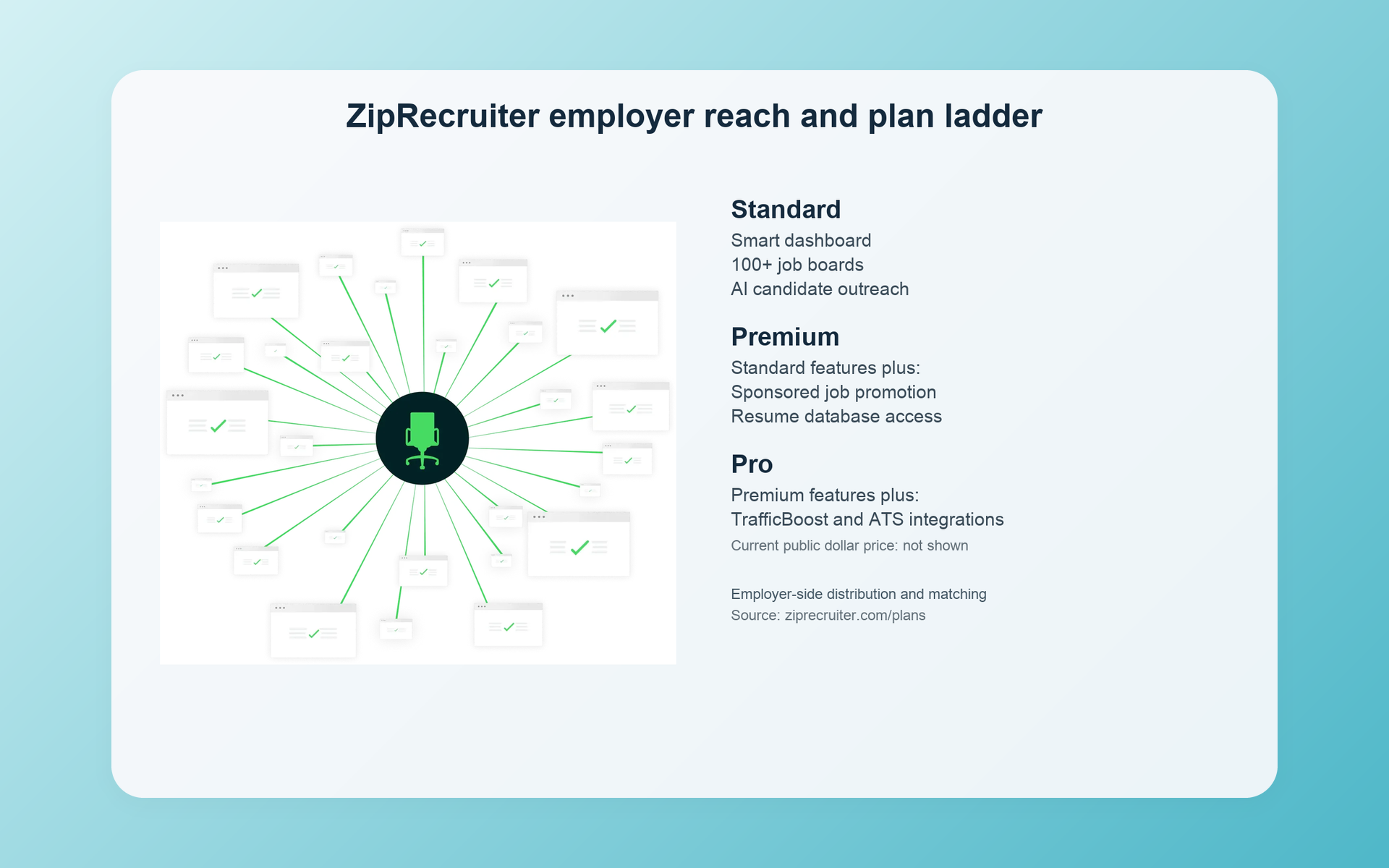
Standard, Premium, Pro, and Enterprise are current plan families. Buying models include subscriptions, reusable job slots, pay-per-day posting, and performance campaigns.
A current official support search result advertises a two-day trial for new users. Main product pages describe a trial without giving its duration, so the exact logged-in offer controls.
ZipRecruiter pricing at a glance
The hiring playbook, in your inbox
One email a week - benchmarks, AI screening tactics, and short interview templates from the 100Hires team. No product pitches.
ZipRecruiter publishes enough information to identify each buying path, but not enough to calculate a universal bill. A useful estimate starts with your concurrent hiring capacity and current account offer.
The plan and price table
| Plan | Public amount | Buying path | Billing | Price inputs | Named items |
|---|---|---|---|---|---|
| Standard | Not publicly shown | Self-serve trial CTA | Account offer | Jobs, slots, account | Core plan family |
| Premium | Not publicly shown | Self-serve trial CTA | Account offer | Jobs, slots, account | Premium plan family |
| Pro | Not publicly shown | Chat, email, or phone | Contact-led | Capacity and campaign | TrafficBoost |
| Enterprise | Custom quote, not publicly shown | Sales-led | Subscription or performance | Jobs, role, market, goals | Sponsored Reach, Resume Database, ZipRecruiter Apply |
The current two-day support-page offer applies to new users in that result. Retained evidence does not tie it to Standard, Premium, Pro, or Enterprise, so it is not a plan entitlement in this table.
No row proves a fixed national price. Account settings, job category, geography, industry, hiring volume, goals, strategy, budget, and campaign conditions can change the quote or availability.
Why two employers can receive different prices
One employer may need a reusable slot for sequential hiring. Another may need several concurrent jobs, database access, promoted reach, or a performance campaign. Those are different cost structures.
Location can affect more than price. In one anonymized internal account record, ZipRecruiter was unavailable for an India-based job. That single case does not establish a universal location rule.
Ask for a written offer that names the plan, currency, billing unit, active capacity, add-ons, and campaign conditions. A plan name without those fields is not a usable budget.
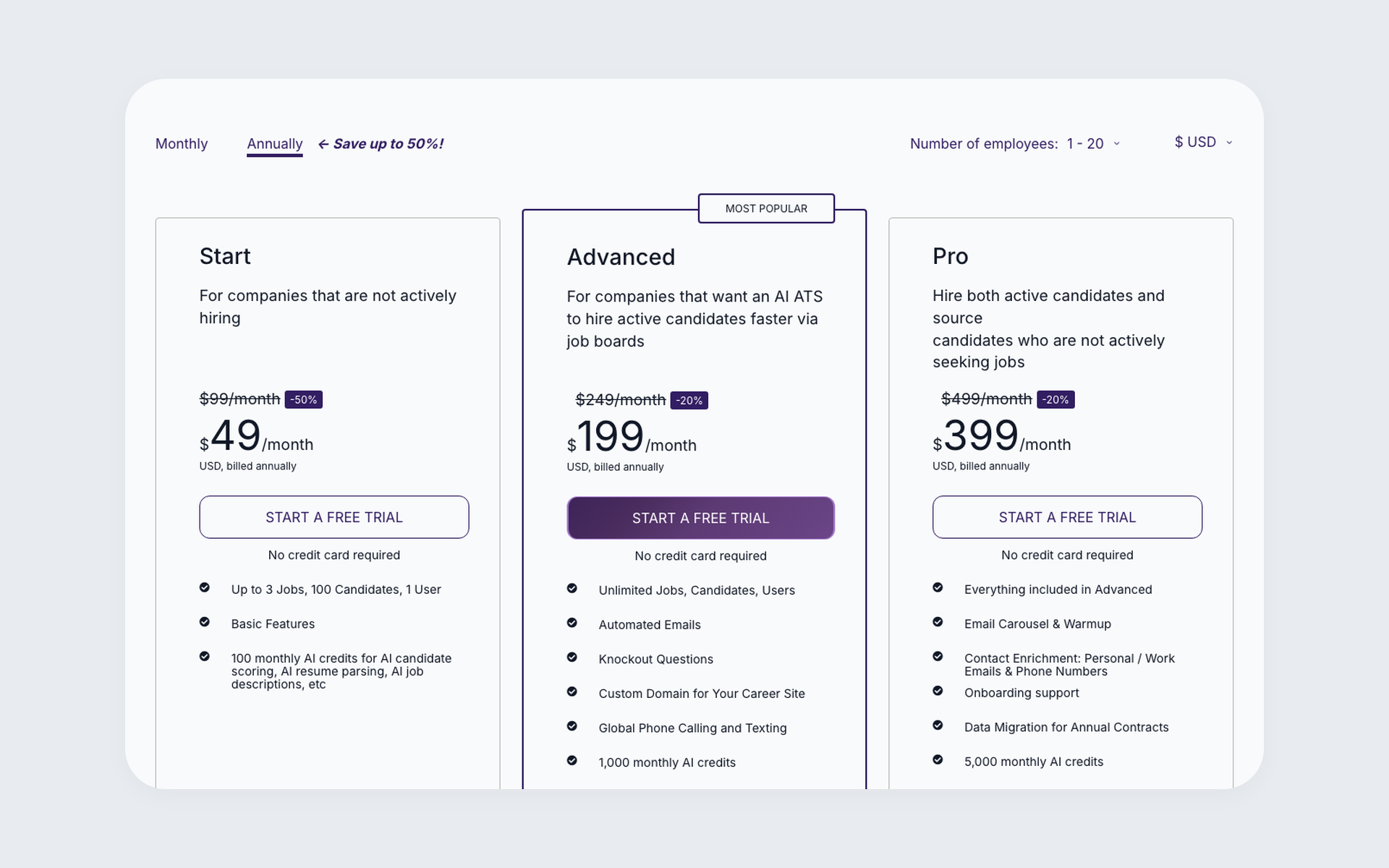
For a public reference point, view 100Hires pricing. Numeric comparisons below use the US USD, 1 to 20 employee selector. The products are not feature-equivalent, and paid ZipRecruiter inventory is not included.
Standard, Premium, Pro, and Enterprise availability
The four plan families do not share one purchase route. That distinction matters when you compare a checkout offer with a sales quote or campaign proposal.
Standard and Premium
Standard and Premium appear as self-serve plan families with trial calls to action. Current retained evidence does not show a universal dollar amount or a complete public entitlement matrix for either plan.
Do not assign Resume Database access, promoted reach, or a fixed slot count from an old comparison page. The selected account offer must show what the chosen family contains.
The support-page result advertises a two-day new-user trial, but it does not assign that offer to Standard or Premium. Save the chosen plan, slot count, post-trial amount, and database terms from checkout.
Pro
Pro is contact-led through live chat, email, or phone. Current plan information lists TrafficBoost for urgent and hard-to-fill jobs, but it does not publish a standalone amount or included quantity.
Request two cost lines in the proposal: recurring hiring capacity and promoted reach. That split lets you measure TrafficBoost or similar spend against qualified applicants rather than raw application volume.
Enterprise
Enterprise is sales-led and supports monthly subscription or pay-for-performance structures. It is not a public Pro price with a larger slot allowance.
Quote inputs can include the number of jobs, job type, location, industry, hiring goals, strategy, budget, and campaign conditions. Each input can change the proposal.
Enterprise material names Sponsored Reach, Resume Database, and ZipRecruiter Apply. No public standalone price was verified for any of them, so request each unit and charge in writing.
How ZipRecruiter job-slot pricing works
A reusable job slot is capacity, not a fee for one permanently assigned vacancy. The key distinction is sequential reuse versus concurrent hiring.
Sequential hiring in one reusable slot
Suppose you post role A, fill it, and close the posting. ZipRecruiter says you can place role B in that slot immediately. The filled job is not locked in place for 30 days.
This can make one slot useful for an employer that hires one role at a time. It does not prove that role A and role B can remain live together in one slot.
Cost per filled job = active-period account cost / filled jobs + per-job add-ons.
The denominator is the number of jobs filled from that paid period. Use the formula only after you obtain the current monthly, slot, or daily rate and identify every recurring add-on.
Continuous replacement and concurrent roles
Now take a team with 25 live roles. It fills eight roles and posts eight replacements at once. The job names change, but the portfolio still contains 25 concurrent openings.
Slot reuse may preserve the same required capacity. The recurring account cost remains active, and database charges, paid reach, or performance fees may return with new postings.
Annual capacity exposure = 12 x recurring account rate + database charges + paid reach + performance charges.
More completed hires can reduce cost per hire without changing the recurring rate. A lower unit cost can reflect better yield, not a lower subscription price.
Track concurrent roles separately from annual fills. Twenty-five open roles and 33 filled roles across a year describe two different parts of the budget.
Pay-per-day and adjustable capacity
ZipRecruiter advertises pay-per-day posting, but the retained public evidence shows no daily dollar amount. Use the rate displayed in the account, not an old third-party figure.
Pay-per-day exposure = active days x current daily rate + add-ons.
Posting count can be adjusted from the account page. Ask how a capacity change affects the current bill and when the first or final paid day begins.
Useful questions include whether billing starts at posting, approval, or activation, and how a cancellation request affects the final billed day. These are offer questions, not universal public rules.
Free trial, renewal, and cancellation conditions
Trial language appears in two forms across current official evidence. The support result gives a duration, but the main product pages do not.
What the current two-day support offer does and does not prove
A current official support search result advertises a two-day trial for new users. Treat that as a current support-page offer, not a universal entitlement for every plan, country, or account.
Main product pages describe a trial without stating a duration. The logged-in offer should control the exact start time, end time, eligibility, selected plan, and post-trial amount.
The retained evidence does not establish a universal card requirement, automatic renewal rule, cancellation cutoff, refund rule, renewal amount, or billing-cycle boundary.
This guide omits old four-day trial claims and third-party conversion terms. A current-looking search result cannot replace the terms presented to your account.
Renewal and cancellation checklist
Capture the offer before publishing a job. Screenshots and saved emails give finance a record that can be checked against the first invoice.
- Trial start and end timestamps, time zone, and eligibility.
- Selected plan, active slots, concurrent-job limit, and currency.
- Billing unit and exact post-trial amount.
- Renewal date, renewal amount, and any rate-change terms.
- Cancellation cutoff, effective date, and proof of submission.
- Refund, credit, add-on, tax, and final-day terms.
The FTC Consumer Advice guide to free trials and auto-renewals recommends checking offer terms and keeping cancellation records.
That guidance is a due-diligence resource. It is not legal advice or proof of any ZipRecruiter policy.
Resume Database and other cost layers
Job-posting capacity and outbound sourcing are separate budget units. A quote that combines them into one total can hide the cost of each database action.
Resume Database access and units
No universal Resume Database price or access limit was verified. The phrase database access does not reveal what an employer can view, save, export, or contact.
Ask whether the quote covers searches, profile views, unlocks, downloads, exports, contact reveals, outreach messages, or a monthly usage cap.
Then ask how unused units expire, when the allowance renews, what an overage costs, and whether one action can consume more than one unit.
Account reports in the research described different view and renewal units. Those anecdotes shape the questions, but none of their dollar amounts is a current public list price.
A useful written manifest has one row per action, its included quantity, reset date, overage rate, and export rights. Without those fields, two database quotes cannot be compared fairly.
TrafficBoost, Sponsored Reach, and ZipRecruiter Apply
| Item | Named availability | Public price | Question to ask |
|---|---|---|---|
| TrafficBoost | Pro material | Not publicly shown | Quantity and trigger |
| Sponsored Reach | Enterprise material | Not publicly shown | Budget and placement unit |
| Resume Database | Enterprise material | Not publicly shown | Access and overage units |
| ZipRecruiter Apply | Enterprise material | Not publicly shown | Campaign and fee basis |
A promoted placement may raise application volume, but a vendor performance claim is not a guarantee. Judge paid reach with cost per qualified applicant and cost per hire.
Cost per qualified applicant = total channel and add-on spend / applicants who meet your stated job criteria.
Cost per hire = total channel and add-on spend / accepted hires attributed to that channel.
Cost by company size and hiring pattern
Employee count can guide the model, but hiring cadence sets the required capacity. The examples below are planning cases, not universal plan recommendations.
Five employees and occasional hiring
A five-person company may open one role, pause after the hire, and reuse capacity later. Active months, active days, and the ability to stop billing can matter more than an annual headline.
The verified 100Hires US USD price shown for 1 to 20 employees applies to this company size. Start may fit up to three jobs, but its 100-candidate and one-user caps still apply.
For ZipRecruiter, compare the current account rate with the expected active period. One reusable slot may suit sequential hiring, subject to the actual offer and any paid-reach needs.
Twenty-five employees and several concurrent roles
A 25-person company might need two to five live roles at once. One reusable ZipRecruiter slot cannot be assumed to cover several simultaneous postings.
Confirm the required concurrent capacity and the cost of changing it. Database access, promotion, and geography can add separate conditions.
For 100Hires, select the live 21 to 50 employee band. Do not reuse the 1 to 20 employee prices shown in this article for a 25-person company.
One hundred employees and continuous hiring
A 100-person employer may keep a steady portfolio of open roles. The budget should name concurrent jobs, expected replacements, database units, paid reach, reporting needs, and campaign fees.
A high annual fill count does not remove the concurrency question. Track the highest number of live roles and the number of times each slot is reused.
For 100Hires, use the live 51 to 100 employee selector. This article does not publish an unverified price for that employee band.
Scenario 1: occasional hiring with 100Hires
This scenario compares budget exposure for an employer with up to three active roles. It does not compare identical inventory or claim that an ATS replaces ZipRecruiter paid reach.
The break-even table
The numeric 100Hires values in this table apply only when the pricing page is set to US USD and 1 to 20 employees. Start includes up to three jobs, 100 candidates, and one user.
| Platform | 2 months | 3 months | 5 months | 6 months | 12 months |
|---|---|---|---|---|---|
| 100Hires Start | $198 | $297 | $495 | $594 monthly or $588 annual | $1,188 monthly or $588 annual |
| ZipRecruiter | 2 x current account rate + add-ons | 3 x current account rate + add-ons | 5 x current account rate + add-ons | 6 x current account rate + add-ons | 12 x current account rate + add-ons |
100Hires Start costs $99 for each monthly-billing month. Its annual option has a $49 monthly equivalent and a $588 derived annual total.
Six monthly payments total $594, so $588 annual billing is $6 lower. Monthly billing costs less through five active months. The crossover arrives at the sixth active month.
For a pay-per-day ZipRecruiter offer, replace the monthly formula with active days x current daily rate + add-ons. No public daily amount was verified.
A company expecting three to five idle months may start with monthly ATS billing. A company hiring across the full year can compare the annual option against its need for flexibility.
What this scenario excludes
The table excludes taxes, a direct ZipRecruiter subscription, paid ZipRecruiter promotion, Resume Database access, and any 100Hires employee-band change.
Start may reach its 100-candidate or one-user cap before the three-job cap. A larger workflow may require Advanced or Pro, changing the comparison.
The 100Hires ZipRecruiter integration may include organic distribution where eligible. Sponsored inventory is separate and paid directly to ZipRecruiter.
You can start a 14-day 100Hires trial without a credit card. The trial stops external-board intake after 10 candidates across the account.
Scenario 2: continuous multi-role hiring with 100Hires
This case models a steady portfolio of live roles. It compares annual ATS exposure with the inputs required for ZipRecruiter, not feature-equivalent products or identical paid inventory.
Annual ATS exposure
The numeric 100Hires values below apply only when the pricing page is set to US USD and 1 to 20 employees. Teams in another employee band must use the corresponding price shown on the pricing page.
| Platform or plan | 12 monthly payments | Annual billing | Public scope | Excluded costs |
|---|---|---|---|---|
| 100Hires Advanced | $2,988 | $2,388 derived total | Unlimited jobs, candidates, users | Paid ZipRecruiter inventory and database |
| 100Hires Pro | $5,988 | $4,788 derived total | Unlimited jobs, candidates, users | Paid ZipRecruiter inventory and database |
| ZipRecruiter | 12 x recurring account rate + charges | Current account offer required | Concurrent capacity must be quoted | Database, reach, and performance charges |
Advanced is $249 with monthly billing or a $199 annual monthly equivalent. Pro is $499 monthly or a $399 annual monthly equivalent.
Advanced annual exposure is $2,988 through 12 monthly payments versus a $2,388 derived annual total. Pro is $5,988 versus $4,788.
Both plans show unlimited jobs, candidates, and users. The choice depends on the needed ATS workflow and sourcing functions, not a claim of parity with ZipRecruiter marketplace inventory.
Replacement cadence and cost per hire
Start with 25 concurrent roles. Eight are filled, closed, and replaced immediately. The team still has 25 live roles, so its capacity need has not fallen.
For ZipRecruiter, model 12 x recurring account rate + database charges + paid reach + performance charges. Put every quoted unit beside the formula.
Divide the full channel spend by the number of qualified applicants for cost per qualified applicant. The denominator should count people who meet the team's stated job criteria.
Divide the same spend by accepted hires attributed to the channel for cost per hire. Keep rejected, withdrawn, and unattributed outcomes out of that denominator.
Applicant volume can vary by role and location. Source-to-qualified-applicant and source-to-hire results give a clearer budget signal than the raw application count.
A better yield can lower cost per hire with no rate change. A higher application count with no accepted hires can move the metric in the opposite direction.
What 100Hires includes, and what it does not
Job boards provide reach. The ATS provides the shared candidate record, source data, and recruiting workflow.
100Hires is an ATS and organic distribution workflow. It is not a replacement for ZipRecruiter's proprietary audience or optional paid marketplace inventory.
The transparent ATS price table
Every numeric value in this table applies only when the pricing page is set to US USD and 1 to 20 employees. Annual totals are derived, and taxes are excluded.
| 100Hires plan | Monthly | Annual equivalent | Derived annual total | Public scope |
|---|---|---|---|---|
| Start | $99 | $49 monthly | $588 | 3 jobs, 100 candidates, 1 user |
| Advanced | $249 | $199 monthly | $2,388 | Unlimited jobs, candidates, users |
| Pro | $499 | $399 monthly | $4,788 | Unlimited jobs, candidates, users |
| Enterprise | Not publicly shown | Not publicly shown | Not publicly shown | Contact 100Hires |
Paid plans include supported-board distribution without a separate per-board surcharge. Current wording from 100Hires conflicts on the board count, so this article does not publish a definitive total.
Start retains its job, candidate, and user caps. Advanced and Pro remove those scope caps, but their prices still depend on the selected employee band and currency.
The 14-day trial needs no credit card. It permits up to 10 candidates received through external job boards across the account during the trial.
100Hires does not bundle TrafficBoost, Sponsored Reach, paid Resume Database access, paid ZipRecruiter inventory, applicant guarantees, board acceptance guarantees, or performance guarantees.
Organic versus sponsored ZipRecruiter inventory
Organic distribution and paid proprietary reach are separate budget lines. The 100Hires ZipRecruiter integration may include a free organic listing by default where eligible.
Sponsored or promoted inventory is optional, configured separately, and paid directly to ZipRecruiter. A direct ZipRecruiter account may still be needed for paid services.
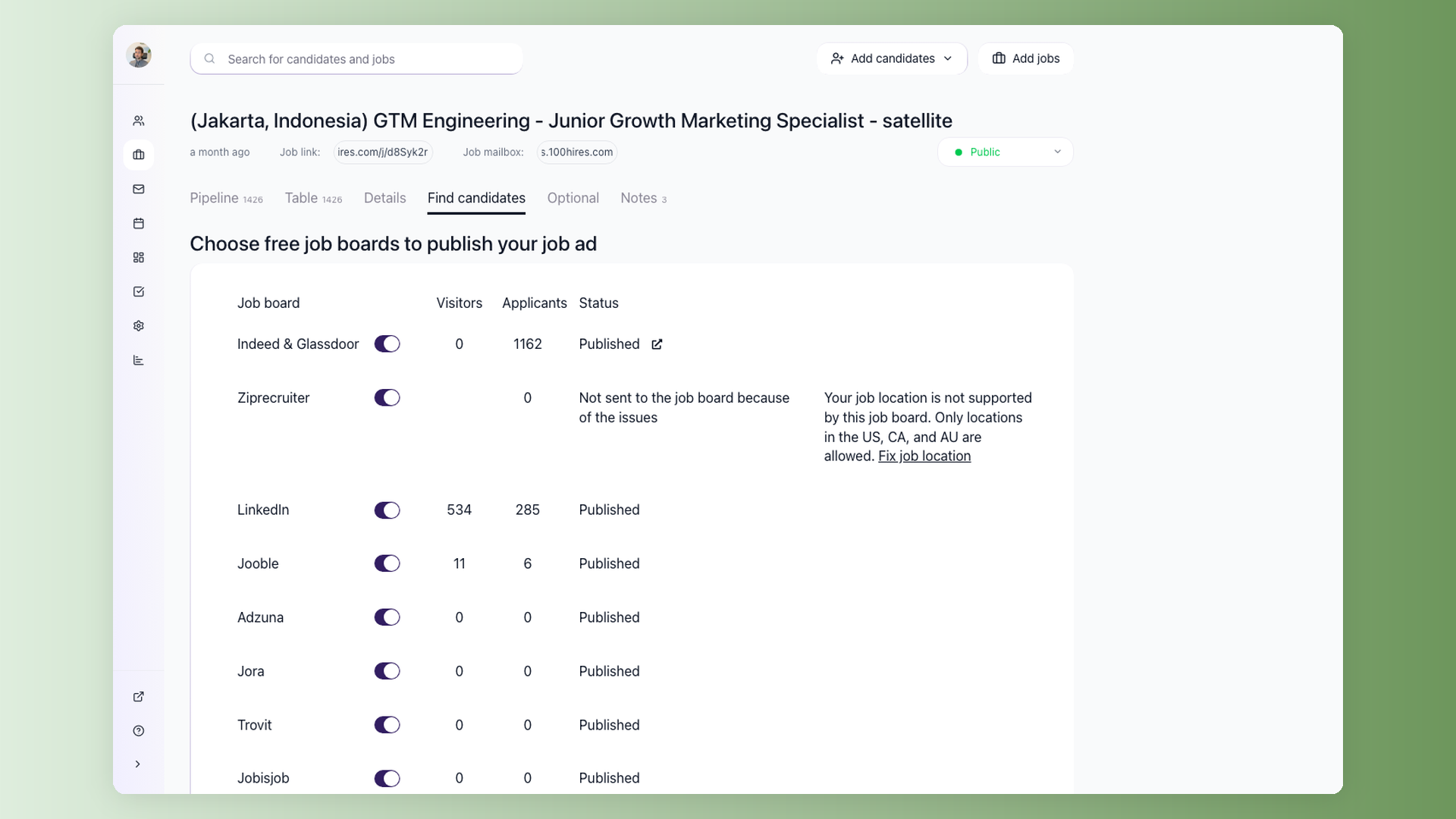
100Hires can keep applications and source results in one ATS. It does not bundle ZipRecruiter Resume Database access or paid reach, and it does not guarantee applicant volume or a hiring outcome.
Questions to ask before accepting a ZipRecruiter quote
A useful quote lets another person reproduce the budget without opening the sales email. Ask the representative to place every rate and usage unit in the proposal.
- What are the exact plan name, price, currency, and billing unit?
- How many slots and concurrent jobs does the price cover?
- What happens to price when capacity rises or falls?
- What are the trial start and end timestamps?
- Does this account offer require a card?
- What post-trial amount appears, and when is it billed?
- What renewal amount and date are written into the offer?
- What cancellation cutoff and effective date apply?
- What refund or account-credit terms apply?
- Which database actions consume a unit?
- What caps, reset dates, export rules, and overages apply?
- What do TrafficBoost, Sponsored Reach, and ZipRecruiter Apply cost?
- Can job type, location, industry, or campaign terms restrict availability?
- Which reports connect spend to qualified applicants and hires?
Save the signed or accepted quote beside the first invoice. Check that the plan, dates, capacity, add-ons, and currency match before building a cost-per-hire report.
Frequently asked questions about ZipRecruiter pricing
How much does ZipRecruiter cost per month?
ZipRecruiter shows no universal monthly employer amount. Its models include subscriptions, slots, pay-per-day posting, and campaigns. 100Hires pricing publishes scoped US USD rates.
How long is the ZipRecruiter free trial?
Current official support advertises two days for new users, but the logged-in offer controls. 100Hires has a 14-day no-card trial capped at 10 external-board candidates across the account.
Does ZipRecruiter charge per job or per slot?
ZipRecruiter offers reusable slots and pay-per-day posting. A filled job can be replaced in its slot, but concurrency needs confirmation. 100Hires Start covers three jobs; Advanced and Pro show unlimited jobs.
Does ZipRecruiter Resume Database access cost extra?
No universal database price or access limit was verified. Ask about views, unlocks, downloads, exports, outreach, caps, renewals, and overages. 100Hires does not bundle paid ZipRecruiter Resume Database access.
Is ZipRecruiter more expensive than Indeed?
There is no universal winner since role, market, and paid settings affect cost. See Indeed vs ZipRecruiter. 100Hires can track both sources but does not replace their paid inventory.
Is 100Hires a ZipRecruiter replacement?
No. 100Hires is an ATS and organic distribution workflow. ZipRecruiter supplies marketplace reach and optional paid inventory, so the products can be complementary without being feature-equivalent.
The bottom line
Do not budget from an old third-party ZipRecruiter range. Obtain the current plan, slot, trial, renewal, database, and paid-reach terms from the account or written quote.
Then compare annual exposure, cost per qualified applicant, and cost per hire. One reusable slot can reduce sequential-hiring cost, but it does not solve a need for several concurrent roles.
Use the live employee selector to view 100Hires pricing, or start the 14-day trial without a credit card. The trial cap and paid-inventory exclusions still apply.
Try 100Hires for free
No credit card. 14-day trial. Forbes Advisor #1 ATS for SMBs.