
Indeed vs LinkedIn for employers: cost, candidate quality, and when to use both in 2026
Indeed and LinkedIn are built for different ways of hiring. Indeed is a job search engine: you post, and active job seekers apply in volume. LinkedIn is a professional network: fewer inbound applicants, better tools for finding people who never applied at all.
So the honest answer to "which is better" is: better for which role, and at what cost per qualified applicant?
That second question got harder over the past 18 months. Both platforms raised effective prices, AI-written applications flooded inboxes, and candidates started distrusting listings on both.
This comparison is written for employers and recruiters who pay those bills, not for job seekers.
Indeed vs LinkedIn at a glance
The hiring playbook, in your inbox
One email a week - benchmarks, AI screening tactics, and short interview templates from the 100Hires team. No product pitches.
Here is the short version before we get into funnel data and pricing mechanics.
| Criteria | Indeed | |
|---|---|---|
| What it is | Job search engine for active seekers | Professional network with a jobs product |
| Reach | 685M job-seeker accounts, 3.5M+ employers (Indeed, 2026) | 1B+ members (LinkedIn's standing claim) |
| Applicant volume | High inbound, fast | Lower inbound, stronger outbound |
| Typical quality pattern | Volume with a heavy screening load | Fewer, more professional applicants for salaried roles |
| Free posting | Up to 3 posts per month, with exclusions (staffing agencies, commission-only) | 1 active free job, auto-pauses at day 14, capped at 10-30 applicants |
| Paid posting | Per click or per started application; Indeed sets a minimum per job | Promoted jobs from roughly $7-10/day |
| Sourcing product | Smart Sourcing, $520/mo or $416/mo billed yearly | LinkedIn Recruiter, no public price |
| Best for | Hourly, local, frontline, high-volume roles | Salaried, professional, and passive candidates |
The two platforms are complements, not substitutes. Most SMB teams end up posting on both and splitting budget by role type, which raises a practical problem: two dashboards, two applicant piles, two bills.
One fix is posting to both boards from a single ATS, so every applicant lands in the same pipeline. More on that later, after the platforms earn their comparison.
Where the candidates are: reach and quality by role type
Raw reach first. Indeed reports 685 million job-seeker accounts worldwide and 3.5 million employers, with 31 hires made every minute (Indeed's About page, 2026). LinkedIn reports over 1 billion members.
Reach numbers flatter both platforms, though. What matters is who actually gets hired from each.
The most useful public dataset comes from Breezy HR's 2025 Source of Hire report, built on 14.2 million applications processed through its platform. It found Indeed produced 76% of hires against LinkedIn's 14%, and 67% of applications against LinkedIn's 22%.
The same report shows movement, though: LinkedIn applications grew 58% year over year. The volume gap is narrowing even as the hires gap stays wide.
The same dataset shows the trade-off inside those totals. LinkedIn applicants got interviewed at a slightly higher rate (2.5% vs 2%), but Indeed converted interviews to offers at 49% vs LinkedIn's 25%, and median time to hire ran 40 days on Indeed vs 61 on LinkedIn.
Practitioner experience splits along role type, and the split is sharp. One agency owner hiring white-collar roles wrote in r/recruiting that 300-400 Indeed applicants yielded one or two worth screening, where LinkedIn gave a 10-15% screen-worthy rate.
Flip the collar color and the result inverts.
An HR coordinator at a 250-person manufacturer described corporate roles filling in 4-6 weeks as welders and CNC operators took 3-4 months: LinkedIn simply has no welders, and Indeed delivers 200 applications with a handful of real ones.
That pattern repeats across the demo calls we run at 100Hires: healthcare, logistics, and local-service teams run Indeed-first, corporate and tech teams run LinkedIn-first, and most mixed teams run both.
Healthcare illustrates the split well. Recruiters filling travel-nurse and frontline clinical roles report Indeed as the workhorse, and the same recruiters switch to LinkedIn the moment the search turns to directors and administrators. Neither platform covers the whole org chart.
One reach detail that surprises many employers: Glassdoor's job feed is Indeed's job feed. Both are owned by Recruit Holdings and operate as one distribution channel, so a post on Indeed already covers Glassdoor. Treating them as two separate line items overstates your reach.
What posting actually costs in 2026
Neither platform sells simple flat-fee postings anymore. Both moved to auction and subscription models, which means list prices tell you little. Cost per qualified applicant is the number to manage.
Indeed pricing: free posts, pay-per-click, and the squeeze
Indeed's free tier still exists: up to three free posts per calendar month posted directly on Indeed, each live up to 30 days, per Indeed's own guide (updated May 2026).
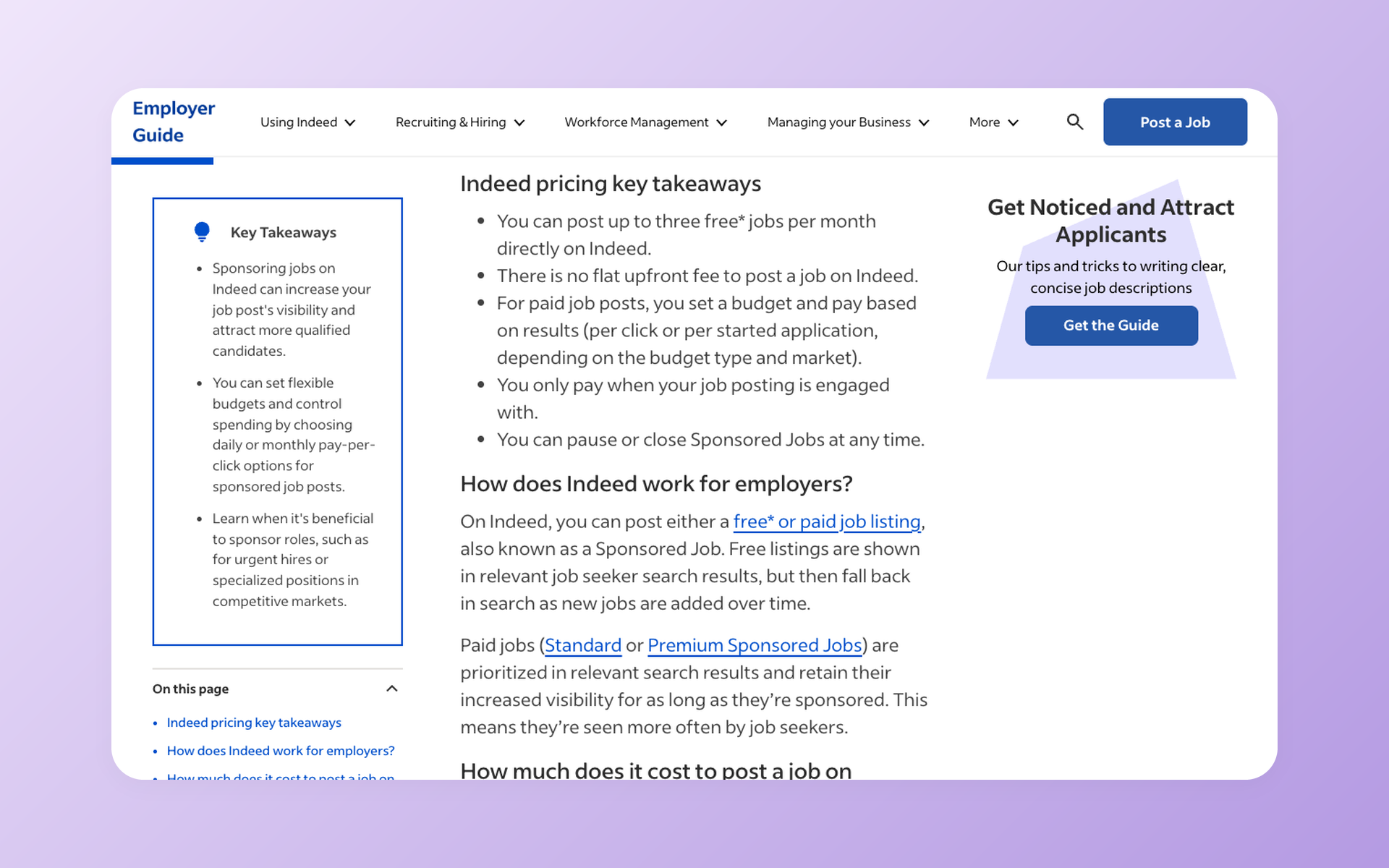
The exclusion list is long, though: staffing agencies, commission-only roles, confidential company names, and repeat identical posts don't qualify.
Sponsored Jobs are results-based: you pay per click, or per started application, against a budget you set. There is no universal $5-a-day minimum; Indeed sets a minimum for each job and shows it when you sponsor.
Indeed dropped its flat pay-per-application model back in December 2023, and secondary pricing guides and practitioner reports put effective costs anywhere from $15 to $50 per application depending on role and metro. Treat that as a reported range, not a list price.
What employers feel in 2026 is the squeeze around that auction.
HR teams in r/humanresources describe a repost rule (no free repost of a role within roughly 4 months) that appears in no published policy, paired with account-manager suggestions of about $500 per month per role in sponsorship.
Budget overruns are the other recurring complaint: recruiters report setting a $500 cap and getting an $800 bill, since daily-budget pacing can spend past the nominal number when traffic is available.
One employer in that thread closed a role after spending over $400 for seven applicants.
Some teams route around the squeeze entirely: they disable board syndication, post on their own careers page, and let Indeed's crawler pick the job up as an organic listing. It works, but you give up the dashboards and the applicant flow becomes harder to track.
Indeed's sourcing side, Smart Sourcing, lists its US Professional plan at $520 a month, or $416 a month billed yearly, for 100 candidate contacts a month; Enterprise is priced on request.
Older guides still quote $120 a month for a Standard tier and $300-$400 for Professional, and recruiters in r/recruiting reported a steep 2026 price increase. Confirm your price in writing.
LinkedIn pricing: a decaying free tier and seat subscriptions
LinkedIn still offers a free job post, but its help pages spell out the limits: one active free job at a time, auto-paused after 14 days, closed at 30, and hidden from search once it collects a free applicant cap that typically runs 10-30 applicants, per LinkedIn's documentation.
Repost the same title within 7 days and promotion becomes mandatory. The marketing pages have quietly stopped advertising a free option at all; current packaging pushes "Hiring Pro" and "Job Slots" with no public prices.
The free post does come with extras now: LinkedIn adds 25 recommended candidate profiles, one top-fit evaluation, and an AI interview preview to every free job, per its help pages. Useful, but none of it lifts the applicant cap.
Promoted jobs run on a daily budget, with reported minimums around $7-10/day and US cost-per-click averages of $1.50-4.50 from secondary trackers. LinkedIn's own claim: 83% of promoted jobs get a qualified candidate within 24 hours (vendor figure, treat accordingly).
The paid recruiter subscriptions are where budgets break. Recruiter Lite runs about $170/month (third-party sources disagree between $120 and $170; LinkedIn publishes no price) for 30 InMails and network-limited search.
Full LinkedIn Recruiter is quote-only: Vendr's procurement benchmark puts typical contracts at $8,000-12,000 per seat per year.
Practitioner reports vary more widely than that: $650/month subscriptions, and a $13,000 single-seat quote shared in r/recruiting, and multi-year enterprise contracts several times higher.
There is no list price, so every figure you see, including these, is somebody's negotiated deal.
One more pattern worth knowing before you sign a jobs contract: recruiters on contract job slots report that they underperform cheaper self-serve ads; one saw 8 applicants from a sponsored slot where a $20/day self-serve budget had pulled 80+ for the same job.
LinkedIn's paid jobs product is weaker than its sourcing product.
Cost per qualified applicant: the only number that matters
Put the two models side by side and the sticker prices stop meaning much. Indeed sells cheap volume that costs you screening hours. LinkedIn sells expensive access with less noise, for salaried roles.
A simple example, not a benchmark: $150 of Indeed spend brings 100 applicants of which 5 survive screening; $300 of LinkedIn promotion brings 20 applicants of which 3 survive. Cost per qualified applicant lands in the same $30-100 zone.
The difference is where you pay: cash on LinkedIn, recruiter hours on Indeed.
Which is why the platform decision matters less than most teams think. The screening stack behind the posting, and the source report that tells you what converted, matter more.
Indeed vs LinkedIn for recruiting: posting or sourcing
If "recruiting" in your search meant actively finding people rather than collecting applications, the comparison inverts.
LinkedIn Recruiter is the default sourcing tool for professional search: unlimited network access, 40+ search filters, 150 InMails a month per seat. Its real competitor is not Indeed's job posts but agency fees.
Recruiters defending the price point put it plainly: against 20% placement fees, a seat pays for itself in a few hires a year.
The complaints are equally consistent: InMail credits burn on non-replies, candidates can't be exported to your ATS, and on our demo calls at 100Hires, a Recruiter renewal price jump is the most common reason a team started shopping at all.
Recruiter Lite gets rougher reviews than the full seat. At about $170/month for 30 InMails and third-degree network limits, recruiters who tried it tend to call it the worst of both worlds: too limited to source seriously, too expensive to keep as a backup.
The budget move practitioners actually recommend, in threads and on YouTube alike, is Sales Navigator at $99/month: 40+ filters, unlimited search, 50 InMail credits.
It is a sales tool wearing a recruiting hat, but for occasional sourcing it covers most of what Lite promises for less.
Indeed's sourcing answer is Smart Sourcing, with 370M+ searchable profiles by Indeed's count. The catch: you contact candidates only through Indeed's own messaging, with no emails or phone numbers revealed, and ATS sync is reserved for higher tiers.
Then there is the change both platforms made quietly: free and organic posting for staffing agencies is effectively over.
Indeed's free-post rules exclude recruitment-based companies outright, and LinkedIn's Basic Jobs policy bars search and staffing firms and restricts third-party ATS listings, per Microsoft's policy documentation (updated December 2025).
If you run an agency, both platforms are pay-to-play now. Few comparison guides mention it, and it changes the budget math for many staffing and agency teams.
For everyone else, the practical split: posting strategy and sourcing strategy are separate line items. Post on both platforms for inbound coverage; buy sourcing (a Recruiter seat, Smart Sourcing contacts) only for the roles where inbound genuinely fails.
A question we hear on 100Hires demo calls almost weekly: does posting through an ATS require, or replace, a LinkedIn Recruiter seat? Neither. ATS distribution uses LinkedIn's free listing tier and needs no subscription, and it does not grant Recruiter's search or InMail.
They are separate purchases for separate jobs.
What changed recently: ghost jobs, AI applications, and trust
Three shifts since 2024 changed what these platforms deliver, and none of them show up on a pricing page.
First, ghost jobs damaged candidate trust on both platforms. Greenhouse's 2024 State of Job Hunting report classified 18-22% of jobs posted on its own platform as ghost jobs, roughly 1 in 5, and forum threads keep pointing at stale, reposted listings on the biggest boards.
Candidates responded rationally: many now use Indeed and LinkedIn for discovery, then apply on company career sites directly.
Second, AI-written applications flooded the top of every funnel. Tech recruiters in r/recruiting describe remote roles pulling 500 applications in a week, half or more of them misrepresented or outright fake. Applicant volume stopped being a proxy for choice.
The concentration is brutal for popular roles: a visible white-collar posting can fill its pipeline within the first day. The operational problem is triage, not reach.
Third, the platforms responded in ways that raise employer costs: Indeed with repost policing and sponsorship pressure, LinkedIn with free-tier decay and required promotion. You pay more to stand out in a noisier pool.
The workflow gap between the two got more visible too. Indeed can send an automatic rejection when you decline an application. LinkedIn has no bulk rejection option at all; one employer described manually closing out 250 LinkedIn applicants one by one.
Add it up and the buying question has changed. It is less "which board has more applicants" and more "which tools filter, screen, and track sources well enough that the noise doesn't eat your week."
Which should you choose: a decision framework
The short rules, based on the funnel data and practitioner patterns above.
- Choose Indeed first for hourly, local, frontline, trades, and high-volume roles, or when you need applicants this week (40-day median time to hire vs 61 in Breezy HR's dataset).
- Choose LinkedIn first for salaried, professional, and executive roles, when employer brand matters, or when the best candidates aren't applying anywhere and you will actually work outbound.
- Run both if your roles are mixed. A 70/30 budget split favoring Indeed matches the funnel data for volume hiring; invert it for professional search.
- Pause both for a single hard specialist role. Referrals, niche boards, and direct sourcing beat ads for those, a point recruiters make constantly in the threads linked above.
Weighing ZipRecruiter as a third option? We compared it with Indeed separately in our Indeed vs ZipRecruiter breakdown.
One habit separates teams that make this work from teams that waste budget: they check results by source monthly. They ask which board produced interviews, which produced hires, and what each cost. The split is an output of that report, not a preference.
Run Indeed and LinkedIn from one pipeline with 100Hires
Full disclosure: 100Hires is our product, so read this section as the vendor's view. It exists in this article for one reason: everything above ends at the same place. Two platforms, two applicant piles, and a screening problem.
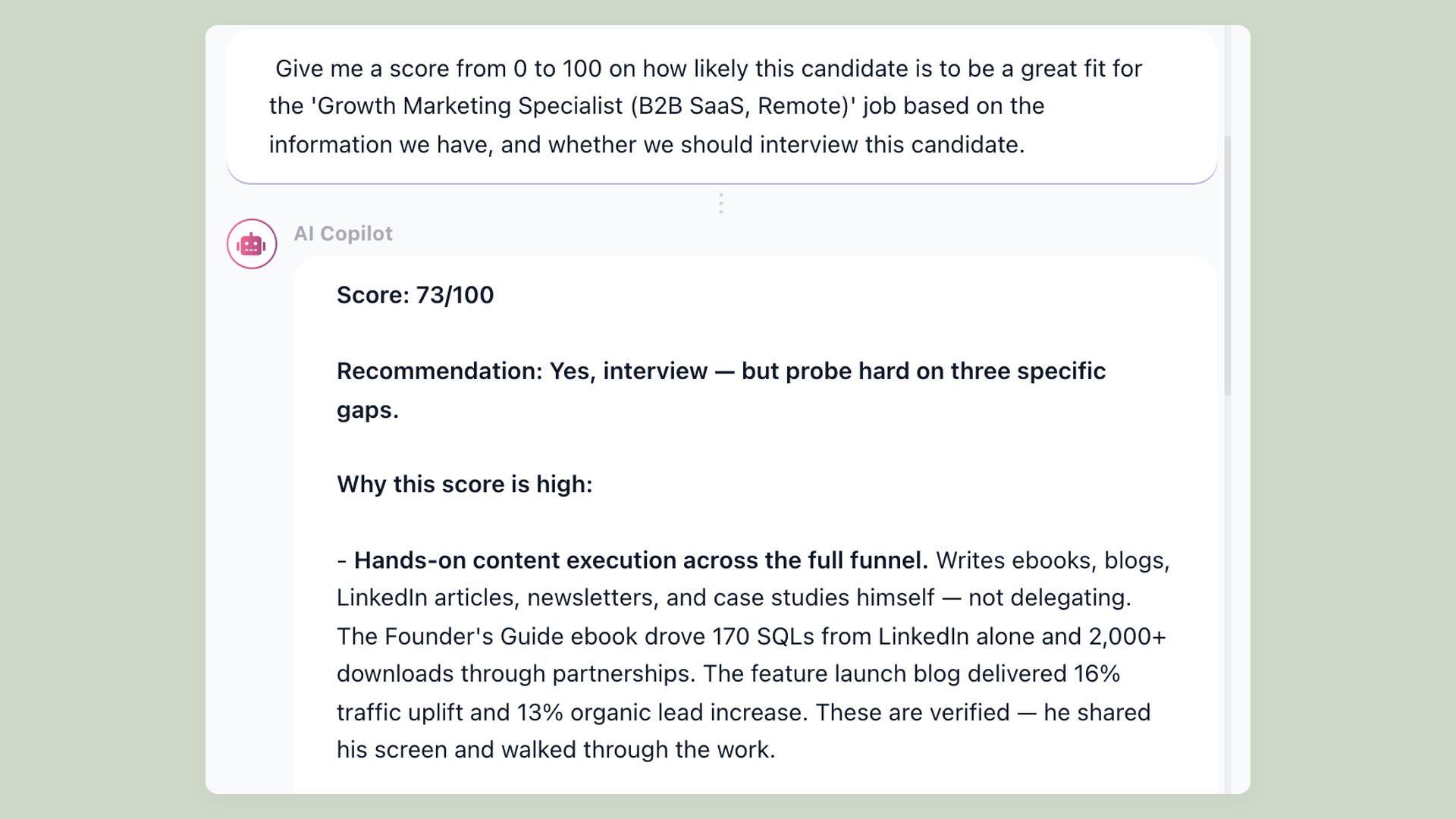
The screening problem is where an ATS earns its keep. In 100Hires, AI Score reads every application against your job description and returns a 0-100 score with written reasoning, so the 400-applicant Indeed pile arrives pre-ranked instead of in chronological order.
Knockout questions catch the dishonest answers recruiters complain about before a human reads anything.
The second half is attribution. Source reporting shows applicants, interviews, and hires per board, so you learn whether Indeed or LinkedIn actually produced your last three hires and shift budget accordingly.
Staffing-tech practitioners keep making the same point on LinkedIn: most firms know their board spend, but almost none know which board converts.
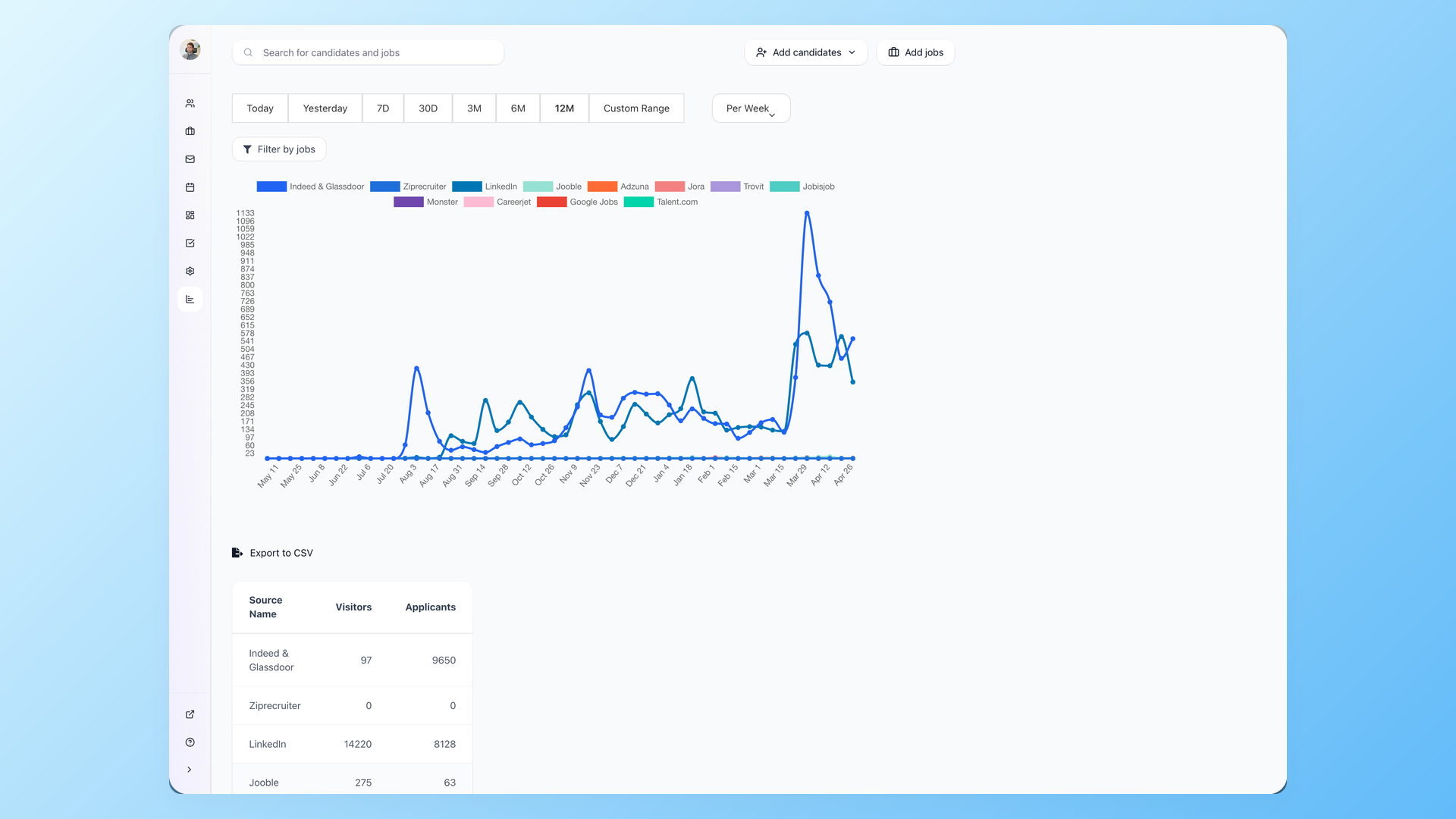
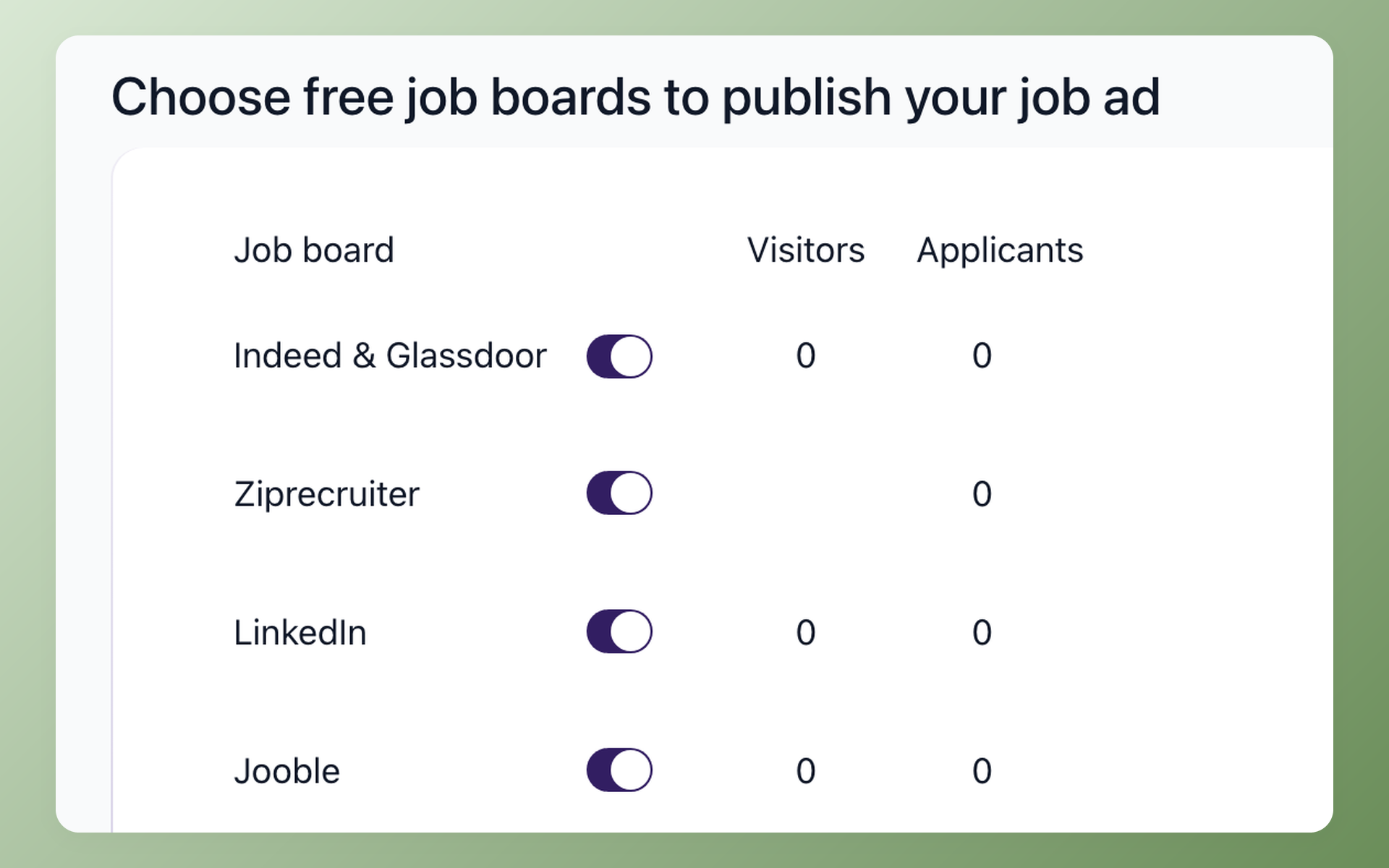
Distribution is the part you would expect: one job form publishes the role to Indeed and LinkedIn plus 11 more boards, 13 in total, with per-job toggles for each board.
How each connection works is on the Indeed integration and LinkedIn job board pages, and trackable links cover any channel beyond those.
Jeff Roberts, who runs the one-person legal staffing agency L&W Recruiting, moved his posting into 100Hires and retired a roughly $10K/year LinkedIn Recruiter contract.
In his words: "The influx of resumes coming in, and the way my jobs are present on Indeed and LinkedIn, is massive."
What 100Hires does not do, so you can calibrate: it does not replace LinkedIn Recruiter's InMail sourcing. If your team lives on outbound, keep the seat and let the ATS handle posting and pipeline.
LinkedIn distribution uses LinkedIn's free listing tier, which appears in search rather than being promoted in the feed, and LinkedIn policy keeps that tier closed to staffing agencies.
On the credibility side, Forbes Advisor lists 100Hires as its best ATS pick for startups and small businesses, and Capterra awarded it Best Value and Best Ease of Use badges.
There is no free plan: paid plans start at $49 per month on annual billing, with a 14-day trial to test the workflow against your real roles.
FAQ
Do employers prefer Indeed or LinkedIn?
Most employers use both, with the mix weighted by role type. Breezy HR's 2025 Source of Hire report (14.2 million applications) found Indeed produced 76% of hires overall; professional and salaried roles skew toward LinkedIn, and hourly and local roles skew heavily toward Indeed. Teams that post on both often do it through one ATS such as 100Hires to keep a single pipeline.
What are the disadvantages of Indeed for employers?
The main ones in 2026: large volumes of unqualified or AI-generated applications, rising sponsorship pressure (recruiters report roughly $500/month per role suggestions and budget overruns), and repost restrictions on free listings. Screening tools offset the volume problem; knockout questions and AI Score in 100Hires are one way teams filter Indeed applicants automatically.
What is the downside of LinkedIn for employers?
Three stand out: the free tier decays fast (one active job, paused at 14 days, capped around 10-30 applicants), Recruiter pricing is quote-only and frequently rises at renewal, and hourly or trade roles get little response. For the posting side, 100Hires publishes jobs to LinkedIn's free listing tier automatically, which covers search visibility without a seat.
Is LinkedIn Recruiter worth the price?
For teams hiring salaried professionals continuously, it usually is: against 20% agency fees, a seat that costs $8,000-12,000 a year (Vendr's 2026 procurement data) pays for itself in a few hires. For teams that only post jobs and review applicants, it usually is not. 100Hires handles that posting side; it does not replace InMail sourcing, so the two are complementary rather than competing.
Can you post to Indeed and LinkedIn at the same time without paying each platform separately?
Yes. A multiposting ATS publishes one job to both platforms' free organic tiers at once; 100Hires covers Indeed, LinkedIn, and 11 other boards, 13 in total. Sponsorship stays optional: if you add a paid Indeed or LinkedIn budget, the platform bills you directly and the applicants still land in the same pipeline.
Who are Indeed's and LinkedIn's biggest competitors for employers?
For job posting: ZipRecruiter, Google for Jobs (an aggregator, not a board you post to directly), and niche boards like Dice or Wellfound for tech. Monster and CareerBuilder have faded; both went through bankruptcy proceedings in 2025. For sourcing, LinkedIn Recruiter's main alternatives are Indeed Smart Sourcing and specialized tools. An ATS like 100Hires is not a competitor to any of them; it distributes one posting across 13 boards and manages the combined pipeline.
The bottom line
Indeed is the volume engine: fastest applicant flow, best for hourly and local hiring, with screening load and sponsorship pressure as the price.
LinkedIn is the professional network: stronger for salaried roles and the only serious outbound sourcing tool, with a decaying free tier and opaque pricing.
Once you count screening hours, their costs per qualified applicant converge. So run both where your roles justify it, and put the real effort into what happens after the click.
If the work after the click is the bottleneck, start a 14-day 100Hires trial to test the workflow against your real roles, or book a demo and we will walk through your funnel math together.
Try 100Hires for free
No credit card. 14-day trial. Forbes Advisor #1 ATS for SMBs.