
Collaborative hiring: how to build a team-based process that actually decides
The hard part of collaborative hiring is the silence after the interview, when the panel has opinions but nobody will commit.
Collaborative hiring is a structured, team-based way to source and assess candidates, built on shared criteria and clear decision rights. This guide explains the roles and debrief rules, lays out an eight-step process, and compares the tools you can use for your next hire.
The cost of getting it wrong is real. In a Fierce, Inc. survey, 86% of employees and executives blamed a lack of collaboration or poor communication for failures at work.
Hiring is where that shows up first. A strong candidate waits a week for feedback that four people already carry in their heads.
Key takeaways
The hiring playbook, in your inbox
One email a week - benchmarks, AI screening tactics, and short interview templates from the 100Hires team. No product pitches.
- Collaborative hiring means shared sourcing and assessment across the funnel, not just more people in the interview room.
- The aim is faster, documented decisions and a more consistent candidate experience. A structured process makes both possible.
- It depends on feedback that is fast, independent, and written down.
- The usual failure modes are slow feedback, gut-feel debriefs, and too many interview rounds.
- Tools handle the reminders and the blind scoring. They do not make the judgment for you.
What is collaborative hiring?
Collaborative hiring is a team-based approach to sourcing and assessing candidates, where a defined group shares the criteria, splits the evaluation, and agrees who owns the final call. You will also see it called collaborative recruitment or team-based hiring. Same idea.
Here is the part people get wrong. It is not "add more interviewers."
A TA manager at ao.com admitted on a recruiting webinar that he first assumed the term just meant more people in the room, then realised it runs across the whole funnel, from sourcing to the decision.
Adding more voices without shared criteria creates a slower version of the same guesswork.
It is not hiring by committee either, where everyone votes on everything and no one is accountable. Collaborative hiring gives each person a lane and names a decision owner. Structure is the difference between a team that decides and a team that stalls.
One vocabulary note. Recruiters rarely say "collaborative hiring" out loud. They say hiring team, panel, debrief, and scorecard, and those are the words you will see through the rest of this guide.
Collaborative hiring vs traditional hiring
Most glossary pages describe the idea and stop. The value is in the contrast, so here is what changes when a team owns the process instead of one manager.
| Criterion | Collaborative hiring | Traditional hiring |
|---|---|---|
| Who owns the decision | One named owner, informed by the team | One manager, working mostly alone |
| How feedback flows | Written and structured, into one shared record | Verbal, scattered across inboxes |
| Decision rule | Agreed before interviews start | Improvised after the fact |
| Speed | Can move faster with named deadlines | Stalls when one person goes quiet |
| Bias controls | Shared criteria and independent scoring | Criteria may stay informal or undocumented |
| Candidate experience | More consistent, quicker closeout | Uneven, prone to silence |
One honest caveat. Structure is not a free win. On the Recruiting Future podcast, Theo Smith noted that rigid scoring can penalise neurodivergent candidates when a panel over-indexes on a narrow rubric.
The fix is to make your criteria measure the job, not conformity to how the current team behaves.
What the evidence actually says about collaborative hiring
Plenty of pages claim team hiring "reduces bias" and cite nothing. So let us use numbers that come with a name attached.
According to Talent Board candidate-experience research, only about two thirds of employers run a structured interview process. The bar is lower than most teams assume, so a real process is a genuine edge.
The same 2024 research, drawn from more than 230,000 candidate responses, ties feedback to referrals. When finalists received specific feedback, their willingness to refer others rose by more than 50%.
Good process is not just internal hygiene. It shapes how people talk about you afterwards.
There is a quieter benefit too. The ao.com webinar argued that a manager left alone tends to hire in their own image, so the team drifts toward one type of person.
The framing there was values fit, not copy fit. A panel with distinct lanes catches what one person's instinct misses.
Say the honest thing about bias, though. A structured process contains it, it does not erase it. As one engineer put it on r/ExperiencedDevs, the realistic goal is awareness, not a cure. Treat collaboration as a way to catch bias, not a certificate that says you are free of it.
Who does what on a hiring team
"Who makes the final decision?" is the question that quietly sinks most collaborative processes. Answer it before you start.
| Role | What they own | Typical 100Hires role |
|---|---|---|
| Hiring manager | The final yes or no, and the role's real requirements | Usually Administrator or Recruiter |
| Recruiter | Structures the process, runs the panel, can flag red flags | Recruiter, scoped to assigned jobs |
| Interviewer | Assesses one competency lane and scores it | Interviewer, added to the job's hiring team |
The consensus among recruiters on r/recruiting is clear. The hiring manager decides, and the recruiter structures feedback and blocks a hire when there is a real red flag, rather than overruling the manager on taste.
Give each interviewer a single competency to assess so no two interviewers cover the same ground and no one votes on everything.
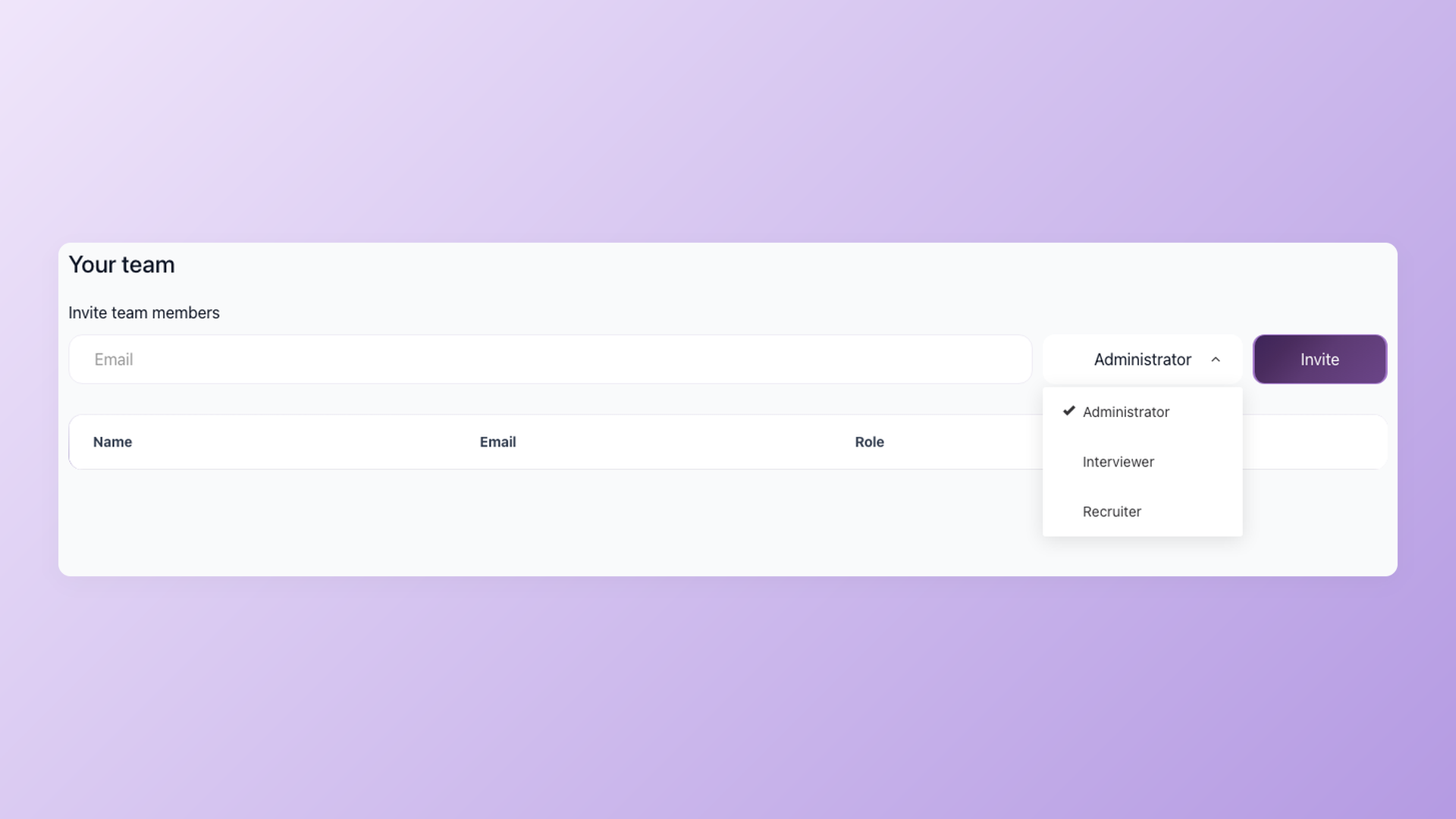
100Hires maps this to three roles: Administrator, Recruiter, and Interviewer. Membership is set per job, so a panelist added to a job's hiring team sees that job and its candidates, and nothing else.
These roles let everyone involved give input while keeping a single source of truth about where each candidate stands.
One limitation worth knowing: the Interviewer role cannot open the Messages tab on a candidate profile. Panelists can score, but they will not see the recruiter's email thread with the candidate.
How to build a collaborative hiring process
Here is a process you can set up for your next role. Eight steps, each one small enough to actually do.
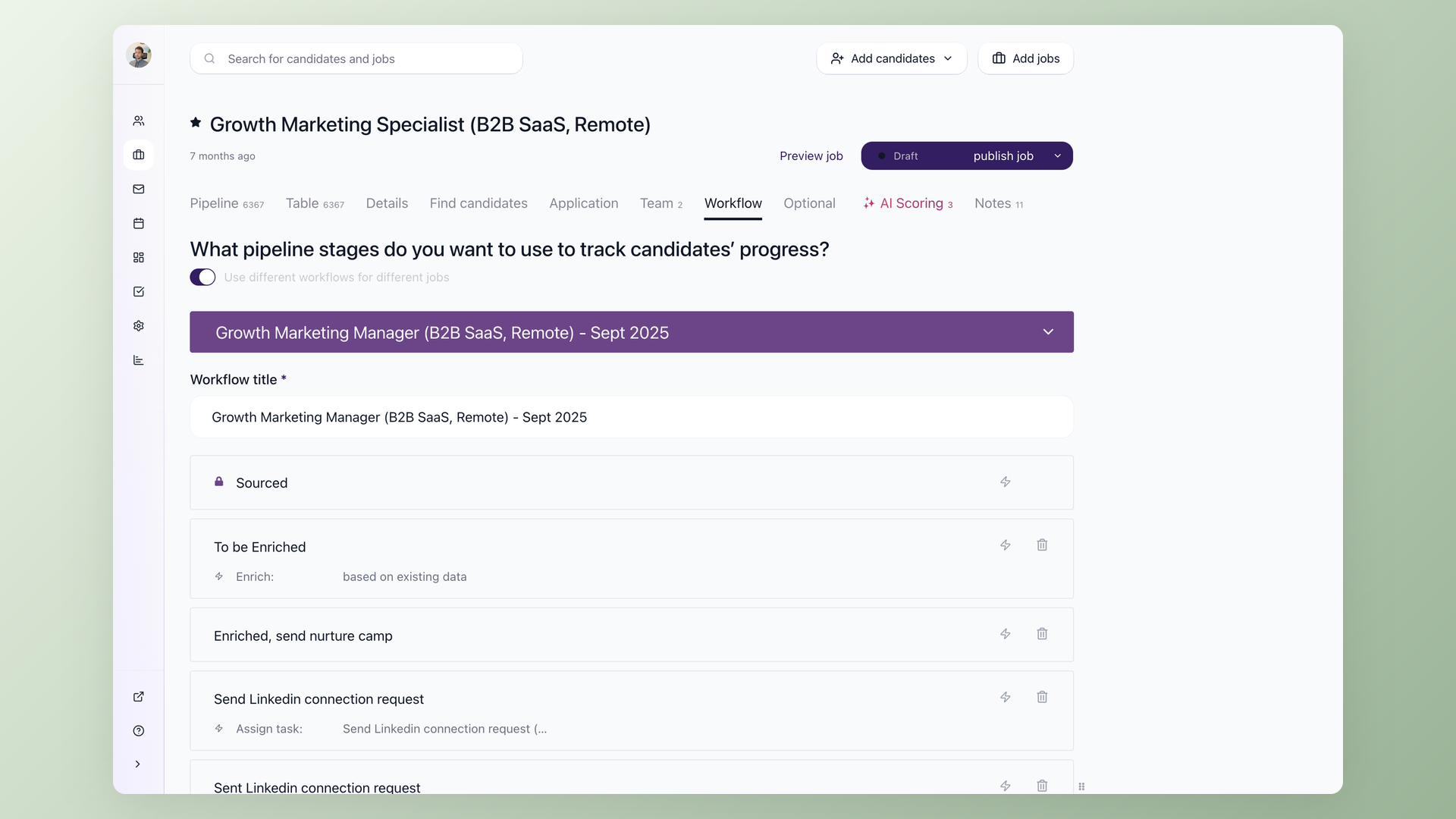
Step 1: Re-validate the role before you post
Before anyone writes a job ad, get the people who work most closely with the role to agree on what it needs now. On the Talent Acquisition in the Trenches podcast, a CPO argued the outgoing person, their close peers, and leadership should all weigh in.
That stops you copying last year's description and asking for undefined "attention to detail," a phrase Theo Smith found in roughly 85% of the 100 graduate ads he reviewed. Our guide on how to hire employees covers the wider setup.
Step 2: Assemble a small team and assign lanes
Keep the panel small. A talent leader on LinkedIn tied a lean panel directly to closing the hire in under two weeks.
Then give each interviewer a distinct lane. An Iterable VP described a four-person panel where each person covers three competencies plus one company value.
When a whole team disagreed with a hiring manager's pick, the ao.com team resolved it by defining what each person was responsible for assessing, rather than letting everyone score everything.
Step 3: Agree on criteria and build one evaluation form
Everyone should rate the same things. A recruiter juggling 8 to 12 open roles shared a fix on r/recruiting: force one universal template across all roles, then customise only the three or four role-specific questions.
In 100Hires, this is an interview scorecard built as an Evaluation Form with custom questions for consistent interviewing. Design the template once and reuse it.
Step 4: Calibrate interviewers and keep criteria job-related
Before interviews start, agree on what a 3 looks like versus a 5. Scripps Health went as far as making a short hiring course mandatory for new managers. Calibration stops a process that looks structured on paper from staying driven by gut feeling in practice.
Keep the criteria job-related and apply them consistently. EEOC guidance makes employers responsible for the outcomes of their selection process, so avoid protected-class questions and provide required accommodations.
A structured process and a tool like 100Hires help you stay consistent. Neither one makes an employer compliant or prevents discrimination on its own.
Step 5: Score independently, right after the interview
Each interviewer submits a written score before any group discussion, while the interview is fresh. A talent leader noted that panelists remember the beginning and end of an interview, and the middle fades within hours.
Getting scores in first keeps the debrief honest instead of anchored to whoever speaks loudest.
Step 6: Debrief the same day
Debrief within hours, not days. A common working fix on r/recruiting is a pre-scheduled 15-minute debrief right after the last interview of the round, capturing feedback on the spot.
Independent scores go in first, then the group talks. The next section explains how to run a debrief without letting the first opinion anchor the discussion.
Step 7: Decide with a pre-agreed rule
Agree the decision rule before interviews, not after. Take a candidate who does not solve the hard problem but shows strong reasoning.
On r/ExperiencedDevs, two highly upvoted comments reached opposite conclusions. One said that is a fine result. The other said that if someone else solved it, the candidate belongs on the reject pile. Neither is wrong.
The mistake is waiting until you are looking at a real candidate to decide which rule to follow. Name one accountable owner, usually the hiring manager, and skip the fantasy of full consensus, which the ao.com team called rare and aspirational.
Step 8: Close the loop fast and measure it
Set a written feedback deadline. A target of 24 to 48 hours is one practitioner example, and Scripps Health runs a 10-day manager response window with an escalation ladder when someone goes quiet.
Or automate the chase. 100Hires emails interviewers a daily reminder until they submit the evaluation form, so the recruiter does not have to follow up manually. Close the loop with candidates quickly too, since a slow, silent process is a common reason good ones drop out.
Track a few simple numbers as you go: feedback turnaround, form completion, round count, and candidate withdrawals.
Worked example: one panel from kickoff to decision
Say you are hiring a support lead. You re-validate the role with the current team, pull together three interviewers with clear lanes, and build one evaluation form.
Each person scores independently right after their interview. The team debriefs the same afternoon, and a pre-agreed rule settles any split decision. The difference between doing that over email and doing it in a shared system is stark.
| Task | Manual (email and spreadsheets) | In 100Hires |
|---|---|---|
| Shared criteria | A doc someone forgets to send | One reusable Evaluation Form |
| Collecting scores | Replies buried in inboxes | Evaluation Forms on the candidate profile |
| Chasing feedback | Recruiter sends manual follow-ups | Daily reminder emails until it is in |
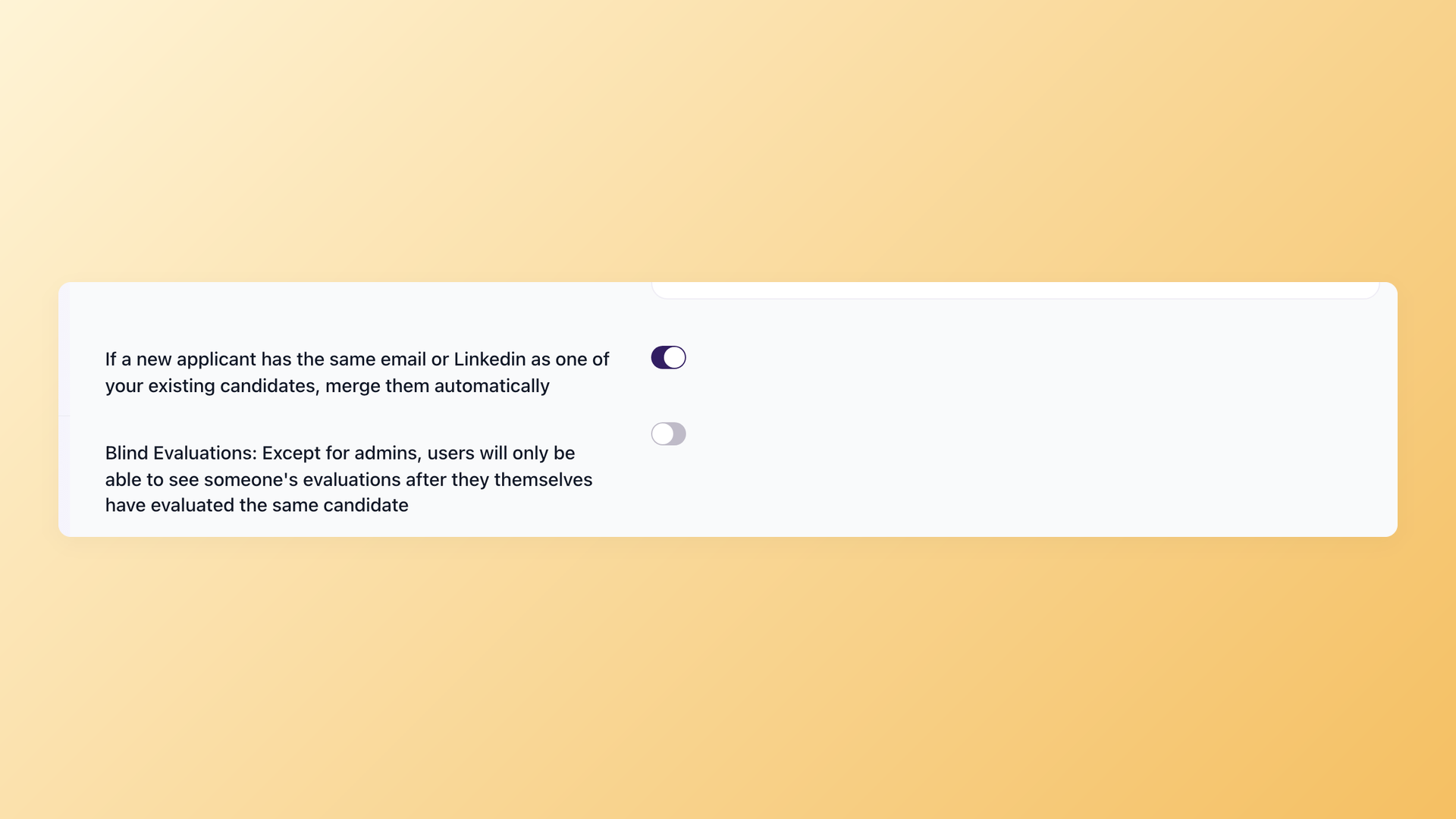
| Keeping scores unbiased | Whoever replies first anchors the rest | Blind Evaluations hide scores until you submit |
| Final decision record | Scattered, hard to reconstruct | Submitted forms and Discussion notes on the profile |
Recruiters describe the manual version constantly. One told us she emails resumes one at a time, so the hiring manager can only review what she sends unless she is sitting next to them.
Another said everything lived in email and spreadsheets, with no clean way to share a candidate or keep notes private. When a hiring team shares one system for notes, feedback, and decisions, the way they manage the hire starts to mirror how they will work together afterwards.
How to run a debrief that does not anchor
Anchoring is the quiet risk in team hiring. The first confident opinion sets the tone, and doubt spreads faster than agreement. Two habits handle most of it.
First, independent written scores go in before anyone speaks. Second, run the debrief within a few hours while impressions are fresh. Get those two right and the discussion starts from evidence instead of from the loudest voice.
Then there is blind scoring. A recruiter on r/recruiting described exactly the feature they wanted: interviewers who can score against shared criteria without seeing each other's scores first, to keep bias out.
That is an industry pattern now, and several ATS platforms offer some version of staggered visibility.
100Hires offers it through Blind Evaluations, a company setting that hides other people's scores until you submit your own. One honest caveat: administrators are exempt by design, so if you need leadership to score blind as well, this toggle alone will not cover them.
For the candidate side of a debrief, a Loxo podcast suggested a useful trick. Check in with the candidate before you talk to the hiring manager, so you catch a perception gap early rather than after the decision.
Common collaborative hiring mistakes
Most of these come straight from recruiters, hiring managers, and candidates describing what went wrong.
- No decision rule. The team never agreed how to handle a split, so it deadlocks and the candidate waits.
- Too many rounds. In a 99-comment Reddit discussion, several candidates treated two or three interviews as their limit and read four or more as a warning sign. Photobook Worldwide reported running four to six rounds before shortening its process, citing reduced candidate motivation.
- Structured in name only. A form exists, but the scores are still based on gut feeling because nobody calibrated what the numbers mean.
- Feedback black holes. The hiring manager pushes for speed, then goes quiet when it is their turn to submit, and the recruiter absorbs the blame.
- Hidden approval rounds. A surprise budget or leadership sign-off appears late and blindsides a candidate who thought they were done.
- Consensus as the goal. Waiting for everyone to feel great is aspirational, not a workable rule. Assign the decision instead.
Tools that support collaborative hiring
Many teams still run team hiring on spreadsheets and a shared document, which is exactly where feedback gets lost. Purpose-built tools make it easier to collect and track that feedback.
100Hires appears first here because its features support the process above: shared Evaluation Forms, Blind Evaluations, and Discussion-note @mentions that send an email with a direct candidate link.
Reminder emails chase interviewers daily until the form is in. You can see how the pieces fit together on the collaborative hiring software page.
| Tool | Collaboration mechanic | Best-fit team | Limitation or evidence gap | G2 rating |
|---|---|---|---|---|
| 100Hires | Evaluation Forms, Blind Evaluations, Discussion-note @mentions, reminders | Lean direct-employer teams | Blind Evaluations exclude admins; Interviewers cannot see Messages | 4.8 (1,354) |
| Greenhouse | Scorecards and structured interview kits | Larger structured orgs | Cost scales up for big teams | 4.4 (3,951) |
| Workable | Interview kits and evaluations on all plans | SMB to mid-market | No specific collaboration gap found in this research | 4.4 (705) |
| Recruitee | Collaboration-first configurable workflows | Collaboration-focused SMBs | Pricing not public, annual contract minimum | 4.5 (450) |
| Homerun | Simple shared team hiring and feedback | Very small teams | Lighter depth as teams scale | 4.4 (159) |
Two more are worth naming, though this research could not fully rate them. Ashby offers Candidate Reviews on its entry Foundations tier. Lever supports feedback sharing, though its collaboration docs were not directly verifiable here.
One pattern across the market: collaboration features are not always locked behind top tiers. Workable includes them on all plans and Ashby on its entry tier. That is not universal, so check with each vendor rather than assuming.
100Hires publishes its ratings openly: 4.8 on G2 from 1,354 reviews and 4.9 on Capterra from 1,166 reviews. To test the workflow rather than read about it, try 100Hires free and set up one evaluation form.
Frequently asked questions
What is collaborative hiring?
Collaborative hiring is a team-based approach where a defined group shares the criteria, splits the evaluation across interviewers, and agrees who owns the final decision. In practice, tools like 100Hires support it with shared Evaluation Forms and role-based hiring teams so everyone assesses the same things.
What is collaborative recruitment?
Collaborative recruitment is another term for the same approach, sometimes used to stress the sourcing side and not just interviewing. The mechanics are the same, and 100Hires supports the interviewing side with shared Evaluation Forms and role-based hiring teams.
How many interviewers should be involved?
There is no fixed number. Many teams keep the panel small and give each person a distinct competency lane, which is an operating choice rather than a rule. 100Hires lets you add interviewers to a specific job's hiring team so each one sees only what they need.
Should interviewers see each other's feedback before submitting?
Many teams withhold it to reduce anchoring, so the first opinion does not sway the rest. 100Hires supports this with Blind Evaluations, which hide other scores until you submit your own, though administrators are exempt by design.
Who makes the final hiring decision?
Name one accountable owner, most often the hiring manager, while the recruiter structures feedback and can flag red flags. 100Hires reflects this with Administrator, Recruiter, and Interviewer roles so responsibilities stay clear.
How long should hiring-team feedback take?
Set a written deadline that fits your team, such as 24 to 48 hours, and hold people to it. 100Hires sends interviewers a daily reminder email until the evaluation form is submitted, so feedback does not stall for days.
Collaborative hiring is a process problem before it is a tooling problem. Get the roles, the criteria, and the decision rule right, and software keeps the record and the follow-ups organised.
Explore the 100Hires team hiring workflow, then try it on your next role.
Try 100Hires for free
No credit card. 14-day trial. Forbes Advisor #1 ATS for SMBs.