
ATS vs Email Recruiting: Which System? | 100Hires
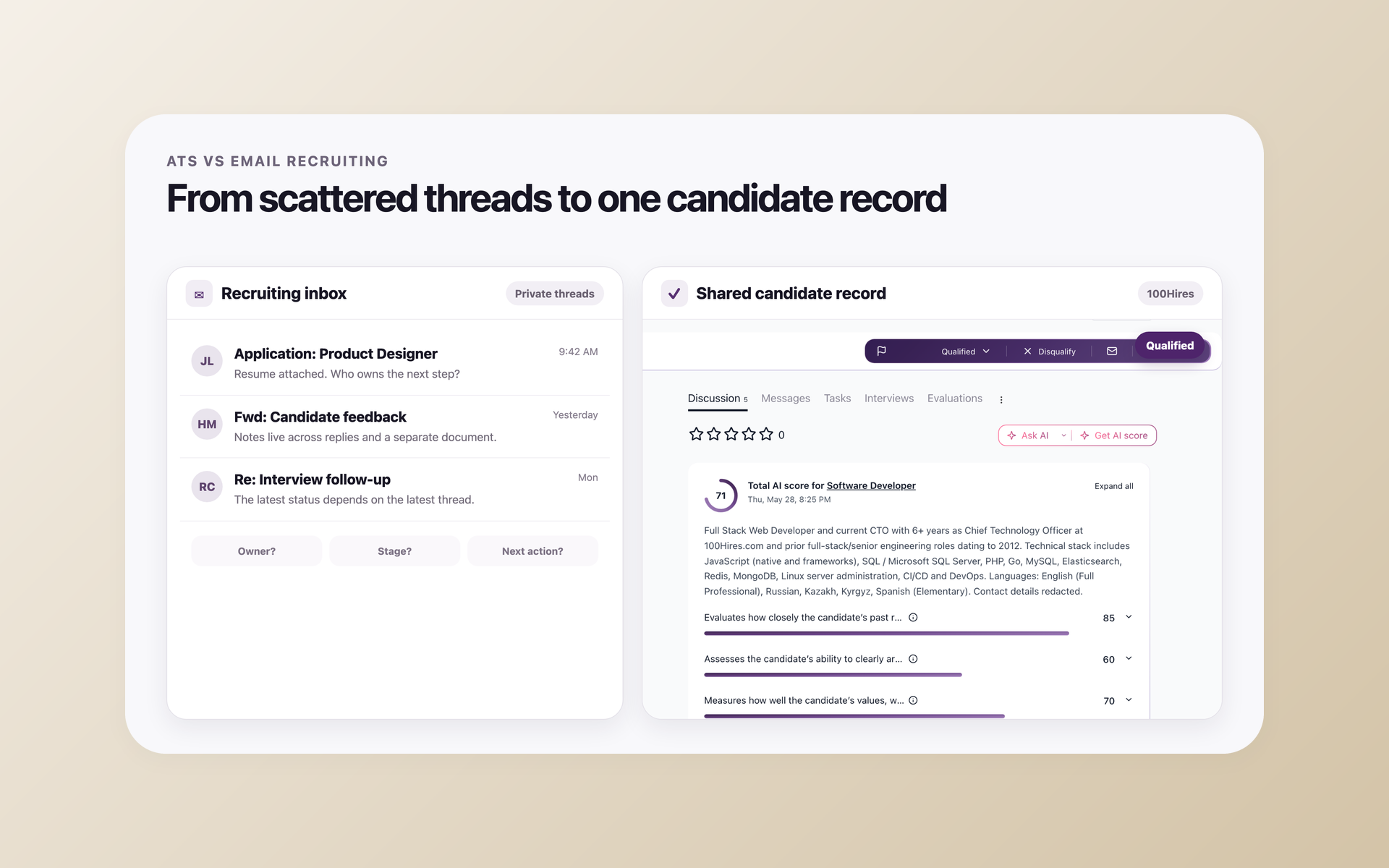
Email recruiting can be enough when one accountable owner can find each candidate's status, feedback, communication history, and next action without reconstructing several threads.
An applicant tracking system is the better operating model when ownership becomes unclear, handoffs lose context, feedback is inconsistent, reporting is manual, or access and retention work needs a repeatable process.
Choosing an ATS does not eliminate email. Candidates and recruiters can keep using it for messages, and the ATS can keep a shared candidate record alongside those messages.
Disclosure: 100Hires publishes this comparison, and 100Hires is our product. We use it as a concrete AI-first ATS example. Capabilities in the typical ATS category vary by product, plan, and configuration.
ATS vs email recruiting at a glance
The hiring playbook, in your inbox
One email a week - benchmarks, AI screening tactics, and short interview templates from the 100Hires team. No product pitches.
The decision is where candidate status and history live: distributed across inboxes or in a shared hiring record.
| Dimension | 100Hires | Typical ATS | Email-only recruiting |
|---|---|---|---|
| Primary role | Shared candidate record with AI assistance | Shared candidate record and workflow | Communication channel and private thread history |
| Ownership | Tasks, stages, assigned users, and job access | Usually assignments, stages, or roles; exact controls vary | Inferred from recipients, replies, labels, or memory |
| Feedback | Evaluation Forms and candidate-linked evidence | Often scorecards, notes, or evaluations; structure varies | Free-form replies and separate documents |
| History | Candidate profile, messages, applications, notes, and stage history | Usually centralized candidate activity; depth varies | Distributed across inboxes, forwards, folders, and exports |
| Reporting | Documented source and pipeline reporting, with limits | Common, but product and configuration determine depth | Manual counting or a separate spreadsheet |
| Governance support | Permissions, export, retention, consent, and deletion controls, with limits | Controls vary and require configuration | Mailbox access and manual policies carry most of the load |
| AI support | AI Score, AI Copilot, and AI Email Composer with human review | Varies by product | Context must be supplied manually to a separate AI tool |
| Honest limit | Sync is not universal, and AI or controls do not automate judgment or compliance | Adoption and configuration determine value | Simple, but shared records and auditability weaken as the process branches |
A typical ATS may offer more or fewer controls than this table shows. Verify the exact workflow before treating a category-level capability as a product promise.
The real difference is communication versus a shared candidate record
Email recruiting means that applications, outreach, scheduling, feedback, and follow-up are handled mainly in personal or shared mailboxes. That can be fast and familiar.
The record of what happened is tied to thread structure, mailbox access, labels, and people's memories.
An ATS attaches candidate data, stages, activity, and team actions to a shared record. Good candidate tracking software lets the next authorized person see the candidate's context without asking for a forwarded history.
Both models still use email. The difference is what surrounds the message. A forwarded thread can transfer words, but it does not necessarily transfer durable ownership, comparable feedback, history with access controls, or a reliable next action.
Follow one candidate through email and an ATS
The contrast becomes clearer when the same candidate moves through the complete hiring process. Each stage creates information someone may need later, separate from the email conversation.
| Candidate stage | Email-only recruiting | ATS operating model | What can still go wrong |
|---|---|---|---|
| Intake | A resume or referral reaches one or more inboxes | The application attaches to a candidate and job record | Duplicate records or missed external messages can still occur |
| Ownership | The owner is inferred from who last replied or was copied | An assigned user, task, job, and stage make ownership visible | A visible owner can still fail to act |
| Screening | Notes live in replies, documents, or memory | Resume, criteria, notes, and decision support share one record | Weak criteria still produce weak review |
| Hiring-manager handoff | The recruiter forwards or summarizes context | The hiring manager opens the same record with controlled access | Permissions and adoption must be configured correctly |
| Interview feedback | Free-form comments arrive in separate threads | Structured evaluations attach evidence to the candidate | Interviewers can still submit weak or biased evidence |
| Candidate communication | Email is direct, but deliverability and thread continuity vary | Email remains a channel, with relevant messages attached to the record where supported | Sync exclusions, spam filters, and candidate behavior remain |
| Status and next action | The recruiter reconstructs the latest state manually | Stage, task, and activity history show the current status | Data becomes stale when users do not update it |
| Reporting | The team counts inboxes or maintains a second sheet | Recorded stage and source data can feed reports | Reporting depth differs by product and setup |
| Retention and deletion | Copies may remain in mailboxes, exports, and shared folders | Permissions, retention, export, and deletion controls can support a process | Controls do not prove permanent erasure or automatic compliance |
Three shifts happen across this journey. First, ownership becomes explicit rather than inferred. A task, assignee, or recorded stage can show who should act even when that person has not sent the latest message.
Second, evidence stays connected to the candidate. Interview feedback, screening notes, messages, and prior applications do not need a new summary every time the candidate changes hands. The team can see which expected inputs are missing.
Third, the team can apply operational controls to the record. Permissions, exports, reports, retention settings, and deletion workflows are easier to apply consistently when the team knows where the candidate record lives.
Those controls remain conditional on setup, adoption, and copies that may exist outside the ATS.
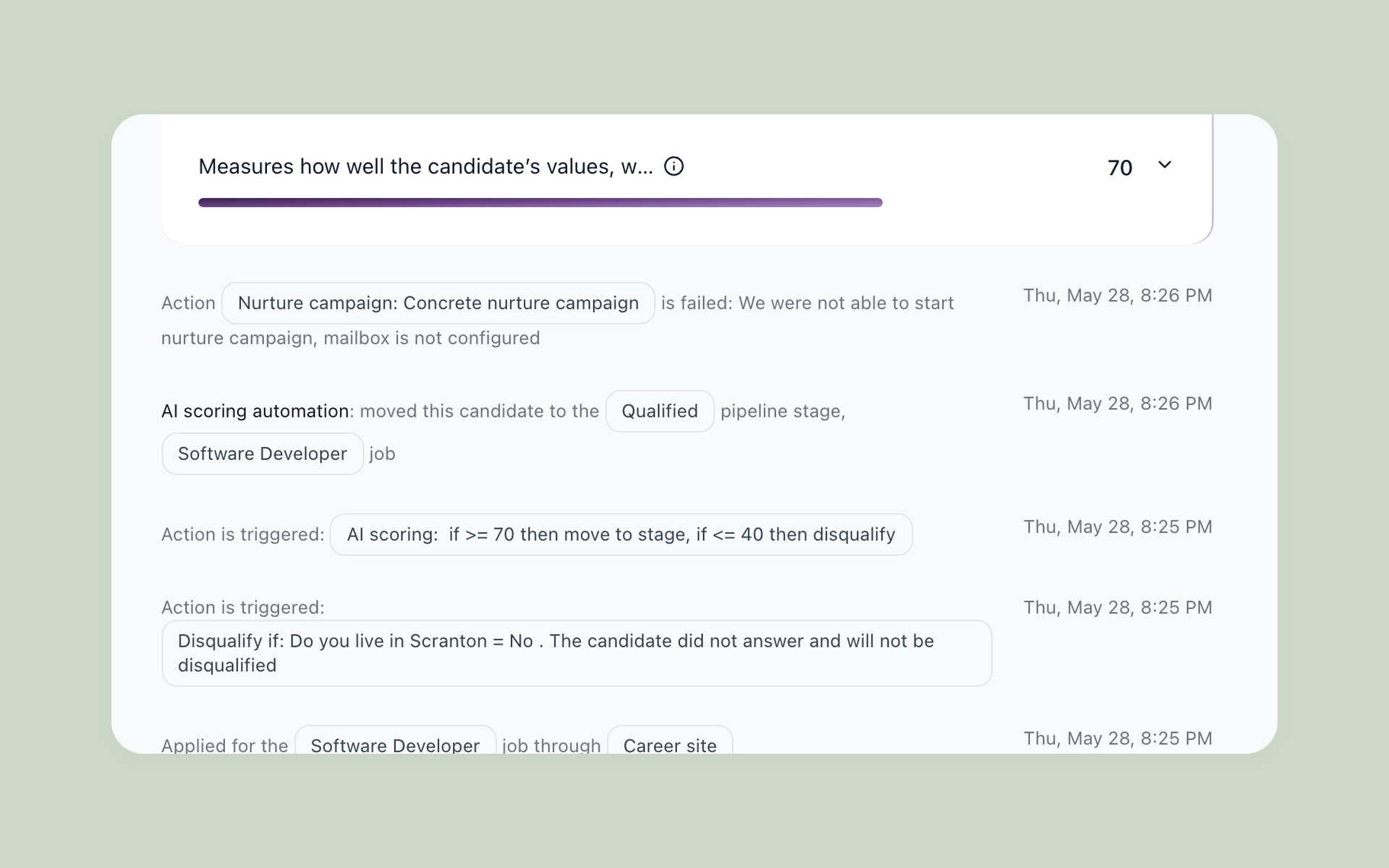
The hiring team must be able to trust the candidate record and apply the right controls to it.
When email-only recruiting can still be enough
An ATS is not automatically the right answer for every hiring process. Email-only recruiting can remain adequate when the following conditions hold:
- One accountable owner can identify the candidate's status, evidence, communication history, and next action quickly.
- Handoffs are rare and do not require rebuilding context from several sources.
- Hiring-manager feedback is accessible and evaluated against shared criteria.
- Leadership does not depend on a manual pipeline or source report.
- Access, retention, deletion, and documentation can be handled consistently.
A practical health check is a handoff. Ask another team member to identify the candidate's latest stage, decision evidence, promised follow-up, and owner without a verbal briefing. If that person can do it quickly, the current system may still be adequate.
Occasional complexity is not a reason to buy software by itself. The useful threshold is repeated loss of visibility or control, not any particular company size, role count, or applicant volume.
Shared mailboxes and labels can improve visibility without adding an ATS. The stronger test is whether those conventions survive an absence, reassignment, or hiring-manager review.
Email may remain enough when a new authorized owner can reconstruct the decision and next action from the record alone.
Set the same evidence standard for either model. After each stage, the team should be able to find the owner, criteria, decision, supporting notes, and promised follow-up. This keeps the comparison focused on record quality rather than feature count.
Watch the work that repeats. The same status question asked twice, feedback rewritten for a handoff, a pipeline report rebuilt from threads, or access changed mailbox by mailbox can show that the current process depends on reconstruction.
Recurrence, not one busy week, is the signal to evaluate a shared system.
Seven signs your recruiting inbox is no longer enough
Look for recurring failures rather than one isolated mistake. The pattern shows where an inbox is being asked to perform the job of a shared candidate system.
1. Candidate ownership is hidden
Team members have to ask who is responsible or infer ownership from the latest reply. The result can be duplicate outreach, delayed action, or no action when each person assumes someone else owns the next step.
Copying several people does not solve this. A recipient list shows who received a message, not who accepted responsibility, what deadline applies, or whether the work was completed.
2. Handoffs require forwarding and retelling
The next reviewer receives a summary instead of the original candidate record and decision context. Every retelling creates a chance to omit a concern, recommendation, commitment, or next action.
The risk grows when scheduling, interview notes, and candidate communication use separate threads. A clean handoff should transfer the current state and its supporting evidence, not merely the recruiter's conclusion.
3. Feedback cannot be compared
Free-form email comments use different criteria and sit outside a shared evaluation. An ATS does not remove bias, but a structured evaluation can make the criteria, evidence, and missing feedback visible before a decision.
4. Candidate history depends on one person's mailbox
Prior applications, interview notes, and decisions become hard to rediscover after a reassignment, absence, or team change. Search can find messages, but only if the right person has access and knows what to look for.
This weakens future hiring. A team may contact the same person without seeing an earlier conversation, or overlook a strong past candidate when the relevant history sits in a former employee's mailbox.
5. Reporting requires a second manual system
Pipeline, source, or stage answers depend on copying status into a spreadsheet or asking recruiters for updates. The report becomes another record that can drift away from the inboxes it is meant to represent.
Manual reporting can still work, but the team must decide which source is authoritative. If the sheet says interview and the latest email says rejected, leadership sees a snapshot that no longer matches the latest hiring status.
6. Access and governance work is improvised
The team cannot apply consistent access, export, retention, deletion, or documentation steps across inbox copies. A written policy helps, but it is harder to operate when the relevant records are scattered.
The failure is not merely that a policy is absent. It is that nobody can show which copies exist, who can access them, which action was completed, and what exception prevented deletion or required preservation.
7. AI lacks the context it needs
A separate AI tool sees only the resume, email, or prompt someone pastes into it. It does not automatically know the approved job criteria, earlier applications, interview evidence, current stage, owner, permissions, or outstanding tasks.
If one or more of these failures recur, evaluate an ATS workflow. One incident should trigger a process review, not an automatic software purchase.
How an ATS changes collaboration without replacing email
A well-configured ATS gives each part of the hiring process a clearer home:
- Email handles candidate communication.
- The candidate record holds stage, owner, evidence, tasks, and history.
- Structured evaluations make interview feedback easier to compare.
- Permissions limit who can see or change job-specific records.
- Reporting uses the workflow data that the team actually records.
This separation makes hidden work visible. A recruiter can see whether feedback is missing. A hiring manager can review the candidate without receiving a rewritten history. A team lead can inspect the pipeline without asking every recruiter for an update.
When the stage, owner, and evidence are recorded, status meetings can spend less time reconstructing updates and more time making decisions or resolving bottlenecks.
Visibility is not enforcement. An ATS cannot force a hiring manager to respond, a recruiter to review an application, or a team to configure the process well. It records the state people create and makes gaps easier to see.
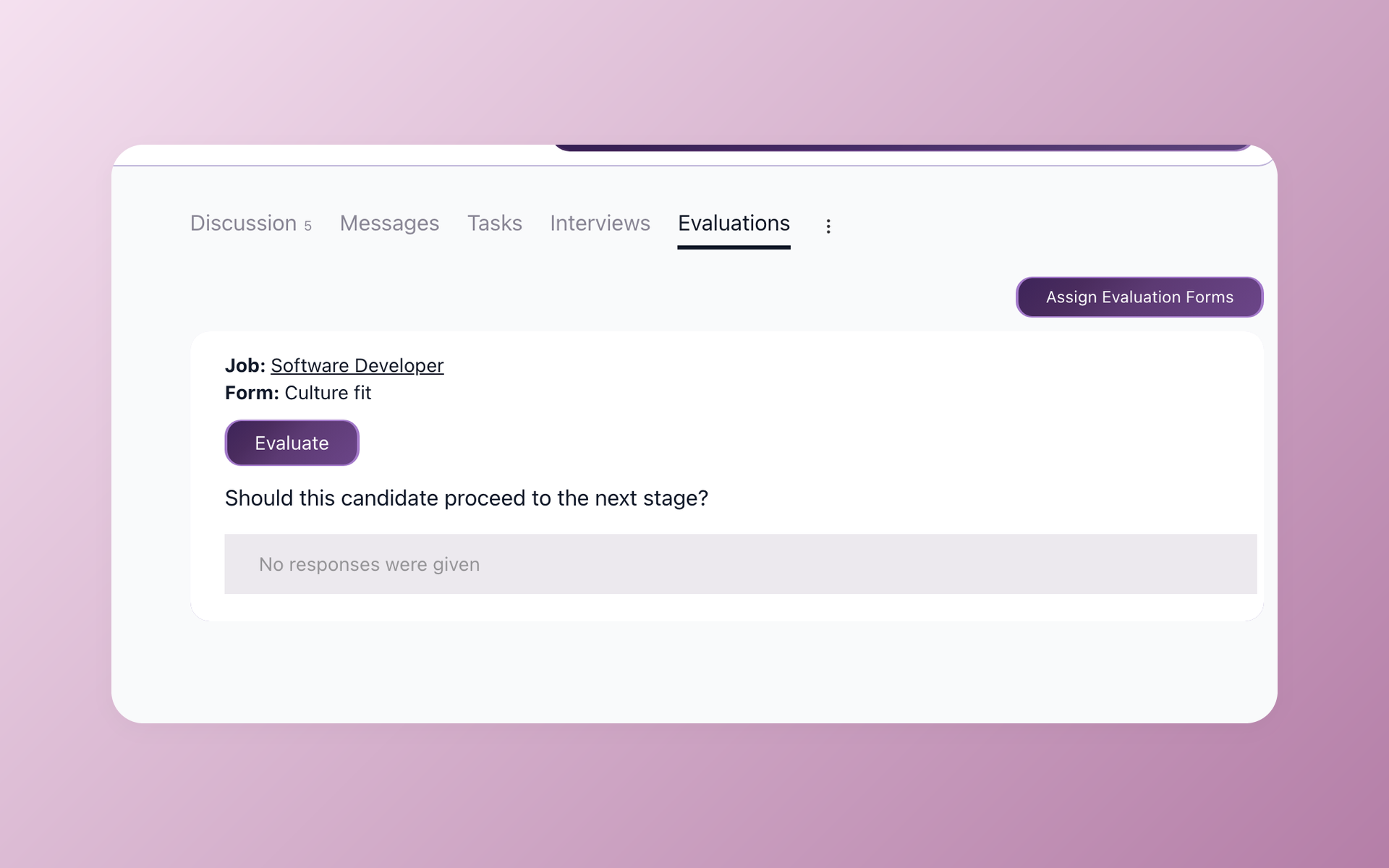
Compliance: better records do not mean automatic compliance
An ATS can support a more consistent process for permissions, documentation, export, retention, and deletion. It cannot decide which laws apply, set every policy correctly, or make the employer compliant on its own.
For employers covered by US federal anti-discrimination laws, the EEOC recordkeeping guidance describes employment-record preservation requirements and exceptions.
Under the EU's data protection legal framework, GDPR Article 5 includes principles such as data minimization, storage limitation, security, and accountability.
The right retention or deletion action depends on the jurisdiction, record type, purpose, and any duty to preserve information. Deleting a candidate record in an application does not automatically erase copies from mailboxes, exports, backups, or subprocessors.
An ATS can give the employer one place to apply controls to the records it holds. The employer can use access, export, retention, and deletion controls to support one documented workflow.
The employer still has to align that workflow with its legal basis, notices, exceptions, and systems outside the ATS.
Use a GDPR-compliant ATS guide to evaluate controls and responsibilities in more detail, and involve qualified counsel for legal decisions. This comparison is not legal advice.
How a candidate record gives AI recruiting more context
An AI assistant can use recorded context more completely than a one-off paste from an inbox. The sequence matters:
- The team records job criteria, candidate data, notes, communication, and evaluations.
- An AI assistant retrieves or analyzes the candidate and job context it is permitted to access.
- A person reviews the result and owns the hiring decision.
With email-only recruiting, a general AI tool can still summarize or draft from the text a user supplies. It will not automatically know the complete candidate history or whether important context was omitted.
AI cannot recreate a historical field that the team never captured. Centralized data makes retrieval more practical, but it does not establish that an output is accurate, fair, explainable, or legally valid.
Data quality and permissions matter too. An AI assistant should work from criteria and records the user may access, distinguish facts from recommendations, and make the underlying evidence easy to check.
More context is useful only when that context is relevant and trustworthy.
For example, the 100Hires AI Email Composer can draft from candidate and job context. The documented workflow still asks the recruiter to review, edit, and send the message.
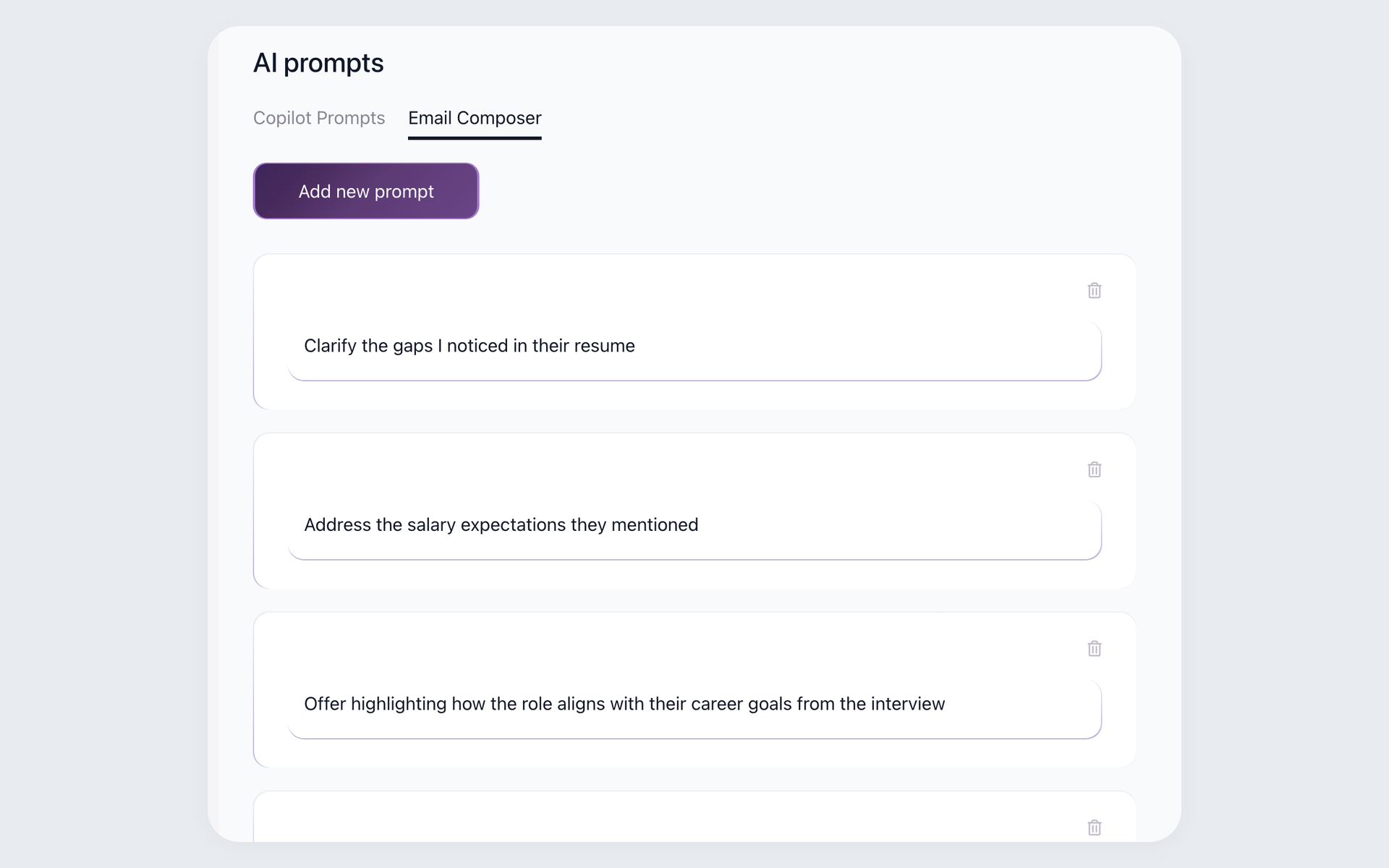
Where 100Hires fits as the AI-first step up from email
For a lean hiring team, 100Hires brings ownership, evidence, stage history, reporting, and AI assistance into one candidate profile. Email remains the communication channel.
A 100Hires candidate profile can bring together a resume, messages, applications, notes, evaluations, interview activity, AI score, and stage history.
Tasks, stages, job-specific permissions, search, duplicate controls, export, and reporting support the operating workflow around that record.
AI Score compares a candidate with written job criteria. AI Copilot can use recorded candidate and job context for analysis. AI Email Composer can help draft a candidate-specific message. These are decision-support tools, not autonomous hiring decisions.
The shared record connects those tools. A recruiter can compare an AI Score with the written role criteria, ask Copilot about the available candidate context, and draft a message without rebuilding the same background in separate prompts.
Human review remains the checkpoint before the analysis affects a decision or a message reaches a candidate.
The limits matter as much as the capabilities:
- Gmail and Outlook integration does not prove that every message will be captured. Documented sync exclusions apply.
- Source and pipeline reporting are documented, but reporting remains bounded and is not a formal regulatory or adverse-impact reporting system.
- Moving a candidate record to the Deleted tab does not prove permanent erasure from every backup, subprocessor, export, or mailbox copy.
- Independent accuracy, validity, fairness, and non-discrimination evidence for AI Score or AI Copilot was not established in this review.
- Permissions, retention, deletion, export, and consent controls can support a process. They do not automate legal compliance.
Those boundaries call for careful evaluation, sound configuration, and human accountability. They do not replace judgment about exceptions, priorities, or the quality of recorded information. Test a real handoff before relying on the workflow every day.
Decision checklist: stay with email or move to an ATS?
Stay with email-only recruiting when the accountable owner can quickly reconstruct each candidate's status and evidence and the team does not repeatedly fail the seven checks above.
Evaluate an ATS when failures recur across ownership, handoffs, feedback, history, reporting, access, or governance. Evaluate 100Hires when you want that shared record plus AI-assisted scoring, analysis, and email drafting with human review.
Create a 100Hires account to test the shared-record workflow with your own hiring process.
Frequently asked questions
What is the difference between an ATS and email recruiting?
Email recruiting uses the inbox as the main place for applications, communication, feedback, and follow-up. In 100Hires, the ATS model gives the team a shared candidate record for stage, ownership, evidence, activity, and reporting, with email continuing as the communication channel.
Can I use email as an applicant tracking system?
You can manage a simple hiring process in email when one owner can reliably reconstruct each candidate's status, evidence, history, and next action. Email is not an ATS. 100Hires is one option when ownership, handoffs, reporting, or governance needs branch across the team.
Does a small hiring team need an ATS?
Team size alone does not decide. A small team may benefit from an ATS such as 100Hires when it repeatedly loses ownership, context, feedback, history, or reporting visibility. A larger team with a simple, well-owned process may still add software only when those failures appear.
Does an ATS replace recruiter email?
No. In 100Hires, recruiters and candidates can keep communicating by email. The ATS should attach relevant messages to the candidate record where the integration supports it and keep the stage, owner, tasks, evaluations, and shared history in that record.
Is an ATS more compliant than recruiting from an inbox?
100Hires provides permissions, retention, export, deletion, consent, and documentation controls that can support a more consistent process. The employer remains responsible for choosing, configuring, and using those controls under the laws and preservation duties that apply.
Can AI manage candidates from email alone?
A general AI tool can work with the email or resume a user supplies, but it will not automatically have complete candidate history, permissions, stages, tasks, or evaluations. 100Hires gives its AI tools more structured candidate context, and a person still reviews the output and owns the decision.
Try 100Hires for free
No credit card. 14-day trial. Forbes Advisor #1 ATS for SMBs.