
Gem Competitors & Alternatives in 2026: Sourcing, Outreach and the New ATS
Gem is no longer just a sourcing CRM. In September 2025 it launched Gem ATS, turning a tool that sat alongside your applicant tracking system into one that replaces it. Any comparison written before that date is describing a different product.
That changes who its competitors are. Gem used to compete with SeekOut, hireEZ and Interseller for the sourcing budget. It now also competes with Greenhouse, Ashby and Lever for the system-of-record budget, which is a much larger and more consequential purchase.
This guide covers both: the sourcing tools people still compare Gem against, and the applicant tracking systems it now sits beside.
What Gem costs
The hiring playbook, in your inbox
One email a week - benchmarks, AI screening tactics, and short interview templates from the 100Hires team. No product pitches.
Gem publishes per-user rates and negotiates larger contracts. Figures below come from Gem's pricing page and marketplace data, checked on 25 July 2026.
| Source | Figure | Note |
|---|---|---|
| Published per-user pricing | $99 to $149 per user per month | Varies by module and company size |
| Vendr median annual contract | About $24,900 | What teams actually sign |
| Annual commitment | 10 percent discount | Payment term selector on the pricing page |
The distance between $99 per user per month and a $24,900 median contract is the story. A five-person team at list price is roughly $7,000 a year.
The median buyer pays three and a half times that, which reflects modules, seat counts and multi-year terms rather than the headline rate.
Gem's review position is genuinely strong: 4.8 on G2 with 97 percent of reviewers rating it four or five stars, 4.7 on Capterra across roughly 297 reviews, and more than 1,200 customer organisations including Anthropic, Zillow, Walgreens, Carmax, Robinhood and DoorDash.
What an existing customer says about the AI
The most useful account of Gem's newer capabilities came from a customer who piloted them, posted in an r/recruiting thread about ATS pricing:
Their account: they demoed the AI in early 2025 as an existing customer, piloted it with the team on applicant review, and nobody endorsed using it. They also rated Gem below expectations on implementation and customer success.
The same commenter added a genuinely useful commercial observation, and it cuts the other way:
They were equally clear on the commercial side, describing Gem as strong at contract negotiation, likely to give a good first-year price and not unreasonable in year two.
They also flagged workflow friction in the sourcing side: the Chrome extension and CSV upload paths for getting candidates into the CRM were described as slower with more clicks per candidate than alternatives.
Read that alongside the 4.8 G2 rating rather than instead of it. The pattern that emerges is a well-liked core product, an AI layer that was not ready when this customer tested it in early 2025, and a vendor that negotiates reasonably.
What reviewers rate most highly
Gem's review position is strong, and it is worth knowing which capabilities earn it. Aggregated mining across both major review sites puts the strengths in this order.
- Automated outreach and follow-up, the top strength. Reviewers credit it directly with higher response rates, which is the core job it was built for.
- Cross-source candidate tracking. Keeping one view of candidates gathered from multiple places.
- Analytics and reporting. Including diversity statistics and campaign effectiveness.
- ATS integrations, with Greenhouse named most often.
That fourth point is worth pausing on now that Gem sells its own applicant tracking system. A meaningful share of its praise comes from working well alongside somebody else's ATS.
If you are being encouraged to consolidate onto Gem's, you are moving away from the configuration that generated much of its reputation.
Which Gem are you comparing?
| What you use Gem for | Compare against | Typical cost |
|---|---|---|
| Sourcing and outreach sequencing | SeekOut, hireEZ, SourceWhale, Interseller | $149 to $494 per month entry |
| Contact data only | SignalHire, Nymeria, ContactOut | $39 to $69 per month |
| The ATS, since September 2025 | Greenhouse, Ashby, Lever, Workable | $299 per month to $15k a year |
| Everything, as one platform | Ashby, Workable | $400 and $299 per month respectively |
Most teams answer the first row and then discover at renewal that they are being quoted for the fourth.
Alternatives for sourcing and outreach
SeekOut
A talent search engine with its own index and more than a billion profiles. Self-serve Recruit Core is $149 per month paid annually ($1,788 a year) or $179 monthly, with custom tiers reported at $10,000 to $30,000 a year. Capterra 4.7 across about 188 reviews.
Strongest on niche technical roles; one recruiter singled out its profile-cloning feature as a "game changer" for engineering and product searches.
hireEZ
Search, reveal and sequencing together, closest to Gem's original shape. Its own site lists solo recruiters starting at $494 per month; third-party list rates run $169 to $250 per seat per month with a Vendr median near $13,000 a year.
Multiple long-term users report both steep renewal increases and declining contact accuracy, so test data quality on your own roles.
SourceWhale
Outreach sequencing rather than search: multichannel campaigns, task management, personalisation at volume. Complements a data source instead of replacing one. Popular with agencies and executive search.
SignalHire and Nymeria
The budget floor if all you need is contact details. SignalHire has a free tier and paid plans from about $69 per month; Nymeria runs $39, $79 and $159 per month. Neither does sequencing or search at Gem's level.
LinkedIn Recruiter
The upstream source for much of this data. Third-party consensus puts Recruiter Lite near $170 per month per seat and Corporate between roughly $9,000 and $15,000 per seat per year.
Alternatives now that Gem sells an ATS
Ashby
The most direct comparison for an all-in-one, with the strongest analytics in the category. Published entry at $400 per month with a 10 percent annual discount. Check the seat definition: hiring managers count as billable seats by default, which has produced renewal surprises.
Greenhouse
Structured hiring, quote-only, roughly $6,000 to $12,000 a year for companies under 100 people according to buyer reports. Stronger on interview structure, weaker on sourcing, and its own reviewers note that it it is not a strong CRM.
Lever
Candidate CRM and nurture were Lever's differentiator long before Gem existed. Quote-only, Vendr median $15,400 a year. Owned by Employ Inc. alongside JazzHR and Jobvite.
Workable
Published pricing: $299 per month for Standard, $599 Premier, $719 Enterprise in the 1 to 20 employee band, plus add-ons for texting, video, assessments and performance. The widest job-board reach here, weaker on outbound sourcing.
100Hires
Published plans from $49 per month, with sourcing and contact enrichment at the Pro tier. Detail and honest limits below.
What the bundle actually changes at renewal
When a vendor adds a system of record to a tool you already use, the renewal conversation changes shape even if you want nothing new. Four things to expect, and how to handle each.
- The quote arrives as a platform number. Ask explicitly for the sourcing-only line item. If it no longer exists as a separate SKU, that is important information about where the product is heading.
- Per-seat maths shifts. A sourcing tool is bought for sourcers. An ATS is bought for everyone who touches hiring, including hiring managers. Confirm who counts as a billable user under the new packaging before you agree a headcount.
- Migration is offered as a sweetener. Free data migration is genuinely valuable, and it is also the strongest possible lock-in. Ask what the export path looks like in year three, not just the import path in month one.
- Multi-year terms appear. Longer terms are how vendors defend the larger contract. They are worth taking only if the price protection is written in and the exit terms are clear.
None of this is bad faith. It is what happens when a product expands, and the customers who do well are the ones who price each layer separately even when the vendor prefers not to.
Test the AI before you buy the AI
Every vendor in this category now leads with AI, and demos are built to show it at its best. The pilot described above is a useful precedent: an existing customer gave their team access, and nobody endorsed it for real work.
Three requests separate capability from a demo script, and any serious vendor will agree to all three.
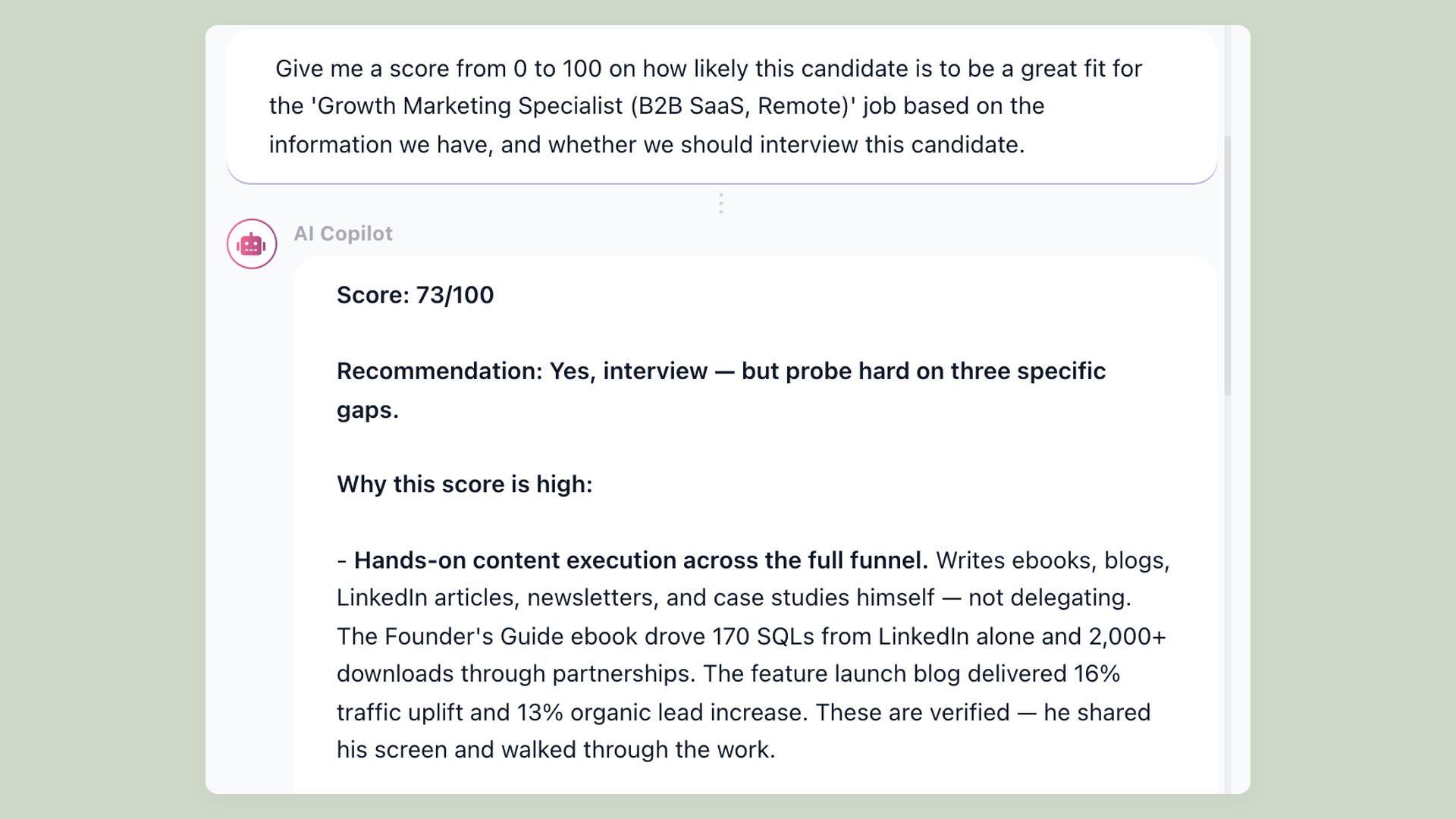
- Score a role you have already filled. Run screening across the real applicant pool from a closed requisition, then compare the ranking with who you actually interviewed and hired. This is the only test that uses your data and has a known answer.
- Show the reasoning, not the number. A score you cannot explain to a hiring manager is a score you cannot defend, and it will quietly stop being used.
- State the cost at volume. Several vendors meter AI separately from seats. Ask what a 5,000-applicant campaign costs before you plan one.
Our verdict
If Gem works for sourcing and you have an ATS you like, do not let the bundle drag you into replacing it. The September 2025 ATS launch gives Gem a commercial reason to sell you a bigger platform. That is fine, but it should be your decision rather than a renewal side effect.
If you are paying near the $24,900 median for sourcing alone, get two quotes. SeekOut's published $149 self-serve seat and hireEZ's published solo rate give you concrete anchors, and the commenter above says Gem negotiates reasonably.
If AI screening is the reason you are considering Gem's ATS, pilot it against your own data first. The one detailed customer account of that pilot ended with the team declining to adopt it for applicant review.
That was early 2025 and products move, which is exactly why you should test rather than take either their word or ours.
If your problem is reply rates rather than reach, none of this category fixes it. Sourcing tools multiply contacts. They do not improve what you send.
Where 100Hires fits, and where it does not
100Hires is an applicant tracking system with sourcing, contact enrichment and multichannel outreach included. Start is $49 per month billed annually ($99 monthly) for up to 100 candidates a month.
Advanced at $199 annually ($249 monthly) covers unlimited jobs, candidates and users. Pro at $399 annually ($499 monthly) adds sourcing tools and contact enrichment. Capterra rating is 4.9 from more than 1,100 reviews as of July 2026.
100Hires is the wrong choice if:
- Outbound sourcing at scale is your core motion. Gem and SeekOut are built around that. We include sourcing; we do not lead on it.
- You need a sophisticated candidate CRM with nurture campaigns. That is Gem's original strength and Lever's, and it is a real capability gap.
- Recruiting analytics is a board-level dependency. Ashby is the better answer.
- You are an agency selling into client accounts. Loxo or Recruit CRM combine sourcing with client-side workflow.
- You already run an ATS you are happy with. Then you need a sourcing tool, not a second system of record.
Where we fit is the team that wants screening, pipeline and enrichment in one published-price product rather than a negotiated platform contract. See 100Hires pricing or start a free trial. For the adjacent comparisons, see our SeekOut alternatives and hireEZ alternatives guides.
Frequently asked questions
How much does Gem cost?
Gem publishes per-user pricing of roughly $99 to $149 per user per month depending on modules and company size, with a 10 percent discount for annual commitment. Vendr marketplace data puts the median annual contract at about $24,900, which is well above the per-seat list price for a small team, reflecting module bundles, seat counts and contract terms.
Does Gem have an ATS?
Yes, since September 2025. Gem launched Gem ATS to give recruiting teams sourcing, CRM and applicant tracking in one platform. Before that it was a sourcing CRM that sat alongside your existing ATS. Any comparison article written before September 2025 is describing the earlier product, which is worth knowing when you read older reviews.
Are Gem's AI features worth it?
The evidence is mixed and worth testing yourself. Gem holds 4.8 on G2 with 97 percent rating it four or five stars, but one existing customer who piloted the AI in early 2025 reported that nobody on the team endorsed it for applicant review. Products change quickly, so the sensible approach is to ask the vendor to run AI screening against a role you have already filled and compare the ranking with who you actually hired.
What is the best Gem alternative for sourcing?
SeekOut if search depth on niche roles matters most, at $149 per month for the self-serve seat. hireEZ if you want search and outreach sequencing in one product, though several long-term users report large renewal increases. SourceWhale if you already have a data source and only need multichannel outreach. SignalHire or Nymeria if all you need is contact details, from $39 to $69 per month.
Should I replace my ATS with Gem ATS?
Only as a deliberate decision, not as a renewal side effect. Replacing a system of record costs weeks of data migration, integration rebuilding and hiring-manager retraining, and Gem's ATS is newer than its competitors' since it launched in September 2025. If your sourcing works and your ATS works, consolidating is a preference rather than a fix, and it should be priced as one.
Try 100Hires for free
No credit card. 14-day trial. Forbes Advisor #1 ATS for SMBs.